
Strength training is an essential component of wrestling. Whether you’re a high school grappler, a competitive college wrestler, or a weekend warrior reliving your glory days, hitting the weights will elevate your game.
Talent will get you on the mat—but strength will keep you on top of it.
With a 15-week off-season training program and a pre-season workout routine, this article is your blueprint for building the kind of functional, explosive strength that wrestlers need—not just to survive the match but to own it from whistle to whistle.
🤼🤼🤼
Click here to open Strength Training for Wrestling directly in StrengthLog.
Click here to jump directly to the Pre-Season Wrestling Workout Routine.
Table of Contents
Why Strength Training For Wrestling?
While strength has always been a backbone of wrestling success, heavy weight lifting or dedicated strength training programs weren’t always as universally accepted as they are today.
For a long time, wrestling training emphasized drilling, live wrestling, bodyweight exercises (like push-ups, squats, bridges, and the rope climb), gymnastics, and conditioning. The focus was on “functional strength” developed through wrestling movements (“mat strength”), endurance, flexibility, and technique.
Those are all essential parts of the sport but won’t give you the maximum strength and power of hoisting heavy iron.
Common concerns included becoming “muscle-bound”—the fear that lifting heavy weights would reduce flexibility and speed and make you slow and stiff—and a lack of functional transfer—coaches and athletes (mistakenly) believed that “gym strength” from lifting weights didn’t directly translate to “mat strength.”
Today, we know that strength training improves almost every aspect of almost every sport and that it prevents injuries, not the other way around, which is why structured strength training is now a widely accepted and essential part of modern wrestling preparation.
Benefits of Strength Training for Wrestling
Wrestlers are some of the best athletes if you consider overall physical capacity, and that requires training that develops all aspects of athleticism. Strength training doesn’t just make your muscles bigger so your singlet fits tighter (although that is admittedly a benefit in itself).
These are the top benefits of strength training for wrestling:
| Benefit | Summary |
|---|---|
| 1. Strength and Explosive Power Output | Increases the ability to execute takedowns, throws, and counters rapidly and forcefully. |
| 2. Opponent Control and Stability | Improves your capacity to dominate ties, maintain position, defend against attacks, and utilize strong grips. |
| 3. Muscular Endurance | Allows you to maintain a high level of force output and resist fatigue throughout intense matches. |
| 4. Protection Against Injuries | Strengthens muscles, connective tissues, and bones, improving joint stability and reducing the risk of injury. |
| 5. Technical Execution | Enables you to perform your techniques more forcefully, quickly, and effectively, even under fatigue or pressure. |
Explosive Strength & Power
Strength training, especially with the combination of compound lifts and plyometrics, is the best way to build the kind of power you need to toss opponents like they’re bags of flour.1 2
As a wrestler, you need both power and maximum absolute strength.
You want to be able to generate maximum force in the shortest possible time to execute offensive actions and react to opponents.
Maximal strength provides the potential force, and then power allows that force to be applied quickly enough to overcome an opponent’s reaction time.
That means you can’t train like a bodybuilder or a powerlifter—you need to train like a wrestler, including many different approaches to strength training in your programming.
Strength & Power Training Methods for Wrestlers
| Method | Description | Wrestling Applications |
|---|---|---|
| Heavy Resistance Training | Lifting heavy loads (≤6 reps) focusing on compound movements (squats, deadlifts, presses, rows). | Builds maximal strength, the base for power development. |
| Olympic Lifts & Variations | Explosive lifts (cleans, snatches, jerks and other Olympic weightlifting exercises) and pulls from various positions (floor, hang, blocks). | Develops high Rate of Force Development (RFD) and triple extension power for takedowns, lifts, and throws. |
| Plyometrics | Exercises using the stretch-shortening cycle (depth jumps, bounds, explosive throws). | Improves reactive strength and explosive power for quick shots, sprawls, and level changes. |
| Bodyweight Power Exercises | Explosive push-ups (e.g., clap push-ups), squat jumps, burpees, get-ups. | Improves relative power, agility, and the ability to generate force quickly from body weight. |
| Functional/Odd Object Training | Using sandbags, sleds, farmer’s carries, tire flips. | Builds functional strength and power in awkward positions, and improves grip and core control (you can’t dominate on the mat if your handshake is weaker than your grandma’s). |
As a result, you can stay in control during a match by applying your increased power and strength. You can dictate the physical terms of the match, resist your opponent’s offensive attempts, and secure effective grips and holds more easily.
Injury Prevention
Your muscles and joints are like armor against sprains, strains, and awkward landings. Stronger shoulders resist dislocations during scrambles, a strong core protects your back during lifts and throws, and powerful legs stabilize your knees.
Injury Prevention Focus Areas in Wrestling Strength Training
| Body Area | Common Wrestling Stressors | Strength Training Focus | Example Exercises |
|---|---|---|---|
| Knees | Twisting forces (takedowns, scrambles), deep flexion, impact, MCL/ACL/meniscus stress, prepatellar bursitis. | Balanced Quad/Hamstring strength, Glute strength, Hip stability, Eccentric control. | Back squats, Lunges, RDLs, Leg Curls, Glute Bridges, Step-ups, Banded Walks. |
| Shoulders | Rotator cuff strain (reaching, pulling), dislocations/subluxations (impact, awkward falls), impingement. | Rotator cuff strength/endurance, Scapular stability, Balanced pressing/pulling strength. | Face Pulls, External/Internal Rotation, Band Pull-Aparts, Rows, Overhead Press, Push-ups, Pull-ups. |
| Neck | Direct pressure (ties, headlocks), bridging forces, impact absorption, concussion mitigation. | Neck flexor/extensor/lateral flexor strength and endurance. | Neck Harness exercises, Neck Curl, Neck Extension, Manual Resistance, Isometrics (neck bridges), Shrugs. |
| Lower Back/Core | Lifting opponents, resisting throws, twisting/rotation, maintaining posture under load. | Core stability (anti-extension, anti-rotation, anti-lateral flexion), Spinal erector strength. | Planks (all variations), Pallof Press, Dead Bugs, Bird Dogs, Suitcase Carries, Back Extensions, Good Mornings, Glute Ham Raises. |
| Ankles/Wrists | Sprains from awkward landings or forceful twisting. | Proprioception, Stabilizer muscle strength, Mobility. | Balance exercises (single leg stance), Calf Raises, Wrist Curls/Extensions, Grip work. |
Strength training effectively cuts the risk of sports injuries by up to about a third.3 4 In other words, it keeps you on the mat, training and competing instead of sidelined with injuries.
Also, weight training builds stability and balance in the core and knees—your body’s shock absorbers. And a wrestler’s body needs to be able to handle plenty of shocks each and every match.
Muscular Endurance
Strength training doesn’t just improve your maximum strength. It also boosts your muscular endurance and stamina and teaches your muscles to fight fatigue so you can still shoot a double-leg in round three.
A stronger muscle operates at a lower percentage of its maximum voluntary contraction capacity. That means that when you do something that requires a specific level of force, it feels less demanding, and you can do it for longer before fatigue sets in.
A wrestling match is not a single maximal effort but a series of submaximal, maximal, and isometric efforts with brief recovery periods in between. Strength endurance is what allows you to maintain both your peak force potential and your muscle endurance throughout the duration of a match,
Also, strength training increases your body’s lactate threshold—when lactic acid builds up in the blood to the point where it feels like your muscles are on fire.5
Technical Execution
Wrestling is a technical sport, but strength makes your wrestling technique more potent.
You learn technique through practice, but strength provides the physical capacity to execute those techniques forcefully and quickly against resistance.
Most important of all, these benefits are intertwined and mutually reinforcing.
- Explosive power relies on a foundation of maximal strength.
- Maintaining control during a match requires both strength and muscular endurance.
- Muscular endurance allows you to use your power and control throughout a match without significant fatigue setting in.
- Staying injury-free allows you to train consistently enough to develop all other physical and technical qualities.
- And your technique is amplified and made more effective by the physical capacities you develop in the weight room.
A good strength training program for wrestling takes care of all these interconnected factors, with the result being that you become a better and stronger wrestler.
How Often Should Wrestlers Strength Train?
The recommended frequency for strength training for wrestlers is very much dependent on the season (off-season vs. in-season). The goals, intensity, and volume of training change significantly between these periods.
| Phase | Frequency | Focus |
|---|---|---|
| Off-Season | 3–4x/week | Strength, hypertrophy, movement quality |
| Pre-Season | 2–3x/week | Power, explosiveness, peak strength |
| In-Season | 1–2x/week | Maintenance, recovery, injury prevention |
- Off-season, with fewer wrestling practices and no competitions, your body can handle a higher training volume and intensity. This period is when you aim for significant gains in strength and muscle that will support your wrestling performance during the season. Conditioning often takes a backseat to strength development but isn’t eliminated.
- During pre-season, you transition from general strength to explosive strength and power while maintaining or peaking strength. Reducing training volume slightly while increasing specificity and explosiveness is a good idea to manage fatigue as your wrestling practice ramps up in intensity. Doing more plyometrics, Olympic lifts, and speed-strength work is beneficial during this phase.
- In-season is when your main focus is on maintaining strength and power, preventing injuries, and avoiding fatigue. It only takes one or two weekly sessions to do so, with low-volume, high-intensity training. You want to prioritize recovery and readiness for matches and practice and use compound lifts to maintain neural drive and muscle recruitment.
Strength Training Programs for Wrestling
Here you will find two strength training programs for wrestlers who want to develop maximum strength, power, balance, and stability while strengthening the body to withstand the rigors of the mat and prevent injuries.
The first is for the off-season (15 weeks), and the second is for the pre-season (for however long your pre-season lasts, typically 6–8 weeks).
They work best if you already have some strength training experience. They feature many different, relatively complex exercises, and if you have never lifted weights before, they might be too much for you to jump right into.
If you’re new to the gym, start with one of our beginner programs, like the Beginner Barbell Training Program. You train three times per week, alternating between workouts A and B.
Workout A
| Exercise | Sets | Reps |
|---|---|---|
| Squat | 3 | 8–10 |
| Bench Press | 3 | 8–10 |
| Barbell Row | 3 | 8–10 |
Workout B
| Exercise | Sets | Reps |
|---|---|---|
| Deadlift | 3 | 6–8 |
| Lat Pulldown (or Pull-Ups) | 3 | 8–10 |
| Overhead Press | 3 | 8–10 |
In other words, you’ll train workouts A B A week one and B A B week two, then go back to week one and keep alternating between the two.
This beginner program (any many more) are available for free in our workout log app, StrengthLog.
You can use the strength you gain on the wrestling mat, and you teach your muscles, brain, and nervous system to play together, allowing you to move on to more complex programs.
If you do have some weight training experience, you’re ready for Strength Training for Wrestling.
Off-Season Training Program for Wrestling
This is a 15-week off-season strength training program for wrestling designed to improve overall strength, explosiveness, neck stability, and grip conditioning while allowing for steady progression across the weeks.
The program is broken into 4 training phases, each lasting 4 weeks (last phase 3 weeks), with 4 workouts per week (Upper/Lower split) and 6 exercises per session.
Program Overview
- Training Days: Monday (Upper), Tuesday (Lower), Thursday (Upper), Friday (Lower)
- Format: 6 exercises per day
- Focus Areas:
- Strength (compound lifts)
- Power (plyometrics, sleds)
- Neck (extension/curl)
- Grip & core (farmer’s carry)
- Progression: Linear → Volume → Intensity → Peaking
Weekly Layout
| Day | Focus | Key Add-ons |
|---|---|---|
| Monday | Upper Body Strength | Neck work (Extension) |
| Tuesday | Lower Body Strength | Plyos (e.g., Box Jumps), Farmer’s Carry |
| Thursday | Upper Body Power | Neck work (Curl) |
| Friday | Lower Body Power | Sled Push, Plyos (e.g., Depth Jumps) |
Note: you can, of course, train on other weekdays if it fits your schedule better—for example Tuesday, Wednesday, Friday, and Saturday.
15-Week Phase Breakdown
Phase 1 (Weeks 1–4): Foundation & Hypertrophy
- Goal: Build muscle and conditioning base.
- Intensity: 60–70% 1RM, 3–4 sets of 10–12 reps.
Phase 2 (Weeks 5–8): Strength Emphasis
- Goal: Build strength.
- Intensity: 70–85% 1RM, 3–5 sets of 5–8 reps.
Phase 3 (Weeks 9–12): Strength + Power
- Goal: Maximal strength, increase rate of force development.
- Intensity: 75–90% 1RM, 3–4 sets of 4–6 reps + explosive plyos.
Phase 4 (Weeks 13–15): Peaking
- Goal: Peak power and speed, reduce volume
- Intensity: 85–95% 1RM, 2–3 sets of 2–4 reps, more focus on speed/explosiveness
Warm up before each training session with a dynamic warm-up routine that addresses hip mobility, shoulder mobility, and core activation (e.g., leg swings, hip circles, light band work for shoulders, etc.).
Rest 90–120 seconds between heavier lifts (strength-focused sets of 5–6 reps) and around 60 seconds for accessory or higher-rep work. Power exercises often need slightly longer rest (2–3 minutes) to maintain explosiveness.
Weekly Template
Below is an example of a week from the program. The exact number of sets and the rep scheme, details of all four phases, including % of 1RM recommendations along with the planned intensity and volume progression route, are available in your StrengthLog workout tracker app.
Workout 1: Upper Body Strength + Neck Extension
| Exercise | Sets |
|---|---|
| Bench Press | 3–4 |
| Chin-Up | 3–4 |
| Incline Dumbbell Press | 3 |
| Barbell Row | 3 |
| Face Pull | 3 |
| Neck Extension | 3 |
Workout 2: Lower Body Strength (Plyos + Carry)
| Exercise | Sets |
|---|---|
| Squat | 3–4 |
| Romanian Deadlift | 4 |
| Walking Lunge | 3 |
| Farmer’s Carry | 3 |
| Box Jump | 3 |
| Plank With Leg Raise | 3 |
Workout 3: Upper Power/Speed + Neck Curl
| Exercise | Sets |
|---|---|
| Push Press | 3–4 |
| Pull-Up | 3–4 |
| Dips | 3 |
| Hammer Curl | 3 |
| Ball Slam | 3 |
| Pallof Press | 3 |
| Neck Curl | 3 |
Workout 4: Lower Power/Speed (Plyos + Sled)
| Exercise | Sets |
|---|---|
| Trap Bar Deadlift | 3–4 |
| Bulgarian Split Squat | 4 |
| Depth Jump | 3 |
| Sled Push | 3 |
| Glute Ham Raise | 3 |
| Core Circuit: Ab Rollout, Hanging Leg Raise, Core Twist | 3+3+3 |
Follow the Off-Season Strength Training for Wrestling Program in StrengthLog
This and many more training programs are in the StrengthLog workout log app. The app is free to use, forever, with no ads. This program, however, is a premium program (it offers advanced percentage-based progression and periodization), which means it requires a premium subscription.
We offer all new users a free 14-day premium trial. You can activate it in the app without any strings attached.
Download StrengthLog and start tracking your workouts today:


Click here to go directly to the program in StrengthLog.
Pre-Season Wrestling Workout Routine
This is a training program for wrestling pre-season, typically lasting 6 to 8 weeks. However, that length can vary depending on your level (high school, college, elite) and your individual training calendar.
Program Overview
- Frequency: 3 full-body workouts per week (e.g., Mon/Wed/Fri or Tue/Thu/Sat)
- Focus: Strength maintenance, power development, neural priming
- Key Elements:
- 1–2 Olympic lift variations per session
- Explosive plyometric drills
- Compound strength lifts (lower volume, moderate intensity)
- Core & grip work for wrestling-specific strength
Weekly Schedule Example
| Day | Focus |
|---|---|
| Workout 1 | Full Body – Emphasis on Power |
| Workout 2 | Full Body – Strength Maintenance |
| Workout 3 | Full Body – Speed & Reactive Power |
Workout Structure Per Day
Each day follows this general structure:
- Plyometrics / Power Primer
- Olympic Lift
- Strength Movement (Lower or Upper)
- Accessory Superset (2–3 rounds)
- Core & Grip Work
Here is an example of a week from the pre-season program. Again, the exact number of sets, rep range, and % of 1RM recommendations can be found in StrengthLog.
Workout 1: Power Focus
| Exercise | Sets |
|---|---|
| Horizontal and Vertical Jump | 3 |
| Power Clean | 4 |
| Squat | 3 |
| Pull-Up | 4 |
| Superset: Kettlebell Snatch +Bulgarian Split Squat | 3 + 3 |
| Hanging Leg Raise | 2 |
| Plate Pinch | 2 |
Workout 2: Strength Focus
| Exercise | Sets |
|---|---|
| Lateral Bound | 3 |
| Hang Power Snatch | 4 |
| Trap Bar Deadlift | 4 |
| Bench Press | 4 |
| Superset: Barbell Row + Reverse Lunge | 3 + 3 |
| Weighted Plank | 2 |
| Towel Pull-Ups | 2 |
Workout 3: Speed & Reactive Focus
| Exercise | Sets |
|---|---|
| Box Jump | 3 |
| Lateral Bound | 3 |
| Block Clean | 5 |
| Push Press | 4 |
| Hip Thrust | 3 |
| Superset: Chin-Up + Dips | 2+2 |
| Core Twist | 2 |
| Dead Hang | 2 |
Follow the Pre-Season Wrestling Workout Routine
The pre-season program is also available in our workout log app.
Click here to go directly to the pre-season wrestling program in StrengthLog.
Strength Training for Wrestling: Exercises
Here are detailed descriptions of the exercises in the Strength Training for Wrestling program in the order they appear.
Bench Press

The bench press is a classic strength training exercise for building upper body strength and chest muscle mass. While it’s often associated with powerlifters as a competitive lift or bodybuilding for building big pecs, it also benefits wrestlers (and almost every other type of athlete).
When you bench press, you train your pushing muscles: the chest, shoulders, and triceps. You use these muscles when you try to drive an opponent off you from the bottom position, extend your arms to control their torso during a takedown or lift, or maintain control in top rides or pinning combinations.
How to Bench Press
- Lie on the bench, pull your shoulder blades together and down, and slightly arch your back.
- Grip the bar slightly wider than shoulder-width apart.
- Inhale, hold your breath, and unrack the bar.
- Lower the bar with control, until it touches your chest somewhere close to your sternum.
- Push the bar up to the starting position while exhaling.
- Take another breath while in the top position, and repeat the movement for your desired number of repetitions.
Chin-Up

A chin-up is a bodyweight back exercise where you hang from a bar with an underhand grip (palms facing you) and pull yourself up until your chin clears the bar. A strong back is essential for posture, stability, generating pulling power, and preventing injuries, and chin-ups are one of the best exercises for developing the lats. It also works your biceps, forearms (grip), and shoulders/upper back (rhomboids, teres major, posterior deltoids).
It is a super important exercise in wrestling, especially for building the kind of upper-body strength and control you need to dominate on the mat, from controlling ties to breaking posture to finishing takedowns to top control and hand fighting.
Go for controlled, full-range-of-motion reps. No half-reps. If you struggle to do strict reps, you can loop a resistance band around the bar, stand on it, and let it give you a helping hand. Conversely, if you can easily do more reps than Strength Training for Wrestling calls for, strap on a weight belt or backpack for more resistance.
How to Do Chin-Ups
- Stand underneath a pull-up bar and grip it with an underhand grip, hands shoulder-width or slightly narrower apart.
- Hang with your arms fully extended and your body in a straight line with a slight bend in your knees.
- Engage your core and retract your shoulder blades, drawing them down and back.
- Pull yourself up by bending your elbows and raising your chin above the bar.
- At the top of the movement, your elbows should be fully flexed.
- Pause briefly at the top of the movement and focus on squeezing your biceps before lowering yourself back to the original position.
- Repeat the movement for the desired number of repetitions.
Incline Dumbbell Press

The incline dumbbell press is a great exercise for targeting the upper chest (clavicular head of the pectoralis major), anterior deltoids (front shoulder), and triceps.
It’s similar to a bench press but with the added benefits of dumbbells (more natural arm and wrist positioning and more need for stabilization—you’re never pushing with both arms symmetrically in wrestling—and a different angle of attack).
Use an angle of ∼30–45 degrees—any higher, and you’re turning it into a shoulder exercise. Get a nice stretch in your chest muscles at the bottom (and you don’t have to clonk the dumbbells together at the top).
How to Incline Dumbbell Press
- Sit on a bench, and lift a pair of dumbbells up to the starting point.
- Press the dumbbells up to straight arms, while exhaling.
- Inhale at the top, or while lowering the dumbbells with control back to your shoulders.
- Repeat the movement for the desired number of repetitions.
Barbell Row
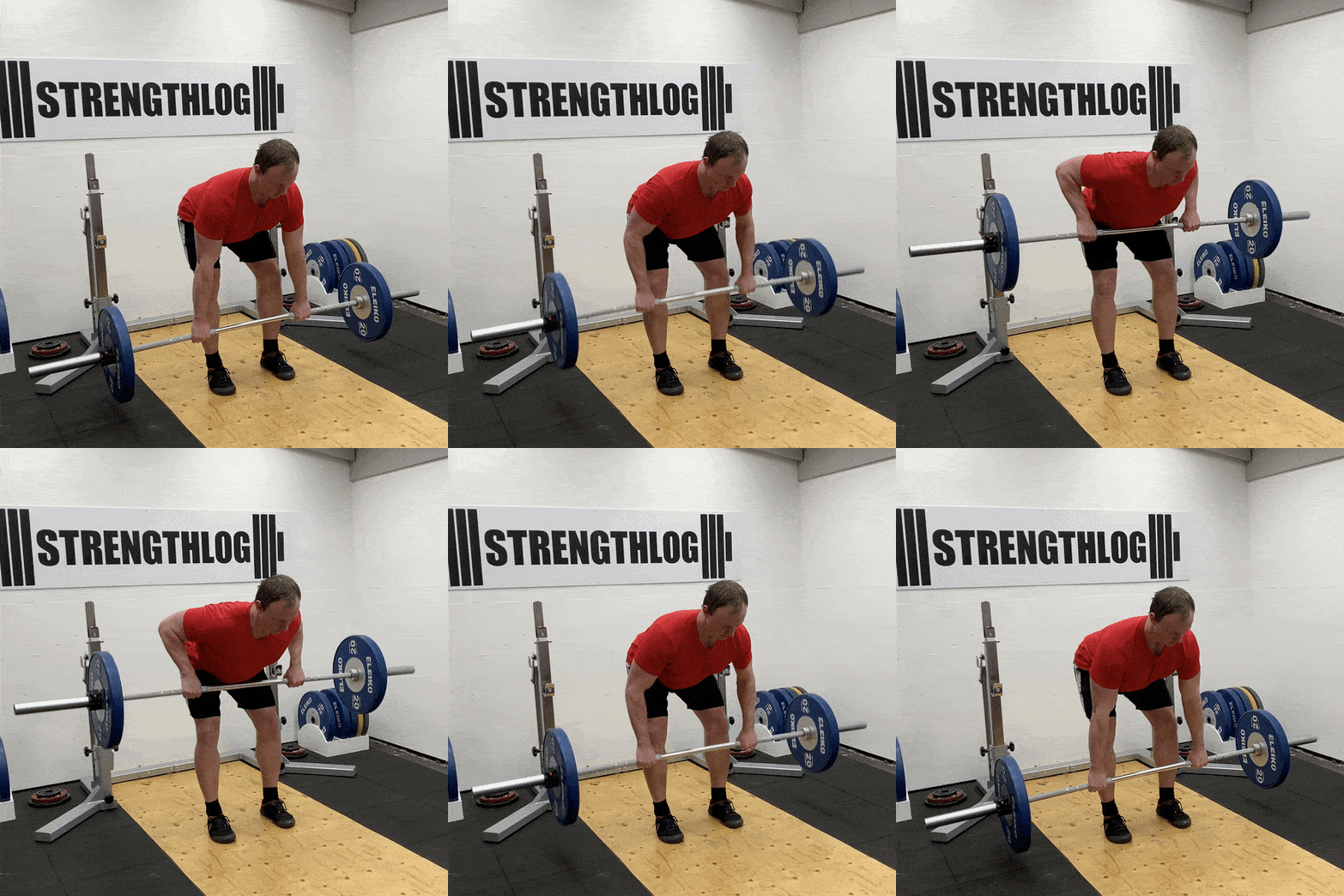
The barbell row is one of the pillars of effective strength training for wrestling. It trains your entire back, rear delts, and biceps, building powerful pulling strength for snapping opponents down, yanking them in for takedowns, controlling tie-ups, breaking your opponent’s posture, and many of the other pulling actions that happen on the mat.
Also, a strong, thick back is just what the doctor ordered for maintaining your wrestling stance, resisting an opponent’s pressure, preventing your posture from being broken, and protecting your spine. The barbell row does all of the above, like almost no other exercise.
How to Do Barbell Rows
- Grasp the barbell with an overhand grip, slightly wider than shoulder-width apart.
- Stand with your feet slightly wider than feet hip-width apart, bend your knees slightly, and hinge forward at your hips, maintaining a straight line from your head to your hips.
- Brace your core and keep your back straight. Pull the barbell towards your lower chest or upper core, keeping your elbows close to your body. Squeeze your shoulder blades together at the top of the movement.
- Lower the barbell back to the starting position in a controlled manner.
- Repeat the movement for the desired number of repetitions.
Face Pull

The face pull is a valuable accessory exercise for wrestlers. While it might look like small potatoes compared to heavy compound lifts, it plays a major role in shoulder health.
Wrestling puts a ton of stress on the shoulder joint with awkward positions, high forces, pushing, pulling, and impacts. Face pulls strengthen several of the (often-neglected) muscles of the upper back that heavy exercises miss, plus the rotator cuff muscles that stabilize the shoulder joint. Healthy external rotators and rear delts counteract the internal rotation forces in grappling and can reduce the risk of shoulder impingement and rotator cuff injuries. The number one reason wrestlers do face pulls is to maintain healthy shoulders, and that’s why you find it in Strength Training for Wrestling.
You don’t want to use too much weight when doing face pulls. Keep it relatively light, focus on higher rep ranges, and maintain good form throughout, for best results.
How to Do Face Pulls
- Fasten a rope handle in a high position on a cable pulley. Grip the ropes with an overhand grip, and take a step or two back.
- With elbows held high, pull the rope towards you by letting your upper arms move straight out towards your sides, while simultaneously rotating your forearms up.
- Return with control to the starting position, by letting your arms move forward again.
- Repeat the movement for the desired number of repetitions.
Neck Extension
The neck extension is an isolation exercise that targets the muscles on the back of the neck.
Having a strong neck is non-negotiable in wrestling for both performance and safety, and strengthening neck extension (the motion of tilting your head backward or resisting force pushing it forward) is a big part of building the kind of neck that can absorb a suplex and keep your head from getting whip-lashed into next week when you’re shooting, sprawling, or taking a hard mat return.
You can do it without any resistance or use a weight plate to progressively overload the neck extensors for more strength, muscle growth, and endurance.
Remember that your neck is sensitive—absolutely no jerky or fast movements. Perform your reps slowly and deliberately through a comfortable range of motion, and prioritize form and control over weight.
How to Do Neck Extensions
- Lie face down on a flat bench with your head hanging just off the edge.
- Position your body so your chest and stomach are supported and your feet are on the ground for stability.
- Place a folded towel on the back of your head for comfort.
- Hold a weight plate over the towel using both hands.
- Tuck your chin slightly and keep your neck in a neutral position.
- Lift your head up by extending your neck and raising the back of your head toward the ceiling.
- Pause briefly at the top, squeezing the muscles at the base of your skull, then lower your head back down under control to the starting position.
- Repeat for the desired number of repetitions.
Squat

The squat is likely the most effective exercise for building muscle in your lower body and improving strength, power, and athletic performance for sports, and wrestling is no exception. It is a compound exercise that primarily works your quads, glutes, adductors, and lower back, with muscles all over your body pitching in to assist and stabilize.
Wrestling matches are won with powerful legs and hips. Squats build the strength you need for shooting takedowns, lifting opponents, maintaining your stance, and defense. It is basically your best tag-team partner in the gym.
How to Squat
- Place the bar on your upper back with your shoulders blades squeezed together. Inhale and brace your core slightly, and unrack the bar.
- Take two steps back, and adjust your foot position.
- Squat as deep as possible with proper form.
- With control, stop and reverse the movement, extending your hips and legs again.
- Exhale on the way up or exchange air in the top position.
- Repeat the movement for the desired number of repetitions.
Romanian Deadlift

The Romanian deadlift (RDL for short) is a hip hinge exercise that builds the posterior chain—glutes, hamstrings, lower back—the engine room for explosive movement and critical for shooting takedowns, driving through opponents, lifting for throws and finishes, and bridging off your back.
Focus on the controlled lowering (eccentric) phase and feel a good stretch in your hamstrings. The eccentric emphasis is also great for maintaining or improving flexibility.
How to Do Romanian Deadlifts
- Get into the starting position by deadlifting a barbell off the floor or by unracking it from a barbell rack. Stand feet hip-width, inhale, and brace your core slightly. If you’re doing single-leg RDLs, lift one leg off the ground.
- Lean forward by hinging in your hips. Keep your knees almost completely extended.
- Lean forward as far as possible with good form (no rounding your back). You don’t have to touch the barbell to the floor, although it is OK if you do.
- Reverse the movement and return to the standing position. Exhale on the way up.
- Repeat the movement for the desired number of repetitions.
Note: The dumbbell Romanian deadlift is a viable alternative to the barbell variant.
Walking Lunge

The walking lunge is basically a dynamic lunge performed while moving forward. Each step puts your legs through a full range of motion, stretching your hips and activating your entire lower body, particularly the glutes, quads, and adductors.
It’s a fantastic exercise for unilateral (one-sided) strength, mobility, and balance. While heavy, stable exercises like the squat give you overall strength and stability, including unilateral movements is always a good idea for athletic performance, especially in wrestling, which is full of asymmetrical stances and movements. You shoot off one leg, defend with one leg forward, and push and pull unevenly.
How to Do Walking Lunges
- Stand with your feet at shoulder-width apart, with a slight bend in the knees. Make sure that your core is engaged.
- Step forward with one of your legs, bending both knees at the same time. Stop the movement just before the back knee touches the floor, you should have about a 90-degree angle in both knees.
- Drive through your front foot and extend the knee until you get back to a standing position.
- Continue by repeating the movement on the other side.
- Repeat the movement for your desired number of repetitions.
Farmer’s Carry

The farmer’s carry (or farmer’s walk) involves picking up something heavy in each hand—dumbbells, kettlebells, or specially designed farmer’s walk handles—and walking with them for a set distance or time.
This is a true full-body exercise that gives you a truly strong grip and trains your upper back & traps, core, legs & hips, and shoulders. The grip strength and endurance you get from walking with heavy things might be the single biggest benefit—wrestling is often decided by grip battles—controlling wrists, maintaining tie-ups, and holding onto limbs for finishes or defense.
You also build tremendous upper back and postural strength and create a powerful “yoke” that helps you maintain your wrestling stance, absorb impact, resist opponents pulling on your head or arms, and act like support during lifts.
How to Do Farmers Walk
- Step in between two farmers walk-cases, or similar implements.
- Inhale, lean forward and grip the handles.
- Hold your breath, brace your core slightly, and lift the weights.
- Look ahead, and start moving forward in small steps. Increase the stride length as you increase the speed.
- Try to keep your body in a straight line and not lean excessively forward as you walk.
- When you are done, lower the implements back to the ground in a controlled manner.
Box Jump

At its core, a box jump is exactly what it sounds like: you jump onto a box. But don’t be fooled by the simplicity—this is no playground hopscotch. A box jump is a plyometric exercise that trains explosive lower-body power, coordination, balance, and fast-twitch muscle fiber activation, all in one dynamic movement.
The core benefit of box jumps is the improved rate of force development (RFD), a key component of power in sports. They train your neuromuscular system to generate force faster—more power applied in less time—which helps with nearly every dynamic action on the mat.
How to Do Box Jumps
- Select a box that is appropriate for your fitness level and jumping ability.
- Stand with your feet shoulder-width apart, a few inches away from the box. Your knees should be slightly bent, and your hips pushed back in an athletic stance, like a mini squat.
- Engage your core and swing your arms back to generate momentum. Keep your chest up, and your weight balanced evenly across your feet.
- Push through the balls of your feet, extending your hips, knees, and ankles as you jump up. Swing your arms forward and upward to help propel yourself onto the box. Jump with both feet leaving the ground at the same time.
- As you land on the box, aim to have both feet hit the surface at the same time. Bend your knees slightly to absorb the impact, keeping your chest up and back straight.
- Once you’ve landed on the box, stand up tall, extending your hips completely to finish the jump.
- Step off the box one foot at a time, and reset your stance before attempting the next jump.
- Repeat the movement for your desired number of jumps.
Plank With Leg Raise

The plank with leg raise is a variant of the traditional plank, one of the most popular exercises for building core strength and muscle endurance.
It strengthens not just your abs but your entire kinetic chain—especially your core and hip stabilizers—which are crucial for sprawling, shooting, and staying balanced when someone’s trying to toss you like yesterday’s laundry.
When you lift one leg while holding a plank, you drastically reduce your base of support, forcing your core muscles (especially obliques and transverse abdominis) to fire to prevent your hips from rotating or dropping and to stop your lower back from arching. That’s anti-rotation— and in wrestling, anti-rotation strength is how you stay on your feet and off your back.
How to Do Plank with Leg Lifts
- Begin by getting into a standard plank position. Place your elbows directly under your shoulders, legs extended straight behind you, and toes pressing into the ground. Your body should form a straight line from your head to your heels.
- Brace your core, keep your back flat, and avoid letting your hips sink down or lift too high.
- Slowly lift one leg off the ground to about hip height without bending the knee. Keep your leg straight during the movement.
- Hold the lifted position for a moment, then gently lower your leg back to the starting position.
- Repeat the lift with the opposite leg, ensuring you maintain a strong plank position throughout the movement.
- Continue to alternate legs for the chosen amount of time.
Push Press

Imagine a strict overhead press went on a date with a jump squat, and nine months later, bam—push press baby. You start with the barbell at your shoulders (like a front rack position), dip slightly at the knees like you’re about to spring into action, and then drive the weight overhead using that leg thrust and upper body strength combined.
It is excellent for developing full-body power and teaches your body to move explosively while staying braced by building explosive hip drive, core stability, and overhead strength and stability.
How to Push Press
- Clean a bar to your shoulders, or lift it out from a rack.
- Let the bar rest against the front of your shoulders, with your grip slightly outside your shoulders.
- Inhale and lightly brace your core.
- Bend your knees, and then forcefully push yourself and the bar upwards using your legs.
- When your legs are extended, immediately start pressing the bar with your arms, until your arms are fully extended.
- With control, lower the bar back to your shoulders.
- Repeat the movement for your desired number of repetitions.
Pull-Up

Pull-ups are a full-on wrestling simulation for your upper body, minus the risk of someone kneeing you in the face mid-roll. They work your lats, traps, rhomboids, biceps, and forearms—the same muscles you use when you’re pummeling, snapping down an opponent, defending a shot, or muscling through a scramble.
Unlike the chin-up, the pull-up uses an overhand (pronated) grip, but both are renowned for building back strength and width. Pull-ups give you power to pull an opponent towards you, control their upper body, and win positional battles.
The things I said about the chin-up goes for the pull-up as well: use a resistance band if you need assistance, or use added resistance if you find the recommended reps in Strength Training for Wrestling too easy.
How to Do Pull-Ups
- Stand beneath a pull-up bar and reach up to grasp it with an overhand grip (palms facing away from you), slightly wider than shoulder-width apart. Ensure your grip is secure and comfortable.
- Hang freely from the bar, fully extending your arms. Your feet should be off the ground.
- Engage your core muscles by squeezing your abs and glutes.
- Inhale and initiate the movement by pulling your body weight up towards the bar by bending your elbows and squeezing your shoulder blades together. Focus on using your back muscles rather than relying on your upper arms.
- Continue pulling yourself up until your chin reaches or clears the bar. Keep your torso upright and avoid excessive swinging or kicking with your legs.
- Slowly lower yourself back down to the starting position while maintaining control and stability, fully extending your arms.
- Repeat the movement for your desired number of repetitions.
Dips

Dips train you to move your own bodyweight through a full range of motion using the same muscles you use for pushing opponents away, creating space, framing, pushing your head down in defense, and driving up from the bottom position: your triceps, chest, and shoulders.
Dips have a reputation for being hard on the shoulders if performed incorrectly. Prioritize perfect form over depth or weight, and actively depress your shoulder blades—pull your shoulders down away from your ears, keeping them stable and avoiding letting them shrug up or roll forward too much, especially at the bottom.
If you find bodyweight dips too challenging, you can make the exercise more accessible by using a resistance band:


Conversely, if you can crank out more reps than the Strength Training for Wrestling program calls for, you can use a weight belt for more resistance.
How to Perform Bar Dips
- Grip a dip station about shoulder-width apart, and climb or jump to get into the starting position.
- Lower yourself with control until your shoulder is below your elbow, or as deep as you comfortably can.
- Reverse the motion and return to the starting position.
Hammer Curl

The hammer curl is a variation of the dumbbell curl, but unlike the standard curl where your palms face upwards (supinated grip), in a hammer curl, you hold the dumbbells with your palms facing each other (neutral grip), like you’re holding a hammer. Like how you’d hold an opponent’s wrist, or lock your hands during a body lock.
Hammer curls hit the biceps, the brachialis—a muscle that sits deep under the biceps—and the brachioradialis, which runs along the forearm. These are functional muscles, the kind that help you snap an opponent’s grip or win a hand fight in the tie-up.
How to Do Hammer Curls
- Start with your feet shoulder-width apart and your arms at your sides, holding a dumbbell in each hand with a neutral grip (your palms facing each other).
- Bend your elbows and curl the dumbbells up towards your shoulders, keeping your upper arms close to your sides. Don’t swing the dumbbells up; focus on contracting your biceps to curl them up.
- At the top of the movement, your forearms should be parallel to the ground, and your biceps should be fully contracted.
- Lower the dumbbells back to the starting position, under control.
- Repeat the movement for the desired number of repetitions.
Ball Slam

The ball slam is exactly what it sounds like: you take a medicine ball, raise it high overhead, and then slam it down like it insulted your entire family. It is a dynamic, full-body exercise focused on generating explosive power that works your posterior chain (glutes, hamstrings, back), core, shoulders, and even hand strength.
Ball slams train your entire body to work together dynamically—extending upwards and then violently contracting downwards, strengthening the core in a way that is very much relevant to what happens on the wrestling mat, from finishing takedowns to resisting extension forces from your opponent.
Use a non-bouncing ball (a “slam ball”) if you don’t want a surprise rebound to your face.
How to Ball Slam
- Stand with your feet about shoulder-width apart, your knees and hips slightly bent, holding the ball in both hands at chest height. Engage your core, and keep a good posture.
- Extend your knees and drive your hips forward while simultaneously lifting the ball. Aim for being as tall as possible, the ball overhead, arms up, hips slightly forward, and on your toes from the force of your drive.
- Use your core and arms to slam the medicine ball straight down between your feet with as much force as possible. Press your hips back and bend your knees to further power the slam. Exhale as you slam the ball down.
- Squat down to pick up the ball from the floor, then immediately move into the next slam by repeating the movement.
- Repeat the movement for your desired number of repetitions.
Neck Curl
The neck curl is an isolation exercise that targets the muscles on the front of the neck.
A well-trained neck can be the difference between control and collapse or even injury in wrestling. You take a lot of impact on the neck, and your neck flexors are your first line of defense. They also give you better posture and leverage in clinches, scrambles, and tie-ups. You can literally resist being pulled or turned just through neck engagement.
It’s a good idea to begin with body weight (head weight) or minimal resistance if you’re new to the exercise. Neck muscles respond well to lighter loads and higher reps initially. Also, keep from doing the exercise with jerky motions—control both the lifting (concentric) and lowering (eccentric) phases, and only move through a range that feels comfortable.
How to Do Neck Curls
- Lie on your back on a flat bench with your head hanging slightly off the edge.
- Place a folded towel on your forehead for comfort.
- Hold a weight plate over the towel with both hands.
- Tuck your chin slightly toward your chest. Keep it tucked throughout the movement.
- Curl your neck forward, lifting your head up toward your chest. Do not lift your shoulders.
- Pause briefly at the top before lowering your head back down slowly and under control to the starting position.
- Repeat the movement for the desired number of repetitions.
Pallof Press

The Pallof press is an anti-rotation core exercise. That means instead of twisting or flexing your spine like in twists or crunches, you’re resisting those movements, training your core to be stable, which is precisely what you want when you’re on the mat, trying to stay upright and untossed by your opponent.
Pallof presses train your obliques, transverse abdominis, and deep core stabilizers and are especially effective for maintaining postural integrity and balance in dynamic positions, which happen, oh, I don’t know… every 5 seconds in a wrestling match?
How to Pallof Press
- Attach a handle in a cable machine at chest height and stand with your side facing the machine.
- Grab the handle with both hands and stand with feet hip-width apart and knees slightly bent.
- Pull the handle to your chest, engage your core, and then press your arms straight out in front of you without rotating your torso.
- Hold briefly, then bring the handle back to your chest in a controlled motion.
- Repeat for the desired number of repetitions, then switch sides.
Trap Bar Deadlift

The trap bar deadlift—also known as the hex bar deadlift—has all the utility of a traditional deadlift, minus the stress on your lower back, and with a side of extra explosiveness. If you’re grinding it out on the mat, this lift might just be your new best bro.
The trap bar itself is shaped like a hexagon (hence the name), and you stand inside it, grabbing the handles on either side. The positioning is already a win for wrestlers. Instead of having the bar in front of you like in a conventional deadlift, the load is more centered with your body—closer to how you’d generate force during a takedown or a lift in a match.
Like regular deadlifts, the trap bar variant hits many major muscle groups simultaneously: legs (quads, hamstrings, glutes), back (erectors, lats, traps), core, and grip. That systemic loading is very effective for building the foundational strength you need as a wrestler. More sport-specific, it trains the hip extension movement pattern against a heavy load, which is super good news for wrestlers who need power in explosive movements like shots, lifts, throws, and sprawling.
How to Do Trap Bar Deadlifts
- Step into the bar’s opening so that the handles are in line with the middle of your feet.
- Inhale, bend down and grip the handles.
- Hold your breath, brace your core slightly, and lift the bar.
- Lift the bar with a straight back, until you are standing straight.
- Lower the bar back to the ground with control.
- Take another breath, and repeat the movement for your desired number of repetitions.
Bulgarian Split Squat

The Bulgarian split squat is a single-leg squat variation where you elevate one leg on a bench, step, or specialized roller behind you.
Wrestling is rarely a “both feet on the ground” sport, and building your unilateral strength with split squats will improve your strength and stability in all the movements where force is produced primarily off one of your legs.
Also, the unstable nature of the exercise forces the small stabilizing muscles around the hip, knee, and ankle to activate, improving balance and proprioception (a fancy way of saying your body gets good at knowing where it is and what it’s doing), which helps you stay on your feet and in control during chaotic wrestling exchanges.
How to Do Bulgarian Split Squats
- Place a bar on your upper back or hold a pair of dumbbells in your hands.
- Stand with your back turned against a bench, which should be about knee height. Stand about one long step in front of the bench.
- Place your right foot on the bench behind you.
- Inhale, look forward, and squat down with control until right before your right knee touches the floor.
- Reverse the movement and extend your front leg again, while exhaling. Your back foot should only act as support.
- Repeat the movement for the desired number of repetitions, then switch side and repeat with your right leg forward and your left foot on the bench.
Depth Jump
The depth jump is a plyometric exercise where you train the stretch-shortening cycle—the neurological and muscular mechanism that lets you go from eccentric (lengthening) to concentric (shortening) muscle contraction quickly and with maximum power.
For wrestling, that matters more than most sports. Why? It builds reactive strength, which is like regular strength’s caffeinated, twitchy cousin. It translates to a number of things on the mat, like quickly absorbing the force of an opponent’s shot and immediately driving back or countering, rapidly changing direction and applying force during chaotic scrambles, and explosively generating force from the mat.
You only need a few good reps—quality > quantity here. Think 3–5 reps per set, 3–4 sets total, with lots of rest between.
How to Do Depth Jumps
- Stand upright on the edge of as bench or platform with feet shoulder-width apart.
- Step off the platform (don’t jump) and let yourself fall naturally.
- Land softly on the balls of your feet, knees slightly bent, in an athletic stance.
- Immediately explode upward into a vertical jump as quickly and powerfully as possible.
- Land again with control, absorbing the impact by bending your knees.
- Reset and repeat for the desired number of repetitions.
Sled Push
The sled push involves loading a sled with weight and pushing it across a surface (commonly turf, grass, or smooth concrete) using handles. It trains your entire body, especially the lower (quads, glutes, hamstrings, calves). A special feature is that it’s almost entirely a concentric movement (the pushing phase) with very little eccentric loading (most lifts have a lowering or braking phase, too).
More leg drive and pushing strength are the most obvious benefits of sled pushes. And the pushing angle is very much like in wrestling, from driving into an opponent for a takedown to pushing through resistance in tie-ups and driving for control from the top position.
The sled push also builds your lactic threshold (your ability to suck it up when everything burns) and is fantastic for improving speed over short distances.6
How to Sled Push
- Load the sled with an appropriate amount of weight.
- Stand behind the sled with your feet shoulder-width apart.
- Grip the sled handles at a comfortable height.
- Lean forward slightly, keeping your back flat and core engaged.
- Drive through your legs and start pushing the sled forward.
- Maintain a steady, powerful stride with knees driving forward.
- Keep your arms extended but not locked.
- Push the sled the desired distance or for the set amount of time.
- Come to a controlled stop and carefully release the sled handles.
Glute Ham Raise

The glute ham raise is a very effective exercise for posterior chain strength—the hamstrings, glutes, and lower back—and it’s especially valuable for wrestlers.
Unlike other hamstring exercises, glute ham raises train both primary functions of the hamstrings: knee flexion (bending the knees) and hip extension (straightening the hip). The first is essential for finishing shots (pulling legs in), leg attacks, sprawling (resisting knee flexion under load), and bridging power. The second works with your glutes to provide explosive power for takedowns, lifts, throws, and driving movements. The best of both worlds.
In addition, research strongly supports eccentric hamstring exercises for reducing hamstring injuries in athletes.7 They often occur during rapid eccentric actions (like sprinting or the deceleration phase of a movement), of which there are many in wrestling.
Can’t do one yet? No shame in that game. These are tough. You can scale it by using resistance bands for assistance or by lowering yourself slowly and pushing up with your arms.
How to Do Glute Ham Raises
- Position yourself in a Glute Ham Raise machine with your knees on the support pad and feet secured under the footplate.
- Keep your body straight from knees to head, engaging your core, and place your hands by your sides or across your chest.
- Lower yourself slowly forward by bending at the knees, controlling the movement until your body is almost parallel to the floor.
- Once you reach the bottom position, pull your body back to the starting position by engaging your hamstrings and glutes.
- Repeat for the desired number of repetitions.
Core Circuit: Ab Rollouts, Hanging Leg Raises, Core Twist


You’ll finish the Strength Training for Wrestling training week with a grueling core circuit: ab wheel rollouts, hanging leg raises, and core twists.
This circuit trains all your abdominal muscles and improves both rotational and anti-rotational performance. Take as little rest as possible between exercises within a circuit, but rest normally between circuits.
How to Do Kneeling Ab Wheel Roll-Outs
- Sit with your knees on a soft pad, and place the ab wheel on the floor in front of you.
- Roll out as far as you can, and maintain a straight back throughout the movement.
- Reverse the movement with control, and return to the starting position.
- Repeat for the desired number of repetitions.
How to Do Hanging Leg Raises
- Jump up and grab a bar, placed high enough that you can hang from it with straight legs.
- Without swinging, lift your legs as high as you can in front of you.
- Lower your legs again, with control.
- Repeat for the desired number of repetitions.
How to Do Core Twists
- Sit on the floor with your knees bent and feet either on the ground or lifted slightly off.
- Hold a weight plate, medicine ball, or kettlebell with both hands in front of your chest.
- Lean slightly back with a straight back and engaged core.
- Twist your torso to one side and bring the weight toward your hip, keeping your hips stable.
- Return to the center and rotate to the other side.
- Repeat for the desired number of repetitions.
Strength Training for Wrestling: Final Rep
Strength training isn’t just a part of wrestling—it’s the backbone. It’s what turns effort into impact and potential into performance.
When you’re grinding through your last set, remember that the work you put in when no one’s watching is what makes the difference when everyone is.
Follow this program during your off-season, and you’ll be more than prepared to dominate the mat when pre- and in-season rolls around.
To start Strength Training for Wrestling, download our workout log app and start tracking your workouts today:
Click here to go directly to the program in StrengthLog.
References
- Int J Environ Res Public Health. 2023 Feb 16;20(4):3516. Effects of Strength Training on Physical Fitness of Olympic Combat Sports Athletes: A Systematic Review.
- IOSR Journal of Sports and Physical Education 9(5):9-15. Comparison of the Effect of Resistance Training and Conditioning Programe Pattern on Physical, Physiological Factors and Performace of Young Wrestlers.
- Br J Sports Med. 2014 Jun;48(11):871-7. The effectiveness of exercise interventions to prevent sports injuries: a systematic review and meta-analysis of randomised controlled trials.
- Br J Sports Med. 2018 Dec;52(24):1557-1563. Strength training as superior, dose-dependent and safe prevention of acute and overuse sports injuries: a systematic review, qualitative analysis and meta-analysis.
- Med Sci Sports Exerc. 1991 Jun;23(6):739-43. Effects of strength training on lactate threshold and endurance performance.
- Scand J Med Sci Sports. 2020 Mar;30(3):442-449. Influence of resisted sled-push training on the sprint force-velocity profile of male high school athletes.
- Healthcare (Basel). 2024 Jul 23;12(15):1462. The Effects of Nordic Hamstring Exercise on Performance and Injury in the Lower Extremities: An Umbrella Review.
