
Supersetting is one of the most effective ways to increase your workout density without compromising your gains.
The most obvious benefit of supersetting is saving time, and yes, a superset gets you out of the gym faster. But a good superset also makes sure that your exercise choices, mechanics, and fatigue play nicely together instead of sabotaging each other.
Here are my 12 favorite supersets I keep coming back to. Each is two exercises (so 24 total exercises), and each combo earns its keep for a specific reason.
Table of Contents
What Is a Superset?
A superset is when you perform two exercises back-to-back with minimal rest in between. There are many different types of supersets, the main ones being:
- Antagonist Superset: You combine exercises for opposing muscles, like curls for biceps and pushdowns for triceps.
- Agonist Superset: You combine exercises for the same muscle group, like bench presses followed by push-ups.
- Upper/Lower Superset: You combine an exercise for the upper body (like overhead presses) with an exercise for the lower body (like Romanian deadlifts).
Those are the big three types of supersets, but there are several more you could file under one or more of them.
I’m not going to go into further detail about what supersets are in this article, but if you want to learn more, I have written a complete guide to them that you can check out here:
Instead, I’m here to talk about some of the best exercises to superset. And I’m not going to make up weird combos like single-leg Romanian deadlifts into handstand push-ups (although that would probably be fun and work quite well) for no reason.
We’re going with what’s proven and works.
Let’s get to it. We kick things off with the classic:
Antagonist Supersets
Again, these supersets work opposing muscle groups. While one side works, the other recovers, so you can maintain high strength output on both.
1. Bench Press + Barbell Row

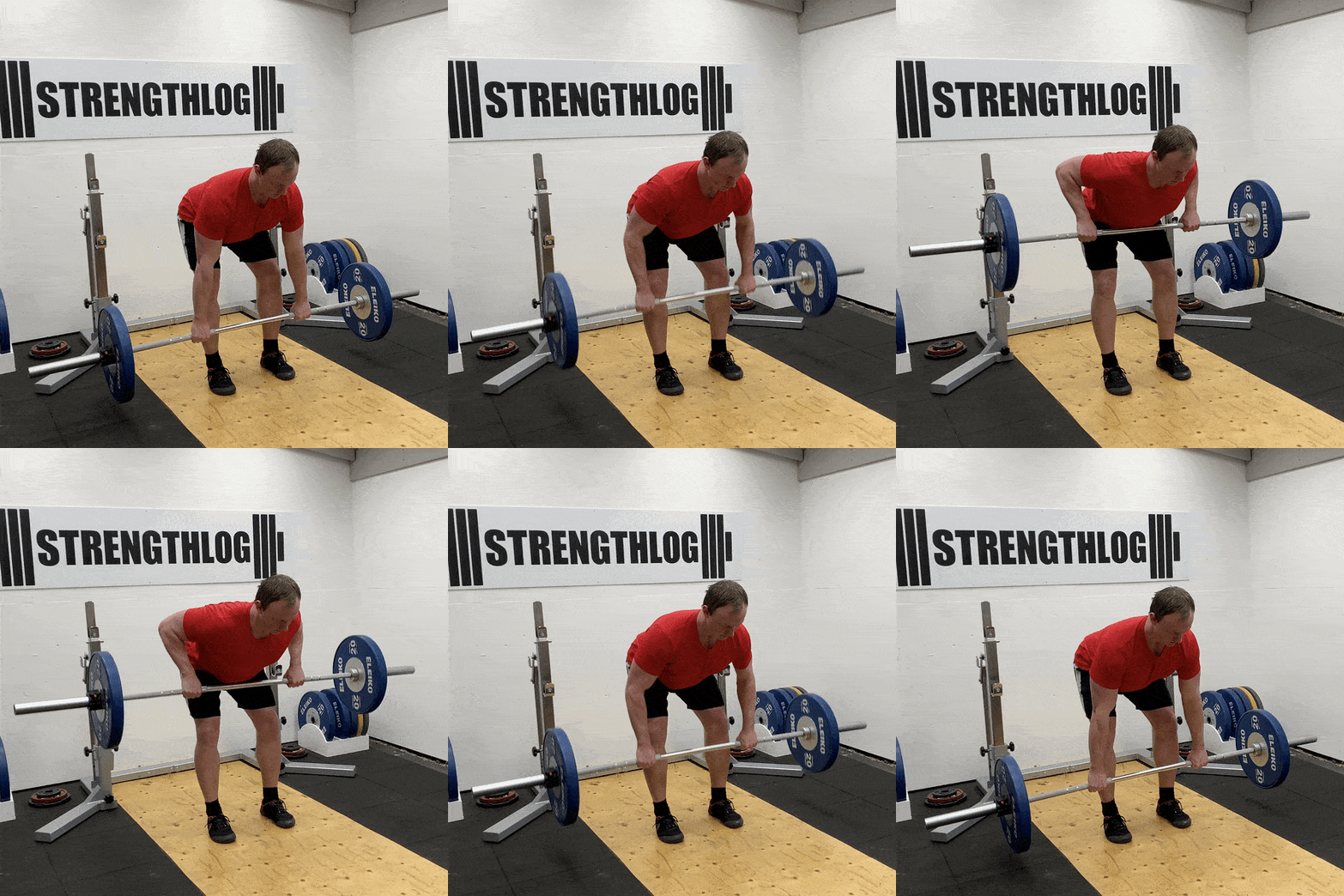
A heavy horizontal push paired with a heavy horizontal pull. It’s the mullet of supersets: business in the front (pecs), party in the back (lats).
I often did this one when I trained chest and back together and wanted to save time but still get quality training in.
Your push muscles—the pecs, triceps, front delts—rest (only stabilize you) while you hit your pull muscles (lats, traps, rhomboids, biceps).
You get a lot of volume in a short window of time, and because you’re flushing blood into both the front and back of your torso, your upper body pump needs to be felt to be believed.
Honorable Mention: Incline Dumbbell Press + Chest-Supported Dumbbell Row


By using dumbbells and a bench for both exercises, you don’t have to hog two stations or load/unload plates.
The chest-supported row is also easier on your lower back. If you do a bent-over row, your spinal erectors get tired, which can make you unstable on the bench.
But if you support your chest, you can focus more on your lats and upper back while your pecs recover for the next set of benching.
2. Barbell Curl + Barbell Lying Triceps Extension


Another classic upper body superset. You blast your arms with two of the most basic and effective exercises:
- The barbell curl, the heaviest isolation movement for overloading your biceps. I prefer a straight bar, but feel free to use an EZ bar if your wrists file a complaint.
- The barbell lying triceps extension, often called a skullcrusher for reasons both historical and motivational, for the triceps (especially the long head). Again, both straight and EZ bars work great.
Together, they team up to form, by far, my favorite arm superset. You can lead with either exercise, but I prefer starting with curls. It has always felt better on my elbows.
This is an isolation combo, so it generally belongs at the end of your workout or on a dedicated arm day.
Honorable Mention 1: Incline Dumbbell Curl + Overhead Triceps Extensions


This one requires you to be able to grab both a bench and a cable station, but it’s worth it.
These two exercises emphasize stretch under load, which is really good for hypertrophy, according to some studies. Overhead extensions are especially good for triceps growth.1 2
Honorable Mention 2: Cable Curls + Triceps Pushdowns


Convenience is king. You set the cable to the bottom, grab the handle, and don’t let go until your arms are pumped like a balloon.
You can use either a straight bar, or, my fave, a rope and do rope pushdowns and hammer-style rope cable curls.
3. Leg Extension + Leg Curl (Seated or Lying)


A staple in the bodybuilding world, pure quad and hamstring isolation.
This superset is like the peanut butter and jelly of leg day: two things that are pretty neat on their own but create something magical when you smash them together.
You remove your lower back, stability, and your cardiovascular system (almost) from the equation, which allows you to safely push your quads and hamstrings to absolute failure.
You can do this superset either as a warm-up to lubricate the joints before heavy squats or leg presses, or as a finisher to empty the tank.
Tip: Try doing the leg curls before the leg extensions. I really like it when the pump in my hamstrings works like a cushion for the knee joint when I do extensions afterward.
4. (Weighted) Pull-Up + Overhead Press


A vertical pull paired with a vertical push: a superset you don’t see in the wild often enough.
If you want a V-taper, this superset delivers. The overhead press hits your delts and triceps, and the pull-up hits your lats and biceps. It’s almost a complete upper body workout in two exercises.
You can switch back and forth, back and forth with little rest on this one, even though it’s two big compound lifts. You’ll notice that local fatigue stays separate; your pressing muscles aren’t the ones doing the pulling, so you can keep peak intensity on both exercises even with minimal rest.
If you haven’t tried this superset before, you might be surprised at how stable your overhead presses feel when your lats are active and have a bit of a pump.
Of course, you can vary it depending on your strength level and your equipment. For example, you can do lat pulldowns if pull-ups aren’t your thing yet, and you can use dumbbells for the shoulder presses.
5. Bar Dip + Pull-Up

This is my favorite bodyweight superset. Vertical push/pull: dips hit the chest, front delts, and triceps; pull-ups hit the lats, traps, and biceps.
It’s perfect for calisthenics, military training, and minimalist strength programs where you don’t have a full gym at hand, but it’s just as effective for bodybuilding purposes. These exercises are two of the finest for building upper body mass. If they were all you did, would you really have to do much more for complete upper body development? I don’t think so.
I know I wrote dip + pull-up because that’s the way most lifters gravitate, but I actually prefer and recommend doing pull-ups first. The shoulder joint is a bit more vulnerable during dips, and I feel that it helps to have the back muscles “woken up” and stabilizing before loading it with dips (especially if they’re weighted).
Plus, gripping the bar is usually the first thing to fail (unless you use straps), so get the pulling done while your hands are fresh. But dips first, pull-ups after is more common, and there is certainly nothing wrong with doing it that way.
Agonist Supersets
Agonist supersets are when you train the same prime mover in two back-to-back sets.
The most common variations are:
- Isolation (single-joint) first, multi-joint (compound) second. Like flyes before bench presses. Also called a pre-exhaustion superset.
- Compound first, isolation second. Like jumping to push-ups right after the bench press. Also called a post-exhaustion superset.
6. Chest Fly + Chest Press

I’ve deliberately left this one open to interpretation. The fly movement can be any type of cable flyes, machine flyes, pec deck, or good old dumbbell flyes. The presses can be anything from traditional bench presses to dumbbell chest presses to machine chest presses.
Regardless of which exercises you pick, you have a tremendous pre-exhaustion superset for your chest. The flyes tire out your chest only, and when you move to the press, your triceps are still fresh, so you can push your already-fatigued pecs past their normal point of failure.
This kind of pre-exhaustion superset is popular among bodybuilders and has been hyped for decades as being great for hypertrophy. However, according to research, it’s not superior for building muscle.3 That being said, they still save time, and you do get a huge pump.
Honorable Mention: Lateral Raise + Shoulder Press


The same thing, but for your delts. You tire out the side delts first, then immediately ask the entire shoulder complex to step in. Because your side delts are already fatigued, they have to work harder during the press.
Again, use the equipment you prefer, but dumbbells for both exercises are easily the most convenient here.
7. Leg Extension + Leg Press

Another pre-exhaustion superset, this time for the quads.
The first time I did this combo, I had trouble walking down stairs for a week.
By doing leg extensions first, you fatigue the quads. Then, when you immediately jump on the leg press, your quads are already tired and become the weak link. You force them to work harder, even though you will probably have to use a lot less weight.
In theory, you could do squats instead of leg presses, but having the stability of the leg presses after blasting your quads with extensions is a good thing. Try it and you’ll know why. Also, you can push to failure safely without a spotter.
8. Barbell Row + Straight Arm Lat Pulldown

This is a little-known gem that will leave your lats pumped like never before: a back post-exhaustion superset.
Rows are your go-to for back thickness, but your biceps can give out before you manage to exhaust your lats and upper back completely. The solution: follow up immediately with a lat isolation exercise and remove the biceps from the equation.
There aren’t many good lat isolation exercises (not many lat isolation exercises, period), but the straight arm lat pulldown is gold. It works your lats through a long range of motion and makes sure your back, not your arms, is the limiting factor.
If you happen to have an old-school Nautilus lat pullover machine, you have the best option for both pre- and post-exhausting your lats. However, they are as rare as a hen’s tooth these days, so I put the much more accessible cable straight arm pulldown as my default choice.
And this superset works just as well with a pull-up/pulldown style exercise instead of rows. Even more lats, less upper back.
9. Bench Press + Push-Up

I really like this one. It’s like a drop set (you use lighter weights when you can’t do any more reps and keep going), but without the hassle of removing plates from the bar.
Bench presses + push-ups is a classic: take a heavy, stable movement and immediately go into a lighter, unstable one that uses the same muscles.
When you reach failure in the bench press, your chest isn’t completely fried. You just can’t lift that specific heavy weight anymore. So, when you drop to the floor and start doing push-ups, you reduce the load (you lift ~70% of your body weight in a push-up).
You can continue squeezing out more reps, driving more blood into the pecs, and accumulating more metabolic stress, a “powerful anabolic signal that promotes muscle hypertrophy”.4
There are also some variations you might consider. If regular push-ups are too easy, you can elevate your feet or add a weight plate on your back. If they’re too hard, go to knee push-ups or incline push-ups. You can also do dumbbell bench presses instead for more shoulder stabilization, or close-grip benches to shift more work to the triceps.
Upper/Lower Supersets
Upper/lower supersets (an upper-body exercise with a lower-body move) are fantastic because they are “non-competing“. While your legs are trembling from a squat, your chest or shoulders are still fresh and ready to press.
You get double the volume in half the time, and your heart rate stays high. Almost like cardio for people who hate cardio.
10. Squat + Pull-Up

This is an excellent superset for working large parts of the body at the same time: quads, adductors, glutes, lower back, lats, and biceps.
I usually don’t like supersetting (heavy) squats with another big compound lift (isolation movements are fine) for most people. You lose stability, and it can get unsafe. There is some research to support this, with a 2025 review suggesting that “supersets are not appropriate for heavy, bilateral, compound lifts—such as squats, deadlifts, and Olympic movements—due to safety and fatigue concerns”.5
However, I make an exception for this one: squats into pull-ups. There is very little interference, balance and stability are non-issues, and if you try it, I bet you’ll barely notice the cardiovascular effects of the squat when you do pull-ups. Your grip might get a little tired, but your legs will be fresh for the next round of squats.
11. Bench Press + Romanian Deadlift

An unconventional upper/lower superset, but no less of a winner for it.
The bench press is one of the compound lifts where your lower back gets a near-total break as you lie down supported by the bench. That’s the perfect time to pair it with the Romanian deadlift (RDL), which hits your lower back and hamstrings.
By the time you finish your RDL reps, your chest and triceps will be back to capacity and ready to push heavy weights again. It might be a good idea to use straps for the RDLs so your grip doesn’t fail you on the bench press, though.
Combine it with the squat + pull-up superset above, and you have a full body workout in four exercises and record time. If you want to stick with it for a minimal full body routine, you can alternate bench presses with overhead presses to get some horizontal pushing in as well.
Bonus Core Superset
Surprise! Here’s a superset that doesn’t fit any standard labels but is still genuinely helpful, especially for athletes.
12. Pallof Press + Farmer’s Walk


I bet you haven’t tried this superset before. It doesn’t fit into any of the big three superset categories (antagonist, agonist, or upper/lower). I think I can best describe it as a core stability superset and an anti-movement superset.
It’s great for athletes and lifters who want to develop stability without spending hours on core work.
- The Pallof press is an anti-rotation exercise. Your obliques and deep core work isometrically to prevent torso twisting as you press the handle away from your center.
- The farmer’s walk is an anti-lateral-flexion and full-body tension exercise. Yes, you train your grip, traps, and legs, but from a core perspective, you’re resisting side-bending and spinal collapse under load.
Combine the two, and you get 1+1=3. You train core force transfer and force resistance from several angles, and you do it with very little local muscular interference.
The same logic extends to superset combos like dead bugs + suitcase carries, or cable chops + sled pulls.
More Great Supersets to Try
And there we go. These were 12 of my favorites, but note that there are many more excellent supersets you can implement in your workout. You might like some others as much or more than the ones on this list, so go ahead and experiment.
Here are seven more than I really like and would have included if I had made this list a top 20 instead. Some classics, some you might not have even thought of.
- Hanging Leg Raise + Back Extension. Trunk flexion with trunk extension: a classic agonist-antagonist superset for the core.
- Romanian Deadlift + Leg Curl. Hit both functions of the hamstrings (bending the knee and extending the hip) at once.
- Push-Up + Inverted Row. Nice superset for the entire upper body. Both exercises are excellent bodyweight alternatives to barbell presses and rows.
- Step Up + Kettlebell Swing. Unilateral and controlled, plus explosive and rhythmic. Knee-dominant and stabilization, plus hip-dominant and ballistic. Much is going on here, but you get a very effective superset for conditioning.
- Calf Raise + Tibialis Raise. The ultimate lower leg superset.
- Kettlebell Swing + Push-Up. Great push-hinge combo for both the posterior chain and the upper anterior chain that spreads the workload across your body instead of frying one area into uselessness.
- Wrist Curl + Wrist Extension. Two simple exercies = maximal forearm pump.
Exercises NOT to Superset
Most exercises can be supersetted without much of a problem.
But just like you wouldn’t chase a shot of tequila with a glass of milk, there are some exercises that have no business being performed back-to-back.
“Bad” supersets usually fail for one of three reasons: they compromise your spine, they fry your grip before the muscle you’re trying to train, or they tax your central nervous system (CNS) so hard that your form disintegrates or you can’t recover between sets.
Sure, you can superset these, but should you? Probably not.
1. Squats + Overhead Press (Standing)
Both these exercises require axial loading (a force compressing your spine from top to bottom).
Your core and lower back muscles keep you upright when you squat, and if you get under a barbell again and start pressing it over your head, you are asking those same stabilizers to protect your spine again under a new load.
That doesn’t mean you’ll injure yourself (although the risk is likely higher), but you will compromise performance.
2. Deadlift + Barbell Row (or Barbell Row + Deadlift)

Back day! Let’s do all the back stuff at once!
Let’s not.
The barbell row is an upper back and lat exercise, but it requires an isometric hold from your lower back. Deadlifts, well, they decimate your lower back (in a good way).
If you row after deadlifts, your tired lower back might round, putting your spine in a vulnerable position. If you deadlift after rowing, you won’t be able to lock your stabilizers for a heavy pull.
Either way, it’s not an ideal superset combo.
3. Deadlift + Pull-Up/Farmer’s Walk
Your posterior chain is powerful. Your forearm muscles are tiny. If you superset two heavy pulling movements, your grip will fail before your target muscle groups.
What will likely happen is that you end up stopping the set because your hands are slipping, not because your back or legs are fatigued.
Don’t turn a back workout into a mediocre forearm workout.
These supersets could work with straps, but if you want the compound benefits plus the grip work, do these exercises the traditional way.
4. Heavy Compound Movements (e.g., Bench Press + Squat, Deadlift + Squat)
These exercises require mental focus and neural drive. If you jump right into an equally taxing exercise, your nervous system won’t have recovered, and your power output will drop.
Even if you physically feel up to it, you’ll increase the risk of a freak accident due to a lapse in concentration.
Three Sample Superset Workouts
Armed with these supersets, you can design a superset workout for any combination of muscle groups.
But what if you don’t want to design your own? Instead of fiddling with the programming, you want to get straight to lifting, right?
No problem at all. Let’s take a look at some great superset workouts you can run right now.
Here we have superset arm workouts and superset chest-and-back workouts in three variants each: one for beginners, one for intermediates, and one for advanced trainees.
Plus, a neat full body workout for when you want to train your entire body and get the job done right in minimalistic superset fashion.
You can follow these workouts in our free workout log app, StrengthLog. When you follow them in the app, you can easily keep track of the weights you use and how many reps you do, so you know what to beat next time.
Biceps and Triceps Superset Workout
This is a simple but very effective arm workout where you use both free weights and cable machines. You hit every head of both muscles, with special emphasis on the long head of the triceps, which has the greatest growth potential.
| Exercise | Sets | Reps |
| Barbell Curl + Barbell Lying Triceps Extension | 2–4 | 6 |
| Barbell Preacher Curl + Barbell Standing Triceps Extension | 2–4 | 10 |
| Cable Curl + Triceps Pushdown | 2–4 | 15 |
- Beginners: Perform two supersets.
- Intermediates: Perform three supersets.
- Advanced: Perform four supersets.
Rest only as long as you need to move between exercises within a superset, then rest ~2 minutes between supersets.
Start the Biceps and Triceps Superset Workout in StrengthLog:
- Beginner (free)
- Intermediate
- Advanced
Chest and Back Superset Workout
Supersetting chest and back was a favorite of the Austrian Oak, Arnold Schwarzenegger, who used this combo in his Arnold split routine.
We’re talking two big muscle groups, so supersetting them isn’t a walk in the park, but the pump is worth every drop of sweat.
Note the pullover at the end of the workout, another favorite of Arnold’s. Do this one as straight sets.
| Exercise | Sets | Reps |
| Bench Press + Barbell Row | 2–4 | 6–12 (pyramid) |
| Incline Dumbbell Press + Lat Pulldown | 2–4 | 10 |
| Cable Chest Fly + Seated Cable Row | 2–4 | 8–12 |
| Dumbbell Pullover | 2–4 | 8–12 |
- Beginners: Perform two supersets.
- Intermediates: Perform three supersets.
- Advanced: Perform four supersets.
Again, try to rest as little as possible between exercises in the supersets, then rest 2 minutes (or more—you might find that you need more time to recover compared to biceps and triceps supersets) between the supersets.
Go directly to the Chest and Back Superset Workout in StrengthLog:
- Beginner (free)
- Intermediate
- Advanced
Full Body Superset Workout
This is a full body workout built around two of the supersets I presented above.
You train your entire body using exercises that target the major movement patterns in a minimalist yet time-efficient way. You can easily do it in less than 20 minutes. That’s hard to beat for a full body session.
| Exercise | Sets | Reps |
| Squat + Pull-Up | 3 | 10 |
| Bench Press (or Overhead Press) + Romanian Deadlift | 3 | 10 |
Feel free to do overhead presses instead of bench presses for variation. If you use it as your go-to full body routine (entirely viable), alternate between bench presses and overhead presses to get both horizontal and vertical pushing.
This workout is free in StrengthLog. Start it now:
Follow These Workouts in StrengthLog
These are three of the many workouts in our workout tracker, StrengthLog.


StrengthLog remembers what weights you used in your last session, and automatically loads them into your next one.
That makes it super easy to keep track of your weights and reps and make sure you’re on the fast road to progress.
Download it and start tracking your gains today!
StrengthLog is free to use, and so are the beginner and the full body superset workouts.
For the intermediate and advanced routines, you’ll need a subscription to follow it in-app. We offer a 14-day free trial (no strings attached and no funny business) that you can activate in the app, so you can check it out before making a decision.
Track Your Training. See Real Progress.
Log your workouts in one place and watch your numbers climb, week after week.
- Free to get started
- Cardio and strength training
- Beginner-friendly
- Superset tracking built in
- Free weights and machines
- Progress over time, personal bests
- Free and premium training programs and workouts for every fitness goal
Download StrengthLog free:


Final Rep
Time to make like a tree and get out of here.
Supersets are your best friend when the clock is ticking but the gains can’t wait.
Thanks for reading, and I hope you found some inspiration for your superset workouts.
Or fire up StrengthLog and try one of our pre-made ones. They’re designed to get you in, out, and swole.
Good luck with your training!
Want even more?
Subscribe to our weekly newsletter to get notified of new articles and get weekly training tips!
Last reviewed: 2026-02-10
References
- Sports Medicine and Health Science, Volume 8, Issue 1, January 2026, Pages 34-42. Does longer-muscle length resistance training cause greater longitudinal growth in humans? A systematic review.
- Eur J Sport Sci. 2022 Aug 11;1-11. Triceps brachii hypertrophy is substantially greater after elbow extension training performed in the overhead versus neutral arm position.
- Sport Sciences for Health, Volume 21, Pages 495–504, (2025). Equated volume load: similar improvements in muscle strength, endurance, and hypertrophy for traditional, pre-exhaustion, and drop sets in resistance training.
- Sports Orthopaedics and Traumatology, Volume 41, Issue 1, March 2025, Pages 9–18. Anabolic signals and muscle hypertrophy – Significance for strength training in sports medicine.
- J Strength Cond Res. 2025 Nov 1;39(11):1216-1234. The Acute and Chronic Effects of Superset Resistance Training Versus Traditional Resistance Training-A Narrative Review.
