
Unlike compound movements, which simultaneously engage multiple muscles and joints, isolation exercises often focus on a single muscle group. They can help make a basic workout routine more comprehensive and are particularly useful for more advanced lifters.
Whether you’re a seasoned gym-goer looking to fine-tune your biceps or a beginner trying to figure out what the heck an isolation exercise even is, you’ve come to the right place. In this article, we’ll explore the top 20 isolation exercises that can help you achieve your fitness goals.
Click here to jump directly to the list of isolation exercises!
What Are Isolation Exercises?
Isolation exercises, also known as single-joint exercises, involve movement around only one joint. They typically—but not always—target one specific muscle group, allowing you to focus on and strengthen that particular area.
Unlike compound exercises, which call in multiple joints and muscle groups for a team effort, isolation exercises focus on one muscle, allowing for more precise control and concentration on that particular area. Take the squat vs the leg extension, for example:


Examples of isolation exercises include the concentration curl for the biceps, triceps extensions, and leg extensions. These exercises move only one joint (the elbow and knee joint, respectively) and zero in on a particular muscle group. There are exceptions to the “one major muscle group”-rule, like Romanian deadlifts, a single-joint exercise that involves multiple muscle groups along the entire posterior chain.
Differences Between Isolation Exercises and Compound Movements
Isolation exercises and compound movements are both common components of a well-rounded strength training routine, but they serve different purposes and have distinct characteristics.
- Muscles Worked
- Isolation Exercises: Often target a single muscle group. For example, biceps curls specifically target the biceps.
- Compound Movements: Involve multiple muscle groups and joints. For example, a squat hits the quadriceps, adductors, glutes, and lower back.
- Joint Involvement
- Isolation Exercises: Involve one joint. For instance, leg extensions focus solely on the knee joint.
- Compound Movements: Involve two or more joints. For example, the bench press involves the shoulder and elbow joints.
- Strength and Muscle Gain
- Isolation Exercises: Ideal for developing muscle size and strength in specific areas.
- Compound Movements: Promote strength and muscle growth in several muscle groups at once, improving functional fitness and coordination.
- Energy Expenditure
- Isolation Exercises: Generally require less energy and are less taxing on the body. They are often performed with lighter weights and higher repetitions.
- Compound Movements: Demand more energy due to the involvement of multiple muscle groups. They typically involve heavier weights and lower repetitions.
- Training Applications
- Isolation Exercises: Used to target specific muscles, often at the end of a workout session, for a finishing pump.
- Compound Movements: Form the foundation of most strength training routines, providing the bulk of muscle and strength gains.
Benefits of Isolation Exercises
- Isolation exercises allow you to target a specific muscle area and help increase the size and strength of that particular muscle. They are beneficial for bodybuilders and athletes looking to improve the aesthetics and performance of individual muscles.
- These exercises are often prescribed in physical therapy to rebuild strength in a specific area without putting undue stress on the rest of the body. You can also use isolation movements to “work around” an injury where compound movements would trigger pain and discomfort.
- Isolation exercises can correct muscle imbalances by focusing on one muscle at a time. They are particularly useful for athletes who overuse certain muscles in their sport, leading to underdevelopment or weakness in other areas. Bodybuilders can use them to specifically target stubborn muscle groups.
- Isolation exercises can enhance the so-called mind-muscle connection, leading to better muscle activation. An improved neural connection helps you use your muscles more effectively during other exercises and daily activities.
Drawbacks of Isolation Exercises
- Isolation exercises often focus on one muscle group at a time, which might not be the best choice if you’re looking to maximize your workout efficiency. Compound exercises, which engage multiple muscles, give you more bang for your training buck.
- Because they target specific muscles, isolation exercises might not translate as well to real-world movements that require multiple muscle groups working together.
- If you’re trying to hit every muscle group with isolation exercises, your workouts can get pretty lengthy. For those with tight schedules, this might not be practical.
Do You Need to Do Isolation Exercises?
Do you need them? Not necessarily. But do they add something beneficial to most training routines? Absolutely.
- If you’re aiming for overall fitness and health, compound exercises provide a more efficient workout. You’re likely not missing out if you don’t do any isolation work. Compound exercises work multiple muscle groups simultaneously, making them great for shorter, more effective workouts.
- Most beginners do not need to do isolation exercises. Compound exercises provide the stimulus you need at this point. Even if you train a muscle indirectly, like when your biceps are involved when you do back exercises, it’s enough for excellent strength and muscle gains.
However, once you’re no longer a strength training newbie and when you’re training to build muscle, adding isolation movements to your workout routine is likely a good idea and can lead to more complete muscle development.1
In short, compound exercises are often your best bet for general fitness and efficiency. That doesn’t mean isolation exercises are useless. On the contrary, most people benefit from including both: have compound movements make up the foundation of your workout routine and then sprinkle isolation exercises on top. If your only goal is building muscle, basing your routine on isolation movements is likely OK. However, your training sessions will be unnecessarily extensive if you want to cover every muscle and every part of your body.
Isolation Exercises List
Chest Isolation Exercises
The bench press is a great example of a compound exercise for the chest. It’s also hugely popular, one of the best exercises you can do for your chest, and it builds your delts and triceps at the same time.
However, unless your pecs respond very well to heavy pressing exercises and are a strong point in your physique, adding some isolation work can mean a more fully developed chest.
Dumbbell Chest Fly

The dumbbell fly is the classic isolation exercise for the chest. Unlike compound movements like the bench press, dumbbell flyes isolate the chest muscles, particularly the pectoralis major. That means you’re giving your pecs the solo they deserve, free from the interference of your triceps and shoulders.
Dumbbell flyes allow for a greater stretch and contraction of the chest muscles compared to presses. This deep stretch at the bottom of the movement is like a call to action for muscle growth.
Lower the weights only until you feel a good stretch in your chest. Go for a full range of motion, but don’t overstretch. Going too deep can strain your shoulders and doesn’t do anything extra for your pecs.
Start with lower weights to master the form. This exercise isn’t about lifting as much weight as possible; it’s about feeling the chest muscles work. You can vary the angle of the bench to target different parts of the chest. Flat hits the middle, incline targets the upper chest, and decline works the lower chest.
How to Do Dumbbell Chest Flyes
- Lie on a bench and lift a pair of dumbbells up to the starting position.
- Slowly lower the weights in an arc to your sides until your chest is fully stretched. Maintain a slight bend in your elbow joint throughout the movement to protect your joints and maintain tension in your chest.
- When you’ve lowered the dumbbells as deep as possible, reverse the motion and return the dumbbells to the starting position.
- Repeat the movement for your desired number of repetitions.
Standing Cable Chest Fly

The standing cable chest fly is one of the best isolation movements for building muscle mass in the chest. Although it might not be your go-to exercise for overall upper body strength, this exercise allows you to zero in on the chest more than bench presses or push-ups.
Cable flyes work your pecs similarly to dumbbell flyes, but might be even more effective. The cables provide continuous tension throughout the entire range of motion, so your chest muscles work hard from start to finish. With the dumbbell fly, tension drops at the top of the movement, meaning your muscles aren’t working as hard as they could be. Both are excellent single-joint exercises for the chest, but cables might trump free weights in this case.
For best results, concentrate on squeezing your chest at the peak of the movement when your hands meet in front of you (or cross your hands for even greater contraction) and getting a good stretch at the top.
How to Do Standing Cable Chest Flyes
- Set up a cable crossover machine with two handles, one on each side, between chest to shoulder height. Stand in the center of the device, facing away from the weights.
- Grasp the handles of the cable machine, one in each hand, with your palms facing forward. Take a step forward to create tension on the cables. Stand with your feet comfortably apart and your knees slightly bent. You can step forward with one leg if that feels more comfortable and stable. Your upper arms should be at ~30 degrees away from your upper body.
- Pull the handles towards each other with a slight bend in your arms until your hands meet in front of your body.
- Contract your chest muscles, then slowly release the handles back to a stretched position. Your arms should remain slightly bent throughout the movement.
- Repeat the movement for your desired number of repetitions.
Machine Chest Fly

The machine chest fly removes all balance and stability requirements from your chest training. With most compound lifts, you’re constantly battling gravity and stabilizing muscles, which can be great, but might take away from pure chest isolation.
Experienced lifters and bodybuilders sometimes prefer machines because the stable path of motion allows them to focus solely on squeezing the pecs without worrying about balancing the weights.
Machines can also be great for beginners and are generally more user-friendly. There is no need to worry about getting dumbbells into position or figuring out the perfect angle—just set the weight and go. That means that if you’re new to the fly game, machines are a great way to learn the movement pattern safely.
How to Do Machine Chest Flyes
- Adjust the back support and handles so that you can grip the handles at shoulder height and get a long range of motion.
- With just a slight bend in the arms, push the handles forward until they meet in front of your body.
- With control, let the handles go back to the starting position.
- Repeat the movement for your desired number of repetitions.
Back Isolation Exercises
The back is unlike most other muscle groups. You could build great pecs, shoulders, or arms using only isolation moves, but when it comes to back training, you need multi-joint exercises in your workout routine for optimal results.
That being said, these isolation exercises help you add muscle to a specific area of this particular muscle group.
Shrugs


The shrug is an isolation exercise for your upper back muscles, specifically the trapezius, those magnificent slabs of muscle running from your neck to your mid-back. It is common to do shrugs when training shoulders (which is perfectly fine, by the way), but the trapezius is one of your back muscles.
You can do shrugs in several different ways.
- Barbell Shrugs: Great for heavy weights and maximal strength gains.
- Dumbbell Shrugs: Allows for a more extended range of motion.
- Behind-the-Back Shrugs: Work the traps from a different angle and hits your middle traps more.
- Smith Machine Shrugs: If you prefer the guidance of the Smith machine’s fixed path.
- Trap Bar Shrugs: Keeps the weight centered for a balanced lift and allows you to hoist some weighty weights.
Remember not to roll your shoulders—lift the weight straight up and down. Rolling can lead to shoulder injuries without any added benefits. The weight is too heavy if you can’t lift your shoulders without momentum.
How to Do Barbell Shrugs
- Hold a barbell in straight arms in front of your body.
- Lift your shoulders straight up as high as possible.
- Lower your shoulders again.
- Repeat the movement for your desired number of repetitions.
How to Do Dumbbell Shrugs
- Hold a pair of dumbbells at your sides.
- Lift your shoulders straight up as high as possible.
- Lower your shoulders again.
- Repeat the movement for your desired number of repetitions.
Straight Arm Lat Pulldown

The straight-arm lat pulldown is one of the best exercises for isolating your latissimus dorsi muscles, the large, fan-shaped muscles on either side of your back that give you that coveted V-shaped torso, without those pesky biceps getting involved.
Straight arm lat pulldowns can be used at the beginning of a back workout to pre-exhaust your lats before moving on to multi-joint movements or at the end to finish with a great pump. Either way, focus on feeling the muscle working rather than using as much weight as possible.
How to Do Straight Arm Lat Pulldowns
- Grip the bar with an overhand grip, slightly wider than shoulder-width.
- With straight arms, push the bar down in front of you by contracting your lats.
- Slowly return the bar to the starting position.
- Repeat the movement for your desired number of repetitions.
Dumbbell Pullover

The dumbbell pullover is a classic exercise, used since the dawn of modern bodybuilding to build chest and lat muscle mass and expand the rib cage (although the latter is likely more myth than reality).
Even though pullovers work both the chest and back, you can target your lats by keeping your arms bent, flaring your elbows out, and maintaining tension in your lats as you move the dumbbell as close to your body as possible.
At the bottom, focus on feeling the stretch in your lats rather than the chest. Think about pulling your shoulders down and back as you lower the weight. As you reach the bottom of the movement, engage your lats by thinking about pulling your upper arms back towards your torso using your back muscles rather than pushing with your chest.
How to Do Dumbbell Pullovers
- Lie down on a bench and lift a dumbbell up to almost straight arms above you.
- Lower the dumbbell down behind your head, while keeping your arms almost completely straight, just with a slight bend in the elbows. Keep your shoulder blades against the bench throughout.
- Reverse the motion and return the dumbbell to the starting position.
- Repeat the movement for your desired number of repetitions.
Back Raise

The back raise, or back extension if you want to be fancy, is the best isolation exercise for your lower back. Unlike deadlifts, which work almost your entire body, back raises specifically target the lumbar region.
They primarily work the erector spinae, a group of muscles that run along your spine and are essential for posture and spinal stability, even reducing the risk of injury. In addition, they give your glutes a good workout, and even your hamstrings get some love in the process.
Maintain proper form throughout the exercise. It’s better to perform the exercise with good technique and no additional weight than to add weight before you’re strong enough. But once you can do your target reps with your body weight, you can hold a weight plate to your chest for added resistance.
How to Do Back Raises
- Adjust the machine to position the top pad against the top of your thighs.
- Step onto the machine and position yourself with your feet shoulder-width apart and your upper thighs against the top pad.
- Your upper body should be hanging off the edge of the machine, with your arms crossed over your chest or your hands behind your head.
- If you want to use additional weight, hold a weight plate against your chest .
- Take a deep breath, and as you exhale, engage your lower back muscles to lift your upper body until your body forms a straight line.
- Hold this position for a second, then inhale as you slowly lower your upper body back down to the starting position. Keep your movements controlled, and don’t use momentum to swing your body up or down.
Shoulder Isolation Exercises
Compound movements like the overhead press are awesome for building strong, muscular shoulders, but isolation exercises are a great addition to your delt workout. They allow you to target weak points and zero in on individual parts of the shoulder muscles.
Lateral Raise

Lateral raises are fantastic for isolating the deltoid muscles, particularly the lateral or middle deltoid. They help create the broad, capped delts that give you a V-tapered look and are one of the best ways to get wider shoulders.
There are several types of lateral raises. Let’s break them down.
- Dumbbell Lateral Raises: The classic. Great for targeting the middle deltoid. Simple yet effective.
- Cable Lateral Raises: Offer constant tension, which can lead to better muscle activation and growth.
- Resistance Band Lateral Raises: Portable and versatile, bands are perfect for home workouts or travel.
- Machine Lateral Raises: Controlled movement, easy to learn.
Keep the weight light enough to control the movement regardless of which type of lateral raise you’re doing. Focus on the mind-muscle connection to really feel your delts working. Avoid using momentum; do not swing to get the weight up.
How to Do Dumbbell Lateral Raises
- Stand with your feet hip-width apart and hold the dumbbells in your hands with your palms facing your thighs.
- Begin the movement by lifting both arms to the sides, keeping a slight bend in your elbows, and raising the dumbbells until they reach shoulder height.
- Lower the dumbbells back down to the starting position while maintaining control.
- Repeat the movement for your desired number of repetitions.
Front Raise


The front raise is one of the best isolation exercises most people don’t need to do.
Hear me out—front raises are not a bad exercise. On the contrary, they’re a fantastic exercise for the front delts. The thing is, most people get most, if not all, the front delt work they need from their chest training and overhead presses.
But if you do need to grow your anterior delts, the front raise is the best exercise for the job. It directly isolates the front of your shoulders without involving any other major muscle groups.
The barbell front raise and the dumbbell front raise are equally effective.
How to Do Barbell Front Raises
- Hold a barbell in straight arms, in front of your body.
- With control, lift the barbell forward with straight arms, until the bar is at shoulder height.
- Reverse the movement and lower the bar with control.
- Repeat the movement for your desired number of repetitions.
How to Do Dumbbell Front Raises
- Hold a pair of dumbbells in straight arms, in front of your hip.
- With control, lift the dumbbells forward with straight arms, until the dumbbells are at shoulder height.
- Reverse the movement and lower the dumbbells with control.
- Repeat the movement for your desired number of repetitions.
Reverse Dumbbell Flyes

The reverse dumbbell fly, also known as the bent-over lateral raise, is an isolation exercise for the rear deltoids (the back part of your shoulder muscles). It also works the upper back muscles, including the rhomboids and traps.
Many people have overdeveloped front delts compared to rear delts. While back exercises like bent-over rows and pulldowns work the rear delts to some extent, including direct posterior shoulder exercises in your training program for balanced shoulder development is a good idea. Only training the front delts might give you a lopsided appearance.
Select a light to moderate weight that you can handle without swinging and using momentum, which reduces the exercise’s effectiveness.
Instead of using dumbbells, you can do reverse cable flyes or reverse machine flyes for constant tension throughout the movement.
How to Do Reverse Dumbbell Flyes
- Hold a pair of dumbbells, lean forward, and let your arms hang towards the floor.
- With almost straight arms (just a slight bend at the elbow), slowly lift the dumbbells by raising your arms out to the sides.
- Reverse the movement and lower the dumbbells back to the starting position.
- Repeat the movement for your desired number of repetitions.
Biceps Isolation Exercises
The best biceps exercises are all about isolation movements. Yes, back exercises involve your biceps significantly. And if your goal is functional strength and efficiency, compound movements like rows and pull-ups are usually enough. However, adding direct biceps work might be necessary if you want optimal biceps development.
You can’t go wrong with any of these three bicep curl variations.
Barbell Curl

The traditional barbell curl allows for heavy loads and is excellent for adding bicep mass. If you want to get those guns locked and loaded, this is a staple exercise you can’t ignore.
If you feel discomfort when curling with a straight bar (or just for variation), you can use an EZ-bar (a type of barbell with a zigzag or undulated design), which can be easier on the wrists and allows for a more comfortable grip.
How to Do Barbell Curls
- Stand up straight with your feet hip-width apart.
- Hold the barbell with an underhand grip at around shoulder-width or slightly wider. Your palms should be facing forward.
- Bend elbows and curl the barbell up towards shoulder height, keeping your elbows close to your sides.
- Continue curling the bar until your forearms are nearly vertical and the bar is close to your chest. Squeeze your biceps at the top of the movement for a second to maximize the contraction.
- Lower the barbell back to the starting position with control.
- Repeat the movement for the desired number of repetitions.
Dumbbell Curl

The classic dumbbell curl involves lifting a dumbbell with a supinated grip, targeting the bicep muscles effectively by isolating them through the movement.
You can also switch it up and do hammer curls. They are performed like a dumbbell curl but with a neutral grip and are great for the long head of the biceps, the brachialis, and the forearms.
Another variation is the incline dumbbell curl. Performed on an incline bench, this exercise places your arms behind your body for a loaded stretch, which is excellent for muscle hypertrophy.
How to Do Dumbbell Curls
- Hold a pair of dumbbells in an underhand grip (palms facing forward), arms hanging by your sides.
- Curl the dumbbells up towards your shoulders by only moving your forearms.
- Don’t let your upper arms travel back during the curl. Keep them at your sides or move them slightly forward.
- Reverse the movement and lower the dumbbells back to the starting position.
- Repeat the movement for the desired number of repetitions.
Preacher Curl

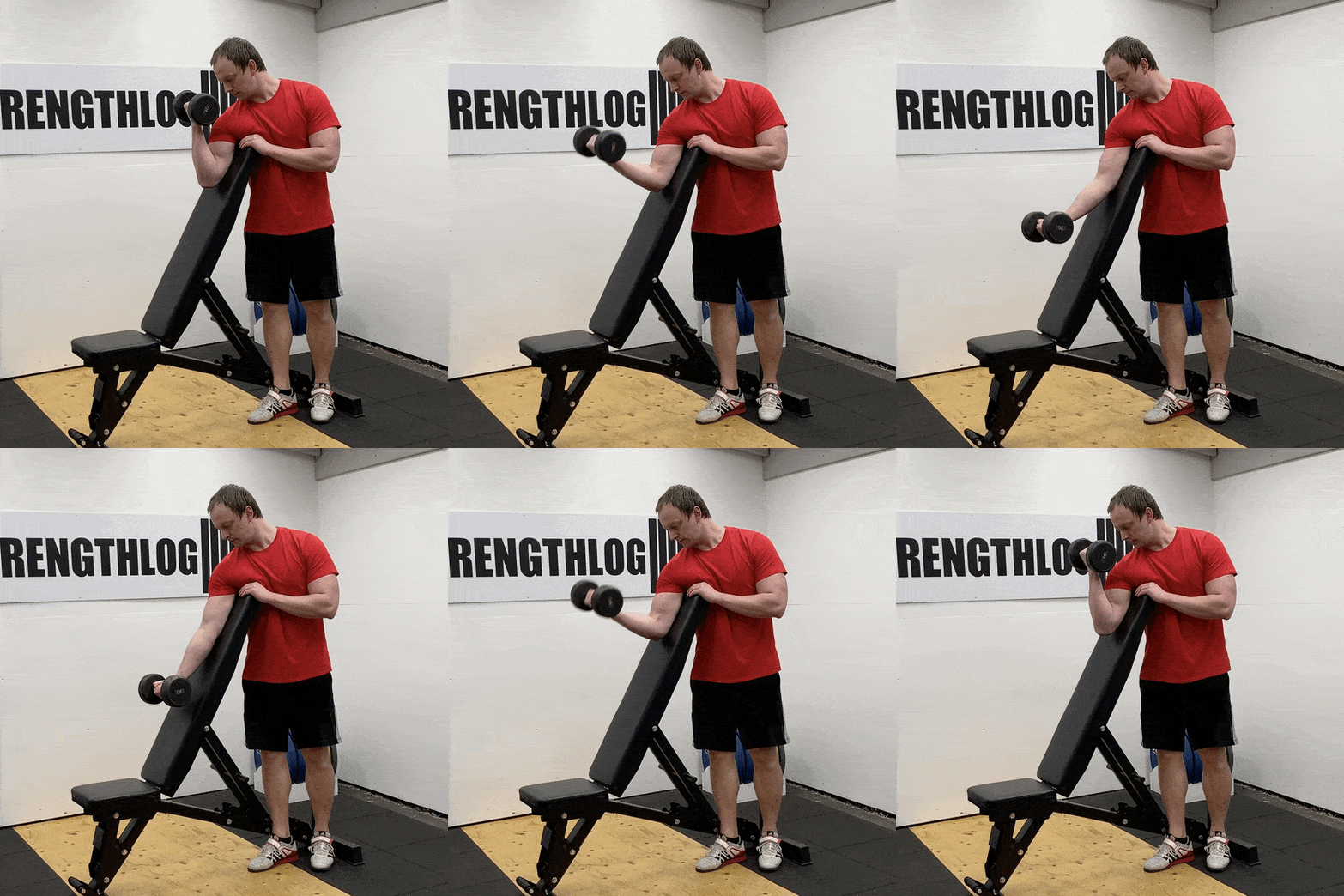
The preacher curl is the ultimate example of an isolation exercise. This curl variation eliminates momentum using a preacher bench for strict form and almost complete biceps isolation.
You have many different types of preacher curl at your disposal in your quest for bigger biceps.
- Barbell Preacher Curl: The classic preacher biceps curl version where you use a straight barbell.
- EZ-Bar Preacher Curl: Using an EZ curl bar, which has a zigzag shape, this version is easier on the wrists and provides a slightly different angle of resistance.
- One-Arm Dumbbell Preacher Curls: Do them on a dedicated preacher bench or a regular incline bench with your upper arm against the backrest. Focusing on one arm at a time allows you to focus even more on each bicep.
- Machine Preacher Curls: A preacher curl machine offers a controlled movement and consistent tension throughout the exercise.
- Cable Preacher Curls: Using a cable machine provides continuous tension on the biceps throughout the entire range of motion.
- Reverse Preacher Curls: Performed with a reverse grip (palms facing down) using either a barbell or an EZ bar. This variation targets the meaty brachioradialis part of your forearm.
How to Do Barbell Preacher Curls
- Grab a barbell and sit down at a preacher curl bench, resting your upper arms against the pad.
- Lower the barbell as far as you can, with control, to straight arms.
- Reverse the motion and return to the starting position.
- Repeat the movement for the desired number of repetitions.
How to Do Dumbbell Preacher Curls
- Use a preacher curl bench, or position the back rest of a regular training bench so that it leans back slightly.
- Grab a dumbbell, stand behind the bench, and rest your upper arm against the back rest.
- Lower the dumbbell as far as you can, and then reverse the motion, returning to the starting position.
- Repeat the movement for the desired number of repetitions.
Triceps Isolation Exercises
Like with biceps and back training, your triceps are heavily involved whenever you do compound moves and pressing exercises, like bench presses, push-ups, and overhead presses for your chest and shoulders.
Again, while this is enough for some, including direct triceps work in your workout program will allow you to enhance triceps growth and target some areas of the triceps that pressing movements fail to stimulate maximally.
Remember that the triceps make up about two-thirds of your upper arm’s muscle mass, so if you want those sleeves to stretch, focusing on triceps is the way to go.
Barbell Lying Triceps Extension

The barbell triceps extension might be the single best mass-builder for the triceps. It checks all the boxes: a full range of motion, loaded stretch, and it’s easy to overload the target muscle.
However, to make it the best possible exercise for triceps growth, you will have to stray a bit from the isolation exercise criteria of only involving one joint. Instead of doing regular “skull crushers” where you lower the bar to your forehead, lower it down behind and below your head to place maximum stress on the long head, the part of the triceps with the greatest growth potential.
How to Do Barbell Lying Triceps Extensions
- Lie down on a flat bench with your feet on the floor and your head close to the edge.
- Hold a barbell over your chest with an overhand grip and your arms extended. Keep your hands relatively close together, spaced approximately 6 inches (15 cm) apart.
- Keep your elbows pointing straight up and lower the barbell behind your head, bending your elbows.
- Lower the barbell as far as you comfortably can while maintaining control and tension in your triceps muscles.
- Reverse the motion and extend your arms back up to the starting position.
- Repeat the movement for the desired number of repetitions.
Dumbbell Triceps Extension

Overhead triceps extensions are the best way to trick the long head of the triceps into growth. Research suggests 40% greater muscle growth from training your triceps with your arm in an overhead compared to a neutral position.2
Use a weight that allows for a deep stretch at the bottom of the movement and a complete contraction at the top. Excessively heavy weights or allowing your elbow to flare out can compromise form and reduce the effectiveness of the exercise.
How to Do Dumbbell Triceps Extensions
- Stand with your feet shoulder-width apart and hold a dumbbell in your right hand with an overhand grip.
- Raise the dumbbell overhead so that it is directly above your shoulder.
- Keeping your upper arm stationary, bend your elbow and lower the dumbbell behind your head.
- Get a good stretch at the bottom of the movement, then extend your elbow to raise the dumbbell back to the start position.
- Repeat the movement for the desired number of repetitions, then switch arms and repeat with your left hand.
Triceps Pushdown

The triceps pushdown is the most popular exercise for the triceps and an excellent isolation movement that’s easy to learn for the beginner but remains highly effective regardless of fitness level. It’s a staple in any gym-goer’s routine who is serious about building horseshoe-shaped triceps.
You can use different attachments (rope, straight bar, V-bar) to hit your triceps slightly differently.
Keep your elbows locked to your sides to ensure your triceps are doing the work, focus on squeezing your triceps throughout the movement, and control the movement, especially on the way back up, to maximize muscle engagement and growth.
How to Do Tricep Pushdowns
- Stand facing a cable machine with your feet comfortably apart. Grip the bar with an overhand grip, keeping your hands about shoulder-width apart. Your elbows should be slightly bent, and your upper arms close to your sides and perpendicular to the floor.
- Engage your core and maintain an upright posture throughout the exercise to help stabilize your body and isolate the triceps.
- Start by extending your arms downward, focusing on pushing the bar down towards your thighs. Keep your upper arms close to your sides and stationary during the movement.
- As you lower the cable, squeeze your triceps and focus on contracting the muscle. Feel the tension in your triceps as you fully extend your arms.
- Return to the starting position by allowing the cable to rise back up using the same path. Maintain control throughout the ascent.
- Repeat the movement for the desired number of repetitions.
Leg & Calf Isolation Exercises
Compound movements like the barbell squat and leg press are the bread and butter of most leg day workouts. However, adding isolation exercises to your lower body sessions allows you to stimulate specific areas of a muscle that most compound lifts can’t optimally target.
Leg Extension
The leg extension is like the espresso shot of leg workouts – a small move with a big kick and the best isolation exercise for the quadriceps, a group of four powerful muscles located at the front of the thigh.
While the squat (and similar compound movements) are great for quadriceps strength and muscle growth, they all have one thing in common: they aren’t that effective for one part of the quads, the rectus femoris muscle.3 Leg extensions, however, are.

They activate the rectus femoris much better and complement squats perfectly for a complete quad workout.
The most important thing when doing leg extensions is to keep the movement controlled. Extend your legs fully, squeeze your quads for a moment, and then lower back down slowly.
How to Do Leg Extensions
- Adjust the leg extension machine so the pad is just above your feet, with a ∼90-degree angle between your upper and lower legs.
- Sit on the seat and place your ankles behind the pad, ensuring that they align with the pivot point of the machine.
- Grip the handles on the sides of the machine for stability.
- Engage your core and maintain an upright posture.
- Extend your legs, raising the weighted bars in a controlled manner. Focus on the quadriceps muscles as you move.
- Ensure that the motion is smooth and that you’re not using momentum or jerking the weight up.
- Extend your legs fully, hold this position for a moment, and squeeze your quads.
- Lower the weight back to the starting position with full control.
- Repeat the movement for the desired number of repetitions.
Leg Curl


The leg curl comes in several variations, all highly effective for isolating the hamstrings. The hamstrings are often neglected because people tend to focus on the quads and glutes for the classic leg day pump. But strong hamstrings are crucial for leg strength, athletic performance, and injury prevention. Plus, nothing beats well-rounded leg muscles that look good from all angles.
The seated leg curl and the lying leg curl are both excellent hamstring exercises, but if you have the choice, the seated version is your number one option. One study found 55% greater hamstring muscle growth after 12 weeks of seated leg curl training compared to lying.4
Regardless of which one you pick, make sure you fully extend and curl your legs to work the muscle in it’s entire length.
How to Do Leg Curls
- Adjust the machine so that you are correctly positioned. Your knees should be in line with the machine’s joint.
- Lift or push the weight down (depending on whether you chose the lying or seated leg curl) by bending your knees as far as possible.
- Slowly lower or let the weight back again.
- Repeat the movement for the desired number of repetitions.
Romanian Deadlift

Many people call the Romanian deadlift a compound movement. However, that’s not really true. There is only significant movement at the hip joint, making it an isolation exercise. Compare that to the regular deadlift, an actual compound exercise that involves multiple joints.
The Romanian deadlift does work a multitude of muscle groups, however.
- It is fantastic for building strong, muscular hamstrings and shaping a well-rounded backside. It’s not a glute isolation exercise, but it is still one of the best exercises for your glute muscles, including the gluteus maximus and gluteus medius.
- In addition, it strengthens the muscles around your lower back and encourages better hip hinge mechanics, which are crucial for many other movements in the gym and daily life.
When you do Romanian deadlifts, get a good stretch at the bottom, but only go as low as you can while maintaining proper form. For some, this might be just below the knees; for others, it might be mid-shin.
How to Do Romanian Deadlifts
- Get into the starting position by deadlifting a barbell off the floor, or by unracking it from a barbell rack.
- Inhale, brace your core slightly, and lean forward by hinging in your hips. Keep your knees almost completely extended.
- Lean forward as far as possible without rounding your back. You don’t have to touch the barbell to the floor, although it is OK if you do.
- Reverse the movement and return to the starting position. Exhale on the way up.
- Take another breath, and repeat the movement for the desired number of repetitions.
Standing Calf Raise

A good calf workout requires only one exercise: the standing calf raise.
Many people struggle to grow their calf muscles, which is understandable since they are a notoriously stubborn muscle group.
Some studies show that when calves grow from strength training, they do so significantly slower than other muscles. Many gym bros, even pro bodybuilders, can attest to the truth of those findings.
For example, muscle protein synthesis (the process where your muscle fibers grow bigger as your body adds new protein) is 200% higher in the thigh muscles after a workout.5
That being said, new research suggests that the cure for stubborn calves might be to train them more. After all, they are used to a lot of hard work, having been used to carry your body around your entire life. And there is no better exercise for the job than the standing calf raise.
Science-backed pro tips to turn your calves into cows:6 7
- Ensure you lower your heels below the step and rise as high as you can onto your toes. Feel that stretch and squeeze.
- Experiment with different foot positions. Pointing your toes slightly inward, outward, or straight ahead targets different parts of the calf.
- Include extra-heavy calf raises, where you only do the bottom half of the movement and focus on getting a good stretch.
How to Do Standing Calf Raises
- Place your toes and the ball of your feet on the foot support. Place the shoulder pads against your shoulders and stand upright in the starting position.
- Lower yourself down by bending your ankles in a controlled movement.
- Push yourself up by extending your ankles.
- Repeat the movement for the desired number of repetitions.
Building a Workout with Isolation Exercises
Now that you’ve learned about the best isolation exercises for building muscle and strength, the questions are: how many should you do per muscle, and how do you design a workout with them?
While there is no one-size-fits-all answer to those questions, most trainees benefit from doing their compound work first. Compound movements are more demanding, and doing them first when you’re fresh maximizes your energy and strength, allowing you to lift heavier and gain more overall benefit. Afterward, you can target specific muscles with isolation exercises to fine-tune your physique.
However, there are no rules in strength training. You can try starting with an isolation exercise and then moving to compound work. In fact, a number of advanced bodybuilders prefer to start with isolation exercises to pre-fatigue a muscle. For example, doing leg extensions before squats can make your quads work harder during the squat.
In general, you want to do at least 10–12 sets per muscle group per week.8 9

Read more:
>> How Many Sets and Reps Should You Do to Build Muscle?
We’re talking about high-effort sets where you go to or close to failure. If you’re an advanced lifter or bodybuilder, you might need twice that number of sets for maximum gains, but there are no universal recommendations on how many sets should be from isolation exercises. Some do compound movements only; others might do one compound exercise to start and then spend the rest of the training session doing isolation work.
A superb strategy for most intermediate-level trainees is to do three exercises, two of which are compound movements, and then finish with an isolation movement. Let’s look at some examples of great workouts for each muscle group using this method: starting with compound work before moving to one or two isolation exercises.
Chest Workout
For the chest, you could start with the standard barbell bench press for overall chest development and then move to the incline dumbbell press to hit your upper chest. Those two compound movements make an excellent pec workout all by themselves. However, any fly exercise, like dumbbell or cable flyes, makes an awesome finisher and gives you a great chest pump to finish the session.
| Exercise | Sets | Reps |
|---|---|---|
| Bench Press | 3 | 6–8 |
| Incline Dumbbell Press | 3 | 10 |
| Dumbbell Chest Fly | 3 | 12 |
Back Workout
This back workout starts with two compound movements: pull-ups and rows, which add width and thickness to your upper and middle back. You then finish with shrugs and back raises, two of the best isolation exercises for your traps and lower back, respectively.
| Exercise | Sets | Reps |
|---|---|---|
| Pull-Up | 3 | Max reps |
| Dumbbell Row | 3 | 10 |
| Dumbbell Shrug | 2 | 10 |
| Back Extension | 3 | 12 |
Shoulder Workout
This shoulder workout features more isolation movements than compound exercises. Starting with overhead presses takes care of most of your delts, and you can polish them off with targeted isolation work afterward.
| Exercise | Sets | Reps |
|---|---|---|
| Overhead Press | 3 | 6–8 |
| Dumbbell Lateral Raise | 3 | 10 |
| Reverse Dumbbell Flyes | 3 | 12 |
Biceps Workout
This biceps workout is short and sweet, with two isolation movements. You start with barbell curls, which allow you to load up a lot of weight, before moving to a preacher curl for a massive pump.
| Exercise | Sets | Reps |
|---|---|---|
| Barbell Curl | 3 | 8 |
| Dumbbell Preacher Curl | 3 | 12 |
Triceps Workout
Both exercises in this triceps workout are isolation movements, and both target the long head, the one with the most growth potential. Combine it with chest and shoulder pressing exercises, and you’ve got a killer recipe for horseshoe triceps.
Leg Workout
A comprehensive leg workout with only one compound exercise? Yes, the squat takes care of so many muscles that you spend the rest of the workout focusing on isolating specific areas. This workout adds lean mass and strength to your entire lower body.
| Exercise | Sets | Reps |
|---|---|---|
| Squat | 4 | 6–8 |
| Leg Extension | 3 | 10 |
| Seated Leg Curl | 3 | 10 |
| Romanian Deadlift | 2 | 8 |
| Standing Calf Raise | 3 | 12 |
Final Words
You have reached the end of this guide to the best isolation movements. Thank you for reading!
You can find all these exercises and hundreds of training programs and workouts that make the best use of them in our workout log app.
StrengthLog is 100% free to download and use as a workout tracker and general strength training app. All the basic functionality is free – forever. It’s like a personal trainer in your pocket.
Download StrengthLog for free, keep track of your weights and reps, and try to beat your previous numbers each workout.


Check out all our workout routines in our full list of training programs.
And for more resources like this, take a gander at these articles:
- The 15 Best Compound Exercises for Muscle and Strength
- The 25 Best Accessory Exercises to Improve Your Bench Press
- Top 20 Bodybuilding Exercises for Every Muscle Group
- Top 20 Powerlifting Exercises For Strength & Mass
- The 30 Best Barbell Exercises for Every Muscle Group
References
- Strength and Conditioning Journal 45(1):p 49-57, February 2023. Hypertrophic Effects of Single- Versus Multi-Joint Exercise of the Limb Muscles: A Systematic Review and Meta-analysis.
- Eur J Sport Sci. 2022 Aug 11;1-11. Triceps brachii hypertrophy is substantially greater after elbow extension training performed in the overhead versus neutral arm position.
- J Sports Sci. 2021 Oct;39(20):2298-2304. The role of exercise selection in regional Muscle Hypertrophy: A randomized controlled trial.
- Med Sci Sports Exerc. 2020 Oct 1. Online ahead of print. Greater Hamstrings Muscle Hypertrophy but Similar Damage Protection after Training at Long versus Short Muscle Lengths.
- Acta Physiol Scand. 2004 Oct;182(2):189-96. Human soleus muscle protein synthesis following resistance exercise.
- J Strength Cond Res. 2020 Aug;34(8):2347-2351. Different Foot Positioning During Calf Training to Induce Portion-Specific Gastrocnemius Muscle Hypertrophy.
- J Strength Cond Res. 2023 Sep 1;37(9):1746-1753. Greater Gastrocnemius Muscle Hypertrophy After Partial Range of Motion Training Performed at Long Muscle Lengths.
- J Hum Kinet. 2022 Feb 10:81:199-210. A Systematic Review of The Effects of Different Resistance Training Volumes on Muscle Hypertrophy.
- International Journal of Strength and Conditioning, Vol 1 No 1 (2021). Resistance Training Recommendations to Maximize Muscle Hypertrophy in an Athletic Population: Position Stand of the IUSCA.
