
Volleyball is a game of finesse, skill, and speed, but strength also plays a big part in almost everything you do on the court, and weight training (be it in a gym or using your body weight) is the best way to improve it.
But here’s the catch: powerlifting or bodybuilding training won’t cut it. To be your best, you need a training plan that builds explosive strength, improves your speed and power, and prevents injuries.
In this guide, we’ll break down the essential exercises so you can dominate every rally and put them all together into training programs and workouts (one for off-season, one for in-season) to help you jump higher, hit harder, and stay injury-free.
***
Want to jump right into the training program?
Click here for the Strength Training for Volleyball program.
Table of Contents
Benefits of Strength Training for Volleyball
Volleyball is one of the most popular sports worldwide, with over 800 million players engaging in it recreationally and competitively across indoor, beach, and even snow volleyball variations.1 It is fast-paced, team-oriented, and requires players to be explosive and agile. And while volleyball is not a power sport per se, you must be strong to perform your best on the court.
Lifting weights is an essential part of the training of almost every physically demanding sport, but it hasn’t always been this way. And in some parts of the volleyball community, strength training has been (and sometimes still is) frowned upon due to outdated beliefs.
Some players and coaches worry that lifting heavy iron will make athletes too bulky or slow, reducing their ability to move quickly on the court.
But in reality, well-structured weight training improves power and speed and protects against injuries. Stronger legs = higher jumps, stronger core = better stability, and stronger upper body = more powerful spikes and serves.
Here are three of the most important reasons why strength training should be part of your volleyball training year-round. Or, if you are a volleyball coach, why you should program resistance training into your athletes’ workout plans.
Explosive Power & Vertical Jump
Jumping ability is, well, not everything, but supremely important in volleyball. The higher you can get off the ground, the better, both for spiking the ball and for defending.
Squats, deadlifts, and Olympic lifts (cleans and snatches) build legs that generate more force so you can jump higher and develop the fast-twitch muscle fibers you need for explosive power and improving your reaction time. You won’t develop your jumping ability to the utmost without spending some time with the weights. Heavy squats are particularly effective, and your 1RM in the barbell squat is a major predictor of how high you can jump.2
Injury Prevention
Volleyball is a very safe sport, even at the highest levels of competition.3 That being said, injuries do happen, and prevention is always better than rehab. And if you get hurt, your entire team takes the hit.
Ankle sprains are, by far, the most common volleyball injuries, followed by knee injuries, finger boo-boos, lower back issues, and shoulder injuries.4

The good news is that strength training is the number one countermeasure against sports injuries, cutting them by one-third or more and reducing overuse injuries by 50%.5 By building muscle around the joints, you provide extra support and stability, reducing the risk of injury, both acute stuff like sprains and strains of the ankle joints and overuse injuries from overhead swings and jump landings.
More Hitting & Serving Power
Strength training is a must if you want to hit harder and serve faster. Upper body strength is directly tied to how much power you can generate when spiking or serving.
Research shows that resistance training improves volleyball players’ strength, power, and flexibility.67
It can even boost the accuracy of things like serve receiving skills because when you serve, your ability to generate power and place the ball exactly where you want it comes from your ability to stabilize your body mid-air, which in turn depends on muscle strength for accuracy and control.8 One study found that weight training, while improving the strength of the participants, did not transfer to hitting speed.9 But that study used very light weights (30% of 1RM), which was likely not enough intensity for significant game-relevant benefits.
It’s also essential to train the entire body, not just the muscle groups directly involved in serving. You generate power from the ground up—your legs, core, and upper body work together to create force—and if one part of that chain is weak, the end result is a less powerful serve. With strength training, you teach your entire body to work in sync, allowing you to hit with more force while maintaining control.
How Often Should Volleyball Players Strength Train?
The ideal strength training frequency for volleyball depends on the time of year (off-season vs. in-season), your current training goals, and your individual needs.
Here are some general guidelines and rationale if you want to plan your own workout routine.
Offseason and Pre-Season (3–4 Strength Sessions per Week)
Off-season is the time to address weaknesses, build a base of strength, add lean muscle, and lay the groundwork for more explosive power to build upon during pre-season as the competitive season approaches.
Volleyball players benefit from increasing muscle size (hypertrophy) initially, then focusing on maximal strength to improve subsequent power training. It’s a myth that muscle mass makes you slow. On the contrary, you can use the lean mass you build with strength training for more power, explosiveness, and speed. Sure, if you woke up with the muscle mass of a pro bodybuilder, it would be a hindrance to your game, but the chances of that are zero, almost negative. A strength training program for volleyball does not make you “muscle-bound” (if such a thing exists) or slow.
The off-season is also a great time to emphasize exercises for imbalances and weaknesses that keep you from doing your thing in-game at 100% (e.g., serving, hitting, jumping). Perfect your technique and address tight or weak areas (hips, ankles, and shoulders are common in volleyball).
Two to four strength sessions per week are common for collegiate and competitive club-level players (and above). If you have the time and it doesn’t compromise recovery, you could hit the gym five days per week, but the marginal benefits of five workout days compared to four are, well, marginal.
Splitting your body into upper/lower or full-body sessions are great alternatives, depending on your schedule and training experience. Full-body workouts are ideal for beginners, and if you want to increase your training volume over time, a body part split allows you to do so without your sessions getting overly long. Traditional bodybuilding routines like the PPL (Push/Pull/Legs) split work well, too.
Regardless of the split, include at least one complete rest day per week and make sure your recovery (adequate sleep, good nutrition) is on point.
In-Season (1–2 Strength Sessions per Week)
While your off-season training goals include increasing maximal strength, power, and muscle mass with heavier compound lifts using a high training volume and intensity that allows you to push your limits without worrying about game-day fatigue, in-season strength training is another beast.
Now, you focus on maintaining strength and optimizing performance without causing excessive fatigue that could interfere with match-day performance, doing lower-volume sessions while keeping the intensity high.
One or two training sessions per week is typical in-season—one session if your competitive match load is very high or you have multiple matches in a week, or two sessions if your schedule allows enough recovery time between matches.
Even low-volume sessions (maintenance workouts) help prevent significant strength losses over the season, so you don’t need to spend many hours every week in the weight room in addition to your match schedule. Intensity (as in relatively heavy weights) is more important than volume, and you can aim for efficient 30–45 minute sessions a couple of times per week and maintain your strength and muscle perfectly fine.
One important consideration is to not schedule a heavy strength training session the day before a match, as it will decrease your volleyball performance for at least 48 hours.10 You want to be fresh when you step on to the court, not fatigued from lifting heavy iron.
Full-body workouts are ideal—let’s say you want to lift twice a given week, but your schedule suddenly only allows for one workout. With a total-body session in the bag, you’ve already trained every major muscle group and are good to do.
If you are logging heavy playing time or dealing with minor injuries, you may need to reduce volume further or shift training days to avoid conflicts with competition or travel days.
Strength Training Program for Volleyball
This is a strength training program for volleyball players who want to develop maximum strength, power, balance, and stability while strengthening the body to prevent injuries. It’s suitable for the off-season or pre-season (see above) and for intermediate-level volleyball players and above.
This program works best if you already have some strength training experience. It features many different, relatively complex exercises, and if you have never lifted weights before, it might be too much for you to jump right into.
If you’re new to the gym, start with one of our beginner programs, like the Beginner Barbell Training Program. You train three times per week, alternating between workouts A and B.
Workout A
| Exercise | Sets | Reps |
|---|---|---|
| Squat | 3 | 8–10 |
| Bench Press | 3 | 8–10 |
| Barbell Row | 3 | 8–10 |
Workout B
| Exercise | Sets | Reps |
|---|---|---|
| Deadlift | 3 | 6–8 |
| Lat Pulldown (or Pull-Ups) | 3 | 8–10 |
| Overhead Press | 3 | 8–10 |
In other words, you’ll train workouts A B A week one and B A B week two, then go back to week one and keep alternating between the two.
This beginner program (any many more) are available for free in our workout log app, StrengthLog.
You can use the strength you gain on the court, and you teach your muscles, brain, and nervous system to play together, allowing you to move on to more complex programs.
If you do have some weight training experience, you’re ready for Strength Training for Volleyball.
14-Week Strength Training Program for Volleyball
This is an 14-week progressive training program designed for off-season strength (both general and volleyball-specific strength) and power gains.
Progression Blocks
- Weeks 1–2: Moderate intensity, focus on form and establishing baseline loads.
- Weeks 3–4: Increase load and/or volume slightly.
- Weeks 5–6: Further progression with heavier loads or added sets/reps (while keeping form strict).
- Weeks 7–8: Peak or near-peak loads; slightly reduce volume if needed to maintain intensity and power.
- Week 9: Deload
- Week 10–14: Translate your gains into power and speed to prepare for in-season performance. Power and plyometric training take center stage.
Suggested progression for selected compound exercises weeks 1–8:
| Exercise | Wks 1–2 | Wks 3–4 | Wks 5–6 | Wks 7–8 |
|---|---|---|---|---|
| Back Squat | 3×8 | 4×6 | 4×5 | 5×3–4 |
| Bench Press | 3×8 | 4×6 | 4×5 | 5×3–4 |
| Deadlift (RDL) | 3×10 | 3×8 | 3×8 | 4×6 |
| Bent-Over Row | 3×10 | 3×8–10 | 4×6–8 | 4×6 |
| Hang Clean | 4×3 | 5×3 | 5×2–3 | 5×2–3 |
During weeks 11–14, you’ll perform each exercise with as much explosiveness as you can muster (resist it during the eccentric phase). The most important things to focus on is on speed and exploding the weight, not grinding slow reps to failure. Your sets end when you can’t move the weight as fast, not when you fail to complete a rep. 3–5 reps for compound and power movements, and 8–10 for plyometric exercises.
Weekly Split Overview
You train three times per week (e.g., Monday/Wednesday/Friday).
- Day 1 (Lower-Body Emphasis + Core)
- Day 2 (Upper-Body Emphasis + Core)
- Day 3 (Full-Body Power + Accessory)
Each day will have some overlap in muscle groups (as most compound exercises are full-body to some degree), but the emphasis shifts.
You can pick which days you hit the weights to fit your schedule, but take a rest day between strength training sessions, if possible.
Workout Tips
- Start with a dynamic warm-up (light cardio, mobility drills, shoulder activation with bands, etc.).
- Rest 90–120 seconds between main strength sets. Accessory exercises can have slightly shorter rest periods (60–90 seconds).
- Control the eccentric (lowering) and try to be more explosive on the concentric (lifting) phase—especially for power exercises (e.g., hang clean).
Follow This Training Program in StrengthLog
This program and many more are in the StrengthLog workout tracker app. The app is free to use, forever, with no ads. This program, however, is a premium program (it offers built-in progression and advanced periodization), which means it requires a premium subscription.
We offer all new users a free 14-day premium trial. You can activate it in the app without any strings attached.
Download StrengthLog and start tracking your workouts today:


Weeks 1–8: Strength & Muscle Gain
Workout 1: Lower Body Strength & Core
| Exercise | Sets |
|---|---|
| Squat | 3–5 |
| Walking Lunge | 3–4 |
| Romanian Deadlift | 3–4 |
| Calf Raise | 3 |
| Core Circuit: Ab Wheel Roll-Out, Hanging Leg Raise, Plank | 3 rounds |
Workout 2: Upper Body Strength & Core
| Exercise | Sets |
|---|---|
| Push-Up | 3–5 |
| Barbell Row | 3–4 |
| Dumbbell Shoulder Press | 3–4 |
| Pull-Up | 3 |
| Face Pull | 3 |
| Wood Chop | 3 |
Workout 3: Full Body Power & Accessory
| Exercise | Sets |
|---|---|
| Hang Clean * | 4–5 |
| Front Squat | 3–5 |
| Incline Dumbbell Press | 3–4 |
| Dumbbell Row | 3–4 |
| Superset: Farmers Walk + Ball Slam | 3 + 3 |
* If you’re not comfortable with cleans, substitute with jump squats (light load, high power).
Week 9: Deload
Use 50–60% of regular weight.
Workout 1
| Exercise | Sets | Reps |
|---|---|---|
| Front Squat | 2 | 10 |
| Romanian Deadlift | 2 | 10 |
| Walking Lunge | 2 | 10 |
| Hanging Leg Raise | 2 | 12 |
Workout 2
| Exercise | Sets | Reps |
|---|---|---|
| Push-Up | 2 | 10 |
| Pull-Up | 2 | 10 |
| Dumbbell Shoulder Press | 2 | 10 |
| Ball Slam | 2 | 12 |
Weeks 10–14: Power & Speed
Workout 1: Lower Body Power & Speed
| Exercise | Sets |
|---|---|
| Squat | 4 |
| Jump Squat | 3 |
| Single-Leg Romanian Deadlift | 3 |
| Horizontal and Vertical Jump | 3 |
| Hanging Leg Raise | 3 |
Workout 2: Upper Body & Rotational Strength
| Exercise | Sets |
|---|---|
| Dumbbell Shoulder Press | 4 |
| Superset: Push-Up + Wall Ball | 3 |
| Pull-Up | 4 |
| Ball Slam with rotation | 3 |
| High to Low Wood Chop | 3 |
Workout 3: Full Body Power & Agility
| Exercise | Sets |
|---|---|
| Hang Clean | 4 |
| Box Jump | 3 |
| Jump Squat | 3 |
| Sled Push (sprint focus) | 4×15 meters/yards |
| Pallof Press | 3 |
In-Season Volleyball Workout (1–2x per Week)
Below is a full-body strength training workout for volleyball in-season that you can do once or twice weekly. It features exercises that cover every major muscle group essential to volleyball performance, with sections focusing on power/speed and strength, respectively.
Focus on low reps, relatively heavy weights, and explosive movement. Don’t go all the way to failure; terminate a set when the weight starts to slow down.
| Exercise | Sets & Reps |
|---|---|
| Box Jump | 3×5 |
| Ball Slam | 3×8 |
| Front Squat | 3×4–6 |
| Walking Lunge | 3×6 per leg |
| Pull-Up | Max reps |
| Dumbbell Shoulder Press | 3×6 |
| Banded External Rotation | 2×12 per arm |
| Pallof Press | 2×10 per side |
| Dead Bug | 2×12 |
Strength Training Exercises for Volleyball
Here are detailed descriptions of all the exercise selections in the Strength Training for Volleyball program in the order they appear.
Squat

Few exercises can be called “essential,” but if there is one that comes close, it’s the squat. Almost every athlete in sports requiring athleticism benefits from learning to squat, and volleyball players are no exception. Squats build the quads, glutes, and adductors while also hitting the core and stabilizing muscles for balance and injury prevention.
Volleyball isn’t a slow, grind-it-out sport—it is a series of quick, high-intensity movements, from jumps, dives, and lateral shuffles to sudden changes in direction. Every one of those movements begins and ends with a strong and explosive lower body, and no exercise improves athletic performance and power output like the barbell squat.
How to Squat
- Place the bar on your upper back with your shoulders blades squeezed together. Inhale and brace your core slightly, and unrack the bar.
- Take two steps back, and adjust your foot position.
- Squat as deep as possible with proper form.
- With control, stop and reverse the movement, extending your hips and legs again.
- Exhale on the way up or exchange air in the top position.
- Repeat the movement for the desired number of repetitions.
Walking Lunge

The walking lunge is a straightforward but effective exercise for the quads, glutes, and adductors that prepares you for the unpredictableness of the sport by forcing you to stabilize through motion, translating to better balance and control on the court and making it the perfect complement to regular squats.
Few sports require you to get into a deep lunge position more than volleyball (like reaching for a low ball in a dig attempt,) and if your legs aren’t strong in that extended position, you’ll either collapse, lose balance, or just be too slow to get there in the first place.
Note: You can do walking lunges either with a barbell like in the video demonstration above or holding a pair of dumbbells or kettlebells in your hands. Or with just your body weight to start.
How to Do Walking Lunges
- Stand with your feet at shoulder-width apart, with a slight bend in the knees. Make sure that your core is engaged.
- Step forward with one of your legs, bending both knees at the same time. Stop the movement just before the back knee touches the floor, you should have about a 90-degree angle in both knees.
- Drive through your front foot and extend the knee until you get back to a standing position.
- Continue by repeating the movement on the other side.
- Repeat the movement for the desired number of repetitions.
Romanian Deadlift


Volleyball demands a lot from your posterior chain (glutes, hamstrings, and lower back). When jumping for a spike, diving for a dig, or exploding into a block, you need muscles that can handle rapid changes in direction and repetitive impact, and the Romanian deadlift (RDL) is one of the best exercises to get you there.
A strong posterior chain means you can produce more force for lateral movements and pushing off the ground, and every time you land from a jump, your hamstrings and glutes act like shock absorbers. Romanian deadlifts build the power behind your jumping and landing mechanics and keep your knees happy.
In the Strength Training for Volleyball program, you’ll do both regular RDLs and single-leg RDLs, which train the same muscles but involve additional stability requirements and also improve proprioception and core control.
How to Do Romanian Deadlifts
- Get into the starting position by deadlifting a barbell off the floor or by unracking it from a barbell rack. Stand feet hip-width, inhale, and brace your core slightly.
- Lean forward by hinging in your hips. Keep your knees almost completely extended.
- Lean forward as far as possible with good form (no rounding your back). You don’t have to touch the barbell to the floor, although it is OK if you do.
- Reverse the movement and return to the standing position. Exhale on the way up.
- Repeat the movement for the desired number of repetitions.
Note: The dumbbell Romanian deadlift is a viable alternative to the barbell variant demonstrated in the video above.
Calf Raise

If you want to add explosive power to your jumps and keep your ankles stable when landing from a spike, the calf raise is your exercise. It’s a simple exercise—rise onto the balls of your feet, and then lower back down under control—but it’s the most effective one for building strong calf muscles that absorb impact, provide the spring in your step, and let you explode upward for blocks and spikes.
Get a full stretch at the bottom and a full contraction at the top of each rep. Half-reps or bouncing at the bottom don’t count.
If you don’t have a standing calf raise machine, you can do barbell standing calf raises. It’s the same excellent calf training movement, but you only need a barbell and some weight plates.
How to Do Standing Calf Raises
- Place your toes and the balls of your feet on the foot support. Place the shoulder pads against your shoulders and stand upright with your feet hip-width. This is your starting position.
- Lower yourself down until you feel a slight stretch in your calves by bending your ankles in a controlled movement. Avoid letting your heels drop too quickly or bounce at the bottom.
- Push yourself up by extending your ankles to lift your heels as high as possible.
- Repeat the movement for the desired number of repetitions.
Ab Wheel Rollout

The ab wheel rollout is one of the best core exercises you can do. Unlike standard crunches or sit-ups, where you’re shortening your abs, they work your core through an eccentric contraction, meaning your muscles lengthen under tension. Because you’re extending out into what is essentially an unstable plank, they involve the deep core muscles responsible for posture and spinal stability like few other exercises.
Rollouts are also one of the most effective anti-extension exercises, meaning they train your core to resist excessive spinal arching—exactly what volleyball players who are constantly extending their bodies, reaching for a block, arching for a serve, or diving for a save need for a stable midsection and transfer power efficiently from the legs to the upper body.
If rolling out all the way is too challenging, start small by limiting your range of motion and gradually increase the depth.
How to Do Ab Wheel Rollouts
- Start by kneeling on the floor with your hands on the ab wheel, placed directly in front of your knees.
- Engage your core and slowly roll the wheel forward until your body forms a straight line from your knees to your head.
- Be sure to keep your back straight and your core engaged throughout the entire movement.
- Reverse the movement, roll the ab wheel back towards your knees, and return to the starting position.
- Repeat the movement for the desired number of repetitions.
Hanging Leg Raise

Strong core muscles are a foundation for explosive movements, and the hanging leg raise is one of the best ways to train your abs and hip flexors, two of the centerpieces for quick, dynamic action in volleyball.
If lifting your straight legs feels like an impossible dream, bend at the knees and do hanging knee raises by lifting your thighs toward your chest instead.
Regardless of which, squeeze your abs and use them and your hip flexors to control your movement from a dead start to get maximum benefits from the leg raise—no swinging or momentum.
How to Do Hanging Knee/Leg Raises
- Grasp a pull-up bar with an overhand grip, shoulder-width apart.
- Hang from the bar with your arms fully extended and your body in a straight line from your head to your heels.
- Engage your core and keep your back straight.
- Raise your knees or legs towards your chest, as high as you can, keeping your back straight and your core engaged.
- Slowly lower your legs back down to the starting position.
- Repeat the movement for your desired number of repetitions.
Plank

The plank is an isometric exercise (which means it works your muscles without requiring movement) for your core. You get into position, hold it, and let time work its magic.
Your core is like the central command of your body. It connects your upper and lower body and allows you to generate more force from your legs and transfer it efficiently to your arms. A weak core means lost power and wasted energy.
In the Strength Training for Volleyball program, you will be doing planks at the end of a three-exercise circuit without rest, so prepare yourself for some serious ab burn.
How to Perform the Plank
- Stand on your elbows and feet.
- Brace your abs and try to form and hold a straight line from your head to feet.
- Hold the position for the intended length of time or as long as you can.
Push-Up

The push-up is a classic bodyweight exercise that primarily strengthens the chest, shoulders, and triceps, which are involved in both attacks and defensive plays in volleyball.
I prefer push-ups over bench presses (which essentially train the same muscles) for volleyball athletes because they are a closed-chain exercise (your hands are fixed, and your body moves), while the bench press is open-chain (your hands move the weight). Closed-chain movements often translate better to sports performance and dynamic balance because they are more like how your body moves in the real world. Also, push-ups allow natural scapular movement, unlike the bench press, where your back is pinned.
In Strength Training for Volleyball, you’ll be doing speed reps with maximum explosiveness to develop fast-twitch muscle fibers. You can do them on your knees if you struggle with regular push-ups, or load them with resistance bands or by having a cat sit on your back if they are too easy.

How to Do Push-Ups
- Begin by lying face down on the floor. Place your hands slightly wider than shoulder-width apart, with fingers pointing forward. For regular push-ups, extend your legs back, balancing on the balls of your feet. Keep your knees on the ground for kneeling push-ups instead of extending your legs.
- Ensure your body forms a straight line from your head to your heels (regular) or knees (kneeling). Engage your core muscles to prevent your hips from sagging or sticking up in the air.
- Inhale as you slowly bend your elbows to lower your body towards the floor. Aim to lower until your chest or chin nearly touches the floor. Your body should remain straight throughout the movement, with your lower back in a natural curve. Avoid any sagging or arching.
- Exhale as you push through your hands to straighten your elbows, lifting your body back to the start position. Maintain that straight body line as you push up.
- Repeat the movement for your desired number of repetitions.
Barbell Row
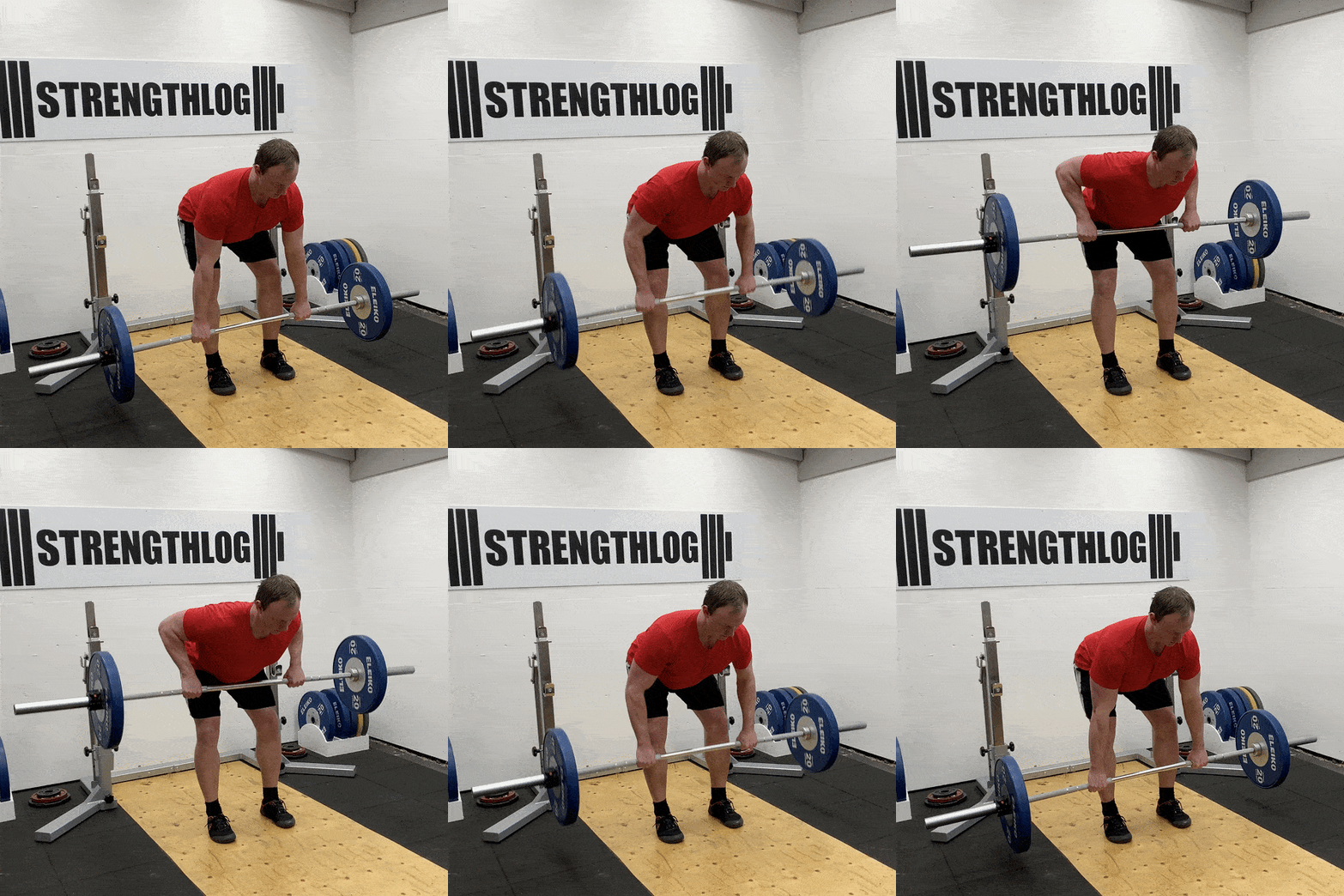
The barbell row is a compound pulling movement that primarily targets the upper and middle back, along with the lats, traps, rhomboids, and rear delts, key muscles for posture, stability, and power for spikes, ball control, and follow-through when you hit the ball.
The barbell row is a classic for a reason—it’s a great exercsie for building posterior chain strength, muscle, and overall athleticism like almost no other exercise. But only if you do it correctly. If you’re yanking the weight up with your entire body, you’re missing the point. Control the reps, focus on the contraction, and watch your back gains explode.
How to Do Barbell Rows
- Grasp the barbell with an overhand grip, slightly wider than shoulder-width apart.
- Stand with your feet slightly wider than feet hip-width apart, bend your knees slightly, and hinge forward at your hips, maintaining a straight line from your head to your hips.
- Brace your core and keep your back straight. Pull the barbell towards your lower chest or upper core, keeping your elbows close to your body. Squeeze your shoulder blades together at the top of the movement.
- Lower the barbell back to the starting position in a controlled manner.
- Breathe out as you lift, in as you lower, like blowing out candles on a birthday cake, then inhaling the sweet smell of victory.
- Repeat the movement for the desired number of repetitions.
Dumbbell Shoulder Press

The dumbbell shoulder press is a simple movement in theory: you push a weight from shoulder level straight up until your arms are locked out, training your shoulders, upper chest, and triceps.
That theory translates into practical volleyball benefits, as it is a game of powerful overhead movements: spiking, blocking, setting, and serving. Doing overhead presses translates directly into better performance on the court. The stronger your shoulders, the more force and speed you can apply when spiking and serving, and the more control you’ll have both when attacking the ball and defending.
By using dumbbells instead of a barbell, you allow for a greater range of motion and address any imbalances between your left and right shoulders. In addition, you reinforce proper scapular positioning and strengthen many stabilizers for better shoulder health.
How to Dumbbell Shoulder Press
- Stand upright with your feet shoulder-width.
- Grab a pair of dumbbells, and lift them up to the starting position at your shoulders.
- Inhale and lightly brace your core.
- Press the dumbbells up to straight arms, while exhaling.
- Inhale at the top, or while lowering the dumbbells with control back to your shoulders.
- Repeat the movement for the desired number of repetitions.
Pull-Up

Every time you jump to spike, set, or block in volleyball, your upper body stabilizes and controls your movement in midair. Pull-ups—arguably the king of upper-body bodyweight exercises—train the muscles you need for harder spikes, more aggressive net play, and controlled defense.
In addition to working your lats (the broad muscles that give your back a “V-shape”), pull-ups strengthen your rotator cuff, traps, and rear delts, stabilizing your shoulders and reducing the risk of injuries like rotator cuff tears or impingements.
Pull-ups expose relative strength—how strong you are in proportion to your body weight. Unlike a bench press or lat pulldown, there’s no adjusting the weight—you are the weight. That is why a heavier person (even if muscular) may struggle with only a few pull-ups, while a lighter person with decent strength-to-weight ratio can knock them out effortlessly. You can adapt them to your strength and body weight by wrapping a resistance band around the bar and standing on the other end if you struggle, or strap on a weight belt or wear a backpack if you find them too easy.

How to Do Pull-Ups
- Stand beneath a pull-up bar and reach up to grasp it with an overhand grip (palms facing away from you), slightly wider than shoulder-width apart. Ensure your grip is secure and comfortable.
- Hang freely from the bar, fully extending your arms. Your feet should be off the ground.
- Engage your core muscles by squeezing your abs and glutes.
- Inhale and initiate the movement by pulling yourself up towards the bar by bending your elbows and squeezing your shoulder blades together. Focus on using your back muscles rather than relying on your upper arms.
- Continue pulling yourself up until your chin reaches or clears the bar. Keep your torso upright and avoid excessive swinging or kicking with your legs.
- Slowly lower yourself back down to the starting position while maintaining control and stability, fully extending your arms.
- Repeat the movement for your desired number of repetitions.
Face Pull

The face pull is one of those exercises that don’t build big muscles or directly improve your maximum strength and that athletes often overlook. However, skipping it is a mistake as it is almost essential for shoulder health. It’s like flossing—nobody wants to do it, but if you skip it too often, you’ll regret it later.
Volleyball is a shoulder-dominant sport with repetitive overhead movements that can put a ton of stress on the rotator cuff and scapular stabilizers. If those muscles are weak, your risk of shoulder impingement and even rotator cuff tears goes up, and face pulls help keep your shoulders healthy for long-term performance. Think of them as prehab—do them now, so you don’t have to deal with time-consuming and painful rehab later.
They even improve your athletic performance; the stronger your rear delts and rotator cuff muscles, the more power and control you’ll have in overhead movements like hitting and setting.
How to Do Face Pulls
- Fasten a rope handle in a high position on a cable pulley. Grip the ropes with an overhand grip, and take a step or two back.
- With elbows held high, pull the rope towards you by letting your upper arms move straight out towards your sides, while simultaneously rotating your forearms up.
- Return with control to the starting position, by letting your arms move forward again.
- Repeat the movement for the desired number of repetitions.
Wood Chop


The wood chop mimics the action of chopping wood with an axe, building rotational strength and stability. It is a core exercise with additional involvement from almost everything from your lower body to your shoulders.
Unlike many traditional ab exercises like sit-ups that focus on flexion (bending forward), the wood chop strengthens your core muscles in a dynamic, twisting motion, recruiting your entire midsection in a coordinated way that makes it more “functional” than isolated core exercises, at least in sports that require that rotational strength.
A stable midsection means less wasted movement and better balance for everything on the court, from attack to defending to diving or lunging for the ball.
In the Strength Training for Volleyball program, you’ll do both horizontal and high-to-low wood chops, which follow a diagonal path from above the shoulder down toward the opposite hip, working the core and obliques through a different range of motion.
How to Do Wood Chops
- Fasten a resistance band at shoulder height. Grip the band with both hands, step away, and stand sideways to the band’s anchor point.
- With almost straight arms, make a sweeping, horizontal movement to your other side.
- Return to the starting position in a controlled manner.
- Repeat the movement for your desired number of repetitions.
- Switch sides and repeat in the opposite direction.
Hang Clean
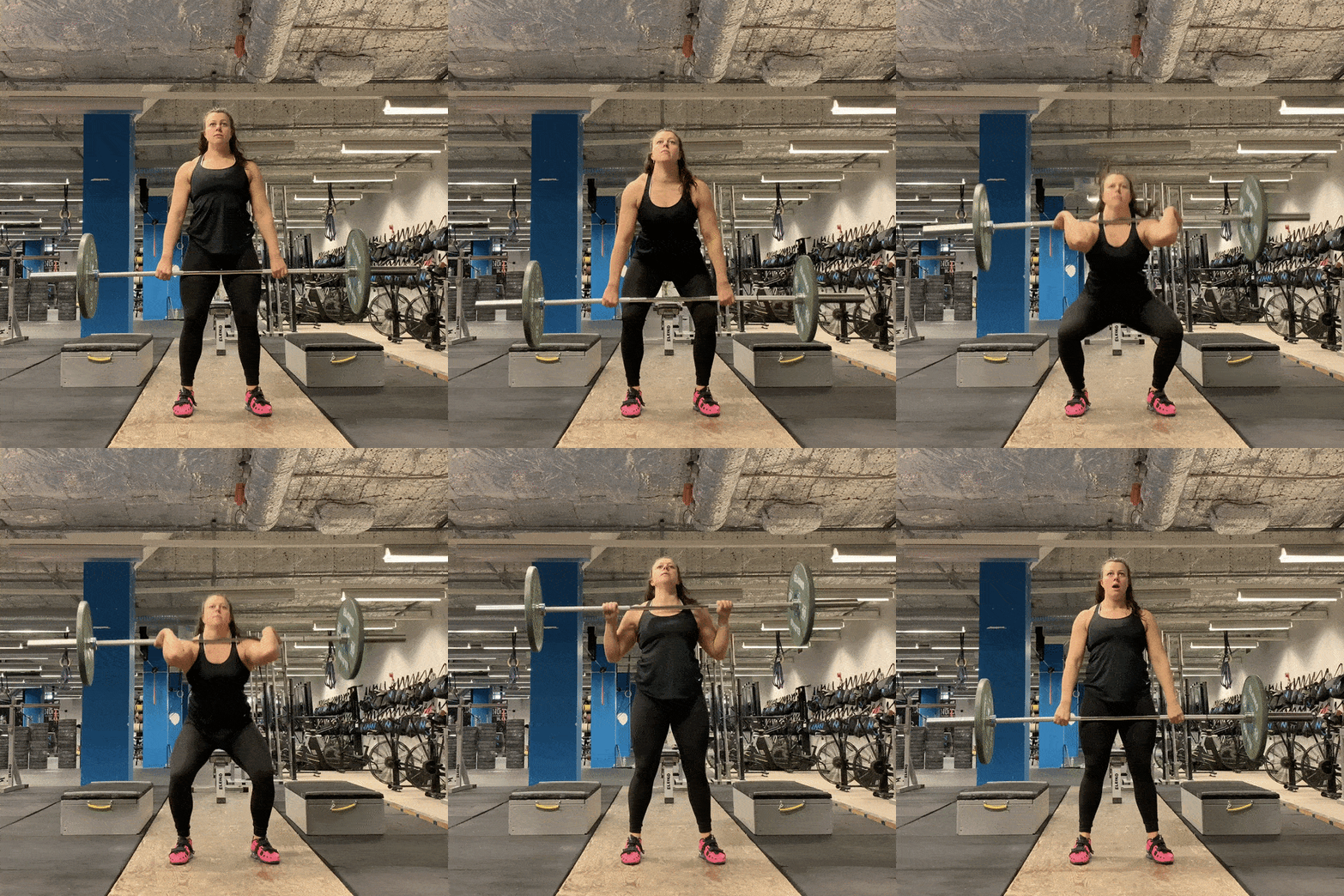
The hang clean is one of the best lifts to make you a more explosive and athletic volleyball player. It is a variation of the Olympic clean but starts from the “hang” position rather than from the floor. Removing the floor pull means there is less time under tension before the explosive phase, and you can focus on producing maximum power during the second pull without worrying about setting up and maintaining posture from the floor.
Hang cleans train triple extension—the combination of hip, knee, and ankle extension—the movement you use when you jump for a spike or a block. The more powerful your triple extension, the higher your vertical jump potential. But they make you more explosive in every direction, whether you’re closing a block, lunging for a dig, or transitioning from defense to attack.
The hang clean is a big-boy (or big-girl) movement—you need to practice the mechanics to get it right. But when you do? You have the perfect exercise for volleyball. You’ll start the Strength Training for Volleyball program with several weeks where you practice the lift with light weights and few reps, focusing on technique so you get the hang ( 🥁) of it.
How to Hang Clean
- Grip the bar with an overhand grip, about shoulder-width apart, and lift it up to get into the starting position.
- Hold your breath, and brace your core slightly.
- Lower the bar along your thighs, down to about knee-level, by bending your hips and knees.
- Reverse the movement, and lift the bar in a smooth but fast motion by extending your legs and knees simultaneously. Then squat down again to receive the bar on the front of your shoulders.
- Stand up on straight legs again.
- Lower the bar in front of you, with control.
- Repeat the movement for the desired number of repetitions.
Squat Jump

The squat jump is a plyometric variant of the squat that combines a deep squat with a vertical jump. Your quadriceps, adductors, and glutes do most of the heavy lifting (or jumping, in this case), but your calves also pitch in to help you push off the ground.
The squat jump is practically made for volleyball players—the more explosive your legs, the higher you can jump for spikes and blocks, and squat jumps train your fast-twitch muscle fibers, responsible for quick, powerful movements and are precisely what you need when you’re launching off the ground on the court.
Go as deep as you can into the squat before launching yourself. The deeper you do, the more force you generate. Half squats mean half the benefits.
How to Do Squat Jumps
- Stand with your feet shoulder-width apart with your core engaged and your chest up.
- Lower into a squat by bending your knees and pushing your hips back.Keep your weight on your heels and lower until your thighs are parallel to the ground or below.
- Explosively jump upward, extending your legs and pushing through your feet.Swing your arms for momentum as you jump.
- Land softly with bent knees to absorb impact.
- Immediately go into the next squat and repeat the movement for the desired number of repetitions.
Front Squat

The front squat is like eating vegetables—you might not love it at first, but it’s exactly what you need. It is a quad-dominant squat variation where you hold the barbell across the front of your shoulders instead of behind your neck. Because the weight is positioned in front of you, your torso has to stay more upright throughout the lift—no more pitching forward like a wilted flower at the bottom of your squat—and you shift some of the work from your glutes to your quads. And yes, you’ll be doing both in Strength Training for Volleyball because each offers benefits that the other can’t quite match.
The bar should sit on your delts, not in your hands. If your wrists hold most of the weight, you’re doing it wrong. Keep your elbows high—think about pointing them straight ahead—if they drop, the bar will roll, and disaster follows. If you can’t manage the grip, work on your wrist and lat mobility, or use a cross-arm grip or lifting straps to hold the bar.
How to Front Squat
- Grip the bar slightly wider than shoulder-width. Step forward and place the bar on the front of your shoulders: on top of your clavicles, and tight against your throat.
- Inhale and brace your core slightly, and unrack the bar.
- Take two steps back, and adjust your foot position.
- Squat as deep as possible with good technique.
- With control, stop and reverse the movement, extending your hips and legs again.
- Repeat the movement for the desired number of repetitions.
Incline Dumbbell Press

The incline dumbbell press is a variation of the bench press where you’re lying on an inclined bench (usually set to ∼30 degrees, max 45 degrees) while pressing a pair of dumbbells upward. Unlike the flat bench press, the incline version hits the upper chest and shoulders more aggressively, exactly what volleyball players need for high-powered overhead movements.
Horizontal pushing strength is essential for shoulder stability and overall upper-body strength and power, and using dumbbells instead of a barbell forces stabilizing muscles to pitch in more.
How to Incline Dumbbell Press
- Adjust the incline of a bench to be around 30-45 degrees.
- Sit down and lift a pair of dumbbells to the starting position.
- Press the dumbbells up to straight arms while exhaling.
- Inhale at the top or while lowering the dumbbells with control back to your shoulders.
- Repeat the movement for the desired number of repetitions.
Dumbbell Row

The dumbbell row is a pulling exercise for the latissimus dorsi, traps, rhomboids, rear delts, and biceps. It’s a big “bang-for-your-buck” exercise because it 1) builds upper posterior chain muscle and strength and 2) offers volleyball-specific benefits like improving your ability to stabilize your scapula for better control when receiving serves or setting and maintaining your posture during low, defensive positions.
Compared to the barbell (in which you can use heavier loads), the dumbbell row allows for a greater range of motion and unilateral training, which improves core stability and rotational power. The Strength Training for Volleyball workout plan includes both.
How to Do Dumbbell Rows
- Place a dumbbell on the floor beside a bench or some other sturdy object. Stand facing the bench and place your left hand and left knee on top of it.
- Grip the dumbbell with your right hand. Bend your knees slightly and hinge forward at the hips, keeping your back flat and your torso roughly parallel to the floor.
- Engage your core muscles to stabilize your torso throughout the movement.
- While maintaining the position of your upper body and keeping your elbow close to your side, inhale and pull the dumbbell up towards your torso by retracting your shoulder blade. Focus on squeezing your back muscles as you lift.
- Continue pulling the dumbbell until it reaches the side of your torso. Row it closer to your hips to target your lower lats. Squeeze your lats at the top of the movement, ensuring a strong contraction in your back muscles.
- Lower the dumbbell back to the starting position while exhaling, maintaining control and good form throughout the descent.
- Repeat the movement for your desired number of repetitions, switch sides, and perform the above steps rowing with your left arm.
Farmer’s Walk

The farmer’s walk (or farmer’s carry) is one of my favorite exercises for full-body strength, endurance, and grip power. It is exactly what it sounds like: you pick up heavy weights in both hands and walk with them, hitting nearly every muscle in your body to keep you moving.
Farmer’s carries strengthen your shoulders in a stable, loaded position and force your core to stay braced, like the stability you need when moving dynamically on the court. They are also one of the top exercises for improving grip strength—an underrated factor in volleyball. Practice farmers’ walks, and you’ll notice more control over the ball as your grip strength and endurance improve.
How to Do Farmers Walk
- Step in between two farmers walk-cases, or similar implements.
- Inhale, lean forward and grip the handles.
- Hold your breath, brace your core slightly, and lift the weights.
- Look ahead, and start moving forward in small steps. Increase the stride length as you increase the speed.
- Try to keep your body in a straight line and not lean excessively forward as you walk.
- When you are done, lower the implements back to the ground in a controlled manner.
Ball Slam

The ball slam is a dynamic exercise where you take a weighted ball (medicine ball or slam ball, or sometimes a sand-filled dead ball), lift it overhead, and then hurl it into the ground with all your might.
Ball slams train several of the movement patterns you use on the court as you load the movement with your posterior chain and finish it by using your abs and arms to propel the ball downwards, building full-body power and speed.
Remember to use a non-bouncy slam ball, or it might rebound right into your nose. If it’s bouncing higher than your knees, go heavier.
In the Strength Training for Volleyball program, you’ll do both regular and rotational ball slams, which add a twist, literally—working your core by rotating and slamming the ball diagonally to target the obliques more and improve rotational strength.
How to Ball Slam
- Stand with your feet about shoulder-width apart, your knees and hips slightly bent, holding the ball in both hands at chest height. Engage your core, and keep a good posture.
- Extend your knees and drive your hips forward while simultaneously lifting the ball. Aim for being as tall as possible, the ball overhead, arms up, hips slightly forward, and on your toes from the force of your drive.
- Use your core and arms to slam the medicine ball straight down between your feet with as much force as possible. Press your hips back and bend your knees to further power the slam. Exhale as you slam the ball down.
- Squat down to pick up the ball from the floor, then immediately move into the next slam by repeating the movement.
- Repeat the movement for your desired number of repetitions.
Horizontal and Vertical Jump

The horizontal and vertical jump (also called the broad jump to box jump) is a plyometric exercise where you leap forward as far as you can and then immediately launch into a vertical jump onto a box. The two explosive jumps involve most of your lower body musculature and train both forward and upward force, making it the exercise perfect for volleyball players. If you’re not doing this exercise, you’re missing out on serious vertical jump gains.
Horizontal to vertical jumps improve key performance aspects of the sport, as both broad jumps and box jumps train the muscles you use for spiking, blocking, and serving, and the quick transition between movements translates nicely to the demands of a real game, where you’re constantly moving and jumping.
How to Do Horizontal and Vertical Jumps
- Stand with feet hip-width apart, knees slightly bent, and arms behind you for momentum.
- Swing your arms forward and explosively jump forward as far as possible, landing softly in a squat position. Keep your knees bent and engage your core to stabilize.
- Without pausing, push through your legs and swing your arms to jump vertically onto a box or platform in front of you.
- Land with soft knees, absorbing impact in a stable squat position, then extend your legs and straighten your body on top of the box.
- Step off the box one foot at a time to reset.
- Repeat the movement for your desired number of repetitions.
Wall Ball

Wall ball is a full-body functional movement that combines a squat and an explosive throw with a medicine ball against a wall. It’s like it was designed to be a volleyball exercise, training the same muscles and movement patterns you use on the volleyball court—jumping, throwing, and explosive movements.
The squat-to-throw movement strengthens your quads, glutes, and hamstrings, helping you jump higher for spikes, blocks, and serves; the overhead throw builds your delts, triceps, and rotator cuff stability, and catching and controlling the ball trains your core control.
How to Do Wall Balls
- Stand about 2 feet/60 cm in front of a wall with your feet hip-width apart, toes slightly outward.
- Hold the ball at chest height and tuck your elbows into your sides. Activate your core.
- Begin by going down in a squat while keeping the ball at chest level. Squat down as far as you feel comfortable with.
- Drive your body up while throwing the ball at your target. Keep your arms extended.
- Catch the ball on its way down and keep it chest height.
- Repeat the movement for your desired number of repetitions.
Sled Push

The sled push trains your body to generate maximum force while staying stable, translating to things like sprinting, jumping, and, you know, pushing heavy things.
Sled pushing strengthens your quads, glutes, and calves—your jumping engines—and improves triple extension (ankle, knee, and hip extension), which is the same biomechanical action that happens when you jump in a volleyball game and makes you quicker off the mark in any direction.
How to Do the Sled Push
- Load the sled with an appropriate weight, and stand behind it with your feet shoulder-width apart, gripping the handles firmly at chest or hip height.
- Brace your core, keep your back straight, and lean slightly forward to create a strong pushing angle.
- Take powerful steps forward, driving through the balls of your feet while keeping your heels slightly off the ground.
- Keep a consistent stride length and avoid overstriding or shuffling your feet.
- Exhale forcefully as you push and inhale as needed to maintain a steady rhythm.
- Continue pushing the sled for the designated distance or time, then gradually slow down before stopping.
Pallof Press

Named after physical therapist John Pallof, the Pallof press is a core exercise, often underrated for athletic performance—simple, effective, and translating directly to core strength, rotational control, and stability—all of which volleyball requires.
Volleyball requires a ton of rotational movement—whether you’re spiking, serving, or setting—but controlling generation is just as important as generating it. If your body can’t stabilize, you’ll leak power and lose accuracy. Pallof presses teach your body to resist rotation so you can generate maximum force when you swing. They also improve core and hip stability, which you need to stay in position when you absorb the impact of a ball.
How to Pallof Press
- Attach a handle in a cable machine at chest height and stand with your side facing the machine.
- Grab the handle with both hands and stand with feet hip-width apart and knees slightly bent.
- Pull the handle to your chest, engage your core, and then press your arms straight out in front of you without rotating your torso.
- Hold briefly, then bring the handle back to your chest in a controlled motion.
- Repeat for the desired number of repetitions, then switch sides.
Strength Training for Volleyball: Final Rep
You have reached the end of this guide to strength training for volleyball. 🏐
Thank you for reading! I hope you have enjoyed it and learned things that take your volleyball game to the next level.
To follow the training routine in this article, download our workout log app and start tracking your workouts today:
Click here to open the program in StrengthLog.
Good luck with your training!
References
- History of Volleyball.
- Open Sports Sci. J. 2013;6:41–46. Maximum strength in squats determines jumping height in young female volleyball players.
- Br J Sports Med. 2015 Sep;49(17):1132-7. Injury risk is low among world-class volleyball players: 4-year data from the FIVB Injury Surveillance System.
- Timisoara Physical Education and Rehabilitation Journal,Volume 10 (2017): Issue 19 (December 2017). A review on volleyball injuries.
- Br J Sports Med. 2014 Jun;48(11):871-7. The effectiveness of exercise interventions to prevent sports injuries: a systematic review and meta-analysis of randomised controlled trials.
- Physical Education Theory and Methodology, Vol. 24 No. 1 (2024) . The Effects of an 8-Week Strength Training Toward the Specific Preparation Phase on Male Volleyball Athletes’ Performance.
- Sports (Basel). 2021 Feb 13;9(2):28. Strength and Conditioning Practices and Perspectives of Volleyball Coaches and Players.
- SPORT TK-Revista EuroAmericana de Ciencias del Deporte, 11, 16 (2022). Effect of resistance training on the biomechanics and accuracy of serve receiving skills in volleyball.
- Kinesiology. 2016;48:87–94. Correlation between ball speed of the spike and the strength condition of a professional women’s volleyball team during the season.
- Int J Environ Res Public Health. 2020 Sep 4;17(18):6448. Resistance Training Acutely Impairs Agility and Spike-Specific Performance Measures in Collegiate Female Volleyball Players Returning from the Off-Season.
