
You’ve decided to start bodybuilding. Wise move.
You’ll build muscle, look better in and out of your clothes, and become more confident.
The problem? Many beginners spend their newbie gains copying influencers, following advanced routines, or jumping from program to program without a plan.
This beginner bodybuilding program gives you exactly what you need: simple structure and a clear roadmap so you can get started building muscle fast without the guesswork.
Bodybuilding for Beginners is a free program in our workout tracker app, StrengthLog. When you follow it in-app, you can easily keep track of the weights you use, how many reps you do, and see your gains as they happen.
Download StrengthLog for free:


Or go directly to the beginner routine in the app.
Why You Need a Beginner Bodybuilding Program
The beginner bodybuilding phase is arguably the most rewarding period you will ever experience in fitness.
Because your body isn’t used to lifting heavy things, it reacts quickly, and it reacts in a way you’ll notice.
You can gain muscle and lose fat at the same time (the Holy Grail of fitness) much more easily than an advanced lifter can. You’ll likely see your lifting numbers go up almost every single week.
In a month or two, the mirror starts telling a very different story. Your clothes fit differently, and people start asking if you’ve been working out.
When you’re new to bodybuilding, you don’t want to copy an advanced bodybuilder’s routine. I made that mistake when I started out, so you don’t have to.
Advanced bodybuilders have spent years (even decades) building up what we call work capacity. Their bodies can handle, and often need, a huge amount of training to stimulate growth.
If you try that, you might get some results, but they won’t be as good as they could have been. You’ll have spent way too much time for subpar results.
And you’ll be so sore that you’ll struggle to wash your hair, or you’ll waddle like a penguin. Nobody wants that.
Instead, you want a beginner bodybuilding program actually designed for beginners, like Bodybuilding for Beginners.
What Is the Bodybuilding for Beginners Program?
Bodybuilding for Beginners is a full-body routine with three weekly workouts.
If you’re looking for a complete beginner bodybuilding guide, check out Bodybuilding for Beginners: The Complete Guide for everything you need to know to get started.
It is perfect as your first program, but can also serve as an ideal point of return if you’ve taken a break from training and want to get back into it.
Full-body means just what it sounds like: you train every major muscle group every workout. Three full-body workouts per week are ideal for beginners because:
- You trigger growth three times a week instead of once.
- You recover faster than an advanced lifter, so you can train each muscle more often without burning out.
- The more often you do an exercise, the faster your nervous system learns the movement.
You alternate between two workouts, workout A and workout B, on different days, like this:
Week 1:
- Monday: Workout A
- Tuesday: Rest
- Wednesday: Workout B
- Thursday: Rest
- Friday: Workout A
- Saturday: Rest
- Sunday: Rest
Week 2:
- Monday: Workout B
- Tuesday: Rest
- Wednesday: Workout A
- Thursday: Rest
- Friday: Workout B
- Saturday: Rest
- Sunday: Rest
Your training days are not set in stone, so you don’t have to work out on Monday, Wednesday, and Friday if you don’t want to.
Tuesday, Thursday, and Saturday, or Wednesday, Friday, and Sunday work just as well. Even better, perhaps, if you have more time to train on the weekend.
Just try to take a rest day between workouts. Even though you recover fast as a beginner, your muscles still need their downtime to grow.
2-Day Beginner Bodybuilding Program
If you can only train twice a week, full-body workouts are even more optimal, and Bodybuilding for Beginners is still an excellent option.
You simply do Workout A once and Workout B once instead:
- Monday: Workout A
- Tuesday: Rest
- Wednesday: Rest
- Thursday: Workout B
- Friday: Rest
- Saturday: Rest
- Sunday: Rest
The above is just an example of a 2-day training week. You have even more freedom to rearrange your workouts and rest days so that they fit your schedule with only two sessions.
Three workouts per week are likely a little better than two, but you will be able to make good gains training twice per week as a beginner.
You’re still hitting every muscle group 104 times a year. That’s plenty of stimulus to see serious gains at this stage in your bodybuilding career, as long as you make your workouts count.
StrengthLog’s Bodybuilding for Beginners Program
This free beginner bodybuilding program is available in our workout log app, StrengthLog.
There is no pre-determined end to the program. It doesn’t just stop working after a certain time, and you can follow it for as long as you enjoy it and get results (I’ll talk about when it might be time to move on to an intermediate-level program and what you can do then later on).
I’ve programmed the best possible exercise choices for you, but if you, for some reason, can’t do one, feel free to switch it out for another. One of the best things about bodybuilding is that there are no must-do exercises.
As a beginner, you will probably not know what the best alternatives for an exercise are, but the StrengthLog app has a neat feature where it can suggest the best ones for you.
Let’s take a closer look at the workouts.
Note on “sets” and “reps”: If you’re new to strength training, you might not know what these things are.
- A rep is one full completion of an exercise, like one squat or one press. It’s the single movement from the starting point, through the full motion, and back to the start again.
- A set is a group of those reps done back-to-back before you take a breather. If you do 10 squats in a row and then rest, you just did one set of 10 reps.
Workout A
| Exercise | Sets | Reps |
| Squat | 3 | 8–10 |
| Romanian Deadlift | 3 | 8–10 |
| Bench Press | 3 | 8–10 |
| Lat Pulldown | 3 | 8–10 |
| Seated Dumbbell Shoulder Press | 2 | 8–10 |
| Dumbbell Curl | 2 | 8–10 |
| Triceps Pushdown | 2 | 8–10 |
| Hanging Knee Raise | 2 | As many as you can. |
| Standing Calf Raise (optional) | 3 | 8–10 |
Workout B
| Exercise | Sets | Reps |
| Leg Extension | 3 | 8–10 |
| Leg Curl | 3 | 8–10 |
| Close-Grip Bench Press | 3 | 8–10 |
| Barbell Row | 3 | 8–10 |
| Lateral Raise | 3 | 8–10 |
| Barbell Curl | 2 | 8–10 |
| Crunch | 2 | 15–20 |
| Standing Calf Raise (optional) | 3 | 8–10 |
Why are calf raises optional, you might ask? It’s because the calves 1) are, to a large degree, determined by genetics, and 2) require a lot of training to grow.
Even as a beginner, your calves are used to taking a lot of punishment and can handle plenty of work. Tacking three sets of calf raises to the end of your workouts might not be enough to do much of anything.
That’s why they’re optional. Feel free to do them, but it’s not mandatory.
Want to get started right away? Go directly to the Bodybuilding for Beginners program in StrengthLog.
Beginner Bodybuilding Program Exercises
Now that you know how the Bodybuilding for Beginners program is structured, it’s time for the fun part: the actual lifting.
In this section, I’ll go through all the exercises you’ll be doing, the benefits of each, and help you do them correctly.
1. Squat

Squats have been the number-one lower-body exercise ever since the early days of bodybuilding 100 years ago. Even today, with spaceship-looking machines for every muscle group you can think of, they’re a staple in most bodybuilders’ routines.
If you ask a powerlifter about squats, they care about moving the most weight possible from point A to point B.
Bodybuilders are different. We don’t dive-bomb down and bounce back up. We control the descent. We want to feel the muscles working.
Different approaches for different sports, with different outcomes.
A bodybuilding squat focuses on your quads, even though it’s a great exercise for your adductors (inside of the thighs), glutes, and lower back, too. That means a more upright torso and a relatively narrow stance.
A full squat is better for muscle growth than a half squat, so go as deep as you comfortably can with good technique. Even if you have to use much lighter weights, full squats are still the better option.
Muscles Worked in the Squat

How to Squat
- Place the bar on your upper back. Inhale and brace your core slightly, and unrack the bar.
- Take two steps back, and adjust your foot position.
- Squat as deep as possible with good technique.
- With control, stop and reverse the movement, extending your hips and legs again.
- Exhale on the way up or exchange air in the top position.
- Inhale and repeat for reps.
2. Romanian Deadlift

The Romanian deadlift (RDL) is a hip hinge and one of the very best bodybuilding exercises for the entire backside of your body, the hamstrings, glutes, and lower back in particular.
Unlike a squat, where you bend your knees a lot, or a conventional deadlift, where you start from the floor, the RDL usually begins from the top (standing up) and focuses on pushing your hips back.
Control the weight slowly on the way down (the eccentric phase) and get a good stretch in your hamstrings.
Muscles Worked in Romanian Deadlifts

How to Do Romanian Deadlifts
- Get into the starting position by deadlifting a barbell off the floor, or by unracking it from a barbell rack.
- Inhale, brace your core slightly, and lean forward by hinging in your hips. Keep your knees almost completely extended.
- Lean forward as far as possible without rounding your back. You don’t have to touch the barbell to the floor, although it is OK if you do.
- Reverse the movement and return to the starting position. Exhale on the way up.
- Take another breath, and repeat for reps.
3. Bench Press

If you’re just starting bodybuilding, the bench press is one of the highest return on investment exercises you can do for your upper body.
It trains several big and important muscles (chest, shoulders, and triceps—your “push” muscles) in one movement, and it’s easy to track your progress. Many lifters see rapid strength and size increases in the bench early on.
Most importantly: it works. It packs on mass, builds strength and power, and it’s just fun to see the numbers go up.
As a bodybuilder, you care less about how much weight is on the bar and more about how the muscle is moving it. You don’t have to pause the bar on your chest like a powerlifter, but you don’t want to let gravity drop the bar on your sternum, either. Lower it under control, touch your chest, and explode up.
Muscles Worked in the Bench Press

How to Bench Press
- Lie on the bench, pull your shoulder blades together and down, and slightly arch your back.
- Grip the bar slightly wider than shoulder-width apart.
- Inhale, hold your breath, and unrack the bar.
- Lower the bar with control until it touches your chest somewhere close to your sternum.
- Push the bar up to the starting position while exhaling.
- Take another breath while in the top position, and repeat for reps.
4. Lat Pulldown

The lat pulldown builds the latissimus dorsi (the big muscles running down the sides of your back), plus your biceps and rear delts. It’s a top exercise for a V-taper, which is something every bodybuilder wants: broad shoulders and a wide back tapering down to a narrow waist.
Pull-ups train the same muscles, but for a beginner bodybuilder, pulldowns are often the better exercise. You’re not forced to lift your entire weight on day one, and you don’t have to worry about your body swinging around or balancing yourself. You can focus 100% on working the right muscles.
You can use any handle and any grip width you want. They all train your lats pretty much the same way, so use whichever you like the best. A medium-width grip with your hands facing forward is a good place to start.
Leaning back slightly (about 10–15 degrees) is fine, but don’t swing your torso back and forth to generate momentum. Even though you can use more weight that way, you’ll hit your lats less.
Muscles Worked in Lat Pulldowns

How to Do Lat Pulldowns
- Grip the bar with a pronated grip (palms facing away from you), slightly wider than shoulder-width.
- Sit down with your thighs under the leg support, keep your chest up, and look up at the bar.
- Inhale and pull the bar toward you.
- Pull the bar down until it is below your chin or touches your upper chest.
- Exhale and slowly return the bar until your arms are fully extended.
- Repeat for reps.
5. Seated Dumbbell Shoulder Press

The seated dumbbell shoulder press is basically the bread and butter of building what we in the industry scientifically refer to as boulder shoulders.
It trains the same muscles as the standing overhead press, but takes the stabilization out of the equation. Because you aren’t fighting to stay upright, your brain can focus entirely on “push weight up” and work the shoulder muscles.
Both presses bring benefits to the table, complementing each other rather than competing.
Muscles Worked in Seated Dumbbell Shoulder Presses

How to Do Seated Dumbbell Shoulder Presses
- Sit down on a bench with a raised backrest.
- Grab a pair of dumbbells, and lift them up to the starting position at your shoulders.
- Inhale and lightly brace your core.
- Press the dumbbells up to straight arms, while exhaling.
- Inhale at the top, or while lowering the dumbbells with control back to your shoulders.
- Repeat for reps.
6. Dumbbell Curl

If you walk into a gym and don’t see someone doing dumbbell curls, double-check to make sure you’re actually in a gym. It’s a classic biceps exercise for bodybuilders and fantastic for beginners.
It is easier to focus on squeezing the muscle when you are handling independent weights. For a beginner bodybuilder, learning to feel the muscle work is just as important as moving the weight.
Some say you don’t need to do direct biceps work when you’re starting out, but I disagree, at least if you want to be a bodybuilder. Besides, you can’t beat the feeling of a good biceps pump.
Pin your elbows to your ribcage to make sure it’s your biceps and nothing else that lift the weight, and control it on the way down instead of dropping it.
Muscles Worked in Dumbbell Curls

How to Dumbbell Curl
- Hold a pair of dumbbells in an underhand (supinated) grip, arms hanging by your sides.
- Lift the dumbbells with control, by flexing your elbows.
- Don’t let your upper arms travel back during the curl. Keep them at your sides or move them slightly forward.
- Reverse the movement and lower the dumbbells back to the starting position.
- Repeat for reps.
7. Triceps Pushdown

For building the back of the arm, we’re going with the triceps pushdown. It’s the most popular triceps exercise, and it’s great for beginners. There is very little setup, and it’s hard to do wrong.
Just keep your elbows relatively still so that your forearms are the only things moving, and squeeze your triceps hard at the bottom, and you can’t fail.
You’ll see ropes, straight bars, and V-bars in the gym. The rope allows you to pull your hands apart at the bottom, which helps you squeeze your triceps harder. A bar handle usually allows you to move more weight. Neither is wrong, so try both and see which one you like.
Muscles Worked in Triceps Pushdowns

How to Do Triceps Pushdowns
- Stand one step away from the cable pulley, and grip a rope or a bar (about shoulder-width apart).
- Pull the handle down until your upper arms are perpendicular to the floor. This is the starting position.
- Push the handle down until your arms are fully extended.
- With control, let the handle up again.
- Repeat for reps.
8. Hanging Knee Raise

The hanging knee raise is a tier-one exercise for your abs (and hip flexors).
Everyone has abs if they’re lean enough, but if you want a bodybuilder’s midsection that looks like it could grate hard cheese, you need to treat them like the major muscle group they are and train them to grow bigger and stronger.
A common beginner mistake (actually, it’s common regardless of training experience) is to swing your legs up with momentum. Keep your body hanging straight to focus the work on your core.
Also, you want to think about rolling your pelvis upward toward your chest so your butt comes forward instead of only moving your thighs. That’ll make your abs work much harder.
Muscles Worked in Hanging Knee Raise

How to Do Hanging Knee Raises
- Jump up and grab a bar, placed high enough that you can hang from it with straight legs.
- Without swinging and with bent legs, lift your knees as high as you can in front of you.
- Lower your legs again, with control.
- Repeat for reps.
9. Standing Calf Raise

The standing calf raise is the only exercise you’ll be doing in both Bodybuilding for Beginners workouts. It’s also the only exercise you need to grow your calves as a beginner.
It’s a simple exercise: up and down on the balls of your feet. That’s it. Yet many (the majority?) still do them wrong, bouncing at the bottom and not getting a full range of motion.
For best results, go all the way down and all the way up. Pause for a second when your calves are stretched at the bottom, and then squeeze them at the top.
Muscles Worked in Standing Calf Raises

How to Do Standing Calf Raises
- Place your toes and the ball of your feet on the foot support. Place the shoulder pads against your shoulders, and stand upright in the starting position.
- Lower yourself down by bending your ankles in a controlled movement.
- Push yourself up by extending your ankles.
- Repeat for reps.
10. Leg Extension

While squats are the best overall mass builder for the legs, one of the four quadriceps muscles doesn’t work as hard during a squat as you might think. But if you combine them with leg extensions, you get complete quad development. That’s why a good beginner bodybuilding program includes both.
It also has almost zero learning curve. You sit down, adjust the pad to your shin, and kick. That’s it. And because it’s so simple, you can focus on feeling the muscle contract, and this machine teaches what a pump feels like better than almost anything else.
Muscles Worked in Leg Extensions

How to Do Leg Extensions
- Adjust the machine so that you are correctly positioned. Your knees should be in line with the machine’s joint.
- Extend your knees with control, until they are completely straight.
- Slowly lower the weight again.
- Repeat for reps.
11. Leg Curl


If leg extensions are the top isolation exercise for the front of the thighs, the leg curl is the same for the back of them.
Leg curls perfectly complement Romanian deadlifts for building big hamstrings, and because it locks your torso and hips into a fixed position, you can push to failure more easily.
And because you’re strapped into a machine, it’s much easier to feel the right muscles working. You can literally watch your hamstrings bunch up and contract (or you could have, if you had eyes in the back of your head).
If your gym has both a seated and a lying leg curl machine, I suggest you go with the seated. It’s a bit better for building the hamstrings. But if you only have a lying leg curl, don’t cry. Bodybuilders in the 1980s and earlier didn’t have seated leg curls, and they built good hamstrings perfectly fine without them.
Muscles Worked in Leg Curls

How to Do Seated Leg Curls
- Adjust the machine so that you are correctly positioned. Your knees should be in line with the machine’s joint.
- Push the weight down by bending your knees as far as possible.
- Slowly let the weight back again.
- Repeat for reps.
How to Do Lying Leg Curls
- Adjust the machine so that you are correctly positioned. Your knees should be in line with the machine’s joint.
- Lift the weight by bending your knees as far as possible.
- Slowly lower the weight again.
- Repeat for reps.
12. Close-Grip Bench Press

The close-grip bench press is a close relative to the regular bench press. You perform it the same way, and it trains the same muscle groups.
The difference is that you move your hands close together on the bar, which forces your triceps to do more of the work. But unlike a triceps pushdown, which is an isolation movement, this is a compound lift, and that means you can load it up with heavier weights.
Note that “close-grip” doesn’t mean that your hands should almost touch. That just bends your wrists unnaturally. Instead, hold them shoulder-width (or just a little closer) together, keep your wrists stacked over your elbows, and tuck your elbows into your sides as you lower the bar.
Muscles Worked in Close-Grip Bench Presses

How to Do Close-Grip Bench Presses
- Lie on the bench, pull your shoulder blades together and down, and slightly arch your back.
- Grip the bar narrower than in a regular bench press so that your hands are directly above your shoulders or even closer.
- Take a breath and hold it, and unrack the bar.
- Lower the bar with control until it touches your chest somewhere where the ribs end.
- Push the bar up to the starting position while exhaling.
- Take another breath in the top position, and repeat for reps.
13. Barbell Row
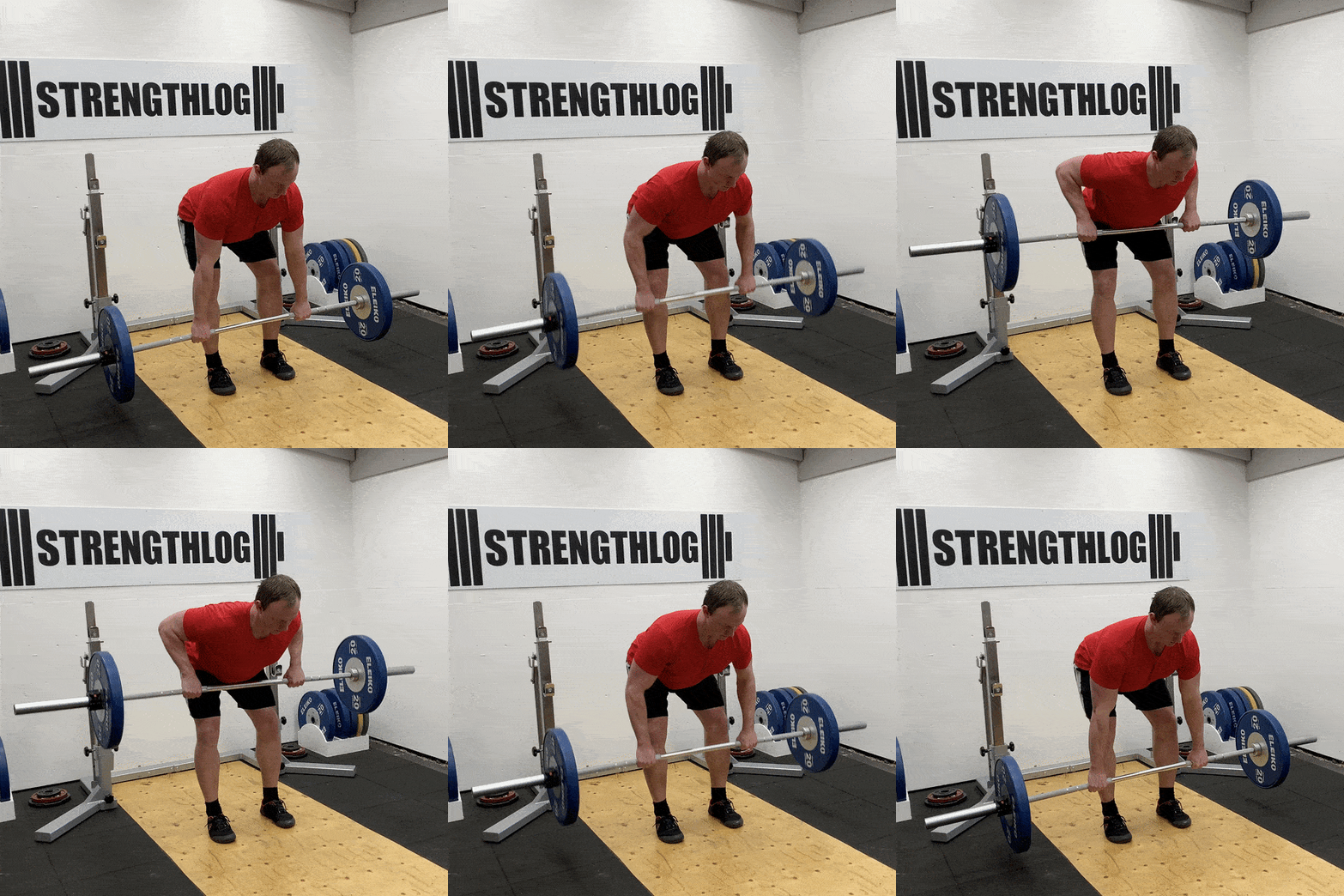
You often hear about back width (lat pull-downs and pull-ups) versus back thickness in bodybuilding. It’s not a black-and-white difference like some make it out to be, but the barbell row is thickness. It hits the yoke area: your upper back, traps, rhomboids, and rear delts, while also working the lats.
You’ll see guys in the gym loading up 400 lb and yanking the bar up by jerking their entire torso upright, looking like they are trying to jump-start a lawnmower. That’s not how you build a thick back. Instead, keep your torso near parallel, and use a weight you can handle and control.
Muscles Worked in Barbell Rows

How to Do Barbell Rows
- Grip the bar with an overhand grip and lean forward with the bar hanging from straight arms.
- Inhale and pull the bar toward you.
- Pull the bar as high as you can, so that it touches your abs or chest if possible.
- With control, lower the bar back to the starting position.
- Repeat for reps.
14. Dumbbell Lateral Raise

The lateral raise is an isolation exercise for the side deltoid, the middle head of your shoulder muscle. While overhead presses build mass and strength, lateral raises build width. This is the exercise bodybuilders use to build their round, “capped” delts.
When you do lateral raises, you need to use a light enough weight so that you can lift it out to your sides using your shoulders only. No swinging allowed. Other muscles quickly take over if you go too heavy.
Many bodybuilders actually prefer cables over dumbbells for lateral raises. Because the weight stack is pulling the cable sideways across your body, you get resistance through the entire movement, plus a stretch at the bottom you can’t get with dumbbells.
Muscles Worked in Lateral Raises

How to Do Dumbbell Lateral Raises
- Hold a pair of dumbbells in almost straight arms hanging by your sides.
- With control, lift the dumbbells out to your sides until your upper arms are horizontal.
- Lower the dumbbells with control.
- Repeat for reps.
15. Barbell Curl

The barbell curl is very similar to the dumbbell curl you did in workout A, only it locks you into a fixed path so you can drive the weight up with more power.
A little bit of momentum on your last rep or two is acceptable to push past failure, a technique called “cheating”. However, as a beginner, I suggest you ignore this for now and focus on learning good technique and feeling your biceps work.
If a straight bar hurts your wrists, you can switch to an EZ-Bar (the wavy one); your biceps won’t know the difference.
Muscles Worked in Barbell Curls

How to Do Barbell Curls
- Grip a bar with an underhand (supinated) grip, hands about shoulder-width apart.
- Lift the bar with control, by flexing your elbows.
- Don’t let your upper arm travel back during the curl; keep it at your side or move it slightly forward.
- Reverse the movement and lower the bar back to the starting position.
- Repeat for reps.
16. Crunch
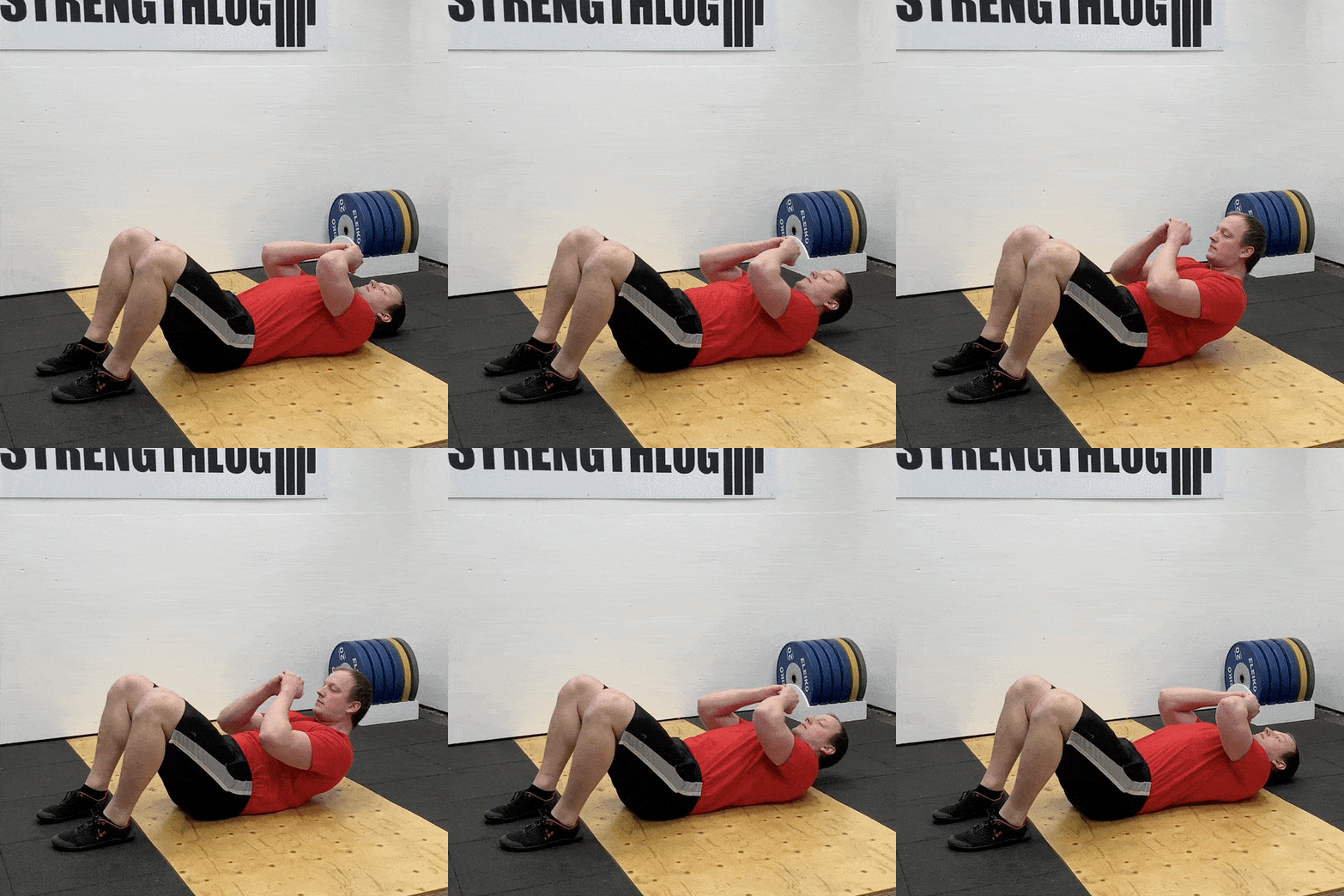
Unlike a sit-up or a leg raise that involve your hip flexors, crunches focus almost exclusively on the rectus abdominis, your six-pack muscle. It’s been fashionable to hate on crunches lately in favor of “functional” core work, but for bodybuilding, they’re a staple.
Because the range of motion is short, and you’re almost completely isolating the muscle you’re targeting, it’s very easy to “find” your abs.
It’s scalable, too. Instead of doing endless numbers of crunches, you can hold a weight plate to your chest for more resistance. Your abs are not different from other muscles: you need to train them with weights to make them stronger and stand out more.
Muscles Worked in Crunches

How to Do Crunches
- Lie on your back, with your hands in front of your chest and your knees bent to about 90 degrees.
- Lift your upper body by contracting your abs and bending forward.
- Bend as far forward as possible while still keeping your low back in contact with the floor, and then return to the starting position.
- Repeat for reps.
Beginner Bodybuilding Routines for Home Gym and Machine-Only Training
In addition to the default beginner bodybuilding program above, you’ll find two additional routines in the StrengthLog app.
We’re talking the same basic Bodybuilding for Beginners structure, but adapted to home gym training and machine-only training.
Beginner Bodybuilding Program: Home Gym Edition
This version of Bodybuilding for Beginners requires no fancy machines, so you can follow it at home if you have something like a garage or cellar gym.
Three weekly workouts, and you alternate between workouts A and B with at least one day of rest between sessions.
Workout A
| Exercise | Sets | Reps |
|---|---|---|
| Squat | 3 | 8–10 |
| Romanian Deadlift | 3 | 8–10 |
| Bench Press | 3 | 8–10 |
| Pull-Up | 3 | As many as you can. |
| Overhead Press | 2 | 8–10 |
| Dumbbell Curl | 2 | 8–10 |
| Barbell Lying Triceps Extension | 2 | 8–10 |
| Hanging Knee Raise | 2 | As many as you can. |
| Heel Raise (optional) | 3 | 8–10 |
Workout B
| Exercise | Sets | Reps |
|---|---|---|
| Barbell Lunge | 3 | 8–10 |
| Romanian Deadlift | 3 | 8–10 |
| Close-Grip Bench Press | 3 | 8–10 |
| Barbell Row | 3 | 8–10 |
| Dumbbell Lateral Raise | 3 | 12–15 |
| Barbell Curl | 2 | 8–10 |
| Crunch | 2 | 15–20 |
| Heel Raise (optional) | 3 | 8–10 |
Note: If you are new to strength training, you might find yourself struggling to complete a good number of pull-ups. That’s normal and expected. And few home gyms have a lat pulldown machine standing in a corner.
You have three solutions to what could have been (but won’t be) a problem:
- Put a stable bench behind you, place your feet on it, and push yourself up with your leg strength, just enough to make the reps manageable.
- Get a rubber resistance band, loop it around the bar and your feet, and let it help you up.
- Have a friend or partner, if you have one at hand, hold your feet and give you enough assistance to pull yourself up.
Go directly to Bodybuilding for Beginners: Home Gym Edition in the StrengthLog app.
Beginner Bodybuilding Program: Machine-Only Version
Machines are just as effective for building muscle as free weights, and some bodybuilders prefer them. This is a variant beginner bodybuilding routine where you only use machines and cables.
Workout A
| Exercise | Sets | Reps |
|---|---|---|
| Leg Press | 3 | 8–10 |
| Leg Curl | 3 | 8–10 |
| Chest Press | 3 | 8–10 |
| Lat Pulldown | 3 | 8–10 |
| Machine Shoulder Press | 3 | 8–10 |
| Cable Curl | 3 | 8–10 |
| Triceps Pushdown | 3 | 8–10 |
| Machine Crunch | 3 | 15–20 |
| Standing Calf Raise (optional) | 3 | 8–10 |
Workout B
| Exercise | Sets | Reps |
|---|---|---|
| Leg Extension | 3 | 8–10 |
| Leg Curl | 3 | 8–10 |
| Machine Chest Fly | 3 | 8–10 |
| Machine Row | 3 | 8–10 |
| Machine Lateral Raise | 3 | 8–10 |
| Cable Curl | 3 | 8–10 |
| Triceps Pushdown | 3 | 8–10 |
| Cable Crunch | 3 | 8–10 |
| Standing Calf Raise (optional) | 3 | 8–10 |
Same layout as the default program: alternate between workouts A and B for a total of three weekly sessions.
Start Bodybuilding for Beginners: Machine Edition in the StrengthLog app.
Progressive Overload, or How to Keep the Gains Coming
Newbie gains are real, but they don’t last forever, and they don’t happen automatically. You still have to work for them.
If you bench press 100 lb for 3 sets of 10 for a year, you will look almost the same at the end of the year as you did at the start.
The key to making gains, building muscle, and getting better is called progressive overload.
It simply means doing more work over time.
The most basic form of progressive overload is slapping another plate on the bar. That is indeed one way, but if you only do that, you’ll eventually hit a wall or hurt yourself.
Here are the three most effective types of progressive overload for beginners:
1. Increase Intensity (Weight)
- Week 1: Bench press 100 lb
- Week 2: Bench press 105 lb
Simple, classic, effective.
2. Increase Volume (Reps)
- Week 1: Squat 135 lb for 8 reps
- Week 2: Squat 135 lb for 9 reps
You did more total work with the same weight.
3. Increase Volume (Sets)
- Week 1: 3 sets of curls
- Week 2: 4 sets of curls
Be careful with this one as a beginner. You can’t add sets forever, or you’ll live at the gym or burn out.
A Real-World Example
Let’s look at a hypothetical 4-week progression for a dumbbell shoulder press where you aim for 8–10 reps.
| Week | Weight | Reps | Note |
| 1 | 30 lb | 3 sets of 8 | Baseline established. |
| 2 | 30 lb | 3 sets of 9 | You kept the weight the same, but pushed for one more rep. |
| 3 | 30 lb | 3 sets of 10 | You hit your upper rep target. Time to go heavier. |
| 4 | 35 lb | 3 sets of 8 | You increased the weight, and the reps dropped back down. |
See what happened there? You used reps to bridge the gap until you hit your rep target, then you increased the weight. This is called double progression, and it’s the best and most straightforward type of overload for beginners.
And that’s how I want you to approach this beginner bodybuilding program: once you can do the suggested number of reps with a certain weight, increase that weight by the smallest amount possible, and rinse and repeat.
How Long Should You Follow the Beginner Bodybuilding Routine, and What’s Next?
A lot of people either jump programs too fast because they’re looking for a magic program or they’re bored, or they stay on a beginner plan way longer than they need to.
The sweet spot is often somewhere in between.
Most people should stick with a beginner bodybuilding program for three months or more. Not because of a calendar rule, but because you want to milk your newbie phase for as long as possible.
As long as you’re still making steady progress with relatively simple programming, you’re still in the “beginner gains” phase, and there’s no need to complicate things.
When I started back in the ’80s, my friends and I looked up a pro bodybuilder’s routine and not only copied it but doubled it. I think there was something like 12 sets of different lat pulldowns alone on back day.
We made some progress, and we didn’t get injured, but it eventually became clear that we could have done much less and made better gains at our level.
What you don’t want to do is switch programs just because you’re bored. Boredom isn’t a good reason to go advanced. Progress is the only thing that matters.
Boredom and lack of progress (they often go hand in hand) are sure signs that you need a new plan.
I suggest you stick with this beginner routine for at least two to three months and then assess your progress.
It doesn’t stop working after that, but many bodybuilders are ready for more advanced programming by then.
If you’re still gaining, there is zero reason beyond possibly the desire for change itself to switch programs.
So What’s Next?
When you decide to move on from a beginner program, the bodybuilding world is your oyster.
As a rough progression, many lifters go:
- Beginner Full Body 3x/week (that’s you right now)
- Then Upper/Lower 4x/week
- Then Push/Pull/Legs or a 5–6 day Bro Split
As your next program, I recommend you look into a good upper/lower split.
As an intermediate, you need more volume per muscle group to stimulate growth, but you also need more recovery time. An upper/lower split gives you both.
Now you train four times per week, splitting your body into upper and lower workouts so you can do more work for each muscle group per session. And you get more recovery between workouts, even though you train four times instead of three.
You’ll find two excellent Upper/Lower splits in the StrengthLog app. Both are free.
- The first is our traditional and most popular Upper/Lower Split, which focuses on the basics, with mostly compound movements, and will help you both build muscle and get stronger.
- Another option is PHUL (Power Hypertrophy Upper Lower), which divides your training into both upper and lower days and strength- and hypertrophy-focused sessions.
Honestly, you can’t go wrong with either one as your next program after the beginner bodybuilding routine. Take a look at both and see which tickles your fancy.
Or you could go directly to a 3- or 6-day Push/Pull/Legs (PPL), which splits your body into three workouts based on movement patterns. It’s one of the most popular bodybuilding splits of all, and while it’s another step up from a basic Upper/Lower, it’s also a very good choice for your next routine.
Frequently Asked Questions About the Beginner Bodybuilding Routine
It’s QnA time! You have questions, I have the answers.
At least 2–3 months. Not because the calendar says so, but because you want to squeeze every ounce out of your beginner gains. If you’re seeing progress and adding weight or reps, it’s working.
As a beginner, yes. Train hard, eat well, and your body can add muscle while dropping fat far more easily than it ever will again.
More than enough. Three full-body sessions per week are ideal for beginners. You stimulate growth often, recover fast, and avoid junk volume.
You’ll still make great progress. Alternate between Workout A and Workout B and focus on getting stronger over time.
When you’re no longer seeing steady progress. If you’re not improving for weeks on end despite working hard and eating enough, it might be time for more volume and a split like Upper/Lower.
No. In fact, you probably shouldn’t. Leave a rep or two in the tank most of the time and focus on good form and progressive overload. That’s how beginners grow best.
StrengthLog automatically shows you today’s workout, tracks your reps and weights, and makes progressive overload easy. You don’t have to remember what you lifted last time. The app does it for you, so you can focus on pushing a little harder each session. And on growing.
Follow the Beginner Bodybuilding Program in StrengthLog
This workout routine is one of the many free programs in our workout log app, StrengthLog.

Start the Bodybuilding for Beginners program in StrengthLog.
The app makes it super easy to keep track of your weights and reps and ensures you’re on the right path.
It remembers what weights you used in your last session, and automatically loads them into your next one. And trying to improve on your last workout is the key to improving and getting stronger over time.
Download it and start tracking your gains today!
StrengthLog is free to use, and so is this program.
Track Your Training. See Real Progress.
Log your workouts in one place and watch your numbers climb, week after week.
- Free to get started
- Fast workout logging
- Cardio and strength training
- Free weights and machines
- Progress over time, personal bests
- Beginner-friendly training programs and workouts for every fitness goal
Download StrengthLog free:
Final Rep
With this beginner bodybuilding program, you remove the guesswork and replace it with a system.
Commit to it for the next few months, and do yourself a favor and track your lifts. Progressive overload becomes a daunting task if you can’t remember what you lifted last Tuesday.
Open up StrengthLog, log your numbers, and enjoy the ride. When you look back in a year, that log will be more than a list of numbers. It will be the proof of the work you put in and the blueprint for how you built your new physique.
Welcome to bodybuilding!
Want more?
Subscribe to our weekly newsletter to get notified of new articles, and get weekly training tips!
Or, you can view all our training programs here.
Last reviewed: 2026-02-18
