
This is your complete guide to strength training for runners.
You’ll learn why lifting matters, which exercises have the biggest payoff, and how to build strength without compromising your running. You’ll also get time-efficient, proven programs for every experience level, so you know exactly what to do and when to do it.
Already sold on lifting? If you know the benefits and just want the plans, skip the reading and get to work. Use the link below to jump straight to the training programs:
Note: this article is about distance running. If you came here looking for sprinting, Strength Training for Sprinting is what you’re looking for.
Table of Contents
Introduction to Strength Training for Runners
Go back to the ’70s, ’80s, and even the ’90s, and the prevailing wisdom was: runners run. Period.
There was a fear that lifting weights would make you muscle-bound, stiff, heavy, bulky, and ruin your stride.
The strength training runners did back when I got into the lifting and running game was often high-rep calisthenics. But that’s what running itself already does.
During the late 1980s and 1990s, research started to show that heavy, low-rep lifting actually improves running performance. But it wasn’t until maybe the early 2000s that I noticed that runners in general started to appear in the gym.
If you want to be a better runner, you have to be an athlete first. And athletes are strong.
I was never an elite-level runner, but I’ve spent years balancing fairly serious running with serious lifting, with some modicum of success. At my best, I ran ~34 minutes for 10K and a marathon just outside three hours, while benching 310 lb and squatting 440 lb.
But the point isn’t the numbers. The point is that combining these two goals is absolutely doable if you have the right approach. And that’s what this guide is about: helping make you stronger and less prone to injuries so you can become a better runner.
What Are the Benefits of Strength Training for Runners?
Many runners still treat strength training as something optional. Something nice in theory, but easy to skip when your mileage climbs.
And I get it. You want to spend your training time running, not messing about in the weight room.
However, a workout plan that includes the right amount of heavy strength training could be your best approach to becoming a better and less injury-prone runner.
Here are the top benefits of strength training for runners.
1. Improves Running Economy
Running economy is the amount of oxygen or energy your body uses to maintain your running pace.

Several reviews and meta-analyses show that you can improve your running economy significantly if you add weight training to your workout routine.
They find moderate-to-large effects, often ~3–4%, although individual studies have found improvement of up to 8%.1 2 3 4
Basically, your brain gets better at telling your muscles when to fire, and your tendons get stiffer (in a good, springy way), so you can produce more force without wasting as much energy.
In short, you can run at the same speed while using less oxygen and energy. These positive effects occur regardless of your training status, whether you are moderately or highly trained.
2. Reduces Injury
While running is an excellent exercise for your health, it also comes with significant injury risks. You hit the ground with 2.5 to 3 times your body weight thousands of times per run.
Our bodies are made to handle a lot of stress, but sometimes, it gets too much. Research shows that between 37% and 56% of runners suffer an injury each year.5
Preventing an injury is much better than having to treat it, and we know from extensive research that strength training is one of the best ways to prevent sports injuries in general.
Lifting weights is associated with fewer injuries, reducing sports injuries to less than one-third and cutting the number of overuse injuries in half.6 7
The catch is that the sports in those studies often involve body contact, cutting, and fast turns: mechanisms that cause acute injuries like ACL tears. Strength training is incredible at preventing those.
Running injuries, on the other hand, are almost entirely overuse, with the exception of a twisted ankle and whatnot here and there. The mechanism is different.
What Does the Research Say?
So, is strength training helpful for injury prevention in runners specifically?
I was pretty sure that this was the case when I was doing research, but a 2024 meta-analysis says that if you pool all the data together, strength training does not statistically reduce the risk or rate of injury in runners.8
However, when I read the fine print, it turns out the devil is in the detail (and in injury prevention).
Yes, the researchers found that when they looked at all studies (most of which involved giving runners a PDF or a video and telling them “good luck”), there was no benefit.
However, when they isolated the studies where the strength training was supervised (meaning someone made sure the runners actually did the work and did it correctly), the injury risk significantly dropped.
And I hate to say it, but runners are notorious for skipping their strength work or doing it with sloppy form because they’d rather be out running. In the unsupervised studies, compliance was often poor.
What does this all mean? It means that, yes, strength training makes your body more able to withstand the pounding you put it through, even if there are still not that many well-designed studies looking at runners specifically. If you lift consistently and with progressive overload, you’ll very likely tolerate mileage better.
3. Time Trial Performance
Time trials are an excellent way to measure your progressive improvements in running performance. You simply run a certain distance against the clock, making it very easy to measure progress.
According to research (like a 2018 meta-analysis pooling the results of a number of studies), resistance training can improve time trial performance by 3–5% in middle-distance races and 2–4% in long-distance events.1
These aren’t theoretical benefits calculated by some guy in a lab coat, either. In most studies, the time trials took place in real-life scenarios, using similar conditions and environments as a race. That means that the results are likely to be relevant to your own training and race performance.
Three percent might not sound like much, but consider this:
Let’s say your best 10K run is 60 minutes. If you add strength work to your run training and improve your time trial performance by 3%, you’d cut almost two minutes off your personal best time.
4. Boosts Sprint Speed
The fourth potential benefit is sprint speed. Lifting weights might improve it.
Might?
Yes, because this is the benefit with the least evidence. It’s not that weight training doesn’t improve sprint capacity (there are studies showing just that), but that the existing literature is too sparse and underpowered for researchers to be sure.9
The mechanisms through which strength training might improve sprinting speed are three things: maximal force, rate of force development, and “neuromuscular efficiency”. That’s when your nervous system is able to activate the right muscles with the right timing and intensity and with minimal wasted effort.
Being able to crank up your sprint speed to max can be a huge boon for all parts of a race, even if you’re a middle- or long-distance runner.
Start, Middle, and Finish
- The start of a race can be a mess with every runner vying for position, and if you’re not on top of things, you can end up in an unfavorable place. With a tactical sprint, you can position yourself the way you prefer, which can be the difference between a win and a loss, especially in short races.
- Every competitive runner is familiar with mid-race surges – sudden accelerations. When they happen, you had better be prepared to let loose a well-timed sprint or be left behind. And if you have a greater sprint and acceleration capacity, that surge won’t disrupt your running smoothness, because it’ll be a smaller percentage of your maximum speed.
- If your body knows how to recruit its fast-twitch fibers even when you are fatigued, you’ll be able to switch gears and sprint across the finish line while your competitors are stuck in the same gear.
I would be surprised if lifting doesn’t improve sprint capacity, but there are currently not enough good studies to say for sure.
How Often Should Runners Lift Weights?
In most studies that report improvements in running economy and performance from strength training, participants spend 2–3 times per week in the gym.
That’s a great training frequency for getting stronger, giving you the best results for the time spent.10
Three strength training sessions per week do lead to a bit better strength gains than two sessions per week in general.11 However, if you’re already engaging in running, two weight-training sessions are likely enough.2
But what if you can only hit the weights one day per week? Don’t worry; you still benefit from lifting.12 While you might not gain as much strength as with two or three workouts per week, you’ll still make meaningful improvements.
Balancing Benefits, Time Spent, and Recovery
As a runner, running is your primary form of training. Lifting weights 4–5 times per week is one thing if that’s your focus, but you can only recover from so much training. You’re a runner who lifts, not a lifter who runs, so you can’t overdo the lifting part or you might risk overtraining and possible injury.
Besides, there is a point where your running doesn’t benefit from you getting even stronger. You just need to be strong enough, not strongman strong.
For the hobby runner, time is also an important aspect. Most of us can only spend so much time exercising. As a runner, you probably want to spend most of your training time doing just that. Adding many days of strength training to your schedule could take up too much of your valuable free time you’d rather spend running.
If I had to summarize it in a couple of sentences, I’d say that two days per week probably offers optimal performance benefits for the time invested for casual runners. Three days would be slightly better if you have the time and the capacity for recovery. And, even if you can only engage in strength training once per week, it’s still way better than no weight training at all.
Don’t You Get Big and Bulky If You Lift Weights?
Lifting weights is the definite way to build muscle. That’s why bodybuilders and athletes who want to bulk up and add muscle mass focus on strength training.
It’s also one of the main reasons why runners avoid strength training.
A heavier body requires more energy and effort to move. Running 10 kilometers requires around 12,500 steps, and considering you leave the ground with every step, even a small increase in body mass could be detrimental to your performance.
If you worry about getting big and bulky if you take up lifting, fear not.

Perhaps surprisingly, adding strength training does not lead to changes in body composition, body mass, or lean muscle mass in runners. Virtually all studies show that combining resistance training and running improves running economy and performance without adding muscle and making you heavier.1
The reason you don’t get big and bulky by lifting weights as a runner is likely, at least in part, explained by the interference effect.
The Interference Effect
When you lift, you activate genes that tell your body to make your muscle fibers grow.13
Running, on the other hand, sends chemical signals that inhibit the pathways used to build massive size.14
Best of all, while running might slow down muscle gains (which is one reason bodybuilders often avoid running), strength training does not interfere with your endurance development. As a runner, you only get the benefits, not the drawbacks.
Also, muscle doesn’t appear out of thin air. It requires extra fuel (calories) to build new tissue. You won’t gain weight unless you’re in a calorie surplus (eating more than you burn). As a runner, you probably avoid long-term overeating because you get heavier and slower if you gain a lot of weight.
Besides, running burns a ton of calories. Many runners have a hard time eating enough to maintain their weight, let alone gain pounds and pounds of pure beef.
All in all, no, you don’t have to worry about strength training making you bulky. Plenty of studies show that strength training for runners does not lead to changes in body composition, body mass, or big gains in muscle mass.
Strength Training Programs for Runners
Here, you’ll find two strength training programs for runners designed to make you stronger, faster, and more resistant to injuries.
- The first program is for beginners. You are not necessarily new to running, but you’re not an experienced lifter (or you haven’t hit the weights for a long time). It features a simple template where you learn the lifts, with flexible progression.
- The second for intermediate and advanced trainees. You have experience lifting weights and have worked up the tolerance for a higher training volume. This plan features periodized 6-week progression + power work + unilateral/core/calf detail + auto-progression in-app.
| Feature | Basic Program | Intermediate/Advanced Program |
| Cost | Free | Premium (Free Trial Available) |
| Days/Week | 2 Days | 3 Days |
| Focus | Base Strength & Compound Lifts | Base Strength Plus Power, Plyometrics & Unilateral |
| Best For | Beginners to Lifting / Time-Crunched Runners | Runners With Some Lifting Experience and the Time to Train 3X a Week |
Both are available in our workout log app, StrengthLog. The beginner program is free to follow, while the more advanced program requires a premium subscription (you can activate a free 14-day trial in the app).


Things to Consider (Applies to Both Programs)
- Lift Heavy: It’s easy to think that a runner should do high-rep training with light weights for muscle endurance. Don’t make that mistake; you should move fairly heavy weights for the best results. After all, you already perform the best exercise for muscle endurance: running. It’s a far better way to improve your muscle endurance than high-rep weight training. When you hit the weights, train for strength and power.
- Don’t Train to Failure: If the program calls for, say, 6 reps, choose a weight you could lift 7 or 8 times, but stop. Leaving those “reps in reserve” minimizes fatigue, allows you to recover better, and gives you the same strength gains. Leave training to absolute failure to bodybuilders chasing muscle growth.
- Practice Progressive Overload: To get stronger, you need progressive overload: lift a little heavier or do one more repetition when you can. I want you to prioritize increasing the weight when you can do the suggested number of reps, not doing more and more reps with the same weight.
- Run and Lift on Different Days When Possible: If you do both on the same day, try to run in the morning and lift in the evening, or vice versa. Avoid heavy lower-body lifting within 24 hours before long runs or important workouts.
- Don’t Rush Between Sets: Rest long enough between sets to recover and perform well. There is no benefit from rushing from set to set for some kind of “cardio effect”. You get all the cardio you need from your running. Let your strength work be strength work. Some suggestions (not set in stone).
- Heavy compound lifts (e.g., squats, deadlifts): 2–4 minutes
- Moderate lifts (e.g., shoulder presses, lat pulldowns): 2–3 minutes
- Accessories, core: ~60 seconds
Basic Strength Training Program for Runners
This is a two-day-a-week, basic full-body training plan that will make your entire body stronger, focusing on the muscles you use when you run.
Compound movements that activate large muscles give you the most bang for the buck, and that’s what you get with this program.
- Perform 3–5 sets per exercise. If you’re brand new to strength training, start with only one set per exercise and work your way up to 3–5 by adding a set per week.
- Select a weight with which you can do 5–8 reps. The last rep should be challenging but not impossible to complete.
- Increase the weight when you can without compromising proper form. When you’re just starting, it can be a good idea to use lighter weights than you can handle for a few weeks and learn how to do the movements correctly.
While research shows that anything from 3 to 15 reps gives similar results, I still feel a medium-high number of reps is preferable. Always going super heavy can tax the joints, and high reps are uncomfortable and mentally challenging without clear benefits.
Workout 1
| Exercise | Sets | Reps |
|---|---|---|
| Squat | 3–5 | 5–8 |
| Romanian Deadlift | 3–5 | 5–8 |
| Calf Raise | 3–5 | 5–8 |
| Bench Press | 3–5 | 5–8 |
| Barbell Row | 3–5 | 5–8 |
| Plank | 2 | Hold as long as you can. |
Workout 2
| Exercise | Sets | Reps |
|---|---|---|
| Deadlift | 3–5 | 5–8 |
| Lunge | 3–5 | 5–8 |
| Lat Pulldown | 3–5 | 5–8 |
| Overhead Press | 3–5 | 5–8 |
| Hip Thrust | 3–5 | 5–8 |
| Hanging Knee/Leg Raise | 3–5 | Do as many reps as you can. |
Try to add weight or do one more rep each workout. When you can do the designated number of reps for each set, increase the load the next time you hit the gym.
Intermediate and Advanced Strength Training Program for Runners
This is a 6-week, 3-day strength training program for runners who already have some lifting experience.
The plan supports running performance (economy, power, injury prevention) without overloading your recovery. It uses built-in progression, unilateral work, and runner-specific core and calf strength.
Here’s what a week of training looks like.
Your strength training focuses on the lower body, but with relevant upper-body work to support running economy, posture, and fatigue resistance.
- Workout 1: Lower Body Strength
- Workout 2: Upper Body + Core
- Workout 3: Unilateral, Plyometric & Posterior Chain
You will follow this progression route:
- Weeks 1–2: Accumulation (volume & control)
- Weeks 3–4: Heavier loads
- Weeks 5–6: Power & peak strength (lower reps, move the weight fast)
After week 6, simply start over from week 1, but use heavier loads to match your new, improved strength. You can use our nifty 1RM calculator to do so (also available in the app):
Here’s a snapshot of the first week of the program. The exact set and rep details of the full plan, along with the planned intensity and volume progression route, are available in StrengthLog.
Workout 1
Lower Body Strength
| Exercise | Sets | Reps |
|---|---|---|
| Squat | 4 | 6 |
| Romanian Deadlift | 3 | 8 |
| Walking Lunge | 3 | 10 |
| Standing Calf Raise | 4 | 10 |
| Tibialis Raise | 3 | 15 |
| Dynamic Side Plank | 3 | 12 |
Workout 2
Upper Body + Core
| Exercise | Sets | Reps |
|---|---|---|
| Bench Press | 4 | 8 |
| Lat Pulldown | 4 | 8 |
| One-Arm Landmine Press | 3 | 8 |
| Pallof Press | 3 | 10 |
| Hanging Knee/Leg Raise | 3 | 12 |
| Back Extension | 3 | 12 |
Workout 3
Unilateral, Plyometric & Posterior Chain
| Exercise | Sets | Reps |
|---|---|---|
| Box Jump | 4 | 3 |
| Medicine Ball Rotational Throw | 3 | 5 |
| Bulgarian Split Squat | 3 | 8 |
| Hip Thrust | 4 | 5 |
| Single-Leg Romanian Deadlift | 3 | 8 |
| Seated Calf Raise | 4 | 10 |
Lifting a little heavier or doing one more repetition when you can is key to improving, so increase the weight 2–5% weekly when you complete all sets of an exercise with good form.
The Best Strength-Training Exercises for Runners
Running builds a body that’s good at running, while lifting builds a strong and powerful body that can handle whatever you throw at it.
When you combine both, you get the best of each without any downside (when appropriately programmed, of course).
In this section, I’ll walk you through all the exercises in the two programs we talked about above: which muscles they train, and why doing them will make you a better runner.
You’ll see which of the programs (or both) feature a certain exercise.
If you don’t want to go to a gym or don’t have access to one, you can substitute the weights with quality resistance bands for most of the exercises (or even bodyweight exercises, like push-ups instead of bench presses). Your muscles don’t know where the resistance comes from, so as long as you’re able to challenge yourself, what equipment you use doesn’t matter that much.
1. Squat
Basic, Premium

Often referred to as the king of all exercises, the squat is one of the best, if not the best, exercises to improve athletic performance, including running.
It is the cornerstone in exercise performance studies and involves many of the large muscle groups you use when you run.
Muscles Worked in the Squat

Primary muscles worked:
Secondary muscles worked:
How to Squat
- Place the bar on your upper back. Inhale and brace your core slightly, and unrack the bar.
- Take one step back with each foot, and adjust your foot position.
- Squat as deep as possible with good technique.
- With control, stop and reverse the movement, extending your hips and legs again.
- Exhale on the way up or exchange air in the top position.
- Inhale and repeat for reps.
2. Romanian Deadlift
Basic, Premium


The Romanian deadlift strengthens the back of your entire body, the posterior chain muscles, including your glutes, your hamstrings, and your lower back.
Feel free to do the exercise with dumbbells instead if you prefer.
In the more advanced premium program, you’ll perform the single-leg variant of the exercise, which involves the stabilizing muscles in your ankles, knees, and hips more.
Muscles Worked in Romanian Deadlifts

Primary muscles worked:
Secondary muscles worked:
How to Do Romanian Deadlifts
- Get into the starting position by deadlifting a barbell off the floor, or by unracking it from a barbell rack.
- Inhale, brace your core slightly, and lean forward by hinging in your hips. Keep your knees almost completely extended.
- Lean forward as far as possible without rounding your back. You don’t have to touch the barbell to the floor, although it is OK if you do.
- Reverse the movement and return to the starting position. Exhale on the way up.
- Take another breath, and repeat for reps.
3. Calf Raise
Basic, Premium


Your Achilles tendon works like a spring that stores and releases energy during every step, and your calf muscles are attached to your Achilles tendon.
The calf raise is the number one exercise to put that spring into your step. Standing raises involve the entire calf, while seated raises put more direct stress on the soleus, the deeper calf muscle. The basic strength training program for runners includes only standing; the advanced premium features both.

How to Do Standing Calf Raises
- Place your toes and the ball of your feet on the foot support. Place the shoulder pads against your shoulders and stand upright in the starting position.
- Lower yourself down by bending your ankles in a controlled movement.
- Push yourself up by extending your ankles.
4. Bench Press
Basic, Premium

The bench press is one of the best upper-body exercises and strengthens your pecs, delts, and triceps. A strong upper body is essential for maintaining posture even when fatigue sets in during long runs.
If you prefer dumbbells, you get the same benefits from the dumbbell chest press.
Muscles Worked in the Bench Press

Primary muscles worked:
Secondary muscles worked:
How to Bench Press with Proper Form
- Lie on the bench, pull your shoulder blades together and down, and slightly arch your back.
- Grip the bar slightly wider than shoulder-width apart.
- Inhale, hold your breath, and unrack the bar.
- Lower the bar with control, until it touches your chest somewhere close to your sternum.
- Push the bar up to the starting position while exhaling.
- Take another breath while in the top position, and repeat for reps.
5. Barbell Row
Basic
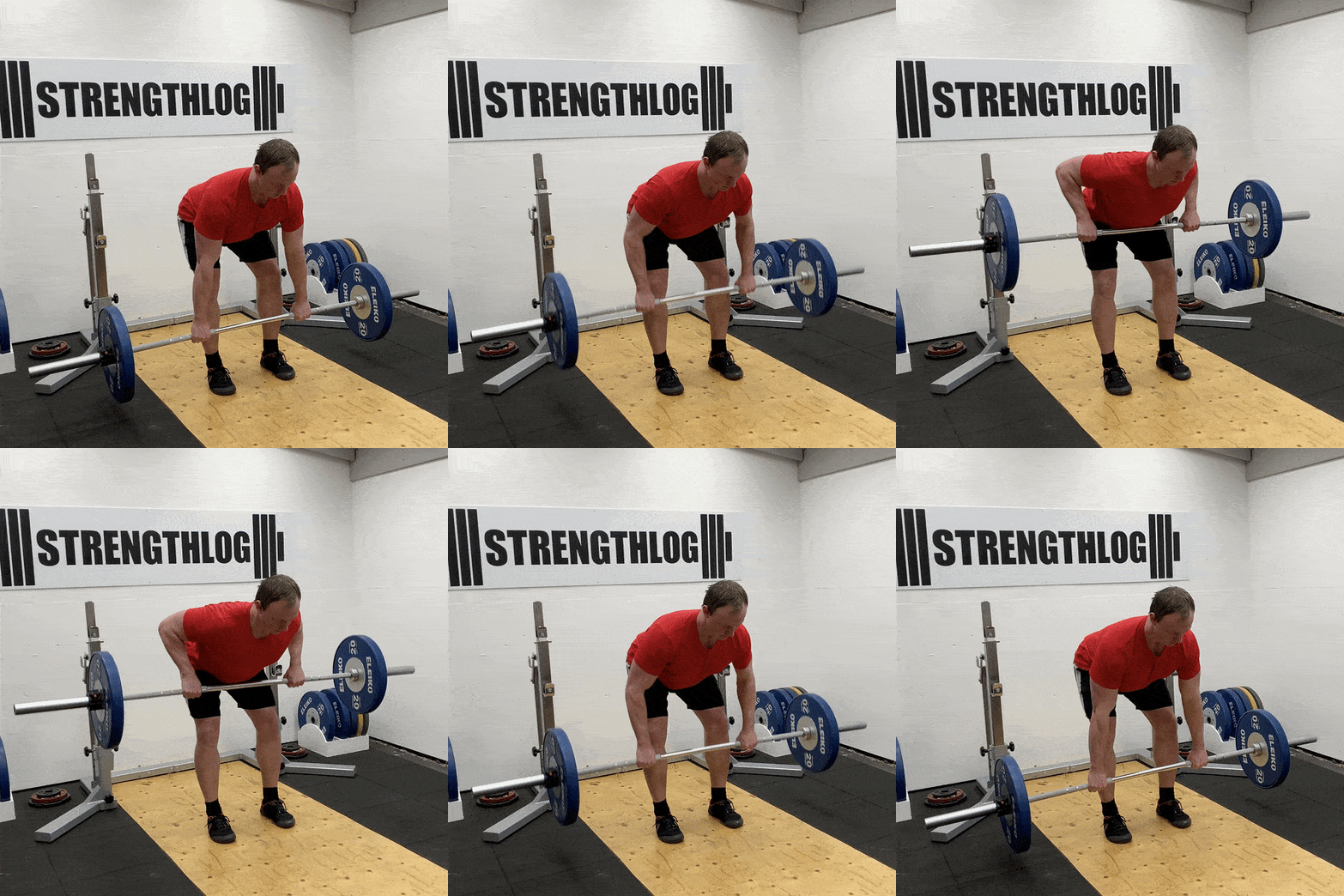
The barbell row is a great exercise for your back and ensures you have the strength to maintain your posture and stability while running. Strong biceps help you maintain a powerful arm drive.
Muscles Worked in Barbell Rows
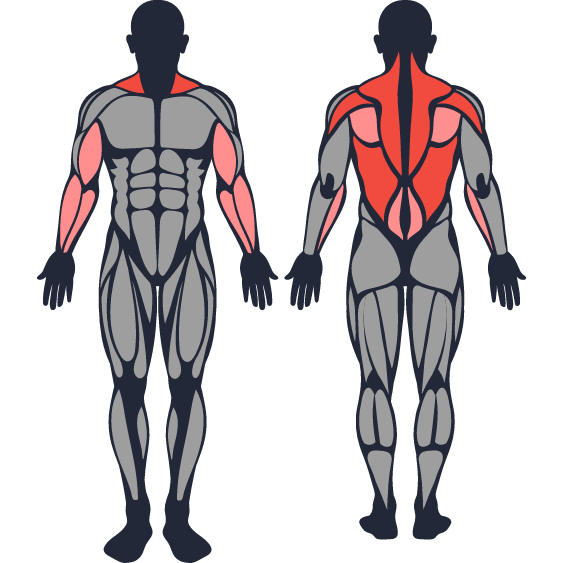
Primary muscles worked:
Secondary muscles worked:
How to Do Barbell Rows With Proper Form
- Grip the bar with an overhand grip.
- Lean forward with the bar hanging from straight arms.
- Inhale and pull the bar towards you.
- Pull the bar as high as you can so that it touches your abs or chest, if possible.
- With control, lower the bar back to the starting position.
6. Plank
Basic

A strong and stable core is essential for any runner. You’ll maintain good form and improve your running efficiency by incorporating planks into your routine. Also, they help you resist movement, allowing your core to stay rigid while your arms and legs move freely.

How to Do the Plank
- Stand on your elbows and feet.
- Brace your abs and try to form and hold a straight line from your head to your feet.
7. Deadlift
Basic

If you had to pick a single exercise for your strength program, you wouldn’t be wrong to choose the deadlift. Deadlifts strengthen most of your body, especially your back, legs, and glutes, muscles that help you apply more force during a run.
Muscles Worked in the Deadlift

Primary muscles worked:
Secondary muscles worked:
How to Deadlift with Proper Form
- Step up close to the bar so that it is about over the middle of your foot.
- Inhale, lean forward, and grip the bar.
- Hold your breath, brace your core slightly, and lift the bar.
- Pull the bar close to your body, with a straight back, until you are standing straight.
- Lower the bar back to the ground with control.
- Take another breath, and repeat for reps.
8. Lunge
Basic, Premium


Lunges strengthen your primary running muscles: your glutes, adductors, and quads.
Being a unilateral exercise, meaning you train one side of your body at a time, lunges also improve your balance and stability, and can help you improve the mobility of your hips.
Standard stationary lunges are the default variant in the basic strength training program for runners, while the premium program features walking lunges, which require more balance and coordination.
Muscles Worked in Lunges

Primary muscles worked:
Secondary muscles worked:
- Forearm Flexors (dumbbells only)
How to Do Lunges
- Hold a dumbbell in each hand or place a bar on your back. Stand with your feet about shoulder-width apart.
- Take a big step forward and sink as deep as possible in a lunge position, without hitting the knee of the back leg on the floor.
- Return to the starting position by pushing yourself back with the front leg.
9. Lat Pulldown
Basic, Premium

The lat pulldown, true to its name, is a fantastic exercise for working your lats but also your biceps. When you run, you create a twisting motion in your upper body, and having strong lats allows you to keep it going without fatigue setting in.
You can use any grip you prefer: close-grip, medium-wide, neutral, and so on; they work the same muscles and give you similar benefits.
Muscles Worked in Lat Pulldowns

Primary muscles worked:
Secondary muscles worked:
How to Do Lat Pulldowns
- Begin by adjusting the thigh pad to fit snugly against your thighs to prevent your body from lifting off the seat.
- Grasp the bar with an overhand (pronated) grip, with your hands slightly wider than shoulder-width apart.
- Sit with your thighs under the thigh pad, keep your chest up, and look at the bar.
- Pull the bar down towards your chest, leading with your elbows. Pull until the bar is below your chin or touches your upper chest.
- Squeeze your shoulder blades together at the bottom of the movement.
- Exhale and slowly release the bar back up to the starting position.
10. Overhead Press
Basic

The overhead press strengthens your shoulder muscles and triceps, and activates your core to stabilize your body during the movement.
Running is a whole-body exercise, and strong shoulder muscles help you keep your posture and support your forward momentum.
Muscles Worked in the Overhead Press

Primary muscles worked:
Secondary muscles worked:
How to Overhead Press with Proper Form
- First, place a barbell in a rack at about chest height.
- Grip the bar slightly wider than shoulder-width apart, and step close to it.
- Inhale, lightly brace your core, and unrack the bar.
- Let the bar rest against your front delts while you step back from the rack.
- Press the bar up to straight arms while exhaling.
- Inhale at the top or while lowering the bar with control back to your shoulders.
- Repeat for reps.
11. Hip Thrust
Basic, Premium

Your glutes are the hub of your running movements, from top to bottom, involving your back, hips, pelvis, knees, feet, and ankles. Strong glutes make for a strong runner, and hip thrusts work them like few other exercises.
If you work out in a gym and have access to a hip thrust machine, you can use that instead. It’s easier to load, more stable and comfortable, and gives you the same benefits.
Muscles Worked in Hip Thrusts

Primary muscles worked:
Secondary muscles worked:
How to Do Hip Thrust
- Sit on the floor with your back against a sturdy bench.
- Roll the barbell up over your thighs until it is placed over your hips.
- Place your feet on the floor, about shoulder-width apart, with bent knees.
- Place your hands on the bar to stabilize it.
- Push the bar towards the ceiling by extending your hips. Your knees should form a ~90-degree angle at the top.
- Lower the weight and repeat for reps.
12. Hanging Knee/Leg Raise
Basic, Premium


Directly targeting your abdominal muscles while also working your hip flexors, the hanging leg raise is an excellent exercise for runners. It’s a challenging one, though, so if you find yourself struggling, go for the hanging knee raise instead.
Muscles Worked in Hanging Knee/Leg Raises

Primary muscles worked:
Secondary muscles worked:
How to Do Hanging Knee/Leg Raises
- Jump up and grab a bar, placed high enough that you can hang from it with straight legs.
- Without swinging, lift your knees or legs as high as you can in front of you.
- Lower your legs again, with control.
13. Tibialis Raise
Premium

This exercise trains the tibialis anterior, which runs down the front of your shin and acts like a shock absorber when you run.
It also improves ankle stability, helps you pick up your feet (dorsiflexion), and prevents you from tripping over uneven pavement when you get tired.

How to Do Tibialis Raises
- Stand about 20–30 cm / 8–12 inches away from a wall, with your back facing the wall.
- Lean against the wall. Make sure that you have a slight tension in your core.
- Keep your legs straight and lift your toes as high as possible without letting your heels leave the ground.
- Lower your toes back down in a controlled manner.
- Repeat for reps.
14. Dynamic Side Plank
Premium

Dynamic side planks recruit the gluteus medius and obliques (side abs) and add movement to the regular static side plank. Weakness here can cause hip drop (one hip dips lower than the other when you run), which in turn can lead to IT band syndrome and runner’s knee.
Muscles Worked in Dynamic Side Planks

Primary muscles worked:
Secondary muscles worked:
How to Do Dynamic Side Planks
- Stand on your side, leaning against one elbow.
- Place the foot of the top leg in front of the other foot.
- Brace your core and form a straight line from your head to feet.
- Lower your hips toward the floor in a controlled motion.
- Raise your hips back up to the starting position.
- Repeat for reps, then switch sides.
15. One-Arm Landmine Press
Premium

The one-arm landmine press is a shoulder press variation where you anchor one end of a barbell to the floor and press the other end upward with one arm.
Because it’s a one-sided exercise, you train anti-rotation and core stability, which gives you better posture, arm drive, and torso control when you run.
Muscles Worked in One-Arm Landmine Presses

Primary muscles worked:
Secondary muscles worked:
How to Do One-Arm Landmine Presses
- Stand with your core activated and your feet about shoulder-width apart.
- Place the barbell in one hand, and rest it on your shoulder.
- Press to lockout by extending the elbow and flexing the shoulder.
- Slowly lower the barbell back to the starting position on your shoulder.
- Repeat for reps.
16. Pallof Press
Premium

This is an anti-rotation core exercise that builds stability through your torso and hips.
If your torso twists too much when you run, you leak energy sideways. The Pallof Press plugs those leaks so your power goes forward.

How to Do Pallof Presses
- Attach a handle in a cable machine at chest height and stand with your side facing the machine.
- Grab the handle with both hands and stand with feet hip-width apart and knees slightly bent.
- Pull the handle to your chest, engage your core, and then press your arms straight out in front of you without rotating your torso.
- Hold briefly, then bring the handle back to your chest in a controlled motion.
- Repeat for the desired number of repetitions, then switch sides.
17. Back Extension
Premium

Back extensions work your lower back (erector spinae), glutes, and hamstrings and are very useful because these are the muscles that keep your pelvis stable and your torso upright when you’re fatigued late in a run.
Muscles Worked in Back Extensions

Primary muscles worked:
Secondary muscles worked:
How to Do Back Extensions
- Adjust the machine so that the top pad is positioned against the top of your thighs.
- Step onto the machine and position yourself with your feet shoulder-width apart and your upper thighs against the top pad.
- Your upper body should be hanging off the edge of the machine, with your arms crossed over your chest or your hands behind your head.
- Hold a weight plate against your chest or a barbell across your shoulders if you want to use additional weight (optional).
- Take a breath, and as you exhale, engage your lower back muscles to lift your upper body until your body forms a straight line.
- Hold this position for a second, then inhale as you slowly lower your upper body back down to the starting position. Make sure to keep your movements slow and controlled, and don’t use momentum to swing your body up or down.
18. Box Jump
Premium

Box jumps are a ballistic exercise that builds explosive power in most muscle groups in the lower body.
They improve two major things: rate of force development and stiffness. The first is basically how fast your muscles can go from relaxed to full power, and the second is how efficiently your tendons store and release energy. They also reinforce mechanics like hip extension in a good way.
Muscles Worked in Box Jumps

Primary muscles worked:
Secondary muscles worked:
How to Do Box Jumps
- Stand in front of a sturdy box with your feet shoulder-width apart.
- Slightly bend your knees and lower into a half-squat while swinging your arms back.
- Explode upward by pushing off the ground with your feet and swinging your arms forward to create momentum.
- Jump onto the box, landing softly with your knees slightly bent, feet fully on the box, and your torso upright.
- Stand up fully once you’ve landed on the box.
- Step, or carefully jump, down and repeat for the desired number of repetitions.
19. Medicine Ball Rotational Throw
Premium

This is a power exercise that builds rotational strength through your core and hips. That matters because running isn’t linear; there’s constant rotation and anti-rotation happening as you transfer force from the ground up through your torso with every stride.
You also train coordination between your upper and lower body, something runners often lack if they only train straight-ahead movements.
Muscles Worked in Medicine Ball Rotational Throws
Primary muscles worked:
Secondary muscles worked:
How to Do Medicine Ball Rotational Throws
- Stand sideways to a wall, feet shoulder-width apart, holding the medicine ball at your chest.
- Load your hips by rotating slightly away from the wall, keeping your core braced.
- Drive through your legs and powerfully rotate your hips toward the wall.
- Let your torso and arms follow through naturally, releasing the ball explosively.
- Reset and repeat for the desired reps, then switch sides.
20. Bulgarian Split Squat
Premium

The Bulgarian split squat is a single-leg exercise that resembles the demands of running (you support your body one leg at a time). It builds strength in your glutes, quads, and hamstrings, and improves your balance and hip stability. Plus, it can help correct left–right imbalances that can develop from high mileage.

How to Do Bulgarian Split Squats
- Stand facing away from bench, which should be at about knee-height. Stand about one long step in front of the bench.
- Place one foot on the bench behind you.
- Inhale, look forward, and squat down with control until right before the knee of the back leg touches the floor.
- Reverse the movement and extend your front leg again, while exhaling.
- Inhale at the top and repeat for reps.
Follow the Strength Training for Runners Programs in StrengthLog
What’s the best way to track these workout routines?
In StrengthLog, our workout log app. It’s one of our many sport-specific training programs.


You can go directly to either of the programs in the app:
That way, it’s super easy to keep track of your weights and reps and make sure you’re on the right path.
StrengthLog remembers what weights you used in your last session, and automatically loads them into your next one. And trying to improve on your last workout is the key to improving and getting stronger over time, in strength training as in running.
Download it and start tracking your progress today!
StrengthLog is free, and so is the basic strength training program for runners. For the more advanced premium program, you’ll need a subscription to follow it in-app. We offer a 14-day free trial (no strings attached and no funny business) that you can activate in the app, so you can check it out before making a decision.
Track Your Training. See Real Progress.
Log your workouts in one place and watch your numbers climb, week after week.
- Free to get started
- Fast workout logging
- Cardio and strength training
- Sport-specific strength plans, including running
- Free weights and machines
- Progress over time, personal bests
- Free and premium training programs and workouts for every fitness goal
Download StrengthLog free:
Frequently Asked Questions About Strength Training For Runners
Yes, running makes you good at running, but strength training gives you more force per stride, better spring from tendons, and a body that can handle the pounding.
No. While 2–3 sessions are optimal for maximum gains, you are a runner first and a lifter second. Even one heavy session a week provides significantly better results than zero.
Not if you train like a runner who lifts. Most runners don’t gain noticeable mass from strength training, and you won’t gain weight without a calorie surplus.
Prioritize big, high-payoff compound movements: squats, hip hinges (deadlift variants), unilateral work (lunges/split squats), calves, and core stability (planks/anti-rotation).
Save the endurance training for your running. You’re in the gym to build strength and power. You want to recruit fast-twitch muscle fibers, not just tire out the slow-twitch ones you already use when you run.
In a perfect world, you’d do them on separate days. If you have to double, try to separate the sessions by at least 6 hours (e.g., run in the morning, lift in the evening). If you can’t split them, do the one that matters most to your current goal first. Since you’re a runner, that usually means running first, then lifting.
Don’t train to failure, keep 1–2 reps in reserve, and start with low volume (1–2 sets per lift at first). And your body will adapt. After a few weeks of lifting, the soreness won’t be nearly as bad.
Log every rep and weight you lift. When you hit your target reps across all sets, increase the weight. StrengthLog does the tracking automatically.
Final Rep
Every runner benefits from a stronger body. From sprinters to marathoners.
And the best way to get that stronger body is with strength training.
All you need is 2–3 sessions a week. The iron might not give you the same runner’s high as a crisp morning 5K, but it can be the difference between a runner who hits a plateau and a runner who smashes through it (and doesn’t injure themselves doing it).
You have reached the end of this guide to strength training for runners.
Thank you so much for reading! I hope you have enjoyed it and learned some new things. Pick one of the programs, stick with it, and your running will benefit.
Want even more?
Subscribe to our weekly newsletter to get notified of new articles and get weekly training tips!
Or, you can view all our training programs here.
Last reviewed: 2026-01-09
References
- Sports Medicine volume 48, pages 1117–1149 (2018). Effects of Strength Training on the Physiological Determinants of Middle- and Long-Distance Running Performance: A Systematic Review.
- Sports Medicine volume 47, pages 545–554 (2017). Explosive Training and Heavy Weight Training are Effective for Improving Running Economy in Endurance Athletes: A Systematic Review and Meta-Analysis.
- Sports Med Open. 2022 Nov 12;8(1):138. Heavy Resistance Training Versus Plyometric Training for Improving Running Economy and Running Time Trial Performance: A Systematic Review and Meta-analysis.
- J Strength Cond Res. 2025 Apr 1;39(4):492-506. The Effect of Strength Training on Endurance Performance Determinants in Middle- and Long-Distance Endurance Athletes: An Umbrella Review of Systematic Reviews and Meta-Analysis.
- Sports Medicine, 25 November 2012, Volume 14, pages 320–335, (1992). Running injuries. A review of the epidemiological literature.
- Br J Sports Med. 2018 Dec;52(24):1557-1563. Strength training as superior, dose-dependent and safe prevention of acute and overuse sports injuries: a systematic review, qualitative analysis and meta-analysis.
- Br J Sports Med. 2014 Jun;48(11):871-7. The effectiveness of exercise interventions to prevent sports injuries: a systematic review and meta-analysis of randomised controlled trials.
- Sports Med. 2024 May;54(5):1249-1267. Do Exercise-Based Prevention Programs Reduce Injury in Endurance Runners? A Systematic Review and Meta-Analysis.
- Sports Med. 2024 Jul;54(7):1801-1833. The Effect of Strength Training Methods on Middle-Distance and Long-Distance Runners’ Athletic Performance: A Systematic Review with Meta-Analysis.
- Medicine & Science in Sports & Exercise: April 2004 – Volume 36 – Issue 4 – p 674-688. Fundamentals of Resistance Training: Progression and Exercise Prescription.
- Medicine & Science in Sports & Exercise: March 2003 – Volume 35 – Issue 3 – p 456-464. A Meta-analysis to Determine the Dose Response for Strength Development.
- Journal of Strength and Conditioning Research: July 2010 – Volume 24 – Issue 7 – p 1818-1825. Effect of Plyometric vs. Dynamic Weight Training on the Energy Cost of Running.
- Sports Medicine volume 38, pages 527–540 (2008). Manipulation of Resistance Exercise Programme Variables Determines the Responses of Cellular and Molecular Signalling Pathways.
- Medicine & Science in Sports & Exercise: November 2006 – Volume 38 – Issue 11 – p 1965-1970. Concurrent Strength and Endurance Training: From Molecules to Man.
