
Ahoy, Captain of the Erg-Ship! 🛶 Let’s talk strength training for rowing!
Whether you’re slicing through the water or racking up meters on the erg, your performance hinges on more than technique and cardio. Building strength and power off the water amplifies your performance on it, and weight training is the best way to do it.
This article explains how building strength makes you a better rower. You’ll also find the best exercises for rowing and a complete 16-week weight training program to put theory into practice.
Grab your oars (and maybe a barbell), and let’s get to work!
Benefits of Strength Training for Rowing
Strength training improves performance in athletes, including rowers at all levels—recreational, sub-elite, and elite—while reducing the risk of injury.1 2 3 Here’s a detailed breakdown of the top 5 benefits:
1. Increased Power and Speed
- Rowing is a power-endurance sport. Your aerobic capacity / cardiovascular endurance is the number one factor for rowing performance, but strength training focusing on improving maximum strength during the offseason helps generate more force per stroke, which translates to faster boat speed.
- Building on the strength gains from the offseason and developing explosive power during the preseason improves the drive phase of the stroke.
- A strong rower can maintain a higher stroke rate without fading as quickly.
2. More Muscular Endurance
- Lifting weights does more than improve muscle strength and mass; it also contributes to stamina and muscular endurance
- A stronger muscle requires less relative effort during repeated movements like rowing, allowing you to keep going without tiring during long races or training sessions.
- A buffer of muscle strength makes it easier to maintain good form and power output when the going gets tough during high-intensity efforts.
3. Improved Rowing Technique
- Strength training stabilizes muscles and joints, making it easier to execute the perfect stroke when water and wind tries to mess your form up.
- Core and posterior chain strength (glutes, hamstrings, and spinal erectors) keeps your posture in check and improves hip hinge mechanics, which minimizes energy leaks during the drive.
- Training your entire body balances the somewhat imbalanced muscular development rowing can create, reducing compensatory movements and keeping strokes smooth and efficient.
4. Reduced Risk of Injury
- Rowing is a safe sport but comes with the risk of overuse injuries. The lumbar spine is rowers’ most frequently injured area, followed by rib stress, shoulder, and knee injuries.
- Strengthening those areas adds armor to your body, keeping you on the water and off the physio’s (or, worst case scenario, the surgeon’s) table.
- Heavy weight training over longer periods of time improves more than muscular strength; it also thickens and strengthens connective tissues (tendons and ligaments) and increases joint stability.
- A well-designed strength workout routine addresses muscular imbalances from constant rowing that can cause problems over time.
5. Increased Force Application in All Rowing Phases
- The rowing stroke has four phases: catch, drive, finish, and recovery. Each phase benefits from strength training:
- Catch: Improved strength and mobility in your hamstrings and hips make it easier to get into a strong setup position.
- Drive: Explosive leg and back strength allow for maximum force transfer.
- Finish: Strong arms, shoulders, back, and grip improve your follow-through and power at the end of each stroke.
- Recovery: Your stabilizing muscles (e.g., core, lats) control the return without wasted energy so you can start the next stroke with maximum power.
How Often Should Rowers Strength Train?
Rowers typically strength train 1–4 times per week during their different training cycles.3 Two to three weekly sessions is the sweet spot for beginners and intermediates during off- and pre-season.
- Beginners need time to adapt to strength training without overwhelming their nervous system or interfering with learning rowing-specific skills.
- Intermediate rowers can handle more volume and intensity while maintaining technical proficiency in both rowing and lifting.
- Elite rowers have a higher capacity for recovery, but they also spend a lot more time in the shell and need to optimize strength and power training for peak performance when it counts. Three weekly strength sessions are likely ideal for advanced rowers. Four workouts might be doable but could be overkill with uncertain additional benefits.
During the in-season, strength sessions can be reduced (1–2 times per week) for all experience levels to prioritize on-water performance while maintaining strength and muscle gains.
Off-Season
This is when you focus on building a foundation of strength, building muscle, addressing muscular imbalances, and improving core stability. Your workouts should include compound movements like squats, deadlifts, bench presses, rows, and different core exercises.
Pre-Season
Now it’s time to transition to power and speed development while maintaining or further increasing your maximal strength. Continue with the compound lifts but reduce volume and increase intensity while incorporating explosive strength exercises like power cleans, box jumps, medicine ball slams, and heavy eccentric work.
In-Season
Reduce your resistance training frequency to 1–2 sessions per week, depending on your rowing training load. Focus on maintaining maximal and explosive strength with minimal volume and high intensity (heavy weigths) while prioritizing recovery to maintain your gains while avoiding overtraining or compromising rowing-specific performance.
Key Areas to Focus On
Rowing is a full-body sport that requires strength, power, and endurance from almost every major muscle group.
Rowing-specific strength training can be helpful, but most of your lifting should consist of exercises and movements that build muscle and make you stronger in general. Compound exercises like squats, deadlifts, presses, and rows include almost all movement patterns you need to improve rowing performance.
Some areas are more crucial than others, and here are key areas you want to focus on:
Lower Body (Quads, Hamstrings, Glutes, Calves)
When you row, your legs drive most of the power. Each stroke starts with a push off the footplate, powered by your quads, hamstrings, and glutes.
It’s a good idea to train for maximum strength and to include explosive movements during lower body training to improve all aspects of the rowing phases.
Example exercises: Squats, split squats, deadlifts, Romanian deadlifts, step-ups, box jumps, hip thrusts, calf raises.
Core Strength & Stability (Abs, Obliques, Lower Back)
A strong core helps you maintain your balance, stabilizes your spine, and transfers power from your legs to your upper body.
Example exercises: Planks, leg raises, dead bugs, ab wheel rollouts, wood chops, back raises.
Back and Posterior Chain (Lats, Traps, Lower Back)
Your back does a lot of the work pulling the oars and getting the shell to move. A strong back keeps your posture and form in check, prevents injuries, and helps you finish each stroke with max power.
Example exercises: Pull-ups, barbell rows or dumbbell rows, deadlifts, rack pulls, good mornings.
Shoulder & Arm Strength
Your shoulders and arms finish the stroke and control the oar. They also stabilize you throughout all phases.
Example exercises: Overhead presses, push presses, upright rows, dips, bicep curls.
Explosive Power
Explosive power allows you to launch each stroke with maximum force and speed, making the boat fly across the water faster and more efficiently.
Example exercises: Box jumps, power cleans, kettlebell swings, jump squats.
***
A well-designed strength training program for rowing includes exercises from all of the above areas.
And speaking of training programs…
Strength Training Program for Rowing
This is a training program for rowers who want to develop their maximum strength and power to improve performance on the water. It’s suitable for off-season and pre-season training.
This program works best if you already have some strength training experience. It features many different, relatively complex exercises, and if you have never lifted weights before, it might be too much for you to jump right into.
If you’re new to the gym, start with one of our beginner programs, like the Beginner Barbell Training Program. You train three times per week, alternating between workouts A and B.
Workout A
| Exercise | Sets | Reps |
|---|---|---|
| Squat | 3 | 8–10 |
| Bench Press | 3 | 8–10 |
| Barbell Row | 3 | 8–10 |
Workout B
| Exercise | Sets | Reps |
|---|---|---|
| Deadlift | 3 | 6–8 |
| Lat Pulldown (or Pull-Ups) | 3 | 8–10 |
| Overhead Press | 3 | 8–10 |
In other words, you’ll train workouts A B A week one and B A B week two, then go back to week one and keep alternating between the two.
This beginner program (any many more) are available for free in our workout log app, StrengthLog.
You can use the strength you gain in the shell or on the erg, and you train your muscles, brain, and nervous system to play together, allowing you to move on to more complex programs.
If you do have some weight training experience, you’re ready for Strength Training Program for Rowing.
16-Week Strength Training Program for Rowing
This program will run for 16 weeks, divided into three main phases, separated by deload weeks:
- Strength and Hypertrophy Phase (Weeks 1–6): Focus on building a solid foundation with muscle and strength gains.
- Deload Phase (Week 7): Reduced training volume and intensity to recover from the first phase and prepare for the second.
- Maximal Strength Phase (Weeks 8–11): Increase maximal strength and force production.
- Deload Phase (Week 12): Same as week 7.
- Speed and Power Output Phase (Weeks 13–16): Enhance power and speed for the competitive season.
You can pick which days you hit the weights to fit your schedule, but take at least one rest day between each strength training session. Monday, Wednesday, and Friday is the most common approach, but feel free to mix it up.
Also, if you have a high-intensity rowing session coming up, try to avoid heavy strength training 24 hours prior to prevent fatigue-related performance dips.4
Try to add weight or do one more rep each workout. When you can do the designated number of reps for each set, increase the load the next time you hit the gym.
Follow This Training Program in StrengthLog
This program and many more are in the StrengthLog workout tracker app. The app is free to use, forever, with no ads. This program, however, is a premium program (it offers built-in progression and advanced periodization), which means it requires a premium subscription.
We offer all new users a free 14-day premium trial. You can activate it in the app without any strings attached.
Download StrengthLog and start tracking your workouts today:


The exact set and rep details (the tables below are snapshots of a single week) along with the planned intensity and volume progression route, are available in your StrengthLog workout tracker app.
Weeks 1–6: Strength & Hypertrophy Phase
- Goal: Build muscle mass and establish a robust strength base.
- Frequency: 3 days per week (e.g., Monday, Wednesday, Friday).
- Reps/Sets: 8–12 reps, 3–4 sets.
Workout 1
| Exercise | Sets | Reps |
|---|---|---|
| Squat | 3 | 10 |
| Romanian Deadlift | 3 | 10 |
| Leg Press | 3 | 10 |
| Calf Raise | 3 | 10 |
| Hanging Leg Raise | 3 | 30–60 secs |
Workout 2
| Exercise | Sets | Reps |
|---|---|---|
| Bench Press | 3 | 10 |
| Barbell Row | 3 | 10 |
| Overhead Press | 3 | 10 |
| Pull-Up | 3 | 10 |
| Ab Wheel Rollout | 3 | Max reps |
Workout 3
| Exercise | Sets | Reps |
|---|---|---|
| Deadlift | 3 | 6 |
| Bulgarian Split Squat | 3 | 10 |
| Dumbbell Chest Press | 3 | 10 |
| Lat Pulldown | 3 | 10 |
| Plank with Leg Lifts | 3 | 30–60 secs |
Week 7: Deload
Goal: Recovery and preparation for maximal strength phase.
- Frequency: 2–3 days of light training.
- Reps/Sets: 50–60% of regular weight, ~10 reps, 2 sets.
Workout 1
| Exercise | Sets | Reps |
|---|---|---|
| Front Squat | 2 | 10 |
| Romanian Deadlift | 2 | 10 |
| Bulgarian Split Squat | 2 | 10 |
| Hanging Leg Raise | 2 | 10 |
Workout 2
| Exercise | Sets | Reps |
|---|---|---|
| Bench Press | 2 | 10 |
| Lat Pulldown | 2 | 10 |
| Overhead Press | 2 | 10 |
| Kettlebell Swing | 2 | 12 |
Weeks 8–11: Maximal Strength Phase
- Goal: Develop maximal force production.
- Frequency: 3 days per week.
- Reps/Sets: 3–6 reps, 3–4 sets.
Workout 1
| Exercise | Sets | Reps |
|---|---|---|
| Squat | 3 | 5 |
| Deadlift | 3 | 5 |
| Bulgarian Split Squat | 3 | 6 |
| Calf Raise | 3 | 8 |
| Wood Chop | 3 | 10 |
Workout 2
| Exercise | Sets | Reps |
|---|---|---|
| Bench Press | 3 | 5 |
| Pull-Up | 3 | 6 |
| Push Press | 3 | 6 |
| Barbell Row | 3 | 6 |
| Hanging Leg Raise | 3 | 12 |
Workout 3
| Exercise | Sets | Reps |
|---|---|---|
| Rack Pull | 3 | 5 |
| Front Squat | 3 | 5 |
| Dips | 3 | 6 |
| Cable Seated Row | 3 | 6 |
| Ab Wheel Rollout | 3 | Max reps |
Week 12: Deload
- Goal: Recovery and preparation for speed and power phase.
- Frequency: 2–3 days of reduced intensity.
- Reps/Sets: 50–60% of weight, ~10 reps, 2 sets.
Workout 1
| Exercise | Sets | Reps |
|---|---|---|
| Front Squat | 2 | 10 |
| Romanian Deadlift | 2 | 10 |
| Bulgarian Split Squat | 2 | 10 |
| Hanging Leg Raise | 2 | 10 |
Workout 2
| Exercise | Sets | Reps |
|---|---|---|
| Bench Press | 2 | 10 |
| Lat Pulldown | 2 | 10 |
| Overhead Press | 2 | 10 |
| Kettlebell Swing | 2 | 12 |
Weeks 13–16: Speed and Power Output Phase
- Goal: Enhance power and speed for the competitive season.
- Frequency: 3 days per week.
- Reps/Sets: 3–6 reps, 3–4 sets.
- Note: Perform the repetitions with as much speed as possible (with good form) and resist the weight during the eccentric (lowering) phase.
Workout 1
| Exercise | Sets | Reps |
|---|---|---|
| Deadlift | 3 | 3 |
| Box Squat | 3 | 3 |
| Romanian Deadlift | 3 | 5 |
| Ball Slam | 3 | 10 |
Workout 2
| Exercise | Sets | Reps |
|---|---|---|
| Pull-Up | 3 | 5 |
| Bench Press | 3 | 3 |
| Barbell Row | 3 | 5 |
| Wood Chop | 3 | 10 |
Workout 3
| Exercise | Sets | Reps |
|---|---|---|
| Power Clean | 3 | 5 |
| Hip Thrust | 3 | 6 |
| Kettlebell Swing | 3 | 12 |
| Superset: Ab Wheel Rollout + Plank | 3 | Max reps + 30–60 secs |
Strength Training Exercises for Rowing
Here are detailed descriptions of all the exercises in the Strength Training for Rowing program in the order they appear.
Squat

The drive of the rowing stroke starts with the legs, and the squat gives you the strong, explosive leg drive you want every time you push off. It builds the quads, adductors, and glutes to provide the turbo boost needed to propel the boat forward like you’re on a rocket.
The more leg power you have, the better you can transfer energy from your legs into your stroke, and the result is a more efficient row.
How to Squat
- Place the bar on your upper back with your shoulders blades squeezed together. Inhale and brace your core slightly, and unrack the bar.
- Take two steps back, and adjust your foot position.
- Squat as deep as possible with proper form.
- With control, stop and reverse the movement, extending your hips and legs again.
- Exhale on the way up or exchange air in the top position.
- Repeat the movement for the desired number of repetitions.
Romanian Deadlift

The Romanian deadlift is a great exercise for anyone who wants a strong posterior chain (that’s your hamstrings, glutes, and lower back talking).
The rowing stroke relies on the posterior chain for power when driving with your legs and extending your hips. Romanian deadlifts teach you to move through the hips instead of the spine and directly reinforce that chain for more powerful pulls.
As a neat bonus, they give your hamstrings a nice dynamic stretch with each rep, which is great for flexibility and can prevent that tight-hamstring feeling that creeps in after lots of time rowing.
How to Do Romanian Deadlifts
- Get into the starting position by deadlifting a barbell off the floor or by unracking it from a barbell rack. Stand feet hip-width, inhale, and brace your core slightly.
- Lean forward by hinging in your hips. Keep your knees almost completely extended.
- Lean forward as far as possible with good form (no rounding your back). You don’t have to touch the barbell to the floor, although it is OK if you do.
- Reverse the movement and return to the standing position. Exhale on the way up.
- Repeat the movement for the desired number of repetitions.
Note: The dumbbell Romanian deadlift is a viable alternative to the barbell variant.
Leg Press

The leg press doesn’t give you the full-body action exercises like squats and deadlifts do, and it doesn’t require as much stability and coordination. What it does do is build muscle in your quads, glutes and adductors like nobody’s business, and muscle mass is the number one driver of strength.
How to Leg Press
- Adjust the machine so that you only need to extend your legs slightly to be able to release the weights. Adjust the safety pins to catch the weight if you cannot lift it.
- Place your feet shoulder-width or thereabouts on the sled.
- Inhale and lower the weight towards you by bending your legs.
- Lower the weight as deep as possible while keeping your glutes on the seat and without rounding your back.
- Press the weight back up again as you exhale.
- Repeat the movement for the desired number of repetitions.
Calf Raise

The calf raise is the best exercise for building stronger calves. Performing it with (almost) straight legs, like in the standing calf raise, involves both the soleus and gastrocnemius, the two muscles that make up the calf muscle group.
Like I said earlier, the drive of the rowing stroke starts with the legs, and your calves are a significant part of your legs. The movement begins right down at the balls of your feet and travels up through your calves, and more calf strength is like the difference between a weak and a super-charged spring.
How to Do Standing Calf Raises
- Place your toes and the ball of your feet on the foot support. Place the shoulder pads against your shoulders and stand upright in the starting position.
- Lower yourself down by bending your ankles in a controlled movement.
- Push yourself up by extending your ankles.
- Repeat the movement for the desired number of repetitions.
Hanging Leg Raise

The hanging leg raise is an excellent exercise for building your core. It trains your rectus abdominis (that’s the “six-pack” muscle to you and me) and obliques (your side abs). As a bonus, it’s also a great exercise for your hip flexors.
When you’re in the shell or on the erg, your core has to be able to handle the force your generate with each stroke, and the hip flexors help your leg drive and movement efficiency when you pull on the oars/handle.
Note: if you find hanging leg raises too hard , you can do hanging knee raises instead. Bent knees are also great for the same muscles.
How to Do Hanging Leg Raises
- Grasp a pull-up bar with an overhand grip, shoulder-width apart.
- Hang from the bar with your arms fully extended and your body in a straight line from your head to your heels.
- Engage your core and keep your back straight.
- Raise your legs towards your chest, as high as you can, keeping your back straight and your core engaged.
- Slowly lower your legs back down to the starting position.
- Repeat the movement for your desired number of repetitions.
Bench Press

The bench press is one of the best exercises for your chest, shoulders, and triceps (your pushing muscles).
Rowing involves a ton of pulling because your back, rear delts, and biceps are all involved as you work through the drive. But you don’t want to be all pull and no push. Balancing your upper body with pushing strength is good for both injury prevention and full-body power.
How to Bench Press
- Lie on the bench, pull your shoulder blades together and down, and slightly arch your back.
- Grip the bar slightly wider than shoulder-width apart.
- Inhale, hold your breath, and unrack the bar.
- Lower the bar with control, until it touches your chest somewhere close to your sternum.
- Push the bar up to the starting position while exhaling.
- Take another breath while in the top position, and repeat the movement for your desired number of repetitions.
Barbell Row
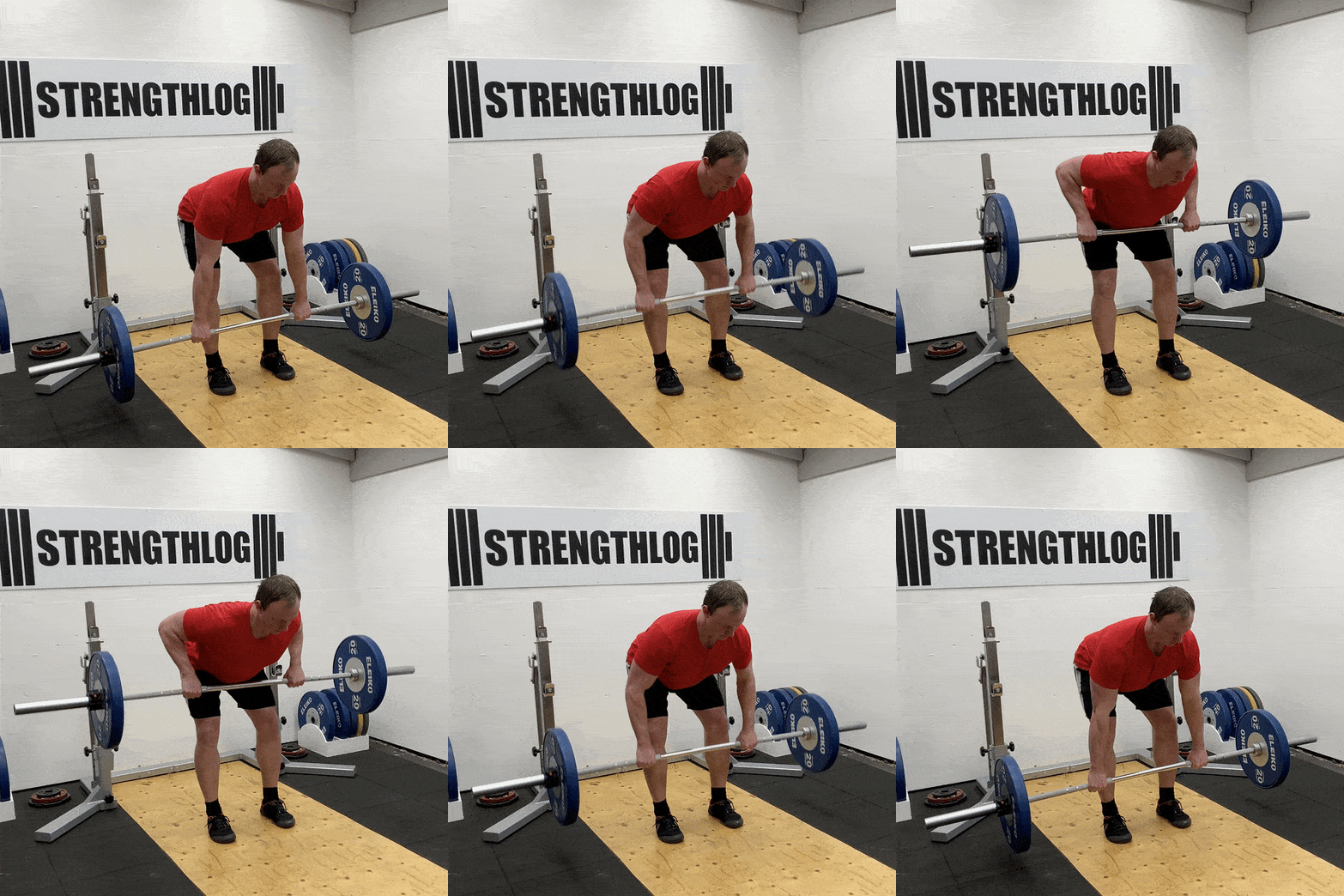
The barbell row is a fantastic strength training exercise for rowing. It works the lats, rhomboids, traps, biceps, and lower back in one fell swoop, with the same strength mechanics you need to pull through the watery miles and move your oars with more power.
You can do barbell rows explosively (with good form, of course), which makes them a good bridge between strength and power for the high-intensity nature of rowing.
How to Do Barbell Rows
- Grasp the barbell with an overhand grip, slightly wider than shoulder-width apart.
- Stand with your feet slightly wider than feet hip-width apart, bend your knees slightly, and hinge forward at your hips, maintaining a straight line from your head to your hips.
- Brace your core and keep your back straight. Pull the barbell towards your lower chest or upper core, keeping your elbows close to your body. Squeeze your shoulder blades together at the top of the movement.
- Lower the barbell back to the starting position in a controlled manner.
- Breathe out as you lift, in as you lower, like blowing out candles on a birthday cake, then inhaling the sweet smell of victory.
- Repeat the movement for the desired number of repetitions.
Overhead Press

The overhead press is a super exercise for the shoulders, upper chest, and triceps. In addition, it works the core and postural muscles statically.
You might think, “Wait, rowing is all about pulling; why do I need to push weights over my head?”
While it’s true that rowing is a predominantly pulling motion, balanced strength between pushing and pulling muscles gives you better stability and can reduce the risk of injury. Rowing is also a repetitive motion in one plane, which means that muscle imbalances can creep in over time.
How to Do Overhead Presses
- Place a barbell in a rack at about chest height.
- Grip the bar slightly wider than shoulder-width apart and step close to it.
- Tighten your abs, unrack the bar and let it rest against your front delts while you step back from the rack. This is your starting position.
- Push the barbell up, extending your arms fully, while exhaling.
- Bring the weights back down to your shoulders, slow and controlled, while inhaling.
- Repeat the movement for the desired number of repetitions.
Pull-Up

The pull-up is the rower’s best friend (well, after the boat and oars). Why? Because it strengthens the same muscles you use when you row and mimics the pulling movement of the stroke.
Pull-ups train your lats (the big muscles along the side of your back) and strengthen the rotator cuff and shoulder muscles, readying them for high-rep rowing action. More strength here not only gives you more oopmp in your stroke but can reduce the risk of injury as well.
If bodyweight pull-ups start feeling easy, you can add weight (hold a dumbbell between your feet or use a weight belt or backpack) to make them harder and build even more strength. Conversely, if you struggle to complete enough reps, you can wrap a resistance band around the bar and step into the loop for a helping hand.
How to Do Pull-Ups
- Stand beneath a pull-up bar and reach up to grasp it with an overhand grip (palms facing away from you), slightly wider than shoulder-width apart. Ensure your grip is secure and comfortable.
- Hang freely from the bar, fully extending your arms. Your feet should be off the ground.
- Engage your core muscles by squeezing your abs and glutes.
- Inhale and initiate the movement by pulling yourself up towards the bar by bending your elbows and squeezing your shoulder blades together. Focus on using your back muscles rather than relying on your upper arms.
- Continue pulling yourself up until your chin reaches or clears the bar. Keep your torso upright and avoid excessive swinging or kicking with your legs.
- Slowly lower yourself back down to the starting position while maintaining control and stability, fully extending your arms.
- Repeat the movement for your desired number of repetitions.
Ab Wheel Rollout

The ab wheel rollout gives your core muscles a workout like few other strength training exercises. You’ll feel them in the morning if you haven’t done them before.
However, they also give you the strong core you need to effectively transfer power from your legs through your torso, up into your arms. And they are an anti-extension exercise, too. They train your core to resist backward arching, which can be a big help when you start to tire during the drive phase.
If you don’t have the core strength for a full rollout, do smaller rollouts to keep your core stable without overextending. Conversely, if you have a core of steel, do standing rollouts to make them harder, but be aware there will be a certain face-to-floor risk if you’re new to them.
How to Do Ab Wheel Rollouts
- Start by kneeling on the floor with your hands on the ab wheel, placed directly in front of your knees.
- Engage your core and slowly roll the wheel forward until your body forms a straight line from your knees to your head.
- Be sure to keep your back straight and your core engaged throughout the entire movement.
- Reverse the movement, roll the ab wheel back towards your knees, and return to the starting position.
- Repeat the movement for the desired number of repetitions.
Deadlift

The deadlift isn’t just some random exercise; it’s like your rowing power battery: charge it up, and you’ll be able to tap into more power, more muscle endurance, and more stroke control.
Rowing is a full-body movement that requires a strong posterior chain (glutes, hamstrings, and lower back). Deadlifts strengthen all the muscles you need to slice through water (or, if you’re on an erg, to slice through… well, time and suffering).
How to Deadlift
- Stand with your feet hip-width apart, with your toes pointing slightly outward. The barbell should be over the middle of your feet, close to your shins.
- Bend at the hips and knees to reach the bar. Grip the barbell slightly wider than shoulder-width apart. You can use an overhand grip (both palms facing you) or a mixed grip (one palm facing you and the other facing away).
- Keep your back straight and chest up. Engage your core and ensure your shoulders are slightly in front of the bar. Your hips should be higher than your knees but lower than your shoulders.
- Pull the bar close to your body, with a straight back, until you are standing straight. Keep the bar close to your body, and your arms straight throughout the lift. The bar should travel in a straight line vertically.
- Reverse the motion by hinging at the hips and bending the knees. Lower the bar to the starting position in a controlled manner, maintaining a straight back.
- Reset your position if necessary.
- Repeat the movement for your desired number of repetitions.
Bulgarian Split Squat

If rowing had a designated lower-body exercise, the Bulgarian split squat would be up there. It works wonders for building quad, glute, and adductor strength and muscle mass.
Since it’s a single-leg exercise, it doubles as a power and stability booster. Each of your legs has to work independently, so no slacking off on the weaker side if you have one.
In addition, split squats are great for hip flexor mobility. When you stretch the hip flexors of the rear leg while the front leg works, you’re basically killing two birds with one squat.
How to Do Bulgarian Split Squats
- Place a bar on your upper back or hold a pair of dumbbells in your hands.
- Stand with your back turned against a bench, which should be about knee height. Stand about one long step in front of the bench.
- Place your right foot on the bench behind you.
- Inhale, look forward, and squat down with control until right before your right knee touches the floor.
- Reverse the movement and extend your front leg again, while exhaling. Your back foot should only act as support.
- Repeat the movement for the desired number of repetitions, then switch side and repeat with your right leg forward and your left foot on the bench.
Dumbbell Chest Press

The dumbbell chest press works the same muscles as the barbell bench press: your pecs, front delts, and triceps.
Using dumbbells, you can lower your arms further than you could with a barbell, which means a deeper stretch at the bottom of the movement, and, because you force each arm to work independently, you recruit more stabilizer muscles, especially in the shoulders.
How to Dumbbell Chest Press
- Lie on a bench, and lift a pair of dumbbells up to the starting position.
- Press the dumbbells up to straight arms, while exhaling.
- Inhale at the top, or while lowering the dumbbells with control back to your shoulders.
- Repeat the movement for the desired number of repetitions.
Lat Pulldown

The lat pulldown builds upper body strength that translates directly into better rowing performance. It hits the latissimus dorsi (“lats”), the big muscles that sweep across your back and get to work every time you pull the oar.
Strong lats mean a more powerful stroke, especially at the catch and the drive—where the initial power originates. Lat pulldowns also help you maintain a stable posture so your arms and legs can do their thing.
How to Do Lat Pulldowns
- Sit on the lat pulldown machine and adjust the thigh pad to fit snugly against your thighs.
- Reach up and grasp the wide bar attachment with an overhand grip (palms facing away from you), slightly wider than shoulder-width. Ensure your grip is secure and comfortable.
- Keep your feet flat on the floor and sit with your back straight and chest up.
- Take a deep breath and engage your core strength to maintain a stable torso throughout the exercise.
- Begin the movement by pulling the bar down towards your upper chest while keeping your elbows pointed to the sides. Imagine bringing your shoulder blades together as you pull down.
- Continue pulling until the bar is below your chin or touches your upper chest. Maintain control and avoid using momentum to swing or jerk the weight.
- Squeeze your lats in the contracted position, slowly release the tension, and allow the bar to rise until your arms are fully extended. Maintain control and proper form throughout the entire range of motion.
- Repeat the movement for your desired number of repetitions.
Plank With Leg Lifts

The plank is a static ab exercise that builds endurance, stability, and strength in the core muscles rowers need most.
Adding a leg raise to the movement challenges your balance and stability and strengthens smaller stabilizer muscles in your hips and core that keep you steady in the boat.
How to Do Plank with Leg Lifts
- Begin by getting into a standard plank position. Place your elbows directly under your shoulders, legs extended straight behind you, and toes pressing into the ground. Your body should form a straight line from your head to your heels.
- Brace your core, keep your back flat, and avoid letting your hips sink down or lift too high.
- Slowly lift one leg off the ground to about hip height without bending the knee. Keep your leg straight during the movement.
- Hold the lifted position for a moment, then gently lower your leg back to the starting position.
- Repeat the lift with the opposite leg, ensuring you maintain a strong plank position throughout the movement.
- Continue to alternate legs for the chosen amount of time.
Front Squat

The front squat gives you the leg drive rowers need for each stroke and reinforces core and posture stability. It hits the same muscles as the back squat but with more emphasis on the quads.
In addition to lower body strength, front squats improve your thoracic spine and shoulder stability and mobility, which benefits the forward reach and subsequent pull in rowing.
How to Front Squat
- Grip the bar slightly wider than shoulder-width. Step forward and place the bar on the front of your shoulders: on top of your clavicles, and tight against your throat.
- Inhale and brace your core slightly, and unrack the bar.
- Take two steps back, and adjust your foot position.
- Squat as deep as possible with good technique.
- With control, stop and reverse the movement, extending your hips and legs again.
- Repeat the movement for the desired number of repetitions.
Kettlebell Swing

As a rower, your glutes, hamstrings, and lower back are key muscle groups, and they’re precisely what the kettlebell swing fires up. Building strength and endurance in these posterior chain muscles makes you a stronger, faster rower.
The kettlebell swing is all about hip drive, and rowing? Same deal. You’re not yanking with your arms; you’re driving with your glutes and hips, and kettlebell swings are great for the explosive hip hinge you want.
How to Do Kettlebell Swings
- Place a kettlebell on the ground, about one or two feet in front of you.
- Take a wide stance, lean forward, and grip the kettlebell.
- Brace your core slightly, and swing the kettlebell back between your legs while inhaling.
- Swing the kettlebell forward by extending your hip while exhaling.
- Try to swing the kettlebell to about chest height.
- Repeat for the desired number of reps and put the kettlebell back on the ground when you’re finished.
Wood Chop

The wood chop is a dynamic, functional exercise that develops power, stability, and efficient energy transfer. It works your obliques and deep core muscles, which stabilize the trunk, so you can rotate powerfully without straining your back or losing stability in the boat.
Use a challenging but manageable weight; you want to feel the burn in your core, not struggle with the weight in your arms.
Note: you can do this exercise with either a resistance band (like in the video demonstration above) or a cable pulley system.
How to Do Horizontal Wood Chops
- Fasten an elastic band at shoulder height. Grip the band with both hands, step away, and stand sideways to the band’s anchor point.
- With almost straight arms, make a sweeping, horizontal movement to your other side.
- Return to the starting position in a controlled manner.
- Repeat the movement for your desired number of repetitions.
Push Press

The push press is like a cousin to the regular overhead press, but faster and with more involvement from your entire body.
It primarily target the shoulders and triceps but with a leg drive movement that develops a dynamic “push” from your lower body, giving you a powerful snap to propel you forward.
How to Push Press
- Clean a bar to your shoulders, or lift it out from a rack.
- Let the bar rest against the front of your shoulders, with your grip slightly outside your shoulders.
- Inhale and lightly brace your core.
- Bend your knees, and then forcefully push yourself and the bar upwards using your legs.
- When your legs are extended, immediately start pressing the bar with your arms, until your arms are fully extended.
- With control, lower the bar back to your shoulders.
- Repeat the movement for your desired number of repetitions.
Rack Pull

The rack pull is a deadlift variation where the barbell is set up on a rack just below the knee or mid-thigh, unlike the standard deadlift where you pull from the floor.
It isn’t just a glorified deadlift, though, no sir. It lets you lift heavier than a full deadlift, maximizing upper-back strength with less strain on the lower back.
Rack pulls strengthen your entire upper back (lats, traps, and rhomboids), improve your hip drive, and build the raw pulling power rowers need to stabilize the shoulder and increase the force of every stroke on the water (or on the erg if you’re stuck indoors).
How to Rack Pull
- Set up the barbell in a power or squat rack at an appropriate height. The bar should be positioned at knee level or slightly below. Adjust the safety bars or pins to ensure they are set at the desired height to prevent the weight from going too low.
- Position yourself in front of the barbell with your feet shoulder-width apart or slightly wider. Your toes should be pointing forward or slightly outward.
- Bend at the hips and knees to lower yourself and grip the barbell with an overhand grip (palms facing towards you) slightly wider than shoulder-width. Ensure your grip is secure and comfortable. Use lifting straps if needed.
- With your back straight and chest lifted, engage your core muscles and brace your abs to help maintain stability throughout the movement.
- Inhale and begin the movement by extending your hips and knees, lifting the barbell, and pulling it close to your body.
- Keep your back straight and shoulders pulled back as you lift. Focus on engaging your hamstrings, back, and gluteal muscles to drive the movement.
- Aim to bring your shoulder blades back and down as you lift, squeezing your back muscles at the top of the movement.
- Lower the barbell back down to the starting position by bending at the hips and knees. Keep your back straight and control the descent of the weight.
- Repeat the movement for your desired number of repetitions.
Bar Dip

Dips are fantastic for overall upper body strength, primarily the pushing muscles, a.k.a. the chest, shoulders, and triceps. Because rowing is such a pull-heavy sport, balancing things with pushing exercises outside the boat is important for muscular balance and injury prevention.
Specific to rowing, dips give you triceps strength needed for the recovery phase and improved shoulder stability for better blade control.
How to Do Bar Dips
- Grip a dip station about shoulder-width apart, and climb or jump to get into the starting position.
- Lower yourself with control until your shoulder is below your elbow, or as deep as you comfortably can.
- Reverse the motion and return to the starting position.
- Repeat the movement for the desired number of repetitions.
Seated Cable Row

The seated cable row builds stronger muscles in your back, especially the lats (latissimus dorsi), rhomboids, and traps—and lets your biceps and rear delts in on the action, too.
It is an excellent strength exercise for rowers because it mimics the pull phase of rowing and strengthens the exact muscles that give you a power boost in the water.
- Don’t lean too far back as you pull the handle towards you. Leaning back turns this into a momentum-fueled arm workout rather than a true back-builder.
- Do lean forward as you straighten your arms to spread the scapula and get a better stretch in your lats.
How to Do Cable Seated Rows
- Sit on the seated row bench, facing the cable machine. Your feet should be flat on the footrest, knees slightly bent, and your torso upright with your chest out, shoulders back, and core engaged.
- Grab the handle with a neutral grip (palms facing together) and ensure your arms are fully extended and your back straight in the starting position.
- Pull the handle towards your abdomen by retracting your shoulder blades (squeezing them together). Focus on driving your elbows backward and keeping them close to your body.
- Squeeze your shoulder blades together and contract your lats before extending your arms and leaning forward again. Maintain a controlled motion throughout the movement and avoid using excessive momentum.
- Stretch your lats out without letting your shoulders slump forward, then repeat the movement for your desired number of repetitions.
Box Squat

The box squat is a squat variation where you squat down to a box (or bench) set to a specific height, pause, and then explode up.
Box squats build raw power and train your legs and glutes to fire more explosively from a deeper, more stable position. That pause on the box kills momentum, forcing your muscles to create force from a dead stop, just like you need at the catch in rowing.
How to Do Box Squats
- Place the bar on your upper back, inhale and brace your core slightly, and unrack the bar.
- Take two steps back, and adjust your foot position.
- Squat down to a box, set at your desired heigth.
- Stand up again. Exhale on the way up, or exchange air in the top position.
- Inhale and repeat the movement for the desired number of repetitions.
Ball Slam

The ball slam is not just a fun way to release pent-up rage. They also benefit your rowing by hitting your legs, core, and upper body, requiring explosive power from your hips, back, and arms, similar to the full-body drive you need during a rowing stroke.
Plus, they improve coordination and core stability, both of which are essential for maintaining a strong, balanced rowing form.
How to Ball Slam
- Stand with your feet about shoulder-width apart, your knees and hips slightly bent, holding the ball in both hands at chest height. Engage your core, and keep a good posture.
- Extend your knees and drive your hips forward while simultaneously lifting the ball. Aim for being as tall as possible, the ball overhead, arms up, hips slightly forward, and on your toes from the force of your drive.
- Use your core and arms to slam the medicine ball straight down between your feet with as much force as possible. Press your hips back and bend your knees to further power the slam. Exhale as you slam the ball down.
- Squat down to pick up the ball from the floor, then immediately move into the next slam by repeating the movement.
- Repeat the movement for your desired number of repetitions.
Power Clean

The power clean is a fantastic full-body exercise and a mix of strength, speed, and coordination. Sound familiar? That’s because rowing demands the same three things from your body.
Power cleans develop leg, back, and shoulder strength in one powerful motion, much like the rowing stroke. The first part of the clean—the “pull”—builds explosive leg drive, and a fast, powerful leg drive is basically the first part of every rowing stroke.
Consider working with a coach if you’re new to Olympic lifts—they’re technical but very rewarding and some of the best exercises you can do for athletic performance.
How to Power Clean
- Step up close to the bar, so that it is about over the middle of your foot.
- Lean forward and grip the bar with an overhand grip, about shoulder-width apart.
- Hold your breath, and brace your core slightly.
- Lift the bar in a smooth but fast motion. Bend your knees slightly and receive the bar on the front of your shoulders.
- Stand up on straight legs again.
- Lower the bar in front of you, with control.
- Repeat the movement for your desired number of repetitions.
Hip Thrust

Rowing is a glute-heavy sport. The power in each stroke comes largely from your posterior chain, especially your glutes. The hip thrust is a direct shot of strength to that chain, the glutes in particular, which gives you a more explosive push off the footplates.
Strong glutes also stabilize your pelvis and support your lower back. Rowers spend a lot of time seated and flexed at the hip, so strong glutes keep your pelvis in check and can reduce the risk of pesky lower back strain.
How to Do Hip Thrusts
- Sit on the floor with your back against a sturdy bench.
- Roll the barbell up over your thighs, until it is placed over your hips.
- Place your feet on the floor, about shoulder-width apart, with bent knees.
- Place your hands on the bar to stabilize it.
- Push the bar towards the ceiling by extending your hips. Your knees should form a ~90 degree angle at the top.
- Squeeze your glutes at the top of the thrust like you’re trying to crack a walnut before lowering the weight.
- Repeat the movement for the desired number of repetitions.
Strength Training for Rowing: Final Words
You have reached the end of this guide to strength training for rowing. 🚣
Thank you for reading! I hope you have enjoyed it and learned things that will benefit your rowing.
To follow the training routine in this article, download our workout log app and start tracking your workouts today:
Here’s a summary of the benefits of strength training for rowing:
- Strength training helps you generate more powerful strokes, making the boat go faster with less effort.
- It builds stamina, so you can keep your rowing strong through long races or high-intensity practice sessions.
- Strengthening your muscles and joints means less risk of common rowing injuries like back pain or shoulder strain.
- A stronger core and stabilizing muscles allow you to maintain good form and posture even when you’re tired.
- More strength and power means an improved ability to launch the boat quickly from the starting line and produce a high burst of speed at the finish line, giving you a competitive edge when it counts.
Strength training should be a non-negotiable part of any rower’s workout routine. The harder you train on land, the smoother you’ll glide on the water. So hit the weights, and soon you’ll be pulling harder than the tides.
References
- J Hum Kinet. 2024 Apr 15;91(Spec Issue):135–155. The Effects of Resistance Training on Sport-Specific Performance of Elite Athletes: A Systematic Review with Meta-Analysis.
- J Sports Sci. 2020 May;38(10):1186-1195. Effects of strength training on physical fitness and sport-specific performance in recreational, sub-elite, and elite rowers: A systematic review with meta-analysis.
- J Strength Cond Res. 2011 Mar;25(3):668-82. Strength and conditioning practices in rowing.
- J Hum Kinet. 2016 Apr 13;50:167–177. Investigating the Effects of Typical Rowing Strength Training Practices on Strength and Power Development and 2,000 m Rowing Performance.
