
Hockey is a full-contact chess match on ice, and strength is your checkmate.
This article breaks down how strength training builds better hockey players, from the weight room to the rink.
You’ll learn the benefits of lifting weights to become the best ice hockey player you can be, the best exercises, and an 11-week training program to take your performance to the next level and help you own the ice every time you lace up.
Click here to go directly to the program in StrengthLog.
🏒🏒🏒
Table of Contents
Strength Training for Hockey
Today, strength training is a cornerstone of hockey conditioning across all levels. A well-designed strength program improves athletic development and on-ice performance and prevents injuries.
But hockey hasn’t always embraced strength training the way it does now.
The Good (?) Old Days
Back in the day—especially before the 1980s—many hockey coaches and players were skeptical of strength training.
There was a common myth that lifting weights hurt players’ performance.
This myth permeated most sports, with athletes eschewing weight training for fear of becoming slow and “muscle-bound.”
Turning Point: 1980s–1990s
Things started to shift in the 1980s and especially the 1990s.
Sports science started gaining traction, and compared to some endurance sports, hockey wasn’t slow to take to the weights.
Strength training became more accepted and structured, and teams began hiring strength and conditioning coaches.
Players like Gary Roberts (who completely reinvented himself through strength training after a serious injury) helped change the culture.1 Coaches began to see that stronger athletes weren’t slower—they were faster, more powerful, and more injury-resistant.
Today: Fully Integrated
Now, strength and conditioning is fully integrated into every elite hockey program—from junior leagues to the NHL. Off-ice training includes strength, power, mobility, and conditioning, all periodized to match the season.
Even youth players are encouraged to start age-appropriate strength work. There is no such thing as being too young to lift weights, another myth that has been busted over the years.
Benefits of Strength Training for Hockey
Strength training is essential for hockey players. In youth players, it builds a foundation of fitness, and adult amateur and professional players hit the weights to gain a competitive edge and stay injury-free.
Let’s summarize the top benefits of strength training for hockey players, including improved performance and injury prevention—along with practical examples and recent evidence.
On-Ice Performance
- Building lower-body and core strength translates into more explosive skating strides and faster acceleration on the ice and improves your balance on your skates and your agility in game situations. Basically, become a puck-chasing missile. You also gain stability in the hips and trunk, which helps you maintain control during cuts, dekes, and transitions.
- Gaining more strength in your chest, shoulder, arm, and core (again) muscles allows you to shoot the puck with more force and give/absorb body contacts. That means a defenseman with a stronger upper body can unleash heavier slap shots from the point, and forwards can hold their ground in battles along the boards.
- Weight training can increase jump height and improve change-of-direction speed—athletic qualities closely tied to agility on the ice. For example, a forward with a stronger core and legs will be more nimble when executing tight turns or evasive maneuvers to dodge defenders and less likely to be knocked off the puck.
- Strength training increases your body’s lactate threshold—that’s when lactic acid begins to build up in the blood faster than it can be cleared, causing the sensation of “burning.”2 And there is no other sport that produces as much lactic acid as hockey.
- Stronger muscles are more fatigue-resistant—meaning you can maintain your speed and skills late into a period or during long shifts. Your muscles will be able to perform repeated explosive actions (like multiple quick strides or successive body checks) without tiring as quickly, with less drop-off in skating speed or shot accuracy.
In short, do you want to improve your on-ice performance beyond what playing the game can do? Hit the weights!3 4
Injury Prevention
Hockey is a high-impact sport, but strength training helps your body withstand all those collisions and the physical play better.
By lifting weights, you fortify not only your muscles but also the tendons and ligaments that support your joints, reducing the risk of common hockey injuries. And a well-rounded resistance-training program can correct weaknesses that lead to sprains or strains.
Studies indicate that athletes who incorporate strength training suffer significantly fewer injuries, and several scientific reviews and meta-analyses show that strength training effectively cuts the risk of sports injuries by up to about a third.5 6
For example:
- Building up your quads, hamstrings, and glutes stabilizes the knees during the quick stops and pivots of skating, making ACL/MCL injuries less likely.
- Stronger shoulder and upper back muscles provide stability during falls or collisions and protect the shoulder joint.
- Building a stronger neck, traps, and upper back can mitigate the risk of concussions or whiplash-type injuries.
- A stronger core and upper body act like a natural suit of armor, and a well-muscled player can absorb body checks with less risk of trauma.
- A solid torso and shoulder girdle means that a big open-ice hit might bruise rather than injure you, and you can bounce back quicker.
- Strength training also addresses muscle imbalances—hockey emphasizes certain muscle groups (like the hip flexors and one side of the body for shooting), which can lead to a situation where a weaker muscle group becomes an injury liability. A good strength training program for hockey works all major muscle groups and both sides of the body, including unilateral (one-sided) exercises to correct—or even better, prevent—such asymmetries.
In short, a stronger body—the kind you can only develop by hoisting heavy iron—and a balanced musculature means you’ll be less prone to pulls, tears, and chronic injuries, allowing you to stay on the ice and off the injury list.
Recovery
Beyond improving on-ice performance and preventing injuries, another important benefit of strength training for hockey players is better recovery capacity.
- You can bounce back faster between shifts and maintain high-intensity play throughout an entire match.
- It reduces recovery time between games during demanding schedules.
- It allows you to maintain a high level of performance during a long season.
- You’ll recover more quickly from the physical toll of practices and games.
While it might sound counterintuitive that more training improves recovery, there are physiological reasons: increased mitochondrial density, improved glycogen replenishment, better blood lactate clearance, and hormone profiles that support tissue repair.
These adaptations are even more valuable in hockey, with its unique combination of explosive movements, physical contact, and the need for repeated high-intensity efforts, than in many other sports.
For professional and elite hockey players, the recovery advantage strength training gives you can be the difference between maintaining peak performance all season versus experiencing performance drops as the season progresses.
How Should Hockey Players Strength Train?
Strength training for hockey players requires combining frequency, exercise selection, and seasonal considerations to optimize your athletic performance, minimize injury risk, and make sure you are in peak physical condition throughout the hockey season.
Training Frequency
Hockey players generally benefit from strength training 2–4 times per week. The ideal frequency varies based on the season:
- Off-season (3–4 sessions/week):
- This is the time when you have the best opportunity to develop maximal strength and power and add lean muscle mass. Increased volume and intensity (heavy weights) are common here because your recovery demands from skating and games are minimal.
- Pre-season (2–3 sessions/week):
- At this point, your training shifts gradually toward more explosive movements, speed training, and power production. Training volume decreases slightly, but the intensity remains high to transition your gains onto the ice.
- In-season (1–2 sessions/week):
- Strength training in-season emphasizes maintenance of strength, speed, and power rather than significant gains. The goal is to manage fatigue, maintain muscle mass, and prevent injury. Training frequency is lower due to increased practice and game volume, but it’s a huge mistake to stop strength-training entirely—your strength and power will quickly drop off and so will your performance.
🏒🏒🏒
In addition, your age and league level influence how you should approach strength training. While the core principles of training remain the same, several aspects—volume, intensity, exercise selection, recovery needs, and injury prevention strategies—will vary based on how old you are and whether you’re playing for fun or for a living.
- Pre-puberty, your focus should not be on maximal strength or hypertrophy. Instead, an ice hockey weight training program for really young players should promote movement skills, coordination, and fundamental strength using lighter weights or bodyweight training, avoiding excessive specialization and super-high-intensity training while keeping sessions shorter and fun.
- During puberty through late teens (~13–19 years old), hormonal changes and natural growth provide optimal conditions for rapid improvements in strength and power. This is the perfect time to introduce structured strength and power training (squats, deadlifts, Olympic lifts or variations, plyometrics). Increase intensity and volume as the young player matures while prioritizing safe lifting technique and movement patterns.
- Adult hockey players (~20–35), particularly at competitive or professional levels, can tolerate greater training stress and intensity. Their training can become increasingly specialized, focusing on maximal strength, explosive power, and muscular endurance as needed. At higher levels, you (or your coach) will have to structure your training to the demands of your league, schedule, and positional requirements to stay competitive.
- As you get older (35+), your tolerance for constant high-intensity, high-volume, and high-frequency training decreases, requiring more careful management of fatigue and recovery. If you take up hockey at this age, you’ll make substantial gains, but if you have played consistently since your teens, you’ll likely have to prioritize maintaining strength, power, and muscle mass. You might have to include a higher proportion of injury-preventive exercises (mobility, stability, flexibility) and select exercises carefully; reduce those exercises with higher injury risk (e.g., Olympic lifts can shift towards simpler power exercises like jumps or med ball throws).
Considerations Based on League-Level
- For recreational players, the primary goals often include fitness, enjoyment, and injury prevention rather than performance maximization. You want a training program for all-around general athleticism, balanced strength, core stability, and mobility, but you likely don’t need a ton of complex power exercises (unless proficiently coached and desired).
- At junior and collegiate levels, your training is more geared towards high-performance competition and potential professional advancement. Your training program needs structured periodization focusing on maximal strength, explosive power, speed, and agility, with frequent integration of sport-specific power exercises. In addition, structured recovery strategies, due to higher workloads and competitive stress, become increasingly important, as does greater attention to in-season maintenance.
- Professionals have demanding competition schedules, travel, and intense physical stress. Their training is precise, focused, and carefully managed. At this point, your training program needs to be highly individualized, with constant monitoring and adjustment of training load, recovery status, and injury risks. When you’ve reached this level, you likely have someone planning your training so you can focus on the doing and the playing.
Strength Training Program for Hockey
This is a training program for hockey players who want to develop maximum strength, power, balance, and stability while strengthening the body to withstand the rigors of the rink and prevent injuries. It’s suitable for the off-season and the pre-season transition parts of your training.
This program works best if you already have some strength training experience. It features many different, relatively complex exercises, and if you have never lifted weights before, it might be too much for you to jump right into.
If you’re new to the gym, start with one of our beginner programs, like the Beginner Barbell Training Program. You train three times per week, alternating between workouts A and B.
Workout A
| Exercise | Sets | Reps |
|---|---|---|
| Squat | 3 | 8–10 |
| Bench Press | 3 | 8–10 |
| Barbell Row | 3 | 8–10 |
Workout B
| Exercise | Sets | Reps |
|---|---|---|
| Deadlift | 3 | 6–8 |
| Lat Pulldown (or Pull-Ups) | 3 | 8–10 |
| Overhead Press | 3 | 8–10 |
In other words, you’ll train workouts A B A week one and B A B week two, then go back to week one and keep alternating between the two.
This beginner program (any many more) are available for free in our workout log app, StrengthLog.
You can use the strength you gain to your advantage in the rink. It’s a great way to teach your muscles, brain, and nervous system to play together, allowing you to move on to more complex programs.
If you do have some weight training experience, you’re ready for Strength Training for Hockey.
11-Week Offseason Strength Training Program for Hockey
This is an 11-week offseason strength training program for an intermediate-level hockey player, split into four sessions per week, each with a distinct focus:
- Workout 1 – Lower Body Strength
- Workout 2 – Upper Body Push
- Workout 3 – Lower Body Power
- Workout 4 – Upper Body Pull
You can pick which days you hit the weights to fit your schedule, but training on Monday, Tuesday, Thursday, and Friday is optimal for recovery (and frees up the weekend).
- Warm-Up: Warm up before each training session with a dynamic warm-up routine that addresses hip mobility, shoulder mobility, and core activation (e.g., leg swings, hip circles, light band work for shoulders, etc.).
- Progression: This program is divided into three phases (Weeks 1–4, 5–7, 8–10) plus Week 11 as a deload/peak week. Within each phase, try to increase weight slightly (2.5–5 lb increments for upper body lifts, 5–10 lb increments for lower body) when you can complete all prescribed reps without breaking form.
- Rest: Rest 90–120 seconds between heavier lifts (strength-focused sets of 5–6 reps) and around 60 seconds for accessory or higher-rep work. Power exercises often need slightly longer rest (2–3 minutes) to maintain explosiveness.
Below is an example of a week from the program with the exercises you’ll do during Phase 1, where your main goal is to build a foundation of strength, muscle mass, and technique. The exact number of sets and the rep scheme, details of all three phases, including % of 1RM recommendations along with the planned intensity and volume progression route, are available in your StrengthLog workout tracker app.
Workout 1: Lower Body Strength Focus
| Exercise | Sets | Reps |
|---|---|---|
| Squat | 4–5 | 5–8 |
| Romanian Deadlift | 3 | 5–8 |
| Bulgarian Split Squat | 3 | 5–8 |
| Standing Calf Raise | 3 | 20 |
| Pallof Press | 3 | 10 |
Workout 2: Upper Body Push Focus
| Exercise | Sets | Reps |
|---|---|---|
| Bench Press | 4–5 | 5–8 |
| Overhead Press | 3 | 5–8 |
| Incline Dumbbell Press | 3 | 6–10 |
| Lateral Raise | 3 | 10–12 |
| Ab Wheel Rollout | 3 | Max reps |
Workout 3: Lower Body Power Focus
| Exercise | Sets | Reps |
|---|---|---|
| Power Clean * | 4–5 | 2–3 |
| Box Jump | 3 | 5 |
| Squat (speed focus) | 3–4 | 3–5 |
| Singe-Leg Glute Bridge | 3 | 8 |
| Dynamic Copenhagen Plank | 3 | 12–15 |
Workout 4: Upper Body Pull Focus
| Exercise | Sets | Reps |
|---|---|---|
| Pull-Up | 4 | 5–10 |
| Barbell Row | 3 | 6–8 |
| Face Pull | 3 | 10 |
| Hammer Curl | 3 | 6–10 |
| Hanging Leg Raise | 3 | 12–15 |
Phase 2 (Weeks 5–7) Notes
- Main Goal: Increase intensity and reduce reps slightly to focus more on pure strength development while maintaining technique.
- Progression Note: Raise weight on compound movements by 5–10 lb from Phase 1 if form is solid. Reps drop a bit to allow for heavier loads.
Calf Raise —> Hip Thrust 3×6–8
Phase 3 (Weeks 8–10) Notes
- Main Goal: Continue building strength and power. The rep range decreases again for the main lifts, pushing intensity higher.
- Progression Note: Lift heavier loads for main lifts. Maintain explosive speed on power exercises.
Pallof Press —> Plank with Leg Raise 3×45 secs
Lateral Raise —> Dips 3×10
Box Jump —> Depth Jump 3×5
Week 11 (Deload) Notes
Main Goal: Let your body recover while maintaining into preseason. Reduce overall volume (sets/reps), keep moderate-to-light intensity.
Sample Deload Approach:
- Lower Body Strength Day: 3×5 with ~60–70% of the load you used in Week 10.
- Upper Body Push Day: 3×5 Bench Press + Overhead Press with ~60–70% load. Reduce accessory volume by 50%.
- Lower Body Power Day: Perform only 2–3 sets of each power movement, lower the height for jumps.
- Upper Body Pull Day: 3×5 Pull-Ups (or bodyweight only), 3×5 Bent-Over Rows at 60–70% load.
Focus on quality reps, technique, and recovery. By the end of Week 11, you should feel refreshed and stronger, ready to transition to any preseason or in-season training program.
Follow the Strength Training for Hockey Program in StrengthLog
This and many more training programs are in the StrengthLog workout log app. The app is free to use, forever, with no ads. This program, however, is a premium program (it offers advanced percentage-based progression and periodization), which means it requires a premium subscription.
We offer all new users a free 14-day premium trial. You can activate it in the app without any strings attached.
Download StrengthLog and start tracking your workouts today:


Click here to go directly to the program in StrengthLog.
Strength Training for Hockey: Exercises
Here are detailed descriptions of all the exercises in the Strength Training for Hockey program in the order they appear.
Squat

The squat is your way of building the quads, glutes, and adductors—the engine room of your skating stride—you need for power, explosiveness, and stability that last an entire hockey match. You want that first push off the line? Squats. You want to stay on your skates when someone’s trying to dump you into the boards? Squats. You want to hit like a freight train and stay balanced through it? Squats.
Research suggests that the main difference in performance between Division I and Division III hockey players is because of force production.7 And guess the best way to boost your lower-body force production? Squats.
Doing squats in the gym translates to more power in your shot, more pop in your stride, and more oomph in your hits. It’s also a phenomenal way to build resilience—fewer injuries, stronger joints, better recovery.
In Strength Training for Hockey, you’re not just going those quarter- to half-squats you often see hockey players do. Those are effective for sport-specific strength in that limited range of motion (they will increase your skating speed), but only doing them will rob you of benefits like keeping your joints strong and stable through their full range, as well as hypertrophy and overall strength potential.
How to Squat
- Place the bar on your upper back with your shoulders blades squeezed together. Inhale and brace your core slightly, and unrack the bar.
- Take two steps back, and adjust your foot position.
- Squat as deep as possible with proper form.
- With control, stop and reverse the movement, extending your hips and legs again.
- Exhale on the way up or exchange air in the top position.
- Repeat the movement for the desired number of repetitions.
Romanian Deadlift

Hockey is like speed dating for your muscles—fast, explosive, and over before you know what happened. The Romanian deadlift (RDL for short) builds the muscles that drive all of it—the posterior chain—your glutes, hamstrings, and spinal erectors.
For hockey players, the posterior chain is a big part of the back-of-the-body force that powers your skating strides, helps you maintain balance, and keeps you injury-free and on the ice, not the chiropractor’s table.
In addition to regular Romanian deadlifts, you can also do single-leg RDLs. They improve balance and build unilateral strength, which is great because you often rely on one leg in hockey.
How to Do Romanian Deadlifts
- Get into the starting position by deadlifting a barbell off the floor or by unracking it from a barbell rack. Stand feet hip-width, inhale, and brace your core slightly. If you’re doing single-leg RDLs, lift one leg off the ground.
- Lean forward by hinging in your hips. Keep your knees almost completely extended.
- Lean forward as far as possible with good form (no rounding your back). You don’t have to touch the barbell to the floor, although it is OK if you do.
- Reverse the movement and return to the standing position. Exhale on the way up.
- Repeat the movement for the desired number of repetitions.
Note: The dumbbell Romanian deadlift is a viable alternative to the barbell variant.
Bulgarian Split Squat

The Bulgarian split squat is a unilateral (you train one side at a time) lower-body exercise where one foot is elevated behind you on a bench while the other leg does the heavy lifting. I consider it an essential strength exercise for hockey players, and here’s why.
Hockey involves a ton of unilateral movements, from skating to directional changes and stabilization on one leg, and split squats improve your skating power and speed by strengthening muscles crucial for many of those movements—particularly the quadriceps, glutes, adductors, and hip stabilizers, and provide excellent carryover to skating stride mechanics.
Read more: Unilateral vs. Bilateral Strength Training for Strength & Muscle Growth
In addition, they are great for balance and proprioception (your awareness of your body in space) and help you stay upright when someone’s trying to knock you off the puck. They also improve range of motion at the hips, which is very useful for hockey athletes who are often tight in that area.
How to Do Bulgarian Split Squats
- Place a bar on your upper back or hold a pair of dumbbells in your hands.
- Stand with your back turned against a bench, which should be about knee height. Stand about one long step in front of the bench.
- Place your right foot on the bench behind you.
- Inhale, look forward, and squat down with control until right before your right knee touches the floor.
- Reverse the movement and extend your front leg again, while exhaling. Your back foot should only act as support.
- Repeat the movement for the desired number of repetitions, then switch side and repeat with your right leg forward and your left foot on the bench.
Calf Raise

The calf raise is the best exercise to train your lower legs. Stronger calves equals better force transfer from your skates to the ice, which in turn means faster starts and stops and sharper cuts. It’s best to do calf raises with (almost) straight legs, like with standing calf raises or the leg press calf raise. They recruit more muscle fibers and are more effective for muscle growth.8
Although the glutes, hamstrings, and quadriceps do the heavy lifting for the majority of your stride, the calves help convert that power into forward momentum, particularly in the final stage of each push. The more effectively you can articulate through the ankle with each stride, the faster and more efficiently you can skate.
Also, you want to do your calf raises with a full range of motion. All the way up and, even more importantly, all the way down. Research shows training your calves—a notoriously stubborn muscle to develop—at longer muscle lengths is the way to go if you want to grow them.9 In addition, if you’re after one of the primary benefits of the calf raise for hockey players—ankle stability—you want to make sure your calves are strong and supple through their full length. Not only will you improve ankle mobility, but you’ll also reduce the risk of ankle sprains and Achilles tendon injuries.
How to Do Standing Calf Raises
- Place your toes and the balls of your feet on the foot support. Place the shoulder pads against your shoulders and stand upright with your feet hip-width. This is your starting position.
- Lower yourself down until you feel a slight stretch in your calves by bending your ankles in a controlled movement. Avoid letting your heels drop too quickly or bounce at the bottom.
- Push yourself up by extending your ankles to lift your heels as high as possible.
- Repeat the movement for the desired number of repetitions.
Pallof Press

The Pallof press is a deceptively simple exercise that looks like you’re just standing there doing nothing, but your core is actually screaming for help on the inside. It’s a great exercise for hockey players who want a strong and stable core and to be resistant to getting bulldozed on the ice—i.e., every hockey player.
Pallof presses aren’t about moving weight from point A to point B. Instead, they are about resisting movement — specifically, resisting rotation. And that’s gold for hockey players—every time you skate, pivot, check, shoot, or get body-checked into next week, your core is doing some serious anti-rotation work.
In addition to rotational control and spinal stability, Pallof presses give you transverse plane power, which is essential because most hockey movements aren’t just forward/backward—they’re twisty, spinny, and chaotic, and this exercise helps control that chaos.
How to Pallof Press
- Attach a handle in a cable machine at chest height and stand with your side facing the machine.
- Grab the handle with both hands and stand with feet hip-width apart and knees slightly bent.
- Pull the handle to your chest, engage your core, and then press your arms straight out in front of you without rotating your torso.
- Hold briefly, then bring the handle back to your chest in a controlled motion.
- Repeat for the desired number of repetitions, then switch sides.
Bench Press

The bench press is the most popular exercise of them all and one of the best ways to develop the pectoralis major (big chest muscles), triceps brachii (back of the arms—aka the punch-launchers), and the anterior deltoids (front of the shoulders).
These muscles are not just for bro-hugs after winning a hockey game—they form the core of your pushing power, as your upper body drives force through the stick and helps with balance and acceleration.
But most of all, they come into play when you get into close-up action with other players. That driving push you use to throw your weight into an opponent? That’s your pecs, delts, and triceps coming together. And in tight spaces along the boards, when you battle for puck possession, your upper body strength helps you push off defenders or hold your ground.
In Strength Training for Hockey, you’ll bench once a week to build upper-body pushing strength.
How to Bench Press
- Lie on the bench, pull your shoulder blades together and down, and slightly arch your back.
- Grip the bar slightly wider than shoulder-width apart.
- Inhale, hold your breath, and unrack the bar.
- Lower the bar with control, until it touches your chest somewhere close to your sternum.
- Push the bar up to the starting position while exhaling.
- Take another breath while in the top position, and repeat the movement for your desired number of repetitions.
Overhead Press

The overhead press, also called the shoulder press or military press, is one of the most classic and effective compound exercises in strength training. It’s deceptively simple: just press a barbell (or dumbbells) from your shoulders straight overhead.
Hockey players take hits, throw checks, shoot, and stickhandle—all of which demand plenty of strength and stability from your shoulders. The overhead press trains the delts, traps, and rotator cuff stabilizers in a way that reinforces shoulder integrity under load and promotes better shoulder mechanics and long-term structural balance. That’s great for both performance and injury prevention in the rink.
How to Overhead Press
- Place a barbell in a rack at about chest height.
- Grip the bar slightly wider than shoulder-width apart and step close to it.
- Tighten your abdominal muscles, unrack the bar and let it rest against your front delts while you step back from the rack with your feet shoulder-width apart. This is your starting position.
- Push the barbell up, extending your arms fully, while exhaling.
- Bring the weights back down to your shoulders, slow and controlled, while inhaling.
- Repeat the movement for the desired number of repetitions.
Incline Dumbbell Press

The incline dumbbell press is performed on a bench set at an incline, usually between 30–45 degrees. You’re pushing two dumbbells up and together while lying back at an angle, which shifts more emphasis from the lower chest to the upper chest, building strength and control in the forward and upward zone.
By using dumbbells instead of a barbell, you’re not locked into a stiff pattern and train each arm independently. You even out imbalances, which are more rule than exception in hockey where one side is dominant for shooting.
They also allow a more natural arc and range of motion—a plus for shoulder health and control under contact. Plus, they demand more stabilization, so you’re training the tiny muscles that keep you resilient when that 210-pound defenseman tries to sandwich you into the glass.
How to Incline Dumbbell Press
- Sit on a bench, and lift a pair of dumbbells up to the starting point.
- Press the dumbbells up to straight arms, while exhaling.
- Inhale at the top, or while lowering the dumbbells with control back to your shoulders.
- Repeat the movement for the desired number of repetitions.
Lateral Raise

The lateral raise primarily works the lateral deltoid, the outer portion of your shoulder, an area that doesn’t get hit much in compound lifts like overhead presses. That is why isolation exercises like the lateral raise are so important, especially in hockey, where shoulder strength is essential for keeping you in the game. Shoulders that are strong all around—not just in the front—improve your athletic performance and keep you injury-free.
The best of the lateral raise variations for activating your side delts is the internally rotated one, where your thumb is pointing down as if you are pouring a protein drink out of a shaker.10

It is also the potentially most risky position, as it places your shoulder joint in an internally rotated position. If you feel any discomfort, switch to neutral-grip laterals.
When you’re doing lateral raises, remember to select a weight you can handle with good form. Don’t swing the dumbbells up and resist them on the way down. Cheating on this movement to use more weight will only cheat you of any benefits.
How to Do Dumbbell Lateral Raises
- Stand with your feet hip-width apart and hold the dumbbells in your hands with your palms facing your thighs.
- Begin the movement by lifting both arms to the sides, keeping a slight bend in your elbows, and raising the dumbbells until they reach shoulder height.
- Lower the dumbbells back down to the starting position while maintaining control.
- Repeat the movement for your desired number of repetitions.
Ab Wheel Rollout

The ab wheel rollout is one of the best bang-for-your-buck core exercises with several benefits for hockey. When you do an ab wheel rollout, you work the rectus abdominis (the “six-pack” muscles,) the obliques (your side abs,) and the transverse abdominis (the deep core muscles that wrap around your midsection like a corset).
It is also an anti-extension exercise, meaning it trains your body to resist arching backward and teaches your core how not to extend. It helps you maintain posture during skating strides and protects your lower back.
In addition, you can use the core strength you gain from rollouts for shooting and checking. When you wind up for a shot, energy is generated from your legs, transfers through your core, and ultimately delivers force through your arms to the stick. A stronger core means more power is transferred rather than lost somewhere around your midsection.
How to Do Ab Wheel Rollouts
- Start by kneeling on the floor with your hands on the ab wheel, placed directly in front of your knees.
- Engage your core and slowly roll the wheel forward until your body forms a straight line from your knees to your head.
- Be sure to keep your back straight and your core engaged throughout the entire movement.
- Reverse the movement, roll the ab wheel back towards your knees, and return to the starting position.
- Repeat the movement for the desired number of repetitions.
Power Clean

The power clean is a compound weightlifting movement where you explosively lift a barbell from the ground to your shoulders (in the front rack position). It is very close to a full-body workout in itself, hitting the legs, back, shoulders, and core.
This explosive full-body movement is one of the top-tier lifts for building the kind of power and athleticism that make you a better hockey player. It teaches your body to produce maximum force in minimal time—the quality that separates fast, explosive athletes from those still trying to get up to speed.
Consider working with a coach if you’re new to Olympic lifts—they’re technical but very rewarding and some of the best exercises you can do for athletic performance.
How to Power Clean
- Step up close to the bar, so that it is about over the middle of your foot.
- Lean forward and grip the bar with an overhand grip, about shoulder-width apart.
- Hold your breath, and brace your core slightly.
- Lift the bar in a smooth but fast motion. Bend your knees slightly and receive the bar on the front of your shoulders.
- Stand up on straight legs again.
- Lower the bar in front of you, with control.
- Repeat the movement for your desired number of repetitions.
Box Jump

The box jump is an almost-plyometric exercise (“almost” because it doesn’t involve the forceful eccentric phase or a true plyo) that hits every muscle in your lower body and trains your body to produce force rapidly—known as rate of force development or RFD.
RFD is a key component of power in sports, and in hockey, it comes into play every time you push off in a stride, explode into a check, or change direction. Box jumps train your fast-twitch muscle fibers, which are responsible for these kinds of quick and explosive movements.
How to Do Box Jumps
- Select a box that is appropriate for your fitness level and jumping ability.
- Stand with your feet shoulder-width apart, a few inches away from the box. Your knees should be slightly bent, and your hips pushed back in an athletic stance, like a mini squat.
- Engage your core and swing your arms back to generate momentum. Keep your chest up, and your weight balanced evenly across your feet.
- Push through the balls of your feet, extending your hips, knees, and ankles as you jump up. Swing your arms forward and upward to help propel yourself onto the box. Jump with both feet leaving the ground at the same time.
- As you land on the box, aim to have both feet hit the surface at the same time. Bend your knees slightly to absorb the impact, keeping your chest up and back straight.
- Once you’ve landed on the box, stand up tall, extending your hips completely to finish the jump.
- Step off the box one foot at a time, and reset your stance before attempting the next jump.
- Repeat the movement for your desired number of jumps.
Single-Leg Glute Bridge

The single-leg glute bridge is a simple but effective exercise for the posterior chain, primarily the gluteus maximus, the muscle that launches you forward during skating. Every stride you take on the ice runs on glute power, especially during acceleration and sprint transitions.
While it might look like a rehab move at first glance, glute bridges are great for stability and balance—essential for your hockey performance—and doing them with one leg at a time builds unilateral strength for the asymmetrical force production hockey requires as you are constantly pushing off from one leg, cutting sideways, shifting weight, and dealing with uneven contact during a match.
How to Do One-Legged Glute Bridges
- Lie down with one foot on the floor, one leg extended.
- Tuck the pelvis in to properly activate the glutes.
- Push your hips towards the ceiling by using the glute muscle in the bent leg, until your body forms a straight line from head to foot.
- Squeeze your glutes at the top.
- Reverse the movement, and repeat for your desired number of repetitions.
Dynamic Copenhagen Plank

The dynamic Copenhagen plank is an advanced core and adductor exercise that adds a controlled hip dip to the isometric hold of the static version of the exercise. It’s a great exercise for hockey players because it mimics a lot of the single-leg and lateral loading that happens on the ice.
You build core strength that gives you more stability and control when cutting across the ice or absorbing contact, and you train your inner thigh muscles for more powerful skating strides, quicker direction changes, and—crucially — injury prevention. Research shows that a hockey player is 17 times more likely to suffer an adductor muscle strain if their adductor strength is less than 80% of their abductor strength.11
How to Do Dynamic Copenhagen Planks
- Lie on your side with your top leg resting on a bench.
- Place your forearm on the floor directly below your shoulder for support.
- Engage your core and lift your bottom hip off the ground so your body forms a straight line.
- Keep your bottom leg off the ground, hanging under the bench, or lightly touching it for balance.
- Lower your hips toward the ground, dipping them down in a controlled motion.
- Pause briefly at the bottom, then squeeze your obliques and adductors to raise your hips back up to the starting position.
- Repeat for the desired number of repetitions, then switch sides and repeat the movement.
Pull-Up

The pull-up is one of the iconic bodyweight exercises that belong in every athlete’s toolbox.
When doing pull-ups, you’re training many of the upper-body movement patterns and muscles that get taxed during a shift. It is primarily powered by the latissimus dorsi, the wide, wing-like muscles on your back, but it also works your traps, rhomboids, rear delts, biceps, and grip (if you don’t use lifting straps).
These muscles are key to any pulling motion, which is a big part of hockey. When you’re muscling someone off the puck or snapping your stick into a slapshot, that power starts from the lats and ripples out. To maximize your performance on the ice, you want to target your back muscles from all angles. That means including both horizontal pulling (rows) and vertical rowing (pull-ups, chin-ups, pulldowns), and my favorite of the latter to program if we’re talking about hockey performance is the pull-up.
If you can’t do the prescribed number of reps in Strength Training for Hockey, you can use a resistance band as a helping hand, if necessary, before progressing to full bodyweight pull-ups.

How to Do Pull-Ups
- Stand beneath a pull-up bar and reach up to grasp it with an overhand grip (palms facing away from you), slightly wider than shoulder-width apart. Ensure your grip is secure and comfortable.
- Hang freely from the bar, fully extending your arms. Your feet should be off the ground.
- Engage your core muscles by squeezing your abs and glutes.
- Inhale and initiate the movement by pulling your body weight up towards the bar by bending your elbows and squeezing your shoulder blades together. Focus on using your back muscles rather than relying on your upper arms.
- Continue pulling yourself up until your chin reaches or clears the bar. Keep your torso upright and avoid excessive swinging or kicking with your legs.
- Slowly lower yourself back down to the starting position while maintaining control and stability, fully extending your arms.
- Repeat the movement for your desired number of repetitions.
Barbell Row
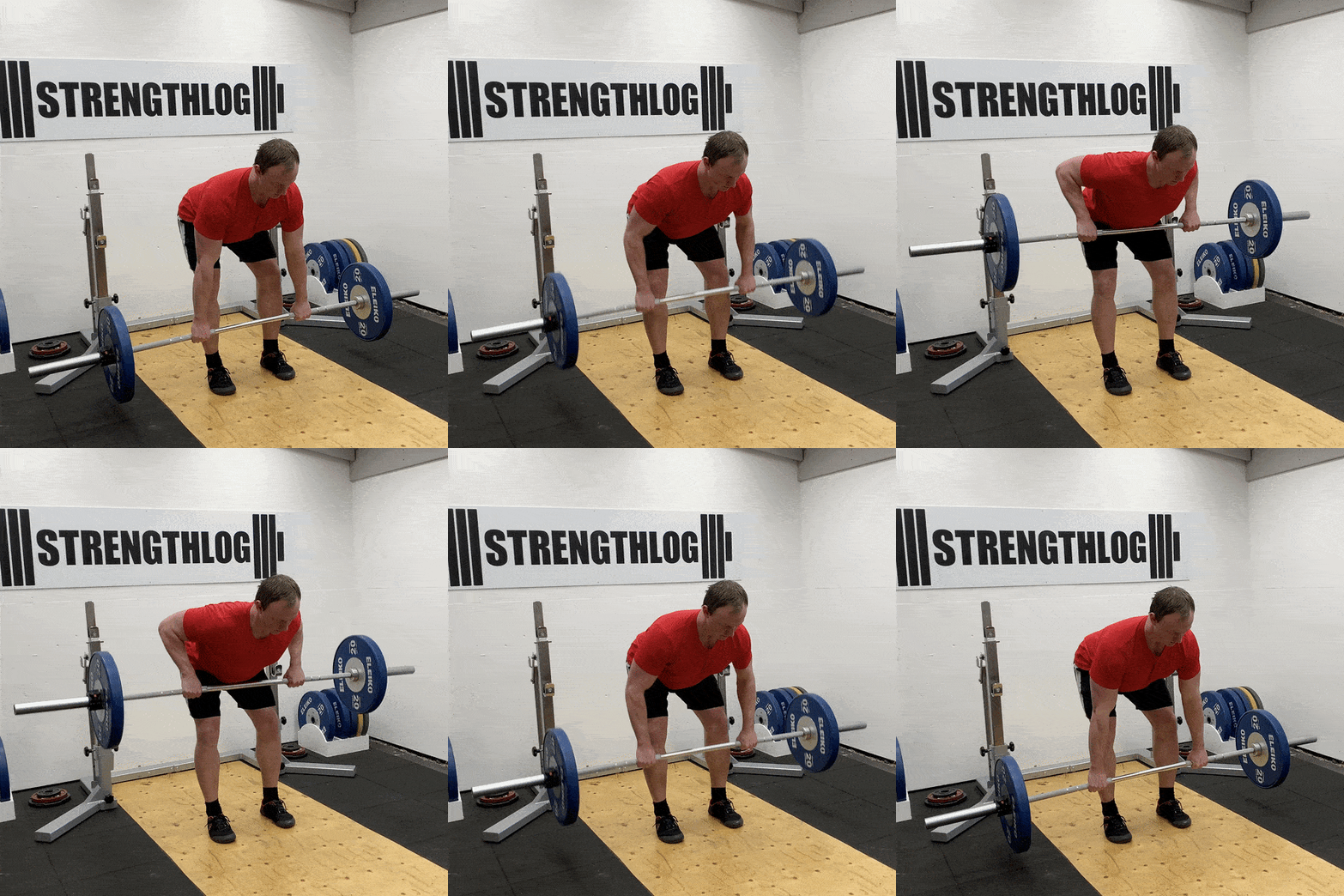
The barbell row is a compound exercise for the upper back that hits the latissimus dorsi, trapezius, rhomboids, and rear delts while also giving the biceps, forearms, and spinal erectors some quality time. Basically, if it’s in your upper back or helps you pull something, it’s involved.
On the ice, you need upper-body strength and control, especially when you’re battling in the corners, trying not to be yeeted into the boards by someone built like a vending machine. The barbell row develops pulling power for performance for sure, but it also promotes postural strength for better balance and endurance in that skating stance.
And let’s not forget injury prevention. With stronger upper and mid-back muscles, you reduce the risk of injuries, which is common in a sport full of slapshots and collisions.
How to Do Barbell Rows
- Grasp the barbell with an overhand grip, slightly wider than shoulder-width apart.
- Stand with your feet slightly wider than feet hip-width apart, bend your knees slightly, and hinge forward at your hips, maintaining a straight line from your head to your hips.
- Brace your core and keep your back straight. Pull the barbell towards your lower chest or upper core, keeping your elbows close to your body. Squeeze your shoulder blades together at the top of the movement.
- Lower the barbell back to the starting position in a controlled manner.
- Repeat the movement for the desired number of repetitions.
Face Pull

The face pull is an underrated but valuable exercise for hockey players—especially when it comes to shoulder health, posture, and upper-body strength balance. It’s not a flashy exercise like heavy bench presses or power cleans, but it strengthens small but essential muscles for performance, injury prevention, and longevity on the ice.
Face pulls work the rear delts, rhomboids, parts of the traps, and the external rotators of the shoulder, especially the infraspinatus and teres minor and help undo the muscular imbalances hockey creates—dominant internal rotators and front delts, for example. They even indirectly improve your performance by reinforcing shoulder stability during explosive upper-body movements like shooting or checking.
You don’t want to use a lot of weight when doing face pulls. Keep it relatively light, focus on higher rep ranges, and maintain good form throughout.
How to Do Face Pulls
- Fasten a rope handle in a high position on a cable pulley. Grip the ropes with an overhand grip, and take a step or two back.
- With elbows held high, pull the rope towards you by letting your upper arms move straight out towards your sides, while simultaneously rotating your forearms up.
- Return with control to the starting position, by letting your arms move forward again.
- Repeat the movement for the desired number of repetitions.
Hammer Curl

The hammer curl is a variation of the traditional dumbbell bicep curl with more going for it than just arm aesthetics for hockey players.
In addition to training your biceps (with emphasis on the long head), it’s a great exercise for the brachioradialis, which runs from the upper arm down into the forearm. It gives you more grip strength and wrist control, which translates to better stickhandling, firmer passes, shot power, puck protection, and even injury prevention by reinforcing the muscles around the elbow and wrist.
How to Perform Hammer Curls
- Start with your feet shoulder-width apart and your arms at your sides, holding a dumbbell in each hand with your palms facing each other.
- Bend your elbows and curl the dumbbells up towards your shoulders, keeping your upper arms close to your sides. Don’t swing the dumbbells up; focus on contracting your biceps to curl them up.
- At the top of the movement, your forearms should be parallel to the ground, and your biceps should be fully contracted.
- Lower the dumbbells back to the starting position, under control.
- Repeat the movement for the desired number of repetitions.
Hanging Leg Raise

The hanging leg raise is a basic (but no less effective) exercise for the abdominal and hip flexor muscles.
As a hockey player, you need a core that can handle whatever a match throws at you, from any angle. You must be able to depend on it to maintain balance while in a skating stance and to stabilize the trunk during any aggressive movement like shooting, checking, or rapid direction changes. That is the reason Strength Training for Hockey includes a number of different core and ab exercises. The added hip flexor strength you get from leg raises improves skating stride power and acceleration.
How to Do Hanging Knee/Leg Raises
- Grasp a pull-up bar with an overhand grip, shoulder-width apart.
- Hang from the bar with your arms fully extended and your body in a straight line from your head to your heels.
- Engage your core and keep your back straight.
- Raise your knees or legs towards your chest, as high as you can, keeping your back straight and your core engaged.
- Slowly lower your legs back down to the starting position.
- Repeat the movement for your desired number of repetitions.
Hip Thrust

The hip thrust is a lower-body exercise that primarily builds the glutes, with secondary activation of the quads and adductors. It’s a compound movement—it involves multiple joints—but you’d be forgiven for thinking it’s an isolation exercise because it’s so glute-heavy. It’s popular for building a big booty, glute strength, and hip extension power and for improving athletic performance.
Hip thrusts are awesome for hockey players because the glutes are your power pack for powerful skating strides and lower-body explosiveness. More hip extension power contributes to better acceleration, stability, and balance on the ice. Also, it improves muscular balance and control in and of the muscles that support your pelvis, which could reduce the risk of groin and lower back injuries.
Note: You can do this exercise in a hip thrust machine if you have access to one.
How to Do Hip Thrusts
- Sit on the floor with your back against a sturdy bench.
- Roll the barbell up over your thighs, until it is placed over your hips.
- Place your feet on the floor, about shoulder-width apart, with bent knees.
- Place your hands on the bar to stabilize it.
- Push the bar towards the ceiling by extending your hips. Your knees should form a ~90 degree angle at the top.
- Squeeze your glutes at the top of the thrust like you’re trying to crack a walnut before lowering the weight.
- Repeat the movement for the desired number of repetitions.
Depth Jump

The depth jump is a plyometric exercise designed to improve explosive power in the lower body. It involves a rapid transition from landing to jumping, utilizing the stretch-shortening cycle of muscles to improve reactive strength.
Athletes typically include depth jumps in their training to boost vertical leap, but you’ll benefit from doing it as a hockey player, too, even though high jumps aren’t a big part of a hockey match. That’s because they develop explosive leg power and quickness—a must-have for fast starts, quick stops, and rapid direction changes on the ice. Also, the reactive strength you gain from depth jumps is great for overall agility and balance—always welcome, as they are key components of skating power and performance in high-speed game situations.
How to Do Depth Jumps
- Stand upright on the edge of as bench or platform with feet shoulder-width apart.
- Step off the platform (don’t jump) and let yourself fall naturally.
- Land softly on the balls of your feet, knees slightly bent, in an athletic stance.
- Immediately explode upward into a vertical jump as quickly and powerfully as possible.
- Land again with control, absorbing the impact by bending your knees.
- Reset and repeat for the desired number of repetitions.
Plank With Leg Raise

The plank is one of the most popular ab exercises. You hold your body in a straight line from head to heels while balancing on your forearms and toes to strengthen your core. It trains both your superficial abs (rectus abdominis, outer obliques) as well as the deep core muscles (transverse abdominis, inner obliques), and the leg raise part adds one more stabilization component to the exercise.
Hockey-specific benefits include a stronger core, glutes, and lower back, which are crucial for maintaining stability and power during skating and body checks. It also improves balance and coordination and gives you more single-leg strength for better stride efficiency and reduced injury risk.
How to Do Plank with Leg Lifts
- Begin by getting into a standard plank position. Place your elbows directly under your shoulders, legs extended straight behind you, and toes pressing into the ground. Your body should form a straight line from your head to your heels.
- Brace your core, keep your back flat, and avoid letting your hips sink down or lift too high.
- Slowly lift one leg off the ground to about hip height without bending the knee. Keep your leg straight during the movement.
- Hold the lifted position for a moment, then gently lower your leg back to the starting position.
- Repeat the lift with the opposite leg, ensuring you maintain a strong plank position throughout the movement.
- Continue to alternate legs for the chosen amount of time.
Dips

Dips—not the nacho kind, sadly—are a bodyweight pushing exercise where you support yourself on parallel bars, lower your body by bending your elbows until your upper arms are roughly parallel to the ground, and then push yourself back up. It’s very effective for building muscle mass and strength in your chest, front delts, and triceps.
Unlike some other pressing exercises where you’re lying down, dips are upright and dynamic, forcing your body to stabilize and move through space—more like you do in a game. Battling in the corners, throwing checks, fending off opponents, and protecting the puck all require serious upper-body strength and stability, and that’s what you get if you do dips regularly.
If you find bodyweight dips too challenging, you can make the exercise more accessible by using a resistance band.


Conversely, if you can crank out more reps than the Strength Training for Hockey program calls for, you can use a weight belt for more resistance.
How to Perform Bar Dips
- Grip a dip station about shoulder-width apart, and climb or jump to get into the starting position.
- Lower yourself with control until your shoulder is below your elbow, or as deep as you comfortably can.
- Reverse the motion and return to the starting position.
Strength Training for Hockey: Final Rep
Whether you’re chasing a championship or just trying to outmuscle your buddies on beer league night, you need to make strength training part of your hockey playbook.
Follow this training program for 11 weeks, and you’ll have built a fantastic base of strength, muscle, and power and be ready for in-season play.
To follow Strength Training for Hockey, download our workout log app and start tracking your workouts today:
Click here to go directly to the program in StrengthLog.
References
- NBC Sports. Gary Roberts discusses his post-NHL career as a strength and conditioning coach.
- Med Sci Sports Exerc. 1991 Jun;23(6):739-43. Effects of strength training on lactate threshold and endurance performance.
- Strength and Conditioning Journal 40(2):p 1-16, April 2018. Preparing for the Demands of Professional Hockey.
- Strength and Conditioning Journal 36(6):p 28-36, December 2014. A Strength and Conditioning Approach for Ice Hockey.
- Br J Sports Med. 2014 Jun;48(11):871-7. The effectiveness of exercise interventions to prevent sports injuries: a systematic review and meta-analysis of randomised controlled trials.
- Br J Sports Med. 2018 Dec;52(24):1557-1563. Strength training as superior, dose-dependent and safe prevention of acute and overuse sports injuries: a systematic review, qualitative analysis and meta-analysis.
- J Strength Cond Res. 2015 May;29(5):1191-6. Division I Hockey Players Generate More Power Than Division III Players During on- and Off-Ice Performance Tests.
- Front Physiol. 2023 Dec 13:14:1272106. Triceps surae muscle hypertrophy is greater after standing versus seated calf-raise training.
- J Strength Cond Res. 2023 Sep 1;37(9):1746-1753. Greater Gastrocnemius Muscle Hypertrophy After Partial Range of Motion Training Performed at Long Muscle Lengths.
- Int J Environ Res Public Health. 2020 Sep; 17(17): 6015. An Electromyographic Analysis of Lateral Raise Variations and Frontal Raise in Competitive Bodybuilders.
- Am J Sports Med. 2001 Mar-Apr;29(2):124-8. The association of hip strength and flexibility with the incidence of adductor muscle strains in professional ice hockey players.
