
This is a 12-week off-season strength training program for handball players to build functional muscle mass, maximal strength, power, and speed, and to prevent injuries on the court.
- Duration: 12 weeks
- Frequency: Three days per week.
- Level: All handball players (some strength-training experience recommended)
Nobody gets into handball to gently lob the ball into the net.
You want the satisfying thwack of a cannonball shot.
You want to soar through the air for a jump shot.
You want to shoulder past a defender and make it look easy.
To do that, you’re going to need more than cardio and good intentions.
You need strength and power.
This program for handball gives you the edge to outmuscle, outlast, and outplay your opponents with the best exercises and strategic progression.
Go directly to the program in StrengthLog.
Table of Contents
What Is Handball?
Since you’re reading something as specific as a guide to strength training for handball, I’m sure you are already quite familiar with the sport, so I’ll keep this short and to the point.
Handball is a fast and physical team sport where two teams of seven players, including a goalkeeper, try to score by throwing a ball into the other team’s goal.
A match consists of two 30-minute halves with a 10-minute halftime break. At the end of the game, the team with the most goals wins.
Handball is popular in many parts of the world, with around 30 million registered players globally, and is recognized as an Olympic sport. Europe is the epicenter of the sport, where it’s the second most popular team sport behind football (soccer) in several countries.
However, it’s a tiny sport in the US, and many people have never heard of it.
There is also American handball (wallball), in which players hit a small ball against a wall with their hands, but this article is about the “European” version, the team sport.
Benefits of Strength Training for Handball
If you’re looking for a game that’s all action with very little downtime, you’ve found it. Handball is a very fast-paced and physically demanding sport.
Players are constantly running, jumping, sprinting, and changing direction during a match. They can only stand still holding the ball for three seconds and are limited to just three steps before they must pass or shoot.
It’s also a full-contact sport where the defenders use their bodies to stop attackers.
That combination of speed and physicality makes handball one of the most demanding team sports, certainly comparable to basketball or water polo.
It requires a ton of endurance, but also full-body strength and explosive power, the kind you can only build in the weight room.
Just try to find an elite handball player nowadays who doesn’t dedicate a significant portion of their training to building strength and power.
I say nowadays because, as with almost every team sport, that wasn’t always the case.
Go back a few decades, and coaches in many team sports, including handball, believed that lifting weights made players “muscle-bound,” slow, and inflexible.
Today, sports science recognizes that strength training is the most effective way to boost throwing speed and that stronger players outperform equally skilled but weaker players in every way.1 2 3 4
In other words, to be the best handball player you can be, you need to know your way around the weights.
How Strength Training Improves Handball Performance
| Strength Training Focus | Benefit in Handball | On-Court Impact |
|---|---|---|
| Lower Body Strength | Jumping power, sprint speed, and stability | Higher shots, faster transitions, better balance in defense |
| Upper Body Strength | Throwing speed and accuracy | More powerful shots, longer passes, harder-to-block throws |
| Core Strength | Rotational power, balance, and body control | Stable shooting stance, quicker direction changes |
| Explosive Power, Plyometric Exercises | Reaction speed, quick accelerations | Faster breaks, quicker rebounds, and agile defense |
| Grip & Forearm Strength | Ball control, resistance to defensive pressure | Fewer turnovers, stronger ball handling under contact |
| Strength Endurance | High performance throughout the entire match | Less fatigue, consistent intensity until the final whistle |
| Injury Prevention Training | Strengthens, joints, tendons, and ligaments | Fewer injuries, quicker recovery, longer career longevity |
Strength Training for Handball: The Basics
The year of a handball player is divided into off-season, pre-season, and in-season, with the first two usually lasting 12–16 weeks.
I’m going to refer to the first two combined as the preparation period. This is when you focus on building a foundation of strength, power, speed, and endurance to prepare your body for the competitive season.
There is no mandatory length of a handball preparation period (it varies by league and athlete), but if you can dedicate at least 12 full weeks to getting ready for next compeitive season, it’s ideal.
You don’t want to cram 12 weeks worth of training into a month. Improvements in power, strength, and speed take time, and the more advanced you get, the longer they take.
How Often Should Handball Players Lift Weights?
| Training phase | Typical weekly strength dose |
|---|---|
| Off-season (general preparation, no matches) | 3–4 sessions (e.g., full body or upper/lower split, hypertrophy & strength) |
| Pre-season (≥4 weeks before first competition season) | 2–3 sessions (focus-shift towards power and speed). |
| In-season | 2–3 sessions (shorter sessions for maintaining strength and power rather than building new muscle mass). |
The recommendations above are meant for intermediate or recreational players.
- If you’re a beginner, you can do fewer workouts in the off-season (two per week) and focus on basic movements and learning how to perform the exercises.
- If you’re an elite player with plenty of strength-training experience, you can train more often in the off-season. But at that level, you likely have a coach who adjusts the plan to your needs, and a one-size-fits-all program might not be as effective.
Every handball player must be able to sprint, jump, throw, and handle plenty of physical contact. Strength training can improve all four factors, as long as your workout routine must cover all bases.
Your training should be functional, but don’t fall for the idea that your weight training must replicate handball moves.
Strength and muscle are functional. Most of your lifting should build overall strength, power and muscle, then add some handball-specific drills to connect that strength to your game.
Choosing the Right Strength Training Exercises for Handball
| Function in handball | Go-to exercises | Main muscles worked | Why it matters |
|---|---|---|---|
| Lower-body force & vertical power | Squat / Front squat, Trap-bar deadlift, Hip thrust | Quads, glutes, core | Faster first step, powerful take-off, sturdier body contact. |
| Posterior-chain speed & deceleration | Romanian deadlift, Nordic hamstring | Hamstrings, glutes, spinal erectors | Sprint speed and safer braking/landing after jumps and shots. |
| Single-leg strength & change of direction | Bulgarian split squat, Lateral lunge | Quads, glutes, adductors, core | Quicker cuts, better and safer landings under contact. |
| Lateral/groin strength | Copenhagen plank, Lateral lunge | Adductors, obliques, glute med | Groin injury protection and side-step power. |
| Ankle stiffness & rebound | Calf raise | Gastrocnemius, soleus | Quicker ground contact, higher repeated jumps, cleaner landings. |
| Upper-body pushing & transfer | Bench press, Push press, Landmine press | Pecs, delts, triceps, legs/core (push press) | Contact strength, shot stability, leg-to-arm power transfer. |
| Upper-body pulling & arm decel | Pull-up, Barbell row, Dumbbell row | Lats, mid-back, biceps, scap stabilizers | Deceleration controlafter throws, balances pressing volume. |
| Shoulder health & scap control | Face pull, Y Raise | Rear delts, external rotators, lower traps, serratus | Keeps shoulders healthy for shooting and blocking. |
| Rotator-cuff integrity | External rotations (band/cable) | Infraspinatus, teres minor | Protects your throwing shoulder and improves accuracy. |
| Core anti-rotation & anti-tilt | Pallof press, Suitcase carry | Obliques, transverse abdominis, grip | Resists trunk twist and side-bend in contact; better force transfer. |
| Game-like resisted acceleration | Sled push | Quads, glutes, calves, core | Sprint-specific force without soreness |
Each and every one of the above exercises are strategically implemented in Strength Training for Handball.
Sample Week of Strength Training for a Handball Player
Here is what a sample week of training could look like for an intermediate-level handball player; not a pro but one who balances training with a job and family and can do one session per day.
| Training Day | Training Type |
|---|---|
| Monday | Lower Body Strength |
| Tuesday | Technical & Agility |
| Wednesday | Upper Body Strength |
| Thursday | Endurance & Conditioning |
| Friday | Full Body Strength |
| Saturday | Technical & Tactical |
| Sunday | Rest / Recovery |
Strength Training Program for Handball
This is a training program for handball players who want to develop their strength, power, speed, and stability and prevent injuries on the court.
It’s suitable for the off-season and into the pre-season parts of your training.
The program works best if you already have some strength training experience. It features many different, relatively complex exercises, and if you have never lifted weights before, it might be too much for you to jump right into.
If you’re new to the gym, start with one of our beginner programs, like the Beginner Barbell Training Program. You train three times per week, alternating between workouts A and B.
Workout A
| Exercise | Sets | Reps |
|---|---|---|
| Squat | 3 | 8–10 |
| Bench Press | 3 | 8–10 |
| Barbell Row | 3 | 8–10 |
Workout B
| Exercise | Sets | Reps |
|---|---|---|
| Deadlift | 3 | 6–8 |
| Lat Pulldown (or Pull-Ups) | 3 | 8–10 |
| Overhead Press | 3 | 8–10 |
In other words, you’ll train workouts A B A week one and B A B week two, then go back to week one and keep alternating between the two.
This beginner program (and many more) are available for free in our workout log app, StrengthLog.
You can use the strength you gain to your advantage on the handball court. It’s a great way to teach your muscles, brain, and nervous system to play together, allowing you to move on to more complex programs.
If you do have some weight training experience, you’re ready for Strength Training for Handball.
12-Week Off-Season/Pre-Season Strength Training Program for Handball
This is a 12-week preparation phase plan for handball players, designed with periodization to build muscle strength, lean mass, maximum power, stability, and speed.
Note: The program is an intermediate-level and above program, but that is regarding your strength-training experience. It works great for all handball players, beginners and up. You don’t have to have played handball for any specific length of time to use it, but it will likely be too advanced if you are completely new to strength training.
The program follows a 3-phase progression:
| Day | Focus |
|---|---|
| Weeks 1–4 | Base Strength & Hypertrophy |
| Weeks 5–8 | Maximal Strength & Force Production |
| Weeks 9–12 | Strength-Speed & Power |
Primary Program Goals
- Build muscle mass and correct imbalances, particularly between dominant and non-dominant sides.
- Increase the absolute force you can produce. A stronger handball player is a better handball player.
- Translate your strength gains into handball-type explosive actions: jumping, sprinting, and throwing.
- Strengthen stabilizers in the shoulders, core, and hips to handle the demands of a long season.
You’ll train three days per week, focusing on strength, power and injury‐prevention, with progressive overload built in.
| Day | Focus |
|---|---|
| Workout 1 (e.g. Monday) | Lower Body + Core |
| Workout 2 (e.g. Wednesday) | Upper Body + Shoulder Health |
| Workout 3 (e.g. Friday) | Full Body (Power Emphasis) |
Do your technical/tactical/agility work on other days, and take at least one rest day per week.
You can pick which days you hit the weights to fit your schedule, but training on Monday, Wednesday, and Friday or Tuesday, Thursday, and Saturday is optimal for recovery.
- Progression: This program is divided into three phases (Weeks 1–4, 5–8, 9–12). Within each phase, try to increase weight slightly (2.5–5 lb increments for upper body lifts, 5–10 lb increments for lower body) when you can complete all prescribed reps without breaking form. During the power phase, focus on bar speed and intent. and keep the weights submaximal but fast.
- Rest: Rest 90–120 seconds between heavier lifts (strength-focused sets of 5–6 reps) and around 60 seconds for accessory or higher-rep work. Power exercises often need slightly longer rest (2–3 minutes) to maintain explosiveness.
- Deload: Feel free to include a deload (-30–40% volume) in Week 4 and Week 8 if you feel fatigued. I have not pre-programmed any deloads, but don’t be afraid to adapt your sessions if you feel overwhelmed.
Dynamic Warm-Up (10–15 Mins)
Don’t skip this part. Do it before each training session, and you’ll increase blood flow, activate your nervous system, and lubricate your joints to perform better.
- Cardio (5 mins): Light jogging, skipping, or stationary bike.
- Dynamic Stretching (5–10 mins):
- Leg Swings (forward & sideways): 10 per leg/direction
- Walking Lunges: 10 per leg (workouts 1 & 3)
- Cat-Cow: 10 reps
- Thoracic Spine Rotations (quadruped): 8 per side
- Arm Circles & Arm Swings: 10 per direction (workout 2)
- Band Pull-Aparts: 2 sets of 15 (workout 2)
- Glute Bridges: 2 sets of 15 (workouts 1 & 3)
Below is an example of a week from the program with the exercises you’ll do during each phase. The exact number of sets and the rep scheme, details of all three phases, including % of 1RM recommendations along with the planned intensity and volume progression route, are available in your StrengthLog workout tracker app.
Weeks 1–4: Base Strength & Hypertrophy
Goal: Build tissue capacity, lean mass, general strength, and stability.
Workout 1: Lower Body & Core
| Exercise | Sets |
|---|---|
| Squat | 4 |
| Romanian Deadlift | 4 |
| Bulgarian Split Squat | 4 |
| Standing Calf Raise | 3 |
| Nordic Hamstring Eccentric | 3 |
| Core Circuit: Pallof Press + Side Plank + Dead Bug | 2 + 2 +2 |
Workout 2: Upper Body
| Exercise | Sets |
|---|---|
| Bench Press | 4 |
| Pull-Up | 4 |
| Dumbbell Row | 3 |
| One-Arm Landmine Press | 3 |
| Circuit: Y Raise + External Shoulder Rotation | 2 + 2 |
Workout 3: Full Body
| Exercise | Sets |
|---|---|
| Block Clean Pull | 5 |
| Front Squat | 3 |
| Hip Thrust | 3 |
| Push Press | 4 |
| Farmers Walk | 3 |
| Medicine Ball Chest Pass | 3 |
Weeks 5–8: Maximal Strength & Force Production
Goal: Drive up heavy patterns and develop maximal strength. Lower reps, heavier loads, slower tempo.
Workout 1: Lower Body & Core
| Exercise | Sets |
| Squat | 5 |
| Trap Bar Deadlift | 4 |
| Bulgarian Split Squat | 3 |
| Nordic Hamstring Eccentric | 3 |
| Standing Calf Raise | 3 |
| Core circuit: Horizontal Wood Chop + Suitcase Carry | 3 + 20 m/side |
Workout 2: Upper Body
| Exercise | Sets |
| Bench Press | 5 |
| Pull-Up | 5 |
| Overhead Press | 3 |
| Barbell Row | 3 |
| Face Pull | 3 |
| Ball Slam | 3 |
| Circuit: Y Raise + External Shoulder Rotation | 2 + 2 |
Workout 3: Full Body
| Exercise | Sets |
| Hang Power Clean | 5 |
| Front Squat | 5 |
| Romanian Deadlift | 3 |
| Incline Dumbbell Press | 4 |
| Side Lunges | 3 |
| Box Jump | 3 |
Weeks 9–12: Strength-Speed & Power
Goal: Move heavy-ish loads fast. Keep some heavy work but more power work: translate strength to speed and explosive movement. Focus on high speed and technique; increase the load once speed drops <90%.
Workout 1: Lower Body & Core
| Exercise | Sets |
| Depth Jump | 3 |
| Front Squat (max speed) | 5 |
| Jump Squat | 3 |
| Bulgarian Split Squat | 3 |
| Nordic Hamstring Eccentric | 3 |
| Dynamic Copenhagen Plank | 3 |
| Core circuit: Ab Wheel Roll-Out + Pallof Press | 3 + 3 |
Workout 2: Upper Body
| Exercise | Sets |
| Circuit: Landmine Rotation + Ball Slam | 3 |
| Bench Press (max speed) | 5 |
| Dumbbell Row | 4 |
| Landmine Press | 4 |
| Medicine Ball Chest Pass | 3 |
| Circuit: Y Raise + External Shoulder Rotation | 2 +2 |
Workout 3: Full Body
| Exercise | Sets |
| Horizontal and Vertical Jump | 3 |
| Kettlebell Swing | 5 |
| Trap Bar Deadlift | 5 |
| Sled Push | 5 |
| Pull-Up | 3 |
| Single Leg Romanian Deadlift | 3 |
| Suitcase Carry | 3 × 25–30 m/side |
Follow the Strength Training for Handball Program in StrengthLog
This and many more training programs are in the StrengthLog workout log app. The app is free to use, forever, with no ads. This program, however, is a premium program (it offers advanced percentage-based progression and periodization), which means it requires a premium subscription.
We offer all new users a free 14-day premium trial. You can activate it in the app without any strings attached.
Download StrengthLog and start tracking your workouts today:


Strength Training for Handball: Exercises
Here are detailed descriptions of all the exercises in the Strength Training for Handball program in the order they appear.
Squat

Power, speed, and agility start from the ground up. And what’s the best way to build a powerful lower body? The good old barbell squat.
Squats build strength and power in your quads, glutes, and adductors, and these are the muscles that launch you upwards and allow you to sprint faster. Studies have found that how heavy you can squat also predicts how high you can jump.5
Good squat strength is also important for protecting your knees in handball. Players with low squat strength are more likely to have their knees collapse inwards during jump landings. In one recent study, weaker players had up to 27 times higher odds of knee valgus.6
How to Squat
- Place the bar on your upper back with your shoulder blades squeezed together. Inhale and brace your core slightly, and unrack the bar.
- Take two steps back, and adjust your foot position.
- Squat as deep as possible with proper form.
- With control, stop and reverse the movement, extending your hips and legs again.
- Exhale on the way up or exchange air in the top position.
- Repeat the movement for the desired number of repetitions.
Romanian Deadlift

If the squat is the king of leg day, the Romanian deadlift (RDL for short) is the ruler of the entire posterior chain (the muscles on the backside of your body).
The RDL trains the hip extension movement pattern that fuels your ability to jump higher and sprint faster. It is extra valuable for athletes because the muscles it strengthens are also responsible for preventing injuries, especially around the knees and hips.
The Strength Training for Handball program includes both regular RDLs and the single-leg variation. The latter introduces a balance and coordination component and challenges your hip stability. You often push off or land on one leg in handball, so training all movement patterns unilaterally is a good idea.
How to Do Romanian Deadlifts
- Get into the starting position by deadlifting a barbell off the floor or by unracking it from a barbell rack. Stand feet hip-width, inhale, and brace your core slightly. If you’re doing single-leg RDLs, lift one leg off the ground.
- Lean forward by hinging in your hips. Keep your knees almost completely extended.
- Lean forward as far as possible with good form (no rounding your back). You don’t have to touch the barbell to the floor, although it is OK if you do.
- Reverse the movement and return to the standing position. Exhale on the way up.
- Repeat the movement for the desired number of repetitions.
How to Do Single Leg Romanian Deadlifts
- Stand upright and hold the bar with your hands about shoulder-width apart.
- Brace your core, and lift one leg off the ground.
- Keep the back straight and lean forward by hinging at the hips. Lower until you feel a stretch in the standing leg’s hamstring. Make sure to keep your hips still; you don’t want the side with your lifted leg to start rotating upwards.
- Return to the starting position. Finish all your reps on one side first, then repeat on the other leg.
Note: The dumbbell Romanian deadlift is a viable alternative to the barbell variant.
Bulgarian Split Squat

The Bulgarian split squat is a one-leg squat where your back foot rests on a bench, step, or pad.
You don’t do much with two feet planted symmetrically in handball. Single-leg strength is supremely valuable on the court, where you’re almost constantly pushing off with one leg as you sprint, jump for a shot, or cut past a defender.
Split squats are unstable; great for activating the small muscles around your hips, knees, and ankles. This way, you improve your balance and body awareness when you land from a jump, fight through contact, or change direction mid-sprint.
And, unlike regular squats, split squats build strength and muscle without loading your spine as much, making it a good complement to your heavier lifts.
How to Do Bulgarian Split Squats
- Place a bar on your upper back or hold a pair of dumbbells in your hands.
- Stand with your back turned against a bench, which should be about knee height. Stand about one long step in front of the bench.
- Place your right foot on the bench behind you.
- Inhale, look forward, and squat down with control until right before your right knee touches the floor.
- Reverse the movement and extend your front leg again, while exhaling. Your back foot should only act as support.
- Repeat the movement for the desired number of repetitions, then switch sides and repeat with your right leg forward and your left foot on the bench.
Calf Raise

Almost every explosive action in handball involves your lower legs, and calf raises are how you build strength in them.
For a handball player, calf strength and power mean quicker direction changes, higher jumps for blocks or shots, and the stability you need to nail your landings without getting hurt. You don’t want to get sidelined by a rolled ankle mid-season.
Make sure you get a full range of motion. All the way up and all the way down. Your calf muscles respond best to the stretched position, and you want strength through their full range for ankle stability and to reduce the risk of Achilles tendon injuries.
I have programmed the standing calf raise as the default calf exercise for this training program, but feel free to do calf raises in the leg press machine instead if it feels more comfortable. The two exercises are virtually identical in muscle activation, and as long as you keep your legs (almost) straight, any calf exercise will do the job (straight-legged calf raises are much more effective than seated).7
How to Do Standing Calf Raises
- Place your toes and the balls of your feet on the foot support. Place the shoulder pads against your shoulders and stand upright with your feet hip-width. This is your starting position.
- Lower yourself down until you feel a slight stretch in your calves by bending your ankles in a controlled movement. Avoid letting your heels drop too quickly or bounce at the bottom.
- Push yourself up by extending your ankles to lift your heels as high as possible.
- Repeat the movement for the desired number of repetitions.
Nordic Hamstring Eccentric

Many athletes love the Nordic hamstring curl for its benefits, but hate that it’s so tough. You should, however, embrace it because eccentric Nordics can halve the rate of hamstring injuries for handball players.8
Not snapping a hammy mid-sprint is reason enough to do them, but preventing injuries isn’t all Nordic hamstrings are good for. They also help with sprint speed and overall lower-body strength. Some coaches claim that Nordic hamstrings will not improve sprint performance since they are a single-joint exercise, but research shows that more eccentric hamstring strength equals better acceleration.9
The exercise itself is simple: kneel down, anchor your feet (or have a teammate hold them), then slowly lower your upper body forward using only your hamstrings to resist the fall. Try not to faceplant, then push yourself back up. The benefits come from the lowering phase, so you don’t have to pull yourself up with hamstring strength alone.
How to Do Nordic Hamstring Eccentrics
- Start off standing on your knees with a straight hip. Feet wedged under something immovable, like a heavily loaded barbell, or a strong training partner.
- Lean your torso forward by extending your knees with no hip movement. In other words, do not push your butt backward.
- Control the eccentric movement by fighting the gravitational forces with all your hamstring strength. If possible, try keeping the eccentric phase to two seconds.
- When your chest reaches the floor, push yourself up using your arms and start over.
- Repeat the movement for your desired number of repetitions.
Core Circuit: Pallof Press + Side Plank + Dead Bug
You’ll finish several Strength Training for Handball workouts with core training circuits where you do several exercises in a row.
They train all your abdominal muscles and improves both rotational and anti-rotational performance without taking forever to do.
Take as little rest as possible between exercises within a circuit, but rest normally between circuits.
Circuit 1: Pallof Press + Side Plank + Dead Bug


How to Pallof Press
- Attach a handle in a cable machine at chest height and stand with your side facing the machine.
- Grab the handle with both hands and stand with feet hip-width apart and knees slightly bent.
- Pull the handle to your chest, engage your core, and then press your arms straight out in front of you without rotating your torso.
- Hold briefly, then bring the handle back to your chest in a controlled motion.
- Repeat for the desired number of repetitions, then switch sides.
How to Do Side Planks
- Stand on your side, leaning against one elbow.
- Place the foot of the top leg in front of the other foot.
- Brace your core, and try to form and hold a straight line from your head to your feet.
How to Do Dead Bugs
- Lie on your back like a bug that’s been flipped over, with your arms straight up towards the ceiling and your legs stacked over your hips, with the knees bent in a 90-degree angle.
- Engage your core, and make sure that the lower back has contact with the surface.
- With control, straighten out the right leg and lower it towards the floor at the same time as you lower the left arm over your head as far as you can. Keep the lower back in contact with the floor the entire time.
- Reverse the movement, and repeat for the other side.
Circuit 2: Horizontal Wood Chop + Suitcase Carry


How to Do Horizontal Wood Chops
- Fasten a handle in a cable machine, as high up as possible. Grip the handle with both hands, step away, and stand sideways to the cable’s anchor point.
- With almost straight arms, make a sweeping, chopping-like movement diagonally downward.
- Return to the starting position in a controlled manner.
A horizontal cable chop best matches handball throw patterns and lets you train rapid hip–torso rotation and bracing against the cable’s pull. You can switch it up and do low-to-highs and high-to-lows occasionally, but keep horizontals as the standard.
Note: you can do this exercise either in a cable machine (like in the video demonstration above) or with a resistance band.
How to Do Suitcase Carries
- Pick up a kettlebell or dumbbell with one hand, letting it hang at your side, like when carrying a suitcase. Brace your core and start walking forward.
- Take small steps and focus on keeping the core tight and your posture straight, rather than leaning forward.
- Continue this movement for the desired distance. When finished with the first side, set the weight down.
- Pick up the kettlebell with the other hand and repeat.
Circuit 3: Ab Wheel Roll-Out + Pallof Press

How to Do Ab Wheel Rollouts
- Start by kneeling on the floor with your hands on the ab wheel, placed directly in front of your knees.
- Engage your core and slowly roll the wheel forward until your body forms a straight line from your knees to your head.
- Be sure to keep your back straight and your core engaged throughout the entire movement.
- Reverse the movement, roll the ab wheel back towards your knees, and return to the starting position.
- Repeat the movement for the desired number of repetitions.
Bench Press

The bench press is the most popular exercise for strength athletes, but it’s also useful for handball players. It develops your chest, triceps, and front delts, which all contribute to more strength and power behind every throw.
Yes, the power for a shot comes from your legs, hips, and core in a whip-like sequence, but bench presses make the final links in that chain stronger. Those are the muscles that provide the explosive, final push on the ball.
Research confirms that getting stronger in the bench is good for your throws.10 And you want to train for both maximum strength (lifting heavy) and explosive power (lifting lighter weights fast) to get the best results on the court. Strength Training for Handball is pre-programmed to cover all bases during different phases of the program.
How to Bench Press
- Lie on the bench, pull your shoulder blades together and down, and slightly arch your back.
- Grip the bar slightly wider than shoulder-width apart.
- Inhale, hold your breath, and unrack the bar.
- Lower the bar with control, until it touches your chest somewhere close to your sternum.
- Push the bar up to the starting position while exhaling.
- Take another breath while in the top position, and repeat the movement for your desired number of repetitions.
Pull-Up

When you do a pull-up, you build the muscles that control your scapula, protect your shoulders, and add velocity to your throws.
Pull-ups train your back (particularly the lats) and the biceps, which are important for the wind-up part of your throws. They are also great for muscle balance. Every hard throw creates torque, and without a strong back to counter it, your shoulders might start writing checks your joints can’t cash.
If you have a pull-up bar with a neutral grip (palms facing each other), you can vary regular pull-ups with it to place your shoulders in a more natural and less stressful position, ideal for handball players who do a lot of overhead throwing.
How to Do Pull-Ups
- Stand beneath a pull-up bar and reach up to grasp it with an overhand grip (palms facing away from you), slightly wider than shoulder-width apart. Ensure your grip is secure and comfortable.
- Hang freely from the bar, fully extending your arms. Your feet should be off the ground.
- Engage your core muscles by squeezing your abs and glutes.
- Inhale and initiate the movement by pulling your body weight up towards the bar by bending your elbows and squeezing your shoulder blades together. Focus on using your back muscles rather than relying on your upper arms.
- Continue pulling yourself up until your chin reaches or clears the bar. Keep your torso upright and avoid excessive swinging or kicking with your legs.
- Slowly lower yourself back down to the starting position while maintaining control and stability, fully extending your arms.
- Repeat the movement for your desired number of repetitions.
Dumbbell Row

The dumbbell row is another exercise for the muscles in your back – the lats, rhomboids, and traps (also your biceps and rear delts) – responsible for retracting and stabilizing your shoulder blades.
It’s super common for handball players to have a stronger, more developed throwing side. Dumbbell rows force each side to pull its weight and prevent your stronger side from compensating for the weaker one. A balanced body makes you perform better on the court and helps you stay off the physio’s bench.
One arm at a time also means you’re working on your core control, which is what you need when you’re twisting and getting bodied by defenders.
Rememeber to not just yank the weight up. To get the real benefits, you need to do it right, which means using a weight you can handle without involving your entire body,
How to Do Dumbbell Rows
- Find a flat bench. Place a dumbbell on the floor to one side of it.
- Plant your left knee and left hand firmly on the bench. Your back should be flat and close to parallel to the floor. Your right foot should be planted firmly on the floor out to the side for stability.
- Reach down with your right hand and pick up the dumbbell. Let it hang straight down, feeling a good stretch in your back.
- Take a breath, keep your back straight, and pull the dumbbell up towards your hip/lower chest. Lead with your elbow and imagine you’re trying to stuff it into your back pocket. Squeeze your shoulder blade at the top of the movement.
- Lower the dumbbell back to the starting position, with control; don’t just let it drop. Finish all your reps on one side before switching to the other.
One-Arm Landmine Press

The one-arm landmine press builds shoulder strength, improves rotational stability, and trains muscles and movement patterns you use all the time during a handball match, from throwing to blocking to shrugging off a defender with one arm while keeping the other in play.
And, when you press with one arm, you build anti-rotational strength (your core has to stop your torso from twisting) that will help you transfer power from your lower body, through your core, and into your throws.
I suggest you do the exercise in a split stance to add some lower-body coordination and balance work, just like when you brace on one leg for a shot or defend with a staggered stance.
How to Do One-Arm Landmine Presses
- Stand with your core activated and your feet about shoulder-width apart.
- Place the barbell in one hand and rest it on your shoulder.
- Press to lockout by extending the elbow and flexing the shoulder.
- Slowly lower the barbell back to the starting position on your shoulder.
- Repeat the movement for your desired number of repetitions.
Band External Shoulder Rotation

Here’s a small but mighty exercise that every handball player should have in their back pocket: the band external shoulder rotation.
Handball involves a ton of throwing that relies on the big, strong muscles on the front of your shoulder and chest (your internal rotators). The problem is that the smaller muscles on the back of your shoulder, the external rotators, often fall behind.
Shoulder problems are very common in handball, and weak external rotators is a big risk factor for shoulder pain.11
That’s why you want to make sure you keep them in shape by training them directly, like with external rotations.
However, just tacking on some rotations after handball practice is not enough.12 You want to integrate them into a complete strength training program, like this one, to reduce the risk of injury and even get some small but swell performance benefits.13 14
How to Do Band External Shoulder Rotations
- Fasten an elastic band at elbow height. Grab the band, step away, and stand sideways to it.
- Grab the band with your arm on the opposite side from its attachment point. Keep your upper arm close to your side, and bend your elbow to 90 degrees.
- Rotate your upper arm externally (outwards) against the band’s resistance, as far as possible.
- Reverse the movement, and repeat for reps.
- Repeat the movement for your desired number of repetitions.
Clean Pull

The clean pull is a weightlifting exercise where you explosively lift a barbell from the floor up to slightly above your waist. It’s a less complicated verstion of the full power clean but without the need to worry about flying under a bar or crashing it on your collarbones.
Clean pulls make you better at generating power in your hips and legs through triple extension. That is when your ankles, knees, and hips all straighten out in one coordinated movement, the same motion you use when you jump or sprint. So, the clean pull trains that movement pattern, like a cannon shot from your legs, through your hips, and into your upper body, and makes you more explosive on the court.
How to Clean Pull
- Stand with your feet hip-width apart and grip the bar just outside your knees. Keep your back straight, chest up, and shoulders slightly in front of the bar.
- Push through your legs to lift the bar from the floor, keeping it close to your body. Maintain a straight back and extend your knees while keeping your torso angle constant.
- Once the bar passes your knees, explosively extend your hips, knees, and ankles while pulling the bar upward.
- As you extend, shrug your shoulders forcefully and let the momentum bring the bar up. Keep your arms relaxed and elbows pointing up.
- Let the bar descend under control and reset for the next rep.
- Repeat the movement for the desired number of repetitions.
Front Squat

The front squat builds strength, power, and control that transfer superbly to handball performance. It is fantastic for an explosive leg drive, so whether you’re launching yourself for a jump shot or blocking an opponent, you’ve got juice to spare.
Front squats train the same muscles as the back squat, but because the barbell sits in front of your body (on your shoulders), it forces you to stay more upright, which increases core muscle activation. In addition, it activates muscles that support your shoulder complex, scapula, and lower back.
The upright position is also slightly more athletic, more like the posture you use in defense and during jumps.
Back and front squats excel in different areas, and you’ll do both on different training days in Strength Training for Handball.
How to Front Squat
- Grip the bar slightly wider than shoulder-width. Step forward and place the bar on the front of your shoulders: on top of your clavicles, and tight against your throat.
- Inhale and brace your core slightly, and unrack the bar.
- Take two steps back, and adjust your foot position.
- Squat as deep as possible with good technique.
- With control, stop and reverse the movement, extending your hips and legs again.
- Repeat the movement for the desired number of repetitions.
Hip Thrust

The hip thrust is an excellent exercise for handball players to build explosive power in the hips and glutes, your engine for sprinting. And that matters because almost everything in handball, from sprinting and jumping to shoving past defenders and changing direction, starts with your hips.
Powerful glutes mean a powerful hip extension, the driving force behind your acceleration. Some studies find that hip thrusts are even more effective than squats for improving sprint speed over short distances (10 and 20 meters).15
Note: You can do this exercise in a hip thrust machine if you have access to one. In fact, I recommend it, because it’s a hassle and a half to set up and get into the free barbell hip thrust.
How to Do Hip Thrusts
- Sit on the floor with your back against a sturdy bench.
- Roll the barbell up over your thighs, until it is placed over your hips.
- Place your feet on the floor, about shoulder-width apart, with bent knees.
- Place your hands on the bar to stabilize it.
- Push the bar towards the ceiling by extending your hips. Your knees should form a ~90 degree angle at the top.
- Squeeze your glutes at the top of the thrust like you’re trying to crack a walnut before lowering the weight.
- Repeat the movement for the desired number of repetitions.
Push Press

The push press is a full-body power builder dressed up as a shoulder exercise. It starts like a strict overhead press but with a little leg oomph. You dip at the knees and hips, like you’re about to fake out a defender, then drive through the floor and launch the weight overhead with as much explosive leg power as you can muster with a coordinated blast from your lower body, through your core, into your shoulders and triceps.
Push presses train the kinetic chain, legs to hips to shoulders, that you need during in-game movement. Plus, they toughen up your delts and stabilizers, which is great when you’re launching balls trying to blast one past the goalie.
How to Push Press
- Clean a bar to your shoulders, or lift it out from a rack.
- Let the bar rest against the front of your shoulders, with your grip slightly outside your shoulders.
- Inhale and lightly brace your core.
- Bend your knees, and then forcefully push yourself and the bar upwards using your legs.
- When your legs are extended, immediately start pressing the bar with your arms, until your arms are fully extended.
- With control, lower the bar back to your shoulders.
- Repeat the movement for your desired number of repetitions.
Farmer’s Walk

The farmer’s carry (or farmer’s walk) involves picking up something heavy in each hand (dumbbells, kettlebells, or specialized farmer’s carry handles) and walking with them. It’s a low-tech, high-reward exercise that builds functional strength for the court.
Farmer’s carries build a gorilla grip in a way few other exercises can. A stronger grip means better ball control, harder shots, and being able to rip the ball out of an opponent’s hands.
They also train core stability and shoulder endurance. And it builds toughness. All things you need when you’re wrestling for the ball and fending off opponents.
How to Do Farmer’s Walk
- Step in between two farmers’ walk-cases, or similar implements.
- Inhale, lean forward, and grip the handles.
- Hold your breath, brace your core slightly, and lift the weights.
- Look ahead, and start moving forward in small steps. Increase the stride length as you increase the speed.
- Try to keep your body in a straight line and not lean excessively forward as you walk.
- When you are done, lower the implements back to the ground in a controlled manner.
Medicine Ball Chest Pass
The med ball chest pass is a neat little drill for handball players to improve passing power and explosiveness. You throw a ball straight out from your chest with a weighted medicine ball, either to a partner or against a wall.
It trains your muscles to generate maximum force in the shortest amount of time. It’s a two-handed pass, but the movement pattern works the muscles you use in a handball shot or pass: your chest, shoulders, and triceps, building explosive strength from your core to your fingertips through the entire chain of movement.
I suggest you use a lighter to moderate-weight ball to start, like 1–3 kg (2–6 pounds), to learn the movement. Once you can maintain good form and explosive speed, go up to 4–6 kg (8–12 lb). Or even heavier.
How to Do Med Ball Chest Passes
- Stand with your feet shoulder-width apart, knees slightly bent, 3 to 6 feet (1 to 2 meters) away from a wall and facing it.
- Hold a medicine ball at chest level with both hands, elbows bent.
- Engage your core and keep your back straight.
- Push the ball explosively forward from your chest, extending your arms fully.
- Release the ball toward the wall.
- Catch the ball and repeat for the desired number of repetitions.
Trap Bar Deadlift

The trap bar deadlift is my favorite deadlift variation for athletes. It is the sweet spot between a squat and a traditional deadlift and will improve your ability to explode off the ground, change direction, and hold your position when you’re being bumped around.
Unlike a regular deadlift, where you hold the bar in front of you, you stand inside the frame of a hex bar with the weight closer to your center of mass. You can lift heavier and stay in a more upright, athletic position, similar to how you actually move on the handball court.
Studies have shown that athletes can lift heavier and move the weight faster with a trap bar compared to a traditional barbell deadlift. More weight moving faster equals more power. And it activates most muscles better than either sumo or conventional styles.16
How to Trap Bar Deadlift
- Step into the bar’s opening so that the handles are in line with the middle of your feet.
- Inhale, bend down and grip the handles.
- Hold your breath, brace your core slightly, and lift the bar.
- Lift the bar with a straight back, until you are standing straight.
- Lower the bar back to the ground with control.
- Take another breath, and repeat the movement for your desired number of repetitions.
Overhead Press

I talked about the push press earlier and how it benefits your handball game. The overhead press looks similar but leaves the lower body out of the movement and builds pure upper-body strength (shoulders and triceps).
Overhead press = strength and stability. Push press = power and athletic transfer. Strength Training for Handball uses both, one to build your strength foundation, the other to teach your body to use that foundation to fire like a cannon.
How to Overhead Press
- Place a barbell in a rack at about chest height.
- Grip the bar slightly wider than shoulder-width apart and step close to it.
- Tighten your abs, unrack the bar and let it rest against your front delts while you step back from the rack. This is your starting position.
- Push the barbell up, extending your arms fully, while exhaling.
- Bring the weights back down to your shoulders, slow and controlled, while inhaling.
- Repeat the movement for the desired number of repetitions.
Barbell Row
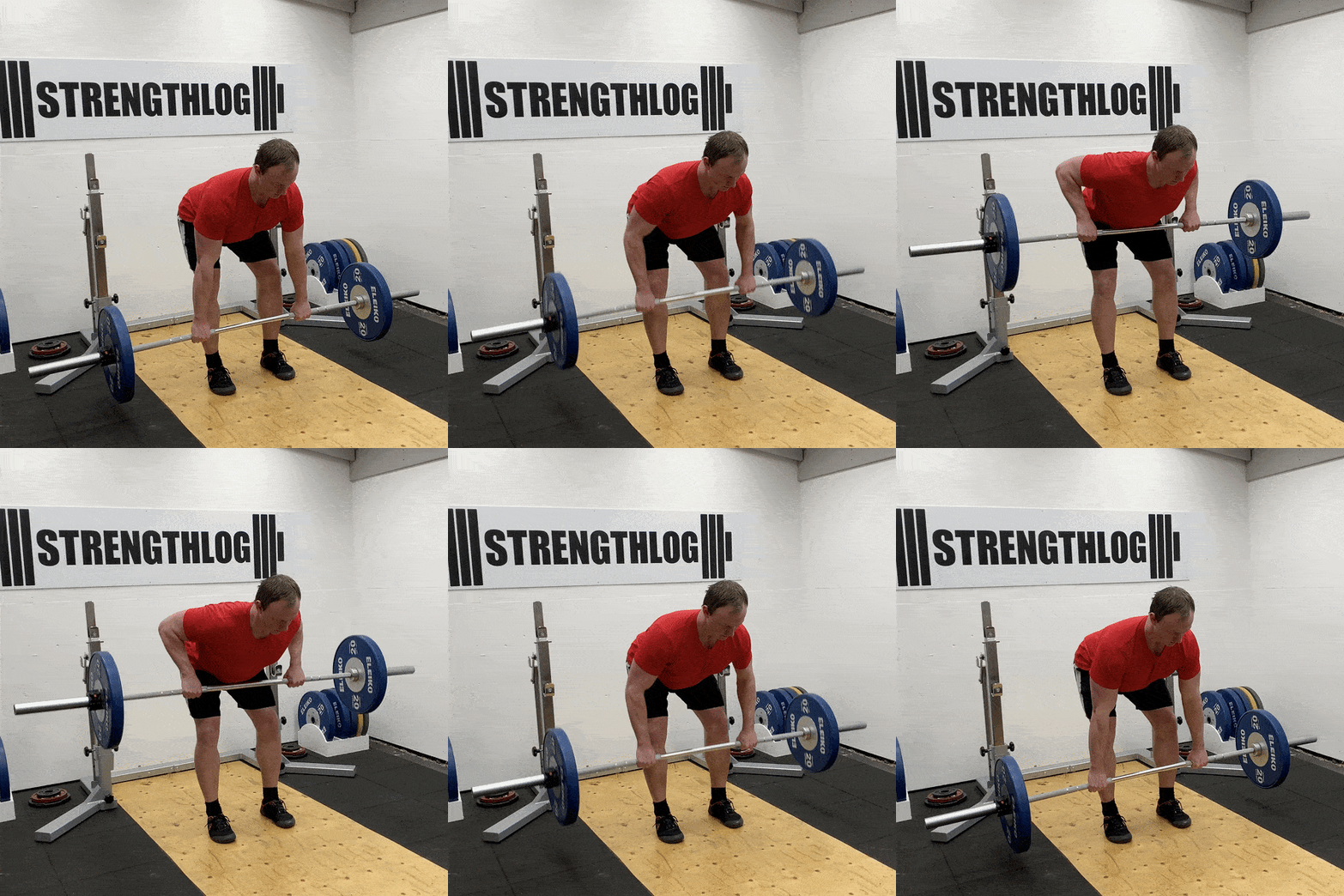
The barbell row is a classic compound exercise for your upper back muscles (lats, rhomboids, traps) and a great counter for all the throwing and shooting that strengthens the front of your body you do in handball.
A strong back pulls your shoulders back into a healthy position and puts your shoulder joint in a safer and more powerful position to throw from. Your upper back muscles work as decelerators for your arm after you release the ball.
It is not a rival to the dumbbell row we discussed earlier. They’re teammates who complement each other. The barbell row is your primary heavy strength builder, and the dumbbell row involves rotation and a greater range of motion. A smart handball training program includes both.
How to Do Barbell Rows
- Grasp the barbell with an overhand grip, slightly wider than shoulder-width apart.
- Stand with your feet slightly wider than hip-width apart, bend your knees slightly, and hinge forward at your hips, maintaining a neutral spine curve.
- Brace your core and keep your back straight. Inhale and pull the barbell towards your lower chest or upper abdomen, keeping your elbows close to your body. Squeeze your shoulder blades together at the top of the movement.
- Lower the barbell back to the starting position in a controlled manner.
- Repeat the movement for the desired number of repetitions.
Face Pull

The face pull is the antidote to the forward shoulder slump and internal rotation overload that comes from throwing and pushing all day.
They work the rear delts, rhomboids, and external rotators and build an upper back that holds your shoulder joint in the proper position.
You don’t want to use too much weight or mindlessly yank the rope when doing face pulls. Keep it relatively light, focus on feeling the muscles working, and maintain good form throughout.
How to Do Face Pulls
- Fasten a rope handle in a high position on a cable pulley. Grip the ropes with an overhand grip, and take a step or two back.
- With elbows held high, pull the rope towards you by letting your upper arms move straight out towards your sides, while simultaneously rotating your forearms up.
- Return with control to the starting position, by letting your arms move forward again.
- Repeat the movement for the desired number of repetitions.
Ball Slam

The ball slam is a dynamic exercise that teaches you to link your lower body, core, and upper body together to produce maximum force.
It also trains body mechanics for overhead motion and might even help prevent shoulder injuries, since you’re working the muscles that stabilize your shoulder joint under load in a more controlled way than during a match. As a bonus, you get to release frustration from missed shots or questionable referees.
Use a non-bouncy slam ball so it doesn’t rebound right into your nose. If it’s bouncing higher than your knees, go heavier.
How to Ball Slam
- Stand with your feet about shoulder-width apart, your knees and hips slightly bent, holding the ball in both hands at chest height. Engage your core, and keep a good posture.
- Extend your knees and drive your hips forward while simultaneously lifting the ball. Aim for being as tall as possible, the ball overhead, arms up, hips slightly forward, and on your toes from the force of your drive.
- Use your core and arms to slam the medicine ball straight down between your feet with as much force as possible. Press your hips back and bend your knees to further power the slam. Exhale as you slam the ball down.
- Squat down to pick up the ball from the floor, then immediately move into the next slam by repeating the movement.
- Repeat the movement for your desired number of repetitions.
Y Raise

Y raises work the lower traps, rotator cuff, and scapular stabilizers, the muscles that keep your shoulder blades moving like well-oiled hinges and depress the scapula properly.
It’s a prehab meets performance kind of exercise; it won’t directly make you more powerful or a better player, but it makes sure everything runs smoothly and doesn’t break down, so you can stay on the court and off the physio’s table.
In Strength Training for Handball, you’ll do Y raises in superset fashion, alternating with external shoulder rotations.
How to Do Y Raises
- Lie face down on an incline bench (about 30–45°) with your arms hanging straight down.
- Raise your arms forward and slightly outward in a Y shape (about 30–45° from your torso), thumbs pointing up.
- Pull your shoulder blades down and together as you lift your arms to head height.
- Pause briefly at the top, then lower under control.
- Repeat for the desired number of repetitions.
Hang Power Clean

The hang power clean is a weightlifting exercise where you explosively pull a barbell from a standing “hang” position (bar around mid-thigh) and catch it on your shoulders in a partial squat.
The triple extension you get in a hang power clean, where your ankles, knees, and hips all extend at the same time, is the same mechanic you use when you jump to shoot or throw a pass.
Hang power clean also builds full-body coordination and posterior chain power (glutes, hamstrings, traps), which is very valuable in sports that require explosiveness and the capacity to generate high forces in short amounts of time. Like handball.
Just make sure you get the technique right to reap the benefits.
How to Hang Power Clean
- Grip the bar with an overhand grip, about shoulder-width apart, and lift it up to get into the starting position.
- Hold your breath, and brace your core slightly.
- Lower the bar along your thighs, down to about knee-level, by bending your hips and knees.
- Reverse the movement, and lift the bar in a smooth but fast motion by extending your legs and knees simultaneously.
- Bend your knees slightly and receive the bar on the front of your shoulders.
- Stand up on straight legs again.
- Lower the bar in front of you, with control.
Incline Dumbbell Press

The incline dumbbell press is a great exercise for the chest, shoulders, and triceps.
The angle puts a bit more emphasis on the upper chest compared to the flat bench press and is close to the arm path of an overhand throw.
And because it’s dumbbells, you get the added bonus of improving shoulder stability and ironing out strength imbalances.
How to Incline Dumbbell Press
- Sit on a bench, and lift a pair of dumbbells up to the starting point.
- Press the dumbbells up to straight arms, while exhaling.
- Inhale at the top, or while lowering the dumbbells with control back to your shoulders.
- Repeat the movement for the desired number of repetitions.
Side Lunge

The side lunge builds strength and control for the side-to-side push needed to brake and accelerate laterally on the court. It targets your glutes, quads, and especially the adductors, the inner thighs that work like internal brakes, all within the frontal plane movement pattern.
It’s also great for strength and flexibility in the hips and groin, areas that can get wrecked if you’re not careful in a fast, explosive sport like handball.
If your body weight feels too easy, use a barbell on your back or hold a pair of dumbbells in your hands.
How to Do Side Lunges
- Stand up straight with plenty of space to your side for you to step out.
- Lightly brace your core, and take a big step to the side.
- Go as deep as possible without your heel lifting from the ground and while maintaining control.
- Push yourself back up by pressing the foot from the ground.
- Repeat the movement for the desired number of repetitions.
Box Jump

The box jump is an explosive semi-plyometric (it lacks the forceful eccentric phase or a true plyo) exercise where you jump from the floor and land on top of the box in one movement.
It trains your fast-twitch muscle fibers, the ones responsible for quick and powerful movements, so you can jump higher and move faster. It’s a vertical exercise, but its forceful muscle contractions improve the explosive first step you need for short sprints, too.
How to Box Jump
- Stand in front of a sturdy box with your feet shoulder-width apart.
- Slightly bend your knees and lower into a half-squat while swinging your arms back.
- Explode upward by pushing off the ground with your feet and swinging your arms forward to create momentum.
- Jump onto the box, landing softly with your knees slightly bent, feet fully on the box, and your torso upright.
- Stand up fully once you’ve landed on the box.
- Step, or carefully jump, down and repeat for the desired number of repetitions.
Depth Jump
Handball is full of reactive moments when you must jump again right after landing. The depth jump is king for training this quality, called reactive strength.
It involves stepping off a box, landing briefly, then explosively jumping upward as high as possible. The shock from landing, the rapid eccentric loading, primes your muscles and tendons like a spring for a more powerful takeoff, like turning your legs into a couple of coiled-up jack-in-the-boxes.
Note that depth jumps are not beginner-friendly. In Strength Training for Handball, you do them first in the workout when your body is fresh.
If you haven’t done them before, start with a lower height (under 18 inches or 45 cm) and gradually increase it. But you only need a few good reps, 3–5 reps per set, 3–4 sets total. Quality over quantity.
How to Do Depth Jumps
- Stand upright on the edge of as bench or platform with feet shoulder-width apart.
- Step off the platform (don’t jump) and let yourself fall naturally.
- Land softly on the balls of your feet, knees slightly bent, in an athletic stance.
- Immediately explode upward into a vertical jump as quickly and powerfully as possible.
- Land again with control, absorbing the impact by bending your knees.
- Reset and repeat for the desired number of repetitions.
Jump Squat

The jump squat is pretty much what it says on the tin: you drop into a bodyweight squat (or with a light load), but instead of just standing back up, you explode from the bottom of the squat into a maximal vertical jump. You then land, absorb the impact, and go right into the next rep/jump.
Jump squats train your legs to explode and recover, just like you need in handball. And because landing with control is part of the movement, they also improve stability and reduce injury risk around the knees and ankles.
How to Do Jump Squats
- Stand with your feet shoulder-width apart with your core engaged and your chest up.
- Lower into a squat by bending your knees and pushing your hips back.Keep your weight on your heels and lower until your thighs are parallel to the ground or below.
- Explosively jump upward, extending your legs and pushing through your feet.Swing your arms for momentum as you jump.
- Land softly with bent knees to absorb impact.
- Immediately go into the next squat and repeat the movement for the desired number of repetitions.
Dynamic Copenhagen Plank

The dynamic Copenhagen plank is a souped-up version of the side plank for your inner thighs (adductors/groin).
With your top leg on a bench while your bottom leg is underneath, the dynamic part comes from moving your hips. Instead of holding still, you lower your hips down toward the floor and then drive them back up past the starting point, squeezing your inner thigh and obliques.
It works those muscles in the way they’re used during play: under tension and during movement, training both explosive lateral movement, stability, and injury prevention for the groin area.
How to Do Dynamic Copenhagen Planks
- Lie on your side with your top leg resting on a bench.
- Place your forearm on the floor directly below your shoulder for support.
- Engage your core and lift your bottom hip off the ground so your body forms a straight line.
- Keep your bottom leg off the ground, hanging under the bench or lightly touching it for balance.
- Lower your hips toward the ground in a controlled motion.
- Pause briefly at the bottom, then squeeze your obliques and adductors to raise your hips back to the starting position.
- Repeat for the desired number of repetitions, then switch sides and repeat.
Horizontal and Vertical Jump

The horizontal and vertical jump (also called the broad jump to box jump) is a two-part plyometric drill that you perform as one movement. It trains your muscles to generate power in two planes: forward and upward, just like you would when lunging to retrieve a loose ball and then jumping to shoot or pass.
It also strengthens your landing mechanics, so you reduce your risk of injury when you come down from airborne plays. Strengthen them during training under controlled conditions, and then benefit during play.
Make sure your horizontal jump ends with a soft landing in a semi-squat position and with your knees tracking over your toes, chest up. Then fire into your vertical jump with as little pause as possible.
How to Do Horizontal and Vertical Jumps
- Stand with feet hip-width apart, knees slightly bent, and arms behind you for momentum.
- Swing your arms forward and explosively jump forward as far as possible, landing softly in a squat position. Keep your knees bent and engage your core to stabilize.
- Without pausing, push through your legs and swing your arms to jump vertically onto a box or platform in front of you.
- Land with soft knees, absorbing impact in a stable squat position, then extend your legs and straighten your body on top of the box.
- Step off the box one foot at a time to reset.
- Repeat the movement for your desired number of repetitions.
Kettlebell Swing

The kettlebell swing is an explosive hip hinge, the same kind of movement you use when you jump, sprint, or unload a fast throw. You could say that handball is a game of explosive hip extension.
Kettlebell swings give you many of the benefits of Olympic lifts (except the full ankle, knee, and hip triple extension), but are much faster and easier to learn. You get 90% of the hip-power benefits but none of the hassle.
Also, while Olympic lifts excel at developing maximum, single-effort (or low-rep) power, kettlebell swings are great for your ability to be explosive repeatedly. So choose a weight that allows you to maintain explosive form for all repetitions.
How to Do Kettlebell Swings
- Place a kettlebell on the ground, about one or two feet in front of you.
- Take a wide stance, lean forward and grip the kettlebell.
- Brace your core slightly, and swing the kettlebell back between your legs, while inhaling.
- Swing the kettlebell forward by extending your hip, while exhaling.
- Try to swing the kettlebell to about chest height.
- Repeat for the desired number of repetitions.
Sled Push

The sled push is when brute force meets functional finesse. It builds explosive leg drive, lower-body strength, and core stability so you can sprint faster and remain immovable in defensive stances and shuffles.
Unlike traditional lifts, the sled push has minimal eccentric loading (most exercises have a lowering phase, but not the sled push), so you can do it without wrecking your legs for days with soreness.
It also improves your lactic threshold and is proven to make you faster over short distances.17
How to Sled Push
- Load the sled with an appropriate amount of weight.
- Stand behind the sled with your feet shoulder-width apart.
- Grip the sled handles at a comfortable height.
- Lean forward slightly, keeping your back flat and core engaged.
- Drive through your legs and start pushing the sled forward.
- Maintain a steady, powerful stride with knees driving forward.
- Keep your arms extended but not locked.
- Push the sled the desired distance or for the set amount of time.
- Come to a controlled stop and carefully release the sled handles.
Strength Training for Handball: Final Rep
When I was in high school, we often played either handball or volleyball during PE class.
Don’t tell anyone, but I actually preferred volleyball, because it meant less running and took a lot less effort (at least on that level).
During this time, I started lifting weights. Back then, strength training was much less common among high school students than today, with only me and one other guy from class hitting the gym.
After only a few months, we noticed that we improved at both sports, more so than everyone else in class, without doing much of any athletic activities outside of school.
I am positive that those improvements were largely due to lifting weights. I got so much stronger and more explosive in such a short time, more than natural growth could accomplish (and I was a pretty unathletic kid).
🤾🤾♂️🤾♀️
Thank you for reading; the theory is done. The only thing left is the action. Go lift something heavy.
To follow this program, download our workout log app and start tracking your workouts today.
Track Your Training. See Real Progress.
Log your workouts in one place and watch your numbers climb, week after week.
- Free to get started
- Fast workout logging
- Cardio and strength training
- Sport-specific strength plans, including handball
- Progress over time, personal bests
- Free and premium training programs and workouts for every fitness goal
Download StrengthLog free:
Last reviewed: 2025-09-08
References
- Int J Environ Res Public Health. 2019 Nov 15;16(22):4520. In-Season Weightlifting Training Exercise in Healthy Male Handball Players: Effects on Body Composition, Muscle Volume, Maximal Strength, and Ball-Throwing Velocity.
- J Hum Kinet. 2023 Apr 20:87:189-200. Conditioning Strategies for Improving Handball Throwing Velocity: A Systematic Review and Meta-Analyses.
- Journal of Strength and Conditioning Research 38(5):p 966-975, May 2024.The Influence of Strength Level on Handball-Specific Fitness Elements Between Stronger and Weaker Professional Players.
- J. Funct. Morphol. Kinesiol. 2024, 9(4), 268. Effects of Off-Season Heavy-Load Resistance Training on Lower Limb Mechanical Muscle Function and Physical Performance in Elite Female Team Handball Players.
- Open Sports Journal, 20 Aug 2013. Maximum Strength in Squats Determines Jumping Height in Young Female Volleyball Players.
- Sports (Basel). 2023 Nov 27;11(12):236. The Significance of Maximal Squat Strength for Neuromuscular Knee Control in Elite Handball Players: A Cross-Sectional Study.
- Front Physiol. 2023 Dec 13:14:1272106. Triceps surae muscle hypertrophy is greater after standing versus seated calf-raise training.
- Br J Sports Med. 2019 Nov;53(21):1362-1370. Including the Nordic hamstring exercise in injury prevention programmes halves the rate of hamstring injuries: a systematic review and meta-analysis of 8459 athletes.
- Prevention and Rehabilitation of Hamstring Injuries (pp.117-143), March 2020. Neuromuscular Factors Related to Hamstring Muscle Function, Performance and Injury.
- Int J Sports Physiol Perform. 2007 Dec;2(4):414-22. Relationship between throwing velocity, muscle power, and bar velocity during bench press in elite handball players.
- Phys Ther Sport. 2020 Jul:44:92-98. Development of a short and effective shoulder external rotation strength program in handball: A delphi study.
- J Orthop Sports Phys Ther. 2021 Apr;51(4):174-187. No Added Benefit of 8 Weeks of Shoulder External Rotation Strength Training for Youth Handball Players Over Usual Handball Training Alone: A Randomized Controlled Trial.
- Br J Sports Med. 2017 Jul;51(14):1073-1080. Preventing overuse shoulder injuries among throwing athletes: a cluster-randomised controlled trial in 660 elite handball players.
- Sports Med Int Open. 2021 Aug 25;5(2):E65–E72. Effects of an Elastic Resistance Band Intervention in Adolescent Handball Players.
- J Strength Cond Res. 2017 Apr;31(4):999-1008. Effects of a Six-Week Hip Thrust vs. Front Squat Resistance Training Program on Performance in Adolescent Males: A Randomized Controlled Trial.
- International Journal of Strength and Conditioning, Vol. 5 No. 1 (2025). Differences in Muscle Activation and Joint Kinematics Between Deadlift Styles When Performed at High-Intensity Training Loads.
- Scand J Med Sci Sports. 2020 Mar;30(3):442-449. Influence of resisted sled-push training on the sprint force-velocity profile of male high school athletes.
