
Are you new to strength training and want an easy (yet effective) training program to start your training journey in the comfort of your own home? We’ve created a beginner strength training program that doesn’t require any equipment, can be done at home, is easy to follow and straightforward.
The ambition is to give you an easy way into strength training, where you can focus on building the habit of strength training without any unnecessary hurdles.
Who Is This Program For?
As mentioned, this program is created for someone new to strength training with no previous experience, who wants to build a healthy habit but doesn’t quite know how yet.
We’ve made this program completely without equipment, so that you can start training without needing to invest in a gym membership or home gym equipment.
Starting strength training can feel like a really big mountain to climb, and we want to make it as easy as possible for you. We know that it can be scary to enter a gym without any experience, and that many people want to be a person who works out, but the first step can feel intimidating.
If you already have some experience in strength training and are looking for a program to continue learning and growing, check out these articles instead:
Read more: Beginner Strength Training Workout for Women at Home
Read more: 10 Home Strength Training Exercises Without Equipment
The Structure of the Beginner Strength Training Program Without Equipment
This program consists of three workouts per week, targeting all major muscle groups in your body.
All workouts consist of a handful of exercises with a focus on the fundamental movements in strength training.
Before diving into all the exercises in this program, we want to set a few things straight:
- You don’t have to be able to perform all exercises with perfect form straight away. You’re probably introducing new movements with this program which your body isn’t used to. Do your best, and the more you practice these exercises, the easier they’ll get.
- The assigned number of reps is for you to aim for. Even if the program says two sets with 10 reps, that doesn’t mean that you should give up if you only manage a couple. Just aim for doing one more rep the next time. And then one more the time after that. And so on.
- Don’t stress it. It takes time to learn new stuff. Don’t beat yourself up if it feels hard. Be consistent, and do your best each workout, and you’ll notice small steps forward.
Here’s an overview of how the workout looks. If you keep reading, we’ll go through all the exercises, one by one. So if you don’t recognise them by their names, we’ve got you, just keep reading.
Workout A
| Exercise | Sets | Reps |
|---|---|---|
| Half Air Squat | 2 | 10 |
| Kneeling Incline Push-Up | 2 | 10 |
| Inverted Row | 2 | Max reps |
| Crunch | 2 | 15 |
Workout B
| Exercise | Sets | Reps |
|---|---|---|
| Step Up | 2 | 10 |
| Shallow Lunges | 2 | 10 |
| Kneeling Incline Push-Up | 2 | 10 |
| Glute Bridge | 2 | 10 |
Workout C
| Exercise | Sets | Reps |
|---|---|---|
| Half Air Squat | 2 | 10 |
| Inverted Row | 2 | Max reps |
| Bench Dip | 2 | 10 |
| Kneeling Plank | 1 | Max time |
Each training session is a full-body workout, and we suggest that you train every other day with one rest day between workouts, like this:
- Monday: Workout 1
- Tuesday: Rest
- Wednesday: Workout B
- Thursday: Rest
- Friday: Workout C
- Saturday: Rest
- Sunday: Rest
If you want to train and rest on other weekdays, go right ahead. Just try to get at least one day of rest between sessions.
Beginner Strength Training Program Without Equipment – The Exercises
Below, I’ll guide you through all the exercises, how to perform them, which muscles they involve and other things that might be good to know before digging into the program.
If you feel like you already know what you need to get started, you can just jump straight to the program in our app StrengthLog by tapping the link below.
Take me to the Beginner At-Home Strength Training Program Without Equipment
Half Air Squat
The air squat is a classic leg exercise that requires no equipment. This version of the air squat is suitable if you cannot do a squat with full depth yet, or are having trouble with the balance. If you feel like this exercise is difficult to get the hang of, you might want to start with the chair squat instead.
Go as deep as possible, and don’t worry if you can’t perform the exercise exactly as the instructional demo – practice makes perfect!

How to Do Half Air Squats
- Stand with your feet about shoulder-width apart, or where you feel comfortable.
- Squat as deep as possible by pushing your hips back, rather than straight down, like when you’re going to sit down on a chair.
- Reverse the movement, and return to a standing position.
- Repeat for as many reps as assigned.
Muscles Worked by Half Air Squats

Kneeling Incline Push-Up
Push-ups are one of the most common ways of training your chest without any equipment. However, it can be a very heavy exercise for someone in the beginning of their training journey.
By doing them with your hands on an elevated surface and on your knees instead of on your toes, you’re decreasing the difficulty by a few steps. The higher elevation, the easier it will be.

How to Do Kneeling Incline Push-Ups
- Assume the starting position on your knees, with your hands on an elevation, slightly wider than shoulder-width apart.
- Try to form a straight line from head to knee, and brace your abdomen slightly.
- Lower yourself as deep as you can, while inhaling.
- Reverse the motion when you’ve touched the board, and push yourself up to straight arms again while exhaling.
- Repeat for reps.
Muscles Worked in Kneeling Incline Push-Ups

Inverted Row
Training your back without equipment can be quite hard. This is an alternative that can work, but you do need to find something to pull yourself up towards. It could be a table (but then you might need to change your grip compared to the video instruction below), a bar, or basically anything you find at a decent height that can hold your bodyweight. If you’re struggling with your grip, or feel like this is too advanced, you can switch the exercise to a dumbbell row instead, just fill a bag with some stuff until you get a reasonable weight.
By keeping the legs straight and placing only your heels on the floor, you make the exercise as hard as possible. If you want to take some load off, simply place your feet closer to your body.

How to Do Inverted Row
- Grip the edge of the table/the bar with an underhand grip, about shoulder-width apart. Brace your core.
- Inhale, and pull yourself up as high as you can, or until your chest touches the bar.
- Exhale, while lowering yourself back to the starting position with control.
- Repeat for reps.
Muscles Worked in Inverted Row

Crunch
The crunch is a classic bodyweight exercise for strengthening your abs. You might want to lie on a mat or something for this exercise, to protect your spine from the discomfort. If you find the exercise a bit difficult to master, you can think that your lower ribs should aim to touch your hip bones. They won’t, but it’s a good cue to teach your body how to perform the movement.
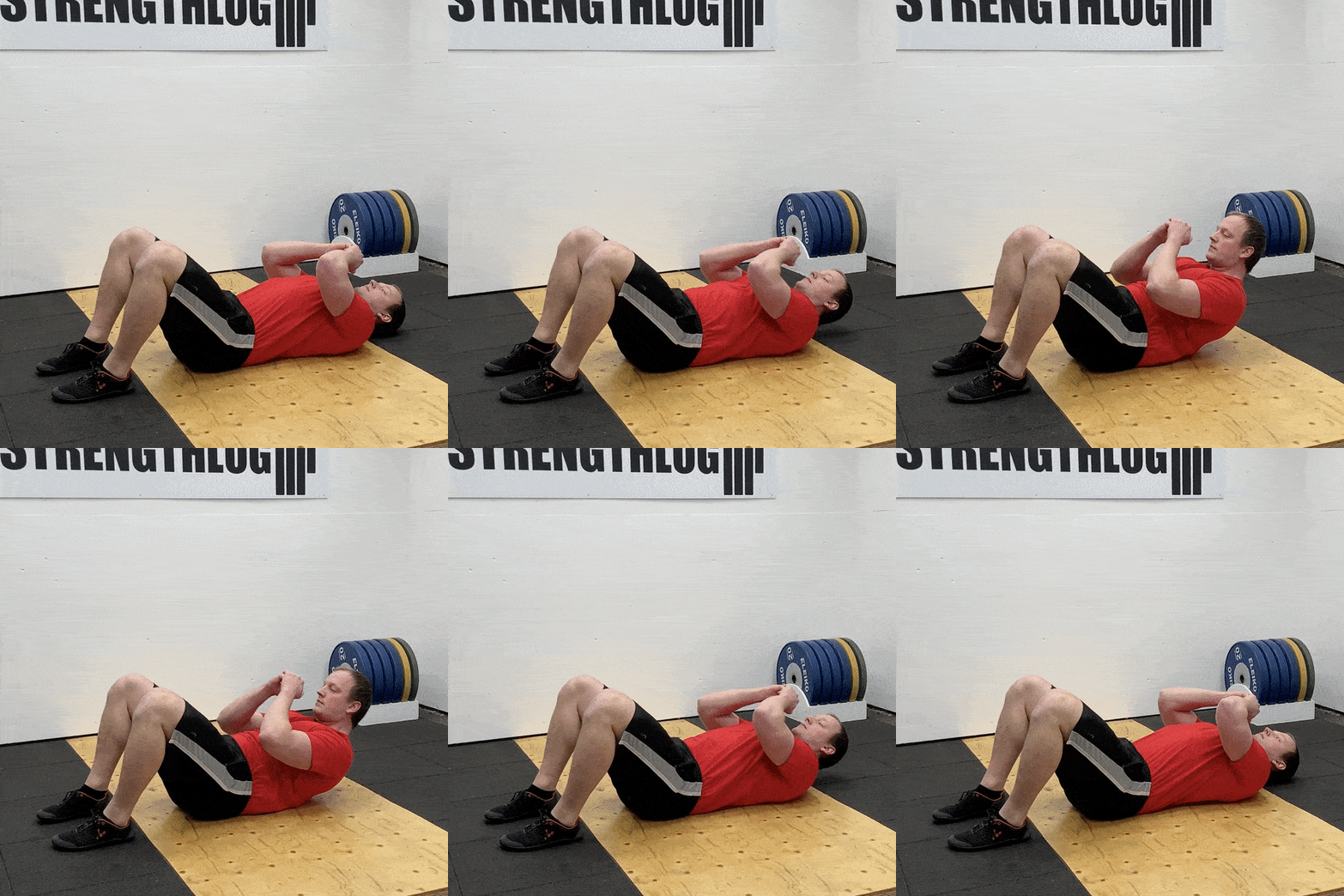
How to Do Crunches
- Lie on your back, with your hands in front of your chest and your knees bent to about 90 degrees.
- Lift your upper body by contracting your abs and bending forward.
- Bend as far forward as possible while still keeping your low back in contact with the floor, and then return to the starting position.
- Repeat for the assigned number of reps.
Muscles Worked in Crunches

Step Up
Step-ups are a great exercise for your quads and glutes. You can step up on whatever furniture you have at hand – a chair, a stair step or a bench, for example.

How to Do Step-Ups
- Stand in front of a chair, bench or something else that you can step up on.
- Place your foot on the chair.
- Lightly brace your core, and step up until your leg is straight.
- Lower yourself in a controlled motion.
- You can keep your foot at the chair, and repeat for reps.
Muscles Worked in Step-Ups

Shallow Lunge
The lunge is a body weight exercise that not only strengthens your leg muscles, but it can also be used to train your balance, coordination and control.
Shallow lunges are an easier version of the body weight lunge. It is a suitable exercise if you can not do lunges with full depth yet, and want to learn to master them.

How to Do Shallow Lunges
- Take a big step forward, and lower your body in a lunge position.
- Go as deep as your mobility allows, or where you want to reverse the movement.
- Lift your body by pressing the front leg away from the ground.
- Repeat for reps, then switch sides.
Muscles Worked in Shallow Lunges

Glute bridge
Glute bridges are one of the easiest ways to start training your glutes at home. Since the exercise is performed on the floor, you’ll be able to focus on the movement and muscle connection without worrying about balance and other distractions.

How to Do Glute Bridges
- Lie down with your feet on the floor.
- Tuck your pelvis in (imagine tucking your tailbone between your legs) to properly activate the glutes.
- Push your hips towards the ceiling by using your glutes, until your body forms a straight line from your head to your knees.
- Squeeze your glutes at the top.
- Reverse the movement, and repeat for reps.
Muscles Worked in Glute Bridges

Bench Dip
The bench dip is a variant of the bar dip where you’re using a bench instead of a dip station. That puts some more focus on your triceps rather than your chest, and it makes it easier to adjust the load of the exercise. While first trying this exercise, take it slow and steady, and go as deep as your mobility allows.
You adjust the load the same way as in the inverted row. By keeping the legs straight and placing only your heels on the floor, you make the exercise as hard as possible. If you want to take some load off, simply place your feet closer to your body.

How to Do Bench Dips
- Turn your back towards a sturdy bench, and put your hands on the pad about shoulder-width apart. Extend your legs in front of you.
- Lower yourself with control for as far as comfortable by bending your arms.
- Reverse the motion and return to the starting position.
- Repeat for reps.
Muscles Worked in Bench Dips

Kneeling Plank
The kneeling plank is a good starting point if you’re new to core training. It allows you to focus on building strength and stability without the exercise feeling overwhelming.
Start with short holds and gradually increase the time as your core gets stronger.

How to Do Kneeling Plank
- Stand on your elbows and knees.
- Brace your abs and try to form and hold a straight line from your head to your knees.
Muscles Worked in Kneeling Plank

How to Progress in the Beginner Strength Training Program Without Equipment
Like previously mentioned, while first starting out you should aim for completing all prescribed reps in the program.
But what about when you’ve reached that level, and the workouts start to feel too easy? There are several ways of progression, let’s dig into them!
Progressive Overload
The term “progressive overload” is often used in strength training. What it means is that you need to make the resistance bigger over time to keep challenging your muscles. To do this, you need to increase any of the following:
- Reps. Try to do more reps than you did last session.
- Sets. Add another set to the exercise.
- Weight. Add resistance to the exercise you’re performing.
You are also able to aim to do the same amount of reps, but in shorter time. This puts your muscles under a bigger stress, but during shorter time.
Read more: Five Ways to Get Bigger and Stronger
Exercise Changes
If you want to keep with the prescribed reps and sets in the beginner strength training program without equipment, but advance in another way, you are able to increase the difficulty of the exercises as well. I’ll list a few suggestion to all exercises so that you get an idea of how to proceed.
Half Air Squat
The natural progression of the half air squat is to lengthen the range of motion to a full air squat. Strive to go as deep as possible. When you get to a stage where these are too easy as well, you can either proceed to goblet squats by holding a filled backpack or something in front of you, or to jump squats if you want to continue without equipment.


Kneeling Incline Push-Up
When the kneeling push-ups feel easy breazy, you can remove the incline and to regular kneeling push-ups instead. This lengthens the range of motion, and challenges your muscles more.
After a while, you might have mastered the kneeling push-ups as well? Then it’s time to bring back the incline and do some incline push-ups, before finally mastering the regular push-up!


Inverted Row
The inverted row is a bit trickier to progress in. It is hard to train your back without equipment. So in this case, the easiest way to progress in the exercise is to add weight by filling a backpack and put it on you while performing the exercise. If you have access to a pull-up bar and some rubber bands, you can also try the assisted pull-up as an alternative.

Crunches
When you feel like you are able to do your crunches with ease, try to switch it up a bit! Two alternatives that might be good substitutes are dead bug and lying leg raises. In both cases, remember to push your lower back down on the floor.


Step Up
In the step ups, you can first and foremost increase the difficulty by increasing the height of what you step onto. After that, you can add a weight, by putting on a backpack, holding a couple of books etc. When you feel ready for a new exercise, the Bulgarian split squat can be a good one to try. First with your bodyweight, and later on with some added weight.


Shallow Lunges
Just like in the air squats, the natural progression here will be to increase the range of motion to a full lunge. They can be done both by taking a step forward, or backward. The latter is a bit easier, so that will be my suggestion to start with.
Once you’ve mastered the lunge, you can make it harder either by adding weights (use a filled backpack, or hold something heavy in your hands), or by doing jumping lunges instead.


Glute Bridge
When you feel like the glute bridge isn’t enough of a challenge, you can advance by making it a unilateral exercise. That means, working with one side at a time. The one-legged glute bridge isn’t just heavier, it also demands more in form of control and balance.
If you want to challenge yourself even more, you can try the hip thrust (with or without weight) with both, or one leg at a time.


Bench Dip
The bench dip is a good exercise because it’s easy to adjust in itself. Just place your feet further away from your body to make it gradually heavier. But once you feel like you are ready for the next step, a good transition can be close grip push-ups. First on your knees, and later on your toes.

Kneeling Plank
When you’re able to hold a kneeling plank for say about 60 seconds, you might want to try a full plank instead. If this feels much harder, know that it’s supposed to. Don’t get stressed out about it, just try to hold the position for a few more seconds each workout. And when you feel ready for it, you can add leg lifts or shoulder taps to your planks as well.


Final Rep
So, there you have it! A complete beginner strength training program, with everything you, as a beginner, need to get started with your training at home. A training routine without equipment, and a guide on how to advance when you are ready to.
Since one of the keys to getting better at strength training is by adding progressive overload – don’t forget to keep track of what you’ve done. (Also, it is quite motivating to be able to go back and see your progress!) Open up StrengthLog, track your sets, and try to beat your past self next week.
Track Your Training. See Real Progress.
Log your workouts in one place and watch your numbers climb, week after week.
- Free to get started
- Fast workout logging
- Cardio and strength training
- Big bodybuilding and powerlifting focus
- Free weights and machines
- Progress over time, personal bests
- Free and premium training programs and workouts for every fitness goal
Download StrengthLog free:


