
It’s time to talk about something many badminton aficionados might be neglecting: strength training. “Strength training? For badminton?” I hear you. Sounds about as necessary as a helmet in a pillow fight, right?
Hold your shuttlecocks, my friend. Stick with me, and I’ll show you how building strength and a bit of well-placed muscle can give your badminton game the boost it’s been missing, with a 12-week training program and a selection of the best exercises you can do.
Time to swap some of those drop shots for dumbbells, because we’re about to build a badminton body, baby.
Click here to go directly to the program in StrengthLog.
🏸🏸🏸
Table of Contents
Benefits of Strength Training for Badminton
Badminton is one of the most popular sports globally, with an estimated 220 million amateurs and 14 million pros playing regularly (and with more than 700 million fans who might not all play themselves but enjoy following it).1 2 That makes it the second most played sport worldwide, just behind soccer.
Anyone who thinks badminton is just a gentle back-and-forth garden party game has clearly never seen or played it at a competitive level. You can certainly have a fun, casual hit-around without the physical prowess of an athlete (one of the swell things about badminton is that it is for everyone), but to play badminton well and competitively requires speed, power, agility, endurance, coordination, and, yes, strength.
It’s a full-body sport that requires a well-rounded athlete.3
But strength training hasn’t always been part of badminton players’ routines. Historically, badminton was seen more as a finesse and endurance sport. Players got fit by, well, playing a lot of badminton! General fitness was important, sure – you needed stamina and speed, and you naturally built some strength from all the lunging and swinging. But there was this idea that building muscle and strength with weights would somehow gum up the works and make you slow and “muscle-bound”.
However, as sports science evolved, it became clear that strength training made players faster, more explosive, and less likely to injure themselves. And today, if you’re a serious player and not doing strength work, you’re getting left in the shuttle dust.
These are the top benefits of strength training for badminton.
Explosive Power
This one’s a no-brainer. Stronger muscles mean more power for badminton players. You improve your smash velocity and accuracy, can overwhelm your opponents, and create more attacking opportunities.
Speed & Agility
Weight training for the lower body builds stronger legs that help you change directions quicker, jump higher, and move more efficiently on the court.
Injury Prevention
The risk of injury in badminton is not super high but varies a lot depending on your level: 1–7 injuries per 1,000 hours of play (for perspective, the number for pro soccer players is ~8 injuries/1,000 hours). And age; according to one study, 77% of senior players had injured themselves during badminton play or training the previous year.
Numbers aside, badminton can be tough on the joints, especially your shoulders, knees, and ankles. That’s why strength training is a big one here. It has been proven to cut the risk of sports injuries by up to a third, which is huge.
Endurance
Strength training also improves your endurance. Not in the way that lets you run for miles, but stronger muscles mean muscles that can work harder for longer before they throw in the towel.
Core Strength & Stability
Your core is central in more ways than one in badminton. A strong core improves not only your general fitness (strength, power, stability, and balance) but also technical stability and power transfer within kinetic chains (force from the lower body goes through the torso to the upper body for power and stability in almost everything you do on the court).
How Should Badminton Players Strength Train?
The goal of strength training for a badminton player is to improve power, explosive speed, agility, and muscular endurance while staying injury-free.
How Often Should Badminton Players Lift Weights?
| Training phase | Typical weekly strength dose |
|---|---|
| Off-season (general-preparation, no tournaments) | 3–4 sessions (e.g., full body or upper/lower split) |
| Pre-season (4–8 wk before first events) | 2–3 sessions (focus shifts toward power and badminton-specific movement patterns). |
| In-season | 1–2 sessions (shorter sessions for maintenance, mostly power lifts, jumps, core) |
The recommendations above are for intermediate/recreational players. Beginners can do fewer sessions (two per week) during off-season while focusing on basic movements and learning the exercises.
For elite players with strength training experience, the frequency can be even higher during the off-season, but at that level, a coach usually considers individual factors, and a generic workout plan works less well.
Designing a Strength Training Program for Badminton
Badminton is a very demanding, multi-dimensional sport, and your strength-training plan needs to match that. It mixes speed, explosive strength, agility, and both aerobic and anaerobic endurance. You’ll sprint in short bursts, change direction on a dime, lunge, jump for smashes, and recover for the next rally in seconds.
So, what does that mean for the weight room? A well-designed program for badminton does include hoisting heavy weights, but it shouldn’t revolve around that alone. It should:
- Build full-body strength—from powerful legs and hips to a stable core and shoulders, elbows, and forearms that can both dish out the smashes and take the repetitive strain of overhead action.
- Include sprints and plyometrics (jumping, bounding, medicine-ball throws) to build explosive court speed.
- Improve balance, joint stability, coordination, and reaction times.
- Prevent injuries, especially to the shoulders, elbows, knees, and ankles that are vulnerable in badminton, and condition your body to tolerate rapid stop-and-go movements.
Because badminton is so fast, skill-intensive, and multi-faceted, your workout plan must cover all those bases.
That said, I firmly believe getting suckered into thinking all your weight training has to be “functional” by perfectly replicating a badminton lunge with a dumbbell is a mistake.
Here’s the deal: Strength and muscle are functional. Most of your lifting should focus on exercises and movements that build a solid foundation of muscle and make you stronger overall, with a sprinkle of badminton-flavored drills to tie it all together.
Choosing the Right Strength Training Exercises for Badminton
| Category | Exercise | Key Focus | Primary Muscles Targeted | Badminton Relevance |
|---|---|---|---|---|
| Compound Lifts | Squats (Back, Front) | Lower body strength, power for jumping & lunging | Quadriceps, Glutes, Adductors, Core | Jumping power, Lunge strength, Court speed, Stability |
| Lunges (Forward, Side, Reverse) | Unilateral leg strength, balance, stability, multi-directional movement | Quadriceps, Glutes, Hamstrings, Adductors, Abductors, Core | Lunge stability, Change of direction, Footwork agility, Injury prevention (knee/hip) | |
| Bench Press, Incline Dumbbell Press, Push-Ups | Upper body pushing strength, | Pectorals, Deltoids, Triceps | Smash power, Clear power, Upper body endurance | |
| Rows (Dumbbell, Barbell) | Upper body pulling strength, back development | Latissimus Dorsi, Rhomboids, Trapezius, Biceps, Core | Shot power, Postural balance, Shoulder health, Deceleration control | |
| Deadlifts, Trap Bar Deadlifts, Romanian Deadlifts | Posterior chain strength, hip extension power | Hamstrings, Glutes, Lower Back, Core | Jumping power, Overall strength, Injury prevention (back/hamstring) | |
| Overhead Press | Shoulder strength for overhead actions | Deltoids, Triceps | Smash power, Clear power, Shoulder stability | |
| Plyometrics | Box Jumps | Explosive leg power, vertical jump height | Quadriceps, Glutes, Hamstrings, Calves | Smash jump height, Quick take-off |
| Jumping Lunges / Split Jumps | Explosive unilateral leg power, agility | Quadriceps, Glutes, Hamstrings, Calves | Rapid lunging, Change of direction speed | |
| Medicine Ball Throws (Overhead, Ball Slams) | Explosive core & upper body power, rotational strength | Core (Obliques), Shoulders, Back, Arms | Smash power, Rotational power for shots | |
| Lateral Bounds / Cone Hops | Lateral explosive power, agility | Glutes (Medius/Minimus), Quads, Adductors, Abductors | Side-to-side court coverage, Agility | |
| Core | Planks (Front, Side, Rotational) | Core stability & endurance | Transverse Abdominis, Rectus Abdominis, Obliques, Erector Spinae | Balance, Power transfer, Injury prevention (back), Posture |
| Core Twists | Rotational core strength | Obliques, Rectus Abdominis | Smash power, Rotational shots | |
| Leg Raises | Lower abdominal strength | Lower Rectus Abdominis, Hip Flexors | Pelvic stability, Core strength | |
| Dead Bug / Bird Dog | Core stability, anti-rotation, coordination | Transverse Abdominis, Multifidus, Glutes, Deltoids | Balance, Limb control, Injury prevention (back) | |
| Upper Body Shoulder Health | External/Internal Rotation (Band/Cable) | Rotator cuff strength & health | Infraspinatus, Teres Minor, Subscapularis | Shoulder stability, Injury prevention (rotator cuff) |
| Y-Raises (Band/Dumbbell) | Scapular stability, upper back strength | Lower Trapezius, Serratus Anterior, Deltoids | Shoulder health, Overhead stability | |
| Wrist/Forearms | Wrist Curls / Wrist Extension / Reverse Curls | Forearm flexor & extensor strength | Forearm Flexors & Extensors | Racket control, Shot power (wrist snap), Injury prevention (elbow) |
| Grip Strengtheners / Towel Wring | Hand & grip strength | Finger & Hand Flexors | Secure racket grip, Shot control | |
| Forearm Blaster / Wrist Roller | Forearm flexor & extensor endurance | Forearm Flexors & Extensors | Grip endurance, Racket control |
Sample Week of Strength Training for a Badminton Player
Here is what a sample week of training could look like for an intermediate-level badminton player, one who balances their training with a job and family and can do one session per day.
| Day | Training Type |
|---|---|
| Monday | On-Court Training (Technical + Footwork Drills) |
| Tuesday | Strength Training – Lower Body + Core |
| Wednesday | On-Court Training (Tactical + Match Play) |
| Thursday | Strength Training – Power + Plyo |
| Friday | Rest |
| Saturday | Strength Training – Upper Body + Core |
| Sunday | On-Court Training (Match Simulation + Serve/Return Drills) |
Strength Training Program for Badminton
This is a training program for badminton players athletes who want to develop their strength, power, balance, and stability and prevent injuries on the court. It’s suitable for the off-season and into the pre-season parts of your training.
This program works best if you already have some strength training experience. It features many different, relatively complex exercises, and if you have never lifted weights before, it might be too much for you to jump right into.
If you’re new to the gym, start with one of our beginner programs, like the Beginner Barbell Training Program. You train three times per week, alternating between workouts A and B.
Workout A
| Exercise | Sets | Reps |
|---|---|---|
| Squat | 3 | 8–10 |
| Bench Press | 3 | 8–10 |
| Barbell Row | 3 | 8–10 |
Workout B
| Exercise | Sets | Reps |
|---|---|---|
| Deadlift | 3 | 6–8 |
| Lat Pulldown (or Pull-Ups) | 3 | 8–10 |
| Overhead Press | 3 | 8–10 |
In other words, you’ll train workouts A B A week one and B A B week two, then go back to week one and keep alternating between the two.
This beginner program (any many more) are available for free in our workout log app, StrengthLog.
You can use the strength you gain to your advantage on the badminton court. It’s a great way to teach your muscles, brain, and nervous system to play together, allowing you to move on to more complex programs.
If you do have some weight training experience, you’re ready for Strength Training for Badminton.
12-Week Offseason/Preseason Strength Training Program for Badminton
This is a 12-week off-season strength training program for badminton athletes, intermediate-level and up, designed with periodization to build strength, lean muscle, power, stability, and speed.
Once you’ve completed a 12-week round, you can start over and use heavier weights because you will have gained plenty of strength during those three months or move into season where do one or two workouts per week for maintenance.
The program follows a 3-phase progression:
| Day | Focus |
|---|---|
| Weeks 1–4 | Foundational Strength & Stability |
| Weeks 5–8 | Maximal Strength |
| Weeks 9–12 | Power & Sport-Specific Transfer |
You’ll train three days per week, focusing on strength, power and injury‐prevention, with progressive overload built in.
| Day | Focus |
|---|---|
| Workout 1 (e.g. Monday) | Strength (Lower-body emphasis) + Core |
| Workout 2 (e.g. Wednesday) | Power/Plyometrics + Rotator-cuff & Swing-specific drills |
| Workout 3 (e.g. Friday) | Strength (Upper-body emphasis) + Core |
Rest or light technical/shuttle work on other days; include 1–2 easy cardio/mobility sessions.
You can pick which days you hit the weights to fit your schedule, but training on Monday, Wednesday, and Friday or Tuesday, Thursday, and Saturday is optimal for recovery.
- Warm-Up: Warm up before each training session with a dynamic warm-up routine that addresses hip mobility, shoulder mobility, and core activation (e.g., leg swings, pogo hops, lateral shuffles, open-/close-gates, inchworms, hip circles, light band work for shoulders, etc.).
- Progression: This program is divided into three phases (Weeks 1–4, 5–8, 9–11). Within each phase, try to increase weight slightly (2.5–5 lb increments for upper body lifts, 5–10 lb increments for lower body) when you can complete all prescribed reps without breaking form. During the power phase, focus on bar speed and intent. and keep the weights submaximal but fast.
- Rest: Rest 90–120 seconds between heavier lifts (strength-focused sets of 5–6 reps) and around 60 seconds for accessory or higher-rep work. Power exercises often need slightly longer rest (2–3 minutes) to maintain explosiveness.
- Deload: Feel free to include a deload (-30–40% volume) in Week 6 and Week 10 if you feel fatigued. I have not pre-programmed any deloads, but don’t be afraid to adapt your sessions if you feel overwhelmed.
Below is an example of a week from the program with the exercises you’ll do during each phase. The exact number of sets and the rep scheme, details of all three phases, including % of 1RM recommendations along with the planned intensity and volume progression route, are available in your StrengthLog workout tracker app.
Phase I (Weeks 1–4): Foundational Strength & Stability
Goal: Build lean mass, gain general strength, stability, and structural balance.
Workout 1 – Lower-Body Strength
| Exercise | Sets |
|---|---|
| Squat | 3–4 |
| Romanian Deadlift | 3 |
| Walking Lunge | 3 |
| Single Leg Glute Bridge | 3 |
| Plank With Shoulder Taps | 3 |
Workout 2 – Power & Shoulder Health
| Exercise | Sets |
|---|---|
| Box Jump | 3–4 |
| Med Ball Chest Pass | 3 |
| Lateral Bounds | 3 |
| Kettlebell Swing | 3 |
| Face Pull | 3 |
Workout 3 – Upper-Body Strength
| Exercise | Sets |
|---|---|
| Incline Dumbbell Press | 3–4 |
| Dumbbell Row | 3 |
| Overhead Press | 3 |
| Lat Pulldown | 3 |
| Copenhagen Plank | 3 |
Phase II (Weeks 5–8): Maximal Strength
Goal: Develop maximal strength. Lower reps, heavier loads, slower tempo.
Workout 1 – Lower Body
Workout 2 – Power & Forearms / Grip
| Exercise | Sets |
|---|---|
| Depth Jumps | 4 |
| Med-Ball Slam | 3 |
| Horizontal and Vertical Jump | 3 |
| Kettlebell Swing | 3 |
| Superset: Wrist Curls + Wrist Extension | 3 + 3 |
Workout 3 – Upper Body
| Exercise | Sets |
|---|---|
| Pull-Up | 4 |
| Bench Press | 4 |
| Barbell Row | 4 |
| Overhead Press | 4 |
| Superset: Ab Wheel Roll-Out + Pallof Press | 3 + 3 |
Phase III (Weeks 9–12): Power & Sport-Specific Transfer
Goal: Translate strength to speed and explosive sport-specific movement. Focus on speed and technique; increase load once speed drops <90%.
Monday – Strength Variant & Core
| Exercise | Sets |
|---|---|
| Front Squat | 4 |
| Bulgarian Split Squat | 4 |
| Romanian Deadlift | 3 |
| Landmine Rotation | 3 |
| Ab Wheel Roll-Out + Dead Bug | 3 |
Wednesday – Reactive Power & Prehab
| Exercise | Sets |
|---|---|
| Box Jump | 4 |
| Trap Bar Deadlift | 4 |
| Med-Ball Slam | 3 |
| Lateral Bounds | 3 |
| Superset: Wrist Curls + Wrist Extension | 3 |
Friday – Upper Strength & Explosive
| Exercise | Sets |
|---|---|
| Push Press | 3 |
| Dumbbell Row | 4 |
| Plyo Push-Up | 3 |
| Single-Arm Landmine Press | 3 |
| Hanging Leg Raise + Core Twist | 3 |
Follow the Strength Training for Badminton Program in StrengthLog
This and many more training programs are in the StrengthLog workout log app. The app is free to use, forever, with no ads. This program, however, is a premium program (it offers advanced percentage-based progression and periodization), which means it requires a premium subscription.
We offer all new users a free 14-day premium trial. You can activate it in the app without any strings attached.
Download StrengthLog and start tracking your workouts today:


Click here to go directly to the program in StrengthLog.
Strength Training for Badminton: Exercises
Here are detailed descriptions of all the exercises in the Strength Training for Badminton program in the order they appear.
Squat (Back Squats & Front Squats)


The squat and the front squat are essential exercises for badminton players. Badminton is an explosive sport, full of lateral movements, accelerations, jumps, lunges, and reactive changes in posture. These aren’t movements you just practice— you build the capacity for them in the gym, and there are no exercises with an overall better transfer to the badminton court.
When you squat, you build quad, glute, adductor, and core strength, which powers your legs during sprints and jumps and stabilizes your body when you’re darting across the court. Squats have a proven record of being phenomenal for improving vertical jump height and sprint speed.10 11
Regular back squats are great for overall strength and stability, and front squats shift the load to the front of your body into the lean-forward athletic posture of badminton. Both complement each other, and I’ve programmed both into Strength Training for Badminton during the strength and power phases of the program, respectively.
How to Squat
- Set the barbell at upper chest height in a squat rack.
- Step under the bar and place it across your upper traps or rear delts.
- Grip the bar just outside your shoulders and pull your elbows down and back.
- Lift the bar off the rack by standing up straight.
- Take a step or two back and set your feet shoulder-width apart.
- Brace your core and keep your chest up.
- Squat down as deep as you can with good technique by bending your hips and knees.
- Extend your hips and legs to stand back up.
- Repeat the movement for the desired number of repetitions.
How to Front Squat
- Set the barbell at upper chest height in a squat rack.
- Step up and place the bar across the front of your shoulders.
- Cross your arms over the bar or use a clean grip, keeping elbows high.
- Lift the bar off the rack by standing up straight.
- Take a step or two back and set your feet shoulder-width apart.
- Brace your core and keep your chest lifted and elbows up.
- Squat down as deep as you can with good technique by bending your hips and knees., staying upright.
- Extend your hips and legs to stand back up.
- Repeat the movement for the desired number of repetitions.
Romanian Deadlift

The Romanian deadlift (RDL) is a great exercise for badminton players because it builds strength, muscle mass, and stability in the posterior chain, the group of muscles on the backside of your body, including the hamstrings, glutes, and lower back.
A stronger posterior chain allows for higher jumps, faster court coverage, and direction changes. You’ll decelerate better so you don’t overrun the shuttle and end up in the umpire’s lap, and build elastic strength to spring back after a low shot or elevate quickly for a net kill.
Also, eccentric training (like the RDL) reduces hamstring injuries by up to 70%, which is very important in a sport with a pretty high risk of hamstring strains and injuries.12
How to Do Romanian Deadlifts
- Get into the starting position by deadlifting a barbell off the floor or by unracking it from a barbell rack. Stand feet hip-width, inhale, and brace your core slightly. If you’re doing single-leg RDLs, lift one leg off the ground.
- Lean forward by hinging in your hips. Keep your knees almost completely extended.
- Lean forward as far as possible with good form (no rounding your back). You don’t have to touch the barbell to the floor, although it is OK if you do.
- Reverse the movement and return to the standing position. Exhale on the way up.
- Repeat the movement for the desired number of repetitions.
Note: The dumbbell Romanian deadlift is a viable alternative to the barbell variant.
Walking Lunge

Badminton demands a lot of lunging, especially when you’re rushing forward to scoop up a drop shot or lunging sideways for a cross-court save. The walking lunge builds up the quadriceps, adductor, and glute strength and balance you need to do that.
With each step, you also dynamically stretch your hip flexors and hamstrings. These guys are often tight from all the shuffling and quick stops in badminton. The deeper the lunge, the more range you build, so you can drop low fast and still explode back up.
How to Do Walking Lunges
- Stand with your feet at shoulder-width apart, with a slight bend in the knees. Make sure that your core is engaged.
- Step forward with one of your legs, bending both knees at the same time. Stop the movement just before the back knee touches the floor, you should have about a 90-degree angle in both knees.
- Drive through your front foot and extend the knee until you get back to a standing position.
- Continue by repeating the movement on the other side.
- Repeat the movement for your desired number of repetitions.
Single-Leg Glute Bridge

The single-leg glute bridge is what happens when you take a basic glute bridge and crank up the challenge by making the exercise unilateral.
Single-leg glute bridges train the glutes, one cheek at a time, and reinforce the same kind of asymmetrical control you use when lunging for a drop shot or pushing off to chase a deep clear. Isolating each side of your backside one cheek at a time makes sure you’re not favoring one leg, which you probably are (as are most of us).
Plus, you’re waking up muscles that tend to nap while your quads hog all the spotlight. What does that mean? Better balance, more powerful drives, and fewer tweaks from weird landings.
Bend your knees and move your feet close to your butt to maximize glute activation.13
How to Do Single-Leg Glute Bridges
- Lie down with one foot on the floor, one leg extended.
- Tuck the pelvis in to properly activate the glutes.
- Push your hips towards the ceiling by using the glute muscle in the bent leg, until your body forms a straight line from head to foot.
- Squeeze your glutes at the top.
- Reverse the movement, and repeat for the desired number of reps.
- Switch legs and do the above over again.
Plank

The plank trains your core to resist movement, which is more important in badminton than just doing crunches until your abs cry. It’s a link in the kinetic chain that connects your upper and lower body. If it snaps, your performance tanks.
The basic forearm plank is a good start, but in Strength Training for Badminton, we spice it up with dynamic variations, like the plank with shoulder taps, to train your stability under movement.
How to Do Planks With Shoulder Taps
- Start in a high plank position with your hands directly under your shoulders and your body forming a straight line from head to heels.
- Lift your right hand off the ground and tap your left shoulder, keeping your body as still as possible.
- Place your right hand back on the ground and immediately lift your left hand to tap your right shoulder.
- Continue alternating shoulder taps while maintaining the plank position.
- Repeat for the desired number of repetitions.
Box Jump

For badminton players, the box jump isn’t just a TikTok trick for gym clout but a way to build the explosive leg power and lightning-fast footwork you need on the court.
Box jumps train your body to produce force rapidly, known as rate of force development or RFD: how quickly you can generate force, basically going from zero to all out in milliseconds. They train your fast-twitch muscle fibers, the ones responsible for speed and explosiveness. That means quicker lateral movements, higher vertical leaps, and more stability when landing after jumps or lunges.
How to Do Box Jumps
- Stand in front of a sturdy box with your feet shoulder-width apart.
- Slightly bend your knees and lower into a half-squat while swinging your arms back.
- Explode upward by pushing off the ground with your feet and swinging your arms forward to create a momentum.
- Jump onto the box, landing softly with your knees slightly bent, feet fully on the box, and your torso upright.
- Stand up fully once you’ve landed on the box.
- Step, or carefully jump down and repeat for the desired number of repetitions.
Medicine Ball Chest Pass
The medicine ball chest pass is exactly what it sounds like: you hold a medicine ball, bring it to your chest, and forcefully thrust it straight out from your sternum, launching it like you’re Iron Man blasting a robot. You can do it solo against a wall or with a partner, someone you trust not to miss the catch and take it to the face.
Med ball chest passes build explosive upper-body power, coordination and core stability, and plyometric conditioning (training your muscles to contract faster). In short: badminton performance wrapped in a 3-kilo orb of pain and potential.
I suggest you use a lighter to moderate-weight ball. If you’re new to med ball training or aren’t strong yet, try a 1–3 kg (approximately 2–6 pounds) ball to learn the movement. Once you can maintain good form and explosive speed with a lighter ball, progress to 4–6 kg (8–12 lb). Or even heavier for experienced and strong athletes.
How to Do Med Ball Chest Passes
- Stand with your feet shoulder-width apart, knees slightly bent, 3 to 6 feet (1 to 2 meters) away from a wall and facing it.
- Hold a medicine ball at chest level with both hands, elbows bent.
- Engage your core and keep your back straight.
- Push the ball explosively forward from your chest, extending your arms fully.
- Release the ball toward the wall.
- Catch the ball and repeat for the desired number of repetitions.
Lateral Bounds

Lateral bounds are essentially side-to-side hops where you’re leaping from one foot and landing on the other. They train explosiveness in the frontal plane (side-to-side), which is how you move during lunges and saves on the badminton court and can make the difference between gracefully intercepting a smash and flailing like you’re auditioning for a blooper reel.
The lateral bound is a full-body movement (but primarily hits your glutes, quads, adductors, abductors, and calves) and trains your balance, stability, agility, and power all in one explosive exercise.
In addition, lateral bounds strengthen the small stabilizer muscles around your hips, knees, and ankles that keep you injury-free. Training them in a controlled environment prepares them for the chaos on the court.
Start with short, controlled bounds with soft landings and balance. Progress to faster, more explosive reps once you’ve earned it. Bonus points if you visualize lunging for a shuttle every time you land.
How to Do Lateral Bounds
- Stand with your feet hip-width apart, knees slightly bent.
- Shift your weight onto your right leg and lift your left foot off the ground.
- Push off your right foot and jump laterally to the left.
- Land on your left foot, bending your knee to absorb the impact.
- Immediately push off your left foot and jump back to the right.
- Continue bounding side to side in a controlled, rhythmic motion for the desired number of reps
Kettlebell Swing

The kettlebell swing is a hip-hinge movement that trains your posterior chain: glutes, hamstrings, and lower back. While kettlebell swings don’t look like badminton, they are a match made in functional fitness heaven.
When you swing a kettlebell, you’re teaching your body to generate force fast. That hip snap transfers to your vertical jump, change of direction, and even the torque you need in an overhead smash.
Choose a weight that allows you to maintain explosive form for all repetitions. If the weight is too heavy and slows the movement down or causes your form to break down, it’s counterproductive for power development. You’re not using kettlebell swings to build maximal strength in Strength Training for Badminton, but for explosive hip power.
How to Do Kettlebell Swings
- Place a kettlebell on the ground, about one or two feet in front of you.
- Take a wide stance, lean forward and grip the kettlebell.
- Brace your core slightly, and swing the kettlebell back between your legs, while inhaling.
- Swing the kettlebell forward by extending your hip, while exhaling.
- Try to swing the kettlebell to about chest height.
- Repeat for the desired number of repetitions.
Face Pull

The face pull is an upper-body exercise where you pull a rope or band toward your face, elbows high, to strengthen your rear delts, traps, and rotator cuffs. It is not a direct power-producing movement for a smash or other badminton shots but is almost essential for shoulder health and stability, which in turn means performance longevity and injury prevention.
Speaking of improved shoulder health and injury prevention, that’s the primary benefit of doing face pulls for badminton players. It strengthens your rotator cuff muscles (rotator cuff tendinopathies comprise 80% of badminton shoulder injuries), balances your shoulder muscles (internally rotated shoulders are pretty common in overhead athletes) and improves your scapular stability and control.2
Indirectly, face pulls do improve your game. The more stable and balanced your shoulder girdle is, the better your overhead mechanics will be, and the more controlled your arm deceleration after a smash.
You don’t want to use too much weight when doing face pulls. Keep it relatively light, focus on higher rep ranges, and maintain good form throughout, for best results.
How to Do Face Pulls
- Fasten a rope handle in a high position on a cable pulley. Grip the ropes with an overhand grip, and take a step or two back.
- With elbows held high, pull the rope towards you by letting your upper arms move straight out towards your sides, while simultaneously rotating your forearms up.
- Return with control to the starting position, by letting your arms move forward again.
- Repeat the movement for the desired number of repetitions.
Chest Press (Bench Press & Incline Dumbbell Press)


Badminton, being the fastest racket sport of all, requires a good deal of pushing strength for shots, racket speed, and upper body stability. The chest press builds the chest, shoulder, and triceps muscle behind that strength.
- The bench press is a classic compound movement that builds general upper body pushing strength. It isn’t specific to the joint angles you use in most badminton strokes, but that’s not a drawback. General strength lays the foundation for more sport-specific power.
- The incline dumbbell press shifts the emphasis upward, hitting the upper chest and anterior deltoids more than the flat bench press does. That’s a more sport-specific pressing angle for badminton, better matching your shoulder position during overhead shots. You’re pressing up and forward, closer to the movement path of your arm in a racquet stroke.
Both are terrific exercises, and in Strength Training for Badminton, you’ll do them both during different phases of the program.
How to Bench Press
- Lie on the bench, pull your shoulder blades together and down, and slightly arch your back.
- Grip the bar slightly wider than shoulder-width apart.
- Inhale, hold your breath, and unrack the bar.
- Lower the bar with control, until it touches your chest somewhere close to your sternum.
- Push the bar up to the starting position while exhaling.
- Take another breath while in the top position, and repeat the movement for the desired number of repetitions.
How to Incline Dumbbell Press
- Adjust the incline of a bench to be around 30-45 degrees.
- Sit down and lift a pair of dumbbells to the starting position.
- Press the dumbbells up to straight arms while exhaling.
- Inhale at the top or while lowering the dumbbells with control back to your shoulders.
- Repeat the movement for the desired number of repetitions.
Row (Barbell Row & Dumbbell Row)
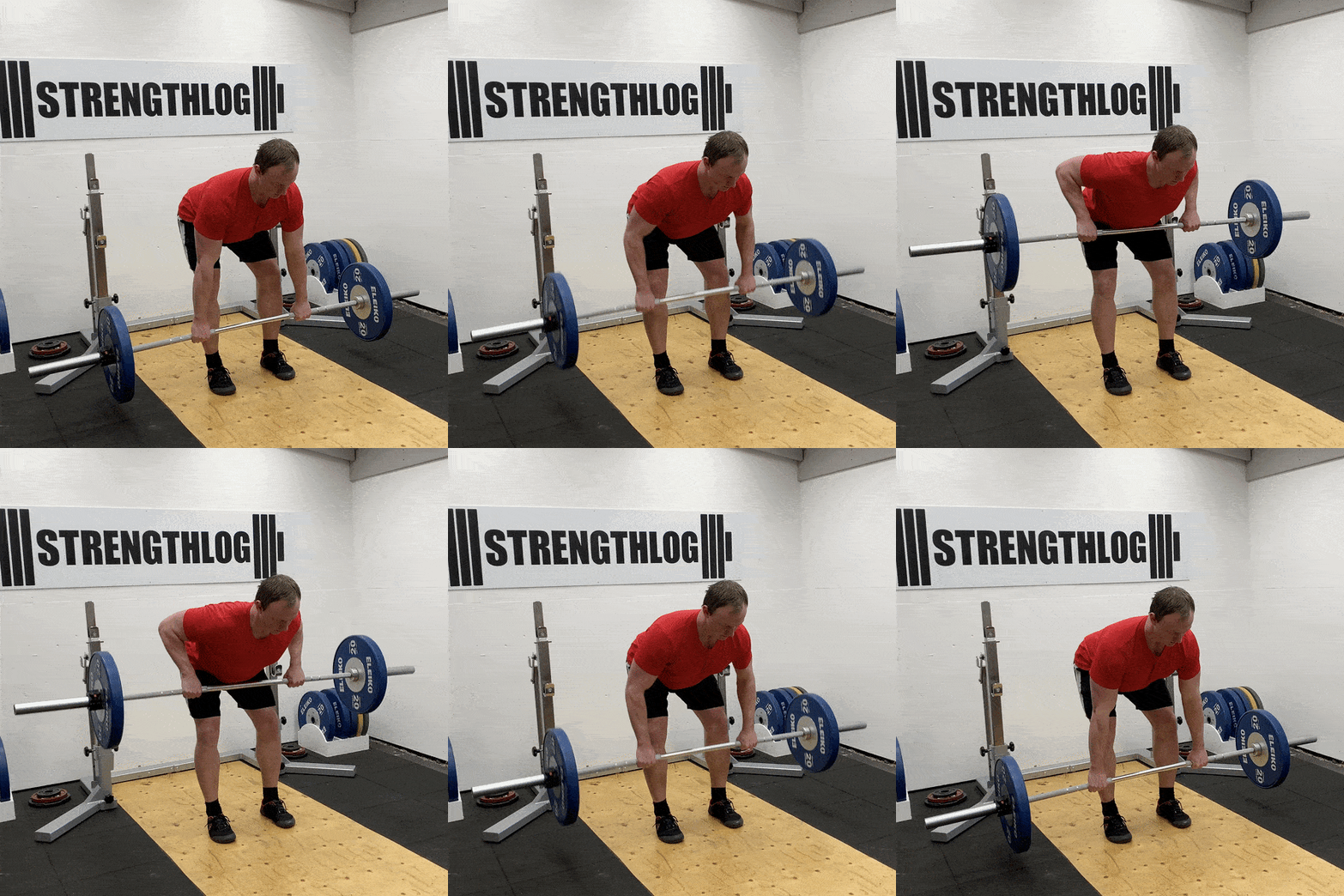

Rows are one of the best things you can do for upper body pulling power and the stability you need for a stronger kinetic chain for your arm swings and for counterbalancing the anterior (front-dominant) activity of badminton. The primary muscles you use when doing rows are your lats, rhomboids, trapezius, and posterior deltoids.
Barbell rows allow you to use a lot of weight to build as much strength and muscle as possible, while dumbbell rows offer a greater range of motion, train anti-rotation, and require more stabilization because you row with each arm independently. Strength Training for Badminton includes both exercises in different phases of the program.
How to Do Barbell Rows
- Grip the bar with an overhand grip.
- Lean forward with the bar hanging from straight arms.
- Inhale and pull the bar towards you.
- Pull the bar as high as you can so that it touches your abs or chest, if possible.
- With control, lower the bar back to the starting position.
- Repeat for the desired number of repetitions.
How to Do Dumbbell Rows
- Place your left knee and left hand on a bench for support.
- Hold a dumbbell in your right hand with your arm extended straight down.
- Keep your back flat and core engaged.
- Pull the dumbbell up toward your waist, keeping your elbow close to your body.
- Squeeze your shoulder blade at the top of the movement.
- Lower the dumbbell back to the starting position with control.
- Repeat for the desired number of repetitions, then switch sides, and repeat.
Overhead Press & Push Press


I have programmed two variants of the barbell press into this workout routine: the regular overhead press and the push press. They might look like twins at first, but they’re more like siblings with wildly different energy levels. One is calm and composed, while the other is hyped up on energy drinks.
- The overhead press is your classic press: straight up from shoulder level to full arm extension, and you do it all with upper body strength without any hip bounce.
- Push presses look like overhead presses, but you dip your knees slightly and use your legs to drive the weight overhead. Push presses train your body to generate force quickly from the ground up, like you do when you leap for a smash or lunge and spring into an overhead drive.
Why both? The overhead press builds the foundation: shoulder strength, control, and stability. The push press builds power, explosiveness, and full-body coordination. And you need it all in badminton.
How to Overhead Press
- First, place a barbell in a rack at about chest height.
- Grip the bar slightly wider than shoulder-width apart, and step close to it.
- Inhale, lightly brace your core, and unrack the bar.
- Let the bar rest against your front delts while you step back from the rack.
- Press the bar up to straight arms while exhaling.
- Inhale at the top or while lowering the bar with control back to your shoulders.
- Repeat the movement for the desired number of repetitions.
How to Push Press
- How to Push Press
- Clean a bar to your shoulders, or lift it out from a rack.
- Let the bar rest against the front of your shoulders, with your grip slightly outside your shoulders.
- Inhale and lightly brace your core.
- Bend your knees, and then forcefully push yourself and the bar upwards using your legs.
- When your legs are extended, immediately start pressing the bar with your arms, until your arms are fully extended.
- Lower the bar back to your shoulders, and repeat the movement for the desired number of repetitions.
Lat Pulldown & Pull-Up


The lat pulldown and the pull-up are two great exercises for your back (primarily the lats), biceps, and rear delts (and your grip if you don’t use lifting straps). In badminton, you need power from your back to whip your racket down, for clears and drives, and for overall upper-body stability.
- Lat pulldowns are like pull-ups on easy mode, or rather, a controlled, adjustable version of them. They are stable and scalable, and you can start with a manageable weight and slowly build strength without having to haul your entire body weight.
- Pull-ups train the same muscles but develop integrated strength, with your back, core, shoulders, and grip all working together under real-life conditions without the stability of a machine.
In Strength Training for Badminton, you start with lat pulldowns to build a foundation and strength, then graduate to pull-ups.
How to Do Lat Pulldowns
- Begin by adjusting the thigh pad to fit snugly against your thighs to prevent your body from lifting off the seat.
- Grasp the bar with an overhand (pronated) grip, with your hands slightly wider than shoulder-width apart.
- Sit with your thighs under the thigh pad, keep your chest up, and look at the bar.
- Pull the bar down towards your chest, leading with your elbows. Pull until the bar is below your chin or touches your upper chest.
- Squeeze your shoulder blades together at the bottom of the movement.
- Release the bar back up to the starting position, then repeat the movement for the desired number of repetitions.
How to Do Pull-Ups
- Grip the bar with palms facing away from you, slightly wider than shoulder-width.
- Keep your chest up, and look up at the bar.
- Inhale and pull yourself up until your chin is over the bar or the bar touches your upper chest.
- Exhale and lower yourself with control until your arms are fully extended.
- Repeat the movement for the desired number of repetitions.
Copenhagen Plank

I know we talked about the plank earlier, but the Copenhagen plank is such a unique beast that it deserves its own entry. It is a variation of the side plank, but with a twist that makes your inner thighs (adductors) scream, in a good way. Instead of resting your bottom leg on the floor, you elevate your top leg on a bench or surface, while your bottom leg either hovers or offers minimal support.
Copenhagen planks build core stability and adductor strength for side-to-side motions. Weak adductors = higher injury risk. For example, groin strains are relatively common among quick-twitch athletes like badminton players whose groins take on eccentric loads that would make even a powerlifter wince, and Copenhagen planks strengthen that entire region.
How to Do Copenhagen Planks
- Lie on your side with your top leg resting on a bench.
- Place your forearm on the floor directly below your shoulder for support.
- Engage your core and lift your bottom hip off the ground so your body forms a straight line.
- Keep your bottom leg off the ground, hanging under the bench or lightly touching it for balance.
- Hold the position for your desired time.
- Lower your body back down, then switch sides and repeat.
Deadlift (Regular and Trap Bar)


The deadlift trains one of the most basic human movement patterns: hinging at the hips to lift something from the ground. It’s a full-body exercise, but it mainly targets the posterior chain, the powerful network of muscles running down the back of your body, including the glutes, hamstrings, and spinal erectors—all 100% essential for generating explosive power.
The trap bar deadlift shifts the load more to your quads and traps, making it a bit more upright in posture. It is also arguably more sport-specific and better for athletic movement, like jumping, driving off the floor, or court sprints.
In Strength Training for Badminton, you do conventional deadlifts to build maximal strength (phase 2) and trap bar deadlifts to develop explosive movement patterns that transfer directly to the court (phase 3).
How to Deadlift
- Step up close to the bar so that it is about over the middle of your foot.
- Inhale, lean forward, and grip the bar.
- Hold your breath, brace your core slightly, and lift the bar.
- Pull the bar close to your body, with a straight back, until you are standing straight.
- Lower the bar back to the ground with control.
- Take another breath, and repeat for the desired number of repetitions.
How to Do Trap Bar Deadlifts
- Step into the bar’s opening and position yourself so that the handles are in line with the middle of your feet.
- Inhale, bend down and grip the handles.
- Hold your breath, brace your core slightly, and lift the bar.
- Lift the bar with a straight back, until you are standing straight.
- Lower the bar back to the ground with control.
- Take another breath, and repeat for the desired number of repetitions.
Bulgarian Split Squat

The Bulgarian split squat is the bee’s knees if you are chasing faster footwork and more powerful lunges on the court. You perform it with one foot elevated behind you on a bench while you squat with the other leg, training your glutes, quads, adductors, and stabilizers in your hips and core.
Badminton involves a lot of single-leg movement. You don’t glide around the court on two feet like a figure skater. Most of the time, your weight is on one leg. Bulgarian split squats not only help even out strength imbalances, but also trains your brain and body to control force on each leg independently. Plus, it’s a great exercise to improve your flexibility, and better than static stretching, it gives you a dynamic flexibility boost, improving your range of motion while building strength.
How to Do Bulgarian Split Squats
- Place a bar on your upper back or hold a pair of dumbbells in your hands.
- Stand with your back turned against a bench, which should be about knee height. Stand about one long step in front of the bench.
- Place your right foot on the bench behind you.
- Inhale, look forward, and squat down with control until right before your right knee touches the floor.
- Reverse the movement and extend your front leg again, while exhaling. Your back foot should only act as support.
- Repeat the movement for the desired number of repetitions, then switch side and repeat with your right leg forward and your left foot on the bench.
Nordic Hamstring Eccentric

The Nordic hamstring is a body weight exercise that trains your hamstrings eccentrically. That means that a muscle lengthens under tension, the way your hamstrings stretch when you decelerate after a lunge or recover from a jump in badminton. You anchor your ankles, and slowly lower your upper body toward the ground, using your hamstrings to resist gravity like your life (or at least your nose) depends on it.
Not only does research show an association between Nordics and better agility and speed in badminton players, but many studies have also found that it is outstanding for reducing the risk of hamstring strains, up to a 51% reduction.14
That’s good news for a badminton player who puts a heavy load on the hamstrings with all the stops and starts during a match. If these guys aren’t strong enough, you’re leaving power on the court and putting yourself on the waiting list for a hamstring strain.
How to Do Nordic Hamstring Eccentric
- Start off standing on your knees with a straight hip. Feet wedged under something immovable, like a heavily loaded barbell, or a strong training partner.
- Lean your torso forward by extending your knees with no hip movement. In other words, do not push your butt backward.
- Control the eccentric movement by fighting the gravitational forces with all your hamstring strength. If possible, try keeping the eccentric phase to two seconds.
- When your chest reaches the floor, push yourself up using your arms and start over.
Hanging Leg Raise

The hanging leg raise is a core exercise that trains your abs and hip flexors. Almost all movements on a badminton court require the kind of core strength and stability you develop with exercises like the leg raise. Much of the force in your shots originates from your core, which transfers the energy from your lower body to the racket. Your core is also a central stabilizer for your entire body, essential for body performance and for keeping injuries away.
If leg raises are too hard, you can do hanging knee raises instead. They work the same muscles but are a lot less challenging because you bend your knees instead of keeping your legs straight.
How to Do Hanging Leg Raises
- Grasp a pull-up bar with an overhand grip, shoulder-width apart.
- Hang from the bar with your arms fully extended and your body in a straight line from your head to your heels.
- Engage your core and keep your back straight.
- Raise your legs towards your chest, as high as you can, keeping your back straight and your core engaged.
- Slowly lower your legs back down to the starting position.
- Repeat the movement for your desired number of repetitions.
Depth Jumps
The depth jump trains what is called the “stretch-shortening cycle”: it teaches your muscles to store and release elastic energy quickly. Now, why should a badminton player care? Because badminton requires that reactive strength for take-offs at the net, recovery from lunges, and the satisfying feeling when your opponent just watches your smash land as you return to the floor.
The key to a good depth jump is in the split-second contact with the ground, as short as you can make it. The shorter your ground contact time while you can still maintain a powerful rebound, the more you’re training your body to be elastic and explosive—two adjectives every badminton athlete should aspire to.
You only need a few good reps—quality > quantity here. Think 3–5 reps per set, 3–4 sets total, with lots of rest between.
How to Do Depth Jumps
- Stand upright on the edge of as bench or platform with feet shoulder-width apart.
- Step off the platform (don’t jump) and let yourself fall naturally.
- Land softly on the balls of your feet, knees slightly bent, in an athletic stance.
- Immediately explode upward into a vertical jump as quickly and powerfully as possible.
- Land again with control, absorbing the impact by bending your knees.
- Reset and repeat for the desired number of repetitions.
Ball Slam

Ball slams are a full-body, explosive movement where you take a medicine ball, raise it high overhead, and then violently slam it into the ground. It’s not finesse training, it’s foundation training. The kind that makes your finesse count. And has some very badminton-specific benefits.
The primary benefit of slamming balls into the ground is that it builds explosive power, recruiting muscles from your shoulders and core down to your legs. It also improves core strength and stability for rotational power and force transfer.
Use a non-bouncy slam ball, or you might catch the rebound with your nose. If it’s bouncing higher than your knees, go heavier.
How to Ball Slam
- Stand with your feet about shoulder-width apart, your knees and hips slightly bent, holding the ball in both hands at chest height. Engage your core, and keep a good posture.
- Extend your knees and drive your hips forward while simultaneously lifting the ball. Aim for being as tall as possible, the ball overhead, arms up, hips slightly forward, and on your toes from the force of your drive.
- Use your core and arms to slam the medicine ball straight down between your feet with as much force as possible. Press your hips back and bend your knees to further power the slam. Exhale as you slam the ball down.
- Squat down to pick up the ball from the floor, then immediately move into the next slam by repeating the movement.
- Repeat the movement for your desired number of repetitions.
Horizontal and Vertical Jump

The horizontal and vertical jump (also called the broad jump to box jump), the overachiever of the plyometric family, combines both length and height in a single explosive exercise.
The horizontal and vertical jump trains explosive multidirectional power to transition between two types of explosiveness: lateral movement to get you across the court, and vertical lift to own the airspace above the net. And coordination, so your body knows how to explode and stick to the landing, not like a sack of potatoes.
How to Do Horizontal and Vertical Jumps
- Stand with feet hip-width apart, knees slightly bent, and arms behind you for momentum.
- Swing your arms forward and explosively jump forward as far as possible, landing softly in a squat position. Keep your knees bent and engage your core to stabilize.
- Without pausing, push through your legs and swing your arms to jump vertically onto a box or platform in front of you.
- Land with soft knees, absorbing impact in a stable squat position, then extend your legs and straighten your body on top of the box.
- Step off the box one foot at a time to reset.
- Repeat the movement for your desired number of repetitions.
Wrist Curl + Wrist Extension


Wrist curls and wrist extensions are two exercises that build strength and stability in the forearm muscles that control wrist movement.
- Wrist curls train the flexor muscles of your forearm, the muscles on the palm side that contract when you grip something or flick your wrist downward. In badminton, they directly help your forehand shots, especially when you’re not winding up a whole swing. They also condition your grip and forearm endurance.
- The wrist extension trains the extensor muscles on the back of your forearm. They come into play during backhand shots, and they stabilize the wrist in nearly every other movement. Unlike the flexors, they don’t usually generate much power.
Together, they improve your racket control, shot accuracy and power, and likely also reduce the risk of common wrist injuries.
How to Do Wrist Curls
- Grab a barbell with an underhand grip and rest your forearms against your thighs, or alternatively against a bench.
- Lower your hands towards the floor, and let the barbell roll out in your fingers.
- Reverse the motion by closing your grip and bending your wrists upwards.
- Repeat the movement for your desired number of repetitions.
How to Do Wrist Extensions
- Grab a barbell with an overhand grip and rest your forearms against your thighs, or alternatively against a bench.
- Lower your hands towards the floor.
- Reverse the motion by bending your wrists upwards.
- Repeat the movement for your desired number of repetitions.
Note: You can do wrist curls and extensions with a pair of dumbbells instead of with a barbell. Dumbbells offer a more natural range of motion and can feel better than locking your wrists into a fixed motion.
Ab Wheel Rollout

The ab wheel rollout is a superb and challenging exercise that lights every muscle in your core on fire. It is extra effective for strengthening the deep stabilizers of your torso, like the transverse abdominis (your body’s natural weightlifting belt).
Rollouts train anti-extension: your core’s ability to resist arching your lower back under pressure. In badminton, that means more stability, control, and power transfer when you lunge, jump, smash, and slide on the court.
The ab wheel is very tough. You don’t need to do a million reps. A few high-quality rollouts done with control can wreck you, in a good way.
How to Do Ab Wheel Roll-Outs
- Sit with your knees on a soft pad, and place the ab wheel on the floor in front of you.
- Roll out as far as you can, and maintain a straight back throughout the movement.
- Reverse the movement with control, and return to the starting position.
- Repeat the movement for your desired number of repetitions.
Pallof Press

The Pallof press is an anti-rotation core exercise where you stand holding a resistance band or cable out in front of you and try not to twist as the band tries to pull you sideways. It’s like doing the plank while standing up and refusing to be seduced by the dark side of rotational movement.
In badminton, your body twists a lot, but not always symmetrically. Pallof presses help you resist that rotation by building the anti-twist strength that protects your spine and improves balance. The better your core can brace and resist being twisted out of shape, the more force your body can generate and redirect, which is a win/win for both performance and injury prevention.
How to Pallof Press
- Attach a handle in a cable machine at chest height and stand with your side facing the machine.
- Grab the handle with both hands and stand with feet hip-width apart and knees slightly bent.
- Pull the handle to your chest, engage your core, and then press your arms straight out in front of you without rotating your torso.
- Hold briefly, then bring the handle back to your chest in a controlled motion.
- Repeat for the desired number of repetitions, then switch sides.
Landmine Rotation

The landmine rotation involves a barbell anchored at one end, either in a landmine attachment or jammed into a corner or a barbell hole. You hold the free end of the bar with both hands, arms extended, and rotate your torso to move the bar in an arc from side to side.
Now, what does this have to do with badminton? Glad you asked. You’re training the muscles responsible for explosive rotation: internal/external obliques, transverse abdominis, hip flexors, and various stabilizers. That kind of rotational movement generates the speed in your smashes, direction changes, and shots. You learn to control that muscle strength across multiple planes of motion.
How to Do Landmine Rotations
- Stand with your feet slightly wider than shoulder-width apart, holding a landmine bar with both hands, arms straight in front of you.
- Rotate your hips and torso to one side, lowering the bar toward the outside of your hip.
- Engage your core and keep your arms straight as you move the bar over to the opposite side by rotating your torso and hips.
- Continue alternating from side to side in a controlled motion for the desired number of repetitions.
Dead Bug

The dead bug is not a tragic insect tale but a core stability exercise in which you lie on your back—ironically like a bug that’s given up on life—and extend one arm and the opposite leg simultaneously while keeping your torso still.
The main benefits of dead bugs are anti-extension strength and improved cross-body coordination (your core stabilizes while different parts of your body are doing their own things: right arm, left leg, and so on)
In simpler terms, the dead bug helps your body move like a unit rather than a messy sack of limbs.
Note: If you feel you can’t maintain complete control over the movement while holding dumbbells, using your bodyweight only is also effective.
How to Do Dead Bugs with Dumbbells
- Lie on your back, holding a ligth dumbbell in each hand. Extend your arms straight up toward the ceiling and lift your legs so your knees are bent at 90 degrees.
- Engage your core and press your lower back into the floor.
- With control, extend your right leg and lower it toward the floor while simultaneously lowering your left arm—holding the dumbbell—overhead. Keep your lower back in contact with the floor throughout the movement.
- Return to the starting position and repeat on the opposite side.
Plyometric Push-Up
A plyometric push-up is an explosive variant of the standard push-up. You lower your chest to the ground, then you launch yourself up with enough force to get your hands airborne (or even clap if you’re an advanced athlete, although that’s not required in Strength Training for Badminton).
Plyometric push-ups work your pecs, triceps, and deltoids and build neuromuscular coordination. You tap into your fast-twitch muscle fibers, so when you’re making quick reflex saves or ripping a jump smash, your body has been trained to explode into action.
How to Do Plyo Push-Ups
- Start in a standard push-up position with hands slightly wider than shoulder-width apart.
- Lower your chest toward the ground by bending your elbows.
- Explosively push through your hands to lift your body off the ground.
- Land softly with bent elbows and immediately go into the next rep.
- Repeat the movement for the desired number of repetitions.
Single-Arm Landmine Press

The landmine press is like a strength coach and a physiotherapist had a beautiful baby just for racket sports: it builds pressing power, overhead stability, and shoulder strength, all delivered in a movement in a way that’s more joint-friendly than a traditional press.
Unlike the standard overhead press, the bar path moves in an arc, not straight up, like how your arm naturally moves when smashing birdies or defending the net. In Strength Training for Badminton, you’re doing the unilateral, one-arm variant.
How to Do Landmine Presses
- Stand with your core activated and the feet about shoulder-width apart.
- Place the barbell in one hand, and rest it on your shoulder.
- Press to lockout by extending the elbow and flexing the shoulder.
- Slowly lower the barbell back to the starting position on your shoulder.
- Repeat for the desired number of repetitions.
Core Twist

The core twist is a rotational exercise for your obliques (the side muscles of your abs), rectus abdominis (six-pack), and transversus abdominis (deep core stabilizers). If done with correct form and range of motion, it also works your lower back and hip flexors as stabilizing muscles.
The twist motion mimics the rotational force you use during shots. Think of it like training the gearbox of your body: your core is what transfers power between your legs and your upper body. Without a strong core, your smash becomes more like a sad flail.
How to Do Core Twists
- Sit on the floor with your knees bent and feet either on the ground or lifted slightly off.
- Hold a weight plate, medicine ball, or kettlebell with both hands in front of your chest.
- Lean slightly back with a straight back and engaged core.
- Twist your torso to one side and bring the weight toward your hip, keeping your hips stable.
- Return to the center and rotate to the other side.
- Repeat for the desired number of repetitions.
Strength Training for Badminton: Final Rep
Alright, let’s wrap this up! So, you’ve made it through the “why” and the “how” of pumping iron for badminton. Pat yourself on the back—that’s a solid first rep!
While you don’t need to bulk up like a bodybuilder to smash a shuttlecock, just a few weekly sessions with the weights, and you’ll not only feel more stable and more explosive but actually deliver it where it counts: on the court.
So don’t treat strength work as an optional extra. It’s part of the game plan. Now go lift something heavy!
🏸🏸🏸
To follow Strength Training for Badminton, download our workout log app and start tracking your workouts today:
Click here to go directly to the program in StrengthLog.
References
- Psychology of Sport and Exercise, Volume 75, November 2024, 102702. Seeing the unseen boundary behind you: Predicting the out-of-bounds of flick serves in playing badminton doubles.
- Electron J Gen Med, Volume 22, Issue 1, February 2025. Badminton-related musculoskeletal injuries in senior players: Epidemiology and preventive strategies for common injuries.
- Sports Med. 2015 Apr;45(4):473-95. The science of badminton: game characteristics, anthropometry, physiology, visual fitness and biomechanics.
- Front. Physiol. Sec. Exercise Physiology, Volume 16 – 2025. Effects of resistance training on performance in competitive badminton players: a systematic review.
- Strength and Conditioning Journal 30(3):p 33-41, June 2008. Design and Implementation of a Specific Strength Program for Badminton.
- Revista Brasileira de Medicina do Esporte 29(2), May 2023. INFLUENCE OF STRENGTH TRAINING ON PHYSICAL FITNESS OF BADMINTON PLAYERS.
- Br J Sports Med. 2014 Jun;48(11):871-7. The effectiveness of exercise interventions to prevent sports injuries: a systematic review and meta-analysis of randomised controlled trials.
- Br J Sports Med. 2018 Dec;52(24):1557-1563. Strength training as superior, dose-dependent and safe prevention of acute and overuse sports injuries: a systematic review, qualitative analysis and meta-analysis.
- PLoS One. 2024 Jun 12;19(6):e0305116. Effect of core strength training on the badminton player’s performance: A systematic review & meta-analysis.
- Sports Med. 2014 Dec;44(12):1693-702. doi: 10.1007/s40279-014-0227-1. Increases in lower-body strength transfer positively to sprint performance: a systematic review with meta-analysis.
- J Strength Cond Res. 2012 Dec;26(12):3243-61. Influence of squatting depth on jumping performance.
- Arthroscopy, Sports Medicine, and Rehabilitation, 10 October 2024. Prevention and Rehabilitation of the Athletic Hamstring Injury.
- Int J Sports Phys Ther. 2017 Aug;12(4):543–549. BUILDING A BETTER GLUTEAL BRIDGE: ELECTROMYOGRAPHIC ANALYSIS OF HIP MUSCLE ACTIVITY DURING MODIFIED SINGLE-LEG BRIDGES.
- Br J Sports Med. 2019 Nov;53(21):1362-1370. Including the Nordic hamstring exercise in injury prevention programmes halves the rate of hamstring injuries: a systematic review and meta-analysis of 8459 athletes.
