
If you think you need a gym membership or a garage full of barbells and rusty iron to build muscle and strength, think again.
In this guide, we’ve rounded up 21 of the best dumbbell exercises to help you get the results you want, plus our best workouts for the entire body.
Note: If you are new to strength training and want to get into dumbbell training, we have an article just for you: The Best Dumbbell Exercises for Beginners.
Table of Contents
Why Are Dumbbells Awesome?
I’ve been around barbells, machines, cables, specialty bars, you name it. And look, I love a heavy barbell as much as the next guy. There’s nothing like loading up a bar for a heavy deadlift or squat.
But dumbbells, oh boy, are they awesome. They don’t lock you in a fixed path, and they are super duper versatile. They are unmatched for balance and stability, and if you fail, you can just dump them to the side. Fail a heavy bench with a barbell and no spotter? That’s sketchy.
Also, not everyone wants to train in a gym. And not everyone has the space or the budget for a full squat rack and barbell setup at home.
But a good set of adjustable dumbbells can replace a whole rack of weights, and you can tuck them away in a corner when you’re done. And they’re perfect for taking your workout on the road.
I’m not saying dumbbells are always better than barbells or machines, but they sure can be better for some people and in some situations.
If you want to build a balanced, powerful, and aesthetic body, all you really need is a couple of dumbbells and a handful of choice exercises. Lucky for you, we’ve got that list right here.
Here are the 21 best dumbbell exercises that will never go out of style:
Best Dumbbell Exercises for Your Chest
Try our dumbbell chest workouts to build your pecs; you’ll find one for any experience level in StrengthLog:
1. Dumbbell Chest Press

The dumbbell chest press is your bread and butter dumbbell exercise for your chest muscles.
Many would argue it’s superior to the barbell bench press for pure muscle building. You get a greater range of motion and can bring the dumbbells deeper for a better stretch in your pecs.
You can handle 15–20% more weight with a barbell, but the dumbbell bench press activates your chest more because your chest has to both press and stabilize.1 2 Plus, it’s more joint-friendly for most lifters’ shoulders.
Pro Tip: Don’t let the dumbbells clink together at the top. Stop just short to keep constant tension on the muscle and focus on squeezing your chest.
How to Do Dumbbell Chest Presses
- Lie on a bench, and lift a pair of dumbbells up to the starting position.
- Press the dumbbells up to straight arms, while exhaling.
- Inhale at the top, or while lowering the dumbbells with control back to your shoulders.
- Repeat for reps.
2. Incline Dumbbell Press

Want that upper shelf on your chest? The incline dumbbell press is the exercise. By setting the bench to an incline, you shift the focus to the clavicular head (the upper chest) of the pec major. Have you ever seen someone with an overdeveloped upper chest? I didn’t think so. Me neither.
Pro Tip: Set the bench to an inclination of 30–45°. That’s the sweet spot; any higher, and you hit the front delt more and the pecs less.3
How to Do Incline Dumbbell Presses
- Adjust the incline of a bench to be around 30–45°.
- Sit down and lift a pair of dumbbells to the starting position.
- Press the dumbbells up to straight arms while exhaling.
- Inhale at the top or while lowering the dumbbells with control back to your shoulders.
- Repeat for reps.
3. Dumbbell Chest Fly

The dumbbell fly is an isolation movement, meaning its job is to isolate the chest by taking other muscles out of the equation. It’s a great exercise for creating a mind-muscle connection and getting a tremendous stretch and pump.
Since you can’t load them up safely with super heavy weight, you don’t want to make flyes the main event on chest day, but they’re great for squeezing the last bit of juice out of your pecs after your big pressing movements.
Pro Tip: Flyes are not about lifting heavy. Focus on a nice stretch at the bottom and squeezing at the top, as if you’re hugging a barrel.
How to Do Dumbbell Chest Flyes
- Lie on a bench, and lift a pair of dumbbells up to the starting position.
- With almost completely straight arms, lower the dumbbells out to your sides.
- When you’ve lowered the dumbbells as deep as possible, reverse the motion and return the dumbbells to the starting position.
- Repeat for reps.
Best Dumbbell Exercises for Your Back
4. Dumbbell Deadlift

The dumbbell deadlift is a tremendous exercise for building muscle and strength in the posterior chain (the muscles on the back of your body), just like the barbell variant.
The only downside compared to barbell deadlifts is that, at some point, your legs and back might be like “Give us more challenge!” while your dumbbells are sitting there like “Sorry, we max out at 60 lb.” You might eventually outgrow them and need a barbell, but until then, enjoy a fantastic all-around strength builder.
Pro Tip: Use lifting straps if you struggle with your grip. You can train grip strength separately, but you don’t want it to be the weak link in your back training.
How to Do Dumbbell Deadlifts
- Hold a dumbbell in each hand, and stand with your feet about hip-width apart.
- Inhale and lightly brace your core.
- Lower the dumbbells close to the floor, by leaning forward and bending your knees.
- Reverse the movement, and return to a standing position. Exhale on the way up.
- Repeat for reps.
5. Dumbbell Row

The dumbbell row is the meat-and-potatoes of dumbbell back training, building thickness and strength through your lats, rhomboids, and traps.
Supporting yourself with one arm on a bench makes it much easier to really focus on one side of your back at a time. You can use a heavier weight and a greater range of motion than with the two-arm version.
Pro Tip: Avoid yanking the weight up with your whole body. Some torso twisting is OK, but stay in control and drive the stretch-and-contract movement with your back.
How to Do Dumbbell Rows
- Start by placing a dumbbell on the floor beside a bench or chair. Stand facing the bench or chair and place your left hand and left knee on top of it.
- Keep your back flat and parallel to the ground, with a slight bend in the standing leg. Grip the dumbbell with your right hand.
- Inhale and pull the dumbbell by driving the elbow toward the ceiling.
- With control, lower the dumbbell back to the starting position while exhaling.
- Complete desired reps on one side, then switch to the opposite arm and leg.
6. Renegade Row
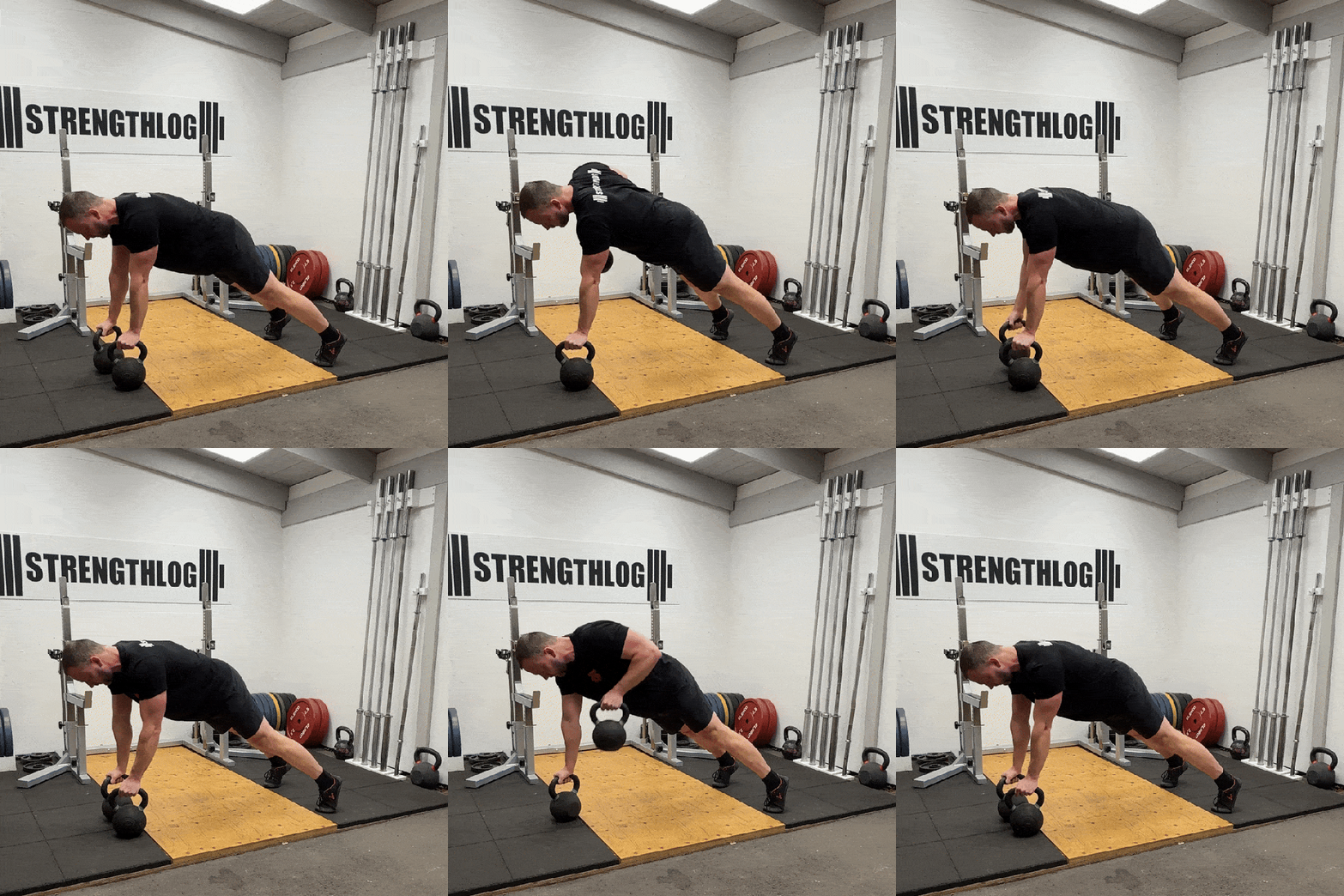
The renegade row is a two-for-one exercise where you’re doing rows while holding yourself in a push-up/plank position. You get the back-building benefits of a row and a core workout as a bonus. It’s great for functional strength, stability, and anti-rotation.
To do renegade rows, you need dumbbells with flat sides (hex dumbbells) for stability (or kettlebells). Doing them with regular round dumbbells turns it into a balance and stability exercise, which isn’t wrong, but it’s not that great of a back exercise anymore.
Pro Tip: Keep your feet wide apart to create a stable base. You want to keep your hips perfectly still as you row; don’t let them twist.
How to Do Renegade Rows
- Start in a high plank position with your hands gripping a pair of hexagonal dumbbells or kettlebells placed directly under your shoulders.
- Keep your body in a straight line from head to heels, feet slightly wider than hip-width for balance.
- Brace your core and row one weight toward your ribcage, keeping your elbow close to your body.
- Lower the weight back to the ground with control.
- Repeat on the opposite side, alternating sides for the desired number of reps.
7. Dumbbell Pullover

The dumbbell pullover is a classic you don’t see enough anymore. It’s unique because it’s one of the few exercises that work opposing muscle groups (chest and lats) at the same time, and you work one or the other harder depending on where you focus your effort.
Old-school bodybuilders swore by the pullover for expanding the rib cage. Science says maybe not, but it does stretch and hit differently than presses and rows.
Pro Tip: To hit your lats more and your pecs less, keep your arms close to your torso, and as you bring the dumbbell back up, pull your upper arms down and in toward your torso.
Best Dumbbell Exercises for Your Shoulders
Build your shoulders with this premium dumbbell workout for intermediates and above: Shoulder Workout With Dumbbells at Home.
8. Dumbbell Shoulder Press

The overhead press is the premier exercise for building strong boulder shoulders, particularly the front delts.
The standing version is a full-body stability challenge, while the seated version takes your legs out of the equation, allows you to push more weight, and forces your delts to do more of the work. Both are great, but the seated version is tops for building muscle.
Pro Tip: Tilt your elbows slightly forward instead of flaring them straight out to the sides. Flaring is not necessarily the rotator cuff-killer some claim, but angling them forward gives you more stability and lets you handle heavier weights.
How to Do Dumbbell Shoulder Presses
- Grab a pair of dumbbells, and lift them up to the starting position at your shoulders, seated or standing.
- Inhale and lightly brace your core.
- Press the dumbbells up to straight arms, while exhaling.
- Inhale at the top, or while lowering the dumbbells with control back to your shoulders.
- Repeat for reps.
9. Dumbbell Lateral Raise

Want wider shoulders? The lateral raise is how you get them. The overhead press builds front-delt mass, but the lateral raise hits your side delts, which are responsible for wide, “capped” shoulders.
Use a lighter weight with perfect form. Swinging the dumbbells up in lateral raises is one of the most common gym mistakes, and it turns the best side delt exercise into momentum and trap work.
Pro Tip: To hit your side delts the hardest, point your thumbs down like you’re pouring a protein drink out of a shaker at the top of the movement.4 Note that doing so places your shoulders in internal rotation, so if you feel any discomfort, switch to a neutral grip.

How to Do Dumbbell Lateral Raises
- Hold a pair of dumbbells in almost straight arms hanging by your sides.
- With control, lift the dumbbells out to your sides until your upper arms are horizontal.
- Lower the dumbbells with control.
- Repeat for reps.
10. Reverse Dumbbell Fly

Everyone smashes their front and side delts, but too many forget the rear. The reverse dumbbell fly hits the posterior deltoids, which do more than many realize for shoulder health, posture, and the 3D look bodybuilders want.
Like with lateral raises, using a weight you can control with strict form is far more important than heaving up the heaviest dumbbells you can find.
Pro Tip: You don’t need to raise the dumbbells higher than shoulder level, or you’ll use more rhomboids and traps (the upper back muscles that pull your shoulder blades together).
How to Do Reverse Dumbbell Flyes
- Hold a pair of dumbbells, lean forward, and let your arms hang towards the floor.
- With almost straight arms (just a slight bend at the elbow), slowly lift the dumbbells by raising your arms out to the sides.
- Reverse the movement and lower the dumbbells back to the starting position.
- Repeat for reps.
Best Dumbbell Exercises for Your Legs
Training at home? Try the Home Leg Workout With Dumbbells in the StrengthLog app (premium; 14-day trial available).
11. Goblet Squat

The goblet squat is arguably the best squat teacher for beginners. Holding the weight in front of you forces you to keep your chest up and makes it easy to sink into a deep squat, grooving a squat pattern that’s hard to mess up.
It’s no less effective for training the quads, glutes, and adductors in trained lifters, although experienced lifters can hit a ceiling. Most gyms don’t stock 200 lb. dumbbells, so you run out of weight when you become strong enough. And even if you find one heavy enough, hugging a massive dumbbell is more like wrestling a boulder, with your arms giving out before your legs do.
That being said, they remain great for high-rep accessory work and mobility even if and when they stop being the best tool for maximum strength.
Pro Tip: Push your knees out as you go down to activate your glutes and help you keep your chest up.
How to Do Goblet Squats
- Grab a dumbbell or kettlebell and hold it against your chest.
- Stand with your feet about shoulder-width apart, and your toes pointing slightly outward.
- Inhale, lightly brace your core, and squat down as deep as possible.
- Reverse the movement and return to the starting position. Exhale on the way up.
12. Bulgarian Split Squat

The Bulgarian split squat is a one-legged squat with your rear foot elevated on a bench. It’s a tough but super effective exercise for the quads, adductors, and glutes. And it’s great for balance and hip mobility.
One benefit of dumbbells compared to a barbell is that it’s easier to bail by dropping them should you happen to lose balance.
Pro Tip: If you want to bias your glutes more, slightly lean your torso forward at the hips instead of staying bolt upright. It also makes it easier to keep your balance.
How to Do Bulgarian Split Squats
- Stand with your back turned against a bench, which should be at about knee height. Stand about one long step in front of the bench and hold a pair of dumbbells in your hands.
- Place one foot on the bench behind you.
- Inhale, look forward, and squat down with control until right before the knee of the back leg touches the floor.
- Reverse the movement and extend your front leg again, while exhaling.
- Inhale at the top and repeat for reps.
13. Walking Lunge

The walking lunge is a dynamic, functional exercise that works every muscle in your lower body while also challenging your stability and coordination. It’s a fantastic finisher to burn out your legs.
The dumbbell advantage compared to a barbell is that it’s 1) easier to set up; just grab and go, and 2) safer if you fail, as you can just drop the weights. On the other hand, it’s easier to load with a barbell, and you don’t risk your grip giving out before your legs.
Pro Tip: A shorter step will work the quads more, while a longer step will place more load on the glutes.
How to Do Dumbbell Walking Lunges
- Hold a pair of dumbbells in your hands.
- Stand with your feet shoulder-width apart, with a slight knee bend. Make sure that your core is engaged.
- Step forward with one of your legs, bending both knees at the same time. Stop the movement just before the back knee touches the floor; you should have about a 90-degree angle in both knees.
- Drive through your front foot and extend the knee until you return to standing.
- Continue by repeating the movement on the other side.
- Repeat for reps.
14. Dumbbell Romanian Deadlift

The Romanian deadlift (RDL) is the top dog exercise for building your hamstrings and glutes while teaching the hip hinge, a basic movement pattern for lifting heavy things and protecting your lower back.
Dumbbells let you keep your hands at your sides instead of in front of your legs like a barbell, which can feel more natural.
Pro Tip: Think of the movement as pushing your hips back, like butting a door closed, not bending over. The dumbbells should stay close to your legs the entire time.
How to Do Dumbbell Romanian Deadlifts
- Stand upright, holding a pair of dumbbells.
- Inhale, brace your core slightly, and lean forward by hinging in your hips. Keep your knees almost completely extended.
- Lean forward as far as possible without rounding your back. You don’t have to touch the dumbbells to the floor, although it is OK if you do.
- Reverse the movement and return to the starting position. Exhale on the way up.
- Take another breath, and repeat for reps.
15. Dumbbell Step-Up

“What if climbing stairs were way harder and made your butt sore for three days?”
That’s the dumbbell step-up, where you step onto a box, bench, or platform while holding a pair of dumbbells. It is a glute-builder extraordinaire, more so than squats and hip thrusts, according to a 2020 study.5
Pro Tip: Don’t drive off the back leg; “pull” yourself up with the lead leg. Many push off the ground with their trailing leg without thinking about it, turning the movement into a kind of hop and robbing the leg on the box/bench of tension and glute and quad activation.
How to Do Step-Ups
- Stand in front of a chair, bench or something else that you can step up on, holding a pair of dumbbells in your hands.
- Place your foot on the chair.
- Lightly brace your core, and step up until your leg is straight.
- Lower yourself in a controlled motion.
- You can keep your foot on the chair, and repeat for reps.
Best Dumbbell Exercises for Your Arms
Do this complete dumbbell arm workout to build your guns and track your progress in StrengthLog (a premium trial is available, with no strings attached).
16. Dumbbell Curl

You train your biceps when you do compound back exercises, but if you want to develop them maximally, you gotta do some direct arm work, too. That means curls, and the classic dumbbell curl is both straightforward and effective.
It trains both the two biggest arm flexors, the biceps brachii and the brachialis underneath, and with dumbbells you can work each arm independently and supinate (twist your wrist from a neutral to a palms-up position) fully for both mass and peak.
Pro Tip: Avoid swinging. If you have to use your back and shoulders to get the weight up, it’s too heavy, although slight “cheating” on the last one or two reps is OK.
How to Do Dumbbell Curls
- Hold a pair of dumbbells in an underhand (supinated) grip, arms hanging by your sides.
- Lift the dumbbells with control, by flexing your elbows.
- Don’t let your upper arms travel back during the curl. Keep them at your sides, or move them slightly forward.
- Reverse the movement and lower the dumbbells back to the starting position.
- Repeat for reps.
17. Incline Dumbbell Curl

The incline dumbbell curl is similar to regular dumbbell bicep curls, but with two differences.
First, you always do it seated. Second, you use a 45–60° incline bench, with your arms hanging behind your body. That puts your biceps in a pre-stretched position, makes it super hard to cheat, and gives you a great contraction and pump.
Pro Tip: Let your arms hang straight down. As you curl up, keeping your upper arm stationary, only your forearm should be moving.
How to Do Incline Dumbbell Curls
- Grab a pair of dumbbells, and sit down on an inclined bench. Let your arms hang straight down by your sides.
- Lift the dumbbells with control, by flexing your elbows.
- Reverse the movement and lower the dumbbells back to the starting position.
- Repeat for reps.
18. Dumbbell Lying Triceps Extension

Your triceps make up roughly two-thirds of your upper arm mass, so if you want big arms, you must focus at least as much on your triceps as your biceps, if not more.
The lying triceps extension is your go-to mass builder for the triceps. Doing it with dumbbells is just as effective as the barbell classic and easier on the elbows and wrists.
Pro Tip: This exercise is also called the “skull crusher,” but you want to lower the weights down behind your head rather than to your forehead. You get a better stretch, a better effect, and you avoid the risk of bonking yourself on the head.
How to Do Dumbbell Lying Triceps Extensions
- Lie down on a bench with your head close to the edge. Hold a pair of dumbbells with your arms pointing straight up.
- Lower the dumbbell down behind your head. Try to keep the same distance between your elbows throughout the movement.
- Reverse the motion and extend your arms again.
- Repeat for reps.
19. Overhead Triceps Extension

The overhead triceps extension is the best exercise for the biggest part of your triceps: the long head. Research shows that overhead extensions grow the long head 1.5 times more than pushdowns, probably the most popular triceps exercise.6
You can do them seated or standing, with one or two dumbbells. Regardless, dumbbells allow you to get into a deep and comfortable stretch that’s hard to achieve with a barbell.
Pro Tip: Keep your upper arm still, your elbow pointed towards the ceiling, and only your forearm moving.
How to Do Dumbbell Standing Triceps Extensions
- Lift a dumbbell up to a straight arm over your head.
- Lower the dumbbell down behind your head, while keeping your upper arm still and vertical.
- Reverse the motion and extend your arm again.
Best Dumbbell Exercises for Your Entire Body
20. Thrusters

The thruster exercise combines a front squat with an overhead press. If you want one exercise to gas you out and work nearly every muscle in your body, this is it. It’s phenomenal for building power, muscular endurance, and conditioning.
Holding two dumbbells in a front rack position is more manageable and wrist-friendly than using a barbell, and you still get the athletic benefits.
Pro Tip: You can also do thrusters with kettlebells, like in the demo above.
How to Do Dumbbell Thrusters
- Stand with your feet shoulder-width apart and hold two dumbbells in rack position.
- Lower into a squat until your thighs are approximately parallel to the ground.
- Drive explosively up from the bottom position by extending your hips and knees, and use the force from your legs to press the weight overhead in one fluid motion.
- Fully extend your arms at the top and lock out the weight overhead.
- Lower the weight back to your shoulders in a controlled manner and immediately transition into the next repetition.
- Repeat for reps.
21. Farmer’s Walk

The farmer’s walk is the simplest exercise on this list. Pick up the heaviest dumbbells you can handle and walk. That’s it.
It is also one of the most effective and about as full-body as it gets. It builds your grip, core, conditioning, and posture in one exercise, and will make you a stronger, more capable human being. And who doesn’t want that?
Pro Tip: Take short, quick steps with the path of each foot narrow under your center of mass. Why? Better stability and less side-to-side wobble.
How to Do Farmer’s Walks
- Pick up a pair of suitably heavy dumbbells.
- Hold your breath, brace your core slightly.
- Look ahead, and start moving forward in small steps. Increase the stride length as you increase the speed.
- Keep your body straight and do not lean excessively forward as you walk.
- When you are done, put the dumbbells back on the ground in a controlled manner.
Should You Get Adjustable or Fixed Dumbbells?
If you work out in a gym all the time, that question becomes irrelevant. You always have all the dumbbells you’ll ever need close at hand.
But if you work out at home, you need to decide if you should get adjustable or fixed dumbbells.

Both will work fine, but for most people, I’d say go with adjustable dumbbells unless you get a super deal on fixed ones and have the room to store them.
I remember trying early adjustable dumbbells something like 20 years ago. They were… they had some quirks. They rattled, the weight plates shifted, and the adjustment mechanisms felt like they were one rep away from giving up on you. But buy a reputable brand today, and you’re not getting the old-school rinky-dink flimsiness anymore.
Adjustable vs Fixed Dumbbells: Pros and Cons
- Pro Adjustable: With adjustables, instead of a clunky rack that hogs half your room, you get the equivalent of 10–15 pairs of dumbbells in the footprint of two. If you don’t have a dedicated garage or cellar gym, that’s a big advantage.
- Pro Adjustable: With adjustables, you can add more weight without having to buy a new set of dumbbells. As a beginner, you’ll start with lighter weights, and a couple of pairs of fixed dumbbells might be enough. But as you get stronger (and you will), you’ll need to keep overloading your muscles, which means more and heavier dumbbells.
- Pro Fixed: Different exercises require different weights. You’re not going to be curling the same weight you’re using for a goblet squat. While adjustable dumbbells allow you to switch between weights relatively quickly, they’ll never be as fast and easy as picking up a different pair.
- Possible Tie: As for cost, the initial price of a good pair of adjustable dumbbells is higher than a single pair of 10-pounders. But, when you do the math on buying individual pairs of 10s, 15s, 20s, 25s, and so on, the adjustable set almost always comes out on top. It’s an investment that pays for itself as you get stronger. That being said, sometimes you can get great deals on used gym equipment, and in that case, you can get a lot of fixed dumbbells for a pittance.
Here’s a quick and easy cheat sheet to help you decide:
| Consider This… | Go with Adjustable Dumbbells if… | Go with Fixed Dumbbells if… |
| Your Space | You’re tight on space and need a compact solution. | You have a dedicated workout area with room for a rack. |
| Your Budget | You want the most bang for your buck in the long run. | You’re starting with just a couple of pairs or have a bigger budget for a full set. |
| Your Workout Style | You like a lot of variety and different exercises in your routine. | You prefer fast-paced workouts like circuit training. |
| Durability | You’re careful with your equipment and won’t be throwing your weights around. | You want something that can take a beating and last a lifetime. |
Ultimately, there’s no single “best” option. It really boils down to your personal situation.
- For most people setting up a home gym, adjustable dumbbells give you the best combination of versatility, space-saving, and value.
- However, if you have the space and budget, the simplicity and durability of fixed dumbbells can’t be beat.
How Many Sets and Reps Should You Do of Each Exercise?
How many reps you should do really comes down to what you’re aiming for.
- If your main goal is to grow your muscles, stick mostly to sets in the 6–15 rep range. Fewer or more work well, too, but that’s the sweet range. Always training heavy puts stress on your joints, and always doing 20+ reps hurts like heck (not harmful pain, but most lifters can’t or don’t want to train through that kind of burn all the time).
- If you’re going for maximal strength, you’ll want to focus on the lower side, around 1–8 reps per set.
- And, if you want a mix of both size and strength, you can start your workout with heavier compound exercises in the lower rep range, then finish off with higher-rep isolation work using lighter weights. That’s the approach we use in many of our bodybuilding and general strength training workouts and programs.
When it comes to sets, research shows that more sets usually mean more muscle growth, up until about 10 per muscle group per week.7 After that, the benefits taper off.
If you’re doing full-body workouts, you obviously can’t do 10 sets per muscle group each workout, or you’d spend half the day in the gym. Instead, maybe you do three weekly workouts with 3–4 sets per muscle each session.
Conversely, if you follow a “bro split”, training one or two muscle groups each workout, you can do everything in one manageable session and still recover.
Both approaches work equally well for most people, by the way. It mostly comes down to how you prefer to train.
But for beginners, training the whole body several times per week is a tried and tested method that allows you to practice each lift more often (when you’re new to strength training, your nervous system can partially forget perfect form in a week).
Learn more in our in-depth article How Many Sets and Reps Should You Do to Build Muscle?
Full-Body Dumbbell Workout
Now, with this selection of the best dumbbell exercises at your fingertips, let’s design a full-body workout you can do anywhere in 20 minutes. It requires minimal setup and hits the four fundamental movements: squat, push, pull, and hinge.
Here we go:
Quick Warm-Up (2 Minutes) if You Have Time
- Arm circles + shoulder rolls (30 sec)
- Bodyweight squats (30 sec)
- Hip hinges (30 sec)
- Light dumbbell rows (30 sec)
| Exercise | Sets | Reps |
|---|---|---|
| Goblet Squat | 3 | 10–12 |
| Dumbbell Chest Press or Push-Up | 3 | 10–12 |
| Dumbbell Row | 3 | 10–12 |
| Dumbbell Romanian Deadlift | 3 | 10–12 |
| Dumbbell Shoulder Press | 3 | 10–12 |
| Dumbbell Walking Lunge | 3 | 10–12 |
This workout is perfect for beginners who want to train at home and need to get a good training session in less than half an hour. It also works well for intermediate-level (and above) trainees who want to stay in shape when time is limited.
You can do the workout in two ways:
- As a circuit, one set of each exercise, one after the other, with as little rest as possible. After one circuit, rest a minute or two, then do the circuit over.
- As straight sets, finishing all of them for one exercise before moving to the next, and resting a minute or so between each.
Both are equally effective, but the first option saves time, so pick that one if you want a quicker session. If you take 20–30 seconds between moving from one exercise to the next and setting that one up, you can do three rounds in 20 minutes and still rest 1–2 minutes between circuits.
Pick the second option if you have more time and prefer to rest up between each set.
Do this workout 2–3 times per week, preferably with a rest day between sessions, and you have an excellent and time-efficient program for your entire body.
Follow This Workout in StrengthLog
What’s the best way to track this full-body dumbbell workout?
In StrengthLog, our workout log app.
That way, it’s super easy to keep track of your weights and reps and make sure you’re on the right track.
You can start the workout right now in StrengthLog or read more about it here.
The app remembers what weights you used in your last session, and automatically loads them into your next session. And trying to improve on your last workout is the key to improving and getting stronger over time.
The workout is 100% free, and so is our app.
Track Your Training. See Real Progress.
Log your workouts in one place and watch your numbers climb, week after week.
- Free to get started
- Fast workout logging
- Cardio and strength training
- Progress over time, personal bests
- Free and premium training programs and workouts for every fitness goal
Download StrengthLog free:


Final Rep
And that’s it: 21 of the best dumbbell exercises that turn a simple piece of gym equipment into a full-body workout. And yes, the dumbbells themselves may be simple, but the results they deliver are anything but.
Learn perfect form, track progressive overload (gradually increasing the weight or reps) in StrengthLog, and you’ll see amazing results.
Want more?
Thank you for reading, and remember to download our workout tracker app to train this workout (and many more!) and track your gains.
Last reviewed: 2025-09-23
References
- J Sports Sci. 2011 Mar;29(5):533-8. A comparison of muscle activity and 1-RM strength of three chest-press exercises with different stability requirements.
- Journal of Strength and Conditioning Research 31(7):p 1879-1887, July 2017. Maximal Strength Performance and Muscle Activation for the Bench Press and Triceps Extension Exercises Adopting Dumbbell, Barbell, and Machine Modalities Over Multiple Sets.
- Int J Environ Res Public Health. 2020 Oct 8;17(19):7339. Effect of Five Bench Inclinations on the Electromyographic Activity of the Pectoralis Major, Anterior Deltoid, and Triceps Brachii during the Bench Press Exercise.
- Int J Environ Res Public Health. 2020 Sep; 17(17): 6015. An Electromyographic Analysis of Lateral Raise Variations and Frontal Raise in Competitive Bodybuilders.
- Journal of Sports Science and Medicine (2020) 19, 195 – 203. Gluteus Maximus Activation During Common Strength and Hypertrophy Exercises: A Systematic Review.
- Eur J Sport Sci. 2022 Aug 11;1-11. Triceps brachii hypertrophy is substantially greater after elbow extension training performed in the overhead versus neutral arm position.
- J Sports Sci. 2017 Jun;35(11):1073-1082. Dose-response relationship between weekly resistance training volume and increases in muscle mass: A systematic review and meta-analysis.
