
When it comes to soccer, skill and strategy might steal the spotlight, but strength training works behind the scenes as a core element of your development as a player. A skilled and strong player beats out an equally skilled but weak player every time.
This article explores how strength training not only makes you a stronger player by boosting your power and speed on the field but also keeps you injury-free and dominating for the full 90 minutes (and maybe extra time). In addition, you get not one but two 12-week training programs to build you up in time for in-season play, regardless if you’re a novice to lifting or an experienced gym-goer.
***
Want to jump right into the programs?
- Click here for the beginner soccer strength program.
- Click here for the intermediate/advanced soccer strength program.
Benefits of Strength Training for Soccer Players
Back in the day (we’re talking mid-20th century and earlier), coaches thought that soccer players should focus exclusively on skills, agility, and endurance. Strength training was seen as counterproductive—coaches worried that lifting weights would make players muscle-bound and slow, almost turning them into the stereotype of bulky bodybuilders (it turns out bodybuilders aren’t slow or unathletic either, but that was then).
By the 1970s and 1980s, sports science started to change this attitude. Researchers and forward-thinking coaches began to realize that properly designed strength training could improve performance without turning players into muscle-bound strongmen.
Today, strength training isn’t just an option—it is a non-negotiable part of a soccer player’s training. Now we know that a strong body, the kind of strength you only get from weight training, is essential for sprinting, kicking, tackling, and injury prevention.
Here are the top three benefits of strength training for soccer players:
Physical Performance
While strength training cannot improve soccer skill—only soccer practice can do that—it will make you a stronger and more powerful player. And a strong and skilled soccer player is the superior soccer player.
Soccer players must be able to handle rapid accelerations and decelerations, powerful shots, immediate directional changes, and physical duels. In addition to basic soccer skill, all of these actions rely on a foundation of strength and power.
Lifting weights improves the capacity of the neuromuscular system, enabling you to generate greater force, improve your agility, and sprint faster.
Compound exercises like squats, deadlifts, and power cleans build lower body strength and power for greater acceleration and kicking velocity, core exercises give you stability for balance during runs and while battling for possession, and plyo-like exercises like box jumps optimize explosive power for jumps, tackles, and shots.
Injury Prevention
Beyond performance boosts, the biggest benefit of strength training for soccer players is that it is fantastic for preventing injuries.1 2
Soccer involves repetitive high-impact movements, which can strain muscles and joints, and the injury rate in soccer is pretty high.
Incidence of Injury in Soccer
| Type | Male Elite Youth | Male Professionals | Female Players |
| Overall | 2.0–19.4 injuries/1000 h | 2.5–9.4 injuries/1000 h | |
| Game | 9.5–48.7 injuries/1000 h | 8.7–65.9 injuries/1000 h | 12.5–30.3 injuries/1000 h |
| Practice | 3.7–11.4 injuries/1000 h | 1.4–5.8 injuries/1000 h | 1.2–3.8 injuries/1000 h |
In fact, soccer presents the highest rates of injury in youth athletes.3
The good news is that strength training strengthens the muscles, tendons, and ligaments in the body, making them handle much more of both the repetitive stress and demands of the game and the potential acute injuries from collisions and falls. For example, eccentric training reduces hamstring injuries (which are a common injury in soccer) by up to 70%.4 And strength training in general is the number one countermeasure against sport injuries.5
And for female soccer athletes, strength training is even more important for preventing injuries. Female players are 2–3 times more prone to anterior cruciate ligament (ACL) injuries, and benefit immensely from training programs designed to strengthen the hamstrings, gluteus medius, and other stabilizing muscles.6
Lastly, soccer requires a lot of sudden or rotational (or both) movements against high forces. If you lack the flexibility to do so, ligaments in other joints, like the knee, can be subjected to stress they can’t handle. Strength training improves flexibility as effectively as stretching, but even better, it gives you strength you can use within that new, more extended range of motion.
Improved Body Composition
Lifting weights is the best thing for building bigger muscles, as you likely know. And, when people take up strength training, they also tend to lose body fat.7 That is called improving your body composition (the balance of muscle and fat in the body).
While soccer players don’t need massive muscles like football linebackers, they still need enough muscle to be strong and fast and able to handle the physical demands of the sport. Some positions, like defenders, may need more muscle and bulk to handle the more physical parts of the game, like shielding opponents.8
Also, strength training is huge for keeping your muscles during the season. Soccer involves a lot of running, sprinting, and walking, which uses up plenty of energy. If you do hours and hours of endurance training, you can lose the muscle you worked so hard to build in the off-season. Weight training tells your body that, hey, you really do need to keep this muscle mass.
Good nutrition and regular resistance training are super important throughout the training year to help you build muscle during the off-season and maintain it during the in-season. They allow you to gain and maintain muscle, protect against potential muscle loss from running around for hours and hours chasing the ball, and give you the foundation of lean mass you need to perform your best on the field.
How Should Soccer Players Strength Train?
Balancing strength training with soccer training requires some planning to avoid overtraining while improving performance in both. You can’t focus as much on lifting during the preseason or the in-season (where strength training should complement but not overshadow your on-field performance) as you can during the off-season, where you don’t have to recover or prepare for a heavy match schedule.
Frequency
Off-Season
- The off-season is the ideal time for building muscle mass and maximal strength and addressing weaknesses without the pressure of match schedules. During this period, hitting the weights at least twice weekly is a good idea, but many soccer players can benefit from three strength sessions per week.
- Off-season sessions involve heavier weights, longer rest periods between sets, and exercises that prioritize pure strength gains over sport-specific exercises to prepare your body for the preseason.
Preseason
- During the preseason, your goal is to build on the foundation of strength and power you created during the off-season while balancing other types of training. Two days in the weight room per week allows you to make good gains without overtraining while ramping up soccer practice.
- Load management is critical during preseason to prevent fatigue and overwork that might interfere with building aerobic capacity and skill training, both of which are focal points during this phase.
In-Season
- In-season training focuses on maintaining the gains you made during the off-season and preseason. Professional players might scale back to one or two gym sessions per week to avoid interfering with recovery and match preparation. You minimize fatigue while maintaining the lean mass, strength, and power you need for optimal performance on the field. However, it’s a huge mistake to eliminate strength and power training entirely; always hit the weights at least once a week.
- For young or recreational players, two sessions per week can still be beneficial during the preseason. With a more relaxed schedule than the pros, they can continue to make gains and improve performance while combining soccer practice and matches with lifting.
Intensity and Volume
Soccer players want to maximize strength and power gains, while hypertrophy (muscle growth) is useful but not the number one goal, as is the case for a bodybuilder.
Training for strength, power, and muscle growth differs in intensity and volume because each focuses on different physiological adaptations. However, there’s definitely overlap, like a Venn diagram of gains.
For example:
- Training for strength boosts muscle size as a secondary effect,
- Power training involves strength but moves the weights faster. It won’t lead to as much hypertrophy because the volume usually isn’t high enough.
- Hypertrophy makes you stronger simply by building a bigger muscle.
| Goal | Intensity (% of 1RM) | Repetitions per Set | Rest Period | Notes |
|---|---|---|---|---|
| Maximal Strength | 85–100% | 1–6 | 2–5 minutes | Focuses on high load and low reps to maximize neural and muscular strength adaptations. |
| Power | 30–70% (dynamic lifts) | 1–6 | 2–4 minutes | Explosive execution of lifts; lower loads for speed-strength and higher for strength-speed. |
| 75–90% (Olympic lifts) | 1–4 | 2–4 minutes | Higher percentages used for complex power movements like cleans and snatches. | |
| Muscle Growth | 65–85% | 6–12 | 30 seconds–2 minutes | Moderate loads with sufficient time under tension; can vary based on volume and individual preferences. Any load >30% of 1RM is effective, but for practical purposes, higher loads and lower reps are often preferred. |
- High intensities (85% or more of 1RM) stimulate maximal muscle fiber recruitment, which is essential for soccer players to develop the raw strength needed to generate maximum force. Low reps and relatively few sets allow you to maintain optimal form even when using heavy loads.
- Power-focused training includes moderate to high loads performed explosively, and translates strength gains into the rapid movements soccer players need for sprints, jumps, and directional changes. Sport-specific exercises include box jumps, bounding, and Olympic lift variations like the power clean, which come close to soccer’s velocity and movement patterns.
- Depending on the player’s specific goals, hypertrophy (moderate loads, 6–12 reps) and endurance (lighter loads, 15+ reps) can also be useful, but usually less so than strength and power in soccer. You get enough hypertrophy stimulus through heavy training, and the soccer training itself takes care of the endurance.
A good strength training program for soccer includes all these intensities and rep ranges, with focus on strength and power.
Younger or less experienced, recreational players benefit more from general weight training to build a solid foundation of strength, while advanced players require more specific and periodized programs.
Strength Training Programs for Soccer
Here, you’ll find two strength training programs for soccer designed to make you stronger, faster, more explosive, and more resistant to injuries.
They are meant for the off-season and run for 12 weeks.
- The first program is for beginners. You are not necessarily a soccer newbie, but you are not used to lifting weights on a regular basis, or you haven’t done so for a long time.
- The second is for intermediate and advanced trainees. You have experience lifting weights and have worked up the tolerance for a higher training volume.
Both are available in our workout log app, StrengthLog. The beginner program is free to follow, while the more advanced program features advanced programming and requires a premium subscription (we offer a free 14-day trial in the app, no strings attached).


The exact set and rep details (the tables below are snapshots of a single week) along with the planned intensity and volume progression route, are available in your StrengthLog workout tracker app.
12-Week Off-Season Beginner Soccer Strength Training Program
This program will run for 12 weeks, split into four parts:
- General Physical Preparation: Build a foundation of strength.
- Hypertrophy/Strength: Build lean mass and strength.
- Maximal Strength: Full focus on increasing the maximum amount of force your muscles can produce.
- Strength- to Power: translate your gains into power output and speed.
You train three times per week, splitting your body into upper- and lower push- and pull sessions, plus one full-body workout for optimal frequency, volume, and recovery. The workouts are high-intensity but short and stay within your recovery capacity as a beginner.
You can pick which days you hit the weights to fit your schedule, but take at least one rest day between each strength training session. Monday, Wednesday, and Friday is the most common approach, but feel free to mix it up.
Try to add weight or do one more rep each workout. When you can do the designated number of reps for each set, increase the load the next time you hit the gym.
Click here to open the program in StrengthLog.
Weeks 1–2: General Physical Preparation
The General Physical Preparation phase is like a training camp: it focuses on building overall foundational strength and work capacity so that you can handle more high-intensity training without breaking down.
Note: All the exercises have detailed descriptions below, and you can also check them out in our exercise directory.
Workout 1: Lower Body Push & Upper Body Pull
| Exercise | Sets | Reps |
|---|---|---|
| Squat | 3 | 12 |
| Barbell Row | 3 | 12 |
| Hanging Knee Raise | 3 | 12 |
Workout 2: Lower Body Pull & Upper Body Push
| Exercise | Sets | Reps |
|---|---|---|
| Romanian Deadlift | 3 | 12 |
| Bench Press | 3 | 12 |
| High to Low Wood Chop | 3 | 12 |
Workout 3: Full Body
| Exercise | Sets | Reps |
|---|---|---|
| Bulgarian Split Squat | 3 | 12 |
| Ball Slam | 3 | 12 |
| Farmer’s Carry | 3 | 30 meters |
Weeks 3–6: Hypertrophy/Strength
The goal of this phase is to build lean mass while increasing your strength and strength endurance. Muscle mass, strength, and athletic performance go hand in hand, so this is one of, if not the most essential phases of your off-season training.
Workout 1: Lower Body Push & Upper Body Pull
| Exercise | Sets | Reps |
|---|---|---|
| Squat | 3 | 8–10 |
| Bulgarian Split Squat | 3 | 8–10 |
| Barbell Row | 3 | 8–10 |
Workout 2: Lower Body Pull & Upper Body Push
| Exercise | Sets | Reps |
|---|---|---|
| Trap Bar Deadlift | 3 | 8 |
| Leg Curl | 3 | 8–10 |
| Bench Press | 3 | 8–10 |
Workout 3: Power & Core
| Exercise | Sets | Reps |
|---|---|---|
| Box Jump | 3 | 8–10 |
| Ball Slam | 3 | 8–10 |
| Ab Wheel Rollout | 3 | Max reps |
| High to Low Wood Chop | 3 | 8–10 |
Weeks 7–10: Maximal Strength
In this phase, your goal is to increase the maximum amount of force your muscles can produce. You’ll benefit from the muscle mass and foundational strength you’ve built so far as you go for fewer reps with heavier weights.
Workout 1: Lower Body Push & Upper Body Pull
| Exercise | Sets | Reps |
|---|---|---|
| Squat | 3 | 3–5 |
| Bulgarian Split Squat | 3 | 6 |
| Pull-Up | 3 | 6 |
Workout 2: Lower Body Pull & Upper Body Push
| Exercise | Sets | Reps |
|---|---|---|
| Trap Bar Deadlift | 3 | 3–5 |
| Leg Curl | 3 | 6 |
| Push Press | 3 | 3–5 |
Workout 3: Power & Core
| Exercise | Sets | Reps |
|---|---|---|
| Box Jump | 3 | 8 |
| Hip Thrust | 3 | 6 |
| Ab Wheel Rollout | 3 | Max reps |
| High to Low Wood Chop | 3 | 8–10 |
Weeks 11–12: Strength- to Power
With the muscle gain and strength from the previous phases, it’s time to use them to maximize explosive strength, speed, and power while still maintaining your strength.
Workout 1: Lower Body Push & Upper Body Pull
| Exercise | Sets | Reps |
|---|---|---|
| Bulgarian Split Squat | 3 | 6 |
| Dumbbell Row | 3 | 6 |
| Hip Thrust | 3 | 6 |
Workout 2: Lower Body Pull & Upper Body Push
| Exercise | Sets | Reps |
|---|---|---|
| Trap Bar Deadlift | 3 | 2–4 |
| Bench Press | 3 | 3–5 |
| Plank with Leg Raise | 3 | 60 secs |
Workout 3: Lower Body & Core Power
| Exercise | Sets | Reps |
|---|---|---|
| Squat | 3 | 2–4 |
| Kettlebell Swing | 3 | 8 |
| Box Jump | 3 | 8–10 |
| Ab Wheel Rollout | 3 | Max reps |
12-Week Off-Season Intermediate & Advanced Soccer Strength Training Program
This program is basically the same as the beginner program but adapted for someone with more experience with strength training. More exercises, more sets, more everything.
The program is still 12 weeks long, with the same body part split, but with three parts and a more extended hypertrophy/strength phase.
Click here to open the program in StrengthLog.
Weeks 1–6: Muscle Hypertrophy & Strength
We skip the General Preparation Phase for the intermediate (and above) program, as you should already be prepared for more advanced, higher-volume strength training. If you’re back from a layoff or something similar, feel free to use the beginner preparation phase detailed above to build yourself back up before jumping into this program.
Workout 1: Lower Body Push & Upper Body Pull
| Exercise | Sets | Reps |
|---|---|---|
| Squat | 3 | 8–10 |
| Pull-Up | 3 | 8–10 |
| Bulgarian Split Squat | 3 | 8–10 |
| Barbell Row | 3 | 8–10 |
| Plank with Leg Raise | 3 | 60 secs |
Workout 2: Lower Body Pull & Upper Body Push
| Exercise | Sets | Reps |
|---|---|---|
| Romanian Deadlift | 3 | 8–10 |
| Bench Press | 3 | 8–10 |
| Leg Curl | 3 | 8–10 |
| Landmine Press | 3 | 8–10 |
| High to Low Wood Chop | 3 | 10–12 |
Workout 3: Full Body
| Exercise | Sets | Reps |
|---|---|---|
| Trap Bar Deadlift | 3 | 5–6 |
| Push Press | 3 | 8–10 |
| Hip Thrust | 3 | 8–10 |
| Ball Slam | 3 | 8–10 |
| Ab Wheel Rollout | 3 | Max reps |
Weeks 7-9: Maximal Strength
Workout 1: Lower Body & Core
| Exercise | Sets | Reps |
|---|---|---|
| Squat | 3 | 3–5 |
| Romanian Deadlift | 3 | 6 |
| Bulgarian Split Squat | 3 | 6 |
| Hip Thrust | 3 | 6 |
| Plank with Leg Raise | 3 | 60 secs |
Workout 2: Upper Body & Core
| Exercise | Sets | Reps |
|---|---|---|
| Pull-Up | 3 | 6 |
| Bench Press | 3 | 3–5 |
| Barbell Row | 3 | 5–6 |
| Ab Wheel Rollout | 3 | Max reps |
| Hanging Leg Raise | 3 | 10–12 |
Workout 3: Full Body
| Exercise | Sets | Reps |
|---|---|---|
| Trap Bar Deadlift | 3 | 3–5 |
| Push Press | 3 | 3–5 |
| Kettlebell Swing | 3 | 8–10 |
| Ball Slam | 3 | 8–10 |
| Farmer’s Carry | 3 | 30 meters |
Weeks 10–12: Strength- to Power
Workout 1: Lower Body Push & Upper Body Pull
| Exercise | Sets | Reps |
|---|---|---|
| Front Squat (explosive) | 3 | 3 |
| Pull-Up (weighted) | 3 | 4 |
| Bulgarian Split Squat | 3 | 6 |
| Barbell Row | 3 | 6 |
| Farmer’s Carry (heavy) | 3 | 20 meters |
Workout 2: Lower Body Pull & Upper Body Push + Core
| Exercise | Sets | Reps |
|---|---|---|
| Power Clean | 3 | 3 |
| Bench Press | 3 | 4 |
| Single-Leg Romanian Deadlift | 3 | 6 |
| Ball Slam | 3 | 8–10 |
| Side Plank | 3 | 60 secs |
Workout 3: Full Body Power
| Exercise | Sets | Reps |
|---|---|---|
| Squat | 3 | 2–4 |
| Landmine Press | 3 | 6 |
| Hip Thrust | 3 | 6 |
| Kettlebell Swing | 3 | 8–10 |
| Ab Wheel Rollout | 3 | Max reps |
Strength Training Exercises for Soccer
Here are detailed descriptions of all the exercises in the Strength Training for Soccer programs in the order they appear.
Squat

Soccer players need strength, power, and speed for a number of dynamic actions during a game, and there is no better exercise to improve athletic capacity than the squat. It trains the quads, glutes, adductors, and lower back and gives you power and stability throughout the body.
So, should soccer players squat? You bet.
Several studies show massive strength gains after including squats in regular soccer training.12 13 More importantly, squat strength is strongly linked to better sprint times. This effect is apparent in both professional soccer players and youth players.
Squats are gold for soccer ahletes and should be included in any good strength training program for the sport.
How to Squat
- Place the bar on your upper back with your shoulders blades squeezed together. Inhale and brace your core slightly, and unrack the bar.
- Take two steps back, and adjust your foot position.
- Squat as deep as possible with proper form.
- With control, stop and reverse the movement, extending your hips and legs again.
- Exhale on the way up or exchange air in the top position.
- Repeat the movement for the desired number of repetitions.
Barbell Row
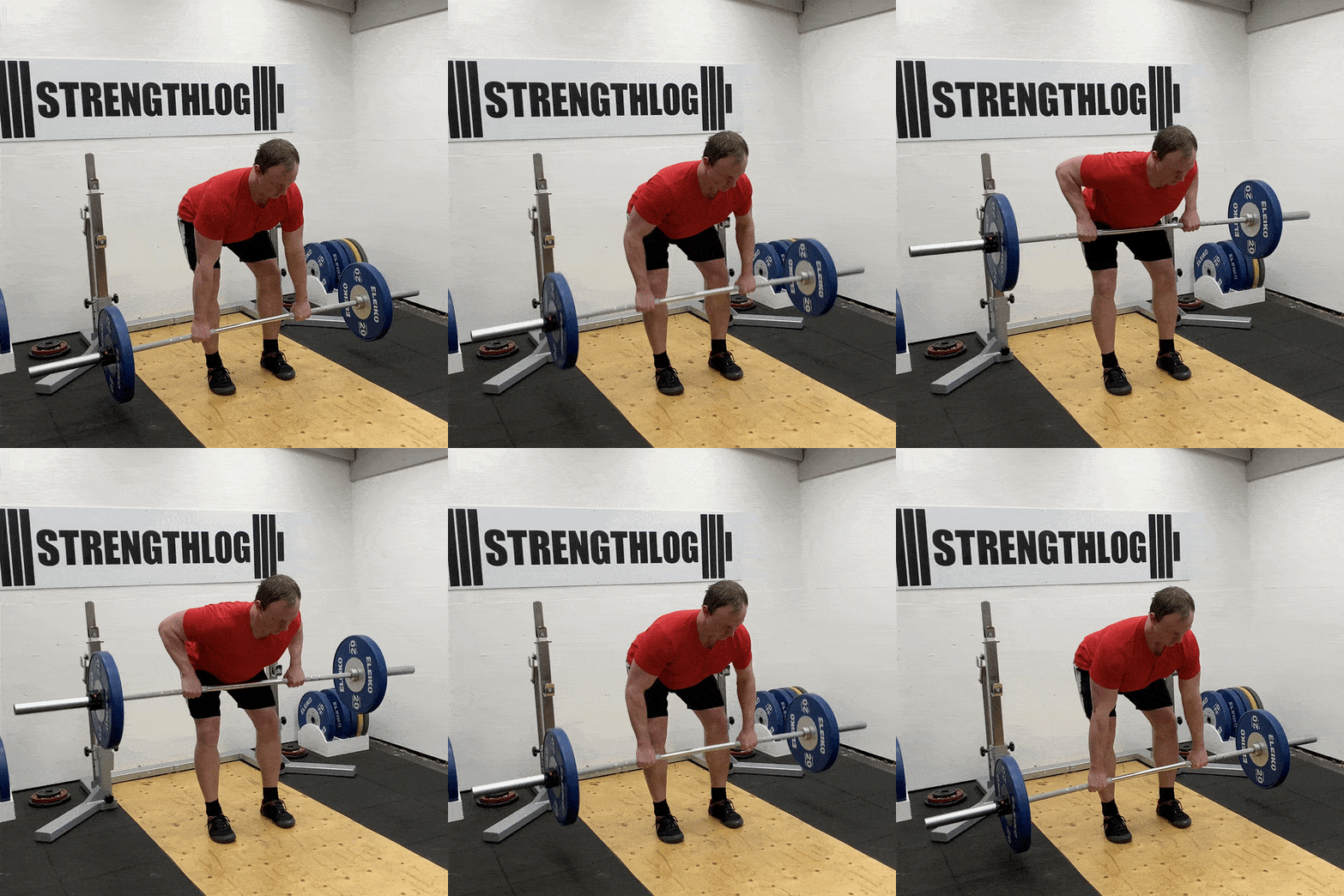
The barbell row is one of the best exercises for the upper back. It trains your latissimus dorsi, traps, rhomboids, and rear delts, in addition to your biceps and lower back, to a lesser degree.
While there isn’t a lot of pulling going on in soccer, a strong back lets you shrug off defenders and hold your ground in shoulder-to-shoulder challenges. In addition, you need a posterior chain (back, glutes, hamstrings) with enough power to fuel explosive speed and tight, controlled turns, and rows build that horsepower.
Don’t load the bar with too much weight and heave it up. Doing so can make your technique break down and increase the risk of injury.
How to Do Barbell Rows
- Grasp the barbell with an overhand grip, slightly wider than shoulder-width apart.
- Stand with your feet slightly wider than feet hip-width apart, bend your knees slightly, and hinge forward at your hips, maintaining a straight line from your head to your hips.
- Brace your core and keep your back straight. Pull the barbell towards your lower chest or upper core, keeping your elbows close to your body. Squeeze your shoulder blades together at the top of the movement.
- Lower the barbell back to the starting position in a controlled manner.
- Repeat the movement for the desired number of repetitions.
Hanging Knee/Leg Raise


The hanging knee raise and the hanging leg raise train the same muscles—your abs and hip flexors—but the bent-knees variant is less challenging to perform. Both are excellent core exercises.
Your core is tremendously important in soccer as it is your center of balance, stability, and power. As you sprint, kick, and dribble, your hips and shoulders create the power, but some of it gets lost if your core isn’t strong enough to pass it all along to the rest of your body where it’s needed, like a leak in a pipe.
Remember not to swing your body to get your legs moving. Instead, squeeze your abs and use them and your hip flexors to control your movement from a dead start to get maximum benefits from the leg raise.
How to Do Hanging Knee/Leg Raises
- Grasp a pull-up bar with an overhand grip, shoulder-width apart.
- Hang from the bar with your arms fully extended and your body in a straight line from your head to your heels.
- Engage your core and keep your back straight.
- Raise your knees or legs towards your chest, as high as you can, keeping your back straight and your core engaged.
- Slowly lower your legs back down to the starting position.
- Repeat the movement for your desired number of repetitions.
Romanian Deadlift

The Romanian deadlift (RDL) is one of the most effective exercises for building the posterior chain muscles (hamstrings, glutes, and lower back) —muscles you need to develop for soccer performance. That’s because soccer is full of sprinting, sudden stops, and quick turns, and your hamstrings and glutes are two of the main drivers of explosive power in such movements.
Also, the eccentric load on the hamstrings during the RDL protects against hamstring strain and tears, which are a nightmare for soccer players. Studies show that eccentric training reduces hamstring injuries by up to 70%.14
And if that wasn’t enough, you also gain flexibility in your hamstrings. Soccer players have notoriously tight hammies, and while they don’t require flexibility like a gymnast, you want a sufficient range of motion and the ability to generate force dynamically within it. Unlike stretching, RDLs give you both.
In addition to regular Romanian deadlifts, you can also do single-leg RDLs. They improve balance and build unilateral strength, which is great because you often rely on one leg in soccer.
How to Do Romanian Deadlifts
- Get into the starting position by deadlifting a barbell off the floor or by unracking it from a barbell rack. Stand feet hip-width, inhale, and brace your core slightly. If you’re doing single-leg RDLs, lift one leg off the ground.
- Lean forward by hinging in your hips. Keep your knees almost completely extended.
- Lean forward as far as possible with good form (no rounding your back). You don’t have to touch the barbell to the floor, although it is OK if you do.
- Reverse the movement and return to the standing position. Exhale on the way up.
- Repeat the movement for the desired number of repetitions.
Note: The dumbbell Romanian deadlift is a viable alternative to the barbell variant.
Bench Press

The bench press is possibly the best exercise for building a stronger chest, shoulders, and triceps. Soccer might be a leg-dominant sport, but don’t write off upper-body strength as useless.
While bench pressing won’t directly improve your shot accuracy or make you a better dribbler, more upper-body strength comes in handy when you shield the ball, battle for position, and hold off opponents.
And, being somewhat balanced strength-wise all throughout the body is essential for overall athletic performance, even in a sport like soccer where lower body development plays a much bigger role.
How to Bench Press
- Lie on the bench, pull your shoulder blades together and down, and slightly arch your back.
- Grip the bar slightly wider than shoulder-width apart.
- Inhale, hold your breath, and unrack the bar.
- Lower the bar with control, until it touches your chest somewhere close to your sternum.
- Push the bar up to the starting position while exhaling.
- Take another breath while in the top position, and repeat the movement for your desired number of repetitions.
High to Low Wood Chop

The wood chop is an excellent exercise for rotational power, improving coordination, and targeting your side abs (obliques). When you play soccer, your ability to rotate using force from your core means more kick power, faster turns, and balance while shielding the ball.
Wood chops also have an anti-rotation component because your core has to resist unwanted movements and maintain control throughout the motion. Anti-rotational strength is equally important in soccer because the sport requires dynamic stability and the ability to generate force from your hips and core without leaking energy through unnecessary twisting.
In other words, wood chops bolster your twisting power when needed but also help you resist unwanted twisting.
Note: you can do this exercise with either a resistance band (like in the video demonstration above) or a cable pulley system.
How to Do High to Low Wood Chops
- Fasten an elastic band high up. Grip the band with both hands, step away, and stand sideways to the band’s anchor point.
- With almost straight arms, make a sweeping, chopping-like movement diagonally downward.
- Return to the starting position in a controlled manner.
- Repeat the movement for your desired number of repetitions.
Bulgarian Split Squat

The Bulgarian split squat is a unilateral (you train one side at a time) lower-body exercise where one foot is elevated behind you on a bench while the other leg works its magic.
Split squats primarily work your quads, glutes, and adductors, which are the powerhouses behind your sprinting ability. And, because they train each leg independently, they make sure both are equally strong (every athlete has a “weaker leg” (don’t lie, you know you do)).
In addition, stretching your hip flexors dynamically, like you do when you go down in split squats, makes them both more flexible and stronger in their extended position.
How to Do Bulgarian Split Squats
- Place a bar on your upper back or hold a pair of dumbbells in your hands.
- Stand with your back turned against a bench, which should be about knee height. Stand about one long step in front of the bench.
- Place your right foot on the bench behind you.
- Inhale, look forward, and squat down with control until right before your right knee touches the floor.
- Reverse the movement and extend your front leg again, while exhaling. Your back foot should only act as support.
- Repeat the movement for the desired number of repetitions, then switch side and repeat with your right leg forward and your left foot on the bench.
Ball Slam

The medicine ball slam is a full-body, explosive movement in which you lift a weighted ball overhead and then slam it down into the ground as hard as you can, and somehow, it’s considered exercise, not vandalism. What a time to be alive.
Slams work your core, shoulders, arms, back, glutes, and legs, training your ability to generate and control explosive power, which means faster sprints, stronger kicks, and more aerial battles won on the soccer field,
Use a non-bouncing ball (a “slam ball”) if you don’t want a surprise rebound to your face.
How to Ball Slam
- Stand with your feet about shoulder-width apart, your knees and hips slightly bent, holding the ball in both hands at chest height. Engage your core, and keep a good posture.
- Extend your knees and drive your hips forward while simultaneously lifting the ball. Aim for being as tall as possible, the ball overhead, arms up, hips slightly forward, and on your toes from the force of your drive.
- Use your core and arms to slam the medicine ball straight down between your feet with as much force as possible. Press your hips back and bend your knees to further power the slam. Exhale as you slam the ball down.
- Squat down to pick up the ball from the floor, then immediately move into the next slam by repeating the movement.
- Repeat the movement for your desired number of repetitions.
Farmer’s Carry

The farmer’s carry (or farmer’s walk) involves picking up something heavy in each hand—dumbbells, kettlebells, or specially designed farmer’s walk handles—and walking with them for a set distance or time.
This exercise is not just for farmers and strongmen wannabes but offers several benefits for athletes, including soccer players like you. These include strengthening your core, making you harder to knock off the ball, and better conditioned to outwork the competition.
If you are new to farmers’ walks or lack the necessary core strength, it is easy to start slouching forward by bending at the upper back. Do your best to resist by pulling your shoulders back and maintaining a straight posture throughout the entire walk. If you can’t, you’re using too much weight. Lighten the load a bit so you last the entire distance.
How to Do Farmers Walk
- Step in between two farmers walk-cases, or similar implements.
- Inhale, lean forward and grip the handles.
- Hold your breath, brace your core slightly, and lift the weights.
- Look ahead, and start moving forward in small steps. Increase the stride length as you increase the speed.
- Try to keep your body in a straight line and not lean excessively forward as you walk.
- When you are done, lower the implements back to the ground in a controlled manner.
Trap Bar Deadlift

The trap bar deadlift is a favorite among coaches who want their athletes strong, fast, and free from injuries: forgiving for beginners but effective enough to challenge pros. As a soccer player, you want to be that athlete.
With the hex bar, the load remains in line with your center of gravity, shifting the focus more from your glutes and lower back to your quads, compared to the standard barbell deadlift. It also allows you to lift heavy without as much technical skill. More weight = more force production = more explosiveness on the pitch.
The force you build in the trap bar deadlift translates to better acceleration and power. That’s because it strengthens the posterior chain (hamstrings, glutes, back)—the engine for running fast.
How to Do Trap Bar Deadlifts
- Step into the bar’s opening so that the handles are in line with the middle of your feet.
- Inhale, bend down and grip the handles.
- Hold your breath, brace your core slightly, and lift the bar.
- Lift the bar with a straight back, until you are standing straight.
- Lower the bar back to the ground with control.
- Take another breath, and repeat the movement for your desired number of repetitions.
Leg Curl

Strong hamstrings are a must for soccer players because they power explosive sprints, stabilize the knees, and boost kicking strength for game-winning goals.
The leg curl is the best (and only) isolation exercise for your hamstrings. For optimal hamstring development, it’s a good idea to include both a hip hinge movement (like the Romanian deadlift) and an exercise where you bend your knees, like the leg curl.
You can do leg curls either seated or lying down, but if you have access to a seated leg curl machine, it’s likely the better option. One study saw 55% greater hamstring growth with seated leg curls compared to another group who did lying leg curls.15 Both are great exercises, so if you don’t have a seated leg curl at your gym, it’s no big deal, but if you do, use it.
How to Perform Leg Curls
- Adjust the machine so that you are correctly positioned. Your knees should be in line with the machine’s joint.
- Lift or push the weight down (depending on whether you chose the lying or seated leg curl) by bending your knees as far as possible.
- Slowly lower or let the weight back again.
- Repeat the movement for the desired number of repetitions.
Box Jump

The box jump involves leaping onto a sturdy, elevated surface (usually a box or platform) from a standing position. It’s a dynamic, almost-plyometric exercise that builds explosive power, agility, and leg strength. “Almost,” because while it does involve plyometric elements, it lacks the forceful eccentric phase true plyos have.
However, it’s still a golden exercise to becoming faster, stronger, and more explosive on the pitch. In soccer, you’re sprinting, changing directions, and exploding off the ground to win headers throughout the match. Box jumps train the exact muscle groups and the explosive power you need on the field.
How to Do Box Jumps
- Select a box that is appropriate for your fitness level and jumping ability.
- Stand with your feet shoulder-width apart, a few inches away from the box. Your knees should be slightly bent, and your hips pushed back in an athletic stance, like a mini squat.
- Engage your core and swing your arms back to generate momentum. Keep your chest up, and your weight balanced evenly across your feet.
- Push through the balls of your feet, extending your hips, knees, and ankles as you jump up. Swing your arms forward and upward to help propel yourself onto the box. Jump with both feet leaving the ground at the same time.
- As you land on the box, aim to have both feet hit the surface at the same time. Bend your knees slightly to absorb the impact, keeping your chest up and back straight.
- Once you’ve landed on the box, stand up tall, extending your hips completely to finish the jump.
- Step off the box one foot at a time, and reset your stance before attempting the next jump.
- Repeat the movement for your desired number of jumps.
Ab Wheel Rollout

The ab wheel rollout is one of the most effective exercises for building your abs and functional core strength, but it’ll also make you feel muscles you didn’t even know you had the next day. It involves a small, wheel-shaped piece of fitness equipment/torture device with handles on both sides. The goal is to roll the wheel forward, stretching your body while maintaining a tight core, then pull yourself back to the starting position.
Soccer requires top-notch core strength for balance, stability, and control. Ab wheel rollouts work both your superficial abs and your deep core muscles, which helps you stay steady or unleash maximum force no matter what you do—pivot, kick, sprint, jump, or tackle—on the field.
If rolling out all the way is overwhelmingly challenging, start small by limiting your range of motion and gradually increase the depth as you build core strength—slow and steady wins the six-pack race.
Conversely, if the kneeling ab wheel feels easy, try “true” rollouts, the standing variant. Master it, and you’re basically Captain Core.
How to Do Ab Wheel Rollouts
- Start by kneeling on the floor with your hands on the ab wheel, placed directly in front of your knees.
- Engage your core and slowly roll the wheel forward until your body forms a straight line from your knees to your head.
- Be sure to keep your back straight and your core engaged throughout the entire movement.
- Reverse the movement, roll the ab wheel back towards your knees, and return to the starting position.
- Repeat the movement for the desired number of repetitions.
Pull-Up

For more than 150 years, the pull-up has been the gold standard for upper-body pulling strength and athletic performance. While soccer is primarily a lower-body-dominant sport, today’s top players have upper bodies to match.
Pull-ups strengthen the lats, rear delts, and biceps, improving your physicality during challenges, shielding the ball, excelling in aerial duels, or holding off defenders.
Use a resistance band for assistance if you can’t do as many full pull-ups as the Strength Training for Soccer program calls for. Conversely, if you can do that many with reps in the tank, wear a weight belt or backpack with a plate in it for added resistance.
How to Do Pull-Ups
- Stand beneath a pull-up bar and reach up to grasp it with an overhand grip (palms facing away from you), slightly wider than shoulder-width apart. Ensure your grip is secure and comfortable.
- Hang freely from the bar, fully extending your arms. Your feet should be off the ground.
- Engage your core muscles by squeezing your abs and glutes.
- Inhale and initiate the movement by pulling your body weight up towards the bar by bending your elbows and squeezing your shoulder blades together. Focus on using your back muscles rather than relying on your upper arms.
- Continue pulling yourself up until your chin reaches or clears the bar. Keep your torso upright and avoid excessive swinging or kicking with your legs.
- Slowly lower yourself back down to the starting position while maintaining control and stability, fully extending your arms.
- Repeat the movement for your desired number of repetitions.
Push Press

The push press is a variant of the overhead press where you use your lower body for a bit of help to drive the weight overhead. Your legs and hips provide the initial momentum, your shoulders and upper chest push the barbell overhead, and your triceps lock that bad boy out overhead.
Push presses give you strength, power, and coordination (timing the leg drive with the press) that you can use on the soccer field. They build dynamic power transfer by using your legs and hips to drive the weight overhead, translating to on-field actions like leaping for a header or pushing off for a sprint.
How to Push Press
- Clean a bar to your shoulders, or lift it out from a rack.
- Let the bar rest against the front of your shoulders, with your grip slightly outside your shoulders.
- Inhale and lightly brace your core.
- Bend your knees, and then forcefully push yourself and the bar upwards using your legs.
- When your legs are extended, immediately start pressing the bar with your arms, until your arms are fully extended.
- With control, lower the bar back to your shoulders.
- Repeat the movement for your desired number of repetitions.
Dumbbell Row

The dumbbell row is an excellent addition to a soccer player’s workouts; soccer is lower-body focused, but it is important not to neglect your upper body.
Dumbbell rows work your lats, traps, rhomboids, rear delts, and biceps, giving you a brick wall vibe defenders hate. Winning headers and controlling aerial balls also require upper-body strength and shoulder stability, both of which dumbbell rows excel at. And it’s a unilateral exercise, meaning you work one side at a time, addressing imbalances and preventing the dreaded “one-arm-wimp syndrome.”
The dumbbell row is like your defensive midfielder—strong, reliable, and keeping your structure intact so you can perform at your peak. While it won’t score the goals, it’ll make sure you are strong and balanced enough to dominate the pitch.
How to Do Dumbbell Rows
- Place a dumbbell on the floor beside a bench or chair. Stand facing the bench or chair and place your left hand and left knee on top of it.
- Grip the dumbbell with your right hand and pull the dumbbell up, keeping your elbow close to your body.
- Pull the weight until it touches the side of your body, around the belly button level. Keep your back flat and parallel to the ground throughout the movement.
- Contract your lats and squeeze your shoulder blades together at the top of the movement, then lower the dumbbell back down to the start position with your arm fully extended.
- Go for a complete range of motion with a nice stretch at the bottom, then repeat the movement for your desired number of repetitions.
- Place your right knee on the bench or chair, grip the dumbbell with your left hand, and repeat the movement for the other side of the body.
Hip Thrust

The hip thrust is an all-in-one exercise for most of your entire posterior chain—the powerful group of muscles running along the back of your body.
It recruits the hamstrings, adductors, quads, and erector spinae (the muscles along your spine) but is primarily known as a phenomenal glute-builder. According to research, hip thrusts offer greater activation of the hip extensor muscles compared to common exercises like deadlifts and squats.16
Stronger glutes equal faster sprints and more powerful kicks. They also stabilize your pelvis, which is essential for athletes in sports requiring agility and rotational power, like soccer.
How to Do Hip Thrusts
- Sit on the floor with your back against a sturdy bench.
- Roll the barbell up over your thighs, until it is placed over your hips.
- Place your feet on the floor, about shoulder-width apart, with bent knees.
- Place your hands on the bar to stabilize it.
- Push the bar towards the ceiling by extending your hips. Your knees should form a ~90 degree angle at the top.
- Squeeze your glutes at the top of the thrust like you’re trying to crack a walnut before lowering the weight.
- Repeat the movement for the desired number of repetitions.
Plank With Leg Raise

The plank is one of the most popular ab exercises. You hold your body in a straight line from head to heels while balancing on your forearms (or hands) and toes (or knees) to strengthen your core.
This variant is a win for athletes (including soccer players) who need stability, balance, and functional strength by adding a little kick to make your core work even harder to stabilize you. It trains both your superficial abs (rectus abdominis, outer obliques) as well as the deep core muscles (transverse abdominis, inner obliques) for a core so strong your opponents will think you’re part cyborg when you deliver kicks and maintain balance under pressure on the field when someone’s trying to knock you off the ball.
How to Do Plank with Leg Lifts
- Begin by getting into a standard plank position. Place your elbows directly under your shoulders, legs extended straight behind you, and toes pressing into the ground. Your body should form a straight line from your head to your heels.
- Brace your core, keep your back flat, and avoid letting your hips sink down or lift too high.
- Slowly lift one leg off the ground to about hip height without bending the knee. Keep your leg straight during the movement.
- Hold the lifted position for a moment, then gently lower your leg back to the starting position.
- Repeat the lift with the opposite leg, ensuring you maintain a strong plank position throughout the movement.
- Continue to alternate legs for the chosen amount of time.
Kettlebell Swing

The kettlebell swing is a ballistic exercise where you use your hips to drive a kettlebell forward and up to shoulder height or above your head before allowing it to swing back down between your legs. It is adaptable for all sports, from football to track and field to tennis and, yes, soccer.
The hip extension in kettlebell swings means more power in explosive movements like sprinting, jumping, and tackling, and soccer is full of explosive movements like that. Sprints, jumps, and sudden direction changes—swings build power in the engine of these movements: your posterior chain. They also counterbalance all the quad-dominant activities in soccer, like kicking and sprinting.
How to Do Kettlebell Swings
- Place a kettlebell on the ground, about one or two feet in front of you.
- Take a wide stance, lean forward, and grip the kettlebell.
- Brace your core slightly, and swing the kettlebell back between your legs while inhaling.
- Swing the kettlebell forward by extending your hip while exhaling.
- Try to swing the kettlebell to about chest height.
- Repeat for the desired number of reps and put the kettlebell back on the ground when you’re finished.
Landmine Press

The landmine press involves using a barbell anchored at one end (usually with a landmine attachment or just jammed into a corner). You grab the free end of the barbell and press it forward or upward, depending on your position.
The landmine press is an excellent exercise for soccer players. It strengthens the upper body, improves core stability, and trains functional movement patterns—all of which are vital for physical duels, holding off opponents, and maintaining control during headers. Doing it one side at a time highlights imbalances and strengthens stabilizers. You’ll get strong, but you’ll also get evenly strong—a double win.
How to Landmine Press
- Stand with your core activated and the feet about shoulder-width apart.
- Place the barbell in one hand, and rest it on your shoulder.
- Press to lockout by extending the elbow and flexing the shoulder.
- Slowly lower the barbell back to the starting position on your shoulder.
- Perform your desired number of repetitions, then switch sides and repeat the movement for the other side of the body.
Front Squat

If your sport demands a quick steps or big leaps, like soccer, the front squat is your friend. Just like the back squat, it is one of the most valuable exercises for athletes. Front squats might edge out if you’re looking at soccer-specific movements like quick sprints and changes of direction, but back squats are better for raw strength.
The solution: use both in your soccer training. Soccer is a dynamic sport, and so should be your squatting strategy.
Front squats shifts emphasis to the quads, while back squats exphasize your glutes and more. Both are prime movers in sprinting, jumping, and other explosive movements in soccer. It also teaches you athletic positions soccer players find themselves in – knees bent, chest up, ready to explode, and builds strength in ranges of motion you’ll use every game.
How to Front Squat
- Grip the bar slightly wider than shoulder-width. Step forward and place the bar on the front of your shoulders: on top of your clavicles, and tight against your throat.
- Inhale and brace your core slightly, and unrack the bar.
- Take two steps back, and adjust your foot position.
- Squat as deep as possible with good technique.
- With control, stop and reverse the movement, extending your hips and legs again.
- Repeat the movement for the desired number of repetitions.
Power Clean

The power clean is a compound weightlifting movement where you explosively lift a barbell from the ground to your shoulders (in the front rack position). It is very close to a full-body workout in itself, hitting the legs, back, shoulders, and core. These are all muscle groups for power, speed, and coordination on the field, and power cleans train your muscle fibers to fire like a cannonball out of a cannon for explosive hip drive and full-body coordination.
Consider working with a coach if you’re new to Olympic lifts—they’re technical but very rewarding and some of the best exercises you can do for athletic performance.
How to Power Clean
- Step up close to the bar, so that it is about over the middle of your foot.
- Lean forward and grip the bar with an overhand grip, about shoulder-width apart.
- Hold your breath, and brace your core slightly.
- Lift the bar in a smooth but fast motion. Bend your knees slightly and receive the bar on the front of your shoulders.
- Stand up on straight legs again.
- Lower the bar in front of you, with control.
- Repeat the movement for your desired number of repetitions.
Side Plank

The side plank is a bodyweight exercise for your obliques, the side muscles of your core. Unlike crunches or sit-ups, it emphasizes stability over movement. Both types of exercises belong in a good strength training routine for a soccer player who wants to both improve performance and prevent injuries.
That’s because soccer requires a strong core to transfer power between your upper and lower body for dribbling, passing, and shooting and to maintain balance and stability throughout an entire match. Side planks give you those performance benefits and also improve spinal alignment and pelvic stability = better performance and lower risk of injury.
How to Side Plank
- Stand on your side, leaning against one elbow.
- Place the foot of the top leg in front of the other foot.
- Brace your core, and try to form and hold a straight line from your head to your feet.
- Hold the position for the chosen amount of time.
Strength Training for Soccer: Final Rep
You have reached the end of this guide to strength training for soccer! 🏋️⚽
Thank you so much for reading! I hope you have enjoyed it and learned things that will benefit your game.
To follow the training routine in this article, download our workout log app and start tracking your workouts today:
Strength training helps you unlock your full potential on the soccer field. While it won’t give you the skill or necessary technical prowess, it will help you sprint faster, strike harder, and give you the edge to outpace, outmuscle, and outlast your opponents.
Let’s hit the gym and make it happen! 💪⚽
References
- Issue Rehabil. Orthop. Neurophysiol. Sport Promot. 2022; 41: 27–39. The role of strength training in preventing musculoskeletal injuries among female and male soccer players.
- Apunts Sports Medicine, 16 October 2020. Strength training in relation to injury prevention in professional and semi-professional women’s football: A systematic review.
- Int J Environ Res Public Health. 2021 May 2;18(9):4857. Epidemiology of Sports-Related Injuries and Associated Risk Factors in Adolescent Athletes: An Injury Surveillance.
- Am J Sports Med. 2023 Jun;51(7):1927-1942. Evidence-Based Hamstring Injury Prevention and Risk Factor Management: A Systematic Review and Meta-analysis of Randomized Controlled Trials.
- Br J Sports Med. 2014 Jun;48(11):871-7. The effectiveness of exercise interventions to prevent sports injuries: a systematic review and meta-analysis of randomised controlled trials.
- Knee Surg Sports Traumatol Arthrosc. 2011 Jan;19(1):3-10. The epidemiology of anterior cruciate ligament injury in football (soccer): a review of the literature from a gender-related perspective.
- Sports Med. 2022 Feb;52(2):287-300. The Effect of Resistance Training in Healthy Adults on Body Fat Percentage, Fat Mass and Visceral Fat: A Systematic Review and Meta-Analysis.
- J Sports Sci. 2009 Aug;27(10):1019-26. Body composition of English Premier League soccer players: influence of playing position, international status, and ethnicity.
- Essentials of strength training and conditioning. Fourth edition. Champaign, IL, Human Kinetics.
- Science and Practice of Strength Training. Third Edition, Human Kinetics.
- Front. Sports Act. Living, 04 July 2022. Resistance Training Variables for Optimization of Muscle Hypertrophy: An Umbrella Review.
- Journal of Strength and Conditioning Research 30(6):p 1534-1539, June 2016. Effects of Strength Training on Squat and Sprint Performance in Soccer Players.
- Eur J Sport Sci. 2013;13(5):445-51. Influence of a 2-year strength training programme on power performance in elite youth soccer players.
- Arthroscopy, Sports Medicine, and Rehabilitation, 10 October 2024. Prevention and Rehabilitation of the Athletic Hamstring Injury.
- Med Sci Sports Exerc. 2020 Oct 1. Online ahead of print. Greater Hamstrings Muscle Hypertrophy but Similar Damage Protection after Training at Long versus Short Muscle Lengths.
- J Sports Sci Med. 2019 Jun 1;18(2):198–206.Barbell Hip Thrust, Muscular Activation and Performance: A Systematic Review.
