
An upper body workout is a training session that targets the muscles from your waist up.
In this article, you’ll learn what that actually means, why you do it, and how to do it without spending three hours in the gym.
You’ll also get not one but two complete workouts, perfect for anyone from beginners to advanced lifters.
Table of Contents
What Is an Upper Body Workout?
An upper body workout is just what it sounds like: a training session where you train some or all of the major muscle groups in your upper body.
It is often part of an Upper/Lower split. In such a split, instead of training one body part per day, you group everything above the belt into one session and everything below (legs, glutes, calves) into another.

When you split your body into one upper body workout and one lower body workout, you can spend more time on each muscle without your training sessions taking forever.
Of course, you do an upper body workout if you only train, say, your arms. Or as part of a Push/Pull/Legs or PPLUL routine.
But in this article, I’m talking about a workout that trains all major muscle groups, directly or indirectly (such as biceps during your back sets).
Muscles Worked in an Upper Body Workout
When you head off to the gym for an upper body day, you’re looking to hit these main groups:
- Push Muscles: Chest, shoulders (deltoids), triceps
- Pull Muscles: back (lats, traps, rhomboids), biceps
Let’s look closer at each of those areas. You can think of them as the geography of your workout.
Chest (Pecs)

Your biggest and strongest pushing muscles. Your chest is not one big slab of meat, but primarily split into two separate muscles, the pectoralis major, which makes up the bulk of your pec muscle mass, and the pectoralis minor, a little guy that sits underneath.
| Muscle | Main Job | Example Exercise |
| Pectoralis Major | Moving your arm at the shoulder joint | Bench Press |
| Pectoralis Minor | Positioning and stabilizing your shoulder blade | Dips |
The pecs can be used both for good or for bad, hugging your grandma or punching someone in the nose.
Back (Lats, Traps, Rhomboids)

Your back consists of the strongest pulling muscles in your body, including the trapezius (traps), rhomboids, and latissimus dorsi (lats).
| Muscle | Main Job | Example Exercise |
| Traps | Shrug up, squeeze back, pull down | Barbell Shrug |
| Rhomboids | Pinch your shoulder blades together | Barbell Row |
| Lats | Pull things towards you and bring your arms down to your sides | Lat Pulldown |
In addition, the rear delts are technically a shoulder muscle, but functionally, they work with your upper back. They stabilize your shoulder joint and give your shoulders the 3D look.
Shoulders (Deltoids)

The deltoid has three distinct heads: the anterior (front), lateral (side), and posterior (rear) heads. They help you lift things overhead and give you shoulder width.
In addition, the rotator cuff muscles won’t make you look jacked but keep your arm attached to your torso.
| Muscle | Main Job | Example Exercise |
| Front Delt | Pushing up/forward | Overhead Press |
| Side Delt | Moving your arm away from your body | Lateral Raise |
| Rear Delt | Pulling your arm back | Face Pull |
| Rotator Cuff | Stabilization | External Rotation |
Arms (Biceps & Triceps)

Welcome to the gun show. The biceps and triceps are the vanity muscles for many, sure, but they are also more functional than many realize. Biceps pull, triceps push.
| Muscle | Main Job | Example Exercise |
| Biceps | Bend the elbow (flexion) and twist the wrist so that the palm faces up (supination) | Barbell Curl |
| Triceps | Straighten the arm (extension) | Tricep Pushdown |
Now it’s time to jump into the fun part: the training!
The Upper Body Workouts
Here are the outlines of two great upper body workouts: a free beginner workout and a more advanced workout for those with some training experience.
Basic Upper Body Workout
You don’t need 15 different machines to build your upper body. You need two movement patterns: push and pull.
This is a classic, no-nonsense upper body workout for beginners and above. If you do it with good form twice a week, you will build muscle and get stronger.
It is based around compound lifts, which are exercises that use multiple joints and muscles. Those give you the most bang for your training buck and are the best ones to focus on when you’re new in the gym.
| Exercise | Sets | Reps | Focus |
| Bench Press | 3 | 6 | Horizontal Push: The classic chest builder. |
| Lat Pulldown | 3 | 8 | Vertical Pull: Width for the back. |
| Overhead Press | 3 | 8 | Vertical Push: Shoulder mass and strength. |
| Barbell Row | 3 | 10 | Horizontal Pull: Thickness for the back. |
| Dumbbell Lateral Raise | 3 | 10 | Accessory: Side delts for shoulder width. |
This workout is available for free in our workout log app, where you can track your reps and weights for each exercise.
Upper Body Workout (Hypertrophy Focus)
This is a classic, very effective upper body workout. It mixes heavy compound lifts with isolation movements (exercises that target one muscle for that sweet pump). Do it twice a week for best results.
To benefit the most from this workout, I recommend that you have some training experience (intermediate to advanced). If you’re a beginner, start with the Basic Upper Body Workout above.
| Exercise | Sets | Focus |
| Bench Press | 3–5 | Horizontal Push |
| Lat Pulldown | 3 | Vertical Pull |
| Overhead Press | 3–4 | Vertical Push |
| Dumbbell Row | 3 | Horizontal Pull |
| Incline Dumbbell Press | 3 | Accessory: Upper chest. |
| Dumbbell Lateral Raise | 3 | Accessory: Side delts. |
| Barbell Curl | 3 | Accessory: Because… biceps. |
| Overhead Cable Triceps Extension | 3 | Accessory: Horseshoe triceps; great for the long head. |
| Reverse Machine Fly | 2 | Accessory: Rear delts. |
This is a premium workout, meaning it requires a subscription to follow in-app and to see the complete set and rep recommendations. We offer a 14-day free trial you can activate in the app if you want to test-drive it.
The Best Upper Body Workout Exercises
Debating the best upper body exercises is a bit like asking for the best pizza topping. Everyone has a strong opinion, and fighting about it usually ends in tears. Or pineapple.
That being said, let us go through each of the exercises in the upper body workouts, why you’re doing them, which muscles they work, and alternative exercises you can pick if you don’t want to (or can’t) do the default ones.
1. Bench Press

If you haven’t been asked, “How much do you bench?”, are you even lifting?
Jokes aside, the flat barbell bench press is a staple for a reason. It is often called the king of upper body exercises, and while some lifts might argue that title, the bench is undeniably the best way to load the most weight for your pushing muscles:
- Your chest muscles do the heavy lifting.
- The front delts help get the bar moving and stabilize it.
- Your triceps lock the weight out at the top.
Go heavy, but not so heavy that you’re not in control. Bouncing the bar off your sternum doesn’t count as a full rep, and having a spotter deadlift the bar off your chest means they got a workout, not you. A full range of motion with less weight beats half-reps with too much weight.
How to Do the Bench Press
- Lie on the bench, pull your shoulder blades together and down, and slightly arch your back.
- Grip the bar slightly wider than shoulder-width apart.
- Inhale, hold your breath, and unrack the bar.
- Lower the bar with control, until it touches your chest somewhere close to your sternum.
- Push the bar up to the starting position while exhaling.
- Take another breath while in the top position, and repeat for reps.
Alternative Exercises:
2. Lat Pulldown

As the name implies, the lat pulldown primarily works the lats, the big wing-like muscles on the sides of your back.
- The lats pull your upper arms down and into your sides.
- Your biceps do quite a bit of work (one study found that pulldowns are as effective as curls for biceps growth).
- The rear delts and rhomboids get involved at the bottom of the movement as you squeeze your shoulder blades.
You can do lat pulldowns with a variety of grips, from close-grip to wide grip, pronated, supinated, and neutral. Newer research suggests that it doesn’t matter much which grip or angle you use, so pick the one you like the best and that feels comfortable.
I wrote an in-depth article about the study that looked at how different handles affected lat activation (hint: they didn’t). You can check it out here:
New Study: Do Different Lat Pulldown Variations Hit the Lats Differently?
What does matter is doing the pulldowns right. Don’t load the whole stack and fling your entire torso backward to jerk the weight down. You turn the pulldown into a row and won’t hit the lats as you could have.
Tip: Try a thumbless grip. A small change, but many people, including me, find that it helps disengage the biceps and connect better with the lats.
How to Do Lat Pulldowns
- Adjust the thigh pad to fit snugly against your thighs to prevent your body from lifting off the seat.
- Grasp the bar with an overhand (pronated) grip, with your hands slightly wider than shoulder-width apart.
- Sit with your thighs under the thigh pad, keep your chest up, and look at the bar.
- Pull the bar down towards your chest, leading with your elbows. Pull until the bar is below your chin or touches your upper chest.
- Squeeze your shoulder blades together at the bottom of the movement.
- Exhale and slowly release the bar back up to the starting position.
- Repeat for reps.
Alternative Exercises
- Pull-Up
- Lat Pulldown With Neutral Grip
- Lat Pulldown with Supinated Grip
- Neutral Close-Grip Lat Pulldown
3. Overhead Press

Before the bench press stole the spotlight in the 1950s, the overhead press was the way to measure upper body strength. It also involves your pushing muscles but focuses on your shoulders rather than your chest.
- The front (primarily) and side delts drive the bar up.
- Just like in the bench, your triceps assist and lockout at the top.
- Your core and glutes stabilize your body.
Overhead presses may be old school, but they are still top-tier for building big and strong shoulders. You can use a lot of weight and really overload your delts, but make sure you’re not leaning way back to get the bar up. If that’s the case, lighten the load so you can press with the right muscles.
How to Do the Overhead Press
- Place a barbell in a rack at about chest height.
- Grip the bar slightly wider than shoulder-width apart, and step close to it.
- Inhale, lightly brace your core, and unrack the bar.
- Let the bar rest against your front delts while you step back from the rack.
- Press the bar up to straight arms while exhaling.
- Inhale at the top or while lowering the bar with control back to your shoulders.
- Repeat for reps.
Alternative Exercises:
4. Barbell Row
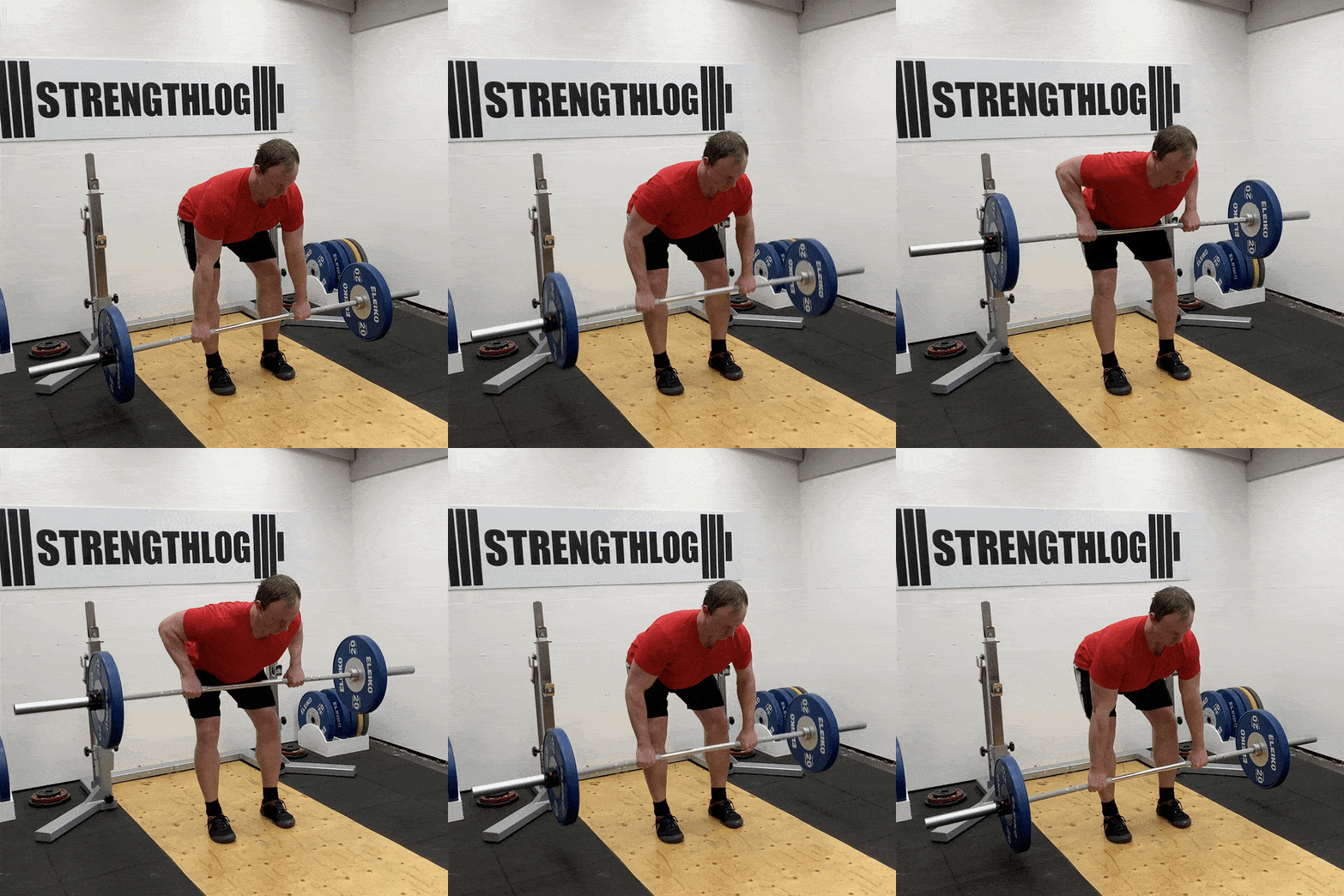
The barbell row is the meat and potatoes of back training (if meat and potatoes could give you a thick, powerful upper back). It’s a fantastic exercise for bodybuilders and strength athletes, and it works very well for new lifters because it’s easy to learn and do correctly.1
Barbell rows work most of the muscles on the backside of your upper body:
- The traps and rhomboids in the middle of your upper back retract the shoulder blades and give you a yoked look.
- Your lats work hard, especially when you pull the bar more toward your hip.
- Your rear delts and biceps help pull the weight (bonus arms again).
- The core and lower back muscles work isometrically to keep you from faceplanting.
You can do your barbell rows with your torso almost parallel to the floor (like in the video animation above) or with it at around a 45° angle. The first variant hits your mid-to-upper back more, and the second shifts more of the action to your upper traps. Neither is right nor wrong, just a question of where you want to build the most muscle.
How to Do Barbell Rows
- Grip the bar with an overhand grip.
- Lean forward with the bar hanging from straight arms.
- Inhale and pull the bar towards you.
- Pull the bar as high as you can so that it touches your abs or chest, if possible.
- With control, lower the bar back to the starting position.
Alternative Exercises
5. Dumbbell Row

You need to row to grow, and the dumbbell row is another great variant. It trains the same muscles as the barbell row (but not the lower back to the same extent because you support your upper body with your free arm) and builds back thickness: rhomboids, traps, lats, plus the usual assistance suspects, biceps, and rear delts.
I usually prefer the dumbbell version over the barbell because I can get a longer range of motion and a better stretch in the lats, but both are fantastic back exercises.
How to Do Dumbbell Rows
- Start by placing a dumbbell on the floor beside a bench or chair. Stand facing the bench or chair and place your left hand and left knee on top of it.
- Keep your back flat and parallel to the ground, with a slight bend in the standing leg. Grip the dumbbell with your right hand.
- Inhale and pull the dumbbell by driving the elbow toward the ceiling.
- With control, lower the dumbbell back to the starting position while exhaling.
- Complete desired reps on one side, then switch to the opposite arm and leg.
Alternative Exercises
6. Incline Dumbbell Press

The flat bench is legendary, but for aesthetics and shoulder health, the incline dumbbell press can often beat it out. It trains chest, front delts, and triceps, just like the bench, but with a different emphasis.
Pressing on an incline bench increases upper chest activation, and using dumbbells instead of a barbell when doing so often feels more natural (not an evidence-based claim but a general observation). You want at least a 32° angle on the bench, and if you can set it close to 45°, you maximize upper chest activation.2
Get a good stretch in your upper chest in the bottom position, but stop just short of the point where your shoulders untuck and roll forward. Overstretching at the bottom removes tension on the chest and puts it on the shoulder joint.
How to Do the Incline Dumbbell Press
- Adjust the incline of a bench to be around 30–45°.
- Sit down and lift a pair of dumbbells to the starting position.
- Press the dumbbells up to straight arms while exhaling.
- Inhale at the top or while lowering the dumbbells with control back to your shoulders.
Alternative Exercises:
7. Dumbbell Lateral Raise

Lateral raises are the best way to get capped shoulders. It’s mostly an aesthetic exercise, but it also gives you shoulder stability. The side delt often doesn’t get enough love from pressing alone, so adding some isolation work can be very helpful, especially once you’re no longer a beginner.
The best way to do lateral raises for the side delt is with internal rotation, meaning you point your thumb down as you lift the dumbbells.3

However, doing them that way can also be the most risky for the shoulder joint, so if you feel any discomfort, do neutral-grip laterals instead.
This is one exercise where using as heavy a weight as possible often makes it worse because you have to heave it up with your front delts and traps instead of the side delts. Don’t go heavier than you can do the raises without momentum.
You don’t need to raise the dumbbells above your shoulders. Once you go past parallel, your traps take over.
How to Do Dumbbell Lateral Raises
- Stand with your feet hip-width apart and hold the dumbbells in your hands with your palms facing your thighs.
- Begin the movement by lifting both arms to the sides, keeping a slight bend in your elbows, and raising the dumbbells until they reach shoulder height.
- Lower the dumbbells back down to the starting position while maintaining control.
- Repeat for reps.
Alternative Exercises:
8. Barbell Curl

The barbell curl is arguably one of the most well-known upper body exercises, preferably performed in the squat rack (kidding – don’t do it).
It’s an isolation exercise strictly for the elbow flexors. Unlike pull-ups and rows, which involve your back and shoulders, barbell curls force your biceps to do all the work.
Keep your elbows tucked at your sides and don’t let them drift forward. And keep your reps strict. If you have to throw your back into it to get the weight up, it’s too heavy. Think biceps gain, not lower back pain. A rep or two at the end of a set where you “cheat” a little is OK, but the majority of your reps should be with good form.
How to Do Barbell Curls
- Grip a bar with an underhand grip (supinated), hands about shoulder-width apart.
- Lift the bar with control by flexing your elbows.
- Don’t let your upper arm travel back during the curl, keep it at your side or move it slightly forward.
- Reverse the movement and lower the bar back to the starting position.
- Repeat for reps.
Alternative Exercises
9. Overhead Cable Triceps Extension

The overhead cable triceps extension is an isolation exercise that does one thing and one thing only: blast the back of your arms. It’s one of the best ways to build bigger triceps.
The triceps makes up about two-thirds of your upper arm mass, and it has three heads (tri-ceps), with the long head being the largest. You can only work it maximally with your arm raised overhead, which is why the overhead triceps extension is gold for upper arm growth.
In one study, 12 weeks of doing either overhead extensions or triceps pushdowns led to the triceps growing 20% with overhead work compared to 14% with pushdowns.4
Don’t let your elbows flare out super wide. Let your shoulder mobility dictate, but keep them tucked in reasonably close to your head, and get as deep of a triceps stretch as you can while staying locked in.
How to Do Overhead Cable Triceps Extensions
- Fasten a rope handle in the lower position of a cable machine. Stand with your back against the pulley, with a slight forward lean, and hold the rope behind your head and your upper arms next to your ears.
- Straighten your elbows until your arms are fully extended.
- Reverse the motion by bending your arms again.
- Repeat for reps.
Alternative Exercises
- Barbell Lying Triceps Extension
- Dumbbell Standing Triceps Extension
- Machine Overhead Triceps Extension
10. Reverse Dumbbell Fly

The reverse dumbbell fly is an isolation exercise for your rear (posterior) delts, traps, and rhomboids. It’s a great exercise for posture, balancing out pressing work, and keeping your rotator cuffs and shoulder joint happy and functional.
But it’s not just for function. You can’t get cannonball, 3D delts if you only train the front and side. The rear delt rounds out the back of the shoulder cap and contributes more to your upper body aesthetics than its small size suggests.
Keep a slight bend in your elbows. Lock that angle in; your elbows shouldn’t move during the set.
How to Do Reverse Dumbbell Flyes
- Hold a pair of dumbbells, lean forward, and let your arms hang towards the floor.
- With almost straight arms (just a slight bend at the elbow), slowly lift the dumbbells by raising your arms out to the sides.
- Reverse the movement and lower the dumbbells back to the starting position.
- Repeat for reps.
Alternative Exercises
How Often Should You Train Your Upper Body?
Look, I know you want a magic number. You want me to say, “Do it exactly twice a week at 4:00 PM, Monday and Thursday,” and send you on your way to gainsville.
Unfortunately, the answer is almost always that annoying “It depends.”
It depends on how much you like being in the gym, how quickly you recover, what your goals are, and your training experience.
That being said, doing an upper body workout twice or thrice weekly is the sweet spot for many lifters.
Two Times Per Week
For the majority of beginner and intermediate lifters, training each muscle twice per week is an excellent option.
If you do an upper body workout, it’s usually part of an Upper/Lower split. You train four days a week: two Upper days, two Lower days.
That way, you hit every muscle group twice a week (high frequency), but you get enough rest days to let your body (muscles and nervous system) recover.
Example:
- Monday: Upper
- Tuesday: Lower
- Wednesday: Rest
- Thursday: Upper
- Friday: Lower
- Weekend: Rest (or “Active Recovery” if you’re feeling guilty)
Three Times Per Week
Three weekly workouts can work very well for both beginners and advanced athletes.
Frequency is king for beginners. Your muscles learn movement patterns faster when you practice them more often. On the split side, you have to cut down on the volume per workout, as you don’t yet have the recovery capacity to train a lot, often.
For a beginner, you’re usually looking at full-body training if you want to hit your upper body three times every week.
If you are doing full-body sessions, you are technically doing an upper body workout every time you step in the gym. You’re just doing it alongside squats and deadlifts.
Example:
- Monday: Full Body (with Upper)
- Wednesday: Full Body (with Upper)
- Friday: Full Body (with Upper)
Some advanced lifters can thrive on a six-day schedule where they train their upper body three of those days:
Example:
- Monday: Upper
- Tuesday: Lower
- Wednesday: Upper
- Thursday: Lower
- Friday: Upper
- Saturday: Lower
- Sunday: Rest
But save that kind of advanced programming for when you’re a fairly experienced lifter.
What About Once Weekly?
Sure, doing these upper body workouts only once a week can work. You will not reach the training volume often considered optimal for maximum muscle growth, but you will see results from one weekly workout, as long as you make every set count.
Ten sets per muscle group per week is often considered the breaking point where you see the best growth.5

That’s not a problem if you do something like a bro split, where you train one or max two muscle groups per workout. But if you’re going to work your entire body in that one workout, it’s going to be a real marathon session, and the muscles you train towards the end will probably be hit with less-than-highest-quality sets.
So, yes, you can gain with upper body work only once a week, but you could probably gain more if you did your upper body workout more often than every seven days.
So, What’s the Verdict?
For most lifters who do upper body workouts and want the best return on investment for their time, I suggest you aim for two weekly sessions.
You get plenty of time to recover, and you can do two lower body workouts as well without getting overwhelmed.
Progressive Overload: How to Keep Getting Better
Progressive overload is the bread and butter of making gains.
If you go to the gym and lift the exact same weight, for the same reps, with the same rest time for the next year, your body has no reason to change. It can already handle what you throw at it.
To build muscle or strength, you have to present your body with a stress it hasn’t encountered before. You have to force it to adapt.
Strength training is like an RPG.
- Level 1: You fight a goblin (lift 50 lb). It’s hard. You gain XP. You level up. You get one point to put into Strength.
- Level 2: If you keep fighting that same level 1 goblin, you earn 0 XP. You stop leveling up.
Instead, you must go find a level 2 goblin (lift 55 lb). Now it’s hard again. You adapt. You grow.
Progressive overload means constantly finding slightly bigger goblins to fight.
In other words: the workout you did today should be slightly harder than the one you did last week.
You won’t always succeed (the more advanced you are, the slower progress becomes), but that should be your goal going through the gym doors.
The Five Types of Overload
The most common way to practice progressive overload is to add more weight. That is one way, but it will only take you so far once you’re past the absolute beginner stage of your lifting career.
You can’t keep adding 5 lb to the bar every workout. Or even every week. If you could, I’d be bench pressing a Toyota Tacoma by now. You’ll hit a wall (or get injured) soon enough.
You have five knobs you can turn to increase difficulty:
1. Increase the Intensity (Weight)
The classic method: adding weight to the bar/machine or use heavier dumbbells.
- Last week: Bench press 100 lb for 6 reps.
- This week: Bench press 105 lb for 6 reps.
2. Increase the Volume (Reps or Sets)
You keep the weight the same but do more work: a rep or two more or one more set.
- Last week: Bench press 100 lb for 6 reps.
- This week: Bench press 100 lb for 7 reps.
3. Use Better Technique
A favorite of bodybuilders: make a light weight heavy. The muscle takes more load, even if the weight on the bar stays the same.
- Last week: You did biceps curls, but you used a bit of momentum to get the weight up.
- This week: You used the same weight, but you kept your upper body still and squeezed the biceps.
4. Decrease Rest Time (Density)
A viable method to save time and still make progress, but not ideal for muscle growth or strength (you want at least 60 seconds for maximum muscle growth and even longer (>2 minutes) for maximum strength gains).6
- Last week: You rested 2 minutes between sets.
- This week: You rested 90 seconds between sets.
5. Tempo
Doing the same work in less time (shorter rest between sets). However, recent research suggests that rep tempo doesn’t matter much for muscle growth (although super-duper-slow (>10 seconds/rep) is bad).7 8
- Last week: You took 2 seconds to lower the bar.
- This week: Lowered it slowly for 3 seconds.
Real-Life Example: The Bench Press
This is a simple and effective method to use progressive overload, and one I recommend to most beginners and intermediates. When you’re an advanced lifter, you have probably figured out which progression systems work best for you and when to use them.
This method uses weight and reps.
Let’s say your program calls for three sets of 6 reps on the bench press. And I’m pretty sure it does, at least if you’re following one of these upper body workouts.

- Week 1: You pick a weight you’re pretty sure you can get all 18 reps with (3×6).
- Week 2: You add something like 5 lb. You’ll probably get something like 6,5,5 reps. Or fewer (and that’s fine).
- Week 3: You use the same weight. You fight to beat last week’s numbers. Let’s say you get 6,6,5. Almost there!
- Week 4: Same weight again. You fight again. Now you get 6,6,6. Woo-hoo!
- Week 5: Time to increase the weights once more. The road to 3×6 starts over, with an even heavier weight.
And there you go. That’s one basic way to introduce progressive overload and make sure you’re always on track.
Absolute beginners can sometimes increase the load and still do the same number of reps because they get stronger (and their nervous system learns how to lift) so fast, but as you get more advanced, you’ll notice that it takes longer and longer to progress. You might even reach a “plateau” and stall for some time. That’s expected and happens to every lifter. But keep at it, and the gains will start to come again.
Frequenctly Asked Questions About Upper Body Workouts
A simple push–pull routine with compound exercises like bench presses, rows, and overhead presses works great. Focus on good form and progressive overload.
Most people get the best results training their upper body two times per week. You get enough training volume and can still recover properly.
Yes, you will build a strong and muscular upper body that way, but you know what they say about skipping leg day. Balancing your upper body training with equal amounts of lower body training is usually a good idea.
A well-structured upper body session typically takes 50–75 minutes, including warm-up and rest between sets. Beginner workouts can take less time.
Doing extra biceps and triceps work can help if your arms are a priority. Beginners often get enough work from presses and pulls.
Track Your Upper Body Workout in StrengthLog
You’ll find both workouts in StrengthLog, our workout log app.


StrengthLog remembers what weights you used in your last session, and automatically loads them into your next one.
That makes it super easy to keep track of your weights and reps and make sure you’re on the right path to tremendous gains.
Download it and start tracking your gains today!
StrengthLog is free, and so is the basic upper body workout. For the more advanced hypertrophy-focused workout, you’ll need a subscription to follow it in-app. We offer a 14-day free trial (no strings attached and no funny business) that you can activate in the app, so you can check it out before making a decision.
Track Your Training. See Real Progress.
Log your workouts in one place and watch your numbers climb, week after week.
- Free to get started
- Fast workout logging
- Cardio and strength training
- Big bodybuilding and powerlifting focus
- Free weights and machines
- Progress over time, personal bests
- Free and premium training programs and workouts for every fitness goal
Download StrengthLog free:


Final Rep
It’s a wrap!
You’ve got the blueprint; now you need to put in the work. Whether you’re training for aesthetics, strength, or athletics, this upper body workout delivers.
But remember, a workout is only as good as your memory of it. Don’t rely on your brain to remember if you benched 150 or 155 lb last week; you’ve got enough to think about. Open up StrengthLog, track your sets, and try to beat your past self next week.
Want even more?
Subscribe to our weekly newsletter to get notified of new articles and get weekly training tips!
Or, you can view all our training programs here.
Last reviewed: 2026-01-21
References
- ACSM’S Health & Fitness Journal 21(2):p 25-28, March/April 2017. The Barbell Row Exercise.
- European Journal of Sport Sciences, 4(5), 25-30. The Effect of Different Incline Angles on the Neuromuscular Activation of the Clavicular Head of the Pectoralis Major Muscle During the Barbell Incline Bench Press Exercise.
- Int J Environ Res Public Health. 2020 Sep; 17(17): 6015. An Electromyographic Analysis of Lateral Raise Variations and Frontal Raise in Competitive Bodybuilders.
- Eur J Sport Sci. 2022 Aug 11;1-11. Triceps brachii hypertrophy is substantially greater after elbow extension training performed in the overhead versus neutral arm position.
- J Sports Sci. 2017 Jun;35(11):1073-1082. Dose-response relationship between weekly resistance training volume and increases in muscle mass: A systematic review and meta-analysis.
- Front Sports Act Living. 2024 Aug 14;6:1429789. Give it a rest: a systematic review with Bayesian meta-analysis on the effect of inter-set rest interval duration on muscle hypertrophy.
- Sports Med. 2015 Apr;45(4):577-85. Effect of repetition duration during resistance training on muscle hypertrophy: a systematic review and meta-analysis.
- Journal of Strength and Conditioning Research 39(12):p 1331-1339, December 2025. How Slow Should You Go? A Systematic Review With Meta-Analysis of the Effect of Resistance Training Repetition Tempo on Muscle Hypertrophy.
