
Tennis requires swift footwork and a killer backhand—but it’s also a game of endurance, explosive power, and strength. Your muscles need to be ready for action because the stronger you are, the harder you hit, the faster you move, and the longer you last.
That’s where strength training comes in. By building strength, lean mass, and explosive speed in the weight room, you’ll add power to every shot and prevent injuries while you’re at it.
In this guide, we’ll break down the best strength exercises for tennis and how to perform them—plus, we’ve put together a 16-week, structured training program to help you increase your on-court performance, whether you’re a weekend warrior or aiming for the big leagues.
🎾🎾🎾
Want to jump right into the training program?
Click here for the Strength Training for Tennis program.
Table of Contents
Benefits of Strength Training for Tennis
Current-day tennis players and coaches know that strength training is hugely beneficial, improving everything from power and endurance to reducing injury risk.

However, it wasn’t always like that.
In the mid-20th century, weight training was largely frowned upon in tennis, both by players and trainers. Most believed that lifting weights would make them “muscle-bound”—excessively bulky and slow—hampering their skills and agility.
Instead, players focused on running, calisthenics, and skill practice, believing that natural ability and endurance mattered more than muscle (it does, but we now know that strength enhances those qualities in every way). A few notable exceptions, like 1960s champion Margaret Court, included weight lifting and circuit training in her training regimen (earning her the nickname “The Aussie Amazon”), which helped keep her relatively injury-free throughout her career.1 But at the time, her methods were the exception, and most people in the sport still avoided weight training.
That mindset slowly started changing in the 1980s when some players proved that strength training actually helped performance rather than hinder it. On the men’s tour, Ivan Lendl was one of the first top players to hoist heavy iron off the court, using weightlifting to build power without losing speed.2
At the same time, Martina Navratilova made strength training a central part of her routine.3 She became the fittest and strongest player on tour, dominating throughout the 1980s.
Their success helped show that the old fears about getting slow and bulky from lifting weights were wrong.
By the 1990s, weight training had become a normal part of tennis training, with top players using strength and conditioning to gain an edge. At the same time, tennis itself became more power-driven—with modern racquets and a more aggressive style of play—and players realized that being stronger could make the difference between winning and losing matches. Sports science has also helped change opinions, as research paper after research paper has demonstrated that weight training improves not only strength (of course) but also speed, muscle endurance, and even flexibility.
Today, the old fears about getting “muscle-bound” have largely disappeared, replaced by the understanding that strength training is essential for success in modern tennis.
These are three of the biggest benefits of strength training for tennis:
Improved Performance on the Court
Strength training translates directly into greater power, speed, and agility on the court and is “vital to a tennis athlete’s performance.”4
- A stronger body can generate higher racket-head speeds and more force in shots, resulting in faster serves and more powerful groundstrokes.5
- And if you gain strength, you also become quicker and improve your footwork; strong leg and core muscles help you explode toward the ball and change direction faster and with more power.
In short, strength is the foundation for many athletic skills—without sufficient muscular strength, it’s nearly impossible to maximize power or speed, and that goes for tennis as well as for most other sports.
Injury Prevention and Muscular Balance
One of the biggest benefits of strength training is a lower risk of injuries.
- Tennis involves high-stress, repetitive motions (serves, swings, sudden stops) that can strain your muscles and joints. Weight training builds not only your muscles but also your tendons and ligaments, creating a body that can withstand that stress.
- A well-designed strength program that includes unilateral training can also correct or prevent muscular imbalances caused by tennis’s one-sided nature, stabilizing shoulders, knees, and other injury-prone areas.
- Stronger athletes are less prone to muscle tears, tendon issues, and joint problems. It cuts sports injuries by one-third or more and reduces overuse injuries by 50%.6
- By strengthening your supporting muscles (like the rotator cuff, core, and leg muscles), you can prevent common tennis injuries like shoulder strains or knee pain before they occur. And it’s always better to prevent than to have to treat.
In short, resistance training is like an armor, protecting your body and keeping you in play and on the court longer.
More Endurance and Stamina
Strength training doesn’t just build power—it also improves your musclular endurance and general fitness. A stronger athlete can perform their best for a longer period, which can be a literal game-changer in tennis, where matches can last several hours.
- Swinging your racket, sprinting, and changing directions are repetitive and exhausting over time, and you inevitably build up fatigue over a match. Your reactions slow down, your strokes weaken, and you start to make mistakes. However, weight training conditions muscles to maintain a high level of effort for extended periods.
- In addition, a body that has done the work in the gym can recover more quickly between all-out efforts on the court. Strength training improves your body’s ability to clear lactic acid and restore ATP (energy stores) more efficiently, meaning you regain explosiveness faster.7 Tennis players only have 25 seconds between points and 90 seconds at changeovers, and the faster you can recover, the better you’ll perform.
In short, strength training allows you to maintain the highest possible performance throughout a long tennis match. And, because of the posture and core stability improvements you gain from lifting, you’ll expend energy more efficiently and waste less of it over the course of a match.
How Often Should a Tennis Player Strength Train?
The best strength training frequency for tennis depends on several factors, including your competition schedule (if applicable), tennis camp time, training experience, and the time of year (off-season vs. in-season). And on what you do besides train. For example, someone who does heavy construction work likely can’t train as much as someone who spends their day at a desk doing little physical work besides pushing pencils.
Two to three strength training sessions per week are ideal for most players. This frequency allows enough stimulus to build strength and power without interfering with on-court performance. Competitive players might lift three or even four times per week during the off-season when they don’t have a tight competition schedule to maximize strength and muscle gains.
A typical weight-training routine could consist of full-body workouts or an upper/lower split, making sure all major muscle groups are covered. But other training splits work well, too—for example, you don’t become a bodybuilder by following a bodybuilding split unless you live like a bodybuilder, but you still get the strength and performance benefits.
As the season begins and match play increases, strength training is typically reduced to twice per week, focusing on maintaining strength and power while avoiding fatigue build-up. The workouts tend to be shorter, with lower volume and an emphasis on explosive movements, mobility, and injury prevention. Intensity trumps duration.
It’s always a good idea to do at least one strength session per week, even during competition-heavy periods, for maintenance. Going weeks without strength training leads to a drop in muscle strength and power, negatively affecting performance, even if you are physically active with tennis. Fortunately, keeping your newfound strength is much easier than gaining it in the first place.
Here’s an example of a weekly training schedule for a tennis player who practices four times per week while doing strength work three days:
| Day | Training Focus |
|---|---|
| Monday | Strength Training + Tennis Practice |
| Tuesday | Speed & Agility + Tennis Practice |
| Wednesday | Strength Training |
| Thursday | Tennis Practice (Tactical & Technical) |
| Friday | Strength Training + Tennis Practice |
| Saturday | Tennis Practice (Match Play or Drills) |
| Sunday | Recovery (Mobility, Light Cardio, or Rest) |
Strength Training Program for Tennis
This is an off-season/pre-season strength training program for tennis players who want to develop maximum strength, power, speed, and stability while strengthening the body to prevent injuries. It’s suitable for intermediate-level trainees and above. And I am talking about your experience with strength training, not tennis. It is made for tennis players of all levels.
This program works best if you already have some strength training experience. It features many different, relatively complex exercises, and if you have never lifted weights before, it might be too much for you to jump right into.
If you’re new to the gym, start with one of our beginner programs, like the Beginner Barbell Training Program. You train three times per week, alternating between workouts A and B.
Workout A
| Exercise | Sets | Reps |
|---|---|---|
| Squat | 3 | 8–10 |
| Bench Press | 3 | 8–10 |
| Barbell Row | 3 | 8–10 |
Workout B
| Exercise | Sets | Reps |
|---|---|---|
| Deadlift | 3 | 6–8 |
| Lat Pulldown (or Pull-Ups) | 3 | 8–10 |
| Overhead Press | 3 | 8–10 |
In other words, you’ll train workouts A B A week one and B A B week two, then go back to week one and keep alternating between the two.
This beginner program (any many more) are available for free in our workout log app, StrengthLog.
You can use the strength you gain on the court, and you teach your muscles, brain, and nervous system to play together, allowing you to move on to more complex programs.
If you do have some weight training experience, you’re ready for Strength Training for Tennis.
14-Week Strength Training Program for Tennis
This is a 16-week strength training program for tennis players, divided into three main 4-week blocks (Foundational Strength & Hypertrophy, Maximum Strength, and Power & Speed), with deload weeks interspersed. Each week has three workouts, and it works the same way as the beginner program I mentioned above: you train workouts A B A week one and B A B the next, then alternate between the two.
Overview of the 16-Week Structure
- Block 1 (Weeks 1–4): Foundational Strength & Hypertrophy
- Three sets per exercise
- Rest: ~60–120 seconds
- Goal: Build a solid strength base and some muscle size.
- Week 5: Deload
- Reduce volume and intensity to recover for the next training block.
- Block 2 (Weeks 6–9): Maximum Strength
- Three sets per exercise
- Rest: ~2–3 minutes for main lifts, ~60–90 seconds for accessories
- Goal: Increase maximal strength with heavier loads.
- Week 10: Deload
- Reduce volume and intensity to recover for the third training block.
- Block 3 (Weeks 11–14): Power & Speed
- Three sets per exercise
- Rest: ~90–120 seconds
- Goal: Convert strength to sport-specific power for tennis.
- Week 15: Deload
- Reduce volume and intensity to recover for in-season performance.
- Week 16: Transition/Maintenance (Optional)
- Similar exercises as the Power block, but with slightly reduced intensity.
- Goal: Maintain gains and transition to in-season play.
Calculating Your 1RM for the Strength Training for Tennis Program
Some of the compound exercises in the Strength Training for Tennis Program are percentage-based, meaning you use a weight corresponding to a percentage of your 1RM, the heaviest weight you can lift a single time.
You might not know your 1RM in different exercises, and if you don’t want to perform an actual 1RM test, you can reliably estimate it using submaximal lifting and prediction formulas.
You can use our online 1RM Calculator or simply go to Calculators under the Settings tab in StrengthLog, where you’ll find it in-app:

Follow This Training Program in StrengthLog
This program and many more are in the StrengthLog workout tracker app. The app is free to use, forever, with no ads. This program, however, is a premium program (it offers built-in progression and advanced periodization), which means it requires a premium subscription.
We offer all new users a free 14-day premium trial— a great way to try it out! You can activate it in the app without any strings attached.
Download StrengthLog and start tracking your workouts today:


Click here to open the program in StrengthLog.
Block 1 (Weeks 1–4): Foundational Strength & Hypertrophy
Weekly Notes for Block 1
- For exercises without percentage-based progression (which is detailed in your StrengthLog app): If all sets/reps are completed with solid form, add 5–10 lbs (2–5 kg) for lower-body lifts or 2.5–5 lbs (1–2 kg) for upper-body lifts the following week.
- Focus on solid technique and controlled tempo.
Week 1
Workout A
| Exercise | Sets |
|---|---|
| Squat | 3 |
| Dumbbell Chest Press | 3 |
| Seated Cable Row | 3 |
| Reverse Barbell Lunge | 3 |
| Plank | 3 |
Workout B
| Exercise | Sets |
|---|---|
| Trap Bar Deadlift | 3 |
| Dumbbell Shoulder Press | 3 |
| Pull-Up | 3 |
| Side Lunge | 3 |
| Side Plank | 3 |
Workout C
Same as Workout A.
Week 2–4
In week 2, you train workouts B A B, then go back to A B A in week 3 before finishing with B A B week 4.
Week 5 (Deload)
- Goal: Recovery and preparation for maximal strength phase.
- Frequency: 2 days of light training.
- Reps/Sets: 50–60% of regular weight, ~10 reps, 2 sets.
Workout A
| Exercise | Sets |
|---|---|
| Squat | 2 |
| Romanian Deadlift | 2 |
| Bulgarian Split Squat | 2 |
| Hanging Leg Raise | 2 |
Workout B
| Exercise | Sets |
|---|---|
| Dumbbell Chest Press | 2 |
| Pull-Up | 2 |
| Box Jump | 2 |
| Plank | 2 |
Block 2 (Weeks 6–9): Maximal Strength
Week 6
Workout A
| Exercise | Sets |
|---|---|
| Squat | 3 |
| Bench Press | 3 |
| Barbell Row | 3 |
| Bulgarian Split Squat | 3 |
| Pallof Press | 3 |
Workout B
Workout C
Same as Workout A.
Week 7–9
In week 7, you train workouts B A B, then go back to A B A in week 8 before finishing with B A B week 10. Just like the previous block.
Week 10 (Deload)
Same as Week 5.
Block 3 (Weeks 11–14): Power & Speed
- Emphasize explosive intent on each rep.
- Loads are lighter than max-strength weeks, but moved quickly and under control.
- Use submaximal loads (50–70% of 1RM) for on compound and Olympic lifts, focusing on bar speed and proper technique. Don’t go to failure on these sets; terminate when the bar slows down.
Week 11
Workout A
| Exercise | Sets |
|---|---|
| Jump Squat | 3 |
| Bench Press | 3 |
| Ball Slam | 3 |
| Lateral Bounds | 3 |
| Plank with Leg Raise | 3 |
Workout B
| Exercise | Sets |
|---|---|
| Hang Power Clean * | 3 |
| Push Press | 3 |
| Wood Chop | 3 |
| Pull-Up | 3 |
| Side Plank With Twist | 3 |
* If you cannot do power cleans (they are technical), substitute them for kettlebell swings. But Olympic lifts are awesome and can’t be replaced 100%, so do try to learn it. Well worth it.
Workout C
Same as Workout A.
Week 12–14
In week 12, you train workouts B A B, then go back to A B A in week 13 before finishing with B A B week 13. Just like before.
Week 15 (Deload)
Same as weeks 5 and 10.
Week 16 (Optional): Transition / Maintenance
Same as week 15 but with slightly reduced intensity to stay sharp without overfatiguing. Use this week to maintain power and strength gains as you begin to transition into (or approach) the in-season period.
The program is detailed in full in your StrengthLog workout tracker, down to the exact number of repetitions per set and percentage-based progression for relevant lifts.
General Tips & Progression
Adjust Based on Competition & Practice: If tennis volume is high or you have matches, reduce training load to avoid excessive fatigue.
Warm-Up Thoroughly: 5–10 minutes of light cardio (e.g., jogging, cycling), followed by dynamic movements and mobility for hips, shoulders, and trunk.
Technique Over Heavy Load: In all phases, prioritize proper form over lifting heavier.
Incremental Progress: Each week, attempt small load increases if you can maintain form and hit all prescribed reps.
Rest Days: You can pick which days you hit the weights to fit your schedule, but take a rest day between strength training sessions, if possible.
Strength Training Exercises for Tennis
Here are detailed descriptions of all the exercises in the Strength Training for Tennis program in the order they appear.
Squat

The squat is one of the—if not the—best exercises for improving athletic performance in almost any sport, including tennis.8 4 It works nearly every major muscle group in your lower body and core, training multiple muscles to work together, which is exactly how your body operates on the tennis court. It builds your quads, glutes, and adductors, the muscles you use for push-offs for sprints, explosive jumps, and stable landings when you hop or split-step, for exploding into forehand or backhand stances and for leaping upward during serves and overheads. They also protect your knees by controlling hip position during lateral movements.
Squats develop high force production in the lower body, the foundation for quick acceleration and jumps. Studies on athletes have found that those with greater squat and lower body strength tend to sprint faster and jump higher.9 Practically, you’ll feel this as being quicker off the mark (tennis players often talk about their “first step” being the most important part of movement) to chase down shots and more explosive when pushing off to change direction.
In addition, the leg drive you gain from squats contributes to stroke power. You might think power in a forehand or serve comes mainly from the upper body, but it starts from the ground up. Your legs generate force, transfer it through your core, and ultimately into your racket swing, and without enough lower body power behind it, you’re leaving speed off your forehands and backhands.
You don’t need to squat deeper than to the point where your thighs are parallel to the ground, as there are few a$$-to-the-grass moments in tennis—the knee angles in ready positions or open-stance shots are often around half-squat depth. Doing full-depth squats is the best way to hit your glutes harder, so they do have benefits beyond what the specificity principle suggests, but you’ll do plenty of other glute exercises in Strength Training for Tennis. Including some really heavy squats in a shorter range of motion can have sport-specific benefits and make you stronger and more explosive within that limited ROM.
How to Squat
- Place the bar on your upper back with your shoulders blades squeezed together. Inhale and brace your core slightly, and unrack the bar.
- Take two steps back, and adjust your foot position.
- Squat as deep as possible with proper form.
- With control, stop and reverse the movement, extending your hips and legs again.
- Exhale on the way up or exchange air in the top position.
- Repeat the movement for the desired number of repetitions.
Bench Press (Barbell & Dumbbell)


The bench press is a compound exercise that primarily hits the chest, shoulders, and triceps—muscle groups necessary for the upper-body strength and muscular balance you need in tennis. When you build more strength in these muscles, you improve the force behind shots like serves and groundstrokes. While there isn’t much chest press-specific tennis research, upper-body strength gains, in general, will improve your stroke metrics, and the bench press (dumbbell or barbell) is fantastic as one part of such a broader program.
You can do barbell bench presses or dumbbell chest presses (and vary with incline and decline variants to hit more upper and lower chest, respectively). I consider using dumbbells to be generally more beneficial for tennis players, and the dumbbell chest press is the default programmed chest exercise in the first block of Strength Training for Tennis. While you can use more weight with a barbell, dumbbells allow each arm to move independently to address strength imbalances between the dominant and non-dominant sides and require more stabilization. You can also get a greater range of motion (ROM) and a more natural movement path. The increased ROM means your shoulder blades (scapulae) can move a bit more freely at the bottom of the press, recruiting stabilizer muscles that a fixed bar might not.
Beyond giving you pure power, a well-developed upper body provides stability and balance on the court. The bench press builds core and shoulder stability because you have to brace your abs, engage your lats, and maintain scapular control during the press, training your body to work as a unit for control during high-speed movements or when reaching for difficult shots.
Another benefit of the chest press is injury prevention. When applied correctly, that is—regular barbell bench presses have a somewhat dubious risk-to-reward ratio. When you strengthen the front delts and chest muscles, you fortify the structures around the shoulder joint and protect the shoulder from the stresses of repetitive serving and hitting, as stronger muscles better absorb forces and stabilize the joint. In combination with upper back and rotator cuff training, more pressing strength contributes to a balanced shoulder that is less prone to common injuries like rotator cuff strains or shoulder impingement.
How to Bench Press
- Lie on the bench, pull your shoulder blades together and down, and slightly arch your back.
- Grip the bar slightly wider than shoulder-width apart.
- Inhale, hold your breath, and unrack the bar.
- Lower the bar with control, until it touches your chest somewhere close to your sternum.
- Push the bar up to the starting position while exhaling.
- Take another breath while in the top position, and repeat the movement for your desired number of repetitions.
How to Dumbbell Chest Press
- Lie on a bench, and lift a pair of dumbbells up to the starting position.
- Press the dumbbells up to straight arms while exhaling.
- Inhale at the top, or while lowering the dumbbells with control back to your shoulders.
- Repeat the movement for the desired number of repetitions.
Rows (Seated Cable Row, Barbell Row)

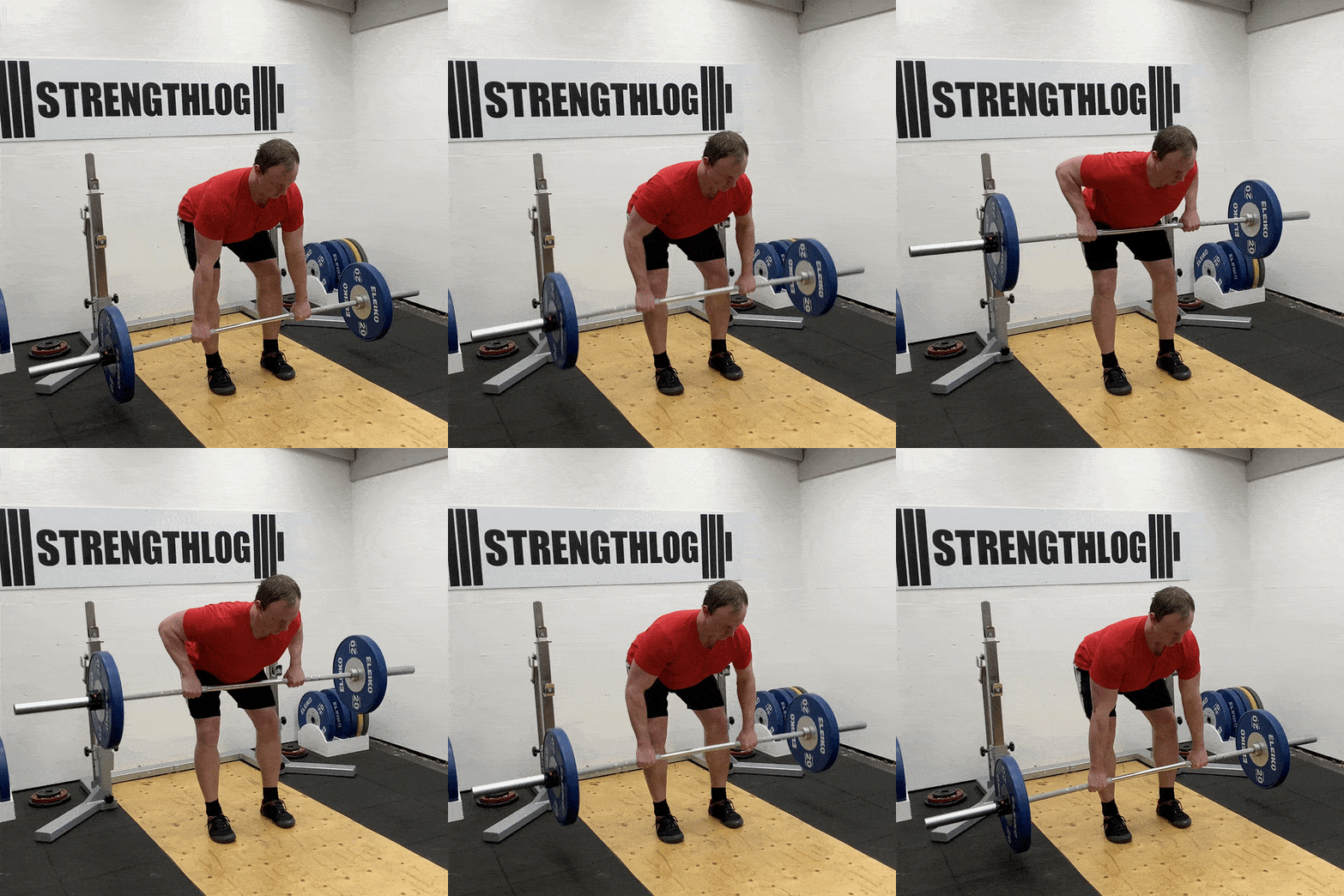
Rows train the entire posterior chain of the upper body, which counters the forward-dominant motions of tennis. It primarily hits your upper back muscles, including the lats, rhomboids, traps, and rear delts (which are essential for shoulder health as they balance out the often dominant front shoulders). It also hits the biceps, which are important for racket control and elbow support during strokes.
Cable rows are not the only horizontal row-type of exercise you can do—barbell rows and dumbbell rows are great alternatives, but the seated cable row is top-tier for tennis as it removes excessive strain from the lower back while still building strength in the upper back, lats, and rear delts—muscles that are essential for powerful strokes, scapular control, and good posture. That’s not to say that loading your lower back is bad—on the contrary—but it’s important to program smart so that you don’t overuse it to the point where it affects your game. For example, in Strength Training for Tennis, you’ll build general strength with the cable row, then maximum strength with the barbell row during the deepest part of off-season.
The main benefit of building a stronger back is that it allows you to exert more force in your swing for higher racket speed and ball velocity. The lats, in particular, are involved in the acceleration of serves and overheads. More power behind your pulling muscles improves the force transfer through the kinetic chain, adding “zip” to your forehands and backhands, and even though a row is not a direct mimic of a stroke, more general upper-body strength translates to harder shots on the court.
In addition, upper back stability is essential when you execute lateral footwork or set up for a shot. Your scapular muscles keep the shoulders back and chest up, which means you can move on the court without hunching or losing form, with effective footwork and recovery steps between strokes. Changes of direction become more efficient, and you can react to shots while staying balanced over your feet.
Last but not least, injury prevention. With stronger scapular stabilizers (rhomboids, mid/lower traps) and shoulder extensors, you improve shoulder joint stability and may prevent common tennis injuries like rotator cuff tendinopathies and impingement. And, with more upper-body strength, you distribute forces more evenly, which can likely prevent overuse injuries in the smaller elbow and wrist joints.
How to Do Cable Seated Rows
- Sit on the seated row bench, facing the cable machine. Your feet should be flat on the footrest, knees slightly bent, and your torso upright with your chest out, shoulders back, and core engaged.
- Grab the handle with a neutral grip (palms facing together) and ensure your arms are fully extended and your back straight in the starting position.
- Pull the handle towards your abdomen by retracting your shoulder blades (squeezing them together). Focus on driving your elbows backward and keeping them close to your body.
- Squeeze your shoulder blades together and contract your lats before extending your arms and leaning forward again. Maintain a controlled motion throughout the movement and avoid using excessive momentum.
- Stretch your lats out without letting your shoulders slump forward
- Repeat the movement for your desired number of repetitions.
How to Do Barbell Rows
- Grasp the barbell with an overhand grip, slightly wider than shoulder-width apart.
- Stand with your feet slightly wider than feet hip-width apart, bend your knees slightly, and hinge forward at your hips, maintaining a straight line from your head to your hips.
- Brace your core and keep your back straight. Pull the barbell towards your lower chest or upper core, keeping your elbows close to your body. Squeeze your shoulder blades together at the top of the movement.
- Lower the barbell back to the starting position in a controlled manner.
- Repeat the movement for the desired number of repetitions.
Reverse Lunge

The reverse lunge strengthens almost every major muscle group of the lower body crucial for explosive movements on the court. That includes the quads, adductors, glutes, and even the hamstrings and calves to a degree.10 These are the muscles you use for pushes off the ground for sprinting, jumping into serves, and driving through groundstrokes. Unlike bilateral exercises like squats, lunges work each leg individually and build balanced strength for the single-leg pushes and lunges common in tennis.
There are many moments in tennis that require excellent balance, like quick changes of direction, sudden stops, and lunging reaches. Reverse lunges are great for training your stability as you move in and out of a split stance, improving proprioception (your body’s awareness of position) and single-leg balance. Over time, you gain more confidence and control when you’re stretched out wide for a shot or recovering back to center and can stay upright and react during off-balance moments in play.
The lunge is also fantastic for flexibility in the hip flexors and ankles. Stepping backward into a lunge gives you a stretch of the hip flexor of the trailing leg, and because tennis players often have to get low for shots, the reverse lunge’s deep bend improves the hip and ankle mobility you need for low volleys or wide lunges. Strength training with a full range of motion is as effective as stretching for flexibility and mobility, so you save time with the three-in-one benefits of the lunge: performance, stability, and flexibility.11
Perhaps most importantly, lunges train tennis-specific movements. Look at how often a tennis player lunges forward for a short ball, wide to the side for an angled shot, or push back to a standing position. With reverse lunges, you make the same muscles you use in on-court lunges stronger, but in a controlled environment, which means you perform these movements more explosively and efficiently on the court when it counts.
Note: You can do reverse lunges either with a barbell like in the video demonstration above or holding a pair of dumbbells or kettlebells in your hands. Or with just your body weight to start.
How to Do Reverse Barbell Lunges
- Take a big step backward and sink as deep as possible in a lunge position, without hitting the knee of the back leg in the floor.
- Return to the starting position by pushing yourself back with the front leg.
- Repeat for the desired number of repetitions, then switch sides.
Plank


Tennis “requires great strength of the abdominal core,” which is key in force conduction, stabilization, and maintaining posture.12 That means that your core strength and stability are a high priority for almost every aspect of the sport. The plank trains your core to stabilize the spine and pelvis, which is vital during the sudden, explosive moves and rapid direction changes on the court. Your core functions as a stabilizing hub, linking the lower and upper body during play, and if it is weak or unstable, energy leaks away, resulting in less powerful strokes and lower accuracy.
Strengthening your core (as you do with planks) also helps protect the body from injuries, particularly in the lower back. The core muscles support the spine, and if they lack strength, other areas (like the lumbar spine or hips) may take on too much of the wrong kind of stress during play. But when they can handle the stress, your body will draw on them for force rather than overstressing smaller, weaker muscles or joints.
You will do several types of planks in Strength Training for Tennis.
- The classic plank is performed in a push-up position: arms straight, hands under shoulders, and body in a straight line from head to heels. It teaches you to engage your abs, glutes, and back to maintain spinal alignment and a stable core, firing all the major core muscles to keep your hips from sagging.
- The side plank with rotation introduces deliberate rotation to the plank, training your core to generate and control twisting force. Start in a forearm side plank, then rotate your torso toward the floor, reach your free arm under your body (a “thread the needle” motion), and then rotate back to the side plank. The rotation targets your obliques and transverse abdominals dynamically and teaches you how to transfer force from the rotation of your trunk into the ball, and helps prevent over-rotating or losing balance during strokes.
- Lastly, the plank with leg raise is very similar to the standard planks but adds one more stabilization component to the exercise for more hip involvement.
How to Do Plank (With Leg Lifts)
- Begin by getting into a standard plank position. Place your elbows directly under your shoulders, legs extended straight behind you, and toes pressing into the ground. Your body should form a straight line from your head to your heels.
- Brace your core, keep your back flat, and avoid letting your hips sink down or lift too high. It you’re doing the standard plank, you can stop reading here. Simply hold the plank for the desired amount of time. If you’re adding the leg raise movement:
- Slowly lift one leg off the ground to about hip height without bending the knee. Keep your leg straight during the movement.
- Hold the lifted position for a moment, then gently lower your leg back to the starting position.
- Repeat the lift with the opposite leg, ensuring you maintain a strong plank position throughout the movement.
- Continue to alternate legs for the chosen amount of time.
Trap Bar Deadlift

The deadlift is one of the most important lifts for athletes and is commonly programmed into training programs for almost every sport, including tennis.13 Unlike the straight bar deadlift, which is more of a hip hinge-focused movement, the trap bar deadlift is a mix of a squat and a hinge that places you in the tennis player’s athletic power position. It builds full-body strength but with an emphasis on the posterior chain (glutes, hamstrings, lower back) plus the quads, which ultimately means better acceleration, deceleration, and power in your game.
A trap bar deadlift is also different from a traditional barbell deadlift in that it positions you within the bar’s frame, with your center of gravity in alignment with the weight, which allows for a neutral grip and a more upright torso angle during the movement, reducing the stress on your lower back and shifting more emphasis to the quads.
In addition, you can perform the trap bar deadlift in different ways depending on where you are in your conditioning phase. You can do them explosively by using lighter loads and with maximum movement velocity—or you can program them with heavy weights close to your 1RM for maximal strength gains, adjusting the load and intensity according to the season. In Strength Training for Tennis, you’ll go from moderate weight and mid-range reps to pushing near top loads during the max strength block and ultimately into explosive power development as you approach the competitive season.
How to Trap Bar Deadlift
- Step into the bar’s opening so that the handles are in line with the middle of your feet.
- Inhale, bend down and grip the handles.
- Hold your breath, brace your core slightly, and lift the bar.
- Lift the bar with a straight back, until you are standing straight.
- Lower the bar back to the ground with control.
- Take another breath, and repeat the movement for your desired number of repetitions.
Overhead Press


The overhead press is a classic strength exercise used by everyone in the iron game, from casual lifters training to look good to Olympic weightlifters to bodybuilders looking to build boulder shoulders to athletes who want to maximize performance. It is a great exercise for tennis that improves your serving power, overhead shots, and general upper-body strength and stability. Plus, you can adapt it with different variants depending on your seasonal training goals.
When you do overhead presses, you’re working your shoulder muscles (primarily the front delts), upper chest, triceps, and some traps. These are all muscle groups that contribute to a strong and stable shoulder girdle, and because tennis places continuous stress on the shoulders from all the rapid, repetitive overhead actions, building these muscles up helps you minimize the risk of issues like rotator cuff strains or shoulder impingement.
Beyond injury prevention, overhead pressing offers several direct benefits to your tennis game. These are just some of them: a more powerful serve and overhead smash, better racket control, improved upper body stability during rallies, efficient movement, and quicker reaction times.
To maximize the benefits of the overhead press for tennis, you want to focus on controlled, high-quality reps with a complete range of motion (with a full extension overhead) to transfer optimally to the demands of tennis movements. No half-reps.
Also, including variations of the standard barbell overhead press, like the dumbbell shoulder press, single-arm overhead press, or push presses (which involve slight leg drive for explosive force), in your workout routine provides additional benefits. For example, using dumbbells involves more stabilizing muscles and works each side individually—very useful because of the asymmetrical nature of tennis where one side typically dominates. Programming push presses or other explosive variations in later phases of your training closer to competitive season improves power output for the explosiveness you need during intense match play. In the Strength Training for Tennis program, these things are already in place, with the early training phase emphasizing general strength and hypertrophy, transitioning to maximum strength and eventually power-oriented training, focusing on heavier loads and explosive, lighter-load sets as the tennis season approaches.
How to Overhead Press
- Place a barbell in a rack at about chest height.
- Grip the bar slightly wider than shoulder-width apart and step close to it.
- Tighten your abdominal muscles, unrack the bar and let it rest against your front delts while you step back from the rack with your feet shoulder-width apart. This is your starting position.
- Push the barbell up, extending your arms fully, while exhaling.
- Bring the weights back down to your shoulders, slow and controlled, while inhaling.
- Repeat the movement for the desired number of repetitions.
Pull-Up

The pull-up (and variations) is one of the most valuable upper body exercises a tennis player can do and should be incorporated into your training regimen year-round. It improves upper body strength and shoulder stability, corrects muscular imbalances, and makes you a better athlete (and tennis player) in general.
Pull-ups primarily hit the latissimus dorsi, a broad muscle of the back that looks like a pair of wings and is responsible for shoulder adduction, extension, and rotation—all essential movements in tennis strokes. When your lats are strong, you can drive your arm downward during a serve or overhead smash with more power, generating greater racquet speed and increased ball velocity. They also work the mid-back, particularly the trapezius, teres major, and rhomboids, which provide more stability and control during strokes, as well as your biceps and forearms for racquet handling, grip strength, and control over the racquet face.
Together, these muscles stabilize your shoulder girdle and protect against shoulder injuries, maintain healthy shoulder mechanics and proper scapular movement during strokes,
The Strength Training for Tennis program adjusts pull-up intensity and repetitions based on your training cycle. In the early training phase (off-season), a higher volume with moderate intensity builds lean muscle and a base of strength. Then, as you move closer to pre-season, you’ll do fewer repetitions at higher intensities with added resistance to boost maximum strength, finally transitioning into speed work for explosive power.
If you are new to pull-ups and can’t do the prescribed number of reps, you can use a resistance band as a helping hand, if necessary, before progressing to full bodyweight pull-ups.

Also worth mentioning is that neutral-grip variations are particularly shoulder-friendly and beneficial if you’re recovering from shoulder issues or want to reduce shoulder stress.
How to Do Pull-Ups
- Stand beneath a pull-up bar and reach up to grasp it with an overhand grip (palms facing away from you), slightly wider than shoulder-width apart. Ensure your grip is secure and comfortable.
- Hang freely from the bar, fully extending your arms. Your feet should be off the ground.
- Engage your core muscles by squeezing your abs and glutes.
- Inhale and initiate the movement by pulling yourself up towards the bar by bending your elbows and squeezing your shoulder blades together. Focus on using your back muscles rather than relying on your upper arms.
- Continue pulling yourself up until your chin reaches or clears the bar. Keep your torso upright and avoid excessive swinging or kicking with your legs.
- Slowly lower yourself back down to the starting position while maintaining control and stability, fully extending your arms.
- Repeat the movement for your desired number of repetitions.
Lateral Lunge

The lateral lunge (side lunge) is an excellent exercise for lower-body strength, lateral agility, and stability, as well as for building many of the muscles essential for on-court movement. Unlike forward lunges, the lateral lunge trains side-to-side mobility, strength, and stability—critical aspects of tennis performance given the sport’s multidirectional movements, where you constantly shift weight laterally when you execute groundstrokes, return serves, or approach the net. It also trains you to control your body weight better during lateral deceleration and explosive acceleration back into position.
Side lunges work large parts of your body, but primarily your quads (lateral movements, acceleration, and deceleration), glutes (hip stability, force production, and controlling lateral movements), hamstrings and adductors (balance and stability when moving sideways, plus knee health support), and various core muscles for stability and body control.
Beyond improving lateral movement, making these muscles stronger allows you to generate more force from the ground up and transfer energy more effectively into shots. You also help your body build resilience against the repetitive stress from continuous and rapid lateral changes in direction, protecting your knees, ankles, hips, and groin muscles from injury.
How to Do Side Lunges
- Stand up straight with plenty of space to your side for you to step out. Hold a dumbbell or kettlebell to your chest for resistance if needed.
- Lightly brace your core, and take a big step to the side.
- Go as deep as possible without your heel lifting from the ground and while maintaining control.
- Push yourself back up by pressing the foot from the ground.
- Repeat the movement for your desired number of repetitions.
Bulgarian Split Squat

The Bulgarian split squat (also known as the rear-foot elevated split squat) is a single-leg squat variation that can improve every tennis player’s lower-body strength and athletic performance. It involves elevating your back foot on a bench or platform and performing a squat with the front leg, working the quads, glutes, and adductors while challenging your balance.
Increased single-leg strength has been shown to improve acceleration and lower-body power, and your single-leg squat performance correlates with better sprint speed and agility.14 For a tennis player, that means faster court coverage and more powerful leg drive. You’ll notice improved push-off when sprinting for a drop shot and better stability when landing on one leg after an overhead or serve. Yes, even your serve can benefit because stronger legs provide a more forceful drive upward. In addition, unilateral strength carries over to bilateral lifts, helping you break plateaus in regular barbell squats.
Because you do split squats on one leg, you are forced to stabilize your body throughout the movement, training your balance and recruiting your core and small stabilizer muscles around the hips and ankles to keep you steady. It teaches you to control rotation and stay aligned under unilateral load, leading to better stability when hitting or moving on one leg.
Also, the Bulgarian split squat is great for mobility. It puts your hips through a deep range of motion—your front hip goes into flexion while your rear hip extends—improving your hip flexor and hip extension range, which helps you maintain a longer stride while running and reach low shots without strain.
Lastly, training your legs one at a time identifies and corrects strength imbalances between your dominant and non-dominant side. Tennis often produces asymmetries (for example, if you are right-handed, you might push off more with the left leg on wide forehands), but unilateral exercises like Bulgarian split squats make sure both legs get equal attention, protecting against injuries caused by one side compensating for the other and reinforcing knee stability.
Note: Earn your progression with this exercise. Start with just bodyweight or light dumbbells until you can do a full range of motion with perfect form and balance. If you are too eager, it’s easy to slap on a heavy barbell or use too-heavy dumbbells before mastering the split squat movement pattern. Because this exercise requires balance and coordination, going too heavy too early can lead to poor form, increase injury risk, and not give you the results you’re looking for. Quality of movement is key—you’ll get far more benefit from a controlled set at a lighter weight than a wobbly, half-range set at a heavier weight.
How to Do Bulgarian Split Squats
- Place a bar on your upper back or hold a pair of dumbbells in your hands.
- Stand with your back turned against a bench, which should be about knee height. Stand about one long step in front of the bench.
- Place your right foot on the bench behind you.
- Inhale, look forward, and squat down with control until right before your right knee touches the floor.
- Reverse the movement and extend your front leg again, while exhaling. Your back foot should only act as support.
- Repeat the movement for the desired number of repetitions, then switch side and repeat with your right leg forward and your left foot on the bench.
Pallof Press

The Pallof press, named after physical therapist and strength coach John Pallof and originally called the “belly press,” is a core exercise for the anti-rotational muscles—those that stabilize your body against rotation.
It trains the deep abdominal stabilizer called the transverse abdominis (which braces your core and maintains spinal alignment during movement), the internal and external obliques (which control and prevent rotation, stabilize your torso, and transfer force), and the rectus abdominis (the six-pack muscle which bends you forward like in a sit-up but also stabilize your core against rotation and extension in this exercise). In addition, it involves small but essential muscles of the lower back and spine that stabilize and protect your spine from rotational stress, as well as the hip muscles that stabilize your pelvis and hips.
Doing Pallof presses makes you better at controlling rotation. While tennis might seem to rely entirely on rotational movements to the untrained eye, the ability to resist and control rotation (anti-rotation strength) is equally essential. That strength allows you to stabilize your torso while generating power in your strokes at the same time. More anti-rotation control means you can hit more accurate shots, maintain better positioning, and reduce unnecessary movements, thus conserving energy throughout a match.
How to Pallof Press
- Attach a handle in a cable machine at chest height and stand with your side facing the machine.
- Grab the handle with both hands and stand with feet hip-width apart and knees slightly bent.
- Pull the handle to your chest, engage your core, and then press your arms straight out in front of you without rotating your torso.
- Hold briefly, then bring the handle back to your chest in a controlled motion.
- Repeat for the desired number of repetitions, then switch sides.
Romanian Deadlift


The Romanian deadlift (RDL) is one of the best strength exercises a tennis player can do for a more athletic body and to make many of the areas most critical to performance on the court stronger, more flexible, and more resistant to injuries. It is a hip-hinge exercise that hits your posterior chain—namely the hamstrings, glutes, and lower back, and, unlike a conventional deadlift, which starts from the ground each repetition, the RDL begins from a standing position, focusing more on the eccentric (lowering) phase of the lift.
For a tennis player like you, these muscles and this movement pattern drive much of your movement for improved court speed, quicker acceleration, and more powerful serves and groundstrokes. A strong posterior chain enables kinetic chain transfer of energy from the ground up. Your lower body initiates force, which travels through your core and into your upper body and the racquet. Doing Romanian deadlifts coordinates and integrates these muscle groups into better stroke efficiency and more power.
In addition, all the repeated sprinting, stopping abruptly, and sudden twisting movements in tennis puts a lot of strain on your hamstrings, hips, and lower back. The RDL’s eccentric loading makes these vulnerable areas stronger and reduces the risk of injury. For example, studies show that eccentric training reduces hamstring injuries by up to 70%.15
In Strength Training for Tennis, you’ll be doing a lot of single-leg Romanian deadlifts. This variation trains the same muscles as regular RDLs but involves additional stability requirements and improves proprioception and core control, which is ideal for on-court positions such as reaching and lunging. Single-leg RDLs also improve unilateral strength and stability and address strength imbalances that are fairly common in tennis athletes.
How to Do Romanian Deadlifts
- Get into the starting position by deadlifting a barbell off the floor or by unracking it from a barbell rack. Stand feet hip-width, inhale, and brace your core slightly. If you’re doing single-leg RDLs, lift one leg off the ground.
- Lean forward by hinging in your hips. Keep your knees almost completely extended.
- Lean forward as far as possible with good form (no rounding your back). You don’t have to touch the barbell to the floor, although it is OK if you do.
- Reverse the movement and return to the standing position. Exhale on the way up.
- Repeat the movement for the desired number of repetitions.
Note: The dumbbell Romanian deadlift is a viable alternative to the barbell variant demonstrated in the video above.
Jump Squat

The jump squat is a plyometric variant of the squat that combines a deep squat with a vertical jump. It hits your quads (knee extension), glutes (hip extension), hip adductors and abductors, and calves, building explosive power in your legs by training fast-twitch muscle fibers and improving your body’s capacity for generating maximal force rapidly.
Adding jump squats to your training regimen also injury-proofs your lower-body muscles and tendons around the knees, hips, and ankles. More joint stability and muscular balance in these areas are very valuable in tennis, where injuries to the lower body from repetitive lateral movement and sudden accelerations are relatively common, and jump squats prepare your body for these movements in a controlled setting.
You can do your jump squats using your body weight alone or with external resistance, like a weighted vest, holding a pair of dumbbells at your sides, or with a barbell on the back. Because you are prioritizing explosive power in the Strength Training for Tennis routine, I suggest you pick a lighter load (approximately 10–20% of your body weight) or stick to bodyweight jumps. Heavier loads shift the focus toward strength rather than explosive power (which isn’t a bad thing, but not what we’re going for here).
How to Do Squat Jumps
- Stand with your feet shoulder-width apart with your core engaged and your chest up.
- Lower into a squat by bending your knees and pushing your hips back.Keep your weight on your heels and lower until your thighs are parallel to the ground or below.
- Explosively jump upward, extending your legs and pushing through your feet.Swing your arms for momentum as you jump.
- Land softly with bent knees to absorb impact.
- Immediately go into the next squat and repeat the movement for the desired number of repetitions.
Ball Slam

The ball slam is an explosive, dynamic exercise that involves lifting a medicine ball overhead and forcefully slamming it down onto the ground. It is very close to being a full-body exercise, from your abs and obliques (a strong core helps transfer energy from the lower body upward through the trunk) to your shoulders, chest, and upper back muscles (which lift and then explosively throw the ball downward) to many of your lower body muscles that generate force from the ground upward.
Ball slams train dynamic movement patterns and sequential muscle activation that are similar to the kinetic chain in tennis strokes and help you time, synchronize, and coordinate them across several muscle groups and joints.
If you haven’t done ball slams before, start with lighter balls until you master the technique (ball slams look easy but can be deceptively challenging to learn since they involve so many muscles, joints, and movement patterns in rapid succession, and it’s easier with lighter resistance,) then gradually progress to heavier weights.
Note: Remember to use a ball designed specifically for slams and medicine ball throws to avoid unexpected bounce-backs to your nose.
How to Ball Slam
- Stand with your feet about shoulder-width apart, your knees and hips slightly bent, holding the ball in both hands at chest height. Engage your core, and keep a good posture.
- Extend your knees and drive your hips forward while simultaneously lifting the ball. Aim for being as tall as possible, the ball overhead, arms up, hips slightly forward, and on your toes from the force of your drive.
- Use your core and arms to slam the medicine ball straight down between your feet with as much force as possible. Press your hips back and bend your knees to further power the slam. Exhale as you slam the ball down.
- Squat down to pick up the ball from the floor, then immediately move into the next slam by repeating the movement.
- Repeat the movement for your desired number of repetitions.
Lateral Bounds

Lateral bounds, also known as side-to-side jumps or skater jumps, are a plyometric exercise that recruits muscles from all over the lower body, including the glutes, quadriceps, hamstrings, calves, and the stabilizing muscles of the hips and ankles.
Lateral bounds improve explosive lateral power, agility, and stability—three physical qualities that are of the highest priority for tennis athletes who do a lot of frequent and rapid lateral movements during matches. They also train your coordination, balance, and proprioception (the body’s awareness of its position in space), which is helpful when you must quickly adjust to changing situations on the court. The result is better on-court performance, with faster movement, quicker reaction time, and better recovery after hitting the ball.
How to Do Lateral Bounds
- Stand with your feet hip-width apart, knees slightly bent.
- Shift your weight onto your right leg and lift your left foot off the ground.
- Push off your right foot and jump laterally to the left.
- Land on your left foot, bending your knee to absorb the impact.
- Immediately push off your left foot and jump back to the right.
- Continue bounding side to side in a controlled, rhythmic motion for the desired number of times.
Hang Power Clean

The hang power clean is a weightlifting movement where you pull a (loaded) barbell from a “hang” position (just above your knees), explosively extending your hips and catching the bar in a front-rack position. Unlike the full clean, where you drop into a deep squat, in a power clean, you catch it higher—typically in a quarter-squat position.
For tennis players, the hang power clean is an excellent exercise that teaches you to move weight fast and build power, then translate that explosiveness into jumps, sprints, and rapid direction changes on the court.
The triple extension (hip, knee, and ankle) in the clean and the force you generate to pull the bar up is the same type of power you need to explode off the ground. Essentially, power cleaning teaches your body to recruit more muscle fibers faster—which leads to a higher vertical and faster sprints.
How to Hang Power Clean
- Grip the bar with an overhand grip, about shoulder-width apart, and lift it up to get into the starting position.
- Hold your breath, and brace your core slightly.
- Lower the bar along your thighs, down to about knee-level, by bending your hips and knees.
- Reverse the movement, and lift the bar in a smooth but fast motion by extending your legs and knees simultaneously.
- Bend your knees slightly and receive the bar on the front of your shoulders.
- Stand up on straight legs again.
- Lower the bar in front of you, with control.
Wood Chop

The wood chop (usually performed with a cable pulley or resistance band) is a rotational exercise widely used in sport-specific strength and conditioning programs and is very useful for tennis players. It develops rotational strength, stability, power, and coordination in the rotational movement patterns in tennis strokes.
Wood chops train all the core muscles involved in rotation—including the obliques, rectus abdominis, transverse abdominis, and lower back muscles—to stabilize and control the movement. In addition, the hips and glutes contribute to generating power and stability.
In Strength Training for Tennis, you’ll do three different variants of the wood chop: the horizontal, the high-to-low, and the low-to-high. All three involve grasping the handle or band with both hands and rotating explosively across the body, driving the rotation through your hips, core, and shoulders in a coordinated manner. It’s not an exercise where you want to use as much weight as humanly possible; instead, perform it with moderate resistance and go for explosiveness and smooth coordination. Focus on form and rep quality over sheer resistance.
Note: you can do this exercise with either a resistance band (like in the video demonstration above) or a cable pulley system.
How to Do Horizontal Wood Chops
- Fasten an elastic band at shoulder height. Grip the band with both hands, step away, and stand sideways to the band’s anchor point.
- With almost straight arms, make a sweeping, horizontal movement to your other side.
- Return to the starting position in a controlled manner.
- Repeat the movement for your desired number of repetitions.
Strength Training for Tennis: Final Rep
You have reached the end of this guide to strength training for tennis. 🎾
Thank you for reading! I hope you have enjoyed it and learned things that take your tennis game to the next level.
To follow the training routine in this article, download our workout log app and start tracking your workouts today. It’s like a personal trainer in your pocket.
Click here to open the program in StrengthLog.
Good luck with your training!
Last reviewed 2025-08-25
References
- Flink, Steve. “Margaret Smith Court Career Retrospective”
- Ivan Lendl: The Father of Modern Tennis.
- Navratilova Says Weight Training Is the Key
- Strength and Conditioning Journal 27(5):p 34-41, October 2005. Strength Training in Adult Elite Tennis Players.
- Front Physiol. 2025 Jan 7;15:1469965. The effects of strength and conditioning interventions on serve speed in tennis players: a systematic review and meta-analysis.
- Br J Sports Med. 2014 Jun;48(11):871-7. The effectiveness of exercise interventions to prevent sports injuries: a systematic review and meta-analysis of randomised controlled trials.
- Med Sci Sports Exerc. 1991 Jun;23(6):739-43. Effects of strength training on lactate threshold and endurance performance.
- Strength and Conditioning Journal 36(6):p 4-27, December 2014. The Back Squat: A Proposed Assessment of Functional Deficits and Technical Factors That Limit Performance.
- Br J Sports Med. 2004 Jun;38(3):285-8. Strong correlation of maximal squat strength with sprint performance and vertical jump height in elite soccer players.
- Appl. Sci. 2024, 14(24), 11480. The Reverse Lunge: A Descriptive Electromyographic Study.
- Healthcare (Basel). 2021 Apr; 9(4): 427. Strength Training versus Stretching for Improving Range of Motion: A Systematic Review and Meta-Analysis.
- Rev Bras Med Esporte 29, 2023. Strength Training in the abdominal core of tennis players.
- Sports (Basel). 2022 Sep 29;10(10):149. Injuries and Strength Training Practices in Collegiate Tennis.
- Interdisciplinary perspectives on health, participation and effects of sport and exercise, 28-30 October 2010, Odense, Denmark. Maximal strength in one leg squat correlates with acceleration capacity and agility.
- Arthroscopy, Sports Medicine, and Rehabilitation, 10 October 2024. Prevention and Rehabilitation of the Athletic Hamstring Injury.
