
Who needs a gym when you can do these strength training exercises at home and build muscle, strength, and functional fitness using nothing but your body weight?
Strength training at home is not only possible but also super practical and effective.
Do you want to transform your living room into a fitness center without dumbbells and weight plates cluttering up the place? Let’s go through the 10 best exercises that will help you reach your fitness goals without having to step inside a gym.
Benefits of Strength Training at Home
Resistance training at home comes with some seriously awesome benefits. Here are five reasons why you should be flexing your muscles in your living room.
- It’s convenient—no more excuses about gym hours or commute times. You can train whenever you want or have the time to squeeze a training session in.
- Forget gym memberships or pricey equipment. With bodyweight exercises, all you need is…you. If you want to take your home training to the next level, basic gear like resistance bands or adjustable dumbbells won’t break the bank.
- There is no need to worry about gym stares or waiting for equipment. It’s just you, your goals, and maybe your dog wondering what you’re doing.
- Since you control when and where you train, some people find it easier to stay consistent and not skip a workout when the gym is 10 steps away.
- No pants required!
Strength training at home keeps things simple, convenient, and effective—plus, you can blast whatever workout music you want with no judgment.
Ready to start? Then, without further ado, let’s jump into 10 home strength training exercises you can do at home without equipment.
Home Strength Training Exercises Without Equipment
These are 10 of the best (but not all) exercises you can do at home without any equipment other than your own body.
Bodyweight training is highly effective. It can be your go-to type of exercise for all fitness goals, from building strength and muscle to weight loss.
However, as with all physical activity, you will have to up the intensity (e.g., lift heavier) as you get stronger to keep improving. This is called progressive overload and is the number one key to building muscle and strength over time.
It is easier to practice progressive overload in the gym, where you can add a plate to the bar or move the pin on the weight machines, but you can absolutely do it at home with bodyweight exercises, too.
Here are some of the best ways to do it without needing a pile of iron.
Progressive Overload at Home
- Do more reps. If you’re doing three sets of 10 push-ups, aim for three sets of 12 the next time. As long as you push yourself, you build just as much muscle with 30 reps as with the standard 6–8.
- Do those push-ups or squats slowwwwly. Lower yourself for 3–5 seconds and then explode back up.
- Change your moves up. Want a harder push-up? Elevate your feet. For squats, try pistol squats (one-legged squats). You can modify most bodyweight exercises to make them more challenging (you’ll find more tips in the exercise descriptions below).
- Add weight. If you have a backpack nearby, fill it with books or cans and wear it while doing exercises like squats, push-ups, or lunges. Fill duffel bags or suitcases with water bottles, and you will have a set of dumbbells.
- Decrease your rest time. If you’ve been chilling for 90 seconds between sets, cut it down to 60 or even 30.
Each of these tweaks increases the intensity of your workout routine, forcing your muscles to adapt and grow stronger without traditional gym equipment.
Now, here we go – the best strength training exercises at home.
1. Push-Up

The push-up is one of the most iconic strength exercises; a no-excuses, anywhere-anytime bodyweight exercise that builds upper body strength like few others. Believe it or not, it’s as effective for building chest and triceps as the barbell bench press, especially in beginners.1
Push-ups work your pecs (chest muscles), delts (shoulder muscles), and triceps (back of the arms). At the same time, they involve many other muscles all over the body for stability, your core muscles in particular.
No gym? No problem. Push-ups require zero equipment (besides your own body weight), just a bit of floor and some elbow grease.
Do full reps for full benefits and the best results – keep the reps under control, and don’t collapse like a soggy noodle. Lower your body until your chest almost touches the floor, then push yourself back up to full extension.
Variations for Fun and Gains (Easiest to Toughest)
- Wall Push-Ups: The easiest type of push-up.
- Knee Push-Ups: Perfect for beginners. Same form as standard push-ups, just on your knees.
- Incline Push-Ups: Like regular push-ups but with your hands on a higher surface (like a bench) to make it easier.
- Decline Push-Ups: Feet elevated. The next step once you’re cranking out regular push-ups like a pro.
How to Do Push-Ups
- Assume the starting position, with hands slightly wider than shoulder-width apart.
- Try to form a straight line from head to feet, and brace your abdomen slightly.
- Lower yourself as deep as you can, while inhaling.
- Reverse the motion when you’ve touched the floor, and push yourself up to straight arms again while exhaling.
- Repeat the movement for the desired number of repetitions.
2. Bench Dip
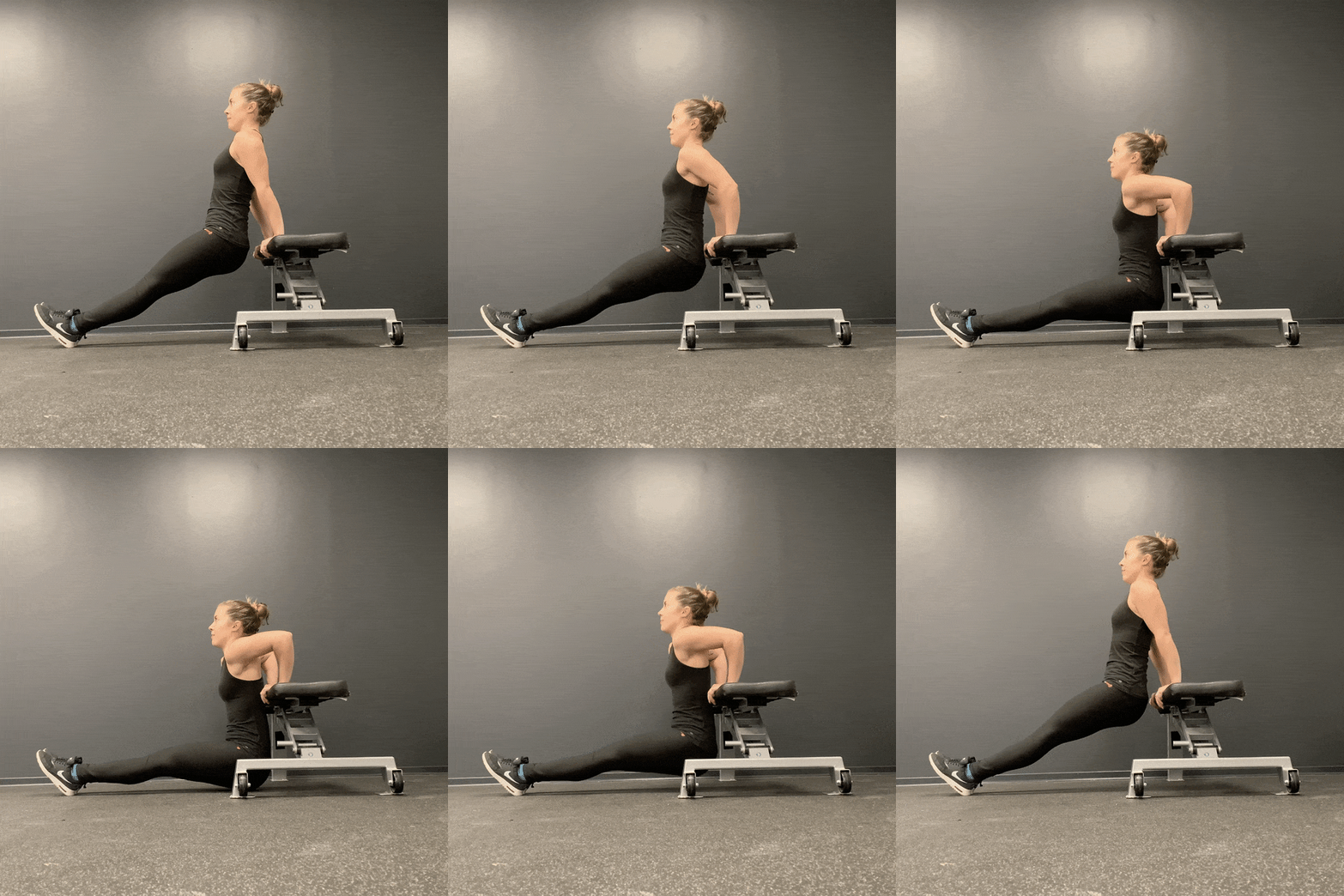
The bench dip (also called triceps dips) is an upper-body exercise that primarily targets the triceps, with bonus engagement for the shoulders and chest. All you need for tricep dips is a stable surface like a chair, a bench, or a low table—perfect for a home workout.
Also, you can easily modify the difficulty to your strength level: bent knees for beginners, legs straight out for the default experience. You can also prop your feet up on another chair or bench or place something heavy (like a few books or maybe your cat if they’re feeling cooperative) on your lap for extra resistance and an even greater challenge.
Keep your back close to the bench. If your hips are too far out, it can put unnecessary strain on your shoulders.
Bench dips are great because they’re simple, effective, and scalable. You can dial up or down the intensity to suit your fitness level, and they complement other bodyweight exercises like push-ups or pull-ups for a full upper-body workout without you having to buy a single dumbbell.
How to Do Bench Dips
- Turn your back towards a sturdy training bench, and put your hands on the pad about shoulder-width apart. Extend your legs in front of you.
- Lower yourself with control for as far as comfortable by bending your arms.
- Reverse the motion and return to the starting position.
- Repeat the movement for the desired number of repetitions.
3. Bodyweight Squat

The bodyweight squat is a classic; one of the best lower body exercises you can do for building muscle strength, lean muscle mass, stability, and coordination without equipment.
Squatting is one of the best things you can do for your body.
- It is a compound exercise, meaning it hits many major muscle groups at once, primarily the quadriceps (the front of your thighs), glutes (your butt), and adductors (a group of muscles on the inside of your thighs that bring them together).
- It’s also a functional exercise, meaning the strength you build translates into real-world activities like standing up, climbing stairs, and getting off the couch to get snacks.
- Dropping into a full squat also helps maintain hip, knee, and ankle flexibility, keeping you spry and agile. And because squats involve the largest muscle groups in your body, they burn more calories than isolation exercises like bicep curls. Squat more, eat more pizza—balance restored.
Go as deep as your mobility allows. Ideally, you want to get your thighs parallel to the ground or lower but don’t force it if your mobility isn’t ready for that deep of a squat position yet. It will improve over time as you keep practicing squatting.
Once your body weight feels too easy, it’s time to grab something heavy. You don’t need dumbbells—use household items like a backpack filled with books. You can front-load the weight by holding something heavy in front of your chest, like in a goblet squat.
How to Do Bodyweight Squats
- Stand with your feet about shoulder width apart.
- Squat as deep as possible.
- Reverse the movement, and return to a standing position.
- Repeat the movement for the desired number of repetitions.
4. Bodyweight Lunge

The bodyweight lunge is an excellent strength-training exercise for your home workouts because it requires no equipment and still provides a solid lower-body workout.
Lunging involves several large muscle groups. Your quadriceps and glutes take the bulk of the load. The deeper the lunge, the more your glutes get in on the action. In addition, your core muscles must work hard to keep you balanced and steady.
- Most of us have a dominant leg, and lunges help address muscle imbalances because they require you to stabilize yourself on a single leg (this type of exercise is called a unilateral exercise).
- They also make daily life easier by strengthening the muscles you use while walking, running, jumping, and climbing stairs.
- In addition, lunges take your hips through a full range of motion, which helps you stay mobile and flexible.
Lunge Variations
- Reverse Lunge: Instead of stepping forward, step backward. It can feel easier on the knees and works the glutes more.
- Walking Lunges: Instead of returning to the start position, keep stepping forward for more of a coordination and balance check.
- Side Lunges: This lunge variation targets your inner thighs more and is a great way to improve lateral mobility.
- Jumping Lunges: Explode from the bottom of the lunge and switch legs mid-air for additional cardio benefits and explosive leg strength.
- Bulgarian Split Squat: A kind of elevated lunge where you prop your rear leg on a chair or bench behind you.
Once bodyweight lunges start to feel easy, you can put on a backpack and stuff it with books, water bottles, canned goods, or anything that’s heavy but fits comfortably. Or turn your luggage into a workout tool by packing two duffel bags with heavy items and holding them by your sides as you lunge.
How to Do Bodyweight Lunges
- Take a big step forward with your right foot and sink as deep as possible in a lunge position, without hitting the knee of the left leg in the floor.
- Return to the starting position by pushing yourself back with the front leg.
- Repeat the movement for the desired number of repetitions.
- Switch legs and repeat the above steps with your left foot forward.
5. Step Up

The step up is exactly what it sounds like: you step up onto an elevated surface (like a sturdy chair, bench, or a stair) and then step back down. It primarily works your quads and glutes (research shows that it hits the butt even harder than exercises like squats or hip thrusts).2 Your hamstrings and core also work as stabilizers, lifting your body and controlling the descent.
You don’t need to buy a fancy box for this exercise—all you need for the step up is a sturdy surface. It could be a step, a bench, or a chair. Just make sure whatever you’re stepping on is sturdy so it won’t slide out from under you.
You can alternate legs every rep or focus on one leg for a set and then switch. Both approaches are legit, but doing one side at a time can make it easier to focus on feeling the pump and mind-muscle connection.
As you get stronger, you can adjust the difficulty by changing the height of the step, adding weights (like a loaded backpack), or increasing your reps.
How to Do Step Ups
- Stand in front of a chair, bench or something else that you can step up on.
- Place your foot on the chair.
- Lightly brace your core, and step up until your leg is straight.
- Lower yourself in a controlled motion.
- You can keep your foot on the chair, and repeat for the desired number of reps.
6. Pull-Up

Few exercises target your back as effectively as the pull-up. If you want a wider back, this is your go-to. In addition, pull-ups work your biceps and rear delts effectively.
You don’t need a full gym setup to do pull-ups. A doorway pull-up bar, a tree branch that can hold your weight, gymnastic rings, or even a sturdy playground structure can be your pull-up station.
If you can’t do a full pull-up yet (don’t worry, most people can’t at first), start with negative pull-ups. Jump or step up to the top of the bar, then slowly lower yourself down. This procedure builds strength in the right muscles, and before you know it, you’ll be able to hoist yourself up without help. If you have some resistance bands lying around, you can also loop a band around the bar and your feet for assistance until you’re strong enough to go unassisted.
The chin-up is a variation of the pull-up where you use an underhand grip (palms facing you). It is similarly effective for your back but emphasizes your biceps more.
How to Do Pull-Ups
- Grip the bar with palms facing away from you, slightly wider than shoulder-width.
- Keep your chest up, and look up at the bar.
- Inhale and pull yourself up until your chin is over the bar or the bar touches your upper chest.
- Exhale and lower yourself with control until your arms are fully extended.
- Repeat the movement for the desired number of repetitions.
7. Back Extension

The floor back extension is a great way to get some lower back training into your home workout without having to hoist heavy weights. It is easy to incorporate into a warm-up, cool-down, or as part of a strength circuit.
It primarily targets the erector spinae (the muscles running along your spine), which help maintain a good posture and stabilize your entire back.
Your core provides the foundation for almost every movement you make, and with a strong back, half the battle in building a solid core is won. Back extensions develop your lower back to support your spine during daily movements, reducing the risk of injury.
You might think the higher you go, the better, but don’t overdo it. Focus on feeling the muscles work, not just arching your back.
How to Do Floor Back Extensions
- Lie on the ground with your arms at about a 90-degree angle to your sides.
- Fix your eyes on the ground to keep the neck in a natural position.
- Lift your upper body by using your lower back. You may pause at the top of the movement, feeling the lower back muscles working.
- Lower your upper body in a slow and controlled motion.
- Repeat the movement for the desired number of repetitions.
8. Single-Leg Glute Bridge

The single-leg glute bridge is a variation of the standard glute bridge but with one leg extended while the other supports your body. What might seem like a slight change ramps up the difficulty by forcing each leg to work independently and making sure there’s no cheating by relying on your stronger side.
True to its name, the one-legged glute bridge primarily targets the glutes. All three gluteal muscles get hit hard. In addition, it works the hamstrings, hip abductors, and core muscles.
Research shows that working the single-leg glute bridge into your training sessions offers several benefits, both in sports and everyday life.3
- It helps with hip extension, lateral stabilization, and explosive movements, boosting performance in a number of sports, including soccer, football, and rugby.
- It also contributes to your stability and helps you maintain balance when you run and jump.
- The single-leg glute bridge strengthens your hip extensors and improves stability, reducing the risk of knee and hip injuries, including patellofemoral pain syndrome (PFPS), which is linked to weak hip muscles.
- Lastly, they can help correct anterior hip tilt and improve walking and running mechanics, contributing to better posture and movement efficiency.
The single-leg glute bridge is a rock-solid addition to your at-home workout. It strengthens the glutes, hamstrings, and core while improving hip mobility, all without needing a gym.
How to Do One-Legged Glute Bridges
- Lie down with one foot on the floor, one leg extended.
- Tuck the pelvis in to properly activate the glutes.
- Push your hips towards the ceiling by using the glute muscle in the bent leg, until your body forms a straight line from head to foot.
- Squeeze your glutes at the top.
- Reverse the movement, and repeat for the desired number of repetitions.
9. Crunch

The abdominal crunch is one of the best strength training exercises focusing primarily on the rectus abdominis—the six-pack muscle. In addition, you get some work on your obliques, the side abs that give you that “V” cut, and your transverse abdominis, your deep core muscles that protect your organs and act like a support belt for your back.
Crunches help build strength in your abs, which is part of your core. A strong core is essential for posture, balance, and pretty much every move you make in life, including walking, lifting, or sitting at your desk pretending to work.
You can crunch anywhere, anytime, with nothing but your body and a little space. It’s the perfect home-friendly exercise. If needed, hold a weight on your chest to increase resistance.
How to Do Crunches
- Lie on your back, with your hands in front of your chest and your knees bent to about 90 degrees.
- Lift your upper body by contracting your abs and bending forward.
- Bend as far forward as possible while still keeping your low back in contact with the floor, and then return to the starting position.
- Repeat the movement for the desired number of repetitions.
10. Plank

The plank is a popular and effective exercise for strengthening your core. It involves holding a static position where you support your body weight on your forearms and toes, keeping your body in a straight line like a—well, plank. It’s great for muscle endurance, helping you build strength that lasts longer than a few seconds.
The rectus abdominis (your six-pack muscle) is the primary muscle activated when you plank, helping to stabilize your spine. In addition, the transverse abdominis (deep core muscles) pull everything together, and the obliques (side abs) stabilize you and keep you from collapsing sideways.
Plank Variations
- Kneeling Plank: If holding your body weight on your toes is too much, drop to your knees for a bit less intensity.
- Side Plank: This exercise targets your obliques even more. Support your body on one arm and the side of one foot, stack your feet, and try to keep your hips high.
- Plank with Leg Lifts: Once you’ve mastered the regular plank, lift one leg at a time to challenge your stability.
How to Do the Plank
- Stand on your elbows and feet.
- Brace your abs and try to form and hold a straight line from your head to feet.
- Hold the plank position for the intended length of time or as long as you can.
Sample At-Home Strength Training Program Without Equipment
With these strength training exercises, you can build your own fitness routine to get in shape at home. They cover the entire body, and you can modify them to grow with you as you become stronger.
However, if you don’t want to create your own, here is a 3-day workout split for beginners to get you started on your fitness journey.
Each training session is a full body workout, and you train every other day with one rest day between workouts, like this:
- Monday: Workout 1
- Tuesday: Rest
- Wednesday: Workout B
- Thursday: Rest
- Friday: Workout C
- Saturday: Rest
- Sunday: Rest
If you want to train and rest on other weekdays, go right ahead. Just try to get at least one day of rest between sessions.
Workout A
| Exercise | Sets | Reps |
|---|---|---|
| Bodyweight Squat | 2 | 10 |
| Push-Up | 2 | 10 |
| Pull-Up | 2 | Max reps |
| Crunch | 2 | 15 |
Workout B
| Exercise | Sets | Reps |
|---|---|---|
| Step Up | 2 | 10 |
| Body Weight Lunge | 2 | 10 |
| Push-Up | 2 | 10 |
| Single-Legged Glute Bridge | 2 | 10 |
Workout C
| Exercise | Sets | Reps |
|---|---|---|
| Bodyweight Squat | 2 | 12 |
| Pull-Up | 2 | Max reps |
| Bench Dip | 2 | 10 |
| Plank | 1 | Max time |
This training program is available for free in StrengthLog, our workout tracker app, along with 80+ other programs and workouts.

In addition to following our programs, you can create your own workout routines, log your workouts, keep track of your personal records, see statistics on your training, and much, much more.
Download StrengthLog for free with the buttons below:


Final Words
Home strength training without equipment is not only possible but also remarkably effective. With just your body weight and a little creativity, you can design a full-body workout to gain strength and build both muscle and a sense of accomplishment.
No gym? No problem!
With these home strength training exercises, you’ve got everything you need to build muscle, burn fat, and get stronger—all without leaving the house or splurging on equipment.
Want More?
Subscribe to our weekly newsletter to get notified of new training programs and articles!
Thank you for reading, and good luck with your training!
References
- Journal of Exercise Science & Fitness. Volume 15, Issue 1, June 2017, Pages 37-42. Low-load bench press and push-up induce similar muscle hypertrophy and strength gain.
- Journal of Sports Science and Medicine (2020) 19, 195 – 203. Gluteus Maximus Activation During Common Strength and Hypertrophy Exercises: A Systematic Review.
- Strength and Conditioning Journal, Vol 0, Number 0, 2017. Single-Leg Glute Bridge.
