
Triathletes are the ultimate all-rounders, juggling not one, not two, but three different disciplines. But what if I told you that strength training can improve almost all aspects of triathletes’ training?
If you’re not already hitting the weights, it might be the missing link that can elevate your performance even further and protect your body from the wear and tear of the rigors of multi-sport training.
This article explores why strength training is essential for triathletes and how you can incorporate it seamlessly into your schedule. You’ll learn the benefits of hoisting heavy iron, which are the best exercises for building muscle and strength without compromising your endurance and speed, and you get a complete 12-week weight training program designed to take your triathlon power to the next level, whether you’re eyeing a personal best or chasing Kona glory.
Table of Contents
Benefits of Strength Training for Triathletes
Decades ago, many endurance athletes (and coaches) believed that strength training makes you slow, bulky, and “muscle bound” and is better left to bodybuilders and strength athletes.
However, up-to-date research demonstrates that hitting the weight room in addition to your regular sport-specific training will improve overall endurance performance.1 In addition, strength training is fantastic for preventing sports injuries, which is important in a demanding sport like triathlon.
Here are the top benefits you can expect:
1. Improved Performance
- Swimming: Swimming power comes from muscular strength. Because there is nothing you can do that increases strength the way lifting weights does; strength training allows you to swim faster with more powerful strokes and kicks. Also, a strong core keeps you streamlined, minimizes energy-wasting movements, and keeps you gliding through the water like a torpedo.
- Cycling: Building stronger quads, hamstrings, and glutes means you can generate more power when you pedal. It’s like having an extra gear when you’re climbing hills or maintaining speed over long distances.
- Running: Leg strength improves your stride efficiency and helps you cover more ground with less energy. Strength training also helps with endurance, so you maintain good form in the final leg of the triathlon when your body is screaming from tiredness.
2. Injury Prevention
Strength training is the best thing for injury prevention, reducing sports injuries to less than one-third.2 And that’s good news because injuries that force you to take a layoff from training or seek medical aid can happen in up to more than 90% of triathletes.3
Lifting heavy things builds more than your muscles; it also strengthens your connective tissues, like your tendons and ligaments, and maintains or improves bone density. That means a lower risk of injuries and wear and tear, whether acute stuff like tears or chronic issues like runner’s knee or swimmer’s shoulder. This process is slower than muscle gain but just as important.
3. Enhanced Economy
And not the financial kind.
A stronger body moves more efficiently. Research shows that strength training improves running and cycling economy—basically, you’ll use less energy for the same output, leaving more gas in the tank for the final stretch.4 5
Also, regular strength training improves how your brain communicates with your muscles and your nervous system. The result? Smoother and more coordinated movements, which reduces wasted effort and makes every stroke, pedal, or stride count.
4. Core Stability
Core strength and stability hold your triathlon performance together. Without enough of them, you can’t efficiently transfer power to your arms and legs during training or a race, which is essential for all three disciplines.
For swimming-specific benefits, your core stabilizes your entire body to stay streamlined in the water and allows for powerful rotations. No floppy fish vibes here—just smooth, efficient propulsion.
On the bike or when running, a strong core supports an upright posture, which allows you to keep going as fatigue invariably sets in during the latter parts of a triathlon. It also stabilizes your pelvis, so each step is efficient even when your body starts to wonder why you signed up for this.
5. Power Boost
Triathlons aren’t all about endurance—there are moments where power is crucial, and explosive strength exercises improve your ability to produce quick, forceful movements when you need them—useful for better starts in swimming, faster breakaways on the bike, and stronger finishes on the run, among other things.
In addition, strength training enhances your ability to generate torque on the bike (in the context of cycling, torque is the rotational force you apply to the pedals or the “oomph” you’re putting into every pedal stroke) and push off the ground more forcefully while running, helping you achieve higher speeds.
Should Triathletes Use Light or Heavy Weights?
It used to be common for coaches to prescribe lighter weights and a high number of repetitions to endurance athletes because they figured this type of strength training better met their sport’s metabolic and muscular demands.
However, we now know there are better ways to go about it. Your swimming, biking, and running take care of your endurance training. In the gym, you want to go for high-load, low-repetition training for optimal benefits, contrary to traditional endurance training paradigms of low weights and high repetitions.6
The focus of your lifting should be to improve maximal strength, force development, muscle power, and neural activity. And how do you do that? You use enough weight to challenge your muscles after only a few reps.

Also, contrary to fears of “getting bulky,” strength training does not increase body mass in endurance athletes to the point where it interferes with your sport because
- You’ll likely not eat in a caloric surplus to gain weight (bulking).
- Concurrent endurance activity suppresses hypertrophy pathways. What does that mean? It means that doing a lot of endurance activities (like a triathlete) at the same time as strength training can slow down your muscle growth because your body focuses more on building aerobic capacity than bulking up. Think of it as your body focusing more on one project at a time.
Now, some muscle gain will only do your triathlon performance good, even if it means a slightly heavier bodyweight. Muscle mass is the key determinant of your maximum strength, and more strength equals better performance in all three disciplines.
How Often Should Triathletes Strength Train?
Triathletes train a lot. Research shows that recreational-level triathletes spend more than six hours, on average, swimming, running, and cycling.7 Now, Ironman-level athletes do much more training than that. They can spend 10 hours or more per week on the bike alone. But managing three different endurance disciplines requires a hefty training dose, even if you’re not elite.
While ~1 hour per day might not sound like much, triathletes must manage their training carefully to avoid overtraining, and their workout schedules need to be structured to balance intensity with recovery, especially when a competition draws close, with race preparation taking priority.
So now you want to add strength training as well because you know it offers additional performance benefits and protection against injuries.
As a triathlete, your endurance training comes first, and your strength training should adhere to the specificity principle: you get good at what you do. You don’t need to (and don’t want to) focus as much on lifting as a strength athlete. Rather, your weight training should complement your regular triathlon training and do so in a way that doesn’t overwhelm your capacity for recovery. Or take too much time, for that matter. Because let’s face it—unless you’re a pro athlete, you probably don’t have all day, every day, to train.
Strength Training Frequency Recommendations
For most triathletes, I suggest they strength train 1–3 times per week, depending on their training phase, experience, and goals. Here’s a breakdown of the benefits of different training frequencies based on what part of the training year you’re in:
Off-Season or Base Phase: 2–3 Sessions per Week
During the off-season, the primary goal of strength training is to build maximal and explosive strength. Secondary goals vary from triathlete to triathlete but can include enhancing movement patterns, improving body composition, and correcting muscle imbalances.
During this part of the year, you have more time for heavy strength training without interfering with long, exhausting endurance workouts. Heavy lifting takes more time both in and out of the gym because 1) you need to warm up more before lifting near-maximum weights, 2) you want longer rest intervals between sets to do yourself justice, and 3) high-intensity strength work requires more recovery time (for example, it’ll be a few hours before you can do anything useful with your leg muscles after a heavy squat session).
Two or three strength training sessions per week are optimal for most triathletes.
One session is typically too little for meaningful gains once you’re past the beginner stage, and more than three weight-training workouts are overkill and will eat into your recovery (and time).
Example Split:
- 2 Sessions/Week: Full-body workouts.
- 3 Sessions/Week: Upper body, lower body, and full-body sessions.
Build Phase (Closer to Race Season): 1–2 Sessions per Week
The build phase is the training period when a triathlete focuses on increasing race-specific readiness by intensifying workouts, refining technique, and balancing endurance with speed to prepare for peak performance.
At this point, your strength goals go from improving max strength as much as possible to maintaining strength and avoiding interfering with increasing endurance training volume and intensity. As your race-specific training intensifies, you reduce your strength training frequency to prioritize swimming, cycling, and running.
Two strength workouts are still doable, but one is often enough (and the best choice in many cases) for maintenance. You still train heavy, but cut the chaff and focus on the exercises that give you the most bang for your workout buck.
Example Split:
- 1 Session/Week: Full-body maintenance workout.
- 2 Sessions/Week: One upper body workout, one lower body workout.
Race Season: 1 Session per Week
Race season is not the time to chase PBs (Personal Bests) in the gym. Instead, your strength workouts will be geared toward maintaining strength without building fatigue or compromising recovery for race day.
You don’t want to cut your lifting out completely, though (except for race week, when you, at most, want to do a very light gym session to maintain muscle/brain/CNS activation).
One minimalistic weight training session helps you retain the power you’ve been training so hard for while prioritizing endurance, recovery, and tapering during the competitive season.
Example Split:
- A single, full-body maintenance session using moderate- to heavy weights and low volume.
Balancing Endurance Training with Strength Training
Because triathlon training means focusing on so many different things at the same time (swimming, cycling, running, and lifting), most athletes will likely train more than strength training on days when they lift.
The best way to combine strength work and endurance work is to separate the workouts, preferably doing them at least four hours apart. However, that might not always be possible, as daily life has a habit of getting in the way. In that case, combining strength work with an endurance session is fine.
Here’s a breakdown of how to approach it:
Same Day vs. Separate Days
- Same Day: Combining strength and endurance on the same day is practical for most triathletes. There simply aren’t enough days in the week for everything to get a day of its own. This approach consolidates training stress and frees up recovery days (having a dedicated rest day is a good idea to allow your body to adapt to all the training stress, recover, and improve).
- Order of Workouts: Perform the most important workout of the day first (based on your current focus).
- Strength-focused phase: Strength training first.
- Endurance-focused phase: Endurance training first.
- Avoid heavy strength training immediately before key swim, bike, or run workouts.
- Order of Workouts: Perform the most important workout of the day first (based on your current focus).
- Separate Days: If time allows, lifting weights one day and doing an endurance session another will optimize performance and recovery for each session. However, this will be harder to implement in a triathlete’s packed training schedule.
Separate Workouts or Same Workout?
- Separate Workouts (Best for Optimal Performance): Ideally, space your strength sessions by at least 4–6 hours to reduce fatigue overlap and make sure you can perform your best in both sessions.
- Example: Morning swim or run, evening strength session.
- Same Workout Block (Best for Time Constraints): If separate workouts aren’t feasible, do them back-to-back, starting with the priority session.
- Example: Strength workout followed by a short, lower-intensity endurance session.
- Doing an exhausting endurance workout and a high-intensity full-body workout filled with heavy compound exercises one after the other is usually not a good idea.
Adjusting for Daily Life
If life disrupts your training schedule, and you can’t do two sessions or one longer workout:
- Prioritize Recovery: Avoid doing multiple intense sessions back-to-back if you’re fatigued. Focus on quality over quantity. And an entire extra day of rest won’t hurt if your body needs it.
- Shorten Workouts: Opt for shorter strength sessions (e.g., 30–40 minutes focusing on compound lifts). Cut out the accessory work for this workout or reduce the number of sets in each exercise.
Sample Weekly Schedule for 2 Strength Sessions
Here’s a balanced weekly training schedule for a triathlete incorporating two strength training sessions into a six-day training week, with one full day of rest, as an example of how you can plan your workouts with minimal interference:
| Day | Activity | Details |
|---|---|---|
| Monday | Swimming + Strength Training | AM: Swim (endurance-focused, 60 mins) PM: Strength Training |
| Tuesday | Biking | AM: Bike (tempo or intervals, 90 mins) |
| Wednesday | Running | Run (easy pace, 60 mins) |
| Thursday | Swimming + Strength Training | AM: Swim (speed-focused, 60 mins) PM: Strength Training |
| Friday | Biking | Bike (long, steady ride, 120 mins) |
| Saturday | Running | Run (intervals or hill work, 60 mins) |
| Sunday | Rest | Full recovery day |
Strength Training Program for Triathletes
This is a training program for triathletes who want to develop their maximum strength and power to improve performance in the water, on the bike, and while running. It’s suitable for the base phase (off-season) part of your training.
This program works best if you already have some strength training experience. It features many different, relatively complex exercises, and if you have never lifted weights before, it might be too much for you to jump right into.
If you’re new to the gym, start with one of our beginner programs, like the Beginner Barbell Training Program. You train three times per week, alternating between workouts A and B.
Workout A
| Exercise | Sets | Reps |
|---|---|---|
| Squat | 3 | 8–10 |
| Bench Press | 3 | 8–10 |
| Barbell Row | 3 | 8–10 |
Workout B
| Exercise | Sets | Reps |
|---|---|---|
| Deadlift | 3 | 6–8 |
| Lat Pulldown (or Pull-Ups) | 3 | 8–10 |
| Overhead Press | 3 | 8–10 |
In other words, you’ll train workouts A B A week one and B A B week two, then go back to week one and keep alternating between the two.
This beginner program (any many more) are available for free in our workout log app, StrengthLog.
You can use the strength you gain in your traithlon training, and you teach your muscles, brain, and nervous system to play together, allowing you to move on to more complex programs.
If you do have some weight training experience, you’re ready for Strength Training Program for Triathletes.
12-Week Strength Training Program for Triathletes
This program will run for 12 weeks, divided into two phases, separated by a deload week. Its goal is to increase maximum and explosive strength to improve swimming, cycling, and running performance.
It features a combination of multi-joint exercises that strengthen your entire body and specific exercises that replicate movement patterns used in the three triathlon disciplines. Often, those two things overlap in a major way.
Program Structure
- Duration: 12 weeks.
- Frequency: 2 strength workouts per week.
- Sets and Reps: 3 sets per exercise, 3–6 reps per set for most exercises.
- Rest Between Sets: 2–3 minutes for compound exercises, 1–2 minutes for isolation exercises.
- Progression: Gradual increase in intensity or volume each week.
You can pick which days you hit the weights to fit your schedule, but take at least one rest day between each strength training session. With two weekly training days, you should be able to work your strength training into your regular triathlon training and everyday life without too much hassle.
Try to add weight or do one more rep each workout. When you can do the designated number of reps for each set, increase the load the next time you hit the gym.
Progression Plan
Weeks 1–2:
- Focus on mastering technique with moderate weights.
- Aim for 6 reps per set.
Weeks 3–4:
- Increase weight slightly.
- Maintain 5–6 reps per set.
Weeks 5–7:
- Further increase weight.
- Target 4–5 reps per set.
Week 8 (Deload):
- Recovery and preparation for the second phase.
- Reduce intensity and frequency.
- 50–60% of weight, ~10 reps, 2 sets per exercise.
Weeks 9–10:
- Increase weight to near-maximal loads.
- Aim for 3–4 reps per set.
Weeks 11–12:
- Peak phase with maximal effort.
- Perform 3 reps per set.
Follow This Training Program in StrengthLog
This program and many more are in the StrengthLog workout tracker app. The app is free to use, forever, with no ads. This program, however, is a premium program (it offers built-in progression and advanced periodization), which means it requires a premium subscription.
We offer all new users a free 14-day premium trial. You can activate it in the app without any strings attached.
Download StrengthLog and start tracking your workouts today:


The exact set and rep details (the tables below are snapshots of a single week) along with the planned intensity and volume progression route, are available in your StrengthLog workout tracker app.
Weeks 1–7 & Weeks 9–12
| Exercise | Sets | Reps |
|---|---|---|
| Squat | 3 | 3–6 |
| Bench Press | 3 | 3–6 |
| Romanian Deadlift | 3 | 6 |
| Pull-Up | 3 | 6 |
| Superset: High to Low Wood Chop + Ball Slam | 3 | 10 / 10 |
| Plank | 3 | 60 secs |
Workout 2
| Exercise | Sets | Reps |
|---|---|---|
| Trap Bar Deadlift | 3 | 3–6 |
| Push Press | 3 | 3–6 |
| Bulgarian Split Squat | 3 | 6 |
| Barbell Row | 3 | 6 |
| Box Jump | 3 | 10 |
| Superset: Ab Wheel Rollout + Hanging Knee Raise | 3 | Max reps / 12 |
Deload Week (Week 8)
Workout 1
| Exercise | Sets | Reps |
|---|---|---|
| Squat | 2 | 10 |
| Romanian Deadlift | 2 | 10 |
| Bulgarian Split Squat | 2 | 10 |
| Hanging Knee Raise | 2 | 12 |
Workout 2
| Exercise | Sets | Reps |
|---|---|---|
| Bench Press | 2 | 10 |
| Pull-Up | 2 | 10 |
| Box Jump | 2 | 10 |
| Plank | 2 | 45 secs |
Strength Training Exercises for Triathletes
Here are detailed descriptions of all the exercises in the Strength Training for Triathletes program in the order they appear.
Squat

Over the years, many coaches and athletes have called the barbell squat “the king of all exercises.” And it’s still true, in more ways than one. Not only is it a fantastic muscle-builder, but it also improves athletic performance like no other exercise.
As a triathlete who must balance the demands of several sports at once, squats are your best friend for building the power engine you need for triathlon dominance. They are great for improving strength, power, and explosiveness that transfer to all three disciplines.
Squats strengthen the quads, adductors, glutes, and core for increased power output for cycling and propulsion for running. And if you didn’t think squats do much for swimming – think again. Research shows that maximum squat strength explains ~50% of the variance in swimming power.8
Go as deep as you can to build strength and athletic capacity in the full range of motion your body is capable of.
How to Squat
- Place the bar on your upper back with your shoulders blades squeezed together. Inhale and brace your core slightly, and unrack the bar.
- Take two steps back, and adjust your foot position.
- Squat as deep as possible with proper form.
- With control, stop and reverse the movement, extending your hips and legs again.
- Exhale on the way up or exchange air in the top position.
- Repeat the movement for the desired number of repetitions.
Bench Press

While bench press strength isn’t directly used in triathlon events, strong pushing muscles (chest, shoulders, triceps) benefit your performance by improving your upper-body stability and muscular endurance. Here are the reasons why:
- The bench press hits the pecs, front delts, and triceps, which contribute to the power phase of the swim stroke.
- On the bike, pushing endurance, especially in the TT position (where you lean forward on the handlebars to minimize wind resistance and maximize speed), and a strong chest and shoulder girdle maintain your posture and prevent fatigue-induced inefficiency (that’s a mouthful).
- During running, it again helps you maintain posture when the going gets tough and gives you a more powerful arm drive.
In short, benching press won’t win you a triathlon, but it’ll help you swim smoother, bike steadier, and run stronger, and that’s a win-win situation.
How to Bench Press
- Lie on the bench, pull your shoulder blades together and down, and slightly arch your back.
- Grip the bar slightly wider than shoulder-width apart.
- Inhale, hold your breath, and unrack the bar.
- Lower the bar with control, until it touches your chest somewhere close to your sternum.
- Push the bar up to the starting position while exhaling.
- Take another breath while in the top position, and repeat the movement for your desired number of repetitions.
Romanian Deadlift

The Romanian deadlift (RDL) is a staple in the toolbox of any athlete serious about building strength and a more capable body. It is the triathlete’s best buddy because they require a strong posterior chain (hamstrings, glutes, and lower back) to excel in all three disciplines.
The RLD is one exercise I always keep in my workout routine, regardless of whether I’m focusing on strength or endurance, and every athlete I have worked with over more than three decades has benefitted from learning and implementing it. Let me count the ways it should have a permanent spot in your own routine:
- Your glutes produce power from your hips, allowing you to run faster and contributing to higher cycling wattage and stability.
- Improving your hamstring strength allows for better knee drive and ground contact efficiency when you run, as well as stabilizing your knees and balancing out quad dominance, which is rather common in triathletes.
- Gaining strength in the RDL teaches you to forcefully hinge and extend your hips, along with your glutes and hamstrings, to power all kinds of underwater kicks in swimming. In addition, the lower back and core stability you build with RDLs make maintaining an optimal body position in the water easier.
- Romanian deadlifts are fantastic for flexibility. And unlike spending hours doing static stretching with dubious benefits, they improve your flexibility and give you the ability to dynamically generate power and force within that extended range of motion.
- Lastly, low back pain is common in triathletes (cycling is the main culprit), and strengthening the lower back with RDLs is a good idea to prevent overuse injuries.
How to Do Romanian Deadlifts
- Get into the starting position by deadlifting a barbell off the floor or by unracking it from a barbell rack. Stand feet hip-width, inhale, and brace your core slightly.
- Lean forward by hinging in your hips. Keep your knees almost completely extended.
- Lean forward as far as possible with good form (no rounding your back). You don’t have to touch the barbell to the floor, although it is OK if you do.
- Reverse the movement and return to the standing position. Exhale on the way up.
- Repeat the movement for the desired number of repetitions.
Note: The dumbbell Romanian deadlift is a viable alternative to the barbell variant.
Pull-Up

The pull-up is one of the most iconic upper-body exercises that build functional strength and explosive power, two attributes that directly benefit triathletes, whose training often skews toward lower-body endurance.
Pull-ups complement and balance your swim-bike-run trifecta with some serious upper-body functional strength, improving performance both directly (swimming) and indirectly (cycling and running) by making all your major muscle groups evenly strong and allowing your body to work in sync.
Pull-ups primarily train the latissimus dorsi muscles, the big wing-like muscles on the side of your back. However, they are also a good bicep exercise and work your rear delts and core (statically) as well. These are the muscles that give you the oomph to propel yourself forward like Aquaman during the swim part of a triathlon. And while you don’t use them while cycling, reserve power in your lats, traps, and shoulders provides better control over the bike. For example, during sprints, like at the finish line or when chasing a breakaway, your upper body stabilizes the bike and maximizes power transfer from your legs. As for running, a strong back powers your arm drive and helps you maintain your posture, especially in the latter stages of a triathlon when fatigue sets in.
Note: pull-ups can be either too hard or too easy depending on your current upper body strength. If you can’t do as many strict pull-ups as the Strength Training for Triathletes program calls for, you can use resistance band for a helping hand. Conversely, if you find them too easy, use a weight belt or wear a backpack with a suitably heavy weight plate for added resistance.
How to Do Pull-Ups
- Stand beneath a pull-up bar and reach up to grasp it with an overhand grip (palms facing away from you), slightly wider than shoulder-width apart. Ensure your grip is secure and comfortable.
- Hang freely from the bar, fully extending your arms. Your feet should be off the ground.
- Engage your core muscles by squeezing your abs and glutes.
- Inhale and initiate the movement by pulling your body weight up towards the bar by bending your elbows and squeezing your shoulder blades together. Focus on using your back muscles rather than relying on your upper arms.
- Continue pulling yourself up until your chin reaches or clears the bar. Keep your torso upright and avoid excessive swinging or kicking with your legs.
- Slowly lower yourself back down to the starting position while maintaining control and stability, fully extending your arms.
- Repeat the movement for your desired number of repetitions.
High to Low Wood Chop

The wood chop is a dynamic, functional exercise that strengthens your core, improves rotational power, and translates beautifully to swimming, cycling, and running. Why? Because all three triathlon sports demand core stability and the ability to transfer power across several planes of motion.
Triathletes thrive on a strong core, and the wood chop works the obliques, rectus abdominis, and deeper stabilizers like the transverse abdominis. It also hits the shoulders, back, and hips to a lesser and less direct degree.
Being able to rotate forcefully (and resist rotation) is most beneficial for swimming, as that’s what drives your swimming strokes. However, cycling and running benefit as well because both disciplines need a strong core to maintain stability, transfer power, generate speed, and synchronize your upper- and lower body limbs movements.
In addition, a strong core reduces energy leaks, meaning more power goes to your stride or stroke (both bike and swim) instead of being wasted.
Remember: Don’t get sloppy! The wood chop is about not swinging wildly like you’re in a lumberjack contest. Keep your core tight and your movements smooth for maximum benefits.
Note: You can do this exercise with either a resistance band (like in the video demonstration above) or a cable pulley system.
How to Do High to Low Wood Chops
- Fasten an elastic band high up. Grip the band with both hands, step away, and stand sideways to the band’s anchor point.
- With almost straight arms, make a sweeping, chopping-like movement diagonally downward.
- Return to the starting position in a controlled manner.
- Repeat the movement for your desired number of repetitions.
Ball Slam

The ball slam is a multi-joint, dynamic exercise that involves muscle groups and movement patterns essential for all three triathlon disciples. It works the core, especially the rectus abdominis and obliques, to transfer power from the lower to the upper body, and also hits your shoulders, arms, back, glutes, and legs—a full-body exercise if ever there was one.
The explosive movement of a ball slam trains your core to generate power and absorb impact, and how to move as one cohesive unit against resistance. Also, a triathlon often requires sudden bursts of energy, and ball slams build the explosive power you need when it counts, like a sprint off the swim start, accelerating on the bike, or grinding through the final kick in the run.
Remember to use the no-bounce kind of slam ball or the ball will shoot right back up and clock you in the chin.
How to Ball Slam
- Stand with your feet about shoulder-width apart, your knees and hips slightly bent, holding the ball in both hands at chest height. Engage your core, and keep a good posture.
- Extend your knees and drive your hips forward while simultaneously lifting the ball. Aim for being as tall as possible, the ball overhead, arms up, hips slightly forward, and on your toes from the force of your drive.
- Use your core and arms to slam the medicine ball straight down between your feet with as much force as possible. Press your hips back and bend your knees to further power the slam. Exhale as you slam the ball down.
- Squat down to pick up the ball from the floor, then immediately move into the next slam by repeating the movement.
- Repeat the movement for your desired number of repetitions.
Plank

The plank is a simple exercise, yet a core-nerstone of strength training, especially for triathletes! Why? Because you rely on a strong core for stability, power transfer, and muscle endurance across all three sports. And your core is the glue that keeps you from unraveling from fatigue mid-race. Here’s the 411 on why and how triathletes should plank:
- The plank helps you build the strength and endurance you need to maintain the optimal body position for a powerful swim stroke—you stay streamlined and reduce drag in the water.
- More core strength prevents power leakage through unnecessary movement, so all your effort from your legs goes straight to the pedals. It also gives you more stamina for climbs and long aero holds.
- When it comes to running, a strong core boosts power transfer for a more efficient stride. And, at the end of a triathlon, when you’re deep into the race and your legs start plotting a mutiny, it helps you maintain an upright posture and save precious energy.
The most common plank has you balance on your forearms and toes, with your elbows directly under your shoulders. To make it an even more effective ab exercise, move your elbows up close to your head so they get further away from your toes. Doing so makes it more challenging and activates your ab muscles several times better, according to research.9 Also, imagine a steel rod from your head to your heels: no sagging hips, no glutes to the sky. Your spine should stay neutral—head aligned with your shoulders—at all times.
How to Plank
- Stand on your elbows and feet.
- Brace your abs and try to form and hold a straight line from your head to feet.
- Hold the position for the intended length of time or as long as you can.
Trap Bar Deadlift

The trap bar deadlift is a deadlift variation in which you use a hexagonal (trap) bar, stand inside it, and lift it by its side handles. It’s like the friendly cousin of the traditional barbell deadlift: less intimidating and with less stress on the lumbar spine, but still awesome for strengthening the entire body from head to toe, with an emphasis on the posterior chain muscles.
Using a trap bar allows you to keep your torso more upright during the lift, which shifts the load more to the quads and glutes compared to traditional deadlifts. Those are the muscles that give you the majority of your cycling and running force as well as the power for your swimming kicks.
A stronger triathlete is a faster triathlete, and incorporating heavy deadlifts means more power for your pedal strokes, explosive running strides, and stronger swimming pulls. In addition, with more strength in the posterior chain, you can maintain your posture over long distances even when fatigue sets in.
How to Do Trap Bar Deadlifts
- Step into the bar’s opening so that the handles are in line with the middle of your feet.
- Inhale, bend down and grip the handles.
- Hold your breath, brace your core slightly, and lift the bar.
- Lift the bar with a straight back, until you are standing straight.
- Lower the bar back to the ground with control.
- Take another breath, and repeat the movement for your desired number of repetitions.
Push Press

The push press is a weightlifting exercise that involves both your upper and lower body. It’s like a less strict version of the shoulder press that uses your hips and a slight leg drive to generate momentum and extra oomph to drive the barbell (or dumbbells) overhead.
Push presses train your shoulders (front and middle), upper chest, and triceps. They are great for both general upper-body pushing strength and for coordination and explosiveness, as your legs, core, and arms work together to dynamically and forcefully push the weight up.
While triathletes primarily focus on endurance, having a reserve of explosive strength to tap into when you need to make a quick transition that requires a short burst of speed, like during a sprint finish or when you pass another competitor, can be the difference between victory and a participation trophy.
How to Push Press
- Clean a bar to your shoulders, or lift it out from a rack.
- Let the bar rest against the front of your shoulders, with your grip slightly outside your shoulders.
- Inhale and lightly brace your core.
- Bend your knees, and then forcefully push yourself and the bar upwards using your legs.
- When your legs are extended, immediately start pressing the bar with your arms, until your arms are fully extended.
- With control, lower the bar back to your shoulders.
- Repeat the movement for your desired number of repetitions.
Bulgarian Split Squat

The Bulgarian split squat is a single-leg strength exercise that is tremendously valuable for triathletes. Its emphasis on unilateral strength, balance, and stability meets the demands of swimming, biking, and running so well that it might as well be renamed the Triathlon Lunge.
Each split squat hammers your quads, adductors, and glutes, key muscles in all three triathlon disciplines, while improving imbalances between your legs and forcing you to stabilize through your core and hips.
“Functional strength training” for athletic purposes, meaning the exercise should mimic the movements of the sport as much as possible, is often overrated. More strength means more function, no matter how you develop it. However, the Bulgarian split is the epitome of functionality for triathletes: the forward-and-down movement replicates the joint angles and muscle recruitment of all three sports, building strength in movement patterns that directly benefit your performance on both land and water.
In addition, split squats are great for flexibility and mobility in the hips, hamstrings, and glutes, which can get tight from a workout routine focused on cycling and running.
How to Do Bulgarian Split Squats
- Place a bar on your upper back or hold a pair of dumbbells in your hands.
- Stand with your back turned against a bench, which should be about knee height. Stand about one long step in front of the bench.
- Place your right foot on the bench behind you.
- Inhale, look forward, and squat down with control until right before your right knee touches the floor.
- Reverse the movement and extend your front leg again, while exhaling. Your back foot should only act as support.
- Repeat the movement for the desired number of repetitions, then switch side and repeat with your right leg forward and your left foot on the bench.
Barbell Row
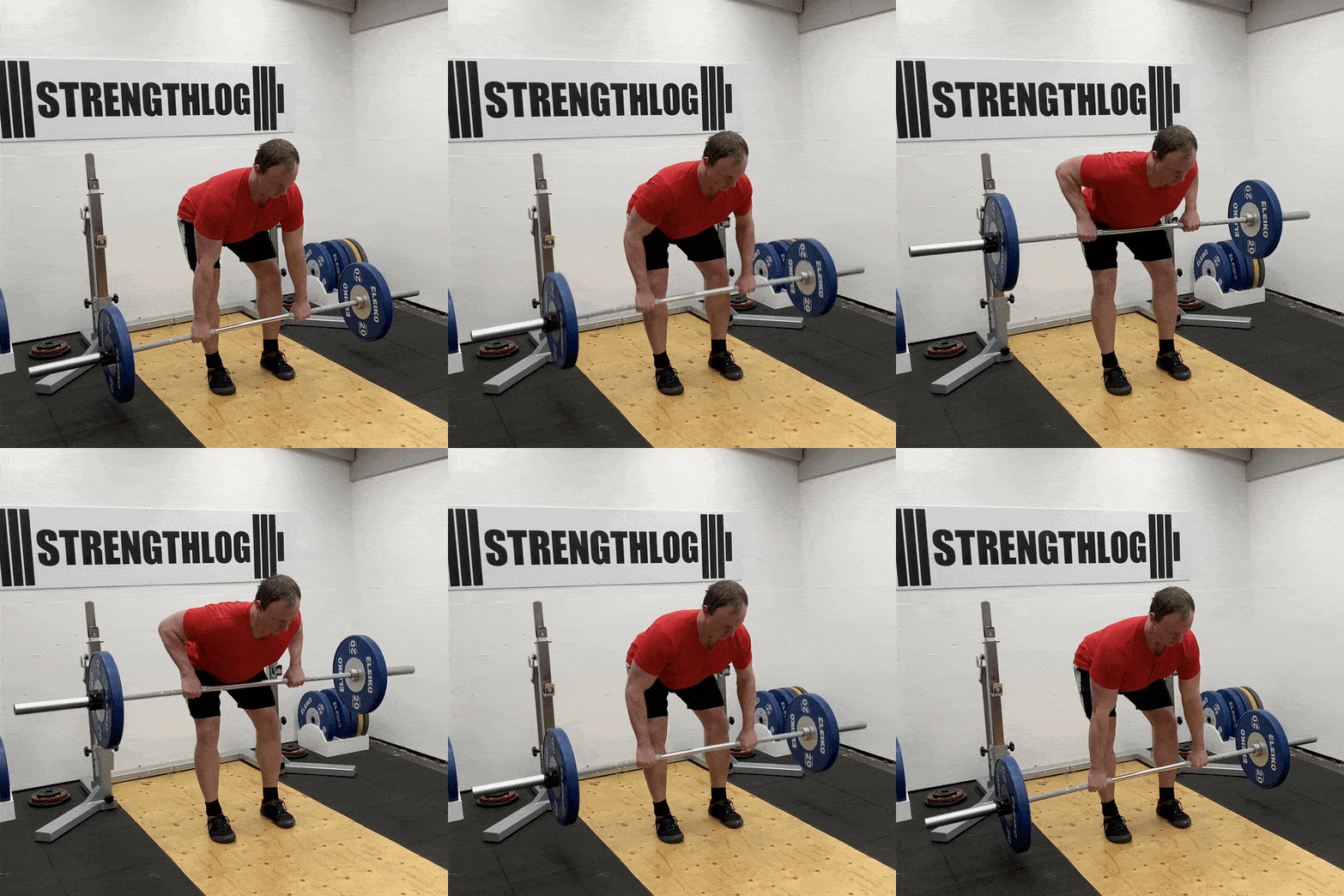
The barbell row might not be the most triathlon-specific exercise you can imagine, but it targets many muscles essential for power, muscle endurance, and injury prevention. It is a compound exercise that works the back muscles, including the lats, traps, rhomboids, and erector spinae, while also hitting the rest of the posterior chain and stabilizing muscles like the core. It even throws a little bicep action your way.
Strenghtening your back with bent-over rows benefits swimming, cycling, and running—how convenient for a triathlete.
They give you the pulling strength and shoulder stability you need for your freestyle stroke. A more powerful pull = faster laps.
Hunching over the handlebars can wreak havoc on your back. Bent-over rowing strengthens both the erector spinae and upper back muscles, which means no more late-race backaches even after hours in the aero position.
During the running part of a triathlon, having a strong back reduces energy leaks caused by losing your posture when fatigue sets in. And, rows also work your arms—crucial for maintaining your arm drive.
In addition, building a posterior chain with fewer weak links balances your body against the overuse of the anterior chain (quads, chest, shoulders), which is rather common in triathlon training.
How to Do Barbell Rows
- Grasp the barbell with an overhand grip, slightly wider than shoulder-width apart.
- Stand with your feet slightly wider than feet hip-width apart, bend your knees slightly, and hinge forward at your hips, maintaining a straight line from your head to your hips.
- Brace your core and keep your back straight. Pull the barbell towards your lower chest or upper core, keeping your elbows close to your body. Squeeze your shoulder blades together at the top of the movement.
- Lower the barbell back to the starting position in a controlled manner.
- Repeat the movement for the desired number of repetitions.
Box Jump

The box jump is an explosive exercise where you leap from the ground onto an elevated surface like a box or platform and then step or hop back down. It’s a favorite among athletes for training the fast-twitch muscle fibers in the lower body, combining strength, speed, and explosiveness.
Box jumps are often called a plyometric exercise, but they aren’t really. Not quite. While they feel plyometric, they miss one critical plyometric ingredient: a rapid, forceful eccentric phase. You’re jumping from a stationary position, meaning the stretch reflex isn’t maximally engaged. That doesn’t mean you shouldn’t do them; on the contrary, triathletes need explosiveness for quick surges, and box jumps are great for building that leg power.
Triathlons may be endurance-heavy, but you never know when an intense burst of power will come in handy. Actually, you do: positioning yourself at the start, sprinting out of a transition, during hill climbs, and when pushing for the finish line, for example.
Focus on speed + control rather than height. Triathletes don’t need to jump onto skyscrapers; explosive but purposeful movements are key. Box jumps are not about showing off—they’re about building explosive power for race-day performance.
How to Do Box Jumps
- Select a box that is appropriate for your fitness level and jumping ability.
- Stand with your feet shoulder-width apart, a few inches away from the box. Your knees should be slightly bent, and your hips pushed back in an athletic stance, like a mini squat.
- Engage your core and swing your arms back to generate momentum. Keep your chest up, and your weight balanced evenly across your feet.
- Push through the balls of your feet, extending your hips, knees, and ankles as you jump up. Swing your arms forward and upward to help propel yourself onto the box. Jump with both feet leaving the ground at the same time.
- As you land on the box, aim to have both feet hit the surface at the same time. Bend your knees slightly to absorb the impact, keeping your chest up and back straight.
- Once you’ve landed on the box, stand up tall, extending your hips completely to finish the jump.
- Step off the box one foot at a time, and reset your stance before attempting the next jump.
- Repeat the movement for your desired number of jumps.
Ab Wheel Rollout

Your core is for more than just looking good in a wetsuit. It’s the linchpin of triathlon performance. A strong core helps you maintain balance and stability and transfer power to the working muscles in all three disciplines. The ab wheel rollout hits the rectus abdominis, obliques, transverse abdominis, and a ton of stabilizers all over your body. While it might feel like an exercise invented by someone who hates you (because it brings a serious burn), it’s also super-duper effective for your entire core. Triathletes juggle three sports, so time-saving exercises like the rollout deliver maximum bang for your training buck.
Don’t rush—go nice and slow to force your core stabilizers to work—just like stabilizing on uneven terrain during a trail run or choppy open water swim.
If you are up to the challenge, try standing rollouts, but be aware that they are one of the most brutal exercises out there, and don’t be surprised if your core taps out halfway. If you are mortal like the rest of us, kneeling rollouts are plenty. And if full kneeling rollouts are too intense, roll the wheel forward just a few inches to start, or do them against a wall to limit the range of motion. Build up to full rollouts gradually.
How to Do Ab Wheel Rollouts
- Start by kneeling on the floor with your hands on the ab wheel, placed directly in front of your knees.
- Engage your core and slowly roll the wheel forward until your body forms a straight line from your knees to your head.
- Be sure to keep your back straight and your core engaged throughout the entire movement.
- Reverse the movement, roll the ab wheel back towards your knees, and return to the starting position.
- Repeat the movement for the desired number of repetitions.
Hanging Knee Raise

Once more to the core: the hanging knee raise is a classic ab exercise where you hang from a pull-up bar and lift your knees toward your chest. It builds ab strength, stability, and endurance in your hip flexors—good news because these areas are all critical for swimming, biking, and running:
- A strong core stabilizes your body and transfers power between your upper and lower body during each leg of the race.
- It helps you maintain a streamlined position in the water during the swim part.
- It reduces sway and helps you keep your balance while pedaling.
- While running, it minimizes energy leaks and keeps posture solid.
Keep the movement controlled to avoid using momentum. If you find knee raises easy, you can extend your legs for a hanging leg raise, but in this program, you’re supersetting this exercise with the ab wheel rollout, so your abs might already be fried even if your core strength is usually up to it.
How to Do Hanging Knee Raises
- Grasp a pull-up bar with an overhand grip, shoulder-width apart.
- Hang from the bar with your arms fully extended and your body in a straight line from your head to your heels.
- Engage your core and keep your back straight.
- Raise your knees towards your chest, as high as you can, keeping your back straight and your core engaged.
- Slowly lower your legs back down to the starting position.
- Repeat the movement for your desired number of repetitions.
Strength Training for Triathletes: Final Words
You have reached the end of this guide to strength training for triathles! 🏊🚴🏃
Thank you so much for reading! I hope you have enjoyed it and learned things that will benefit your triathlon training.
To follow the training routine in this article, download our workout log app and start tracking your workouts today:
Remember that strength training is not a quick fix but a long-term investment in your athletic performance. But that investment offers a very nice interest rate in the form of stronger muscles to push harder and go faster in all three disciplines, a body better equipped to handle the unique demands of triathlon training: a body that can tackle hills, endure miles, and outlast fatigue—race after race, season after season.
Stronger athletes make better triathletes. So hit the gym, because that barbell isn’t going to squat itself.
References
- Int J Sports Physiol Perform. 2018 Jan 1;13(1):57-63. Strength Training for Middle- and Long-Distance Performance: A Meta-Analysis.
- Br J Sports Med. 2014 Jun;48(11):871-7. The effectiveness of exercise interventions to prevent sports injuries: a systematic review and meta-analysis of randomised controlled trials.
- J Hum Kinet. 2022 Feb 10;81:123–134. A Systematic Review of Long‐Distance Triathlon Musculoskeletal Injuries.
- Sports (Basel). 2022 Jun 24;10(7):98. Resistance Exercise for Improving Running Economy and Running Biomechanics and Decreasing Running-Related Injury Risk: A Narrative Review.
- J Funct Morphol Kinesiol. 2021 Mar 17;6(1):29. A Comparison of the Effect of Strength Training on Cycling Performance between Men and Women.
- Strength and Conditioning Journal 44(1):p 1-14, February 2022. Strength Training for Long-Distance Triathletes: Theory to Practice.
- Sports (Basel). 2021 Jun 25;9(7):94. The Training Characteristics of Recreational-Level Triathletes: Influence on Fatigue and Health.
- J Strength Cond Res. 2021 Oct 1;35(10):2839-2845. The Influence of Upper- and Lower-Body Maximum Strength on Swim Block Start, Turn, and Overall Swim Performance in Sprint Swimming.
- Sports Biomech. 2014 Sep;13(3):296-306. An electromyographic comparison of a modified version of the plank with a long lever and posterior tilt versus the traditional plank exercise.
