
Strength training for Muay Thai? Wait, what? Won’t lifting weights make me muscle-bound and slow?
Nope.
Those are last century’s notions, long proven outdated and outright wrong. While technique and speed are the essentials of the Art of Eight Limbs, raw strength and power turn a solid strike into a knockout blow and a defensive move into a wall your opponent can’t get past.
Everything else being equal, a strong fighter is a better fighter.
Strength training, when done right, gives you the edge to outlast and overpower your opponents, without slowing your down.
This article explores strength training strategies that complement your Muay Thai skills, with the best exercises to make you a stronger fighter, and a complete 11-week training program to put theory into practice.
***
Want to jump right into the training program?
Click here for the Strength Training for Muay Thai program.
Table of Contents
Benefits of Strength Training for Muay Thai
Back in the day, strength training in combat sports was mostly ignored and occasionally mocked. The general belief was that lifting weights would make fighters bulky and slow, ruining their speed, agility, and endurance.
Combat sports historically emphasized grinding cardio (like endless running) and sport-specific skills, while building raw strength and power with heavy weights was sidelined as a bodybuilder or powerlifter thing. Coaches often prioritized technical prowess over physical development, believing strength wasn’t as critical as knowing when and how to throw a jab or a kick.
Back then, they didn’t have access to the boatload of sports science we do now, research that clearly shows how beneficial strength training can be for fighters.1 2
Today, fighters balance strength training with all the other parts of their workout routine, like conditioning, skill work, and recovery. They know how to avoid overtraining and that becoming “muscle-bound” is not a thing with properly performed strength training.
These days, if you’re not lifting, you’re likely falling behind.
Here’s a breakdown of the main benefits that’ll make you want to hit the weights between rounds of smashing pads (and opponents).
More Strength = More Striking Power
Stronger muscles strike harder. Strength is a big part of Muay Thai performance, and lifting weights (or at least doing some form of resistance training, like resistance band or bodyweight training) will improve your striking power.
Lower-body strength training makes your kicks more powerful, and upper-body and core strength give you more force behind punches, elbows, and clinches.
But building a strong body is about more than striking power itself. It also gives you the edge when it comes to outpowering your opponent. If two equally skilled Muay Thai fighters meet, chances are the most physically powerful one will come out on top.
Also, your body moves and strikes as a whole. Muay Thai uses almost every muscle in your body—legs for kicks and footwork, core for balance and rotational power, arms and shoulders for punches, and back for clinch control. Neglecting any area creates weak links, and in combat sports, a weak link is a giant bullseye for your opponent. That’s why your workout routine should be balanced with exercises for all major muscle groups.
Muscle Endurance
Lifting weights doesn’t just improve your 1RM (the max weight you can lift one time). It also builds muscular endurance, so you can throw combinations without feeling like your arms are noodles after round three.
It also helps your body handle more intense training sessions or longer fights before you feel that “burning” sensation in your muscles. That is because strength training raises the point at which lactic acid builds up faster than your body can clear it out. As a result, you can keep going for longer without gassing out.3
Balance and Stability
In Muay Thai, you must be able to stay steady while throwing punches, kicks, or defending against being knocked off balance. Strength training helps you improve your balance and coordination, and you should include both unilateral (work one side of your body at a time) and bilateral exercises (use both sides of your body together) in your workouts.
Unilateral exercises, like split squats, are great for moves that need one-sided power, like staying balanced in your stance during a clinch or throwing flying knees, and bilateral exercises, like regular squats, are perfect for any movement that generates power from both sides of the body.4
Since Muay Thai involves both types of movements, it’s smart to train with both.
Read more: Unilateral vs. Bilateral Strength Training for Strength & Muscle Growth
Also, strengthening your core (the muscles around your abs and back) with weight training makes you more stable—super important for keeping your balance when you throw kicks or block sweeps, and it also gives you the strong base you need to explode into powerful moves with your legs.5 It might even directly enhance your skill performance as a Muay Thai athlete.6
Injury Prevention
A strong body can endure more punishment and recover faster, which is critical for handling the wear and tear of Muay Thai, and strength reduces the risk of injury as effectively in someone who has just started out as in pro athletes.7
Strength training builds muscles and strengthens tendons and other connective tissues, which act as shock absorbers when you do high-impact stuff like kicking, punching, and clinching. You reduce the likelihood of sprains, strains, and ligament tears and help prevent overuse injuries. In fact, strength training is the number one countermeasure against sport injuries.8 It is always better to prevent than to have to treat.
Also, bone is living tissue, and strength training provides the greatest benefits for bone mineral density. Strong bones not only benefit you right now as a fighter but will also protect you in the future from age-related bone deterioration.
How Should Muay Thai Athletes Strength Train?
As a Muay Thai fighter, you have a lot on your training plate. Most combat sports challenge both the anaerobic (creates quick bursts of energy without oxygen for short, intense efforts) and aerobic (uses oxygen to produce energy for long, steady activities) systems due to the high-intensity, intermittent nature of fighting. Muay Thai is no exception, and your strength training should complement your skill and aerobic conditioning, not overshadow it.
That means striking a balance to avoid fatigue interfering with technical and tactical training sessions while allowing you to train with enough intensity and frequency to see meaningful gains in strength and power.
Power and Strength Development
Your workout plan should include training for both power development and maximum strength gains.
- Weight training for power focuses on explosive, high-speed movements but not the heaviest weights possible: low reps (3–5) per set at up to 75% of your one-repetition max (1RM), going for explosive force with each repetition. Olympic lifts and plyos are gold and a great way to train for power.
- Training for max strength involves moving really heavy loads to build maximum force capacity, with a rep range of 2–6 reps per set at 80–95% of your 1RM. Compound exercises like squats, bench presses, rows, and deadlifts give you the most bang for the buck.
You’ll increase your strength and power as much as possible without building muscle mass like a bodybuilder. Now, muscle mass is a primary driver of strength, so building muscle is not a bad thing for a fighter, even though it shouldn’t be the primary goal of your lifting. But the muscle mass you gain from heavy lifting does not slow you down. It makes you a stronger and faster figher.
Focusing more on building strength during a training block lasting a certain number of weeks before moving to a power training block and using the strength you’ve just gained for power-based training can be a good idea.
Unilateral and Functional Training
Including single-leg lifts and movements that mimic Muay Thai’s unilateral and rotational demands (e.g., lunges, split squats, step-ups) is essential for optimal benefits. Not only for general stability but because Muay Thai often involves triple extension (the coordinated straightening of the ankle, knee, and hip joints) off a single leg. Each of your legs has to be strong, stable, and able to handle that single-leg action, and unilateral training is the best way to develop unilateral, functional strength.9
Some of your training should include movements that replicate the biomechanics of kicks, punches, and rotational forces. However, thinking that all your weight training should be “functional,” meaning mimicking sport-specific movements, is a mistake. Strength and muscle are functional, and the majority of your gym time should be spent doing things that build those two things the most effectively.
Periodization
Your strength training intensity, volume, and recovery should be periodized based on your Muay Thai competition timeline. Off-season and early preparation includes more general strength building, while closer to competition, your focus shifts to explosive power and more sport-specific movements.
Strength Training Frequency
Combat athletes like Muay Thai practitioners should aim for two weekly strength sessions.10 You’ll build strength and power without overtaxing your body, recover effectively between skill and conditioning sessions, and recover enough to keep your performance sharp for technical work and sparring. I’d say two weight sessions per week is ideal for most Muay Thai athletes.
More does not alway mean better. A combat sport like Muay Thai is already taxing on your muscles, connective tissue, and nervous system. Doing too much strength training can interfere with your recovery, increase the risk of injury, and reduce the focus on skills (which, as important as gaining strength is, are still your priority #1).
You cannot maximize your power and speed if you lift when your body and nervous system are tired, so 1) place your strength training sessions on less intense skill-training days so you don’t gas out your motor skills and 2) rest long enough between sets (2–5 minutes) to recover properly.
Here’s an example of a weekly training schedule for a Muay Thai athlete with two full-body strength training days and one rest day:
| Day | Training Focus |
|---|---|
| Monday | Muay Thai Skills & Technique (Light Session) |
| Tuesday | Full-Body Strength Training |
| Wednesday | Muay Thai Sparring & Conditioning |
| Thursday | Muay Thai Skills & Technique (Focus on Pads) |
| Friday | Full-Body Strength Training |
| Saturday | Muay Thai Sparring, Drills, & Cardio |
| Sunday | Rest Day |
Strength Training Program for Muay Thai
This is a training program for Muay Thai fighters who want to develop maximum strength, power, balance, and stability while strengthening the body to withstand the rigors of the ring and prevent injuries. It’s suitable for the off-season and early preparation parts of your training.
This program works best if you already have some strength training experience. It features many different, relatively complex exercises, and if you have never lifted weights before, it might be too much for you to jump right into.
If you’re new to the gym, start with one of our beginner programs, like the Beginner Barbell Training Program. You train three times per week, alternating between workouts A and B.
Workout A
| Exercise | Sets | Reps |
|---|---|---|
| Squat | 3 | 8–10 |
| Bench Press | 3 | 8–10 |
| Barbell Row | 3 | 8–10 |
Workout B
| Exercise | Sets | Reps |
|---|---|---|
| Deadlift | 3 | 6–8 |
| Lat Pulldown (or Pull-Ups) | 3 | 8–10 |
| Overhead Press | 3 | 8–10 |
In other words, you’ll train workouts A B A week one and B A B week two, then go back to week one and keep alternating between the two.
This beginner program (any many more) are available for free in our workout log app, StrengthLog.
You can use the strength you gain in Muay Thai, and you teach your muscles, brain, and nervous system to play together, allowing you to move on to more complex programs.
If you do have some weight training experience, you’re ready for Strength Training for Muay Thai.
11-Week Strength Training Program for Muay Thai
This program will run for 11 weeks, split into two main parts, separated by a deload week.
- Foundational Strength: Build lean mass and increase the maximum amount of force your muscles can produce.
- Strength- to Power: Translate your gains into power output and speed.
It features a combination of multi-joint exercises that strengthen your entire body and specific exercises that replicate movement patterns used in Muay Thai. Often, those two things overlap in a major way.
Click here to open the program in StrengthLog.
Program Structure
- Duration: 11 weeks.
- Frequency: 2 full-body workouts per week.
- Structure: Two 5-week progressive blocks with a deload week in between.
- Focus: Strength, power, and athletic performance for Muay Thai
- Sets and Reps: 3 sets per exercise, 3–6 reps per set for compound exercises, higher reps (10+) for isolation exercises.
- Rest Between Sets: 2–4 minutes for compound movements , 1–2 minutes for isolation work.
- Progression: Gradual increase in intensity or volume each week.
You can pick which days you hit the weights to fit your schedule, but take at least one rest day between each strength training session. With two weekly training days, you should be able to work your strength training into your regular Muay Thai training and everyday life without too much hassle.
Try to add weight or do one more rep each workout. When you can do the designated number of reps for each set, increase the load the next time you hit the gym.
Follow This Training Program in StrengthLog
This program and many more are in the StrengthLog workout tracker app. The app is free to use, forever, with no ads. This program, however, is a premium program (it offers built-in progression and advanced periodization), which means it requires a premium subscription.
We offer all new users a free 14-day premium trial. You can activate it in the app without any strings attached.
Download StrengthLog and start tracking your workouts today:


The exact set and rep details (the tables below are snapshots of a single week) along with the planned intensity and volume progression route, are available in your StrengthLog app.
Block 1: Foundational Strength (Weeks 1–5)
- Goal: Build general strength and stability to prepare for explosive and dynamic movements.
- Frequency: 2 days/week
- Sets/Reps: 5 exercises/workout, 5–15 reps, 3 sets/exercise.
Workout 1
| Exercise | Sets | Reps |
|---|---|---|
| Trap Bar Deadlift | 3 | 5 |
| Pull-Up | 3 | Max reps |
| Bulgarian Split Squat | 3 | 8 |
| Push Press | 3 | 8 |
| Pallof Press | 3 | 12/side |
Workout 2
| Exercise | Sets | Reps |
|---|---|---|
| Front Squat | 3 | 5 |
| Barbell Row | 3 | 8 |
| Bench Press | 3 | 8 |
| Kettlebell Swing | 3 | 12–15 |
| Hanging Leg Raise | 3 | 12–15 |
Deload Week (Week 6)
- Objective: Allow recovery and adaptation while maintaining movement patterns.
- Frequency: 2 days of light training.
- Sets/Reps: 50–60% of regular weight, ~10 reps, 2 sets/exercise.
Workout 1
| Exercise | Sets | Reps |
|---|---|---|
| Squat | 2 | 10 |
| Romanian Deadlift | 2 | 10 |
| Bulgarian Split Squat | 2 | 10 |
| Hanging Leg Raise | 2 | 12 |
Workout 2
| Exercise | Sets | Reps |
|---|---|---|
| Bench Press | 2 | 10 |
| Pull-Up | 2 | 10 |
| Box Jump | 2 | 10 |
| Wood Chop | 2 | 12 |
Block 2: Power and Explosiveness (Weeks 7–11)
- Objective: Develop explosive power and dynamic strength specific to Muay Thai performance.
- Frequency: 2 days/week
- Sets/Reps: 6 exercises/workout, 5–15 reps, 3 sets/exercise.
Use up to 75% of your 1RM and perform each exercise with as much explosiveness as you can muster (resist it during the eccentric phase). The focus is on speed and exploding the weight, not grinding slow reps to failure.
Workout 1
| Exercise | Sets | Reps |
|---|---|---|
| Power Clean | 3 | 3 |
| Bulgarian Split Squat | 3 | 5 |
| Pull-Up | 3 | 5 |
| Bench Press | 3 | 5 |
| Ball Slam | 3 | 12 |
| Wood Chop | 3 | 12/side |
Workout 2
| Exercise | Sets | Reps |
|---|---|---|
| Squat | 3 | 4 |
| Barbell Row | 3 | 6 |
| Push Press | 3 | 6 |
| Single-Leg Romanian Deadlift | 3 | 6/leg |
| Box Jump | 3 | 10 |
| Ab Wheel Rollout | 3 | Max reps |
Strength Training Exercises for Muay Thai
Here are detailed descriptions of all the exercises in the Strength Training for Muay Thai program in the order they appear.
Trap Bar Deadlift

Every punch, kick, and knee begins with a strong base in the posterior chain: glutes, hamstrings, and back. Trap bar deadlifts build these muscles and are a great exercise for delivering full-body strength, explosiveness, and injury resistance to Muay Thai fighters.
It uses a hexagonal barbell (aka trap bar), and unlike the traditional deadlift, you stand inside the bar, gripping the handles at your sides, keeping your center of gravity closer to your body. Also unlike conventional deadlifts, using a trap bar makes the exercise gentler on your lower back.
How to Do Trap Bar Deadlifts
- Step into the bar’s opening so that the handles are in line with the middle of your feet.
- Inhale, bend down and grip the handles.
- Hold your breath, brace your core slightly, and lift the bar.
- Lift the bar with a straight back, until you are standing straight.
- Lower the bar back to the ground with control.
- Take another breath, and repeat the movement for your desired number of repetitions.
Pull-Up

The pull-up is the crown jewel of upper-body pulling strength and one of the essential exercises for Muay Thai fighters.
In the clinch, you need to pull, control, and dominate your opponent’s posture. Pull-ups work your lats and biceps, two of the key players for yanking an opponent’s head into knee strike territory.
They also develop your scapular stabilizers, including your rhomboids and traps. These muscles help with the retraction phase of your punches, adding snap and power to your strikes.
Use resistance bands or machines if you can’t do bodyweight pull-ups yet. Conversely, if bodyweight pull-ups are way too easy for you, add a weight vest or hold a dumbbell between your legs.
How to Do Pull-Ups
- Stand beneath a pull-up bar and reach up to grasp it with an overhand grip (palms facing away from you), slightly wider than shoulder-width apart. Ensure your grip is secure and comfortable.
- Hang freely from the bar, fully extending your arms. Your feet should be off the ground.
- Engage your core muscles by squeezing your abs and glutes.
- Inhale and initiate the movement by pulling your body weight up towards the bar by bending your elbows and squeezing your shoulder blades together. Focus on using your back muscles rather than relying on your upper arms.
- Continue pulling yourself up until your chin reaches or clears the bar. Keep your torso upright and avoid excessive swinging or kicking with your legs.
- Slowly lower yourself back down to the starting position while maintaining control and stability, fully extending your arms.
- Repeat the movement for your desired number of repetitions.
Bulgarian Split Squat

The Bulgarian split squat is a unilateral (single-leg) squat variation where you elevate one leg behind you on a surface (like a bench) while your other foot is planted firmly on the ground as you lower your body into a squat.
Ask the strongest guy you know to do something athletic on one leg. If he has never done any unilateral training, chances are he won’t be able to fully utilize his strength once balance and coordination come into the picture.
Split squats are great for single-leg athletics and perfect for Muay Thai. They train your quads, glutes, and adductors, delivering stability, balance, strength, and booty gains all in one swoop. They translate into explosive push kicks, flying knees, and pivoting for roundhouse strikes and boost your hip flexibility and mobility, making your kicks snappier and smoother.
How to Do Bulgarian Split Squats
- Place a bar on your upper back or hold a pair of dumbbells in your hands.
- Stand with your back turned against a bench, which should be about knee height. Stand about one long step in front of the bench.
- Place your right foot on the bench behind you.
- Inhale, look forward, and squat down with control until right before your right knee touches the floor.
- Reverse the movement and extend your front leg again, while exhaling. Your back foot should only act as support.
- Repeat the movement for the desired number of repetitions, then switch side and repeat with your right leg forward and your left foot on the bench.
Push Press

The push press gives you just what the Muay Thai doctor ordered: strength, stability, and explosive power in the shoulders and triceps, which you use for throwing punches, defending strikes, and maintaining a strong guard. They also build your shoulders’ ability to absorb and manage force, which is essential when blocking kicks or clinching.
The push press differs from standard overhead presses in that you add a slight dip with your knees and explode upwards to train for generating explosive power—great for pushing opponents off in the clinch or throwing elbows with force.
How to Push Press
- Clean a bar to your shoulders, or lift it out from a rack.
- Let the bar rest against the front of your shoulders, with your grip slightly outside your shoulders.
- Inhale and lightly brace your core.
- Bend your knees, and then forcefully push yourself and the bar upwards using your legs.
- When your legs are extended, immediately start pressing the bar with your arms, until your arms are fully extended.
- With control, lower the bar back to your shoulders.
- Repeat the movement for your desired number of repetitions.
Pallof Press

Originally called the belly press, the Pallof press is a core stability exercise where you resist core rotation while pressing a resistance band or cable forward from your chest, keeping your body aligned and steady. It trains the obliques, transverse abdominis, and stabilizing muscles.
It is great for Muay Thai because it gives you the core strength you need to resist rotational forces and maintain posture during clinch battles or throwing kicks without getting thrown off your game.
How to Pallof Press
- Attach a handle in a cable machine at chest height and stand with your side facing the machine.
- Grab the handle with both hands and stand with feet hip-width apart and knees slightly bent.
- Pull the handle to your chest, engage your core, and then press your arms straight out in front of you without rotating your torso.
- Hold briefly, then bring the handle back to your chest in a controlled motion.
- Repeat for the desired number of repetitions, then switch sides.
Front Squat

The front squat is a compound lower-body exercise where you place the barbell on the front of your shoulders, right near your collarbone, instead of resting it across your upper back. It’s a quad-dominant variation of the squat that emphasizes your core, mobility, and posture more.
Front squats are practically custom-built for Muay Thai fighters like you. The sport involves a ton of explosive leg work—kicks, knees, and teeps (push kicks), and front squats build the strength and explosiveness you need to send your opponent flying across the ring and will make your kicks snappier, your footwork quicker, and your body tougher.
In addition, a deep front squat trains ankle, hip, and thoracic mobility, which will help you maintain form while throwing high kicks or executing evasive footwork.
How to Front Squat
- Grip the bar slightly wider than shoulder-width. Step forward and place the bar on the front of your shoulders: on top of your clavicles, and tight against your throat.
- Inhale and brace your core slightly, and unrack the bar.
- Take two steps back, and adjust your foot position.
- Squat as deep as possible with good technique.
- With control, stop and reverse the movement, extending your hips and legs again.
- Repeat the movement for the desired number of repetitions.
Barbell Row
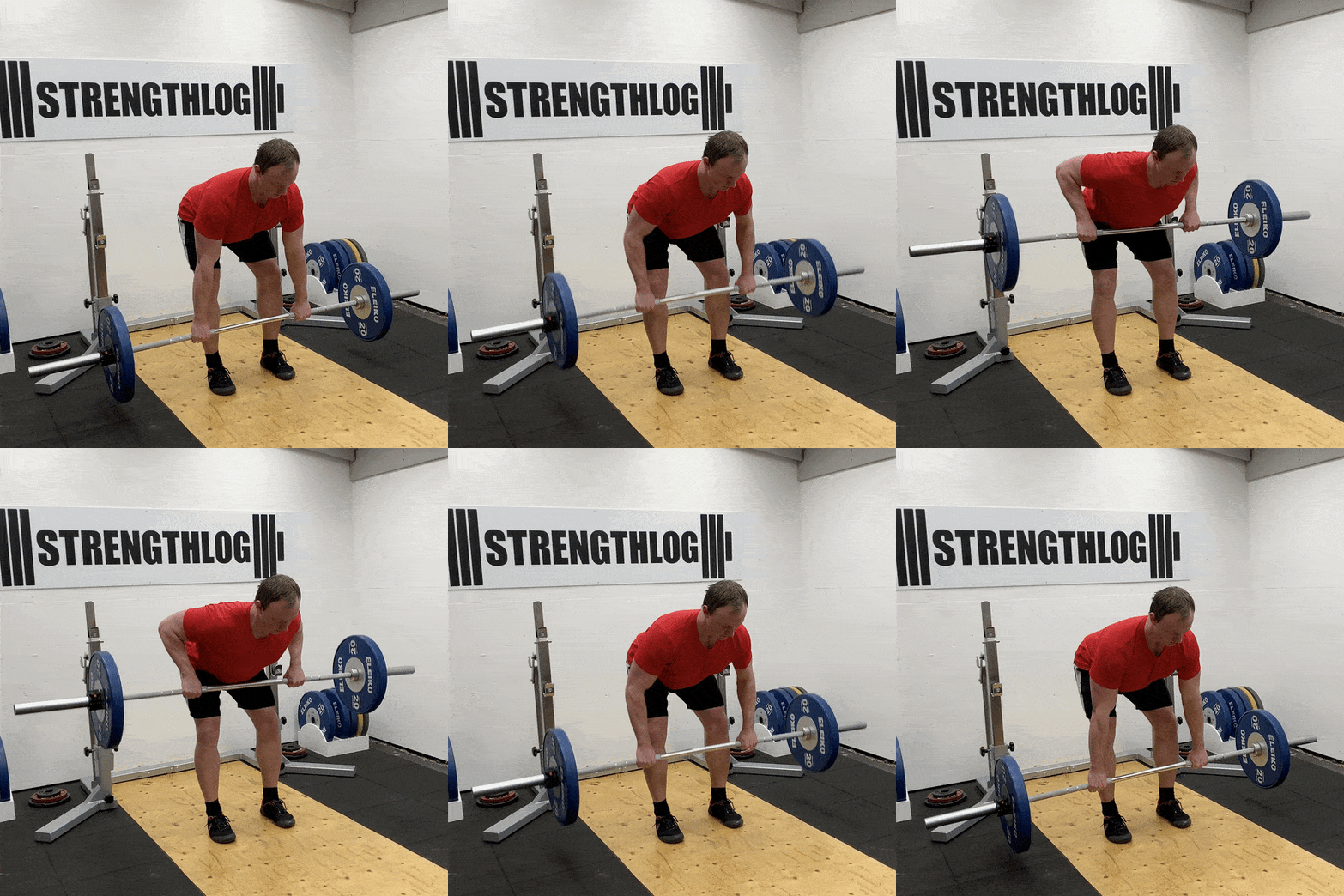
The barbell row is a compound exercise that targets your back muscles, particularly the lats, traps, rhomboids, and rear delts. Your biceps and lower back join the party as supporting players. It’s a pulling exercise, which means you’re working the muscles that help retract and stabilize your shoulders. And, for a Muay Thai fighter, you’re rowing your way to knockout power.
Barbell rows make your entire back stronger, which contributes to the retraction phase of your strikes. A jab, cross, or elbow—powerful back muscles mean quicker and more explosive arm recovery. The stronger your back, the snappier your punches. It also helps you dominate in pulling your opponent down for knees or controlling their posture.
How to Do Barbell Rows
- Grasp the barbell with an overhand grip, slightly wider than shoulder-width apart.
- Stand with your feet slightly wider than feet hip-width apart, bend your knees slightly, and hinge forward at your hips, maintaining a straight line from your head to your hips.
- Brace your core and keep your back straight. Pull the barbell towards your lower chest or upper core, keeping your elbows close to your body. Squeeze your shoulder blades together at the top of the movement.
- Lower the barbell back to the starting position in a controlled manner.
- Repeat the movement for the desired number of repetitions.
Bench Press

Woo hoo—the bench press! A hallmark of powerlifting, it’s a benchmark ( 🥁 ) for upper body strength. It’s a compound exercise that trains several muscle groups—primarily the chest, front delts, and triceps— in one swoop of pushing power.
The bench press might not seem like an immediate match for Muay Thai fighters since it’s not a “functional” movement tied directly to kicks or clinches. However, it offers benefits that translate to the ring, like training the muscles that generate force behind your punches. While much of your punching power comes from the legs and hips, the upper body delivers the knockout snap. It is like building a stronger link in the kinetic chain. Research shows that bench press strength correlates with punching velocity, especially in the rear hand.11
In addition, you do use your chest and shoulders when you push and pull your opponent in a clinch, and building up your bench press adds a layer of strength for these situations.
How to Bench Press
- Lie on the bench, pull your shoulder blades together and down, and slightly arch your back.
- Grip the bar slightly wider than shoulder-width apart.
- Inhale, hold your breath, and unrack the bar.
- Lower the bar with control, until it touches your chest somewhere close to your sternum.
- Push the bar up to the starting position while exhaling.
- Take another breath while in the top position, and repeat the movement for your desired number of repetitions.
Kettlebell Swing

The kettlebell swing is an almost full-body, explosive movement that primarily hits the posterior chain (lower back, glutes, hamstrings) but also works your core, shoulders, and even your cardiovascular system. It is a great exercise for developing power, endurance, and explosiveness—all qualities you need in the ring.
Hip extension is the engine behind your kicks, knees, and punches. When you swing a kettlebell, the hip hinge trains the explosive power generation for a Muay Thai kick and helps you drive force through your strikes like a wrecking ball through drywall.
Also, a stronger posterior chain is essential for most Muay Thai moves, like throwing a teep, springing forward, or pivoting for a roundhouse.
How to Do Kettlebell Swings
- Place a kettlebell on the ground, about one or two feet in front of you.
- Take a wide stance, lean forward, and grip the kettlebell.
- Brace your core slightly, and swing the kettlebell back between your legs while inhaling.
- Swing the kettlebell forward by extending your hip while exhaling.
- Try to swing the kettlebell to about chest height.
- Repeat for the desired number of reps and put the kettlebell back on the ground when you’re finished.
Hanging Leg Raise

The hanging leg raise is a core-centric bodyweight exercise where you hang from a pull-up bar and lift your legs to work your abs, obliques, hip flexors, and stabilizing muscles in your upper body.
Leg raises are a top-tier exercise in Muay Thai. After all, every kick, knee, and strike comes from the hips and core. A strong core and hip flexors let you generate knockout power without relying solely on your arms or legs and are essential for knees to the head or body in the clinch and teep kicks that push your opponent back.
Momentum is your enemy. Squeeze your abs and use them and your hip flexors to control your movement from a dead start to get maximum benefits from the leg raise.
If the leg raise is too challenging, you can do hanging knee raises instead. They train the same muscles, but bending your knees during the movement makes things much easier.
How to Do Hanging Knee/Leg Raises
- Grasp a pull-up bar with an overhand grip, shoulder-width apart.
- Hang from the bar with your arms fully extended and your body in a straight line from your head to your heels.
- Engage your core and keep your back straight.
- Raise your knees or legs towards your chest, as high as you can, keeping your back straight and your core engaged.
- Slowly lower your legs back down to the starting position.
- Repeat the movement for your desired number of repetitions.
Power Clean

The power clean is a compound weightlifting exercise and one of the best things you can do with a barbell for power, strength, and athleticism. It involves lifting a bar from the ground to shoulder height in one explosive motion. It’s like a combination of a deadlift, a jump, and a shrug, all wrapped into one badass movement.
Power cleans teach you to generate explosive power from the ground up—exactly what you need in Muay Thai, where fights are won with rapid, high-impact movements. They develop triple extension (hips, knees, and ankles), the same chain of motion you use to launch strikes and strengthen nearly every muscle you use in Muay Thai.
In addition, you improve coordination, balance, and timing—all skills you need when stringing together combinations or defending against strikes.
Consider working with a coach if you’re new to Olympic lifts—they’re technical but very rewarding and some of the best exercises you can do for athletic performance.
How to Power Clean
- Step up close to the bar, so that it is about over the middle of your foot.
- Lean forward and grip the bar with an overhand grip, about shoulder-width apart.
- Hold your breath, and brace your core slightly.
- Lift the bar in a smooth but fast motion. Bend your knees slightly and receive the bar on the front of your shoulders.
- Stand up on straight legs again.
- Lower the bar in front of you, with control.
- Repeat the movement for your desired number of repetitions.
Ball Slam

The ball slam is a dynamic, explosive exercise performed with a slam ball (a.k.a. medicine ball, but specifically the no-bounce kind—if it bounces back and clocks you in the face, well, lesson learned). You raise the ball overhead and slam it into the ground with maximum force like you’re smashing your opponent into the canvas.
Ball slams target a ton of muscle groups, making it very close to full-body movement. Here’s who’s coming to the party: your shoulders and arms when you lift the ball overhead and control the slam, your legs and glutes when you get into a squat to retrieve the ball, and your core throughout the entire movement.
A mix of aggression and fitness, where you get to throw stuff on the ground and call it exercise —what’s not to love? The ball slam hones the attributes that make you a better Muay Thai practitioner—explosiveness, core power, muscle endurance, and total-body coordination.
How to Ball Slam
- Stand with your feet about shoulder-width apart, your knees and hips slightly bent, holding the ball in both hands at chest height. Engage your core, and keep a good posture.
- Extend your knees and drive your hips forward while simultaneously lifting the ball. Aim for being as tall as possible, the ball overhead, arms up, hips slightly forward, and on your toes from the force of your drive.
- Use your core and arms to slam the medicine ball straight down between your feet with as much force as possible. Press your hips back and bend your knees to further power the slam. Exhale as you slam the ball down.
- Squat down to pick up the ball from the floor, then immediately move into the next slam by repeating the movement.
- Repeat the movement for your desired number of repetitions.
Wood Chop

The wood chop is a powerful, functional exercise that mimics—you guessed it—chopping wood with an axe. It’s a great movement to build a stronger core, improve rotational power, and build stability through your torso, hips, and shoulders. That means better balance and less chance of being swept or knocked off your feet.
Muay Thai involves a lot of twisting motions for strikes like hooks, crosses, and roundhouse kicks. The wood chop strengthens muscles that generate power in those rotational movements, which is where a lot of your striking power comes from.
You can vary the traditional horizontal wood chop with the high-to-low and low-to-high variants, but the horizontal motion should be your number one choice as it is similar to the plane of many Muay Thai strikes and blocks, especially for mid-level punches and defending against body shots. The low-to-high wood chop is great for explosive uppercuts or knees but less useful overall for Muay Thai since most strikes happen on a horizontal or downward plane. The high-to-low variant mimics elbow strikes or downward punches but is more situational and doesn’t translate as broadly to kicks or general striking mechanics.
Note: you can do this exercise with either a resistance band (like in the video demonstration above) or a cable pulley system.
How to Do Horizontal Wood Chops
- Fasten an elastic band at shoulder height. Grip the band with both hands, step away, and stand sideways to the band’s anchor point.
- With almost straight arms, make a sweeping, horizontal movement to your other side.
- Return to the starting position in a controlled manner.
- Repeat the movement for your desired number of repetitions.
Squat

The barbell squat is a compound exercise that primarily targets the quadriceps, adductors, glutes, and lower back while improving power and stability throughout the entire body. It is a foundational lift, often called the king of all exercises for both overall strength and athletic performance, that trains you to move heavy loads through a functional range of motion.
The squat directly boosts the speed and force behind your kicks and knee strikes, but it also translates to more power in your strikes: strong legs = powerful punches because the kinetic chain starts from the ground. In addition, a strong lower body helps you stay balanced during evasions, counters, and clinch battles.
How to Squat
- Place the bar on your upper back with your shoulders blades squeezed together. Inhale and brace your core slightly, and unrack the bar.
- Take two steps back, and adjust your foot position.
- Squat as deep as possible with proper form.
- With control, stop and reverse the movement, extending your hips and legs again.
- Exhale on the way up or exchange air in the top position.
- Repeat the movement for the desired number of repetitions.
Single-Leg Romanian Deadlift

The single-leg Romanian deadlift is a unilateral movement targeting the posterior chain – glutes, hamstrings, and lower back. It is also fantastic for improving stability because maintaining balance on one leg is no joke.
Single-leg Romanian deadlifts are practically tailor-made for the Muay Thai athlete. They strengthen muscles critical for generating power in kicks while keeping your stance, and build the balance you need to stay stable on one leg when you’re throwing kicks, knees, or teeps. In addition, they improve proprioception (your body’s ability to know where it is in space), which is useful when you’re hopping, pivoting, or dodging strikes.
How to Do Single Leg Romanian Deadlifts
- Stand upright and hold the bar with your hands about shoulder-width apart.
- Brace your core, and lift one leg off the ground.
- Keep the back straight and start to lean forward by hinging at the hips. Lower until you feel a stretch in the standing leg’s hamstring. Make sure to keep your hips still, you don’t want the side with your lifted leg to start rotating upwards.
- Return to the starting position. Finish all your reps on one side first, and then repeat on the other leg.
Box Jump

The box jump is an explosive exercise where you jump from the ground onto a sturdy, elevated surface (usually a box, hence the name).
It’s all about explosiveness with box jumps, and while they aren’t quite a plyometric exercise (they lack the forceful eccentric phase of true plyos), they train explosive power, agility, and balance, all of which are foundational for Muay Thai fighters. Think about every dynamic movement you do in the ring: jumping knees, quick teeps, explosive counters, and dodging. Box jumps are like a dry run for those motions, packing strength and explosiveness into your legs and core.
How to Do Box Jumps
- Select a box that is appropriate for your fitness level and jumping ability.
- Stand with your feet shoulder-width apart, a few inches away from the box. Your knees should be slightly bent, and your hips pushed back in an athletic stance, like a mini squat.
- Engage your core and swing your arms back to generate momentum. Keep your chest up, and your weight balanced evenly across your feet.
- Push through the balls of your feet, extending your hips, knees, and ankles as you jump up. Swing your arms forward and upward to help propel yourself onto the box. Jump with both feet leaving the ground at the same time.
- As you land on the box, aim to have both feet hit the surface at the same time. Bend your knees slightly to absorb the impact, keeping your chest up and back straight.
- Once you’ve landed on the box, stand up tall, extending your hips completely to finish the jump.
- Step off the box one foot at a time, and reset your stance before attempting the next jump.
- Repeat the movement for your desired number of jumps.
Ab Wheel Rollout

The ab wheel rollout is a core exercise that uses an ab wheel (a small, rolling wheel with handles) to work the abs.
Muay Thai relies on rotational and anti-rotational core strength for powerful punches, kicks, knees, and elbows, and the ab wheel rollout improves both, strengthening the core in a way that helps you transfer power efficiently from the ground up.
A stable core helps you maintain balance when you deliver powerful strikes or defend against an opponent’s attacks. It can absorb impact better, giving you more confidence in the clinch or when taking hits to the midsection.
If rolling out all the way is overwhelmingly challenging, start with wall rollouts or only go halfway out to build strength and gradually increase the range of motion. Conversely, if the kneeling ab wheel feels easy, try the standing version, but be aware that it is not for the faint of core.
How to Do Ab Wheel Rollouts
- Start by kneeling on the floor with your hands on the ab wheel, placed directly in front of your knees.
- Engage your core and slowly roll the wheel forward until your body forms a straight line from your knees to your head.
- Be sure to keep your back straight and your core engaged throughout the entire movement.
- Reverse the movement, roll the ab wheel back towards your knees, and return to the starting position.
- Repeat the movement for the desired number of repetitions.
Strength Training For Muay Thai: Final Words
You have reached the end of this guide to strength training for Muay Thai. 🥊
Thank you for reading! I hope you have enjoyed it and learned things that will take your fighting to the next level.
To follow the training routine in this article, download our workout log app and start tracking your workouts today:
Click here to open the program in StrengthLog.
Lifting weights won’t give you the skill or necessary technical prowess you need to dominate your opponents, but it will make you hit harder, endure tough training sessions, and stay injury-free. Balance your strength work with your Muay Thai training, stay consistent, and the results will speak for themselves.
References
- Int. J. Environ. Res. Public Health 2023, 20(4), 3516. Effects of Strength Training on Physical Fitness of Olympic Combat Sports Athletes: A Systematic Review.
- Appl. Sci. 2024, 14(21), 9706. Acute and Chronic Effects of Muscle Strength Training on Physical Fitness in Boxers: A Scoping Review.
- Med Sci Sports Exerc. 1991 Jun;23(6):739-43. Effects of strength training on lactate threshold and endurance performance.
- Front. Physiol., 13 April 2023. Effect of unilateral training and bilateral training on physical performance: A meta-analysis.
- Revista Brasileira de Medicina do Esporte 29(4), January 2023. IMPACTS OF CORE STRENGTH TRAINING ON BALANCE IN MARTIAL ARTS ATHLETES.
- Front Physiol. 2022 Jun 6:13:915259. Effect of Core Training on Skill Performance Among Athletes: A Systematic Review.
- American College of Sports Medicine: Resistance tRaining and Injury Prevention.
- Br J Sports Med. 2014 Jun;48(11):871-7. The effectiveness of exercise interventions to prevent sports injuries: a systematic review and meta-analysis of randomised controlled trials.
- Sports Medicine, December 2024, Comparison of Muscle Growth and Dynamic Strength Adaptations Induced by Unilateral and Bilateral Resistance Training: A Systematic Review and Meta-Analysis.
- Strength and Conditioning Journal 30(4):p 42-48, August 2008. Conditioning Strategies for Competitive Kickboxing.
- Journal of Strength and Conditioning Research 34(2):p 308-312, February 2020. Relationship Between Bench Press Strength and Punch Performance in Male Professional Boxers.
