
Everyone wants a pair of nice arms. In this article, you’ll get the ultimate list of arm exercises and workouts to help you add inches to your arms and pounds to your bar.
Whether you have 15 minutes or an hour, here is how to get the most bang for your buck on arm day.
Table of Contents
Know Your Muscles: Arm Anatomy 101
You don’t need a biomechanics degree to build impressive arms.
But you do want to know the basics of how they work to fully understand when I talk about which exercise does what, and short heads this and long heads that.
Don’t worry, I’ll keep it very light. Promise.
If you still want to jump straight to the exercises, that’s OK:
Biceps
When someone asks you to flex a muscle, what do you do? Drop your pants and flex your quads? I don’t think so! You flex your biceps brachii, literally the two-headed muscle of the arm.

Those heads are the short head, which starts at your shoulder blade, and the long head, which hooks up higher on the shoulder. They both merge into one tendon that attaches to the radius, one of your two big forearm bones.
- The short head is on the inside of your arm and gives your biceps both width and thickness.
- The long head sits on the outside of your arm. When you hear a gym bro talking about building the biceps peak, the long head is what they’re talking about.
You can’t isolate one head and turn the other off, but you can emphasize one a little more than the other.
- Exercises where you have your elbows in front of your body, like preacher curls, favor the short head.
- Because the long head crosses the shoulder joint, it gets a big stretch and more activation with your elbows behind your body, like when you do incline curls.
The biceps have two major roles and one minor. The big two are flexing the elbow and supinating the forearm (turning your palms up). The smaller side job is helping bring the arm forward and up when you flex your shoulder.
Brachialis
Most people only think about the biceps, but if you want big upper arms, the brachialis is just as important.
It sits underneath the biceps, and while you can’t see it as well, when it grows, it literally pushes the biceps up and makes your arm look thicker from the side.

Like the biceps, the brachialis flexes the elbow. It is actually the strongest elbow flexor, and that’s all it does.
It originates on the humerus (upper arm bone) and attaches to the other major forearm bone, the ulna. Unlike the radius, the ulna doesn’t rotate when you turn your hand, which means the brachialis doesn’t care about your grip – it works just as hard regardless of how you hold the barbell or dumbbell.
You can still emphasize the brachialis by curling with a neutral grip, like in a hammer curl, because:
- The biceps is strongest when your forearm is supinated.
- It loses some leverage with a neutral hammer-style grip.
- Instead, the brachialis has to contribute more.
So, when you hear that “hammer curls hit the brachialis,” that’s not because the brachialis suddenly turns on, but because the biceps is partially handicapped.
Triceps
While everyone is busy chasing biceps peak, the triceps are what actually give your upper arms size. They make up about two-thirds of your upper arm mass.

The name “triceps” literally means “three heads.” They all merge into one thick tendon that attaches to the pointy part of your elbow (the olecranon process), but they start in different places.
The three heads are:
- The long head on the inner back of your arm. It’s the only head that crosses the shoulder joint and by far the biggest of the three (~50% of the triceps).
- The lateral head on the outside of your arm. It looks like a mighty horseshoe on the side of your arm when you flex.
- The medial head on the deep lower back of your arm. Always working, mostly hidden, it adds thickness near the elbow and provides stability.
The triceps have one primary job: elbow extension. The opposite of what the biceps do. When it’s time to straighten your arm, your triceps clock in for their shift.
However, because the long head attaches to the shoulder blade, it has two more jobs: shoulder adduction (pulling your arm toward your body) and shoulder extension (moving your arm back).
That means:
- The lateral and medial heads don’t care where your shoulder is. If you straighten your arm, they work as hard as they can.
- The long head requires you to get your arms overhead to emphasize it as much as possible.
Check out my article The 10 Best Long Head Triceps Exercises for a deeper dive into how to train the long head specifically.
The 10 Best Arm Exercises
Here is my ultimate top 10 list for arm muscle and strength, split between the triceps and the biceps, backed by a mix of biomechanics, research, and good old-fashioned gym wisdom and opinions.
You don’t have to stick to these arm exercises. I encourage you to try different ones and experiment to find the ones you like the most and that work best for you. You can have the “best” exercise in the world, but if it feels wonky and you can’t perform it safely and effectively, there are always alternatives.
That being said, the exercises in this list are excellent for anyone from beginner to Mr. Olympia-level elite bodybuilders and are enough to build arms of the highest caliber.
Let’s start with biceps. Because, well, biceps. Here are my five go-tos, in no particular order except maybe heaviest first.
1. Chin-Up

You probably think of the chin-up as a back exercise. And you’re right, and it is. But when you do it a certain way, it’s one of the best biceps builders as well. Classic bodybuilder Mike Mentzer thought so, and while he had his share of controversial takes, he wasn’t being contrarian for nothing here.
Because you are using your lats and core to assist, you can overload the biceps with far more weight than you could ever curl.
You can load your biceps with more weight than you can curl, you do it with a long range of motion, and progressive overload is straightforward. That’s why many lifters notice that their arms grow when they get strong at chins, even if they don’t do a single curl.
If your goal is maximum lat growth, you want to minimize biceps involvement when you do pull-ups and chin-ups, but to focus on your biceps, not your lats, you want the opposite. You need to tweak your form a bit.
Instead of pulling your shoulders down and back, start each rep by bending your elbows forward and down. Drive your elbows toward your ribs in front of your body, then finish by squeezing your biceps at the top after pulling yourself as high as possible. After just one set this way, I bet you’ll notice a biceps pump as good or better than from any curl.
Note: You can make your chin-ups easier by looping a resistance band over the chin-up bar and standing on the other end of the band. Or make them harder by wearing a weight belt or a backpack with a plate in it.
How to Do Chin-Ups
- Grip the bar with a supinated grip (palms facing you), about shoulder-width apart.
- Keep your chest up, and look up at the bar.
- Inhale and pull yourself up until your chin is over the bar, or the bar touches your upper chest.
- Exhale and lower yourself with control until your arms are fully extended.
- Repeat for reps.
2. Barbell Curl

The barbell curl is one of the 10 most popular exercises of all, according to our research. If you walk into a gym on a Friday night, you will see a line of guys doing it in the squat rack. And there are reasons it’s so popular: it allows you to load your biceps with more weight than any other isolation exercise, it’s easy to learn and fun to do, and it’s an excellent biceps-builder.
A little bit of momentum on the last couple of reps is fine. It allows you to do a little more work and overload the negative (eccentric) portion of the rep. Just keep the majority of your reps clean.
If the straight bar hurts your wrists, feel free to switch to an EZ bar (the zigzag bar). Purists might say that the straight bar is better for building the biceps because you get full supination, and while it might technically be true, the difference is negligible compared to the benefits of being able to train pain-free.
How to Do Barbell Curls
- Grip a bar with an underhand (supinated) grip, hands about shoulder-width apart.
- Lift the bar with control, by flexing your elbows.
- Don’t let your upper arm travel back during the curl, keep it at your side or move it slightly forward.
- Reverse the movement and lower the bar back to the starting position.
- Repeat for reps.
3. Incline Dumbbell Curl

The incline curl puts your arms behind your body, and because the muscle is stretched before you even start curling, you put it in a mechanically disadvantageous position, so it has to work really hard to contract.
By starting from a stretched position, you’re forcing the muscle to work through a range of motion it rarely sees under heavy load. Training this way is really good for hypertrophy, according to some studies.1 Plus, it’s almost impossible to cheat or use momentum because your back is glued to the bench.
Old-school bodybuilders swear by doing incline curls at the end of a workout when the muscle is already full of blood. While there’s no hard peer-reviewed study saying “pumps equal 20% more growth,” the mind-muscle connection and burn you get from a high-rep finisher set of incline curls is real.
How to Do Incline Dumbbell Curls
- Grab a pair of dumbbells, and sit down on an inclined bench. Let your arms hang straight down by your sides.
- Lift the dumbbells with control, by flexing your elbows.
- Reverse the movement and lower the dumbbells back to the starting position.
- Repeat for reps.
4. Hammer Curl

The hammer curl is very similar to a standard dumbbell curl, with the difference that you hold the dumbbell in a neutral grip, like a hammer.
Most lifters bring the hammer curl out when it’s time to work the brachialis. But you still work the biceps, only slightly less so than with a standard curl. And therein lies the effectiveness of the exercise.
If you didn’t skip the anatomy part earlier (you wouldn’t!), you know that hammer curls are such a good brachialis exercise, not because it activates that muscle more (it doesn’t), but because it takes away the biceps’ leverage and forces the brachialis underneath the biceps to do more of the work.
In addition, you build the meaty muscle on the top of your forearm near the elbow called the brachioradialis.
How to Do Hammer Curls
- Hold a pair of dumbbells in a neutral grip (palms facing each other), arms hanging by your sides.
- Lift the dumbbells with control by flexing your elbows.
- Don’t let your upper arms travel back during the curl. Keep them at your sides, or move them slightly forward.
- Reverse the movement and lower the dumbbells back to the starting position.
- Repeat for reps.
5. Preacher Curl

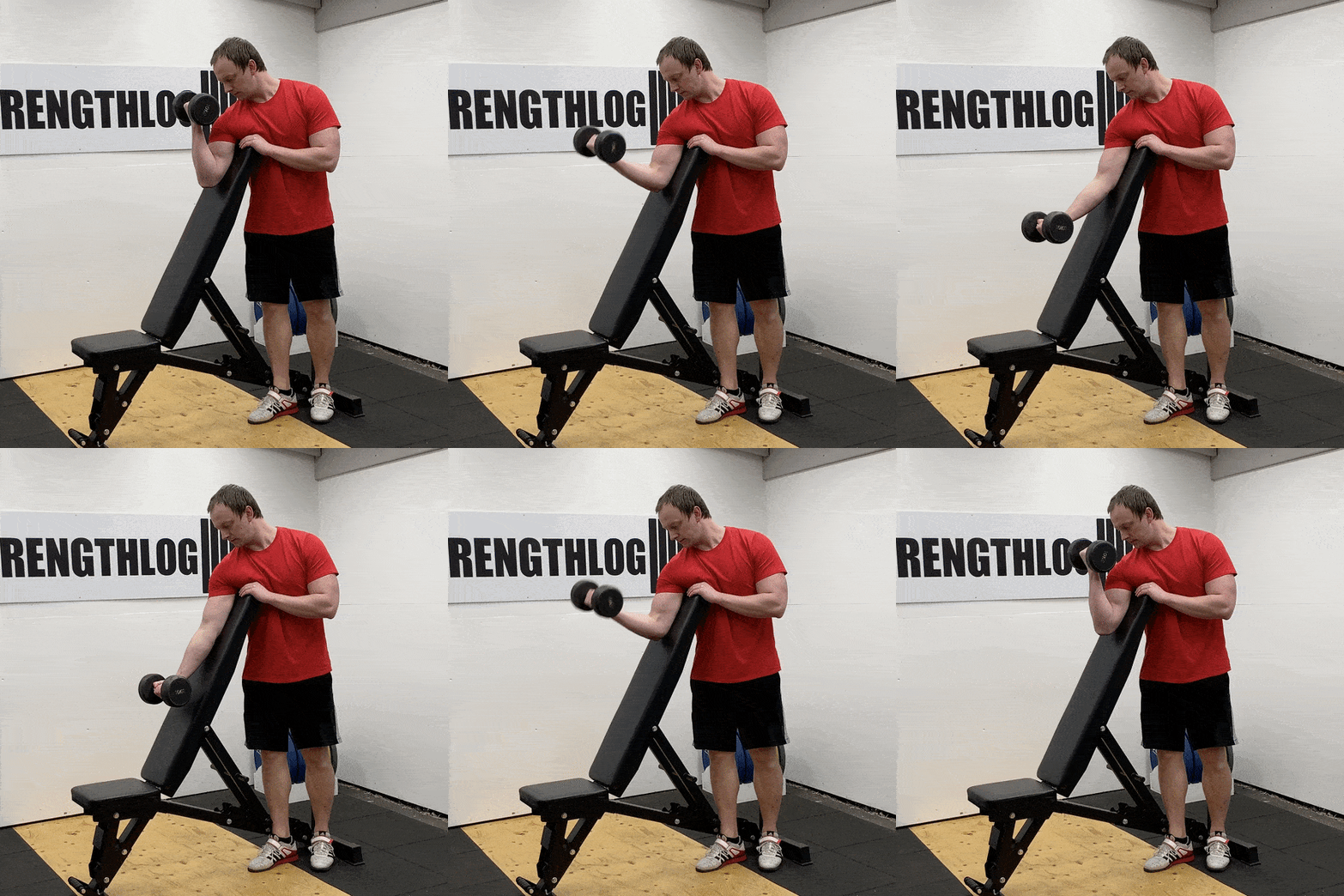
The preacher curl was made popular by Larry Scott, the very first Mr. Olympia, which is why you’ll sometimes hear it called the Scott curl (he didn’t invent it, though; Dale and Harvey Easton likely did back in the 1940s, and legendary trainer Vince Gironda learned it from them and spread its effectiveness). The original bench looked a little different from today’s (it was rounded instead of flat).
Trivia aside, the preacher curl is easily one of the best exercises if you want to isolate your biceps completely. You can do it standing or seated, with a barbell (straight or EZ), a dumbbell (or two), on a cable machine, or on a dedicated preacher curl machine. Hugely versatile exercise. And because it locks you into place the way it does, it becomes very difficult to cheat.
It trains the entire biceps, but it hits the short head slightly more. The long head crosses the shoulder joint, so when you bring your arms forward like in a preacher curl, you put it in a shortened position, and it can’t generate maximum force. Instead, the short head has to work harder. Recent research also shows that preacher curls are extra effective for growing the part of the biceps closest to the elbow.2
How to Do Dumbbell Preacher Curls
- Use a preacher curl bench, or position the backrest of a regular training bench so that it leans back slightly.
- Grab a dumbbell, stand behind the bench, and rest your upper arm against the backrest.
- Lower the dumbbell as far as you can, and then reverse the motion, returning to the starting position.
- Repeat the movement for the desired number of repetitions.
How to Do Barbell Preacher Curls
- Grab a barbell and sit down at a preacher curl bench, resting your upper arms against the pad.
- Lower the barbell as far as you can, with control, to straight arms.
- Reverse the motion and return to the starting position.
- Repeat the movement for the desired number of repetitions.
And with that, we head over to the triceps, again starting with the heavy compounds.
6. Close-Grip Bench Press

If you want raw pressing strength and thick triceps, the close-grip bench press is the cream of the crop. By bringing your grip into about shoulder-width, your triceps contribute more to the force you need to press the bar up compared to if you had used a wider grip.3 4


The close-grip bench is a compound movement, and that means you can easily overload it progressively over time. Compare it to the triceps pushdown: great isolation exercise, but five years down the line, are you really going to be that much stronger than after three years of doing it? Progressive overload is the primary driver of hypertrophy, and I can’t think of any triceps exercise better suited for it than the close-grip bench.
Your hands should be shoulder-width apart, or just slightly inside shoulder-width. A good rule of thumb is to place your index finger on the smooth part of the bar where the knurling (the rough part) begins. There are no triceps benefits to be had from a really close grip, only potential wrist issues. Besides, when you stack your wrist, elbow, and shoulder joints in a straight line like that, you get more power.
How to Do the Close-Grip Bench Press
- Lie on the bench, pull your shoulder blades together and down, and slightly arch your back.
- Grip the bar narrower than in a regular bench press, so that your hands are directly above your shoulders or even closer.
- Inhale, hold your breath, and unrack the bar.
- Lower the bar with control until it touches your chest somewhere close to the lower end of your ribcage.
- Take another breath while in the top position, and repeat for reps.
7. Bar Dip

The only body weight triceps exercise (although you can load it if you need to) on this list of arm exercises is the bar dip, a real classic for building the upper body. You can make your chest or your triceps your main target, depending on how you perform it.
To hit your triceps, you want to keep your torso as upright as possible, almost perpendicular to the floor. Imagine there is a string pulling the top of your head toward the ceiling. If you lean forward, your chest takes over more of the leverage. If you keep your legs straight down or slightly forward, you make it easier to maintain a triceps-focused position.
In addition, you want to keep your elbows tucked relatively close to your ribcage. If you flare them, the load shifts more to your chest. A slightly narrower grip is better for triceps, but you don’t need to go so narrow that you start to feel it in your wrists.
Dips are a fantastic mass builder for the triceps, but if you want to maximize the entire triceps, you need to pair them with an overhead exercise to hit the long head.
Once you’re strong enough that your body weight is not enough anymore, get a dip belt and hang a weight plate from your waist.
How to Do Bar Dips
- Grip the dip station about shoulder-width apart, and climb or jump to get into the starting position.
- Lower yourself with control until your shoulder is below your elbow, or as deep as you comfortably can.
- Reverse the motion and return to the starting position.
- Repeat for reps.
8. Lying Triceps Extension

Now we get to my favorite triceps exercise of all, the lying triceps extension. You can do it with a regular straight barbell, an EZ bar, a pair of dumbbells, or hooked up to a cable machine with a handle in the lower position.
Lying extensions hit all three heads of the triceps, and if you do it right, you really work the long head in a stretched position. And you can load it up with a lot of weight and still really connect with the muscle.
With “do it right,” I mean not doing it regular “skullcrusher” style. Aim for behind your head, not directly at your forehead. Three benefits: you 1) save your elbows, 2) increase the stretch and load on the long head, and 3) eliminate the risk of bonking yourself in the head with a heavy bar (I’ve seen it happen! And it wasn’t me. Promise).
They can be a bit rough on the elbows or wrists for some if you go heavy; if so, try using an EZ-bar (or dumbbells – slightly less stable, but you can rotate your hands however you need for comfort).
How to Do Barbell Lying Triceps Extensions
- Lie down on a bench with your head close to the edge. Hold a barbell with a shoulder-width grip, and lift it up to straight arms over yourself.
- Lower the barbell down behind your head. Try to keep the same distance between your elbows throughout the movement.
- Reverse the motion and extend your arms again.
- Repeat for reps.
9. Overhead Triceps Extension

If you’ve read this far, you know that building the long head of the triceps maximally requires you to get your arms overhead to give it the stretch and tension it craves for hypertrophy. And what exercise does it better than overhead triceps extensions? None of them, that’s what.
One recent study compared overhead extensions with triceps pushdowns and found that the overhead position produced more than 40% better long head growth.5
Can’t I just do overhead extensions with a dumbbell or a barbell? Absolutely you can (although doing it with a straight barbell always felt super awkward to me; I could never get it to feel good). However, the cable is a bit better for two reasons: 1) unlike free weights, cables put tension on the muscle all the way through the rep, meaning no rest for your triceps until the set is over, and 2) many people find the angle of the cable pull is kinder to their elbows than hoisting a heavy dumbbell behind their head (more my observation than documented scientific facts).
Pro Tip: This is a perfect exercise for drop sets (you won’t get crushed under a bar, and changing the weight is fast and easy). When you hit failure, lower the weight by 20–30% and keep going until your arms are numb. Give it a try for the ultimate triceps pump.
How to Do Overhead Cable Triceps Extensions
- Fasten a rope handle in the lower position of a cable pulley. Stand with your back against the pulley, with a slight forward lean, and hold the rope behind your head and your upper arms next to your ears.
- Straighten your elbows until your arms are fully extended.
- Reverse the motion by bending your arms again.
- Repeat for reps.
10. Triceps Pushdown

Let’s finish up with what is also perhaps the best finisher to a good triceps workout: the pushdown. Whether you do it with a bar or a rope attachment, there are few triceps exercises that are easier to do (provided you have a cable machine handy), which reflects the fact that it is the only triceps exercise among the 25 most popular lifts.
Bar or rope? They’re both good. Building your triceps doesn’t come down to which attachment you use in pushdowns. A bar lets you use heavier weight and keeps things very stable. With a rope, you can rotate your hands and get a really nice squeeze, but you won’t be able to load it as much.
I like to do both. Either in separate workouts or even in the same, usually starting with the bar and finishing with the rope. Try heavier bar pushdowns for 6–10 reps, then rope pushdowns for 10–15 reps, and really go for the squeeze. But if you have to pick only one, choose the attachment that feels best to you. Simple as that.
How to Do Triceps Pushdowns
- Stand one step away from the cable pulley, and grip a rope or a bar (about shoulder-width apart).
- Pull the handle down until your upper arms are perpendicular to the floor. This is the starting position.
- Push the handle down until your arms are fully extended.
- With control, let the handle up again.
- Repeat for reps.
Arm Workouts to Build Big Guns
So, you want to stretch the fabric of your t-shirts to their absolute limit. A noble pursuit.
But reading about arm exercises will get you exactly nowhere without putting the work in.
Here are three great arm workouts you can do, all available in the StrengthLog app.
We have something for everyone here: a classic bodybuilding-style arm workout for mass, a dumbbell workout for when you don’t have a full gym, and a superset workout for building maximum guns in minimum time.
Plus, you get two full arm-focused training programs: one for beginners that focuses more on the arms than your typical beginner plan, and, for advanced lifters, the ultimate arm-focused workout routine: Armageddon, a 4-week specialization program to kickstart arm growth.
Arm Workout for Muscle Mass and Strength
This workout features only exercises from this list of arm exercises or variations thereof. You start with a big compound movement for each muscle, move to more heavy mass builders, and finish off with lighter pump work. A classic bodybuilding setup.
| Exercise | Sets | Reps |
| Chin-Up | 3 | Do as many as you can |
| Barbell Curl | 3 | 6–10 |
| Hammer Curl | 3 | 8 |
| Preacher Curl | 3 | 12 |
| Close-Grip Bench Press | 3 | 6 |
| Lying Triceps Extension | 3 | 6–10 |
| Triceps Pushdown | 3 | 8 |
| One-Arm Dumbbell Triceps Extension | 3 | 12 |
Do this workout once a week (your arms get their fair share of work when you train chest, back, and shoulders, too) or twice if you really want to step up your arm training.
Advanced lifters can do one more set per exercise.
This is a free workout.
- Go directly to the Arm Workout for Muscle Mass and Strength in StrengthLog.
- Or read more about it here.
Arm Workout with Dumbbells
When you don’t have access to a full gym, whether you’re on the road or you train at home with limited space, you can still get a perfectly good arm workout with dumbbells.

Do this arm workout once or twice per week in addition to your workouts for the rest of your body.
| Exercise | Sets |
| Dumbbell Curl | 4 |
| Hammer Curl | 3 |
| Concentration Curl | 3 |
| Dumbbell Lying Triceps Extension | 4 |
| Close-Grip Push-Up | 3 |
| Dumbbell Standing Triceps Extension | 3 |
This is a premium workout, so you need a subscription to track your progress in StrengthLog (free 14-day trial available).
- Open the Arm Workout with Dumbbells in StrengthLog.
- Or read more about it here.
Biceps and Triceps Superset Workout
Supersets are two sets for different exercises back-to-back with as little rest in between as possible. They are equally effective for muscle growth as traditional sets but save a ton of time.
Read more: Are Supersets Good for Muscle Growth and Strength?
Supersetting biceps and triceps works great because one muscle rests while the other is working, and you get an awesome arm pump.
The Biceps and Triceps Superset Workout comes in three different levels based on your experience level: Beginner, Intermediate, and Advanced. The exercises are paired so that you can switch between them as quickly and with as little hassle as possible.
The beginner workout looks like this:
| Exercises | Sets | Reps |
| Barbell Curl + Barbell Lying Triceps Extension | 2 + 2 | 6 |
| Barbell Preacher Curl + Barbell Standing Triceps Extension | 2 + 2 | 10 |
| Cable Curl + Triceps Pushdown | 2 + 2 | 15 |
The beginner superset workout is free, while the intermediate and advanced are premium workouts.
- Open the Beginner Biceps and Triceps Superset Workout in StrengthLog.
- Go to Intermediate Workout here.
- Or jump directly to the Advanced Workout.
- You can also read more about them here.
Arm-Focused Training Program for Beginners
This is the training program if you’re a beginner who wants to build bigger arms.
It is a full body routine that includes arm exercises in addition to the compound exercises for your larger muscle groups like the chest, legs, and back.
That’s actually pretty uncommon! Most beginner routines figure that the arms get enough work from all the compound pulling and pushing movements you do.
And that’s often true. But not everyone is satisfied with no arm training, and there’s nothing wrong with training them directly from the start of your lifting career.
This program is a balanced full body training program that makes sure you don’t leave any arm gains to chance.
Here’s the program in detail:
Workout 1
| Exercise | Sets | Reps |
|---|---|---|
| Squat | 3 | 6 |
| Leg Curl (seated or lying) | 3 | 10 |
| Close-Grip Bench Press | 3 | 8 |
| Supinated Lat Pulldown | 3 | 8 |
Workout 2
| Exercise | Sets | Reps |
|---|---|---|
| Barbell Row | 3 | 8 |
| Bench Press | 3 | 6 |
| Barbell Curl | 3 | 8 |
| Leg Extension | 3 | 12 |
Workout 3
| Exercise | Sets | Reps |
|---|---|---|
| Deadlift | 3 | 5 |
| Overhead Press | 3 | 6 |
| Cable Curl | 3 | 10 |
| Triceps Pushdown | 3 | 10 |
A suggested weekly training schedule could look like this:
- Monday: Workout 1
- Wednesday: Workout 2
- Friday: Workout 3
However, that’s just what it is: a suggestion. You can train on Tuesday, Thursday, Saturday, or any other combination of days that fit your schedule. If you can only do two days one week, that’s also fine. Pick two of the workouts and go! Just try to separate each session with a rest day, and you’ll be good.
The program is free in the StrengthLog app!
- Ready to go? Start the Arm-Focused Training Program for Beginners.
Armageddon: Full Arm-Focused Specialization Program
Armageddon is our premium arm program for advanced lifters and bodybuilders, when you really want to push your biceps and triceps to the limit and into growth.
Now, it’s not a year-round program. It’s really high-volume and high-intensity, and I recommend you give it a go only if you really have that training experience. And then only for a month or two to push past a plateau.
Let me show you what the first week of Armageddon looks like in StrengthLog. And it’ll only get tougher from here.

Armageddon is a premium training program in StrengthLog.
You can start it right now: Armageddon.
Or you can read more about it first in this short article.
Follow These Arm Workouts and Programs in StrengthLog
These are just a few of the many proven workouts and programs in our workout log app, StrengthLog.


StrengthLog remembers what weights you used in your last session, and automatically loads them into your next one.
That makes it super easy to keep track of your weights and reps and make sure you’re on the fast road to progress.
Download it and start tracking your gains today!
StrengthLog is free, and so are many of our arm plans. For the premium ones, you’ll need a subscription to follow it in-app. We offer a 14-day free trial (no strings attached and no funny business) that you can activate in the app, so you can check it out before making a decision.
Track Your Training. See Real Progress.
Log your workouts in one place and watch your numbers climb, week after week.
- Free to get started
- Fast workout logging
- Cardio and strength training
- Beginner-friendly
- Free weights, bodyweight training, and machines
- Progress over time, personal bests
- Free and premium training programs and workouts for every fitness goal
Download StrengthLog free:


Final Rep
Building a good pair of arms takes time, effort, and more curls than a ’90s prom night.
That’s why I want you to stop reading (super big thanks for doing so!) and go hit the weights, get a good pump, and don’t forget to track every rep in the StrengthLog app. Those pythons won’t grow themselves, but tracking your progressive overload is the best way to make sure they do.
Want even more?
Subscribe to our weekly newsletter to get notified of new articles and get weekly training tips!
Or, you can view all our training programs here.
Last reviewed: 2026-02-11
References
- Sports Medicine and Health Science, Volume 8, Issue 1, January 2026, Pages 34-42. Does longer-muscle length resistance training cause greater longitudinal growth in humans? A systematic review.
- Int J Sports Med. 2025 May;46(5):334-343. Distinct muscle growth and strength adaptations after preacher and incline biceps curls.
- J Strength Cond Res. 2005 Aug;19(3):587-91. The influence of grip width and forearm pronation/supination on upper-body myoelectric activity during the flat bench press.
- Front Sports Act Living. 2020; 2: 637066. A Biomechanical Analysis of Wide, Medium, and Narrow Grip Width Effects on Kinematics, Horizontal Kinetics, and Muscle Activity on the Sticking Region in Recreationally Trained Males During 1-RM Bench Pressing.
- Eur J Sport Sci. 2022 Aug 11;1-11. Triceps brachii hypertrophy is substantially greater after elbow extension training performed in the overhead versus neutral arm position.
