
Strength training for BJJ is your guide to becoming a better and more skilled fighter.
Brazilian jiu-jitsu is often described as a chess match for the body, but let’s be honest—it’s hard to checkmate someone when they feel like a brick wall. Strength training builds functional power and explosiveness that translate directly to your time on the mats.
It doesn’t replace your technique but complements it to make you an all-around more formidable opponent.
This article explores strength training strategies that give you the upper hand when technique alone isn’t enough, with the best exercises to make you a stronger fighter, and a complete 12-week training program to put theory into practice.
***
Want to jump right into the training program?
Click here for the Strength Training for BJJ program.
Table of Contents
Benefits of Strength Training for BJJ
For a long time in Brazilian jiu-jitsu, the old-school mentality was that strength training was practically heresy. The focus was all about technique over power.
The idea was that BJJ lets smaller, weaker practitioners defeat larger, stronger opponents. There was this romantic notion that lifting weights would somehow corrupt the purity of your technique, and strength training was often considered unnecessary at best and detrimental at worst. Many coaches thought lifting weights could make you bulky, slow, or overly reliant on brute force rather than skill.
There was also a bit of a purist mindset: if you were spending time lifting weights, you could be spending that time drilling sweeps or perfecting your guard game. Strength training was sometimes dismissed as unnecessary or even a distraction from technical prowess.
But times have changed. Now, if you’re not training to get stronger, you might find yourself getting manhandled by those who are. After all, unless you are one of the best in the world, there will always be someone at least as skilled as you. And, if two equally skilled fighters meet, who will likely come out on top? You guessed it: the one who can out-muscle the other.
Turns out, being stronger and more technical is a winning combo. Who knew?
So, while the purists once scoffed at the weight room, today’s top BJJ athletes are in there deadlifting, kettlebell-swinging, and squatting their way to victories. And you should, too.
These are the top benefits of strength training for BJJ athletes.
Body Composition and Strength-Related Performance
Beyond technical skills, general fitness, and mobility, your body composition (the ratio of fat and muscle) and your strength-power profile are big parts of success in BJJ.1 2
More lean mass means more strength and power (you don’t need the muscle mass of a bodybuilder or powerlifter, but muscle is one of the primary drivers of strength), and a favorable ratio between muscle and fat allows you to maintain a high level of effort for longer.
Strength training also boosts your muscle endurance even more because it raises the point at which lactic acid builds up faster than your body can clear it out, which means you can keep going for longer without gassing out.3
Moreover, you develop explosive power, the kind that helps with bridge escapes, takedowns, and guard passes. You’ll also find pinning, maintaining pressure, and holding dominant positions easier. The stronger you are, the easier it will be to dictate the pace and stay on top, which also means fewer reversals—your opponent will struggle to move you when you’ve got an extra reserve of strength to back your technique up.
Lastly, a stronger grip = better control, harder chokes, and less chance of your opponent stripping your hands away. Lifting heavy things (and direct grip training) improves your grip strength beyond what grappling itself can accomplish.
Improved Balance
Balance and coordination are essential in BJJ, helping you stay on your feet, control your opponent, and transition between moves without getting swept or submitted.
Strength training directly improves both, and a good workout routine for BJJ includes unilateral (work one side of your body at a time) and bilateral exercises (use both sides of your body together) along with core work.
Unilateral exercises, like split squats, are great for performing off-balance or asymmetrical techniques, and bilateral exercises, like regular squats, are perfect for any movement that generates power from both sides of the body.4
Since BJJ involves both types of movements, it’s smart to train with both.
Read more: Unilateral vs. Bilateral Strength Training for Strength & Muscle Growth
Also, strengthening your core (the muscles around your abs and back) stabilizes your body during grappling and helps you resist submissions while generating force for sweeps and escapes.5 It might even directly enhance your skill performance.6
Injury Prevention
Injuries are common in BJJ. One survey found that two out of three BJJ athletes reported at least one injury within a 3-year, forcing them to take at least two weeks off from training.7 Another study showed that nine out of 10 BJJ practitioners had hurt themselves during training, with many of them considering quitting the sport because of the injuries.8
While strength training is essential for rehabbing injuries, preventing them in the first place is always the best option, and hitting the weights shines there, too.
There aren’t many, if any, direct studies on resistance training for injury prevention in BJJ, but the consensus in sports science is that strength training is the number one countermeasure against sports injuries.9. It reduces injuries in everyone from beginners to pro athletes.10 BJJ is hard on shoulders, knees, and elbows, and strengthening the muscles around these joints will protect them from hyperextensions and submissions gone wrong.
How Should BJJ Practitioners Strength Train?
As a BJJ fighter, your training schedule is likely already packed. Combat sports push both the anaerobic (short bursts of energy without oxygen) and aerobic (steady energy using oxygen) systems and BJJ is no exception. Your strength training should complement your skills and conditioning, not leave you too drained to practice your technique with enough intensity to progress.
The key? Balance. Devote enough time and intensity to build strength and power, but not so much that it eats into your technical or sparring sessions. You don’t have to live in the weight room to make all the gym gains you need to benefit your BJJ.
Strength and Power: The Essentials
Your program should target both power and maximum strength.
- Power Training – Speed over weight. Perform explosive movements with moderate loads (about 75% of your 1-rep max), sticking to 3–5 reps per set. Olympic lifts, plyometrics, and fast barbell work are great here.
- Max Strength Training – This is where you lift heavy to improve your maximum force capacity. Work in the 2–6 rep range at 80–95% of your 1RM. Focus on compound lifts like squats, deadlifts, bench presses, and rows. These exercises build the raw strength that powers your strikes and clinches.
This kind of heavy, low-rep training will also put on lean muscle. You’re not training to look like a bodybuilder, but muscle isn’t your enemy. Strength drives performance, and the muscle you gain from heavy lifting won’t slow you down – it’ll make you faster and stronger.
One strategy? Cycle your training blocks. Focus on building max strength for some weeks, then switch gears to power-based work to translate that strength into explosive movement.
Unilateral and Functional Strength
Brazilian jiu-jitsu doesn’t happen only on two legs and rarely involves only symmetrical positions. Unilateral training prepares you for the unpredictability of fights by giving you the strength and coordination you need to handle awkward positions.
Single-leg and rotational exercises (like lunges, split squats, and step-ups) are awesome here. They improve balance, stability, and triple extension (powerful movement at the ankle, knee, and hip).
Your legs need to be strong individually to handle the demands of the sport.
And while it’s tempting to make every exercise “sport-specific,” not all strength work needs to mimic the exact movements you use on the mat. Basic strength and muscle are functional. Squats, deadlifts, and presses build the foundation that makes all your BJJ movements more efficient.
Strength Training Frequency
For most BJJ fighters, 2–3 strength training sessions per week hit the sweet spot. You allow for gains in strength and power without burning out or negatively impacting time on the mats (or the quality of that time).
Doing more isn’t always better. Multiple weekly BJJ sessions already put a lot of strain on your body and nervous system. Too much strength training can slow your recovery, increase injury risk, and take time away from improving your techniques.
Here’s how to get it right:
- Lift on lighter training days – Don’t lift when you’ve got tough sparring or hard skill sessions. Save it for days when your body isn’t already wiped out.
- Rest between sets – Take 2 to 4 minutes to catch your breath and let your muscles recover so you can lift heavier and stay explosive, at least for multijoint exercises. If you want to speed things up between, say, leg raise sets, that’s fine.
Lifting when you’re already tired won’t help you get faster or stronger. Smart training > overtraining!
Here’s an example of a weekly training schedule for a BJJ athlete with two full-body strength training days and one rest day:
| Day | Training Focus |
|---|---|
| Monday | BJJ Training (Technique & Sparring) |
| Tuesday | Full-Body Strength Training |
| Wednesday | BJJ Training (Drills & Positional Sparring) |
| Thursday | Full-Body Strength Training |
| Friday | BJJ Training (Live Sparring/Competition) |
| Saturday | BJJ Training (Open Mat or Drills) |
| Sunday | Rest or Active Recovery |
Breakdown by Training Frequency
- 2x per Week – Ideal for active competitors or if you are training BJJ 4–5 times a week. It provides enough strength stimulus without interfering with recovery.
- 2–3x per Week – Great for when BJJ sessions are lighter (e.g., 2–3 times per week).
- 1x per Week – Maintenance mode. Keeps strength without overloading, perfect during peak competition weeks.
Strength Training Program for BJJ
This is a training program for BJJ fighters who want to develop maximum strength, power, balance, and stability while strengthening the body to withstand the rigors of the mat and prevent injuries. It’s suitable for the off-season and early preparation parts of your training.
This program works best if you already have some strength training experience. It features many different, relatively complex exercises, and if you have never lifted weights before, it might be too much for you to jump right into.
If you’re new to the gym, start with one of our beginner programs, like the Beginner Barbell Training Program. You train three times per week, alternating between workouts A and B.
Workout A
| Exercise | Sets | Reps |
|---|---|---|
| Squat | 3 | 8–10 |
| Bench Press | 3 | 8–10 |
| Barbell Row | 3 | 8–10 |
Workout B
| Exercise | Sets | Reps |
|---|---|---|
| Deadlift | 3 | 6–8 |
| Lat Pulldown (or Pull-Ups) | 3 | 8–10 |
| Overhead Press | 3 | 8–10 |
In other words, you’ll train workouts A B A week one and B A B week two, then go back to week one and keep alternating between the two.
This beginner program (any many more) are available for free in our workout log app, StrengthLog.
You can use the strength you gain in BJJ, and you teach your muscles, brain, and nervous system to play together, allowing you to move on to more complex programs.
If you do have some weight training experience, you’re ready for Strength Training for Brazilian Jiu Jitsu.
12-Week Strength Training Program for BJJ
This program will run for 12 weeks, split into two main parts, separated by a deload week.
- Strength and Hypertrophy: Build lean mass and increase the maximum amount of force your muscles can produce.
- Power and Max Strength: Translate your gains into power output and speed.
It features a combination of multi-joint exercises that strengthen your entire body and specific exercises that replicate movement patterns used in Muay Thai. Often, those two things overlap in a major way.
Click here to open the program in StrengthLog.
Program Structure
- Duration: 12 weeks.
- Frequency: 2 full-body workouts with upper- or lower-body focus per week.
- Structure: Two 6- and 5-week progressive blocks with a deload week in between.
- Focus: Strength, power, and athletic performance for BJJ.
- Sets and Reps: 3 sets per exercise, 3–6 reps per set for compound exercises, higher reps (10+) for isolation exercises.
- Rest Between Sets: 2–4 minutes for compound movements , 1–2 minutes for isolation work.
- Progression: Gradual increase in intensity or volume each week.
You can pick which days you hit the weights to fit your schedule, but take at least one rest day between each strength training session. With two weekly training days, you should be able to work your strength training into your regular BJJ training and everyday life without too much hassle.
Try to add weight or do one more rep each workout. When you can do the designated number of reps for each set, increase the load the next time you hit the gym.
Follow This Training Program in StrengthLog
This program and many more are in the StrengthLog workout tracker app. The app is free to use, forever, with no ads. This program, however, is a premium program (it offers built-in progression and advanced periodization), which means it requires a premium subscription.
We offer all new users a free 14-day premium trial. You can activate it in the app without any strings attached.
Download StrengthLog and start tracking your workouts today:


The exact set and rep details (the tables below are snapshots of a single week) along with the planned intensity and volume progression route, are available in your StrengthLog app.
Block 1: Strength and Hypertrophy Focus (Weeks 1–6)
- Goal: Build strength, muscle mass, and stability to prepare for explosive and dynamic movements.
- Frequency: 2 days/week
- Sets/Reps: 6 exercises/workout, 5–15 reps, 3–4 sets/exercise.
Workout 1
| Exercise | Sets | Reps |
|---|---|---|
| Trap Bar Deadlift | 4 | 5 |
| Pull-Up | 3 | Max reps |
| Bulgarian Split Squat | 3 | 8 |
| Barbell Row | 4 | 8 |
| Farmer’s Carry | 3 | 20 meters |
| Hanging Leg Raise | 3 | 12–15 |
Workout 2
| Exercise | Sets | Reps |
|---|---|---|
| Bench Press | 3 | 5 |
| Overhead Press | 3 | 6–8 |
| Front Squat | 3 | 8 |
| Inverted Row | 4 | 10 |
| Plate Pinch | 3 | 20–30 seconds |
| Plank (Weighted) | 3 | 45 seconds |
Deload Week (Week 7)
- Objective: Allow recovery and adaptation while maintaining movement patterns.
- Frequency: 2 days of light training.
- Sets/Reps: 50–60% of regular weight, ~10 reps, 2 sets/exercise.
Workout 1
| Exercise | Sets | Reps |
|---|---|---|
| Front Squat | 2 | 10 |
| Pull-Up | 2 | 10 |
| Box Jump | 2 | 10 |
| Hanging Leg Raise | 2 | 12 |
Workout 2
| Exercise | Sets | Reps |
|---|---|---|
| Bench Press | 2 | 10 |
| Bulgarian Split Squat | 2 | 10 |
| Barbell Row | 2 | 10 |
| Plank | 2 | 60 seconds |
Block 2: Power and Explosive Strength Focus (Weeks 8–12)
- Objective: Develop explosive power and dynamic strength specific to BJJ performance.
- Frequency: 2 days/week
- Sets/Reps: 6 exercises/workout, 3–8 reps, 3–5 sets/exercise.
Use up to 75% of your 1RM and perform each exercise with as much explosiveness as you can muster (resist it during the eccentric phase). The focus is on speed and exploding the weight, not grinding slow reps to failure. Your sets end when you can’t move the weight as fast, not when you fail to complete a rep.
Workout 1
| Exercise | Sets | Reps |
|---|---|---|
| Trap Bar Deadlift | 5 | 3 |
| Box Jump | 4 | 4 |
| Front Squat | 4 | 5 |
| Pull-Up | 3 | 5 |
| Farmer’s Carry | 3 | 20 seconds |
| Hanging Windshield Wiper | 3 | 8/side |
Workout 2
| Exercise | Sets | Reps |
|---|---|---|
| Overhead Press | 5 | 3 |
| Barbell Row | 4 | 6 |
| Bulgarian Split Squat | 3 | 6 |
| Inverted Row | 3 | 8 |
| Plate Pinch | 3 | 20–30 seconds |
| Plank (Weighted) | 3 | 60 seconds |
Strength Training Exercises for BJJ
Here are detailed descriptions of all the exercises in the Strength Training for BJJ program in the order they appear.
Trap Bar Deadlift

The trap bar deadlift is one of the best exercises for full body strength and BJJ performance. It’s done using a trap bar (hexagonal bar) that you stand inside of and grip the handles at your sides, which changes the lifting mechanics compared to a conventional barbell deadlift.
Trap bar deadlifts strengthen the posterior chain (glutes, hamstrings, back) and quads, directly boosting your takedown power and ability to lift opponents from awkward positions. They teach you the movement patterns of explosive lifts and hip drives—essential for shooting double legs or elevating opponents from the guard, basically building your “pick-up-and-slam” strength.
In addition, holding a heavy bar translates to a stronger grip, and grapplers know grip is king.
Another underappreciated benefit of trap bar deadlifts is that they are easier to recover from than conventional deadlifts. That means you can hit them more frequently without feeling like you got rear-naked choked by the recovery process.
How to Trap Bar Deadlift
- Step into the bar’s opening so that the handles are in line with the middle of your feet.
- Inhale, bend down and grip the handles.
- Hold your breath, brace your core slightly, and lift the bar.
- Lift the bar with a straight back, until you are standing straight.
- Lower the bar back to the ground with control.
- Take another breath, and repeat the movement for your desired number of repetitions.
Pull-Up

The pull-up is one of the best ways for BJJ practitioners to build the pulling power and many of the same muscle groups and movement patterns you need to make life on the mat miserable for your opponents.
Pull-ups work the latissimus dorsi, the big V-shaped muscles on your back that help you pull and stabilize, along with your rear delts and biceps. In addition, they give your forearm flexors and hand muscles a good workout.
BJJ is 90% grabbing things (people, gis, limbs), and these muscles provide pulling power for both offense (e.g., securing chokes) and defense (e.g., pulling your opponent’s arms away during escapes). The stronger they are, the more force you can generate when pulling your opponent into position or fighting out of bad spots.
How to Do Pull-Ups
- Stand beneath a pull-up bar and reach up to grasp it with an overhand grip (palms facing away from you), slightly wider than shoulder-width apart. Ensure your grip is secure and comfortable.
- Hang freely from the bar, fully extending your arms. Your feet should be off the ground.
- Engage your core muscles by squeezing your abs and glutes.
- Inhale and initiate the movement by pulling your body weight up towards the bar by bending your elbows and squeezing your shoulder blades together. Focus on using your back muscles rather than relying on your upper arms.
- Continue pulling yourself up until your chin reaches or clears the bar. Keep your torso upright and avoid excessive swinging or kicking with your legs.
- Slowly lower yourself back down to the starting position while maintaining control and stability, fully extending your arms.
- Repeat the movement for your desired number of repetitions.
Bulgarian Split Squat

The Bulgarian split squat is essentially a single-leg squat with the rear leg elevated on a bench or platform, working the quads, glutes, and adductors (and stabilizers all over the body for balance)—basically the whole lower-body VIP section for BJJ performance.
Split squats build leg strength, balance, and unilateral stability—three elements you absolutely must have for maintaining base control and explosive movements on the mat. Unilateral training means training one side of the body at a time, something every good BJJ strength program should include. In BJJ, you often push off one leg at a time (sweeps, guard passing, and takedowns), and training each leg independently can iron out any strength imbalances you might have without even knowing it.
In addition, split squats are awesome for hip mobility. Tight hips are a BJJ curse because they spend a lot of time in a contracted position. Regularly doing Bulgarian split squats stretches your hip flexors while strengthening your glutes and hamstrings—helping with guard retention and possibly reducing injury risk.
How to Do Bulgarian Split Squats
- Place a bar on your upper back or hold a pair of dumbbells in your hands.
- Stand with your back turned against a bench, which should be about knee height. Stand about one long step in front of the bench.
- Place your right foot on the bench behind you.
- Inhale, look forward, and squat down with control until right before your right knee touches the floor.
- Reverse the movement and extend your front leg again, while exhaling. Your back foot should only act as support.
- Repeat the movement for the desired number of repetitions, then switch side and repeat with your right leg forward and your left foot on the bench.
Barbell Row
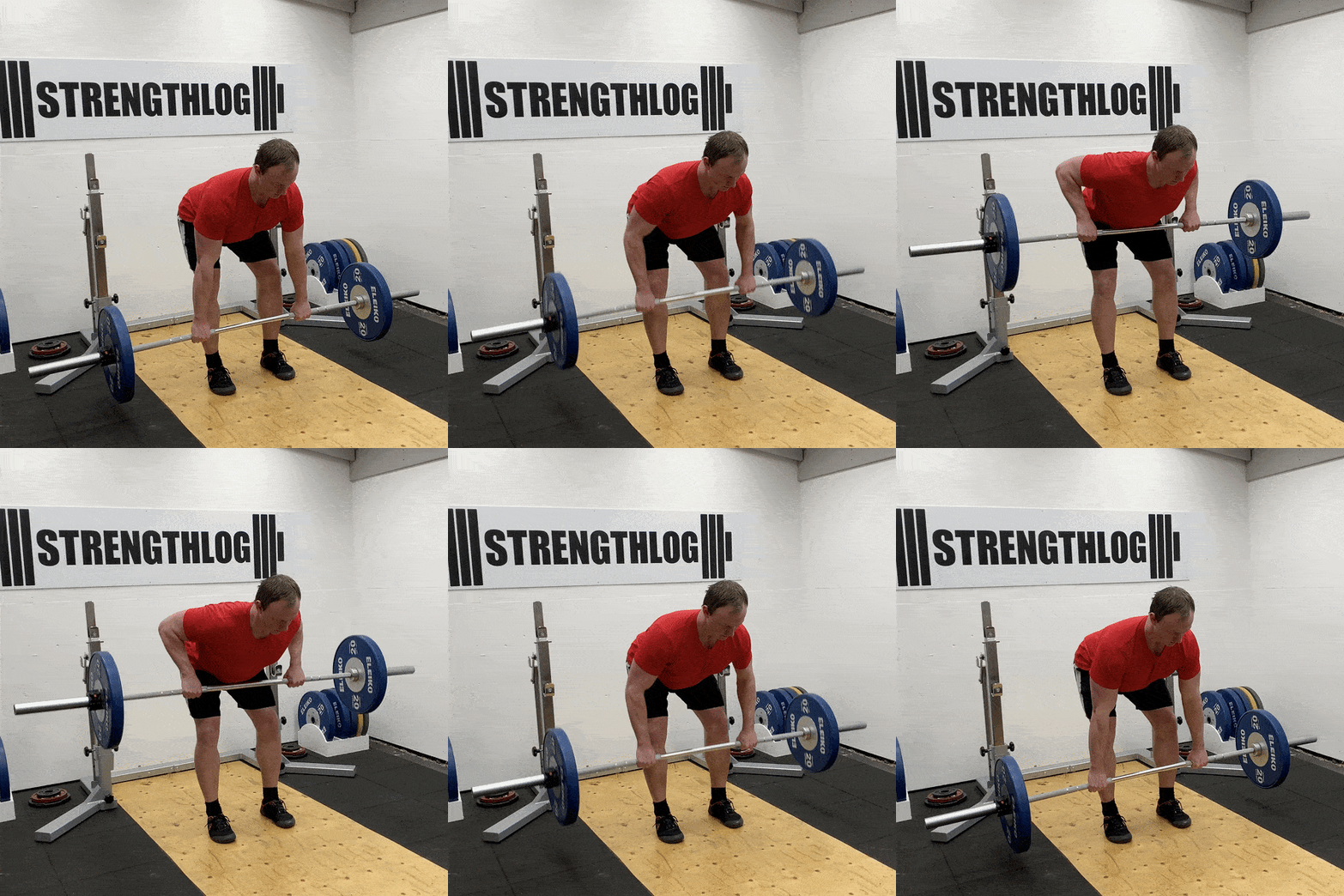
The barbell row is a fantastic exercise for making your back stronger and thicker, directly translating to better performance on the mats.
While pull-ups primarily develop vertical pulling strength, bent-over rows focus on horizontal pulling and strengthen the entire upper posterior chain (lats, traps, rhomboids), helping you explode out of bad positions and stay injury-free. A good BJJ strength training program includes both; just think about how often you’re pulling—snapping grips, yanking opponents off balance, or locking in a rear-naked choke—from many different angles.
How to Do Barbell Rows
- Grasp the barbell with an overhand grip, slightly wider than shoulder-width apart.
- Stand with your feet slightly wider than feet hip-width apart, bend your knees slightly, and hinge forward at your hips, maintaining a straight line from your head to your hips.
- Brace your core and keep your back straight. Pull the barbell towards your lower chest or upper core, keeping your elbows close to your body. Squeeze your shoulder blades together at the top of the movement.
- Lower the barbell back to the starting position in a controlled manner.
- Repeat the movement for the desired number of repetitions.
Farmer’s Carry

The farmer’s carry (or farmer’s walk) involves picking up heavy weights in each hand and walking a certain distance or for a certain time. Sounds basic, right? Well, that simplicity hides the fact that this exercise is brutal for your entire body.
Carries teach your body to resist movement, like defending sweeps or staying heavy in top pressure. They also give you vice-grip muscle endurance, core stability that keeps you upright and hard to tip over, and strong traps and upper back that keep your posture on point during long guard battles or when someone’s hanging off you like a backpack.
If you are new to farmers’ walks or lack the necessary core strength, it is easy to start slouching forward by bending at the upper back. Do your best to resist by pulling your shoulders back and maintaining a straight posture throughout the walk. If you can’t, you’re using too much weight. Lighten the load a bit so you last the entire distance.
How to Do Farmers Walk
- Step in between two farmers walk-cases, or similar implements.
- Inhale, lean forward and grip the handles.
- Hold your breath, brace your core slightly, and lift the weights.
- Look ahead, and start moving forward in small steps. Increase the stride length as you increase the speed.
- Try to keep your body in a straight line and not lean excessively forward as you walk.
- When you are done, lower the implements back to the ground in a controlled manner.
Hanging Leg Raise

The hanging leg raise is a bodyweight exercise for the core muscles, where you hang from a pull-up bar and lift your legs. It works your abs, obliques, hip flexors, and many stabilizing muscles in your upper body.
BJJ is a core-dominant sport. Guard play, inverting, and shrimping all demand strong, dynamic ab control. A strong core helps you stay tight and controlled in scrambles, while more power in your hip flexors is essential for recovering guard, throwing up triangles, and hitting arm bars faster.
Can’t do full raises yet? Tuck your knees and do hanging knee raises instead. Progress to straight-leg raises over time. Conversely, add ankle weights or hold a dumbbell between your feet if and when your feet don’t provide enough resistance anymore.
How to Do Hanging Knee/Leg Raises
- Grasp a pull-up bar with an overhand grip, shoulder-width apart.
- Hang from the bar with your arms fully extended and your body in a straight line from your head to your heels.
- Engage your core and keep your back straight.
- Raise your knees or legs towards your chest, as high as you can, keeping your back straight and your core engaged.
- Slowly lower your legs back down to the starting position.
- Repeat the movement for your desired number of repetitions.
Bench Press

The bench press is arguably the king (or queen) of upper body exercises—the heavyweight champion of chest day. It is excellent for building upper body strength in general and pushing power in particular.
For BJJ fighters, pushing opponents off you from bottom positions (mount or side control) uses chest, triceps, and shoulders—all bench press territory. The bench escape (or Upa) is basically a horizontal bench press with a hip bridge. More strength = more chance you aren’t stuck in a losing position.
In addition, powerful pecs and delts help you maintain posture when defending against closed guard attacks or when you need to drive your way out of tight spots, while more shoulder and tricep endurance gives you the advantage for crossface pressure, posting, and controlling space.
How to Bench Press
- Lie on the bench, pull your shoulder blades together and down, and slightly arch your back.
- Grip the bar slightly wider than shoulder-width apart.
- Inhale, hold your breath, and unrack the bar.
- Lower the bar with control, until it touches your chest somewhere close to your sternum.
- Push the bar up to the starting position while exhaling.
- Take another breath while in the top position, and repeat the movement for your desired number of repetitions.
Overhead Press

The overhead press is a compound exercise for the upper body, primarily targeting the front delts with assistance from the upper chest and triceps. In addition, it recruits muscles from all over the body, including the core, to maintain stability.
Overhead presses strengthen the muscles that help you hold frames longer and improve your ability to resist guard passes and being flattened in side control or mount.
In addition, strong shoulders are less prone to injuries. Pressing overhead strengthens all the muscles around the rotator cuff, which can take a beating in BJJ.
How to Overhead Press
- Place a barbell in a rack at about chest height.
- Grip the bar slightly wider than shoulder-width apart and step close to it.
- Tighten your abdominal muscles, unrack the bar and let it rest against your front delts while you step back from the rack with your feet shoulder-width apart. This is your starting position.
- Push the barbell up, extending your arms fully, while exhaling.
- Bring the weights back down to your shoulders, slow and controlled, while inhaling.
- Repeat the movement for the desired number of repetitions.
Front Squat

The front squat is a quad-dominant variation of the squat where you hold a barbell across the front of your shoulders, keeping your torso upright and emphasizing your core, mobility, and posture more than the traditional back squat.
For BJJ fighters, squats give you the strength to lift your opponents with your legs during elevations, sweeps, or guard retention. The front rack position forces you to engage your core to keep upright and resist being folded like a pretzel during pressure passing.
In addition, front squats give you a mobility boost by forcing you into a deep squat with an upright torso, improving hip, ankle, and thoracic spine mobility—areas that are essential for low stances, transitions, and scrambles.
How to Front Squat
- Grip the bar slightly wider than shoulder-width. Step forward and place the bar on the front of your shoulders: on top of your clavicles, and tight against your throat.
- Inhale and brace your core slightly, and unrack the bar.
- Take two steps back, and adjust your foot position.
- Squat as deep as possible with good technique.
- With control, stop and reverse the movement, extending your hips and legs again.
- Repeat the movement for the desired number of repetitions.
Inverted Row

The inverted row is like the weird, underrated uncle to the pull-up—and it’s perfect for Brazilian jiu-jitsu athletes.
In BJJ, you’re constantly pulling your opponent towards you (gi grips, arm drags, or sweeps). Inverted rows work your entire upper back, rear delts, biceps, and grip strength—all essentials for clinching, pulling, and controlling opponents on the mat. In addition, your core fires up to keep your body straight, building posture and stability you can use during scrambles or when playing guard.
How to Do Inverted Rows
- Place a barbell in a rack, high enough for you to be able to hang below it in straight arms, with your heels on the floor. It you don’t have a bar, anything sturdy like a heavy table than won’t flip over will do.
- Grip the bar with an overhand grip, slightly wider than shoulder-width apart.
- Inhale, and pull yourself up as high as you can, or until your chest touches the bar.
- Exhale, while lowering yourself back to the starting position with control.
- Repeat the movement for the desired number of repetitions.
Plate Pinch

The plate pinch involves holding one or more weight plates between your fingers and thumb, squeezing to keep them from slipping.
In BJJ, grip strength can mean the difference between controlling your opponent or getting tossed around. Whether you’re locked onto a gi, collar, or wrist, a stronger grip = better control, more submissions, and fewer opponents slipping away like sweaty eels. If you want a grip that refuses to let go, this is the drill for you; plate pinches are great for building up your finger and thumb strength.
How to Do Plate Pinches
- Grab a pair of weight plates in a pinching grip with your right hand.
- Lift the weight plates off the ground.
- Hold them for as long as you can, and then put them down in a controlled manner.
- Repeat with your left hand.
Plank

The plank is a popular isometric core exercise where you hold your body in a straight line, balancing on your forearms and toes. It trains both your superficial abs (rectus abdominis, outer obliques) as well as the deep core muscles (transverse abdominis, inner obliques),
In BJJ, your core is at the center of both your body and your performance on the mats. It links your upper and lower body, allowing you to base out in scrambles, frame and resist pressure, and explode into submissions/transitions.
In addition, grappling involves plenty of holding positions for extended periods—just like when you plank. Get really strong in the plank, and you boost your ability to stay tight and unmovable no matter what your opponent has up their sleeve.
To make the standard plank even more effective for your abs, move your elbows up close to your head. Research shows that increasing the distance between your elbows and toes while holding the plank boosts ab activation significantly.11
How to Do the Plank
- Brace your abs and try to form and hold a straight line from your head to feet.
- Stand on your elbows and feet.
- Hold the plank for the desired length of time.
Box Jump

Box jumps are a fantastic addition to a BJJ strength and conditioning routine because they give you explosive power, speed, and coordination—three essential elements for takedowns, guard passes, and quick positional changes.
While the box jump isn’t an actual plyometric exercise (it lacks the forceful eccentric phase of true plyos), it does train the fast-twitch muscle fibers in your hips, glutes, quads, and calves—muscles that drive movement in BJJ—to fire like a shotgun.
Box jumps might not directly teach you how to escape a tight triangle, but they’ll make sure you have the power to explode out of tricky spots or bridge out of bad positions while improving your footwork and stability.
How to Do Box Jumps
- Select a box that is appropriate for your fitness level and jumping ability.
- Stand with your feet shoulder-width apart, a few inches away from the box. Your knees should be slightly bent, and your hips pushed back in an athletic stance, like a mini squat.
- Engage your core and swing your arms back to generate momentum. Keep your chest up, and your weight balanced evenly across your feet.
- Push through the balls of your feet, extending your hips, knees, and ankles as you jump up. Swing your arms forward and upward to help propel yourself onto the box. Jump with both feet leaving the ground at the same time.
- As you land on the box, aim to have both feet hit the surface at the same time. Bend your knees slightly to absorb the impact, keeping your chest up and back straight.
- Once you’ve landed on the box, stand up tall, extending your hips completely to finish the jump.
- Step off the box one foot at a time, and reset your stance before attempting the next jump.
- Repeat the movement for your desired number of jumps.
Hanging Windshield Wiper

Imagine you’re hanging from a pull-up bar. Now, picture raising your legs and rotating them side to side, like the blades of a windshield wiper. That’s the hanging windshield wiper, a bodyweight exercise that hits the core and obliques (and grip strength) while also giving your lats and shoulders a little love. It’s an advanced movement that looks as intense as it feels.
It makes you stronger in the side-to-side motion you use to shift your hips and legs in guard, and improves your ability to shrimp, invert, and hit submissions. In addition, the hanging builds grip strength that transfers directly to gi chokes and lapel control.
If hanging windshield wipers are too challenging, start with lying wipers (or even wipers with bent knees). When gravity isn’t actively trying to pull your legs down, the movement becomes much more manageable.
How to Do Hanging Windshield Wipers
- Grip a pull-up bar and hang with your arms straight and legs together.
- Engage your core and lift your legs until they are parallel to the ground, or higher if possible.
- Keep your legs straight and begin to rotate them in a controlled manner to one side, as far as you can without losing control.
- Rotate your legs back through the center and continue to the opposite side, like a windshield wiper.
- Repeat the movement from side to side for the desired number of repetitions, keeping your core engaged throughout the exercise.
Strength Training for BJJ: Final Words
You have reached the end of this guide to strength training for BJJ. 🤼
Thank you for reading! I hope you have enjoyed it and learned things that will take your fighting to the next level.
To follow the training routine in this article, download our workout log app and start tracking your workouts today:
Click here to open the program in StrengthLog.
Strength training for BJJ is about building a body that works with you, not against you. It won’t replace technique, but over time, the work you put in off the mat will amplify everything you do on the mat.
Stay consistent and hit the weights as hard as your opponents hit the mats, and your results will soon speak for themselves.
References
- Sports (Basel). 2023 Jan 5;11(1):13. Experience, Training Preferences, and Fighting Style Are Differentially Related to Measures of Body Composition, Strength, and Power in Male Brazilian Jiu Jitsu Athletes-A Pilot Study.
- J Strength Cond Res. 2018 Dec;32(12):3326-3332. Maximal Strength Training Improves Strength Performance in Grapplers.
- Med Sci Sports Exerc. 1991 Jun;23(6):739-43. Effects of strength training on lactate threshold and endurance performance.
- Front. Physiol., 13 April 2023. Effect of unilateral training and bilateral training on physical performance: A meta-analysis.
- Revista Brasileira de Medicina do Esporte 29(4), January 2023. IMPACTS OF CORE STRENGTH TRAINING ON BALANCE IN MARTIAL ARTS ATHLETES.
- Front Physiol. 2022 Jun 6:13:915259. Effect of Core Training on Skill Performance Among Athletes: A Systematic Review.
- Orthop J Sports Med. 2021 Dec 20;9(12):23259671211062568. Injury Patterns, Risk Factors, and Return to Sport in Brazilian Jiu Jitsu: A Cross-sectional Survey of 1140 Athletes.
- Sports Health. 2019 Jun 7;11(5):432–439. Injury in Brazilian Jiu-Jitsu Training.
- Br J Sports Med. 2014 Jun;48(11):871-7. The effectiveness of exercise interventions to prevent sports injuries: a systematic review and meta-analysis of randomised controlled trials.
- American College of Sports Medicine: Resistance tRaining and Injury Prevention.
- Sports Biomech. 2014 Sep;13(3):296-306. An electromyographic comparison of a modified version of the plank with a long lever and posterior tilt versus the traditional plank exercise.
