
A powerful back gives you real-world strength and is the secret to looking good from every angle. And you don’t need a jungle of colossal machines, cables, or weight plates to build it. All you need is a pair of dumbbells and the right know-how.
If you provide the first, I’ll give you the second. In this article, I’m going to break down the best dumbbell back exercises, explain which muscles you’re hitting, and put theory into practice with workouts that build a back that’s as strong as it looks.
Table of Contents
Easy Back Muscle Anatomy and Function
Your back is not just one big slab of meat. It’s a multi-layered network of several muscles of many sizes that allows you to stand, bend, twist, and pull.
Let’s peel back those layers of muscle, shall we? It’s beyond the scope of this article to go through the entire muscle anatomy of the back, so I’ll focus very briefly on the biggest and most relevant players for lifters, without sounding like a textbook.
Or perhaps you’re eager to get straight to the dumbbell back exercises?
Latissimus Dorsi (Lats)
These are your wings! The lats are the largest back muscles; latissimus is Latin for “broadest,” and dorsi means “of the back.” So, the lats are literally the broadest muscle of the back.

The lats pull things. When you pull your arm down or back, whether you’re doing a dumbbell row, a lat pulldown, or starting your lawnmower, that’s your lats working.
They also help you turn your arm inward, like you’re giving a thumbs-down when someone curls in the squat rack.
Trapezius (Traps)
The trapezius is a large, diamond-shaped muscle that covers your upper back and neck.

It’s actually made up of three different sections:
- The upper traps are the ones you’re probably most familiar with. They’re the ones that give a bodybuilder their yoked neck. They elevate your shoulders, like when you shrug.
- Your middle traps help pull your shoulder blades back and together.
- Lastly, the lower traps: these guys help pull your shoulder blades down.
Together, the three parts work to control your scapulae (shoulder blades) during a ton of different movements.
Rhomboids
Skulking underneath your traps, the rhomboids (major and minor) are responsible for pulling your shoulder blades together. They also assist your traps if you want to shrug your shoulders for an “I dunno.”

You can’t see your rhomboids, but they still contribute a little to your back density. More importantly, they’re essential for good posture and shoulder health.
Back Extensors
Running right alongside your spine, from your tailbone up to your neck, are the erector spinae. They are your primary back extensors, meaning they help you stand up straight from a bent-over position, like when you do a deadlift.

You also have three small, deep muscles that run between individual vertebrae: the semispinalis, multifidus, and rotatores, which help with extension. You don’t need to train them directly, but they get stronger when you do almost any compound exercise that involves spinal extension or stabilization.
Training the Back Muscles
There are something like 20 individual back muscles in total, but these are the major ones for lifters. And the best thing is that you can train pretty much all of them with just a few basic movement types:
- Back extension (deadlifts, back extensions, kettlebell swings)
- Horizontal pull (barbell rows, seated rows, dumbbell rows)
- Vertical pull (pull-ups, lat pulldowns)
Do one of each on a regular basis, plus perhaps a few scapular and rotator cuff accessories, and you train essentially all of your back muscles, big and small, effectively.
The first two (back extension and horizontal pull) are easy to do with dumbbells. But a true vertical pull is harder to pull off, as gravity only pulls them straight down. You’d need something above you to pull against.
Fortunately, since we can’t defy gravity (yet), you can get close or hit similar muscles (lats and upper back) with some creative variations, like you’ll see soon.
The 10 Best Dumbbell Back Exercises
And with that, I think it’s dumbbell back exercises o’clock. Let’s take a look at 10 of the best, covering each movement type, to build both your upper and lower back.
After that, I’ll show you how to combine them into a complete and effective back workout.
Here we go, in alphabetical order:
1. Chest-Supported Dumbbell Row

The chest-supported dumbbell row is an ego-free upper back builder that takes your lower back out of the equation and isolates your pulling muscles better than almost any other row variation.
It hits a grand coalition of muscles:
- Lats, for width across your back.
- Rhomboids and middle traps give you upper back thickness.
- Rear delts round out your shoulders and stabilize your pull.
- Biceps help with the elbow flexion part of the row.
Because you’re supporting your chest and torso, you can focus better on contracting your upper back muscles only. That makes this exercise a great choice for muscle growth, for anyone with a cranky lower back, or if you’re fatigued from deadlifts.
Keep your elbows around 45° from your torso, and think about driving your elbows back and slightly out, like you’re tucking them into your back pockets. Flaring your elbows too wide turns the exercise into more of a rear delt fly than a row.
Don’t use momentum or so much weight that you have to lift your chest off the bench. Congratulations, you’ve just reintroduced lower back strain. Keep your chest glued down.
Pro Tip: If your bench angle is steeper, you’ll hit more upper traps and rear delts. A shallower angle hits more lats and mid back.
How to Do Chest-Supported Rows
- Set an incline bench to about a 45° angle and position yourself with your chest against the bench, feet firmly on the floor.
- Hold a dumbbell in each hand, letting your arms hang straight down toward the floor.
- Engage your core and pull the dumbbells up towards your hips by bending your elbows and engaging your back muscles.
- Briefly pause at the top when your shoulder blades are squeezed together, then slowly lower the dumbbells back to the starting position.
- Repeat for reps.
2. Dumbbell Deadlift

The dumbbell deadlift is a hip hinge, one of the fundamental movements our bodies are built for: bending at the hips to pick something up from the ground without mangling your spine.
Deadlifts train pretty much everything from your ankles up. Hamstrings, glutes, your entire back (lats, traps, erectors), core, and even your grip.
- Glutes power you back to standing.
- Hamstrings extend your hips and stabilize your knees.
- The lower back stabilizes everything and keeps your spine safe.
- Lats and traps stabilize and lock your torso.
- Your core braces the movement so you don’t collapse forward.
- Forearm flexors maintain your grip (use lifting straps if your main focus is holding onto them).
Dumbbell deadlifts are not inherently better or worse than their barbell cousin. They work the same muscles and the same movement pattern, and both have their own benefits and drawbacks. For example, you can load a barbell with way more weight than you ever could with dumbbells, if you need to. On the other hand, dumbbells can be more comfortable for the shoulders, wrists, and hips, with a more natural range of motion.
Pro Tip: Don’t bend your knees so much that you turn the deadlift into a squat. There is certainly nothing wrong with dumbbell squats if that’s what you’re going for, but they are a different exercise. Think “close a car door with your butt”; that’ll help you get the hip hinge pattern down.
How to Do Dumbbell Deadlifts
- Hold a dumbbell in each hand, and stand with your feet about hip-width apart.
- Inhale and lightly brace your core.
- Lower the dumbbells close to the floor by leaning forward and bending your knees.
- Reverse the movement, and return to a standing position. Exhale on the way up.
- Repeat for reps.
3. Dumbbell Pullover

The dumbbell pullover has been confusing gym-goers for decades. Is it a chest exercise? A back exercise? A stretch? The answer is: yes. It’s a little bit of everything.
If you focus on driving your elbows rather than your hands down and pull with your lats instead of your triceps or pecs, you turn a hybrid exercise into a lat stretch and contraction like few other dumbbell movements. If you do it right, it’ll almost feel like a straight-arm pulldown on a cable machine, except your body is the cable tower.
Half-reps mean half the gains, so let the dumbbell travel down behind your head until you feel a deep stretch in your lats (but not to the point of shoulder discomfort). If you do dumbbell pullovers for the chest, you’d stop short of the bottom stretch part that mostly hits the lats.
The dumbbell pullover is like dessert, best served after your main course. Do it at the end of your back workout, when your lats are pumped and filled with blood, and you’ll get a very nice stretch. You can do it on a flat bench or across it for an even greater lat stretch.
Pro Tip: When you pull the dumbbell back over your chest, don’t think about lifting it with your arms. Think “drag your elbows down toward your rib cage”. You should feel your lats doing the work. Also, keep your hips low. If they start rising, you’re turning it into a weird bridge press hybrid.
How to Do Dumbbell Pullovers
- Lie down on a bench and lift a dumbbell up to almost straight arms above you.
- Lower the dumbbell down behind your head, while keeping your arms almost completely straight, just with a slight bend in the elbows.
- Reverse the motion and return the dumbbell to the starting position.
- Repeat for reps.
4. Dumbbell Row

The dumbbell row is one of the best exercises for building upper- and mid back muscle and strength. If you had to pick a single back exercise and stick with only that one for the rest of your training career, you wouldn’t be making a bad choice with this one.
Dumbbell rows fit perfectly into any upper-body or full-body routine and can be loaded heavy for strength or done lighter for hypertrophy and pump. They work:
- Lats, the wing muscles of your back.
- Rhomboids and traps, which retract and stabilize your shoulder blades and build a denser back.
- Rear delts, which help pull your upper arm behind your torso.
- Biceps and forearms, which also get a decent workout (you can’t pull a heavy weight without them getting involved).
Because you row with one side at a time, it’s really easy to focus on the back muscles working instead of just yanking the weight up.
Pro Tip: Don’t be afraid to rotate your torso a bit during the movement (even if a newly certified personal trainer says to keep robot still). It’s a natural and effective way to row. A controlled rotation allows your scapula to move through its full range of motion for a neat lat stretch at the bottom and a better contraction at the top.
How to Do Dumbbell Rows
- Start by placing a dumbbell on the floor beside a bench or chair. Stand facing the bench or chair and place your left hand and left knee on top of it.
- Keep your back flat and parallel to the ground, with a slight bend in the standing leg. Grip the dumbbell with your right hand.
- Inhale and pull the dumbbell by driving the elbow toward the ceiling.
- With control, lower the dumbbell back to the starting position while exhaling.
- Complete the desired reps on one side, then switch to the opposite arm and leg.
5. Dumbbell Shrug

The dumbbell shrug is a trapezius exercise, primarily for the upper traps, the muscles that run from the base of your skull down to your mid back and across to your shoulders. They help keep your shoulders back, improve your deadlift lockout, and give your entire upper body a powerful yoked look.
Plenty of lifters do shrugs with their shoulder or neck work, and that’s fine; but the traps are part of the upper back and therefore fit equally well on back day. Shrugs complement the rest of your back nicely after deadlifts, rows, and pull-ups have finished thrashing your mid and lower traps, lats, and rhomboids. Round out a back day workout with a few sets of dumbbell shrugs, and you’ll give your traps a pump so juicy you could serve them as two small loaves of bread.
If your forearms give out before your traps, consider using lifting straps. The goal is to work your traps, not test your grip endurance.
Learn more about how to use lifting straps in our in-depth guide.
Pro Tip: That shrug roll thing you sometimes see people do? Useless at best, risky at worst. The traps lift vertically, not in circles. Rolling your shoulders stresses the joints without any benefit for your traps.
How to Do Dumbbell Shrugs
- Hold a pair of dumbbells at your sides.
- Lift your shoulders straight up as high as possible.
- Lower your shoulders again.
- Repeat for reps.
6. Farmer’s Walk

The farmer’s walk (or farmer’s carry) is one of the most functional movements for building a strong body. It doesn’t train the back muscles dynamically like rows or pull-ups, but isometrically, as it stabilizes, balances, and transfers force. In that sense, it’s like strength training for your nervous system as much as your muscles.
- Your lats lock in to keep your shoulders pulled down and back.
- Your traps, especially the middle and lower ones, stabilize your shoulder blades and prevent the weights from yanking you into a shrimp posture.
- Your erector spinae, alongside your spine, hold your torso upright and your spine stable.
- Your rhomboids and rear delts keep your shoulders squared and steady.
And that’s just your back. In addition, farmers’ walks train much of the rest of your body, including your core, large parts of your lower body, and your grip.
You also build anti-movement strength: your back learns how to resist rounding, twisting, or collapsing. That kind of strength carries over to everything from deadlifts to squats to overhead presses, and even endurance training like running.
Is the farmer’s carry the best exercise for making your back wider? No, stick to your pull-ups and rows for that.
But it is one of the top exercises for building functional strength that carries (drumroll) over into everything you do in and out of the gym.
Throw carries in at the end of your workouts as a finisher (or you’ll be too fried to do much but call it a day).
Pro Tip: Before you pick up the weights, pull your shoulder blades back and down and brace your core as if someone’s about to punch you in the stomach. You’ll lock your upper body into a stable position and protect your shoulders.
How to Do Farmer’s Walks
- Pick up a pair of suitably heavy dumbbells.
- Hold your breath, brace your core slightly.
- Look ahead, and start moving forward in small steps. Increase the stride length as you increase the speed.
- Keep your body straight and do not lean excessively forward as you walk.
- When you are done, put the dumbbells back on the ground in a controlled manner.
7. Kroc Row

The Kroc row is a high-repetition, heavy-as-heck, single-arm dumbbell row performed with controlled momentum. It was popularized (and named) by bodybuilder and powerlifter Janae Marie Kroc (formerly Matt Kroczaleski).
The combination of heavy weight and high reps is a terrific stimulus for growth in your lats, traps, rhomboids, and rear delts, and the load makes for great transfer to the deadlift if you’re into powerlifting. Plus, because straps are often discouraged in the Kroc row, it builds forearm and grip strength like few other exercises.
Here are the main differences between it and the regular dumbbell row:
| Kroc Row | Dumbbell Row | |
| Goal | Max back and grip strength, hypertrophy, brute force | Muscle isolation, hypertrophy |
| Weight | Heavy | Moderate to heavy |
| Rep Range | High (15+) | Moderate |
| Form | Loose and explosive | Controlled |
| Grip | Primary target; rotate between using straps and not using them | Secondary; straps can help you focus more on the back |
Powerlifters use it for upper back and grip strength and deadlift carryover. Bodybuilders use it to pack on back mass. Beginners should probably stick with standard dumbbell rows.
One or two all-out sets are all you need. Do them towards the end of your back workout to save time because your back muscles will already be warm and you won’t have to go through an endless number of heavier and heavier dumbbells to reach your working weight.
Pro Tip: Don’t let the “loose and explosive” part turn into downright cheating. Your momentum should come from a rotational rip, not from your torso flying up and down. If your chest is almost parallel to the floor at the bottom and almost vertical at the top of the rep, you’re just doing a bad deadlift-row hybrid and heaving weight for the sake of it.
How to Do Kroc Rows
- Place one hand on a bench for support, and either both feet on the floor, or one knee on the bench. Hold a heavy dumbbell in the opposite hand with your arm fully extended.
- Brace your core, and keep it activated during the entire movement. Lower the dumbbell towards the floor for a full range of motion.
- Pull the dumbbell explosively up towards your hip by engaging your back muscles, keeping the elbow close to your body during the lift.
- Lower the dumbbell back down in a controlled manner to the starting position and repeat for the desired number of reps.
- Switch sides and repeat on the opposite arm.
8. Renegade Row
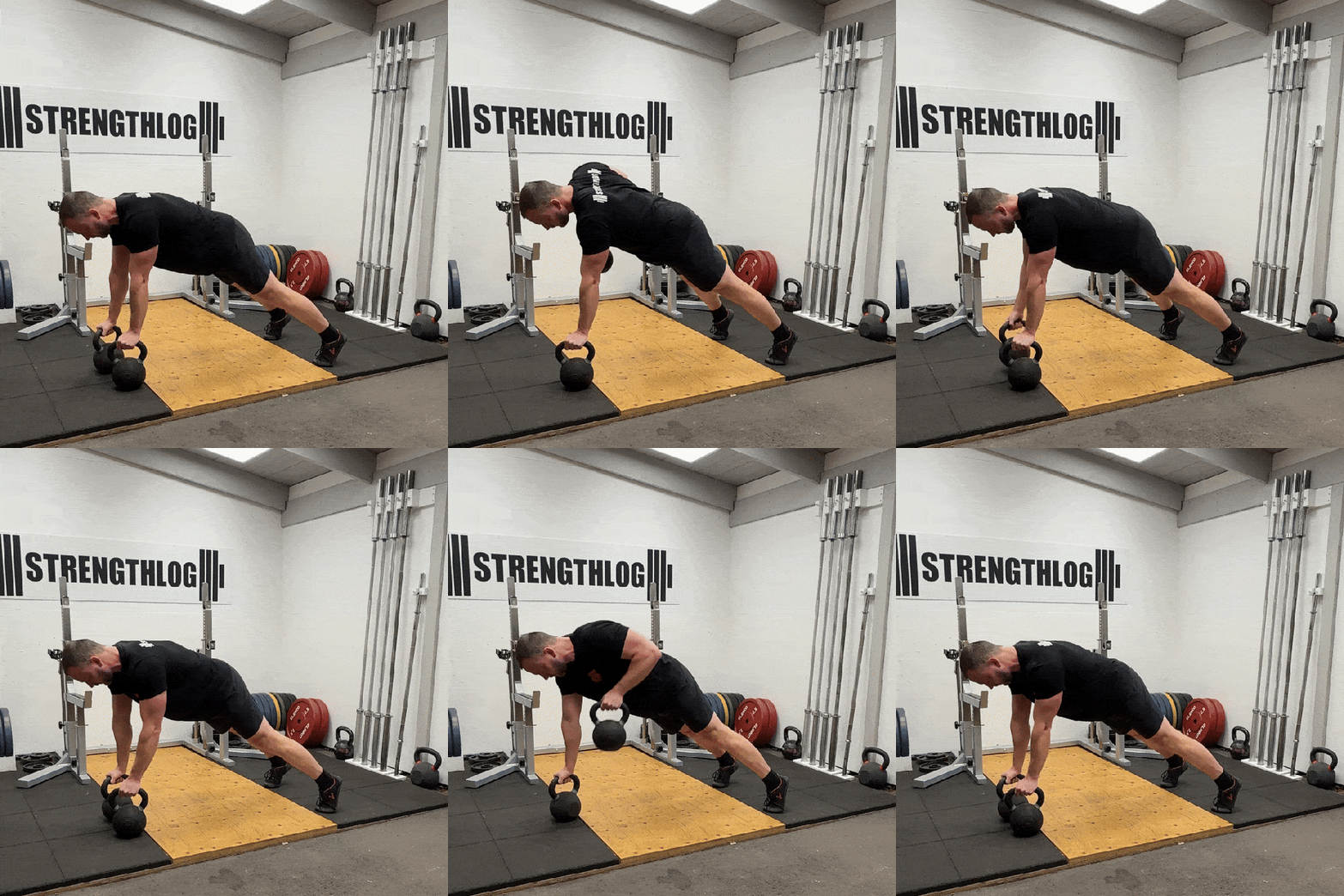
The renegade row is a combination of a high plank with a dumbbell row. You hold a plank position with your hands on two dumbbells or kettlebells, and then you row one dumbbell up to your chest while balancing on the other arm and your toes. Then you switch sides.
Here’s a look at the back muscles it trains:
- Lats, responsible for pulling the dumbbell towards your body.
- Rhomboids and traps stabilize your shoulder blades and help the lats with the row.
- Erector spinae work isometrically to keep your back straight.
Renegade rows look simple when you see someone doing them, but when you try them for the first time, you quickly realize how many systems of your body must work together.
While not the best mass-building, heavy back exercise you can do (stability will be the limiting factor, not your pulling strength, and you can’t get the back stretch of a free row), it’s great in the right context, like circuits, stability training, and as a bang-for-your-buck exercise to work large parts of your body quickly.
Pro Tip: Push the floor away with your non-working hand. It’s easy to focus only on pulling with your working side, but if you actively push down into the floor at the same time, you lock your core in place and will be able to work your back more.
How to Do Renegade Rows
- Start in a high plank position with your hands gripping a pair of dumbbells (hex dumbbells work better than round ones) or kettlebells placed directly under your shoulders.
- Keep your body in a straight line from head to heels, feet slightly wider than hip-width for balance.
- Brace your core and row one weight toward your ribcage, keeping your elbow close to your body.
- Lower the weight back to the ground with control.
- Repeat on the opposite side, alternating sides for the desired number of reps.
9. Reverse Dumbbell Fly

The reverse dumbbell fly often gets grouped with shoulder exercises, which makes sense, because it’s a top-of-the-line rear delt builder.
However, it’s also great for your upper back, the rhomboids and the middle traps. When I follow a push/pull/legs split, I actually prefer to do them on the pull day, with back and biceps.
You can do reverse flyes in many ways, hitting the back or delts a bit differently depending on torso angle:
- If your goal is rear delt growth, keep your torso close to parallel to the ground.
- If your goal is upper back or posture work, use a 30–45° torso angle to bring in more scapular movement.
For the latter variant, using a bench makes the movement more stable and controlled and can make it easier to focus on the right muscles.
Because reverse flyes are an isolation exercise for a smaller muscle group, I think they work best toward the end of your workout, after your heavy rows and pull-ups on back day or after your heavy overhead presses on shoulder days.
Pro Tip: Use a relatively light weight for higher reps to really feel the burn and go for a good mind-muscle connection.
How to Do Reverse Dumbbell Flyes
- Hold a pair of dumbbells, lean forward, and let your arms hang towards the floor.
- With almost straight arms (just a slight bend at the elbow), slowly lift the dumbbells by raising your arms out to the sides.
- Reverse the movement and lower the dumbbells back to the starting position.
- Repeat for reps.
10. Y Raise

The Y raise is a seemingly wimpy exercise, but one of the most underrated ones for strong and pain-free shoulders. It is primarily a scapular stabilizer exercise, building strength in the small muscles that keep your shoulder blades moving correctly: the lower traps, rhomboids, and rear deltoids, with some help from the rotator cuff.
It’s not a mass or 1RM builder, but it’s not meant to be. Y raises work great as:
- A warm-up for your upper-body workouts to get the shoulder stabilizers firing.
- A finisher for back or shoulder day as a burnout/accessory movement.
- A rehab/prehab exercise if you’re rebuilding shoulder strength after an injury (or want to avoid getting one).
This is one exercise where you want to visit the area in the gym with the smallest dumbbells you can find. Using heavy weights turns it into a momentum-fueled mess and completely misses the point.
Pro Tip: Lead with your thumbs and keep your ribs down. Thumbs up means you externally rotate your shoulder, activating your lower and middle traps and protecting your rotator cuff. Ribs down (avoid arching your lower back, in other words) helps you move from your shoulder blades, not compensating with your spine.
How to Do Y Raises
- Lie face down on an incline bench (about 30–45°) with your arms hanging straight down.
- Raise your arms forward and slightly outward in a Y shape (about 30–45° from your torso), thumbs pointing up.
- Pull your shoulder blades down and together as you lift your arms to head height.
- Pause briefly at the top, then lower under control.
- Repeat for reps.
Should You Get Adjustable or Fixed Dumbbells?
If you work out in a commercial gym, you can skip this part. You have more dumbbells than you’ll ever need at hand (probably).
But for a home setup, should you go with fixed or adjustable dumbbells?

For most people, I’d say adjustable dumbbells are the way to go. The space and cost savings are hard to beat, and the quality is nice these days, as long as you go with a reputable brand.
When I first tried adjustable dumbbells several decades ago, they clanked around and felt like I was about to launch a weight plate across the room when doing curls.
Fortunately, today’s adjustables are a world away from those early rinky-dink models. Better materials, more secure locking mechanisms, and designs that feel closer to a traditional fixed dumbbell.
I’m not going to lie: I’ll always prefer fixed, everything else being equal, but the cost and space requirements can be a deal breaker if you’re on a budget and don’t have something like a garage to turn into a home gym.
| Consider This… | Go with Adjustable Dumbbells if… | Go with Fixed Dumbbells if… |
| Your Space | You’re tight on space and need a compact solution. | You have a dedicated workout area with room for a rack. |
| Your Budget | You want the most bang for your buck in the long run. | You’re starting with just a couple of pairs or have a bigger budget for a full set. |
| Your Workout Style | You like a lot of variety and different exercises in your routine. | You prefer fast-paced workouts like circuit training. |
| Durability | You’re careful with your equipment and won’t be throwing your weights around. | You want something that can take a beating and last a lifetime. |
TL;DR: If you have the space and don’t mind spending hundreds of dollars, consider fixed dumbbells. If that doesn’t sound appealing, adjustable dumbbells let you get your workout in at home without needing a dedicated wing of your house for a dumbbell rack.
The Best Dumbbell Back Workouts for Muscle & Strength Gains
With the dumbbell back exercises we’ve just covered, you can design a workout for any experience level and training goal.
But what if you don’t want to design your own?
Then follow one of ours!
For Beginners
If you are new to strength training, you don’t need a separate back day workout with 10 or more sets for your back muscles alone.
Instead, I suggest you go with full-body workouts, training your entire body each session, two or three times per week.
Dumbbells work great with this approach. In fact, we have built a highly effective dumbbell workout you can follow directly in our workout app, StrengthLog. It targets all major muscle groups, and you can do it anywhere.
Home Dumbbell Workout for Beginners
| Exercise | Sets | Reps |
| Goblet Squat | 2 | 10 |
| Dumbbell Romanian Deadlift | 2 | 10 |
| Dumbbell Floor Press | 2 | 10 |
| Dumbbell Row | 2 | 10 |
| Dumbbell Shoulder Press | 2 | 10 |
| Dumbbell Curl | 1 | 10 |
| Dumbbell Triceps Extension | 1 | 10 |
You train your back extensors with deadlifts and your upper back and lats with the dumbbell rows. And that’s plenty if you’re new to lifting. Do 10–12 reps per set, and go through this workout twice or thrice weekly for best results.
Get started with the Home Dumbbell Workout for Beginners, free in StrengthLog.
For Intermediates
If it’s time to take your back training to the next level, give this home back workout a go.
This is an intermediate-level (and above) workout that fits perfectly into almost any three-, four-, five-, or six-day split, including popular routines like Push/Pull/Legs (on Pull day).
It is a premium workout, meaning it requires a subscription to follow in StrengthLog, but you can activate a 14-day free trial to see if it’s for you.
Home Back Workout
You can see the exact set configuration and rep ranges in StrengthLog.
If you don’t have a pull-up bar or can’t do pull-ups yet, switch that exercise out for three sets of dumbbell pullovers. Or do an extra set of each of the last three exercises.
Go directly to the Home Back Workout in StrengthLog.
Follow These Workouts in StrengthLog
What’s the best way to track these workouts?
In StrengthLog, our workout log app.
That way, it’s super easy to keep track of your weights and reps and make sure you’re on the right track.
The app remembers what weights you used in your last session, and automatically loads them into your next session. And trying to improve on your last workout is the key to improving and getting stronger over time.
Download it and start tracking your gains today.
Track Your Training. See Real Progress.
Log your workouts in one place and watch your numbers climb, week after week.
- Free to get started
- Fast workout logging
- Cardio, mobility, and strength training
- Sport-specific strength plans, including running, soccer, judo, boxing, and more
- Progress over time, personal bests
- Free and premium training programs and workouts for every fitness goal
Download StrengthLog free:


Final Rep
Alright, so there you have “what”: a whole arsenal of back-blasting exercises to build strength, muscle, stability, and posture.
The “how” is up to you. Pick your favorites, create your own dumbbell workouts, or follow one of ours. Remember to download our workout log to track your gains.
Want more?
Subscribe to our weekly newsletter to get notified of new articles and get weekly training tips!
Click here to return to our full list of strength training exercises.
Last reviewed: 2025-10-20
