
Everyone talks about lats, traps, and pecs, but rhomboids?
They are two muscles in your upper back, hiding underneath your trapezius muscle. You can’t really see them, but you’d definitely miss them if they weren’t there. Visually, they contribute to your back density, and without them, your shoulders would collapse, and every arm movement would feel unstable.
When you’ve read this article, you’ll know how to train your rhomboids effectively: what they do, the best exercises, and workouts that hit both them and the rest of your back.
And here’s a fun detail: they’re called rhomboids because they look like a rhombus, a diamond shape. Which means you’re literally polishing the diamonds in your back every time you train them. Not bad for a couple of little muscles hiding under the traps.
Table of Contents
Anatomy of the Rhomboids and What They Do
You’ve got two rhomboid muscles on each side of your spine, right between your shoulder blades: the rhomboid minor and the rhomboid major.
- The rhomboid minor is the smaller, superior (superior as in higher up, not better) of the two. It originates from the spinous processes of the C7 and T1 vertebrae (the bony bumps on your neck and upper back) and attaches to the longest edge of your shoulder blade (the medial border) at the base of the scapular spine.
- The rhomboid major is not surprisingly the larger of the duo and sits below its smaller friend. It originates from the spinous processes of the T2 to T5 vertebrae and attaches to the same edge of the shoulder blade, but a bit lower down.

Together, they form a neat diagonal muscle group that looks almost like little ropes pulling your shoulder blades toward your spine.
The rhomboids are situated deep under the trapezius muscle, so you can’t see them, but you can feel them working. It’s easiest to do on someone else, but you can also reach over and feel your own if you’re not too stiff:
Take your left hand, reach over your right shoulder, and press into the fleshy area between your spine and shoulder blade. Bring your right elbow backward, as if you’re trying to elbow someone in the gut, and you should feel the rhomboids pop up.
What the Rhomboids Do for You
The rhomboids have four main responsibilities: one big job and three supporting roles:
- Their number one function is scapular retraction. When they contract, they pull your shoulder blades back and together. That squeezing motion is part of rowing exercises for your back, like when you pull the weight up in a dumbbell row.
- The rhomboids also help you lift your shoulder blades straight up, like when you shrug your shoulders and say, “I dunno” or grunt out a set of dumbbell shrugs. They’re not the main muscles for this scapular elevation (that’s the upper trapezius and levator scapulae), but they’re an important helper.
- In addition, the rhomboids perform downward rotation of the scapula, which is simpler than it sounds: when you lower your arm from overhead, they work with a team of other muscles to pull the bottom of your shoulder blade back down and into its resting position.
- Lastly, they keep your shoulder blades snug against your rib cage. Without that stabilization, your shoulder blades would wing out, your arm movements would lose much of their power, and you’d be more likely to injure yourself.
Exercises for the Rhomboid Muscles
In this section, we’ll take a look at five of the best rhomboid exercises, a diverse “top 5” list that hits them from all angles with different (or no) equipment: heavy compounds, bodyweight exercises, and isolation movements.
By putting them all together, as we’ll do in the next section, you can create a great back/rhomboid workout.
1. Barbell Row
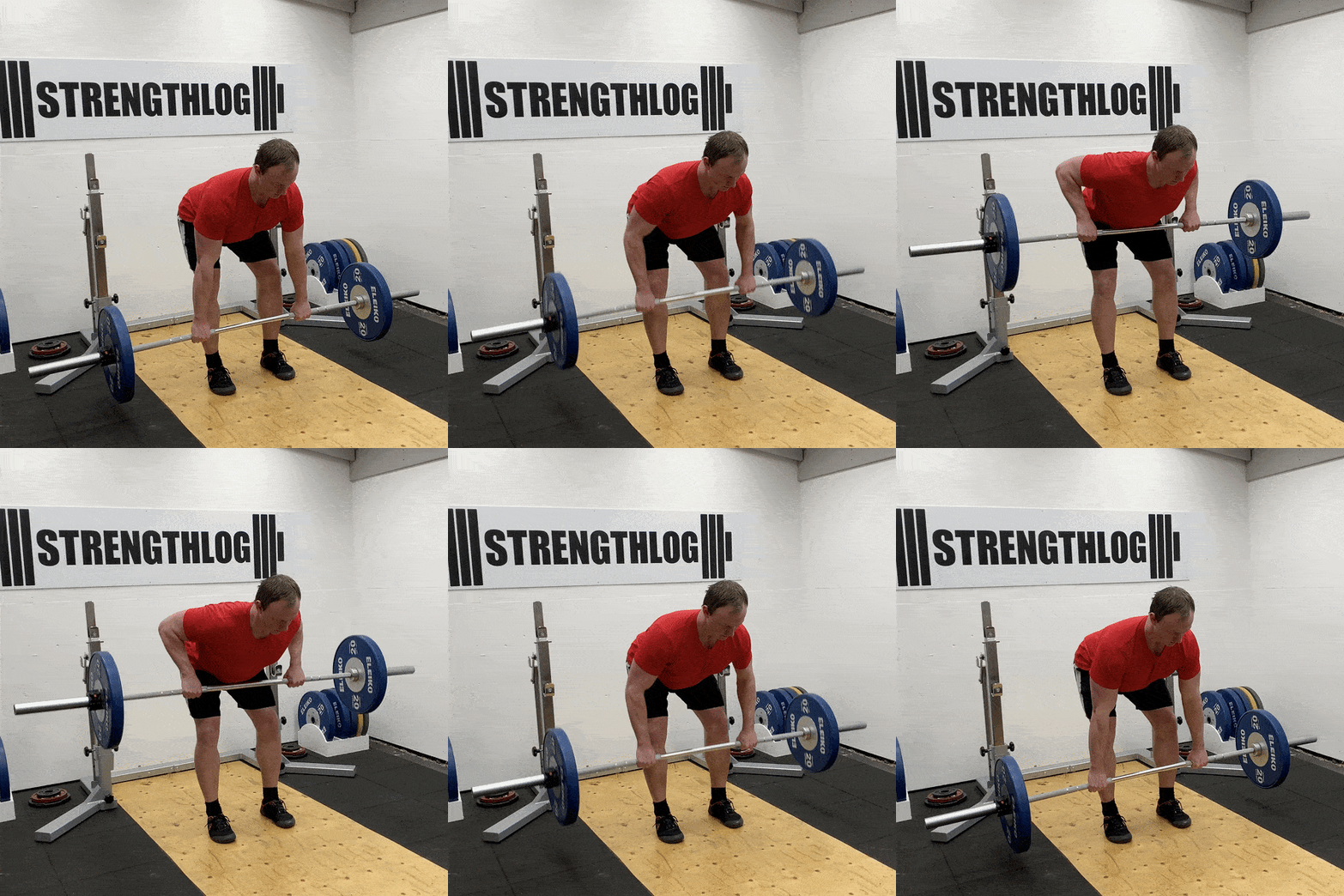
The barbell row is your meat-and-potatoes exercise for back thickness, and the rhomboids get absolutely hammered. It allows you to move the most weight, and more weight equals more potential for strength and size.
It’s also great for the lats and traps, and because you have to stabilize your entire body, it also works your core and lower back.
Pro Tip: To focus more on the rhomboids, think pulling with your elbows, not your hands. Don’t yank the weight up with your hips and lower back, pull the bar towards your lower chest/upper stomach, and feel the squeeze at the top.
How to Do Barbell Rows
- Grip the bar with an overhand grip.
- Lean forward with the bar hanging from straight arms.
- Inhale and pull the bar towards you.
- Pull the bar as high as you can so that it touches your abs or chest, if possible.
- With control, lower the bar back to the starting position.
- Repeat for reps.
2. Dumbbell Row

If the barbell row is a sledgehammer, the dumbbell row is your scalpel. When you lift one side at a time, you can’t compensate with your stronger side, and you get a greater range of motion for a deeper stretch and more peak contraction at the top.
It also takes twice as long as barbell rows, but think of it not just as double the time but as double the fun.
Pro Tip: Instead of doing dumbbell rows robot-strict with your upper body locked in place, let your shoulder blade come forward at the bottom. Then, as the dumbbell comes up, pull it back and focus on the contraction in your mid-back. A slight rotation at the top is OK.
How to Do Dumbbell Rows
- Start by placing a dumbbell on the floor beside a bench or chair. Stand facing the bench or chair and place your left hand and left knee on top of it.
- Keep your back flat and parallel to the ground, with a slight bend in the standing leg. Grip the dumbbell with your right hand.
- Inhale and pull the dumbbell by driving the elbow toward the ceiling.
- With control, lower the dumbbell back to the starting position while exhaling.
- Complete desired reps on one side, then switch to the opposite arm and leg.
3. Inverted Row

The inverted row is basically a reverse push-up and arguably the best bodyweight exercise for the rhomboids. It builds functional pulling strength without loading your spine.
It’s scalable regardless of your strength and fitness level:
- To make it easier, set the bar higher. The more upright your body, the less of it you have to lift. You can also bend your knees and plant your feet on the floor.
- To make it harder, set the bar lower. The more parallel your body is to the floor, the harder it gets. You can also place your feet on a bench or box. If it’s still not challenging enough, you can have a friend place a weight plate on your chest.
Pro Tip: Don’t let your hips sag. It turns the exercise into a weird, ugly hip bridge. Keep your core tight and your body straight.
How to Do Inverted Rows
- Place a barbell in a rack (or use a Smith machine), high enough for you to be able to hang below it in straight arms, with your heels on the floor. If you don’t have a bar, anything sturdy like a heavy table that won’t flip over will do.
- Grip the bar with an overhand grip, slightly wider than shoulder-width apart.
- Inhale, and pull yourself up as high as you can, or until your chest touches the bar.
- Exhale, while lowering yourself back to the starting position with control.
- Repeat for reps.
4. Face Pull

One of the best exercises for shoulder health, the face pull works the rhomboids, the rear delts, and the external rotators of your shoulders in one simple movement.
Use a lighter weight and go for perfect form. You want to focus on feeling the right muscles doing the job instead of trying to move as much of the weight stack as possible.
Pro Tip: Think about making a double biceps pose at the maximum contraction point. It’ll help you get the external rotation and hit the right muscles.
How to Do Face Pulls
- Fasten a rope handle in a high position on a cable pulley. Grip the ropes with an overhand grip, and take a step or two back.
- With elbows held high, pull the rope towards you by letting your upper arms move straight out towards your sides while simultaneously rotating your forearms up.
- Return with control to the starting position by letting your arms move forward again.
- Repeat for reps.
5. Reverse Fly


Wait, isn’t the reverse fly a rear delt exercise? Yes, but it’s also a great rhomboid exercise if you do it right.
It isolates the smaller muscles of the upper back and creates the “popped” look from behind. It’s fantastic for mind-muscle connection and is often used as a finisher to pump blood into the muscles at the end of a workout.
You can do it with dumbbells, cables, or a machine. Dumbbells are fine, but the other two variants allow for a constant tension, and the machine removes the need for stabilization. Regardless of equipment, focus on squeezing your shoulder blades together instead of just swinging the weight back.
Pro Tip: Avoid rocking your body or using momentum; the movement should be driven entirely by your upper back muscles.
How to Do Reverse Dumbbell Flyes
- Hold a pair of dumbbells, lean forward, and let your arms hang towards the floor.
- With almost straight arms (just a slight bend at the elbow), slowly lift the dumbbells by raising your arms out to the sides.
- Reverse the movement and lower the dumbbells back to the starting position.
- Repeat for reps
How to Do Reverse Cable Flyes
- Attach two handles in the upper pulleys of a cable crossover.
- Reach across your body and grab the handle from the right side of the machine with your left hand and the left handle with your right.
- Position yourself in the center of the machine. Keep your arms straight ahead, your chest up, and brace your core.
- Keep the elbows slightly bent while pulling your arms backward until they are about parallel to your body.
- Reverse the movement.
- Repeat for reps.
Rhomboid Workouts
Now, let’s talk about how to train your rhomboids by putting together a few great workouts for them.
First of all, you likely don’t need a dedicated rhomboid workout focusing only on these two muscles.
A well-designed back day that includes rows, pulls, and scapular retraction work should be enough for 99% of lifters. You’ll give your rhomboids a good workout along with other mid- and upper-back muscles like the traps, lats, and rear delts.
But:
- If you have postural issues (rounded shoulders/forward head posture)
- If you notice a major strength imbalance (like strong lats but weak scapular retractors)
- For prehab/rehab after shoulder problems (follow your physio’s recommended exercise plan)
In that case, you might want to add some specific scapular retraction work.
But even then, you don’t need a whole separate routine. Just sprinkle in band pull-aparts, face pulls, or scapular pull-ups at the end of your back workout as a finisher.
Again, most people don’t need that. A comprehensive back day with good pulling variety usually does the trick.
Beginner Rhomboid Training
If you’re new to the gym, one of our beginner programs, like the Beginner Barbell Training Program gives your rhomboids all the training they need.
You train three times per week, alternating between workouts A and B:
Workout A
| Exercise | Sets | Reps |
|---|---|---|
| Squat | 3 | 8–10 |
| Bench Press | 3 | 8–10 |
| Barbell Row | 3 | 8–10 |
Workout B
| Exercise | Sets | Reps |
|---|---|---|
| Deadlift | 3 | 6–8 |
| Lat Pulldown (or Pull-Ups) | 3 | 8–10 |
| Overhead Press | 3 | 8–10 |
In other words, you’ll train workouts A, B, A in week one and B, A, B in week two, then repeat that two-week cycle.
Get started with the Beginner Barbell Training Program, free in StrengthLog.
Once you are past the beginner stage, you might want to split your body into several parts, maybe even with a dedicated back day, but the rows and deadlifts in a program like this are plenty for your rhomboid muscles at this point.
Speaking of back day, here are three back workouts you can do that will give your rhomboids the attention they deserve. They are for intermediates and above and are all available in our workout tracker app, where you can see demonstrations of and track your reps and weights for each exercise.
StrengthLog’s Back Workout
| Exercise | Sets | Reps |
| Deadlift | 3 | 5 |
| Lat Pulldown | 3 | 8 |
| Dumbbell Row | 3 | 10 |
| Back Extension | 3 | 12 |
| Reverse Dumbbell Fly | 3 | 15 |
The exercises complement each other, and cover all the major muscles of the back with a rep range from low reps with heavy weights to high reps with lighter weights.
This workout is free to follow in-app.
Go directly to the Back Workout in StrengthLog.
StrengthLog’s Bodybuilding Back Workout
| Exercise | Sets | Reps |
| Rack Pull | 3 | 5 |
| Lat Pulldown | 4 | 10–12 |
| Barbell Row | 4 | 6–8 |
| Dumbbell Row | 3 | 10 |
| Seated Cable Row | 3 | 12–15 |
| Dumbbell Pullover | 2 | 10–15 |
The bodybuilding back workout is a high-volume training session for intermediate to advanced bodybuilders looking to pack on lean muscle and covers the entire back, from top to bottom, including the rhomboids.
Start the Bodybuilding Back Workout in StrengthLog.
It’s a premium workout, which means it requires a subscription to follow in StrengthLog. But you can activate a 14-day trial in the app to see if it’s for you. No strings attached, pinky promise.
StrengthLog’s Pull Day Workout
| Exercise | Sets | Reps |
| Deadlift | 3 | 5 |
| Barbell Row | 3 | 8 |
| Lat Pulldown | 3 | 10 |
| Dumbbell Row | 2 | 10 |
| Face Pull | 2 | 12 |
| Barbell Curl | 2 | 10 |
| Preacher Curl | 2 | 15 |
In our pull day workout, you train not only the back and rhomboids but also the biceps. It’s a very popular workout and fits perfectly in any of the P spots in a PPL split (push/pull/legs or pull/push/legs).
It is 100% free to follow in our workout log app.
Open the Pull Day Workout in StrengthLog.

You can find all the above workouts (and many more) in our workout log app, StrengthLog. Download it and start tracking your gains today.
Track Your Training. See Real Progress.
Log your workouts in one place and watch your numbers climb, week after week.
- Free to get started
- Fast workout logging
- Cardio, mobility, and strength training
- Sport-specific strength plans, including running, soccer, judo, boxing, and more
- Progress over time, personal bests
- Free and premium training programs and workouts for every fitness goal
Download StrengthLog free:


Stretching Your Rhomboids
How to stretch your rhomboids isn’t self-explanatory. Here are three neat stretches for them, with step-by-step instructions.
But first, you might already be getting enough of a stretch from your workouts. I’d go as far as to say that dedicated rhomboid stretching is probably not necessary for most people who train their back with a full range of motion (ROM).
Because if you do your bent-over rows or dumbbell rows with a full ROM, the starting position of the exercise already places your rhomboids in a stretched position:
- At the bottom of a row, if you allow your shoulder blades to move forward and round a bit, you’re giving your rhomboids a nice stretch.
- The eccentric (lowering) part of the lift lengthens the muscle under tension, which is great for flexibility over time.
And data from more than 50 studies show that strength training is just as effective as stretching if you want to improve flexibility.1
So, Is Dedicated Stretching Useless?
No. Influencers might sell you that “X is KILLING your gains” or “STOP doing Y,” but things are rarely black or white.
Stretching can still be useful:
- If your upper back feels tight and you want to improve faster
- If your chest and front delts dominate and pull you into protracted shoulders
- If you just like the feeling of a good stretch after back day
So, even if it’s just because it feels good, that’s reason enough.
In short, stretching your rhomboids is not necessary in a strict sense. It’s an additional tool for mobility, but not a requirement if you do most of your training with a full ROM.
Making sure your shoulder blades move freely into protraction (stretch) and retraction (contraction) dynamically under load is more important than stretching for the sake of stretching.
If you stretch tight rhomboids without those two things in place, you’re basically putting a Band-Aid on a wound that won’t heal. First, fix why your rhomboids are tight (probably because you’re not training them through their entire range), then add stretching if you need to or if you like how it feels.
Cat Cow

The cat cow is a dynamic stretch for spinal mobility and stretches your rhomboids in the cat phase. You also get the contraction part of the movement during the cow phase as you draw your shoulder blades slightly toward each other.
- Start on all fours, with the shoulders over the wrists and the hips over the knees.
- For the cat pose, push the ground away and round your spine towards the ceiling. Tuck your chin to your chest and spread the shoulder blades apart to make space in the upper back.
- For the cow, arch your back and bring the shoulder blades toward each other, gaze up.
- Flow between cat and cow positions, synchronizing with your breath.
Thread the Needle

The thread the needle stretch pulls your rhomboids into a lengthened position and adds a nice rotational stretch for your thoracic spine (your mid-back).
- Start on all fours. Bring one arm under the other by rotating your torso and lowering the shoulder and ear to the mat.
- Extend the other arm forward. Keep your hips straight over your knees. Hold, then switch sides.
Upper Back Stretch

This upper back stretch puts your rhomboids into a direct stretch by pulling your shoulder blades apart. Besides the rhomboids, it also stretches your mid and lower trapezius muscles and the teres major/minor.
- Seated or standing, extend your arms straight out in front of you as you round your back and actively spread the shoulder blades apart for a stretch in the upper back.
- Round your upper back slightly while keeping your arms extended to increase the stretch.
Want to get started with mobility training? Try StrengthLog free for more than 50 of the best mobility exercises and both static and dynamic stretches.

Frequently Asked Questions About How to Train Your Rhomboids
They pull your shoulder blades back, help with your posture, and stabilize your upper back.
Rows, face pulls, and reverse flys are some of the best exercises.
Not directly, because they sit under your traps. But they add density to your back.
Usually no. A good back day with rows and pulls is enough for most. Try one of the workouts above for complete rhomboid coverage.
Shameless self-promotion: StrengthLog – free to use, easy to log, and packed with back workouts.
Final Rep
And that’s it! By now, you have a good grasp of your rhomboids: how they work, some of the best exercises for this important duo, and how you can combine those exercises into one awesome workout.
Remember to download our workout log app to follow the workouts and track your gains. Increase the weight you use in each exercise to make sure you enjoy continued muscle growth and strength gains.
Want more?
Subscribe to our weekly newsletter to get notified of new articles and get weekly training tips!
Do you want to read more of our muscle group training guides? You can find them all here.
Last reviewed: 2025-09-29
