
This is your no-nonsense blueprint to building big forearms.
You can have biceps that threaten to rip your t-shirt sleeves and triceps like horseshoes, but if your forearms look like a couple of sticks, the illusion is ruined.
In this article, you’ll learn how to turn those sticks into bowling pins. The best exercises, technique tips, and workout routines that actually work.
Want to jump straight to the workouts? No problem!
Table of Contents
Know Your Muscles (Forearm Anatomy 101)
To build big forearms, you have to know what you’re training.
I’ll be super brief, and I promise you won’t have to memorize the Latin names of all 20 muscles. But we need to group them into three buckets, so you know what the exercises we’ll go through do and can hit them effectively.
Your forearms are a complex web of meats that control your hands, wrists, and fingers and allow you to do heavy-duty things like crush a can of pop or deadlift hundreds of pounds and thread a needle.
A pretty neat thing about your hands is that the muscles that move your fingers aren’t inside your fingers. If they were, you would have fingers like bratwursts.
Instead, those muscles are up in your forearm, pulling on tendons that run down through your wrist to your fingertips. When you wiggle your fingers, you’re pulling strings like a marionette.
The forearm muscles are split into two compartments that do opposite things.
Forearm Flexors
Your forearm flexors sit on the underside of your forearm, the same side as your palm.

Their main job is to curl your wrist in (flexion) and close your fingers into a fist. When you grab a dumbbell, squeeze a stress ball, or hang on during a pull-up, your forearm flexors are maximally involved.
- Key Muscles: Flexor Carpi Radialis, Flexor Carpi Ulnaris, and the deep finger flexors.
Forearm Extensors
Your forearm extensors sit on the top of your forearm (usually the hairy side).

They extend your wrist (hence the name) and straighten your fingers. Without them, you couldn’t high-five anyone after a successful set of squats or let go of something once you grabbed it.
- Key Muscles: Extensor Digitorum, Extensor Carpi Ulnaris.
Forearm Pronators and Supinators
The forearms have a special power called rotation, thanks to two bones: the radius and the ulna.

- Supinators: Turn your palm up, like you are holding a bowl of soup (soup-inate – get it?)
- Pronators: Turn your palm down, like you are pouring out the soup.
- Key Muscles: Pronator Teres, Pronator Quadratus, Biceps Brachii, Supinator.
The main function of the biceps isn’t actually to flex your elbow but to supinate your forearm. They connect to the radius in a way that makes them very powerful supinators.
Brachioradialis
There is one muscle that bridges the gap between the forearm and the upper arm: the brachioradialis, the thick and meaty muscle on the top of your forearm near the elbow.
You can see it in the topmost anatomy image above, right below the brachialis and the biceps.
It doesn’t move the wrist; it helps flex the elbow (bring your hand to your face) and gives the forearm its 3D shape and size. Seven-time Mr. Olympia Phil Heath, at his peak, sported brachioradialis that looked like they had their own area code.
Summary Table: Who Does What?
| Action | Group | Example |
| Flexion | Anterior (Front) | Doing a dumbbell wrist curl. |
| Extension | Posterior (Back) | Revving a motorcycle handle. |
| Supination | Rotators | Holding a tray of yummy pizza. |
| Pronation | Rotators | Pouring out a drink. |
To build big forearms, you need to hit all of these muscles and functions.
The Best Exercises to Build Big Forearms
Some people are blessed with genetics that make their forearms grow from just gripping the bar.
I knew a guy in the ’90s who had to use straps for almost everything to minimize forearm involvement, or they would get such a massive pump that he couldn’t hold onto the weight. His forearms were almost bigger than his upper arms.
That’s not most of us, though. Our forearms don’t panic and grow just because we did a few biceps curls. For some, they are the calves of the upper body, seemingly refusing to grow no matter what we throw at them.
I had puny forearms the first half decade when I started training, but after enduring plenty of torture, they are now pretty decent.

Forearms are stubborn, but they will grow if you give them a reason to.
And you don’t need a menagerie of 20 different exercises, one for each forearm muscle. You need a handful of simple, effective ones, and plenty of hard work.
1. Wrist Curl


The classic wrist curl is the most direct way to overload your forearm flexors.
You can use either a barbell or a pair of dumbbells and do it kneeling with your forearms on a bench or seated with your forearms on your quads. I usually prefer dumbbells because they don’t lock my wrists into a set path, but if yours don’t mind, the barbell lets you use a heavier load.
Use a thumbless grip and let the bar roll all the way down into your fingertips at the bottom of the rep, then roll it back up as you curl your wrist. Not having your thumb wrapped around the bar makes it easier to get a nice contraction at the top.
How to Do Wrist Curls
- Grab a barbell or a pair of dumbbells with an underhand grip and rest your forearms against your thighs, or alternatively against a bench.
- Lower your hands towards the floor, and let the weight roll out in your fingers.
- Reverse the motion by closing your grip and bending your wrists upwards.
2. Wrist Extension


Wrist extensions add thickness on the top side of your forearms. When your extensors are strong, they also protect your elbows and wrists, so you can train everything else harder. They are also called reverse wrist curls.
Don’t cheat; I often see people (when I see someone training their forearm extensors in the first place, which isn’t that often) bouncing a too-heavy weight through a short ROM.
I’ve always found that a lighter weight you can control completely, moderate-to-high reps (10 or more), and going for a good burn and pump are ideal here.
Like with wrist curls, you can use a barbell or a pair of dumbbells, whichever you prefer and have at hand.
How to Do Wrist Extensions
- Grab a barbell or a pair of dumbbells with an overhand grip and rest your forearms against your thighs, or alternatively against a bench.
- Lower your hands towards the floor.
- Reverse the motion by bending your wrists upwards.
3. Reverse Curl


The reverse curl uses a pronated grip, which hits the biceps a little less but places a higher load on the brachioradialis.
Keep your wrists neutral (flat) rather than fully extending them (cocking them back) at the top. If you curl your wrists in toward your body, you shift a lot of the tension onto the smaller extensor muscles near your wrist. Which is fine, but you have the reverse wrist curl for that. If you keep them neutral, you’ll force the brachioradialis near the elbow to do more work.
You will be significantly weaker on these than on normal curls. Expect to reverse curl maybe half or a little more than half of what you can do in regular biceps curls.
Again, feel free to use a barbell or dumbbells. Not everyone’s wrists were designed to hold heavy weights horizontal while pronated, so dumbbells can often be the better option if you feel discomfort.
How to Do Reverse Curls
- Grip a bar or a pair of dumbbells with an overhand (pronated) grip.
- Lift the weight with control, by flexing your elbows.
- Don’t let your upper arm travel back during the curl. Keep it at your side or move it slightly forward.
- Reverse the movement and lower the weight back to the starting position.
- Repeat for reps.
4. Farmer’s Walk

The farmer’s walk (or farmer’s carry) is a functional full-body exercise that is much more than a forearm builder. Few exercises train so many muscle groups at once, and it’s great for building work capacity, conditioning, posture, and functional strength.
But let me tell you why it’s good for building big forearms.
When you pick up something heavy and walk with it, like in a farmer’s walk, your forearm flexors have to clamp down to keep your fingers closed. And because you are moving, the load shifts and bounces, so you have to micro-adjust your grip constantly. That creates tension that radiates up your entire arm and fries the muscle fibers in your forearms.
Don’t use straps (obviously). Squeeze the handle (or dumbbells, kettlebells, or whatever you use) harder than you need to. White-knuckle it.
How to Do Farmer’s Walks
- Pick up a pair of suitably heavy weights (dumbbells, kettlebells, or special handles).
- Hold your breath, brace your core slightly.
- Look ahead, and start moving forward in small steps. Increase the stride length as you increase the speed.
- Keep your body straight and do not lean excessively forward as you walk.
- When you are done, put the dumbbells back on the ground in a controlled manner.
5. Bar Hang
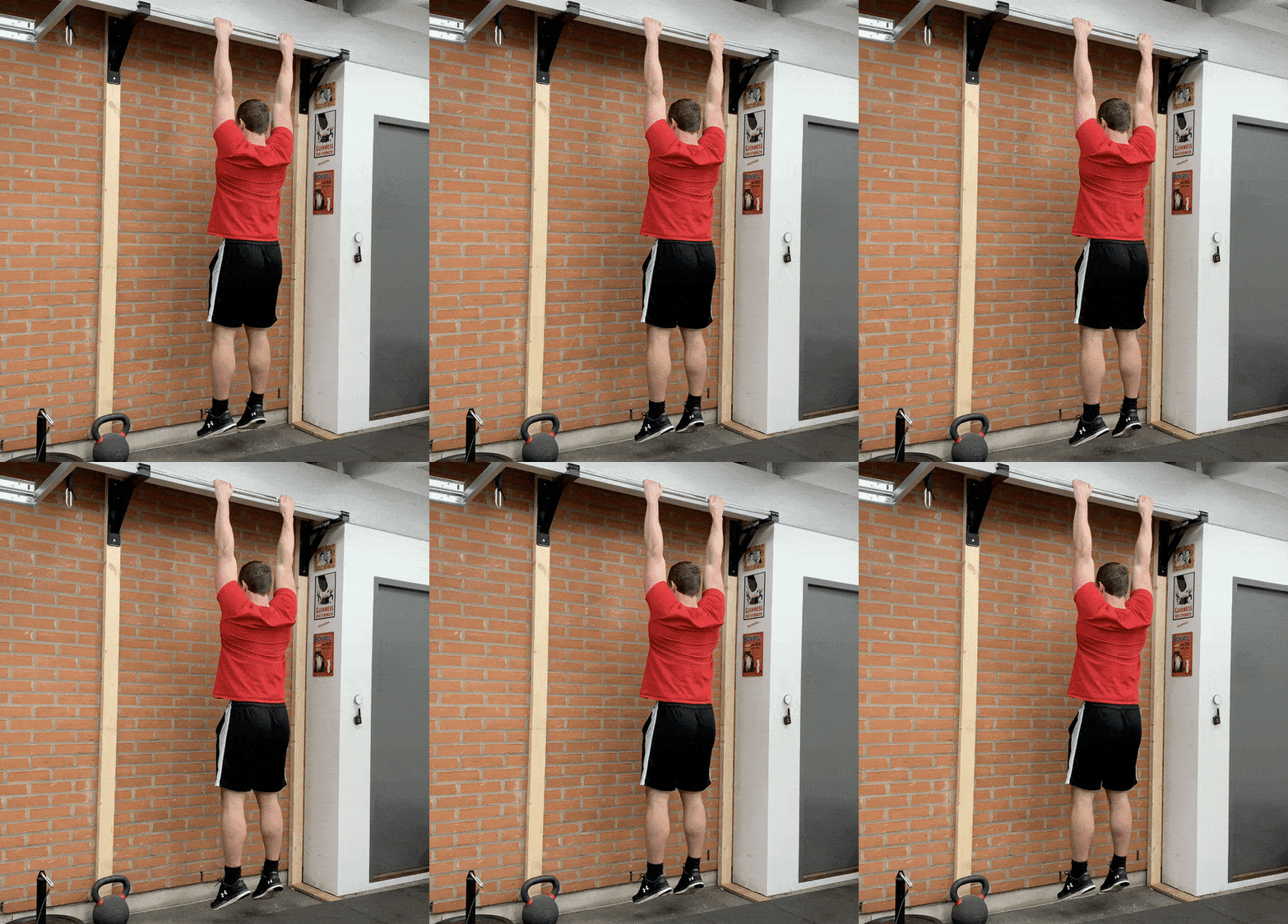
Whether you know them as bar hangs or dead hangs, this exercise hits your forearms with isometric tension as gravity tries to peel your fingers off a bar. They are the best way to train your forearms with only your bodyweight.
Once hanging for the same time becomes easy, you can use Fat Grips or wrap a towel around the bar to force your hand open, and make your flexors work harder. You can also use a backpack or a weight belt to add some extra resistance that way.
If you’re strong enough, you can also try the one-arm bar hang. If you haven’t done it before, you’ll be surprised when your body starts to spin. Resist it with your forearm, and you’ll add a bonus anti-rotation component to the exercise.
6. Wrist Roller

You know that machine with a rope and a weight attached to it? That is the wrist roller. If your gym has one, you have one of the best exercises for building big forearms.
It hits both the flexors and the extensors, depending on which way you roll, and the pump you get from this is bordering on painful. I’m not joking; it fills the muscles with blood and lactate like nothing else and fries every fiber from your elbow to your fingertips.
Do this exercise last in your forearm workout, because you won’t be able to do much more, and your hands might feel like stiff claws for about 5 minutes afterward. This is normal.
How to Use the Wrist Roller
- Stand with your feet shoulder-width apart, holding the wrist roller bar with both hands, arms fully extended in front of you.
- Attach a weight to the rope or cord hanging from the wrist roller.
- Begin the exercise by rolling the bar forward using your wrists, lifting the weight from the ground by winding the rope around the bar.
- Once the weight reaches the top, reverse the motion, unwinding the rope and lowering the weight back to the ground.
- Repeat for reps.
Together, these exercises hit every major forearm function: wrist flexion, wrist extension, elbow flexion under different grips, and gripping under load. They also allow you to use a combination of lighter and heavier weights, different rep ranges, and a long time under tension: exactly what forearms tend to respond to best.
7 Top Tips for Building Big Forearms
There isn’t much research on “how to build big forearms”. A small handful of studies include forearm hypertrophy, but the research base is much, much smaller than for most other muscles.
What does exist tends to fall into a few buckets: 1) direct wrist/forearm resistance programs in people who haven’t done any forearm training before, 2) grip/hand-focused training, and 3) blood-flow restriction (BFR) training that can include the forearm/wrist flexors.
That means that I can’t present any evidence-based guidelines distilled from huge meta-analyses. There aren’t any.
What I can do is give you my best tips based on 40 years of training experience, 30 years of coaching, and what current exercise science knows about muscle growth in general.
1. Train Hard
A no-brainer, you might think. But I mean really hard. Forearms are like calves in that you use them all day, so don’t be surprised if you have to train them to failure and beyond to make them grow.
Stopping at “it burns a bit” probably isn’t enough; stubborn forearms laugh at two reps in reserve.
An effective method for, for example, wrist curls is to train until failure (you can’t complete another rep no matter what), put the bar down on the bench for a few seconds, then pick it up and grind out a few more reps. It’s a painful way to train (immense pump), but might push your forearms into a new growth zone.
2. High Reps or Heavy Weight?
Both.
Most fitness blogs seem to claim that the forearms are mostly Type I (slow-twitch) fibers, but the truth is that there isn’t great, modern, “clean” human biopsy literature that shows this as a general rule. Even textbook data sometimes relies on monkey autopsies.
They are designed to be used all day and are very resistant to fatigue, though.
In my book, it makes sense to do both heavy sets with few reps and lighter sets with many reps, especially since the forearm consists of so many muscles all being trained at the same time, and fiber type likely differs a lot between them, even between regions of the same muscle.
Start with low reps, staying between perhaps 6–10, with as heavy a weight as you can handle with good form and a full range of motion.
Combine those heavy sets with lighter work and high rep ranges (15–25+ reps) or use drop sets or myo-reps (a set of 20, rest 10 seconds, set of 5, rest 10 seconds, set of 5, etc.) to exhaust the muscle fibers completely.
3. Train More Often
You can train forearms more often than, say, legs. Because they have such a good blood supply and are smaller muscles, most people I’ve coached find that they recover quickly.
Instead of doing 15 sets for the flexors and 15 for the extensors on one day of the week and being sore almost until your next forearm workout, you could do 6+6, 6+6, and 6+6 for more weekly volume and not feel as fatigued, or have your other workouts suffer because of it.
Research does support doing all those sets in one go and get similar growth, but for forearms, I feel the risk of the last 50% of those sets turning into junk volume where you can’t go all-out in intensity is pretty high.1 2
Read more about how often to train: The Best Training Frequency for Muscle and Strength.
4. Full Range of Motion Under Load
Research suggests that training through longer muscle lengths is better for hypertrophy.3 For your forearm training, that means letting the wrist extend all the way before curling, and fully flexing before extending, rather than doing partial reps.
That being said, finishing a set with a few “burns” (short, partial reps) when you can no longer do any more full reps is fine and can even be a neat but painful way to go beyond muscular failure. But full ROM first.
5. Train the Brachioradialis
The brachioradialis is the largest single muscle in the forearm group, and it does not cross the wrist joint. That means just tacking on a few wrist curls or extensions at the end of your arm workouts won’t grow it.
The brachioradialis is a primary elbow flexor regardless of how you turn your forearm, but it works the hardest when it’s in a neutral (thumbs up) or pronated (palms down) position.
So, make sure you do some hammer curls or reverse curls to build this meaty guy. I like to do reverse curls in my forearm workouts and hammer curls when I train biceps, so I do both over the week, but that’s more of a personal preference.
6. Control the Eccentric and Pause
Forearm tendons are stiff and elastic, like the Achilles tendon in your lower leg, but on a much smaller scale.
That’s a good thing for athletics (I know “stiffness” sounds bad, but this kind of stiffness is actually beneficial for athletes), but not for muscle growth.
Why? Because if you bounce the weight at the bottom of a wrist curl (very common), it’s not your forearm muscles doing all the work.
The weight stretches that stiff tendon, and when the tendon snaps back, it launches the weight back up the first few inches. Great if you’re sprinting or jumping, but not if you’re trying to build big forearms.
As a result, your muscle fibers do less work during the hardest, and perhaps most productive, part of the lift. And when you’re trying to stimulate hypertrophy, you want the opposite: you want your muscle fibers to fire on all cylinders.
That’s why I want you to do a controlled eccentric (at least a 2–3 second count on the way down). Pause for a second at the bottom, both in wrist curls and wrist extensions. You eliminate the bounce and force the muscle fibers, not the tendon, to move the load from the dead stop.
7. Start Slow and Build Up to a High Volume
You may need a fair amount of training volume to get your forearms to grow. Research shows that a muscle grows more when you do at least 10 weekly sets for it.4
However, only a few studies look at people with training experience. And there is not a single study looking into the optimal number of weekly sets of forearm training in well-trained lifters or bodybuilders.
Would I be surprised if that number were 15 sets, 20 sets, or even more? No, I wouldn’t. Forearms can benefit from a relatively high training volume, especially considering we’re talking about relatively small muscles.
But, and this is important, don’t make the mistake of jumping from no forearm training to daily max-effort training. Start with something like 5–6 sets for the flexors and extensors, respectively, and work your way up to that high volume over time.
Forearm muscles recover quickly, but your tendons do not and need an adaptation period where you gradually increase your forearm training. Otherwise, your efforts might result in wrist pain rather than growth.
Two Great Forearm Workouts
Here, I’m going to present two forearm workouts that will set you on the path to Popeye forearms. You supply the spinach.
The first is a regular forearm workout designed to hit all muscle fibers with a variety of angles and rep ranges.
This is what it looks like:
StrengthLog’s Forearm Workout
| Exercise | Sets | Reps/Time | Notes |
| Reverse Barbell Curl | 3 | 8–10 | Go relatively heavy so you can just crank out the final rep. Keep your elbows tucked; no cheating. |
| Barbell Wrist Curl | 3 | 10–12 | Let the bar roll down to your fingertips, then curl it all the way up. When you reach failure, do a few more partial reps. |
| Barbell Wrist Extension | 3 | 10–12 | Focus on the burn. Shorter rest (~60 seconds). |
| Bar Hang | 2 | 1 minute | Add weight, use fat grips, or try one-arm hangs when you can hang one minute. If you can’t hold on for that long, strive to increase the time each workout. |
| Wrist Roller (optional) | 2 | 25 | Optional burn finisher. |
Do this routine twice per week. Back and biceps days are perfectly suited, as you train your grip anyway and can let your forearms recover on days you train the rest of your body.
If you’re used to forearm work or have trained them twice a week for some time, you can increase the frequency to thrice weekly. Something like Monday, Wednesday, and Friday/Saturday, or Tuesday, Thursday, and Saturday/Sunday.
StrengthLog’s Grip and Forearm Workout
This workout is also excellent for building size and strength in your forearms but focuses more on grip training for building a vice-like grip.
| Exercise | Sets | Reps/Time | Notes |
| Barbell Wrist Curl | 3 | 10 | Let the bar roll down to your fingertips, then curl it all the way up. When you reach failure, do a few more partial reps. |
| Barbell Wrist Extension | 3 | 10 | Focus on the burn. Shorter rest (~60 seconds). |
| Gripper | 3 | 5 | High resistance, few reps. |
| Bar Hang | 3 | 1 minute | Add weight, use fat grips, or try one-arm hangs when you can hang one minute. If you can’t hold on for that long, strive to increase the time each workout. |
| Plate Pinch | 3 | 10 seconds | Use a heavy enough weight that you pretty much have to drop the weight after 10 seconds. |
Same as above: do this twice weekly, as a finisher to a workout. You can eventually add a third weekly workout, once you have adapted to training your forearms two times every week.
Train your forearms at the end of a workout, not at the start. This goes for both workouts above.
I usually recommend training the muscle groups you’re trying to grow the most at the beginning of a workout, when you are your strongest and most focused.
However, with forearms, you don’t want to train them first, or the rest of your workout will be ruined (the exception being leg day). You won’t be able to hold onto weights, and I wouldn’t even want to get under the bar in the bench press with a fatigued grip and forearms.
Track Your Forearm Training in StrengthLog
These are two of the many free workouts in our workout log app, StrengthLog.


The app makes it super easy to keep track of your weights and reps and ensures you’re on the right path.
It remembers what weights you used in your last session, and automatically loads them into your next one. And trying to improve on your last workout is the number one factor for improving, building muscle, and getting stronger.
Download it and start tracking your gains today!
StrengthLog is free to use, and so are both these forearm workouts.
Track Your Training. See Real Progress.
Log your workouts in one place and watch your numbers climb, week after week.
- Free to get started
- Fast workout logging
- Cardio and strength training
- Big bodybuilding and powerlifting focus
- Free weights and machines
- Progress over time, personal bests
- Free and premium training programs and workouts for every fitness goal
Download StrengthLog free:


Eat to Grow
You can curl until your wrists fall off, but you cannot build big forearms out of thin air.

This article is about training, but I’d be remiss if I didn’t give you a quick note on the importance of the nutrition part of getting Popeye forearms.
- If you want to build muscle, you want to eat at least as many calories as you burn, even a slight surplus. If you’re eating like a bird, your forearms will remain bird-sized. But don’t overdo the calories; you want to gain muscle, not just become a slightly fluffier version of yourself.
- You also want carbs for workout energy and fats to produce testosterone and keep your joints healthy. But the actual building blocks come from protein. A good amount to aim for is 2 grams per kg of body weight (around 1 gram per lb) every day. Chicken, beef, fish, eggs, tofu, Greek yogurt, and protein shakes are some examples of good protein sources.
Our calculators can help:
- Calorie calculator: how many calories should you eat to pack on the mass?
- Protein calculator: find out how much protein you need to grow.
And for more in-depth info about everything nutrition for lifting, check out Nutrition for Strength Training – the Fun and Easy Way.
Final Rep
You can’t wish for big forearms or a strong grip. You have to earn them.
And it’s not always fun. The pump is painful and the movements are repetitive.
But if you roll up your sleeves, get to work, and follow these workouts and tips, they will grow.
Want even more?
Subscribe to our weekly newsletter to get notified of new articles and get weekly training tips!
Last reviewed: 2026-01-13
References
- Sci Med Sport. 2019 Mar;22(3):361-370. Resistance training frequency and skeletal muscle hypertrophy: A review of available evidence.
- J Sports Sci. 2019 Jun;37(11):1286-1295. How many times per week should a muscle be trained to maximize muscle hypertrophy? A systematic review and meta-analysis of studies examining the effects of resistance training frequency.
- Sport Sci Health 22, 33 (2026). Muscle hypertrophy from partial repetition at long vs. short muscle length: A systematic review and meta-analysis.
- J Sports Sci. 2017 Jun;35(11):1073-1082. Dose-response relationship between weekly resistance training volume and increases in muscle mass: A systematic review and meta-analysis.
