
Are your forearms looking a little more spaghetti than steel?
Strong forearms can significantly enhance your performance, whether you’re doing deadlifts, carrying heavy objects at work, or struggling with a stubborn pickle jar. The biceps and triceps often steal the limelight, but without matching forearms, it’s like you’re missing a piece of the puzzle to complete arms.
In this article, you’ll learn the best forearm exercises to boost your strength and build the muscle you need to get a grip on your forearm goals.
Click here to jump directly to the forearm exercises!
Forearm Anatomy and Function
Your forearm is the part of your arm between your elbow and your wrist. It’s packed with muscles that allow you to move your hand and fingers in different ways.
These muscles are grouped into two main categories based on their location and function:
- Flexors: Located on the inner side of your forearm, these muscles bend your wrist and fingers.
- Extensors: Found on the outer side of your forearm, these muscles straighten your wrist and fingers.
The following are the main (but not all) muscles found in the forearm and what they do.
Flexor Muscles
The flexor muscles are on the palm side of your forearm. Imagine you’re holding a ball; these muscles help you grip it tightly.

- Flexor Carpi Radialis: This muscle helps you bend your wrist and move it towards your thumb side.
- Flexor Carpi Ulnaris: It helps bend your wrist and move it towards your little finger.
- Flexor Digitorum Superficialis: This muscle bends your fingers at the middle joints.
- Flexor Digitorum Profundus: It bends your fingers at the tips.
- Flexor Pollicis Longus: This one is responsible for bending your thumb.
- Palmaris Longus: This muscle flexes your wrist. Note: About 14% of the population is absent in this muscle, and they do fine without it.
Extensor Muscles
The extensor muscles are on the back side of your forearm. Think of making a stop sign with your hand; these muscles help you straighten your fingers and wrist.

- Extensor Carpi Radialis Longus: Extends and abducts the wrist.
- Extensor Carpi Radialis Brevis: Extends and abducts the wrist.
- Extensor Carpi Ulnaris: Extends and adducts the wrist.
- Extensor Digitorum: Extends the fingers (2nd to 5th) and the wrist.
- Extensor Digiti Minimi: Extends the little finger and assists in wrist extension.
- Extensor Indicis: Extends the index finger and assists in wrist extension.
- Extensor Pollicis Longus: Extends the thumb.
- Extensor Pollicis Brevis: Extends the thumb and assists in wrist extension.
- Abductor Pollicis Longus: Abducts and extends the thumb.
Additional Muscles
Some other muscles also play crucial roles:
- Pronator Teres and Pronator Quadratus: These muscles help you rotate your forearm so your palm faces downwards.
- Supinator: This muscle helps you rotate your forearm so your palm faces upwards.
- Brachioradialis: Flexes the forearm at the elbow and helps the biceps and brachialis with elbow flexion like when you do biceps curls.
Functions in Everyday Activities
- The flexor muscles help you press things, like typing on a keyboard, while the extensor muscles lift your fingers off.
- Flexor muscles help you grip and hold onto objects, while extensors help release them.
- Pronator and supinator muscles rotate your forearm, enabling you to turn things, like a doorknob.
Your forearm muscles work together to perform complex and precise movements. They allow you to grip, lift, rotate, and manipulate objects with your hands, from writing, typing, and performing precise hand movements to holding onto a heavy barbell while doing deadlifts.
The 10 Best Forearm Exercises
These are our picks for the 10 best forearm exercises you can do for strength, function, and muscle hypertrophy.
They include isolation movements that zero in on your forearms and nothing else, as well as compound exercises that work almost all muscle groups in your body while also being great forearm exercises.
1. Wrist Curl


If you’re looking to build those forearms to Popeye proportions without resorting to spinach, then wrist curls are your go-to exercise. No other exercise targets your forearm flexors quite as directly.
Wrist curls can be done with a pair of dumbbells or a barbell. Sit with your forearms resting on your legs, or kneel in front of a bench with your forearms on top of it.
- Barbell wrist curls require less stabilization since both hands grip the same bar. They allow for heavy weights to overload your forearms into growth.
- The dumbbell wrist curl allows for a more natural range of motion, including some wrist rotation, and accommodates your wrist mobility and flexibility (or lack thereof).
Whether you’re a bodybuilder or just want forearms that bulge like watermelons, wrist curls are your ticket to the best results.
- Grab a barbell with an underhand grip and rest your forearms against your thighs, or alternatively against a bench.
- Lower your hands towards the floor, and let the barbell roll out in your fingers.
- Reverse the motion by closing your grip and bending your wrists upwards.
- Repeat the movement for your desired number of repetitions
2. Barbell Wrist Curl Behind the Back

Wrist curls behind the back are a straightforward but effective isolation exercise to build bigger and stronger forearms and improve grip strength. This simple movement requires minimal setup and equipment—just a barbell and some space.
Behind-the-back wrist curls allow you to use heavy loads, but don’t overdo it. Too much weight can lead to poor form and reduce the exercise’s effectiveness. Forearms can be pretty finicky; they often respond better to correct form and a full range of motion rather than sheer weight.
Let the barbell roll down to your fingers, then curl your wrists upwards as far as you can. Keep the movement smooth and controlled. At the top of the movement, give an extra squeeze to engage those forearms. Not letting the bar roll to the fingers or not curling the wrists fully can seriously limit your gains.
How to Do Barbell Wrist Curl Behind the Back
- Stand upright with your feet hip-width apart.
- Grab a barbell behind your back and let it hang in your arms.
- Open your hands and let the barbell roll out in your fingers.
- Reverse the motion by closing your grip and bending your wrists upwards.
- Repeat the movement for your desired number of repetitions
3. Bar Hang
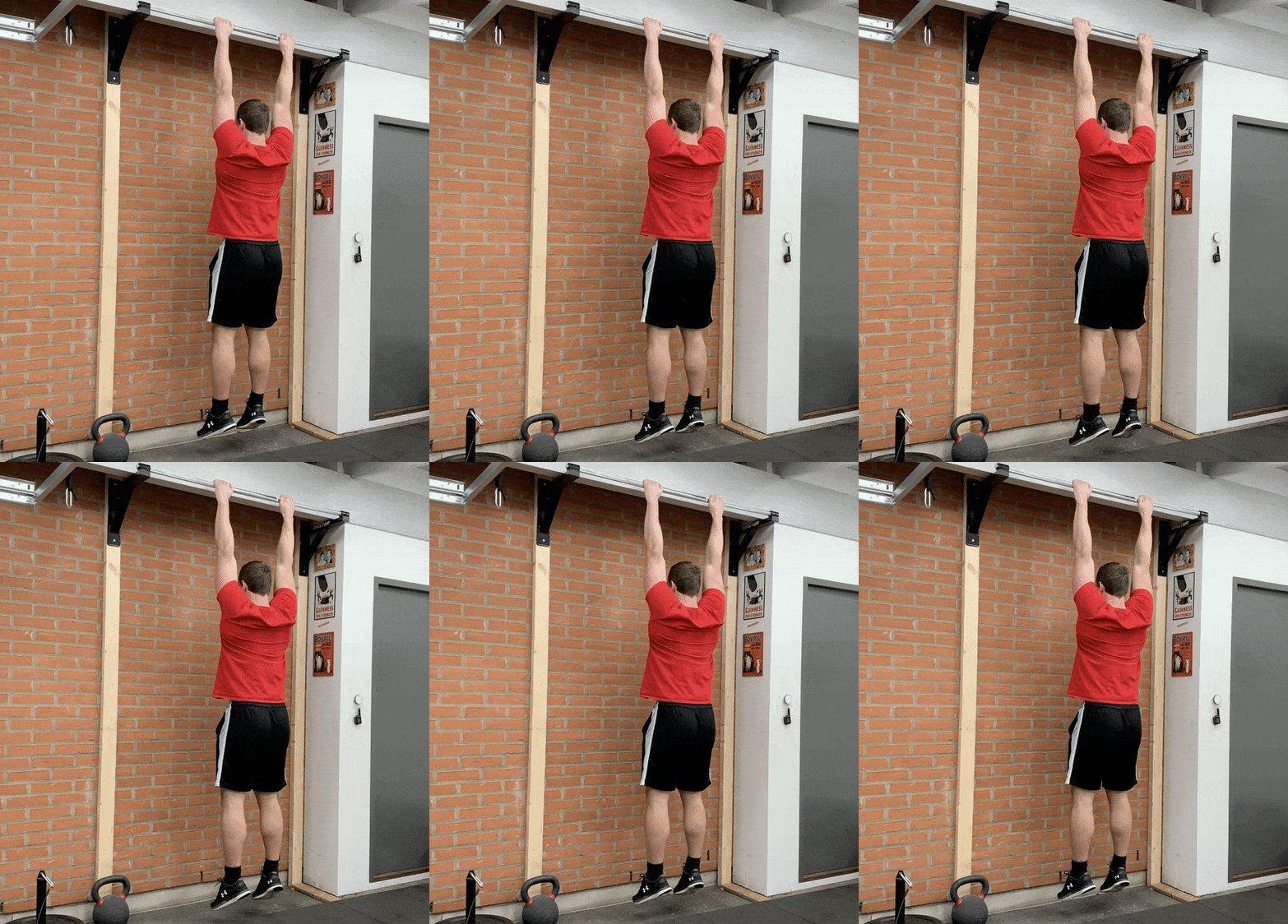
The bar hang, also called dead hangs, is deceptively simple. You just grab a bar and hang there, using your grip alone. It’s like you’re a piece of laundry hanging out to dry, but instead of drying, you’re toughening up your forearms and building better grip strength.
Dead hangs are an isometric exercise where you contract your muscles against a non-moving resistance, holding a position to build strength without moving a muscle. They are an excellent exercise for several reasons:
- First and foremost, they give you a strong grip. They improve muscle strength and endurance in your forearms, hands, and finger flexors.
- There’s a surprising challenge in simply holding on for as long as possible. It tests your mental endurance and increases your pain threshold.
- Dead hangs decompress the spine (it’s debatable whether it has any real physiological benefits, but it sure feels good) and stretch out the shoulders for improved mobility.
As you become a hanging hero, you can add variations:
- Weighted Hangs: Add a weight belt for extra resistance.
- One-Arm Hangs: For the ultimate challenge and bragging rights.
Bar hangs are one of the best forearm exercises to boost forearm muscle and grip strength without any fancy equipment. They’re perfect for almost anyone, from the average person who wants a stronger grip to help with everyday tasks to professional climbers. Plus, they give you an excellent excuse to literally just hang around at the gym.
How to Do Bar Hangs
- Grab a pull-up bar and hang from it.
- Experiment with hanging with relaxed or active shoulders.
4. Plate Pinch

The plate pinch involves—you guessed it—pinching weight plates together and holding them as long as you can. Unlike other grip exercises that involve more of the hand, the plate pinch specifically isolates the pinch strength between your fingers and thumb.
Before you start stacking plates, increase the duration for which you can hold the current weight. Aim to hold the pinch for about 20–30 seconds before increasing the weights.
If possible, use plates without ridges or handles to make the exercise more challenging and effective, as the surface is harder to grip. But watch your toes! Dropping a plate on your toe is a kind of strength training not generally recommended.
Using a single weight plate makes the exercise more straightforward for plate-pinching beginners.
How to Do Plate Pinches
- Grab a pair of weight plates in a pinching grip with your right hand.
- Lift the weight plates off the ground.
- Hold them for as long as you can, and then put them down in a controlled manner.
- Repeat with your left hand.
5. Grippers

Squeezing a grippper is an excellent way to develop strong forearms, enhance your grip strength, and improve your hand endurance.
Make sure to use a hand gripper appropriate for your strength level. They come in various resistances, so start easier and work your way up.
Also, it’s important not to do too much grip training too soon. Training with a gripper can be deceptive, as you generally don’t feel tired afterward. However, the muscles, tendons, and ligaments in your hands and forearms can be prone to overuse injuries, so listen to your body. If you start feeling pain or excessive fatigue, give the grippers a rest.
How to Use Grippers
- Grab a gripper, and hold it so that it is as open as possible without slipping out of your hand.
- Close the gripper all the way by closing your hand.
- Return to the starting position and repeat.
6. Fat Bar Deadlift

The deadlift is one of the best exercises for overall strength as it works almost your entire body and is a staple of back workouts regardless of your fitness goals. When it comes to bulking up your forearms and developing a vice-like grip, introducing a fat bar or fat grips into your deadlift routine can be a game-changer.
A thicker bar means a larger diameter to grasp, which increases the challenge to your grip, like trying to hold onto a giant rolling pin that doesn’t want to be held. Using a fat bar spreads the load over a larger area of the hand, forcing your forearms and hand muscles to work much harder than with a standard barbell, leading to improved grip strength and forearm strength.
When you first switch to a fat bar, you might feel humbled. Start with a lighter weight than you would use for a regular deadlift to get used to the new demands on your grip. Also, don’t use lifting straps like you would if you wanted to lift as much weight as possible.
How to Do Fat Bar Deadlifts
- Use a fat bar or put a pair of fat grips on a regular barbell.
- Step up close to the bar, so that it is about over the middle of your foot.
- Breathe in, lean forward and grip the bar with an overhand grip.
- Hold your breath, brace your core slightly, and lift the bar.
- Pull the bar close to your body, with a straight back, until you are standing straight.
- Lower the bar back to the ground with control.
- Take another breath, and repeat the movement for your desired number of repetitions
7. Farmer’s Walk

The farmer’s walk (also called the farmer’s carry) involves picking up a heavy weight in each hand and walking a set distance or for a period. It’s a straightforward but very effective exercise and definitely not a walk in the park.
The farmer’s walk not only develops mighty forearms and grip strength but also gives your shoulders, traps, and core a serious workout. It’s also great training for daily tasks like lugging around bags of soil or wrangling with oversized packages.
How to Farmer’s Walk
- Choose a pair of dumbbells, kettlebells, or specifically designed farmer’s walk handles. Place the weights on the ground on either side of your feet, which should be about hip-width apart.
- Bend at the hips and knees, pushing your buttocks back while keeping a straight back, to lower yourself down to the weights. Your chest should be up, and your gaze forward.
- Grip the handles of the weights firmly with each hand. Your grip should be centered to balance the weight evenly. Engage your core, then lift the weights by straightening your legs and hips. Avoid rounding your back as you stand up. You should now be standing upright, weights at your sides, with your arms fully extended.
- Start walking forward using short, quick steps. Keep your back straight, shoulders back, and look forward. Your core should be tight to stabilize your body, and your movements controlled to prevent the weights from swinging.
- Throughout the walk, maintain an upright posture. Avoid leaning forward or backward. Keep your chest up and shoulders slightly back to counterbalance the weight.
- If you need to turn around or navigate corners, do so carefully to maintain balance and avoid twisting your spine. Make wide turns to manage the weights safely.
- Once you’ve reached your designated distance or if your grip begins to fail, carefully lower the weights back to the ground by bending at the hips and knees, maintaining a straight back.
- Rest, then repeat the walk for the desired number of sets and distance.
8. Barbell Wrist Extension

Doing the barbell wrist extension (also called reverse wrist curls) is one of the best ways to develop the forearm extensors, the muscles that help straighten your fingers and wrist.
You perform wrist extensions exactly like wrist curls, with one exception: you hold the barbell palm facing down instead of up. You’ll find that your forearm extensor muscles are quite a bit weaker than your forearm flexor muscles, and you’ll likely have to use a significantly lighter bar.
Use a grip not too wide or too narrow. A shoulder-width grip typically works best. Keep your elbows stationary and focus on moving only your hands.
How to Do Barbell Wrist Extensions
- Grab a barbell with an overhand grip and rest your forearms against your thighs, or alternatively against a bench.
- Lower your hands towards the floor.
- Reverse the motion by bending your wrists upwards.
- Repeat the movement for your desired number of repetitions
9. Dumbbell Wrist Extension

The dumbbell wrist extension is another of the best dedicated forearm exercises for the extensors, performed very similarly to the barbell version. The main differences with using dumbbells are:
- They allow for independent movement of each wrist, which can help address muscle imbalances, such as when one wrist or forearm is stronger than the other.
- You can adjust your wrist angle freely, which is excellent if you feel discomfort in your wrists from the fixed angle of a barbell.
- You can work one arm at a time, which can help you focus maximally on the working muscles – the so-called “mind-muscle connection.”
How to Do Dumbbell Wrist Extensions
- Grab a dumbbell with an overhand grip and rest your forearm against your thigh or, alternatively, against a bench. You can also use two dumbbells simultaneously.
- Lower your hand towards the floor.
- Reverse the motion by bending your wrist upwards.
- Repeat the movement for your desired number of repetitions
10. Reverse Barbell Curl

The reverse barbell curl is one of the best exercises for adding forearm size, particularly in the meaty brachioradialis. If you’re looking to build a well-rounded forearm and improve your grip strength, this exercise is a must. In addition, you work your biceps and brachialis for muscle growth in your upper arms.
You can also use dumbbells, an EZ Bar, or do reverse cable curls instead of regular barbell reverse curls.
- Dumbbell Reverse Curl: Use dumbbells instead of a barbell for a more natural range of motion and less potential stress on your wrists.
- EZ Bar Reverse Curl: Easier on the wrists compared to a straight barbell.
- Cable Reverse Curl: Consistent tension throughout the movement.
How to Do Reverse Barbell Curls
- Stand upright with your feet shoulder-width apart. Grasp a barbell with an overhand grip (palms facing down), hands slightly wider than shoulder-width apart.
- Keeping your upper arms stationary, curl the barbell up towards your shoulders by flexing your elbows.
- Slowly lower the barbell back to the starting position in a controlled manner.
- Repeat the movement for your desired number of repetitions.
Forearm Workout for Muscle and Strength
With these fantastic forearm exercises, you’ll be forearmed and ready for anything, including designing the workouts you need to build muscular forearms.
But what if you don’t want to make your own workouts? Easy! Follow ours!
This is one of the best forearm workouts for both the flexors and extensors, guaranteed to add lean mass and strength. It features dynamic and static training for building muscle mass and giving you the powerful forearms you want.
| Exercise | Sets | Reps |
|---|---|---|
| Reverse Barbell Curl | 3 | 8 |
| Barbell Wrist Curl | 3 | 12 |
| Barbell Wrist Extension | 3 | 12 |
| Bar Hang | 2 | Max time |
Feel free to use dumbbells instead of a barbell when applicable.
Add this workout at the end of any training session. It’s not a good idea to start with forearm training, at least not if you’re doing upper body work, because your grip will be weakened and negatively affect the rest of your workout.
This forearm workout is free in our workout tracker app, which you can download for free using the buttons below.


StrengthLog is 100 % free, but our premium version offers additional benefits.
Want to give premium a shot? We offer all new users a free 14-day trial of premium, which you can activate in the app.
Final Words
You have reached the end of our guide to the best forearm exercises. Thank you so much for reading!
Remember, the key to bigger forearms isn’t just in the exercises themselves but in your consistency and dedication. Rome wasn’t built in a day, and neither are forearms that could intimidate a blacksmith.
So, let’s roll up those sleeves and get to work.
You’ve got the tools, you’ve got the knowledge, and now all that’s left is for you to put in the sweat and let everyone feel the power of your new and improved handshake.
Last reviewed: 2025-09-12
