
Vroom vroom! 🏎️💪 Think motorsports are just about reflexes and horsepower?
Think again.
While motorsports might look like a sit-and-steer job to the outsider, there is an athlete holding the wheel behind the high-speed turns and G-force surges—one who needs strength training to build the physical fitness, power, muscle endurance, and stabilty to stay in control.
Buckle up, because we’re about to break down why hitting the gym is almost as important as hitting the gas, with a strength training program (great for beginners!) for the specific needs of racing drivers and the best exercises to get you there.
Click here to go directly to the program in StrengthLog.
🏎️🏍️🏁
Table of Contents
Should Motorsport Athletes Strength Train?
Absolutely—motorsport athletes 100% should strength train. You’re not just sitting in a car doing Sunday drives with grandma—those machines fight back! Conditioning can make the difference between a podium finish and a DNF on race day.
These are the main benefits and why strength training is essential:
Injury Prevention
Motorsport places extreme demands on the neck, core, shoulders, and lower back due to high G-forces, vibration, and impact risk.
Hitting the weights strengthens these areas and makes you less likely to pull something or get wrecked in a crash.
Neck Strength and Endurance
G-forces in high-speed corners can make your helmet feel like it weighs a small elephant. Strong traps, neck, shoulders, and arms help manage that weight without turning you into a bobblehead by lap 5.
Core Strength
Braking, cornering, and acceleration make short work of a weak core. A strong core, on the other hand, helps you stay stable and react quickly—without flopping around like a sack of potatoes.
Posture and Driving Position
Steering input isn’t just flicking your wrists—it’s constant micro-adjustments under load that require a fast reaction time and stamina.
You need shoulders that don’t fatigue after lap 2, and a strong posterior chain (back, glutes, hamstrings) keeps you upright and stable in the seat, even during long races.
Grip Strength
Have you ever tried wrestling a steering wheel through 50 laps at high speeds? Your forearms better be ready. Whether it’s a steering wheel, handlebars, or control levers—more grip strength means better handling, better feel, and fewer blisters.
Improved Body Composition
More muscle mass, less unnecessary bulk. That means a better power-to-body weight ratio—and yes, that matters even if you’re not the engine.
Strength Training Program for Motorsports (2 Days/Week, Beginner and Up)
This program is designed to build foundational strength, postural control, and muscular endurance, with a focus on key areas like the neck, core, shoulders, and grip—essential for motorsport performance (car racing in particular).
It is suitable for everyone, including beginners without strength training experience. It uses accessible compound exercises (exercises that involve several joints and muscles) that cover all the major muscle groups.
Program Details
- Duration: 8–12 weeks
- Schedule: Two whole body sessions per week.
Rest at least 24 hours between each training session. You don’t get stronger while you train but during your rest days when you let your body recover.
Each workout includes:
- 3 sets per main lift
- 8–12 reps per set (higher reps for neck training)
Equipment needed: dumbbells. Yes, you can do this whole program without needing anything but a pair of dumbbells. That means that you don’t need a gym to do these workouts.
I suggest you get a pair of adjustable ones, because you’ll find that you can use more weight in some exercises than others.

Feel free to take as long or short a rest between sets as you need. 60–120 seconds is a good suggestion for most.
Workout 1
| Exercise | Sets | Reps |
|---|---|---|
| Goblet Squat | 3 | 10 |
| Push-Up | 3 | 12 |
| Dumbbell Row | 3 | 10 |
| Dumbbell Romanian Deadlift | 3 | 8 |
| Core Twist | 3 | 12 |
| Neck Curl (Flexion) | 2 | 15 |
| Neck Extension | 2 | 15 |
Workout 2
| Exercise | Sets | Reps |
|---|---|---|
| Dumbbell Lunge | 3 | 10 |
| Dumbbell Shoulder Press | 3 | 10 |
| Renegade Row | 3 | 10 |
| Dead Bug | 3 | 12 |
| Plank with Leg Raise | 3 | Aim for 60 secs. |
| Bar Hang | 2 | Aim for 30 secs. |
Strength Training for Motorsports Progression Plan
You can follow this program for as long as you want.
However, to get stronger and make improvements over time, you need to keep challenging your muscles.
That means trying to do one more rep with a certain weight or adding a little weight next week as long as you can complete all the reps with good form. This form of always doing a little more is called progressive overload. It is the key to training progress. If you always use the same weights, your body has no reason to get stronger.
Here is a suggested progression plan for six weeks of training.
- For the first two weeks, you do 10 reps per set, then increase the weight so that you can only complete eight reps.
- Use that weight for two more weeks, then increase it again, this time so that you can only do six clean reps.
- After six weeks, you go back to 10 reps, but with a higher load than you could handle when you started.
Note that this progression plan is optional. You can stick with the initial number of reps and just increase the weights a bit when you can.
| Week | Sets | Reps | Intensity |
|---|---|---|---|
| 1–2 | 3 | 10 | Light |
| 3–4 | 3 | 8 | Moderate |
| 5–6 | 3 | 6 | Heavier |
What To Do Once You Have Completed Strength Training for Motorsports
While Strength Training for Motorsports is open-ended (you can keep at it for as long as you get results and enjoy it), you might wonder what to do after you have completed a certain number of training weeks, such as 6, 10, or 12 weeks.
Once you’ve completed any strength training program—like a six-week cycle—you have a few smart options, depending on your goals, progress, and the program’s structure.
Here’s how you can decide:
Option 1: Repeat the Program with Progression
This is often the best choice if the program was well-designed (like this one!), aligned with your goals, and you enjoyed it.
- Increase the weights based on your improved strength (e.g., 2.5–10% increase depending on the lift).
- You can also add an extra set to key lifts. For example, you might do four sets instead of three in the first three exercises of each Strength Training for Motorsports workout.
- Add an extra workout (go from two weekly workouts to three in this program). You’d do Workout 1, Workout 2, Workout 1 one week, then Workout 2, Workout 1, Workout 2 the second week, and so on,
This option is best for beginners/intermediates, general strength goals, or when the program felt effective but not exhausting.
Option 2: Start a New Program (with progression)
You can also switch to a different program that builds on what you just did. For example:
- From hypertrophy to max strength or vice versa.
- From general strength to power or sport-specific strength (just an example, as this one is already sport-specific).
- Once you have some strength training experience, you can also modify your existing program. For example, you can introduce more challenging variations (e.g., goblet → front squat) or switch to a heavy weight/low reps cycle.
- Or simply a new program with a similar structure but different exercises to avoid stagnation.
Option 2 is great for intermediate to advanced lifters when the old program feels stale or if your goals have changed.
Important! Don’t switch just for novelty—only change if:
- You’ve plateaued,
- Your current program doesn’t feel fun and enjoyable anymore,
- Your goals have shifted, or
- You need to take your training to the next level with new stimulus for continued adaptation.
Follow Strength Training for Motorsports in StrengthLog
This program (and many more) are free in the StrengthLog workout tracker app, which is free to use forever and has no ads.
We do offer a Premium version of the app that gives you access to more advanced features, programs, and statistics. All new users can activate a free 14-day premium trial to try it out. We won’t try to sell you anything, and there are no strings attached—pinky promise!
Download StrengthLog and start tracking your workouts today:


Click here to go directly to the program in StrengthLog.
Strength Training for Motorsports: The Exercises
Here are detailed descriptions of all the exercises in the Strength Training for Motorsports program in the order they appear.
Goblet Squat
Lower body strength, core bracing

The goblet squat is a great exercise for lower-body strength and muscle endurance. It trains your quads, glutes, and core, the muscles that work hardest during bracing in the car and pedal control.
When you do goblet squats, you have to stabilize and power through the legs while managing the load up top, like the way you need to manage g-forces through turns without turning into a noodle. They also improve your core stability and posture and help you maintain form during long stints behind the wheel.
In addition, the goblet squat naturally makes it easy to get into a deep squat and encourages good positioning. It opens the hips and ankles while keeping your back safe. That’s an overlooked benefit because motorsports demand a surprising amount of hip mobility (beyond getting in and out of the car), like rotating through tight turns, handling unexpected bumps, and other reactive movement in the cockpit.
How to Goblet Squat
- Reverse the movement and return to the starting position. Exhale on the way up.
- Grab a kettlebell in the sides of the handle, and hold the kettlebell against your chest.
- Stand with your feet about shoulder-width apart, and your toes pointing slightly outward.
- Inhale, lightly brace your core, and squat down with a full range of motion, as deep as possible.
- Reverse the movement and return to the starting position. Exhale on the way up.
- Repeat the movement for the desired number of repetitions.
Push-Up
Upper body strength, stability, wheel control

Push-ups are one of the most iconic bodyweight exercises. They build upper body muscle and strength, particularly in the chest, shoulders, and triceps, the so-called pushing muscles.
Getting stronger in these muscles will help you handle the physical demands of racing, from managing the steering wheel to controlling the vehicle through corners to counteracting the forces transmitted from the car.
Several studies have found that push-ups are as effective as the barbell bench press, at least for beginners.1 2 If you can’t yet do enough regular push-ups, you can do them on your knees, which makes it much easier. And if you need more weight, you can use a resistance band like this:

How to Do Push-Ups
- Assume the starting position, with hands slightly wider than shoulder-width apart.
- Try to form a straight line from head to feet, and brace your abdomen slightly.
- Lower yourself as deep as you can, while inhaling.
- Reverse the motion when you’ve touched the floor, and push yourself up to straight arms again while exhaling.
- Repeat the movement for the desired number of repetitions.
Dumbbell Row
Lats, posture, unilateral control

The dumbbell row is an excellent exercise for building muscular strength in the upper and middle back, training your latissimus dorsi, rhomboids, traps, and rear delts—all of which stabilize the shoulders and spine under high stress. That stabilization is crucial when you’re strapped into a cockpit, fighting the wheel through a corner at 180 mph.
Beyond resisting G-forces, you need a good reserve of back strength to maintain an optimal and stable posture in the car. Fatigue in the upper back can cause you to slump or lose your optimal head position.
If you have a training bench, stabilize your body against it. If you don’t, you can use anything stable you have around.
How to Do Dumbbell Rows
- Place your left knee and left hand on a bench for support.
- Hold a dumbbell in your right hand with your arm extended straight down.
- Keep your back flat and core engaged.
- Pull the dumbbell up toward your waist, keeping your elbow close to your body.
- Squeeze your shoulder blade at the top of the movement.
- Lower the dumbbell back to the starting position with control.
- Repeat for the desired number of repetitions, then switch sides, and repeat.
Dumbbell Romanian Deadlift
Posterior chain strength, posture

The dumbbell Romanian deadlift is a hip-hinge exercise for the posterior chain (glutes, hamstrings, and lower back)—collectively, the foundation for hip stability and spinal support.
For a driver, building posterior chain strength means reducing injury risk during long sessions or if something goes sideways (literally), maintaining posture in the seat as fatigue creeps in, and withstanding vibration and load through the hips and spine.
Get a good stretch in the back of your legs and focus on the eccentric (lowering) part of the movement.
How to Do Dumbbell Romanian Deadlifts
- Stand upright holding a pair of dumbbells.
- Inhale, brace your core slightly, and lean forward by hinging in your hips. Keep your knees almost completely extended.
- Lean forward as far as possible without rounding your back. You don’t have to touch the dumbbells to the floor, although it is OK if you do.
- Reverse the movement and return to the starting position. Exhale on the way up.
- Take another breath, and repeat for the desired number of repetitions.
Core Twist
Core stability under torque

Whether you’re behind the wheel of a rally car, a Formula vehicle, or a kart, you need rotational core strength, endurance, and control. The core twist hits all three targets by training the obliques and deep core stabilizers to handle the twisting and bracing required when cornering, absorbing g-forces, or reacting to unpredictable terrain.
Rather than performing core twists fast and loose, you benefit more from deliberate, powerful twists paired with stable breathing—strength and control over speed.
How to Do Core Twists
- Sit on the floor with your knees bent and feet either on the ground or lifted slightly off.
- Hold a weight plate, medicine ball, or kettlebell with both hands in front of your chest.
- Lean slightly back with a straight back and engaged core.
- Twist your torso to one side and bring the weight toward your hip, keeping your hips stable.
- Return to the center and rotate to the other side.
- Repeat the movement for the desired number of repetitions.
Neck Curl (Flexion) & Extension
Neck strength for helmet support and G-force tolerance
Motorsport athletes need a strong neck because of the high G-forces and constant vibrations during racing. These two simple exercises (neck curl and neck extension) build neck strength and endurance, help you resist fatigue from the weight of the helmet, and protect against whiplash and concussion during impacts.
- Neck flexion exercises strengthen the muscles at the front of the neck, stabilizing your head to resist the backward push during acceleration. Imagine launching out of a corner at top speed—if your flexor muscles aren’t strong enough, your head will snap back like a bobblehead on a rollercoaster.
- Neck extension exercises strengthen the muscles at the back of the neck, helping you resist forces that can throw your head forward, like the pull during braking, sudden deceleration, or rear-end collisions.
Good form and technique are very important when it comes to neck training. It’s a sensitive area. Your movements should be slow and controlled, and it’s a good idea to start with your body (head) weight only.
How to Do Neck Flexions
- Sit or lie on your back with a neutral spine.
- Tuck your chin slightly, as if making a “double chin.”
- Flex your neck by bringing your chin toward your chest, keeping the movement slow and controlled.
- Pause at the top, then slowly return to the start position.
- Repeat the movement for the desired number of repetitions.
How to Do Neck Extensions
- Sit or lie face down on a bench with your head over the edge.
- Start with your chin tucked.
- Extend your neck by lifting your head upward against gravity or resistance.
- Pause briefly, then slowly lower back to the start.
- Repeat the movement for the desired number of repetitions.
Dumbell Lunge
Full-body strength and stability, hinge mechanics

The dumbbell lunge is a unilateral (one-sided) exercise that builds strength and muscle in the quadriceps, adductors, and glutes of each leg independently and, importantly, improves stability and balance.
Unilateral training is a big benefit in motorsports, which often involve asymmetrical forces and require independent leg action, especially when you are battling G-forces, making micro-adjustments on the pedals, and bracing your body constantly. The dumbbell lunge hits all those demands right in the gearbox.
How to Do Dumbbell Lunges
- Hold a dumbbell in each hand and stand with your feet about shoulder width apart.
- Take a big step forward and sink as deep as possible in a lunge position, without hitting the knee of the back leg in the floor.
- Return to the starting position by pushing yourself back with the front leg.
- Repeat the movement for the desired number of repetitions, then switch legs. You can also alternate legs each repetition.
Dumbell Shoulder Press
Overhead strength, posture

The dumbbell shoulder press is a pushing exercise that builds the upper body and shoulder strength, endurance, and stability you need to manhandle the machine.
Overhead presses give you both the power to control and resist the forces transmitted through the wheel and precise steering inputs for quick corrections. That’s where the dumbbell shoulder press enters like a pit crew with perfect timing.
If you want to make the exercise even more motorsport-friendly, you can try doing it standing in a staggered stance to simulate the instability of a race car cockpit while developing balance and coordination. But learn the basic movement first.
How to Dumbbell Shoulder Press
- Grab a pair of dumbbells, and lift them up to the starting position at your shoulders.
- Inhale and lightly brace your core.
- Press the dumbbells up to straight arms, while exhaling.
- Inhale at the top, or while lowering the dumbbells with control back to your shoulders.
- Repeat the movement for the desired number of repetitions.
Renegade Row
Upper back, posture, shoulder balance

The renegade row might sound like something out of Fast & Furious, but instead of nitrous, you’re fueling your upper back, arms, core, and stability.
Renegade rows combine a plank hold with a rowing motion, making it a challenging full-body movement and an excellent anti-rotational exercise, meaning it trains your core to resist twisting forces, the kind of isometric strength you need to stabilize your upper body during cornering and braking.
Note: the video instructions above shows the kettlebell variant, but you can do renegade rows with regular dumbbells as well.
How to Do Renegade Rows
- Start in a high plank position with your hands gripping a pair of kettlebells placed directly under your shoulders.
- Keep your body in a straight line from head to heels, feet slightly wider than hip-width for balance.
- Brace your core and row one weight toward your ribcage, keeping your elbow close to your body.
- Lower the weight back to the ground with control.
- Repeat on the opposite side, alternating sides for the desired number of reps.
Dead Bug
Core control and spine stability

The dead bug sounds like something you’d swat off your windshield during track day, but this deceptively simple exercise is fantastic for motorsports.
The primary benefit of dead bugs is cross-body movement—teaching your core to stabilize when different parts of your body are doing different things. It hits your deep core muscles, including the transverse abdominis (your body’s natural “corset”), rectus abdominis (six-pack), obliques (side abs), multifidus (a spinal stabilizer), and the erector spinae (spine flexors).
It also trains anti-extension and anti-rotation, preventing unwanted movement (like arching the lower back) while your limbs are in motion, which happens all the time in motorsports as your entire body is constantly dealing with g-forces, rapid directional changes, and the kind of vibrations that make your chiropractor buy beachfront property.
Note: If you feel you can’t maintain complete control over the movement while holding dumbbells, using your bodyweight only is also effective.
How to Do Dead Bugs with Dumbbells
- Lie on your back, holding a light dumbbell in each hand. Extend your arms straight up toward the ceiling and lift your legs so your knees are bent at 90 degrees.
- Engage your core and press your lower back into the floor.
- With control, extend your right leg and lower it toward the floor while simultaneously lowering your left arm—holding the dumbbell—overhead. Keep your lower back in contact with the floor throughout the movement.
- Return to the starting position and repeat on the opposite side.
Plank With Leg Raise
Core strength, stability, and endurance

The plank is an isometric exercise that builds overall strength, stability, and endurance in your core muscles.
It’s a great exercise for motorsports that translates well to behind the wheel, because if your core isn’t on lockdown, your arms and neck do all the work, and guess what? They’ll burn out faster than tires in a burnout contest. Planks prevent that by distributing the load and keeping your trunk solid like a, well, plank—like the mechanic for your midsection.
How to Do the Plank
- Start in a forearm plank position with your body in a straight line from head to heels.
- Engage your core and glutes to maintain stability.
- Lift one leg off the ground, keeping it straight and avoiding hip rotation.
- Hold for a second at the top, then lower it back down with control.
- Repeat with the other leg and continue alternating for the desired amount of time.
Dead Hang
Grip strength and scapular stability
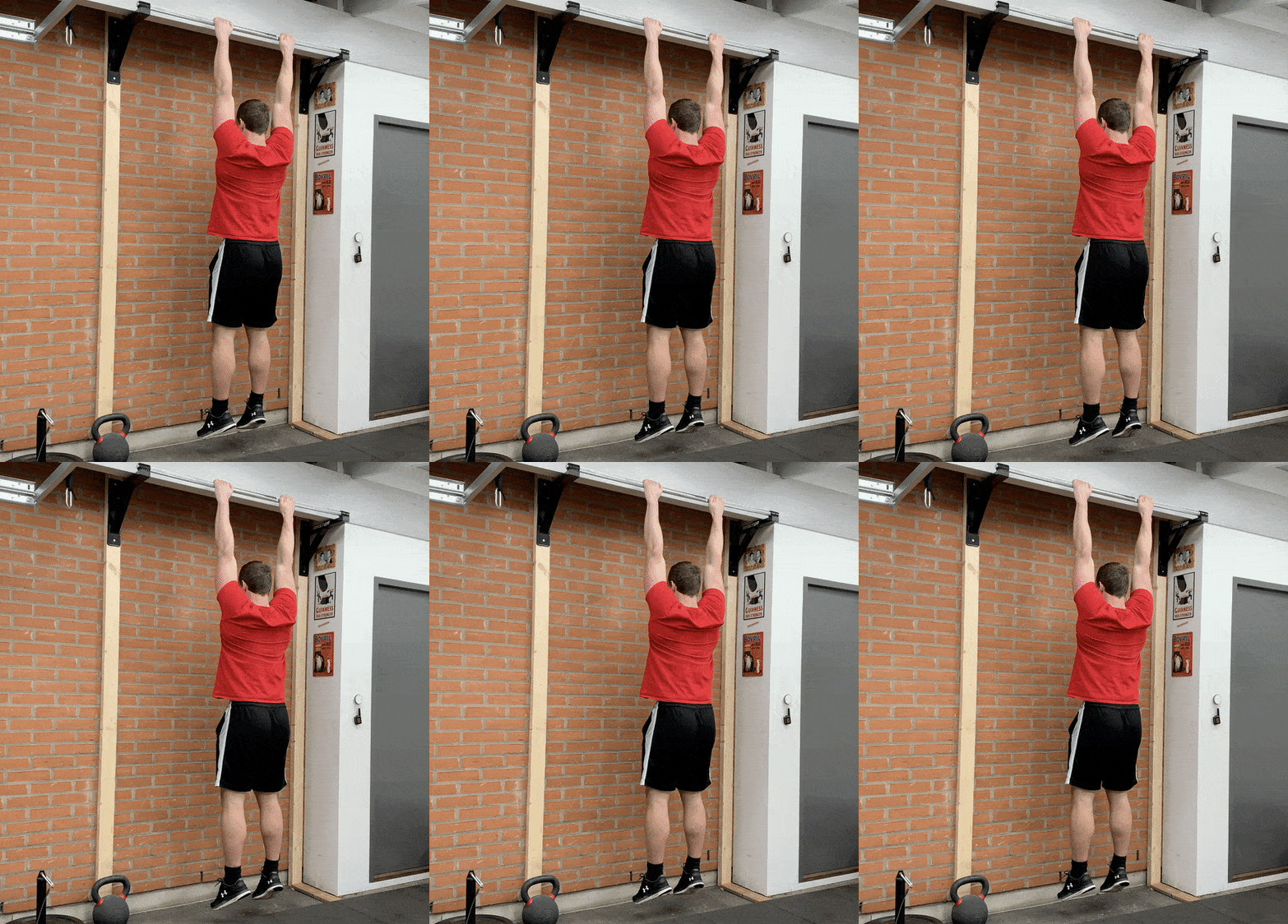
The dead hang—or bar hang—is an isometric exercise where you hang passively from a bar with your arms fully extended and your feet off the ground, training your grip and your forearm strength.
Dead hangs mimic the tension you face when gripping the wheel, shifting, or bracing under impact. In addition to improving grip strength, they build scapular stability, decompress the spine (like a chiropractor without the neck cracks), and improve shoulder mobility—all fantastic for long stints in the driver’s seat, like endurance racing.
Steering forces, especially in vehicles without power assist or under high load, demand a ton of forearm endurance and an ironclad grip. Ignore your grip training, and your forearms will flame out mid-race faster than your buddy’s over-modified Civic at a stoplight showdown.
How to Do Dead Hangs
- Grab a bar and hang from it for the desired amount of time.
- That’s it!
Strength Training for Motorsports: Final Rep
Motorsports might be about horsepower and precision, but the real engine is you. Strength training gives better control, faster reactions, and longer-lasting peak performance behind the wheel.
Follow this training program , and you’ll build a body that can keep up with the demands of the track. Becuase it’s not just your car that needs to be ready—it’s you.
🏎️🏍️🏁
To follow Strength Training for Motorsports, download our workout log app and start tracking your workouts today:
Click here to go directly to the program in StrengthLog.
Last reviewed: 2025-08-29
References
- Journal of Strength and Conditioning Research: January 2015 – Volume 29 – Issue 1 – p 246-253. Bench Press and Push-up at Comparable Levels of Muscle Activity Results in Similar Strength Gains.
- Journal of Exercise Science & Fitness. Volume 15, Issue 1, June 2017, Pages 37-42. Low-load bench press and push-up induce similar muscle hypertrophy and strength gain.
