
Range of motion is a hot topic in strength training. This article reviews the current research and provides practical strategies you can use in your training, whether you want to gain strength, build muscle, or become more flexible.
Key Points:
- Using a full range of motion is an excellent default strategy for most fitness goals, including strength and muscle growth.
- Including exercises that load the muscle in a stretched position (training at a long muscle length) is ideal for building muscle.
- A full range of motion is generally the best option for strength, but if you want to maximize your strength gains in a particular range of motion, including partial reps in your training is likely a good idea.
- To optimize your flexibility, you want to perform most exercises using a full range of motion.
What Is Range of Motion?
Range of motion (ROM) refers to the extent of movement through which a joint can be moved during an exercise.
- A full range of motion means performing an exercise through the entire span of joint movement. For example, during a dumbbell curl, a full ROM means starting with your arm fully extended and curling up until your bicep is fully contracted.
- A partial range of motion means limiting the movement to a specific portion of the joint’s capacity, like performing half-squats instead of going all the way down. However, partials can also refer to any other portion of the movement, like only performing the bottom or middle half of a repetition.
Most coaches believe that a full range of motion is generally the superior option. Still, some researchers argue that a partial range of motion might be at least equally effective, at least for building muscle.1 And, watch a handful of top bodybuilders training, and you’ll likely see several doing their exercises with a mostly incomplete range of motion.
Let’s dive into the pros and cons of each approach to help you decide which method is best for your fitness goals.
Range of Motion for Strength
If you want to get strong, a full range of motion is generally more effective than a partial.2 3
Most research agrees that a partial range of motion can be a tiny bit better for strength gains in that particular ROM. However, a full range of motion is generally significantly better if you want to get stronger throughout the entire movement.
In theory, partial ROMs might be a good way to increase your overall strength. With a shorter ROM, you can use heavier weights as you avoid the sticking point, the most challenging point of the lift, where you fail if you do as many reps as you possibly can. However, research consistently shows that a full ROM is often superior, even when using a lower absolute load.
For example, in one study, four groups of 50 trained men performed the bench press using various ranges of motion.4
- Group 1 performed full repetitions, going from lockout down until the bar touched the chest.
- Group 2 performed the movement with 2/3 of the full range of motion, from lockout down until the bar reached two-thirds of the full range of motion.
- Group 3 did as Group 2 but only went down to one-third of the full range of motion.
- Group 4 acted as the control group and stopped training altogether.
Those who did full repetitions experienced more significant strength gains than groups two and three (not surprisingly, group four got weaker). The greater the ROM, the greater the strength increases.
The fact that you consistently avoid the sticking point with a short ROM might be a problem, not a benefit, even though you’re able to handle heavier loads during training.
Interestingly, the full ROM group got stronger in the one-third and two-thirds ranges than the groups that specifically trained the shorter ROMs, not only in the entire ROM.
The Specificity Training Principle
The specificity training principle states that the body adapts specifically to the demands placed upon it. If you want to get stronger in a part of a movement, like the top half of a squat, you should focus on that specific part, like doing partial squats in this example.
Current research mostly agrees with this principle. Most studies find that you see the greatest improvements in your 1RM (the maximum amount of weight you can lift for one complete repetition of a given exercise with proper form) at the ROM you spend the most time training. That being said, a few, like the bench press study I mentioned above, found that a full ROM is superior even in partial ranges.
The best option might be combining full ROM and partial ROM in your training.
You don’t have to choose between the two. Do both and get the best of two worlds.
For example, if a powerlifter needs to improve in a particular range of motion in the squat, training within that range might provide slight benefits.
However, the majority of the training could still utilize full-depth movements.
- Giving up full ROM training entirely for short ROM training is likely a bad idea for everyone (except if an injury prevents you from a full ROM). You might still get stronger, but your gains would likely suffer compared to if you had done at least some full ROM training.
- However, if you currently only do full ROM training, introducing some training with a partial ROM might translate into greater gains overall.
Most studies look at full or partial ROM, but doing full and partial squats, for example, with heavier weights than you could handle if you go full ATG (ass-to-grass), might make you even stronger. This has been shown in a couple of studies, notably one where a FULL + PARTIAL group tended to gain more strength than a group doing only FULL squats.5

In short, a full range of motion is your default strategy. But that doesn’t mean that all your training must be with a full range of motion.
Range of Motion for Muscle Growth
When it comes to muscle hypertrophy, things get muddier. While many think that a full range of motion is always the superior option, recent research finds that the question of full and partial range of motion for muscle growth doesn’t have a one-size-fits-all answer.
That being said, just like with training for strength gains, a full range of motion is the ideal default strategy for muscle growth.2 6 7
Range of Motion and Muscle Length
When comparing full and partial range of motion for muscle growth, it is not a straightforward comparison. You must consider what type of partial ROM you’re talking about: are you training at short or long muscle lengths?
- Training at a long muscle length means loading a muscle in a stretched position.
- Training at a short muscle length means loading it when it’s flexed.
For most muscles, range of motion can often be used synonymously with muscle length—or at least very close.
For example, if you do the bottom half of a preacher curl, you’re training your biceps at a long muscle length. Conversely, if you do the top half, you’re training it at a short muscle length.
However, you can train muscles that cross two joints (like the hamstrings and the long head of the triceps) at longer or shorter muscle lengths while the range of motion remains the same.
For example, you can lengthen the hamstrings in two ways:
- By flexing your hips
- And by extending your knees.
Let’s take the seated vs. lying leg curl as an example.


Even if you perform the exercises with an identical range of motion, you flex your hips in the seated leg curl but not in the lying. In other words, you train your hamstrings at longer muscle lengths in the seated leg curl compared to the lying, even with the same range of motion at the knees.
In general, training at longer muscle ranges seems more important for muscle growth, even after equating for range of motion.2
For example, in one study, 20 people trained the lying leg curl with one leg and the seated leg curl with the other for 12 weeks.8 All three heads of the hamstrings grew more in the leg that had performed the seated leg curl, which works them at a longer muscle length.
That means that even if you train a muscle with a certain range of motion, different exercises can still be more or less effective for muscle hypertrophy.
Looking at the scientific evidence, it is likely a good idea to train at long muscle lengths if you want to optimize muscle growth.
In fact, training at a long muscle range with a partial range of motion might lead to even more muscle growth than using a full range of motion per se.9 Exercises that stretch the muscle more during the movement can be particularly effective for muscle hypertrophy.
That being said, you don’t need to go overboard and to extreme lengths to train at the longest muscle lengths humanly possible. While doing so isn’t bad for muscle growth, it’s likely enough to perform your exercises through the longest muscle lengths that are comfortable for you.
In short, using a full range of motion most of the time is a great approach for most people. However, feel free to use a shorter range of motion if it means you can place more stretch on the muscle during the exercise.
Regional Muscle Growth
Another exciting topic is regional muscle growth.
A muscle does not grow equally all over when you train it. It can differ between different parts of the muscle or even between different areas of a muscle head.10
Not many years ago, many experts dismissed this idea.
In one study, 38 trained women embarked on a 9-week strength training program consisting of either 4 sets of 12 reps of incline bicep curls or 4×12 dumbbell preacher curls.11

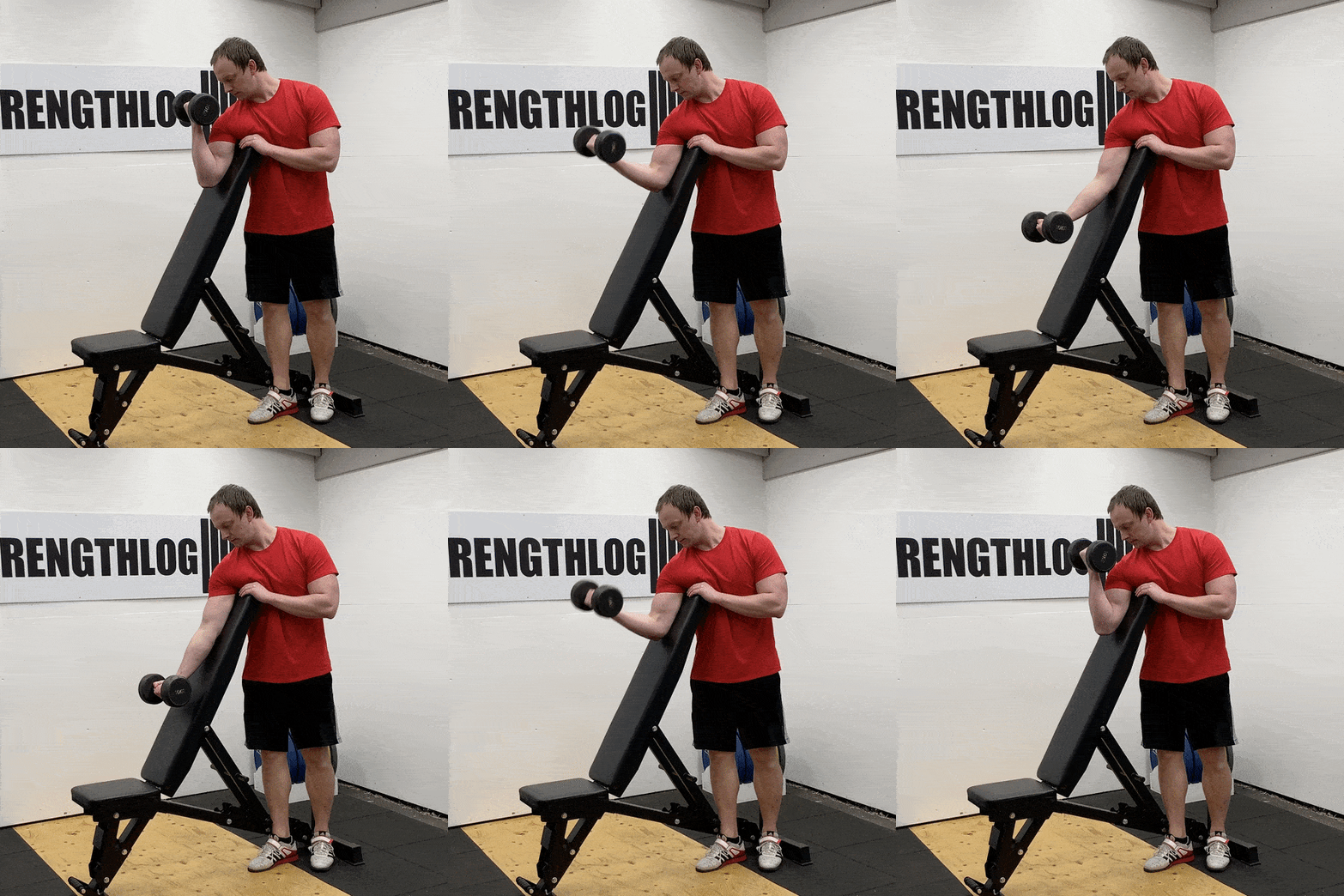
The results showed superior muscle growth in the part of the biceps closest to the elbow in the group that had done preacher curls. Preacher curls place a much higher load on the biceps in the range of motion where you train at long muscle lengths.
The same thing has also been shown for the lower body, where performing leg extensions in the initial part of the movement (where the muscle is stretched) led to more significant muscle growth, especially in the middle and lower parts of the quadriceps, compared to the final part of the movement or even a full ROM.12

Longer muscle lengths during training may increase metabolic stress and activate muscle growth pathways (such as Akt/mTOR signaling), which are important for muscle hypertrophy. Also, partial ROMs at longer muscle lengths allow you to use heavier loads, which can further stimulate muscle growth.
In short, including partials where you train at long muscle lengths in your workout routine might benefit overall hypertrophy and stimulate muscle growth in particular parts of a muscle.
Range of Motion for Flexibility
Lastly, let’s not forget about flexibility.
In years past, the belief that lifting weights makes you inflexible – “muscle bound” – was prevalent, even among coaches and doctors.

We now know that notion is a myth. However, it’s common to see lifters who could use a little more flexibility, if only to be able to perform exercises with good form.
Stretching is the traditional way to improve flexibility. Some people stretch the muscle(s) they’ve trained after every workout, and there is nothing wrong with that. Stretching works.
But what if there was a more time-efficient way?
The good news is that there is, and that way is to perform your exercises with a full range of motion. Research shows that full ROM strength training is just as effective as stretching for improving flexibility.13 I would argue that most people don’t need to stretch post-workout. If you need more flexibility, simply performing your sets with a complete ROM will do the trick. And if you’re already flexible enough, training with a full ROM will maintain your status.
Here’s a case where a full range of motion is superior to a partial range. You must perform a full ROM to get the flexibility benefits—at least if we’re talking about the most common types of partials that work a muscle through short muscle lengths, like half squats. Partials where you train through long muscle lengths, like the bottom half of a bench press from your chest to a halfway locked-out position, should be highly effective for flexibility.
In short, stick with a full ROM, and you’ll stave off the stiffness. If you have exceptional needs for improved flexibility, you can probably benefit from an individualized, targeted stretching program for the problematic areas. But in general, most people do not need to stretch as long as they perform exercises with a full range of motion. Nothing wrong with doing it if you want, though.
Range of Motion: Practical Recommendations
That was a summary of the current understanding of different ranges of motion for strength training adaptations. Now, let’s look at how you can best implement it into your own training.
Range of Motion Recommendations for Strength Gains
- Focus on the range of motion you want to gain strength in. For example, if you want to become as strong as possible in deep squats, do most of your squat training with a full ROM.
- Even if your primary goal is to become strong throughout an exercise’s range of motion, you might still benefit from including partial ROM training in your routine.
- If you have specific performance goals, like improving your partial squat 1RM, include partial range movements in your training to help maximize strength and power gains in the particular ranges you need.
Using a full range of motion is the best default strategy for most lifters.
Range of Motion Recommendations for Muscle Growth
- A full ROM is generally a good practice for building muscle. However, the benefits are likely more modest than many people think.
- Prioritize exercises where you can train at long muscle lengths. For instance, overhead triceps extensions, which train the long head through a long muscle length) are more effective for triceps growth than pushdowns with your arms at your sides, even when the range of motion is identical.
- Don’t avoid superb compound exercises like the squat or the bench press just because they don’t load the muscles trained at the longest possible length. It’s not the only – or even the most important – variable for muscle hypertrophy. Progressive overload – lifting a little heavier or doing one more than you did last workout – is.
- Include some partials at long muscle lengths. Don’t do this all the time, but including sets where you use more weight than you can handle with a full range of motion and only do the portion of the exercise where you go from a fully stretched position to a halfway contracted position could increase the potential for growth. You could even pause for a a second or three in the stretched position.
- There seems to be no benefit of doing partials at short muscle lengths, meaning the top of the movement (unless you’re working around an injury that prevents you from a more extended range of motion).
For general muscle growth, do most of your training using a full range of motion. Load your muscles in a stretched position in exercises that allow it.
Range of Motion Recommendations for Flexibility
A full range of motion is always the better option, as long as you can safely and comfortably perform it.
Read more:
>> Is Stretching Overrated? Strength Training Improves Flexibility
Final Words
There is no one-size-fits-all approach to range of motion.
Full range of motion generally provides slight advantages over partial range of motion across many outcomes, including strength, hypertrophy, power, and body composition. However, the differences are often minor.
You can build strength and muscle with a variety of ROMs. Also, you don’t have to focus solely on one or the other.
Using a full range of motion is an excellent default approach for most trainees. If you’re new to strength training, always use a full range of motion to learn the exercise.
If you experience pain or discomfort with full range exercises, don’t be afraid to modify your movements to a partial range. You can often continue training while managing injuries and respecting your body’s limits.
Both full and partial ranges of motion have their place in a well-rounded strength training program. Align them with your goals, respect your body’s needs and limits, and incorporate a variety of exercises. You’ll optimize your workouts and achieve the best possible results.
Lastly, the current research on range of motion is inconclusive. A full range of motion and training at long muscle lengths benefit most goals, but that benefit seems small to modest. In addition, different muscles might respond differently to various ranges of motion. The last word on the subject has likely not been said.
What we know is that if you go with a full ROM, you’re not doing anything wrong, whether you’re training for strength, hypertrophy, or want to improve your flexibility.
References
- J Strength Cond Res. 2018 Sep;32(9):2652-2664. Partial Compared with Full Range of Motion Resistance Training for Muscle Hypertrophy: A Brief Review and an Identification of Potential Mechanisms.
- International Journal of Strength and Conditioning, 3(1), 2023. Partial Vs Full Range of Motion Resistance Training: A Systematic Review and Meta-Analysis.
- Scand J Med Sci Sports. 2021 Oct;31(10):1866-1881. Effects of range of motion on resistance training adaptations: A systematic review and meta-analysis.
- Journal of Strength and Conditioning Research 36(1):p 10-15, January 2022. Bench Press at Full Range of Motion Produces Greater Neuromuscular Adaptations Than Partial Executions After Prolonged Resistance Training.
- J Strength Cond Res. 2014 Nov;28(11):3024-32. The efficacy of incorporating partial squats in maximal strength training.
- J Strength Cond Res. 2023 May 1;37(5):1135-1144. Which ROMs Lead to Rome? A Systematic Review of the Effects of Range of Motion on Muscle Hypertrophy.
- SAGE Open Med. 2020; 8: 2050312120901559. Effects of range of motion on muscle development during resistance training interventions: A systematic review.
- Med Sci Sports Exerc. 2021 Apr 1;53(4):825-837. Greater Hamstrings Muscle Hypertrophy but Similar Damage Protection after Training at Long versus Short Muscle Lengths.
- J. Funct. Morphol. Kinesiol. 2024, 9(1), 9. Optimizing Resistance Training Technique to Maximize Muscle Hypertrophy: A Narrative Review.
- Strength and Conditioning Journal 42(5):p 94-101, October 2020. Regional Hypertrophy, the Inhomogeneous Muscle Growth: A Systematic Review.
- J Hum Kinet. 2023 Jul; 88: 259–270. Regional Hypertrophy: The Effect of Exercises at Long and Short Muscle Lengths in Recreationally Trained Women.
- Eur J Sport Sci. 2022 Aug;22(8):1250-1260. Partial range of motion training elicits favorable improvements in muscular adaptations when carried out at long muscle lengths.
- Healthcare (Basel). 2021 Apr; 9(4): 427. Strength Training versus Stretching for Improving Range of Motion: A Systematic Review and Meta-Analysis.
