
In this article, you’ll learn how to build a big back without making it overly complicated, without bogus exercises, and without unnecessary fluff.
- What are the best exercises?
- Why should you do them in particular?
- How do you go about it (complete back workout)?
When you have the answers to these questions, you know how to build a big back.
Of course, it’s still not easy; you have to roll up your sleeves and put in the work in the gym. And a hard back workout is probably the toughest upper body session of all, if you do it properly.
But, importantly, you’ll have the roadmap for a back that will block the sun for small children standing behind you.
Now, without any shilly-shallying, let’s get straight down to business.
Table of Contents
Anatomy of the Barn Door Back
Before you start lifting heavy things, you need to know what we are actually building. I’m keeping it super brief, so no medical textbooks here, but you need to know the geography to know the lay of the land.
Lats (Latissimus Dorsi)

Latissimus dorsi literally means “broadest back” in Latin, and the name doesn’t lie. Your lats are your “wings.” When you want width and a V-shape, you train your lats.
It is one of the two largest muscles in the upper body, in close competition with the pecs (the delts and triceps are bigger but consist of three smaller muscles).
Traps (Trapezius)

Your traps run from your neck down to the middle of your back. They give you a yoked look and upper back thickness.
Rhomboids & Rear Delts

Sitting between your shoulder blades, these muscles give you a thick, knobby, 3D look when you stand sideways.
They aren’t very big in and of themselves, but they make a big difference visually, especially when you’re lean.
Erectors (Erector Spinae)

The erectors are like two pillars of muscle running down your spine.
They give you the Christmas tree look at the bottom, rotate and straighten your spine, and keep you from folding in half when you’re doing heavy squats.
To build a complete back and train all these muscles, you can’t do just pull-ups or just deadlifts. You need to pull vertically (for width) and horizontally (for thickness).
The Best Exercises to Build a Big Back
You can Google back exercises and get 400 results. But you can safely ignore more than 95% of them.
You only need a handful of exercises to build a massive back, as long as you do them correctly and with enough intensity.
In fact, I’d say you only need three (and variations of those).
Those are deadlifts, rows, and pull-ups.
1. Deadlifts / Rack Pulls


Nothing builds your entire posterior chain like picking up heavy iron from the floor. Deadlifts hit the traps and thickens your erectors (that sounded dirty, but I’m talking about your spinal erectors) like nothing else. You can use very heavy weights, which is excellent for both strength and overall muscle growth.
However, to get that wide, V-tapered back, deadlifts alone won’t get you there. When you deadlift, your lats are working hard, but they’re not stretching and squeezing through a long range of motion like they do in a pull-up or a row.
So, deadlifts don’t give you wings; they give you a shell. They make you look thick from front to back. Use them as your base, then add pulling work.
My favorite deadlift variation for back growth is the rack pull (from just below the knee). You remove part of the leg drive from the bottom so your back has to carry more of the load. You can often handle more weight than in regular deads, overloading your traps and erectors without frying your legs.
How to Deadlift
- Step up close to the bar so that it is about over the middle of your foot.
- Inhale, lean forward, and grip the bar.
- Hold your breath, brace your core slightly, and lift the bar.
- Pull the bar close to your body, with a straight back, until you are standing straight.
- Lower the bar back to the ground with control.
- Take another breath, and repeat for reps.
How to Do Rack Pulls
- Set the bar at the desired height, using a rack or blocks.
- Step up close to the bar, so that it is over the middle of your foot.
- Inhale, lean forward, bend your knees slightly, and grip the bar.
- Hold your breath, brace your core, and lift the bar.
- Pull the bar close to your body with a straight back, until you are standing straight.
- Lower the bar back to the rack or blocks with control.
2. Rows
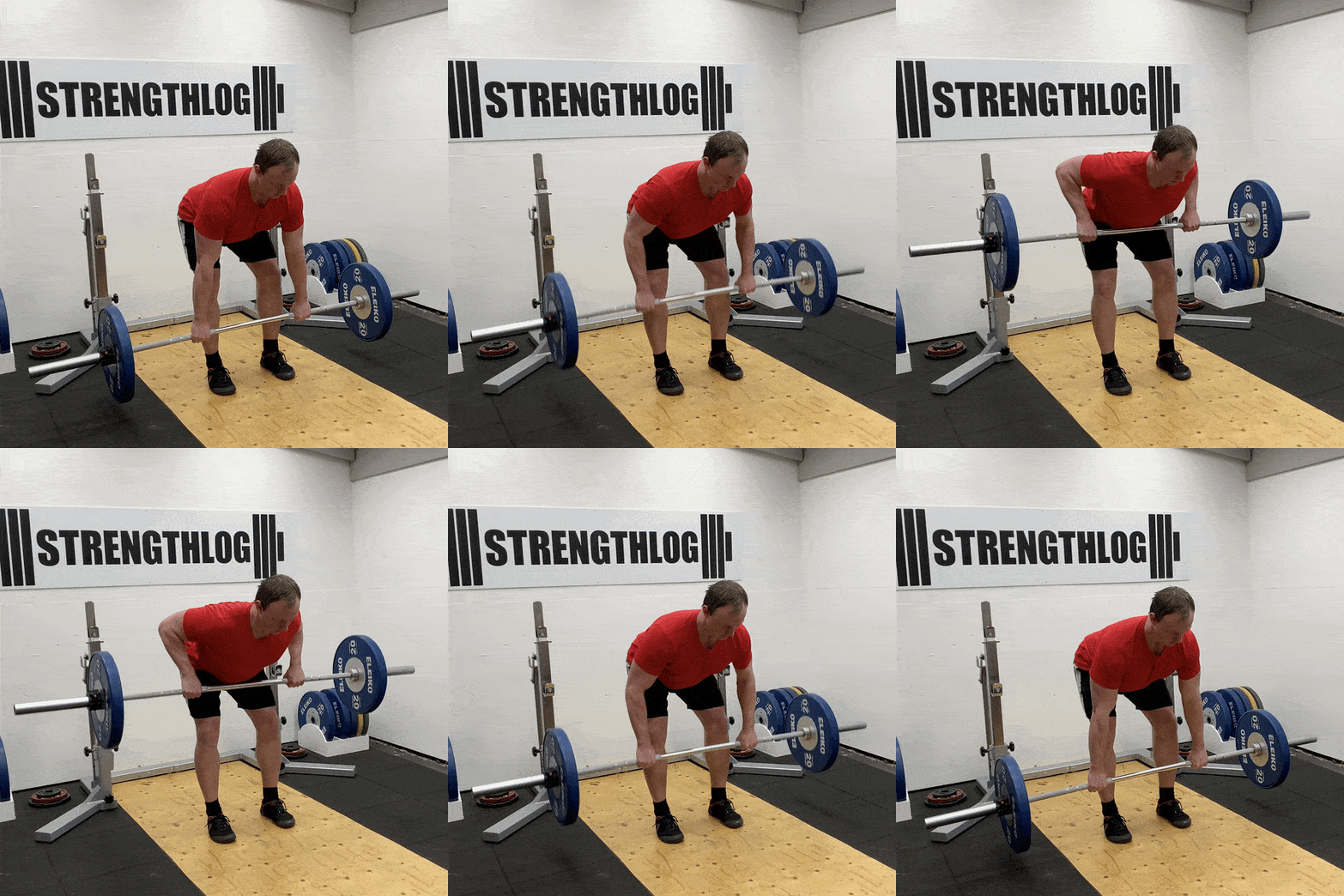

Rows hit everything. They are the heavy compound exercises for the back that allow you to load up the weight and overload your upper posterior chain. Without them, you might look wide from the back, but you’ll disappear when you turn sideways.
These are the most common variations for hypertrophy:
- Barbell rows: The meat and potatoes. Superb for mass and strength; get strong in the barbell row, and you improve your deadlifts, pull-ups, and overall posterior chain strength at the same time.
- T-bar rows: Another great row for heavy loading + stability = you can focus more on back contraction and less on balance.
- Chest-supported rows: These remove your lower back from the equation. If you do a lot of deadlifts, they might be your best choice for mid-back focus.
- One-arm dumbbell rows: Lets you stretch your arm all the way down at the bottom, and some studies show that stretch under load might build a little more muscle.
- Seated cable rows: Easy to push to failure (it’s rarely your lower back that gives out first) and you can focus on different parts of your back: elbows tucked = more lats, or elbows flared = more mid/upper back.
If I had to pick a single one of the above for the rest of my life, and my goal was to build as big a back as possible, I’d go with the good old barbell row. It’s easy to load heavy, and you can progress it for years. But there is no bad choice here, more personal, so go with your favorite. Or rotate them.
3. Pull-Up / Pulldown


Pull-ups (or chin-ups) and pulldowns are your bread and butter for building width, and you’d be hard-pressed to find a massive back that wasn’t built on a steady diet of one or both.
If you have the strength and the technique, pull-ups are fantastic for hypertrophy. If not, I prefer lat pulldowns from a pure muscle-building perspective. You don’t have to stabilize your body in space and can focus all your energy on working your lats without worrying about swinging around or your grip failing.
You can do them with a wide grip, close grip, neutral grip, underhand grip – you name it. But for building your lats, it doesn’t seem to matter much if at all, what handle you use, so go with the one you prefer.
Read more in my article Do Different Lat Pulldown Variations Hit the Lats Differently?
How to Do Pull-Ups
- Grip the bar with palms facing away from you, slightly wider than shoulder-width.
- Keep your chest up, and look up at the bar.
- Inhale and pull yourself up until your chin is over the bar or the bar touches your upper chest.
- Exhale and lower yourself with control until your arms are fully extended.
- Repeat for reps.
How to Do Lat Pulldowns
- Begin by adjusting the thigh pad to fit snugly against your thighs to prevent your body from lifting off the seat.
- Grasp the bar with an overhand (pronated) grip, with your hands slightly wider than shoulder-width apart.
- Sit with your thighs under the thigh pad, keep your chest up, and look at the bar.
- Pull the bar down towards your chest, leading with your elbows. Pull until the bar is below your chin or touches your upper chest.
- Squeeze your shoulder blades together at the bottom of the movement.
- Exhale and slowly release the bar back up to the starting position.
- Repeat for reps.
Technique Tips for Building a Big Back
Here is where most lifters fail. They go through the motions or do the exercises in a way that uses momentum or forces the biceps to do most of the work.
The result: their back stays small while their biceps get tired.
Here is how to fix that.
1. Pull With Your Elbows, Not Your Hands
When you row or pull down, try to focus on not pulling with your hands. Think of your hands as hooks and pull with your elbows.
Don’t think “pull bar to body”. It’s easy for your brain to default to focusing on bending the elbow (which is the biceps).
Do think about driving your elbows down. Two common coaching cues that actually help are:
- Vertical Pulls (Pull-ups/Lat Pulldowns): Think “drive elbows down into the floor.”
- Horizontal Pulls (Rows): Think of “shove your elbows into your back pockets.”
Give them a whirl, and I bet you’ll feel your lats more and your biceps less.
2. Buy a Pair of Straps

This is controversial to some grip purists, but I don’t care. And neither should you.
If your grip gives out before your back does, you aren’t training your back to failure; you’re training your grip and forearms.
We are here to build a big back. Use lifting straps on your heaviest sets so you can really fatigue your back muscles without your hands cramping up or your grip slipping.
I’m not saying you should neglect your grip, but if you need to work on it, do so outside of your back workouts.
Learn how straps can help you in the gym, their science-backed benefits, how to put them on, and more in my article Lifting Straps 101: Types, Benefits & Proper Use.
3. Don’t Be Robot-Strict All the Time
Locking your shoulder blades back and down when doing rows and pulldowns is good beginner advice to learn exercise technique.
Doing so all the time makes your range of motion shorter and reduces the stretch on your back muscles. And that’s a one-way ticket to Small Latsville.
Instead, when you do a row or pulldown, as you return the weight, let the cable/barbell pull your shoulder blades forward or up.
Letting your scapula move like that trains your back through its full function and is how the muscles actually work together.
Look at how Arnold did barbell rows:
Some trainers with fresh PT certificates are probably crying when they see those, but they are gold for hypertrophy.
And they are not dangerous as long as you have the mobility to do them and do them with control (the key word). Your spine is actually meant to be able to bend without busting in two.
If you don’t have the necessary mobility (or poor scapular control, or are very new to training), partial control comes first, and full ROM later.
4. Check Your Range of Motion
A long range of motion is good, but an overly long one is not necessarily better in every scenario.
When you do pulldowns, and your elbows are aligned with your torso at the side of your body, your lats are fully contracted.
Pulling further back past your ribs usually makes your lats work less, instead forcing your rear delts and biceps to crank the weight that last few inches. So, stop when your elbows hit your sides.
The Big Back Workout Routine
Now, let’s get to the fun stuff, the actual lifting.
Here, I’m going to present the best back day workout for muscle, strength, and, well, a healthy back in general. The exercises complement each other to cover all the major back muscles, hit them from different angles, and with a variety of rep ranges.
| Exercise | Sets | Reps | Notes |
|---|---|---|---|
| Deadlift | 3 | 5 | Go heavy. Rest 3–5 minutes between sets. |
| Pull-Up (or Lat Pulldown) | 3 | 8 | Go all the way down to a dead hang (or full stretch). Half reps get you half a back. |
| Dumbbell Row | 3 | 10 | Keep your torso steady and nearly parallel to the floor. |
| Back Extension | 3 | 12 | Focus on technique and feeling the muscles work rather than going for a new 1RM record. |
| Reverse Dumbbell Fly | 3 | 15 | Training rear delts with your back makes sense both visually and functionally. |
Hit this workout once every 5–7 days, either as a standalone back day session or with another muscle group. Training back and biceps is very popular, but you can combine it with any muscle group of your choice, although I advise against quads; training three of the biggest and strongest muscle groups (quads, glutes, back) in one workout will make it impossible to maintain intensity and focus throughout the entire session.
This back workout works best for intermediate-level lifters and above. If you’re a beginner, it’s likely a bit too much at the moment, and you’ll get better results with one of our free beginner programs for building muscle:
Track Your Back Workouts in StrengthLog
This is one of the many free workouts in our workout log app, StrengthLog.

The app makes it super easy to keep track of your weights and reps and ensures you’re on the right path.
It remembers what weights you used in your last session, and automatically loads them into your next one. And trying to improve on your last workout (progressive overload) is the number one factor for improving, building muscle, and getting stronger.
Download it and start tracking your gains today!
StrengthLog is free to use, and so is this workout.
Track Your Training. See Real Progress.
Log your workouts in one place and watch your numbers climb, week after week.
- Free to get started
- Fast workout logging
- Cardio and strength training
- Big bodybuilding and powerlifting focus
- Free weights and machines
- Progress over time, personal bests
- Free and premium training programs and workouts for every fitness goal
Download StrengthLog free:


Quick Note on Nutrition for Building a Big Back
You can do rows until the cows come home, but if you aren’t eating, you won’t grow.
It’s beyond the scope of this article to go in-depth on nutrition, but here are the basics:
- To build a big back, you need to be in a caloric surplus (or at least calorie balance). Your body builds muscle more easily if you eat slightly more energy than you burn.
- Eating enough protein is essential. Protein is the bricks and mortar for that house you’re building. Aim for roughly 2 g per kg of body weight (or 1g per lb).
Our calculators can help:
- Calorie calculator: how many calories should you eat to pack on the mass?
- Protein calculator: find out how much protein you need to grow.
And for more in-depth info about everything nutrition for lifting, check out Nutrition for Strength Training – the Fun and Easy Way.
Want even more?
Subscribe to our weekly newsletter to get notified of new articles and get weekly training tips!
Last reviewed: 2025-12-16
