
If you want to start strength training but aren’t sure where to begin, you’re in the right place. This beginner dumbbell program for the entire body is straightforward, effective, and easy to follow anywhere.
Even if you’ve used dumbbells before but without a structured plan, this routine gives you the tools you need to get stronger the right way.
It’s simple, fun, and it works.
Eager to get started? Nothing wrong with that. Click here to go directly to the program in StrengthLog.
Table of Contents
Why Dumbbells?
You’re asking if dumbbells are good for beginners? Easiest question today!
Dumbbells are one of the best ways to get started with strength training.
If I were tasked with building a starter pack gift for new lifters, the first thing I would wrap is a set of dumbbells. And that goes double for someone who wants to be able to train at home without spending a fortune on equipment.
Let me count just a few of the reasons why a dumbbell program is an S-tier starting point.
- You can train your whole body with easy-to-learn dumbbell exercises like squats, presses, and rows. And you only need a single pair of adjustable dumbbells to get started.
- Dumbbells don’t lock you into a fixed movement pattern, so they are friendly on your joints since you can find the most natural angles for your body.
- If a rep feels too heavy, what do you do? Let me tell you what you don’t do: you don’t get pinned under a heavy barbell. You just set the dumbbells down. So they are super safe for beginners.
- You can start with 5-pounders and work your way up. When a weight starts feeling too easy, you grab the next pair up or turn a knob on your adjustable dumbbells. Easy peasy progression.
As a beginner, your goal is to learn how to do the movements and be consistent, and dumbbells are the perfect tool for that job. They’ll build muscle, teach you the exercises you need, and make you stronger in a safe and effective way. And they’ll do it anywhere.
The Beginner Dumbbell Program
In this beginner dumbbell workout routine, you’re going to train three times per week.
You’ll alternate between two different workouts, Workout A and Workout B, like this:
Week 1:
- Monday: Workout A
- Tuesday: Rest
- Wednesday: Workout B
- Thursday: Rest
- Friday: Workout A
- Saturday: Rest
- Sunday: Rest
Week 2:
- Monday: Workout B
- Tuesday: Rest
- Wednesday: Workout A
- Thursday: Rest
- Friday: Workout B
- Saturday: Rest
- Sunday: Rest
After that, week 3 will be like week 1, and you rotate from there.
Note that your training days are not set in stone. I’m using Monday, Wednesday, and Friday as the example training days here for simplicity (and because it’s a workout schedule most people are comfortable with).
But if you want to train on Tuesday, Thursday, and Saturday, for example, that works just as well. It’s best if you take one day of rest between workouts, but it’s not 100% necessary if you can’t for some reason.
For example:
Life might get in the way from Friday to Sunday one week, and here you are on Thursday with a planned workout the next day. So, instead of waiting until Monday, you do another workout on Thursday even though you trained yesterday.
The Beginner Dumbbell Program is flexible, and you’re free to adapt the training days to your schedule as long as you get your three workouts in.
The Dumbbell Workouts
Now, let’s take a closer look at what the Beginner Dumbbell Program workouts look like.
They are short and to the point. You’ll be able to complete each session in 30 minutes or less, and that’s including a short warm-up (I’ll give you tips on an effective warm-up you can do below).
And that’s plenty. The goal with strength training is not to get tired for the sake of getting tired.
New lifters (and many trainers, honestly) often try to do too much, too soon.
This program gives you enough frequency (hitting all muscle groups ~1.5 times per week) to learn the movements and make “newbie gains,” with plenty of recovery.
Here’s what the two workouts look like. Click on an exercise if you want to learn more about it.
Note on “sets” and “reps”: If you’re new to strength training, you might not know what these things are.
- A rep is one full completion of an exercise, like one squat or one press. It’s the single movement from the starting point, through the full motion, and back to the start again.
- A set is a group of those reps done back-to-back before you take a breather. If you do 10 squats in a row and then rest, you just did one set of 10 reps.
Workout A
| Exercise | Sets | Reps |
| Goblet Squat | 3 | 10 |
| Dumbbell Chest Press (or Floor Press) | 3 | 10 |
| Dumbbell Row | 3 | 10 |
Workout B
| Exercise | Sets | Reps |
| Dumbbell Romanian Deadlift | 3 | 10 |
| Reverse Dumbbell Lunge | 3 | 10 |
| Dumbbell Shoulder Press | 3 | 10 |
Together, the two workouts train all major muscle groups and cover your major movement patterns: squat, hinge, lunge, horizontal push/pull, and vertical push.
Because you are new to training, you will see fast strength and muscle gains with a low training volume because your body is not accustomed to the stress. No need for hour-long workouts with half a dozen exercises.
Your biceps and triceps get the training they need from the pushing and pulling, and your abs are involved in almost every exercise because they have to balance and stabilize your body.
Follow the Beginner Dumbbell Program in Our Workout Tracker
The Beginner Dumbbell Program is also available for free in our workout log app, StrengthLog. Following it in the app makes it super easy to see what’s on the agenda for today’s session and what you need to do to beat your previous workout.
Download StrengthLog free for your device and get started:


Trying to do a little more than last time is called progressive overload and is one of the most important things for getting stronger and building muscle.
As a beginner, you’ll likely be able to do one more repetition or lift a little heavier almost every time you hit the weights. The app remembers exactly what you did in your last workout and makes progressive overload very straightforward.
Beginner Dumbbell Program Exercises
Now that you know what the program looks like, it’s time to start with the actual training.
These are the exercises you’ll do each week. Let’s get into the “why” for each of them.
Why are these exercises the best?
Read The 10 Best Dumbbell Exercises for Beginners to find out.
1. Goblet Squat

The squat is the most basic and best lower-body exercise you can do, and the goblet squat is probably the ultimate squat variation for anyone learning the movement.
Famous strength coach Dan John invented it when he was trying to teach a large group of athletes how to squat correctly and was, as he himself has told, failing miserably.1 He found that having them hold a kettlebell in front of them like a goblet instantly fixed 99% of their squatting problems.
You don’t need a kettlebell to do goblet squats, though. A dumbbell works equally great. The “best” one is usually just the one you have.
Muscles Worked in the Goblet Squat

Primary muscles worked:
Secondary muscles worked:
How to Do Goblet Squats
- Grab a dumbbell vertically and hold it against your chest.
- Stand with your feet about shoulder-width apart.
- Inhale, lightly brace your core, and squat down as deep as you comfortably can.
- Reverse the movement and return to a standing position. Exhale on the way up.
- Repeat for reps.
2. Dumbbell Chest Press

The dumbbell chest press is your horizontal push exercise. You lie on a bench and press two dumbbells from your chest up toward the ceiling.
It’s one of the best exercises for the pushing muscles: your chest, shoulders, and triceps. I know many experienced lifters who consider it better than the classic barbell bench press, because you can rotate your wrists and elbows and work each side independently.
Muscles Worked in the Dumbbell Chest Press

Primary muscles worked:
Secondary muscles worked:
How to Do Dumbbell Chest Presses
- Lie on a bench, and lift a pair of dumbbells up to the starting position.
- Press the dumbbells up to straight arms, while exhaling.
- Inhale at the top, or while lowering the dumbbells with control back to your shoulders.
- Repeat for reps.
3. Dumbbell Floor Press
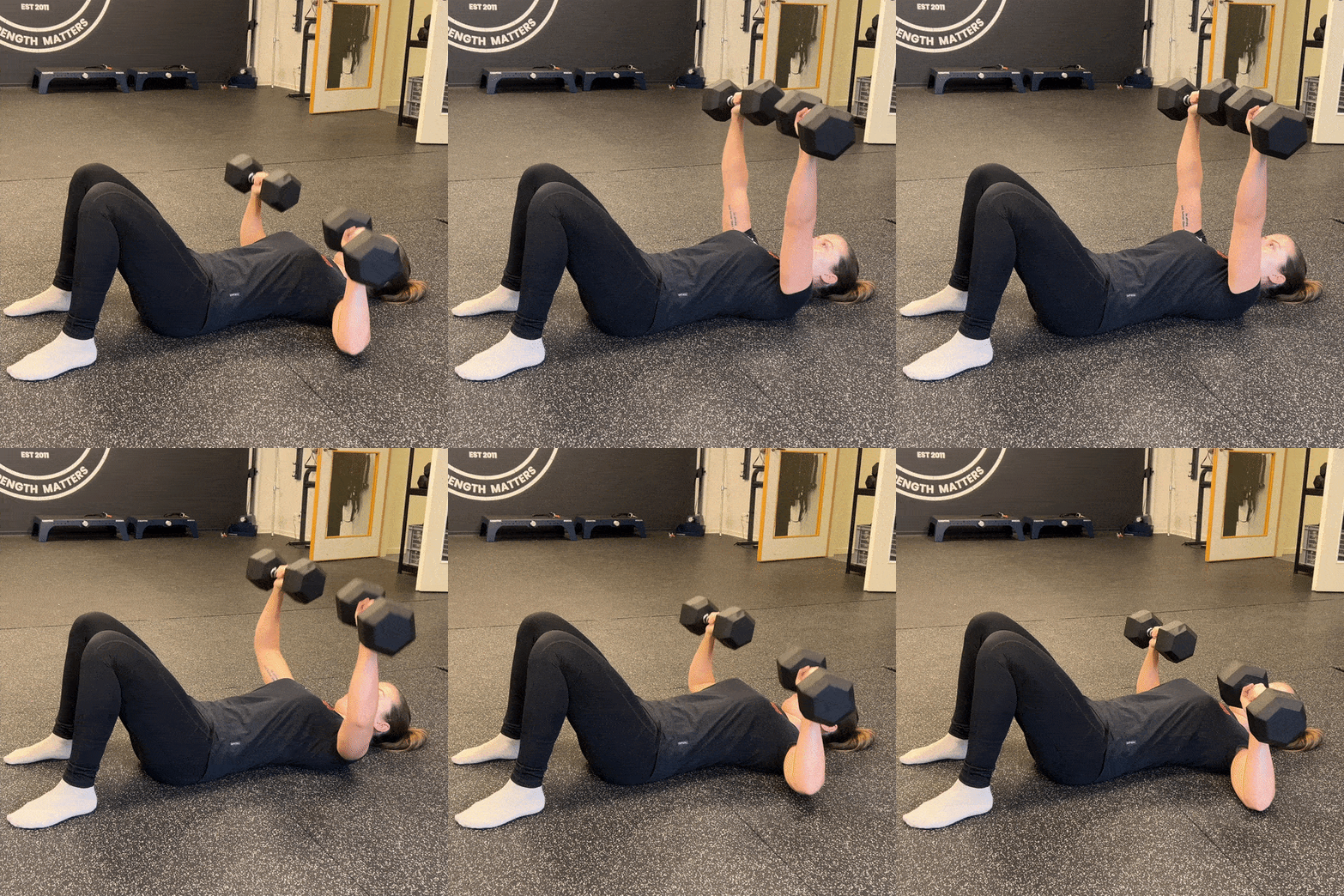
If you don’t have a bench, you’re not doomed to a life of weak pecs. You simply do the dumbbell floor press instead. It’s exactly what it sounds like: you lie flat on your back on the floor and press the dumbbells up from there.
It trains the exact same muscles, and you don’t do both in the Beginner Dumbbell Program. You do the dumbbell chest press if you have a bench, and you do the floor press if you don’t.
Muscles Worked in the Dumbbell Floor Press

Primary muscles worked:
Secondary muscles worked:
How to Do Dumbbell Floor Presses
- Sit on the floor with your legs straight and a pair of dumbbells beside you.
- Pick the dumbbells up and place them in your hip crease.
- Lie down while you bring the dumbbells up to your chest.
- Press the dumbbells to straight arms, bend your knees, and place your feet flat on the floor.
- Lower the dumbbells slowly until your upper arms hit the floor.
- Reverse the motion and push the dumbbells up to a straight-arm position again.
- Repeat for reps, then gently drop the dumbbells to the floor to finish the set.
4. Dumbbell Row

The dumbbell row is a superb pulling exercise for your upper back (lats, rhomboids, traps) which are responsible for pulling your shoulders back and keeping you upright. It also works your rear delts and biceps.
You support yourself with one hand on something sturdy, grab a dumbbell with the other, and pull it up toward your hip, squeezing your back.
Muscles Worked in the Dumbbell Row

Primary muscles worked:
Secondary muscles worked:
How to Do Dumbbell Rows
- Start by placing a dumbbell on the floor. Stand facing a bench, chair, or some other sturdy object and place your left hand and left knee on top of it. You can also stand with your feet shoulder-width apart in front of the bench, whichever feels more comfortable.
- Keep your back flat and parallel to the ground, with a slight bend in the standing leg. Grip the dumbbell with your right hand.
- Inhale and pull the dumbbell by driving the elbow toward the ceiling.
- With control, lower the dumbbell back to the starting position while exhaling.
- Complete the desired reps on one side, then switch to the opposite arm and leg.
5. Dumbbell Romanian Deadlift

The Romanian deadlift is a hip-hinge exercise for the posterior chain, the muscles at the back of your body, primarily the hamstrings, glutes, and lower back.
You hold two dumbbells, keep your legs mostly straight (only a slight bend in the knees), and push your hips back as you lower the weights along your shins. You’ll feel a big stretch in your hamstrings.
Muscles Worked in the Dumbbell Romanian Deadlift

Primary muscles worked:
Secondary muscles worked:
How to Do Dumbbell Romanian Deadlifts
- Stand upright holding a pair of dumbbells.
- Inhale, brace your core slightly, and lean forward by hinging at your hips. Keep your knees almost completely extended.
- Lean forward as far as possible without rounding your back. You don’t have to touch the dumbbells to the floor, although it is OK if you do.
- Reverse the movement and return to the starting position. Exhale on the way up.
- Take another breath, and repeat for reps.
5. Reverse Dumbbell Lunge

The reverse dumbbell lunge is a great exercise for almost the entire lower body that builds strength, balance, and coordination, all in one. Holding a dumbbell in each hand, you step backward into a lunge, drop your back knee toward the floor, and then push through your front foot to return to the start.
Stepping backward is more controlled and often easier on the knee than a forward lunge, and a stable way to learn the movement. It also puts a little more emphasis on the glutes and hamstrings of your front leg, which many beginners need.
Muscles Worked in the Reverse Dumbbell Lunge

Primary muscles worked:
Secondary muscles worked:
How to Do Reverse Dumbbell Lunges
- Hold a dumbbell in each hand and stand with your feet about shoulder width apart.
- Take a big step backward and sink as deep as possible into a lunge position, without hitting the knee of the back leg on the floor.
- Return to the starting position by pushing yourself back with the front leg.
- Repeat for reps.
6. Dumbbell Shoulder Press

The final exercise in the Beginner Dumbbell Program is the shoulder press, a classic vertical pushing exercise for the shoulders and triceps.
You sit or stand, holding two dumbbells at your shoulders, and press them straight overhead until your arms are locked out. Just like the chest press, dumbbells let you find the most natural pressing path.
Squeeze your glutes and brace your abs like you’re about to be punched in the gut so you can press the weights overhead without arching your lower back too much.
Muscles Worked in the Dumbbell Shoulder Press

Primary muscles worked:
Secondary muscles worked:
How to Do Dumbbell Shoulder Presses
- Grab a pair of dumbbells, and lift them up to the starting position at your shoulders.
- Inhale and lightly brace your core.
- Press the dumbbells up to straight arms, while exhaling.
- Inhale at the top, or while lowering the dumbbells with control back to your shoulders.
- Repeat for reps.
Your Beginner’s Guide to Making Progress
So you’ve started slinging some dumbbells around. Awesome. You’re doing your presses, your rows, your goblet squats, and you’re feeling good.
But now what? How do you go from “person lifting dumbbells” to “person getting stronger by lifting dumbbells”?
The not-so-secret secret is a term I mentioned briefly earlier in the article called progressive overload.
It’s a science-y way of saying that to get stronger, you have to challenge your muscles just a little bit more than they’re used to over time.
Your body is smart, but it also likes to stay the same if it can get away with it. Now, you can’t let it do that if you want to continue seeing gains and getting better, which I assume you do.
If you do three sets of 10 with those 20-pounders forever, your body will just go, “I can handle this,” and stop adapting. It has no reason to build new muscle or get stronger.
It’s up to you to give it that reason, and here’s how you do it.
Method 1: Add Reps
This is the easiest way to start.
Most beginner programs give you a rep range, something like “3 sets of 8–12 reps.”
In the Beginner Dumbbell Program, you’re aiming for an even 10 on all exercises. Note “aiming”. It’s not something you always must or even should reach.
Let’s say you’re doing dumbbell presses with 20-pound dumbbells.
- You try as hard as you can and get three sets of 8 reps (8, 8, 8). Nicely done! You write that down.
- The next workout, you come back and try to beat that number. You aim for nine reps. Maybe you get 9, 9, 8. You didn’t quite reach your goal, but you made progress, so it’s still a win!
- Workout three, you keep pushing. Now you get 10, 9, 9 reps. You’re making progress every workout, so you know you’re on the right track.
- Fourth session, and you finally do it. You hit three sets of 10 reps (10, 10, 10). Woo-hoo!
Congrats! You have now reached your rep goal. You’ve officially gotten stronger. Which leads you to…
Method 2: Add Weight
Once you’ve conquered those 10, 10, 10 reps with your 20-pounders, it’s time to graduate.
- You put those 20s back on the rack, and you pick up the 25-pounders.
- You will most likely not be able to do three sets of 10 with the new, heavier weights. And that’s the whole point.
- You go back to Method 1. With your new 25-pound dumbbells, you’re probably back at something like 8, 8, 8 reps.
- And the cycle begins all over again. You now fight, workout after workout, to get the 25-pounders up to 3 sets of 10.
This kind of one-two punch of adding reps until you max out, then adding weight and starting over, is called double progression.
It’s the gold standard of strength training progression for beginners and will take you well into intermediate-level training.
Some workouts, progress will come easily, and some days you won’t hit the numbers you hoped for. That’s normal, so just keep showing up.
And, of course, don’t force more reps at the cost of your form. Good form makes an exercise both safer and more effective than swinging up a heavier weight.
Fixed vs. Adjustable Dumbbells: Which Should You Get?
Now, before you start training, there is one more thing to consider.
You need dumbbells to lift, and you have two basic options: get a set of fixed dumbbells or one or two pairs of adjustable dumbbells. The classic dumbbell dilemma.
Note: If you train in a commercial gym, you can skip this part and head off to the gym right away. You already have all the dumbbells you’ll ever need.
I’m going to cut right to the chase: For 99% of beginners training at home, I think adjustable dumbbells are the clear winner.

Benefits and Drawbacks of Adjustable Dumbbells
To get stronger, you must gradually lift more weight. Adjustables are built for that. You can go from 10 lb. to 12.5 lb., then to 15 lb., all with a single piece of equipment. OK, two pieces. You can’t do that with fixed weights unless you buy all the weights.
And, as a beginner, you’re going to get stronger, fast. Those 10 lb. fixed dumbbells you bought in week 1 will feel like paperweights by month 3. Now you have to go out and buy 15s. And 20s. And 25s. Your wallet will be empty, and your living room will be filled with iron.
Adjustable dumbbells used to be the picture of rinky-dink flimsiness a few decades ago, but that’s not the case anymore. Fixed dumbbells still have the advantage when it comes to sturdiness, but you no longer have to worry about a piece of your adjustables flying across the living room into your TV when you’re in the middle of a workout.
Now, fixed dumbbells can still be the best option, but only if 1) money is no concern, and 2) you have a dedicated space, like a garage, to train in and store your growing dumbbell collection.
For everyone else, the most space- and cost-effective option is to get a pair of adjustable dumbbells (and maybe one more later on as you become stronger). Get a good pair, and you’ll be set for years.
Beginner Dumbbell Program: FAQ
Here are answers to some of the most common questions you might have before starting your new dumbbell routine.
Absolutely. The Beginner Dumbbell Program is designed for complete novices. Every exercise is easy to learn, safe, and can be done with only one pair of dumbbells. If you’re new to strength training, this is exactly how you should start.
Start light. Your first goal is to learn the movements, not to lift as heavy as possible. Pick a weight you’re decently sure you can lift for 10 repetitions with control. It’s better to start too light and add weight next time than to start too heavy with bad form.
Many beginners start with 5–15 lb. (2–7 kg), but the “right” weight depends on your strength level and the exercise (you’ll be able to squat more than you can shoulder press). If you can’t complete the reps, go lighter; if the entire set feels too easy, go heavier. And if you happen to pick a weight that’s too light or too heavy, it’s no big deal at all. Just adjust in the next set or the next workout.
Keep it simple. A 5–10 minute warm-up is perfect.
1. Start with 3–5 minutes of light cardio (jogging in place, jumping jacks, or brisk walking, for example) to get your blood flowing.
2. Follow up with some dynamic movements like arm circles, leg swings, and a few bodyweight squats and lunges.
3. Lastly, do one light set of the first exercise (or all exercises) before you start your main “work sets.”
No problem at all! The Beginner Dumbbell Program includes the dumbbell floor press as a perfect substitute for the chest press. Everything else can be done with just dumbbells and a bit of floor space.
Yes, this program is built around compound exercises that work several muscle groups at once.
Your biceps get a good workout from the dumbbell rows, and your triceps get work in both the chest press and the shoulder press. As for your abs, they keep you stable in every exercise.
This is enough for beginners.
Yes, you can add one or two sets of dumbbell curls (and triceps extensions on another day) to work your arms even more.
But you don’t need to. Don’t make the mistake of adding and adding to a program that works to the point where it becomes too much, especially as a beginner.
This program is a perfect starting point and will serve you well for at least your first 8–12 weeks of training.
You’ll know you’re ready to move on when your progress starts to slow down, but as long as you’re still increasing your reps or weight, the program is working. As a beginner, you’ll see months of steady progress before you need anything more complex.
We have several training programs in StrengthLog for intermediates and above who want to continue building muscle and strength using dumbbells only, like our 4 Week Home Workout Plan (three weekly workouts) and the Home Workout Split (five workouts per week).
It will help you do so, but not automatically. No training program can do that.
To lose weight, you will need to follow a healthy diet with fewer calories than you burn. However, strength training, like this workout plan, will make sure that you lose mainly (or only!) fat while maintaining or even gaining muscle at the same time.
To learn more about weight and fat loss, check out How to Cut: Lose Fat and Keep Your Muscle Mass.
Yes, you can! You have two main options, and both are great:
1. Do cardio on your rest days. This way, it won’t interfere with your lifting at all.
2. Do it after your dumbbell workout. If you prefer to do it all on the same day, lift weights first when you’re fresh and do your cardio after.
Not at all. Progress is never a perfect, straight line. Beginners progress faster than advanced lifters, but it’s not a guarantee every workout. Some days you’ll feel tired, or a particular weight feels heavier than usual.
The important thing is that you showed up and put the work in.
If you aimed for 10 reps and only got nine (just like last time), that’s still a successful workout. Just make a note of it and try to beat it again next time.
Three weekly workouts are slightly better, but not by a significant margin. You will still make progress and get stronger training twice a week as a beginner.
StrengthLog automatically shows you today’s workout, tracks your reps and weights, and makes progressive overload easy. You don’t have to remember what you lifted last time. The app does it for you, so you can focus on pushing a little harder each session.
Follow the Beginner Dumbbell Program in StrengthLog
This workout routine is one of the many free programs in our workout log app, StrengthLog.

The app makes it super easy to keep track of your weights and reps and ensures you’re on the right path.
It remembers what weights you used in your last session, and automatically loads them into your next one. And trying to improve on your last workout is the key to improving and getting stronger over time.
Download it and start tracking your gains today!
StrengthLog is free to use, and so is this program.
Track Your Training. See Real Progress.
Log your workouts in one place and watch your numbers climb, week after week.
- Free to get started
- Fast workout logging
- Cardio and strength training
- Free weights and machines
- Progress over time, personal bests
- Beginner-friendly training programs and workouts for every fitness goal
Download StrengthLog free:
Final Rep
And that’s it: your Beginner Dumbbell Program and blueprint to strength and muscle gains.
But! Reading about getting stronger doesn’t build muscle any more than reading a cookbook makes you a chef. The only thing that works is picking up the dumbbells.
Be patient, stay consistent, and don’t be afraid to challenge yourself (just a little) every time.
Want more?
Subscribe to our weekly newsletter to get notified of new articles, and get weekly training tips!
Or, you can view all our training programs here.
Last reviewed: 2025-11-14
