
Welcome to the ultimate guide on how to get big arms. 💪
Big, muscular arms are awesome. If you’re reading this article, you want them.
Your arms are one of the most visible parts of your body, and when you’re rocking a set of well-developed guns, it’s like carrying around personal trophies of dedication and hard work. Muscular arms can boost your self-confidence tremendously and be a game changer both in and out of the gym.
But big biceps and triceps aren’t just for show.
Many lifters still have a preconceived notion that arm training isn’t “functional,” which is a bunch of baloney. Stronger arms are not just for show—they boost your performance in many physical activities. From sports that require upper body strength in any way to numerous everyday activities to dominating on the beach, the benefits are both practical and visual.
If you have ever been unable to use just a single arm, you know how much they are involved in almost anything you do. Sure, you train your arms when you do pushing exercises for your chest and shoulders and pulling movements for your back. However, unless you have exceptional genetics for arm gains, you’ll never build the same strength and muscle mass as you would from dedicated arm training.
If you want bigger, more muscular arms, you have stumbled across the right article.
Table of Contents
What to Expect from How to Get Big Arms
How to Get Big Arms is for everyone, from the beginner taking their first steps into the world of strength training to the advanced lifter—everyone who wants to build big and bad-a$$ arms.
Are you new to lifting and want arms that stop traffic? This guide will set you on the right path—without neglecting the rest of your body. Don’t fall into the trap of focusing solely on a few muscle groups, tempting as it may be, as it can lead to an uneven physique.
I have seen literally hundreds of gym newbies over the years who have been so focused on building a certain muscle group or two (mostly the arms!) that they have had to play catch up later on when the wisdom of age and the visual appearance of an unbalanced physique in the mirror have made then see the error of their ways.
Are you already past the beginner stage? Fantastic. The workout you need to take your arm gains to the next level awaits you over the following hour or so of reading. Perhaps you’ve been training without direct arm focus for a while or haven’t gotten the arm development you want despite your efforts. I’m not guaranteeing any quick fixes, but combined with hard work and consistency, you will get a thank-you note from your biceps and triceps in time.
You’ll also find advanced tips on how to boost your arm training with advanced training techniques, motivational tips and strategies, exercise and nutrition guides, and much more.
This article will give you a clear roadmap on how to get big and strong arms, paying equal attention to your triceps and its more famous brother in arms, the biceps. Because if you want big arms, the tricep muscle is even more important (be honest: did you know that it is one of if not the, biggest muscles in the upper body?)
You’ll learn:
- Goal-setting: why it’s essential for building big arms and how to go about it
- Basic arm anatomy and function explained in an easy and fun way. Even if you just want to grow them, knowing how the arm muscles work makes it easier to understand why you’re doing a certain exercise.
- Excellent programs and workouts for building big guns, whether you’re a beginner or a more advanced lifter.
- Complete guides to all the arm exercises included in the programs. How do you do them, what muscles do they target, and why are they a great addition to your arm training? You’ll know after reading the Exercises section below.
- Advanced training techniques to help boost your progress further once you’re past the beginner stage and have amassed more arm-training experience.
- How to track your progress and make adjustments as needed.
- What and how much to eat to turn your molehill biceps into mountainous peaks. While you can’t eat your way to big arms, even the most high-intensity training won’t give you the results you want without proper nutritional support.
- Supplements—do you need them (hint: you don’t, but a few can give you that little extra), which ones are worth your money, and which are a waste of your hard-earned cash?
- The importance of rest and recovery for building big arms. Your muscles respond to your efforts in the gym only when you give them the time and opportunity to recover appropriately from your grueling workouts, after all.
Let’s build those pythons!
Setting Your Goals
One of the main goals of fitness enthusiasts all over the world—from entry-level lifters to competitive bodybuilders—is to build bigger and stronger arms.
But when you write down those goals (which you should), it’s quite important to go the realistic and achievable route while keeping motivation alive and making steady strides.
So, how should you set your arm development goals?
Realistic Goals for Arm Development
Establish Your Starting Point
First, evaluate your fitness level, arm strength, and muscular development.
You need concrete numbers, and you get them by measuring and writing down the circumference of your arms, recording the weight you can handle in different exercises, and assessing your current training volume, meaning the number of sessions and sets/reps you do, both per exercise and on a weekly basis.
Basically, you assess your current fitness status. From here, you can map out clear and achievable goals for your arm training.
Define Clear, Measurable Objectives
Set concrete goals, like increasing your biceps circumference by half an inch or being able to curl 20% more weight within a certain time frame, like six months.
Your goals should be measurable so that you can easily track your progress.
It’s essential that you are specific here. Rather than saying, “I want bigger arms,” define what “bigger” means to you in measurable terms.
Set Short-Term Milestones
Breaking your main goal into smaller, short-term milestones makes it easier to stay motivated, and your ultimate goal seems more attainable—like a final boss you know you can beat if you just apply yourself.
For instance, if your goal is to add an inch to your arms in a year, set a milestone of adding a quarter inch every three months.
Be Realistic
While ambition is great—crucial even—your goals must be realistic and achievable within your given timeframe.
If you’re a beginner, chances are you will see faster initial gains from an arm routine than intermediate or advanced lifters.
If you’re on the lucky end of the genetic spectrum and just starting out, your arms might blow up during your first few months of training, even though no one goes from noodles to massive arms without spending years with the iron.
But if you’re like most of us, you’ll have to fight for every quarter of an inch.
A realistic goal for natural lifters who have been training for a while is to aim for approximately 0.5 to 1 inch of growth around the arms within a year, depending on factors like genetics, training experience, and nutrition.
Balance Your Training Intensity With Recovery
Don’t be that person who only trains arms. You want your training plan to include a variety of exercises for all major muscle groups, not just your arms. Working the entire body using compound exercises and heavy weights will only aid you in building a set of impressive arms, as long as you take care not to overdo it.
Balance is key, not just when you choose your exercises but also when it comes to managing your workout intensity, frequency, and recovery.
Building big guns requires high-intensity arm training with plenty of sets, that is true, but going gung-ho in the gym without everything else, like rest, recovery, and nutrition, in place gets you nowhere fast. Overtraining and undernutrition lead to injury and setbacks.
Track Your Progress
Keep a workout log to track your exercises, weights, sets, and repetitions. It will not only help you stay on course but also allow you to make adjustments based on what is or isn’t working.
I feel that tracking your progress is crucial enough for building your arms to dedicate an entire section to it later in the article.
Adjust Your Training and Goals as Necessary
Be flexible in the goals you set and be ready to modify them according to your progress.
If you achieve your milestones sooner than you expected—fantastic! Reassess and set new goals that, while still achievable, are more of a challenge. You want your goals to be within reach but challenging enough that your motivation remains high.
Conversely, if your progress comes at a slower rate than you expected, reassess your approach—everything from nutrition to rest and exercise form. Are you really doing what is necessary to reach your goals, or were they too lofty and unrealistic to begin with?
Celebrate Your Achievements
Celebrating your achievements when you finally reach a fitness milestone, like achieving an arm training goal that once felt distant but is now within reach, is not just about giving yourself a pat on the back—it’s an integral part of maintaining your motivation and momentum.
Each celebration builds a bridge to the next goal, like stepping stones across a river of gains. Each stone is a mini-goal, and celebrating helps you maintain your balance as you step to the next one.
Short-Term Vs. Long-Term Goals
Next, let’s talk about short-term vs. long-term goals.
Both short-term and long-term goals are critical when you set out to improve your physical fitness or performance. Whether you want to become a faster runner, squat twice your body weight, or, in this case, build mighty biceps and triceps, goals are stepping stones to success.
Understanding both and implementing them into your workout plan helps you set realistic expectations and maintain your motivation as you conquer milestone after milestone on your way to your ultimate goal.
Short-Term Goals
Short-term goals are the stepping stones to your larger aspirations.
In an arm training context, short-term goals for the beginner include:
- Learning how to perform each exercise with perfect form.
- Increasing the weight you lift by a small increment each week.
- Consistently doing one more rep or adding an extra set to your workouts.
Your short-term goals should be easy to track and measure.
Goals like these are immediately actionable and measurable and provide you with regular feedback and a sense of accomplishment. They keep your motivation level high and make your exercise and nutrition plans feel doable and less overwhelming.
Short-term goals, especially when you are a lifting newbie, allow you to focus on your workouts and day-to-day routines rather than feeling the pressure of long-term ones. For advanced lifters, short-term goals are just as essential, but at this point, motivation is likely less of a factor—if you didn’t have it, you wouldn’t be where you are, and routines regularly trump having to feel motivated to do what you need to do to reach your long-term goals.
And speaking of long-term goals.
Long-Term Goals
Short-term goals give you direction for the upcoming few days to weeks, but long-term goals provide a clear destination.
If you want to build bigger biceps and triceps, an example of a long-term goal would be to increase your arm size to a particular circumference, like going from 14 to 15-inch guns.
And, even though your final goal might be completely visual, your sub-goals on the way there don’t have to be. Another example of a long-term arm-building goal might be to do ten 80-pound barbell curls. Even if you don’t really care about how much you lift, a stronger muscle is almost always a bigger muscle, so if you go from doing 60-pound curls to 80-pound curls, you can bet a fair amount of cash that your biceps will have increased significantly in size.
Long-term fitness goals provide direction and purpose, but they also serve as a constant reminder of the bigger picture while you conquer one short-term goal after another—especially important when progress feels slow, short-term achievements seem insufficient, or when you face setbacks.
Balancing Both for Optimal Gains
The key to successful goal-setting for your arm training lies in balancing both types of goals.
Short-term goals keep you on target on a daily and weekly basis, while long-term goals make sure that you do not veer off track. Together, they create the framework for planning your training sessions on a day-to-day basis and give you the mental focus and dedication to keep grinding.
Clearly defining what you want to achieve in the short and long run allows you to maintain a workout routine that is both challenging and achievable. Not too easy, not too hard. That balance encourages consistent effort and prevents burnout by making your training effective in the here and now and sustainable over longer periods.
Arm Anatomy and Function
As a bodybuilder or fitness enthusiast looking to build big arms, do you really need a comprehensive understanding of the muscles in your arms and their function?
Not really. You don’t need a degree in anatomy to curl a pair of dumbbells.
That being said, understanding the basics of how your arm muscles work is always a good idea. Whether you’re looking to buff up your biceps or strengthen your triceps, grasping the basics of arm anatomy will help you understand why an exercise is part of a workout plan. Or design your own arm routines for maximum effectiveness.
This section details the anatomy of your biceps and triceps in an easy-to-understand way and explains the function of each muscle during everyday movements and training.
Then, we’ll shed light on the scientific processes behind muscle growth. You’ll learn what really happens when you curl heavy iron and turn those molehills into mountains and the essential training methods to keep your gains coming.
Let’s roll up your sleeves (while you still fit into them) and get started.
Introduction to the Muscles of the Arm
The human arm is a complex assembly of muscles, bones, and connective tissues that coordinate to perform myriad tasks. Understanding the minutiae of arm anatomy is not necessary for someone looking to hoist heavy iron to gain arm size and strength.
However, knowing the basics of the primary muscles is helpful, especially when you want to design your own arm training routines.
These include the biceps brachii, brachialis, and triceps brachii. Let’s go through each of them and find out what they are all about.
Biceps Brachii
The biceps brachii, or biceps for short, is the most famous muscle of the arm and perhaps the entire body. If someone asks you to flex a muscle, it’s likely your biceps they want to see, not for you to drop your pants and flex your quads.
The bicep muscle is located on the front of the upper arm. It has two heads (the long head and the short head), which originate from different points on the scapula and converge to attach at the radius bone of the forearm. The long head on the outer side of the upper arm gives you the famous biceps “peak.”

Functionally, the biceps brachii is known for three major roles:
- Forearm Supination: The bicep muscle is a very strong supinator, meaning it controls the outward rotation of the forearm, allowing you to turn your palms to face upwards. Think of turning a doorknob or using a screwdriver—those are bicep supination in action.
- Elbow Flexion: The biceps also help you flex the elbow, bringing the forearm towards the shoulder. That means your biceps are involved in many things you do every day, like lifting a shaker to your mouth to chug a protein shake or performing a bicep curl. However, the biceps is not the primary elbow flexor—that honor falls to the muscle lurking beneath it: the brachialis.
- Shoulder Flexion: The biceps also have a small role in flexing the shoulder, bringing your arm forward and up.
Brachialis
Beneath the biceps lies the brachialis, an often overlooked muscle that contributes greatly to arm thickness and strength. When most people think of the biceps, they actually mean both the biceps and the brachialis together,
It is this muscle that is mainly responsible for the flexing motion of the elbow, regardless of the position of the forearm. That’s all it does, and it’s really good at it. The brachialis is actually the stronger elbow flexor of the two.
The brachialis attaches from the lower half of the humerus to the ulna, the longer forearm bone. Due to its position and function, the brachialis contributes just as much as the biceps to the appearance of the arm when fully developed. For example, while the peak of your biceps is mainly genetic, a well-developed brachialis pushes the long head up, allowing you to make the most of those biceps peak genetics.
Triceps Brachii
On the flip side of the arm is the triceps brachii, or triceps. Most people are surprised when they find out exactly how big the triceps muscle actually is. It is significantly bigger than the biceps, making up two-thirds of your upper arm muscle mass. It is also larger than the lats and the pecs, rivaling the delts for the top spot as the most sizable muscle in the upper body.

As its name suggests, the triceps have three heads: the long, lateral, and medial. The long head is the largest of the three, making up half of the triceps’ mass. That means that if you want to get big arms, it is paramount that you target the long head of the triceps with the right exercises.

The triceps’s primary function is to extend the elbow, straightening the arm. You use it whenever you push open a door, punch someone in the nose, or do a set of bench presses. Each head of the triceps contracts to push your forearm away from your body in a movement essential for both dynamic athletic activities and everyday functional movements.
Beyond elbow extension, the long head of the triceps also assists in shoulder extension and adduction. Due to its origin on the scapula, the long head helps you pull your arm down towards your body and extend it behind. For example, it assists when you reach for an object behind you or complete a swimming stroke.
Last but not least, well-developed triceps are essential if you want sleeve-busting arms, more so than the much smaller biceps.
How Muscles Grow
When you lift weights, you subject your muscles to tension and stress. That stress increases the rate at which your body builds proteins, which are the building blocks of muscle, a process called muscle protein synthesis.
The exact mechanisms of protein synthesis are way beyond the scope of this article or what you need to know to get big arms, but it is the primary factor behind muscle growth.
Progressive Overload: The Key to Arm Gains
For your muscles to grow, you must challenge them—force them, if you will—to do so. Enter the most important training principle of all: progressive overload.
Progressive overload is like leveling up your muscles. Imagine you’re playing a video game, and each time you defeat a monster, you gain experience points. With enough points, you level up, becoming stronger and more bada$$. In the gym, progressive overload is your way of racking up those points.
To get stronger and build muscle, you must continually increase the demands on your musculoskeletal system. That means doing more over time—lifting heavier weights, increasing the number of reps, or adding more sets to your workouts:
- Track your lifts and try to lift more than your last workout, at least in one exercise or set.
- Doing more reps with the same weight.
- Adding more sets to your exercises and workouts.
- Give yourself less break time between sets, which ups the intensity and endurance challenge.
If you always do the same number of reps with the same weights, you’re not giving your muscles any reason to grow.
By consistently lifting more weight or doing more reps than before, you force your muscles to adapt to handle that stress by growing bigger and stronger. It happens very slowly, but over time, you see a more muscular version of yourself looking back at you in the mirror.
While strength training boosts muscle protein synthesis, you also need proper nutrition (enough calories and protein) and sufficient rest and recovery to get the gains and build the arms you want. You’ll learn all you need to know about these critical factors for muscle growth coming up.
Arm Workout Routines
In this section, you’ll find not one but two workouts to build serious arm mass, one for beginners and one for intermediates and above.
The first workout is a full-body training routine with extra focus on the arms for the beginner. As a strength training newbie, it’s important to follow a balanced training program that covers all major muscle groups of the body. In this one, you train three full-body workouts each week, emphasizing the two most important muscles in the human body (just kidding… or am I?), the biceps and triceps.
The second is our best arm workout for intermediate-level lifters and above who want optimal arm gains. It’s also ideal for advanced trainees and bodybuilders who aren’t satisfied with their current arm development and want to take their biceps and triceps training to the next level. It’s a stand-alone workout that you can integrate into your training program as you see fit, but you’ll also get tips on how to do so for the best results.
Making the Most of Your Arm Workouts
If you haven’t skipped the previous parts of this article, you know how critical progressive overload is for building muscle.
The arm routines in this article are no different; they depend on progressive overload, as do all training programs worth their salt. You must continually try to beat your previous best by lifting a little heavier than last time or doing at least one more repetition.
You won’t be able to do so every workout, at least not once you’re past the beginner stage, but at least try unless you’re tired or having a bad day, which happens to all of us. In that case, give it your best, but don’t stress about it, and come back stronger next time.
Write down your exercises, your sets, how much weight you use, and how many reps you do. Then you’ll know exactly what you have to beat. Don’t rely on memory alone; few people can track their workouts correctly in their heads. Use a notebook or, even better, a digital workout log app like StrengthLog.
More about tracking your progress later.
When to Increase Your Weights
In both the following workouts, you’ll see our recommended rep ranges for each set of an exercise, like 8–10 reps of barbell curls.
First, if you’re new to strength training, always start with a very light weight with which you can easily do the recommended reps. Take your time to practice form and technique before you increase the weights.
The rule of thumb of when to increase your weights is pretty simple: if you can complete your sets at the upper end of the rep range (in the case of the example earlier, 10 reps) with solid form, it’s time to grab those heavier weights or put a pair of small plates on the bar.
Increasing the load will bring you back to the lower end of the rep range, from which you work your way up to the upper end, increase the weight again, and rinse and repeat.
That is the most basic and effective form of progressive overload, and it will take you all the way to the status of advanced lifter. And by that time, you’ll have a set of pretty impressive arms.
Warming Up Before an Arm Workout
Warming up before a heavy arm workout improves performance and might even prevent injuries. Here’s a detailed guide on how to effectively warm up your arms and supporting muscle groups.
General Warm-Up
Begin with ~5 minutes of light cardio, like jogging, cycling, or using a rowing machine to increase your body temperature and blood flow to the muscles. Your goal is not aerobic fitness or to exhaust yourself but to raise your heart rate and warm up your muscles, so no need to go all-out here.
Dynamic Stretching
Next, do a series of dynamic stretches to improve mobility and elasticity in your muscles and joints.
- Arm Circles: Extend your arms to the sides and perform small circles, gradually increasing to larger circles. Do 20 rotations in each direction.
- Swings: Swing your arms across your chest and back out to your sides, slightly behind your back, to open up the chest and warm up the shoulders.
No need for static stretching. It does the opposite of what you want and can even decrease performance for a few hours afterward.
Ramp-Up Sets
Lastly, you want to gradually acclimate to the weight you will lift during the main workout. The best way to do so is to perform a series of ramp-up sets of the first exercise of the workout.
For example, the first exercise of the intermediate arm workout is chin-ups. To warm up properly, do a series of sets of supinated lat pulldowns, increasing the weight of each set.
Begin with a light weight and perform 10–15 reps. Increase the weight in small increments while decreasing the reps through 2–3 sets until you’re warm and ready for your first actual set.
Arm-Focused Training Program for Beginners
This is the training program if you’re a beginner who wants to build bigger arms.
Not only will it start you on the road to getting a pair of great guns, but it’s also an excellent training program for every muscle group, giving you the foundation to take you as far as you want into your muscle-building future.
You train three days per week, doing full-body workouts with a little extra focus on your arms. Even when you train muscles like your back and chest, you’re doing exercises that also work your biceps and triceps. At the same time, the program is structured so that your arms get enough rest between sessions to recover and grow.
Full-body routines are ideal for beginners because they target all your major muscle groups in a single session, maximizing gains with fewer weekly workouts. In addition, you practice training a muscle more often, which is a great boon early on as it improves coordination between your muscles, brain, and nervous system. Plus, they keep things interesting and straightforward, reducing the risk of overtraining and making it easier to stick to your plan without getting overwhelmed.
Here’s the program in detail:
Workout 1
| Exercise | Sets | Reps |
|---|---|---|
| Squat | 3 | 6 |
| Leg Curl (seated or lying) | 3 | 10 |
| Close-Grip Bench Press | 3 | 8 |
| Supinated Lat Pulldown | 3 | 8 |
Workout 2
| Exercise | Sets | Reps |
|---|---|---|
| Barbell Row | 3 | 8 |
| Bench Press | 3 | 6 |
| Barbell Curl | 3 | 8 |
| Leg Extension | 3 | 12 |
Workout 3
| Exercise | Sets | Reps |
|---|---|---|
| Deadlift | 3 | 5 |
| Overhead Press | 3 | 6 |
| Cable Curl | 3 | 10 |
| Tricep Pushdown | 3 | 10 |
A suggested weekly training schedule could look like this:
- Monday: Workout 1
- Wednesday: Workout 2
- Friday: Workout 3
However, that’s just what it is: a suggestion. You can train on Tuesday, Thursday, Saturday, or any other combination of days that fit your schedule. If you can only do two days one week, that’s also fine—pick two of the workouts and go go go. Just try to separate each session with a rest day, and you’ll be good.
Click here to open the program directly in StrengthLog.
Beginner Progression Tips
Always start with a weight you can easily handle for the recommended reps. Practice the movement and learn the proper form before you increase the load.
You can begin adding more weight when you can successfully perform the suggested number of repetitions with proper form and technique. You should increase the load by ~2.5 kg or 5 pounds (or the minimum weight increase in a corresponding machine), which may reduce your repetitions slightly below your target range.
Progressive overload is a gradual process. Once you’ve adjusted to the new weight and are back at the recommended reps, it’s time to add another 2.5 kg or 5 pounds. Slow and steady, patience and consistency win the race. Don’t rush the process, and you’ll see steady progress over time.
As a beginner, you can likely increase the weight frequently, possibly in each session. But as you become more experienced, increasing the weight will require more time. Maintaining your efforts will help you achieve these milestones faster. Initially, you’ll see quick improvements in your strength, but as you advance, it’ll take several sessions or even weeks until you’re noticeably stronger. That’s expected and natural, so don’t rush it.
Remember, not every exercise will see weight increases at the same rate. For instance, you’ll gain strength faster in compound movements (exercises that work multiple muscle groups and joints at once) like the squat and deadlift than you will in the biceps curl, so don’t expect to increase your curl weights at the same rate.
Track This Program in StrengthLog
This arm-focused training program for beginners is free in our workout tracker, StrengthLog. The app itself is also 100% free (both to use and free from ads), so don’t forget to download it for the best way to experience this training program.


Write down exercises, weights, sets, reps, and any additional notes about how the session felt. It’s like a personal trainer in your pocket.
In addition, it comes loaded with more than 200 training programs and workouts, many of which are free and created by experienced coaches. You also get statistics, stats and graphs, personal record tracking, and more, like an extensive library of exercises where you can learn how to do them (including all exercises in this program) by watching video guides and reading easy-to-follow step-by-step instructions.
Intermediate Arm Workout
This workout is for intermediate-level lifters, although it’s also great for advanced trainees. It contains four exercises for your biceps and four for your triceps, structured like this:
- You start with heavy compound exercises that allow you to push a lot of weight to overload your muscles for maximum strength and size gains.
- For the second exercise, you stay with relatively heavy weights, using barbell work to target the biceps and triceps directly.
- You then finish with two dumbbell- and cable isolation movements to end the workout with a sleeve-bursting pump.
Below is what the workout looks like in detail.
- Intermediate lifters: do three sets per exercise.
- Advanced lifters: do four sets per exercise.
Biceps
| Exercise | Sets | Reps |
|---|---|---|
| Chin-Up | 3–4 | Max reps (do as many as possible) |
| Barbell Curl or Dumbbell Curl | 3–4 | 6–8 |
| Hammer Curl | 3–4 | 8 |
| Preacher Curl or Concentration Curl | 3–4 | 12 |
Triceps
| Exercise | Sets | Reps |
|---|---|---|
| Close-Grip Bench Press | 3–4 | 6 |
| Barbell Lying Triceps Extension | 3–4 | 6–8 |
| Tricep Pushdown | 3–4 | 8 |
| One-Arm Dumbbell Triceps Extension | 3–4 | 12 |
Just like the beginner routine, this arm workout is available for free in your StrengthLog workout log app, as Arm Workout for Muscle and Strength. It’ll do everything except lift the weights for you.
Click here to open the workout in StrengthLog.
How to Incorporate This Arm Workout into Your Training Program
This arm workout is incredibly versatile. It fits like a glove right into almost any workout routine you can think of, like a three- four- five- or six-day training split.
Here are some examples:
Three-Day Split
- Day 1: Chest and back
- Day 2: Legs
- Day 3: Chest and arms
Four-Day Split
- Day 1: Chest and back
- Day 2: Legs
- Day 3: Shoulders
- Day 4: Arms
Five-Day Split
- Day 1: Chest
- Day 2: Back
- Day 3: Legs
- Day 4: Shoulders
- Day 5: Arms
You can also split the biceps and triceps parts of the workout and train them separately, with back or chest, for example:
- Back and triceps
- Back and biceps
- Chest and biceps
- Chest and triceps
The possibilities are nearly endless, and best of all, they’re all great.
Using Supersets with This Arm Workout
Supersets are a fun and effective way to trick your muscles into working harder by performing two back-to-back exercises with no rest.
They target opposing muscle groups (e.g., biceps and triceps, like in this workout) or different body parts (e.g., legs and shoulders). They don’t build more muscle than regular straight sets, but they speed up your workout and keep it spicy and efficient.
Feel free to superset this arm workout. It would look like this:
- Chin-Up + Close-Grip Bench Press
- Barbell Curl + Barbell Lying Triceps Extension
- Hammer Curl + Tricep Pushdown
- Preacher Curl + One-Arm Dumbbell Triceps Extension
In short, pair the first biceps exercise (chin-ups) with the first triceps exercise (close-grip bench presses), the second biceps exercise with the second triceps exercise, and so on.
Move between exercises within a superset with as little rest as possible, but rest normally (typically 1–3 minutes) between supersets.
Track This Workout in StrengthLog
Like the beginner program, you can follow this workout in StrengthLog, where it is pre-programmed and ready.
In the app, you can also check out video guides to all exercises in real-time when you’re in the gym, see your progress from week to week, and find hundreds of other great workouts and programs to take your training to the next level.
Armageddon It
There you have it: two fantastic arm routines for beginners and intermediates.
But what if you’re an advanced lifter looking for an arm training program to match?
Don’t worry. I’m not leaving you hanging.
Armageddon is our premium arm program, guaranteed to push your biceps and triceps to the limit, forcing them to grow.
But take heed—it is not for the faint of heart. It’s a high-volume, high-intensity routine, and I recommend you give it a go only if you really are an advanced lifter or bodybuilder. Or over the course of a month or two to push past a plateau.
Click here to go directly to the program in StrengthLog.
Note that Armageddon requires a subscription to StrengthLog to follow it in-app.
Exercises to Get Big Arms
This part of How to Get Big Arms is all about the best exercises for building huge guns!
You’ll find all the exercises from the training program and workout above here including several others you can use for variation. Each exercise is summarized in visuals and text guides on how to perform it correctly.
Most of these exercises are isolation exercises, focusing only on the biceps or triceps, but you’ll also find a couple of compound exercises that would belong in any back or chest routine. Pulling and pushing movements also work your arms, sometimes just as well as isolation biceps and triceps work.
We start with biceps exercises, in alphabetical order, before moving to triceps movements.
Biceps Exercises
Barbell Curl

The barbell curl is a classic exercise in the pursuit of bigger biceps. It’s one of the all-time most popular exercises, and it’s not hard to understand why. It’s easy to set up and learn, you can use a lot of weight to overload your biceps, and it’s one of the most effective exercises for adding lean muscle to your upper arms.
The key to a killer curl is in the control. Using momentum and swinging might help you lift more, but your biceps won’t be the ones reaping the benefits. Pin your elbows to your sides and curl the bar up using only upper arm strength.
Unless you’re deliberately doing cheat curls, that is. A cheat curl is like the rebel of the bicep curl, bending the rules for a bit more muscle engagement. It’s a version of the standard barbell curl where you allow a bit of body momentum to help hoist the weights.
Strategically used, cheat curls let you lift heavier or do a few more reps than you normally would, allowing for greater training volume and intensity and, thus, more growth. Most of your barbell curls should be strict, but you can allow yourself to loosen up a bit on your form for the last few reps of your heavy sets. Remember to resist the bar on the way down, though.
How to Do Barbell Curls
- Stand up straight with your feet hip-width apart.
- Hold the barbell with an underhand grip at around shoulder-width or slightly wider. Your palms should be facing forward.
- Bend elbows and curl the barbell up towards shoulder height, keeping your elbows close to your sides.
- Continue curling the bar until your forearms are nearly vertical and the bar is close to your chest. Squeeze your biceps at the top of the movement for a second to maximize the contraction.
- Lower the barbell back to the starting position with control.
- Repeat the movement for the desired number of repetitions.
Cable Curl

The cable curl is an isolation movement for your biceps. It is very similar in execution and muscle activation to the traditional barbell curl but with a few differences and benefits.
With barbells, the load you put on your biceps is gravity-dependent. The angle change makes it heaviest during the bottom half of the movement, after which it gets a tad easier as you curl the bar up. With a cable curl, the resistance doesn’t let up, giving your biceps a relentless tug throughout the entire motion. Your muscles work hard all through the curl.
In addition, cables give you more freedom to tweak your movement. You can step forward or back to adjust the angle and get a different stretch and contraction in your biceps.
You can also switch between attachments. Use a rope or a straight bar to target the muscle slightly differently and spice up your arm routine.
Regardless of how you do it, the cable curl is a worthwhile addition to barbell and dumbbell curls, especially when you’re training for muscle growth and a good pump.
How to do Cable Curls
- Fasten a bar in the lower position of a cable cross. Grip the bar with an underhand (supinated) grip, hands about shoulder-width apart, and take a step back.
- Lift the bar with control, by flexing your elbows.
- Don’t let your upper arm travel back during the curl, keep it still or move it slightly forward.
- Reverse the movement and lower the bar back to the starting position.
- Repeat the movement for the desired number of repetitions.
Chin-Up

An excellent exercise for training your lats and building a wide back, the chin-up is also a tremendous biceps builder, especially after a few tweaks:
- Use a shoulder-width (or slightly narrower) grip to place your lats in a disadvantageous position and force your biceps to do more of the work.
- Instead of pulling your body straight up like when you’re training back, try to keep a distance between yourself and the bar and perform a curl-like motion to pull yourself as high as possible until your chin clears the bar, and squeeze your biceps as hard as you can at the top.
If you struggle to do many chin-ups, you can take a resistance band, loop it around the bar, stand on the other end, and let it help pull you up.
Conversely, if body weight chin-ups are too easy, wear a weighted belt, hold a dumbbell between your thighs, or put on a backpack with something heavy in it.
Supinated lat pulldowns are also a great alternative. Use a grip width slightly narrower than your shoulders, pull the bar all the way down to your chest, hold the bar, and squeeze your biceps.
How to Perform Chin-Ups
- Stand underneath a pull-up bar and grip it with an underhand grip, hands slightly narrower than shoulder-width apart.
- Hang with your arms fully extended and your body in a straight line with a slight bend in your knees.
- Engage your core and retract your shoulder blades, drawing them down and back.
- Pull yourself up by bending your elbows and raising your chin above the bar.
- At the top of the movement, your elbows should be fully flexed.
- Pause briefly at the top of the movement and focus on squeezing your biceps before lowering yourself back to the original position.
- Repeat the movement for the desired number of repetitions.
Concentration Curl

The concentration curl puts a laser-focus on your biceps. You place your arm in an anchored position which makes it nearly impossible to cheat by using momentum or other muscles to curl the weight.
Concentration curls were one of Arnold Schwarzenegger’s favorite arm exercises for their ability to build the biceps peak. Today, we know that how much peak your biceps have is mostly due to genetic factors, but he wasn’t entirely wrong, because the concentration curl is a tremendous exercise for the long head of the biceps, the part of the muscle responsible for the peaked look when you flex it.
Go for a full range of motion, getting a complete biceps stretch at the bottom and a complete contraction where you squeeze the muscle at the top.
How to Do Concentration Curls
- Sit on a bench or chair with your feet flat on the ground, and hold a dumbbell in your right hand with a supinated grip (palms facing up).
- Lean forward and place your elbow against the inside of your thigh, just above your knee. Keep your upper arm close to your body and your other hand on your opposite knee for support and stability.
- Curl the weight towards your shoulder while keeping your upper body, arm, and elbow stationary. All the movement should be in your elbow joint.
- Squeeze your biceps at the movement’s top, and hold briefly before lowering the weight to the starting position.
- Repeat the movement for the desired number of reps, switch arms, and repeat the exercise with your left hand.
Dumbbell Curl

The dumbbell curl is a classic among bicep exercises and one of the top choices for building big guns, rivaling the barbell curl for the top spot. It’s easy to learn as a beginner and remains supremely effective as you gain training experience.
You can do dumbbell curls seated or standing. Both are equally effective, although the seated version makes it easier to minimize swinging and focus solely on your biceps.
In addition, you can curl the dumbbells simultaneously or alternate arms, lifting one at a time. Alternate dumbbell curls can allow you to use more weight, as the left arm gets to rest a bit as you curl with the right, and vice versa.
Another benefit of the dumbbell curl is that your hands aren’t locked into one position, which can be easier on the wrists, as some people feel discomfort curling a straight bar.
How to Do Dumbbell Curls
- Hold a pair of dumbbells in an underhand grip (palms facing forward), arms hanging by your sides.
- Curl the dumbbells up towards your shoulders by only moving your forearms.
- Don’t let your upper arms travel back during the curl. Keep them at your sides or move them slightly forward.
- Reverse the movement and lower the dumbbells back to the starting position.
- Repeat the movement for the desired number of repetitions.
Hammer Curl

The hammer curl might look like regular dumbbell curls, but it has something special going for it: the grip. Using a neutral grip, you turn the dumbbell curl into a unique and—many lifters think—essential exercise for complete arm development.
Instead of curling the weights with your palms facing up, you’ll keep your palms facing each other. It’s a subtle twist, but it shifts the focus slightly, targeting not only the biceps and brachialis and the brachioradialis (the muscle near your elbow that bridges your bicep and forearm). This makes the hammer curl an excellent variation for adding mass and thickness to your upper arms.
How to Hammer Curl
- Start with your feet shoulder-width apart and your arms at your sides, holding a dumbbell in each hand with your palms facing each other.
- Bend your elbows and curl the dumbbells up towards your shoulders, keeping your upper arms close to your sides. Don’t swing the dumbbells up; focus on contracting your biceps to curl them up.
- At the top of the movement, your forearms should be parallel to the ground, and your biceps should be fully contracted.
- Lower the dumbbells back to the starting position, under control.
- Repeat the movement for the desired number of repetitions.
Incline Dumbbell Curl

The incline dumbbell curl is an old-school biceps exercise with a unique twist: you move your arms behind your body as you perform it. That stretch and constant tension put your biceps muscle in a weakened position, making even a pair of light dumbbells feel heavy. It also gives you an intense pump and effectively targets the long head of the biceps.
It’s almost impossible to cheat when doing incline curls. All you have to remember is not to move your shoulders forward as you curl the dumbbells, as doing so shifts some of the action away from your biceps to your delts.
How to Do Incline Dumbbell Curls
- Adjust an incline bench to an angle between 45 to 60 degrees.
- Sit back on the incline bench with a dumbbell in each hand.
- Let your arms hang straight down to the sides with your palms facing forward.
- Curl the dumbbells up towards your shoulders. Keep your upper arms stationary, moving only your forearms during the curl.
- Reverse the movement and lower the dumbbells back to the starting position while keeping your elbows from moving forward or backward.
- Repeat the movement for the desired number of repetitions.
Preacher Curl

The preacher curl, invented by bodybuilding guru Vince Gironda and popularized by the first Mr. Olympia Larry Scott, is a popular exercise that completely isolates the biceps.
The name “preacher curl” comes from the position you adopt while performing the exercise—it resembles a preacher standing at the pulpit if gym rats designed it. When you lean over the preacher bench, your arms extend over the pad, mimicking a preacher leaning over the pulpit. That position and the pad combine to prevent other muscles from helping out, like a sermon on bicep focus.
You can perform preacher curls in many different ways: with free weights like a barbell or a pair of dumbbells, in a cable machine, or using a dedicated preacher curl machine. With dumbbells, you can opt for curling them with one arm at a time or two dumbbells simultaneously.
If you don’t have a preacher bench, you can make a makeshift dumbbell preacher curl by using the backrest of an incline bench.
How to Do Barbell Preacher Curls
- Grab a barbell and sit down at a preacher curl bench, resting your upper arms against the pad.
- Lower the barbell as far as you can, with control, to straight arms.
- Reverse the motion and return to the starting position.
- Repeat the movement for the desired number of repetitions.
Triceps Exercises
Barbell Lying Triceps Extension

Sometimes referred to as “skull crushers,” the lying triceps extension is one of the best exercises for adding lean mass to the entire triceps, including the long head.
To maximize the benefits of the exercise, lower the barbell down below your head, not to your forehead. Doing so puts your triceps in a stretched position, leading to up to 40% greater muscle growth in studies.1
If you prefer, you can use an EZ-bar or a pair of dumbbells instead of a straight barbell. They are all equally effective.
How to Do Barbell Lying Triceps Extensions
- Lie down on a flat bench with your feet on the floor and your head close to the edge.
- Hold a barbell over your chest with an overhand grip and your arms extended. Keep your hands relatively close together, spaced approximately 6 inches (15 cm) apart.
- Keep your elbows pointing straight up and lower the barbell behind your head, bending your elbows.
- Lower the barbell as far as you comfortably can while maintaining control and tension in your triceps muscles.
- Reverse the motion and extend your arms back up to the starting position.
- Repeat the movement for the desired number of repetitions.
Bench Dip
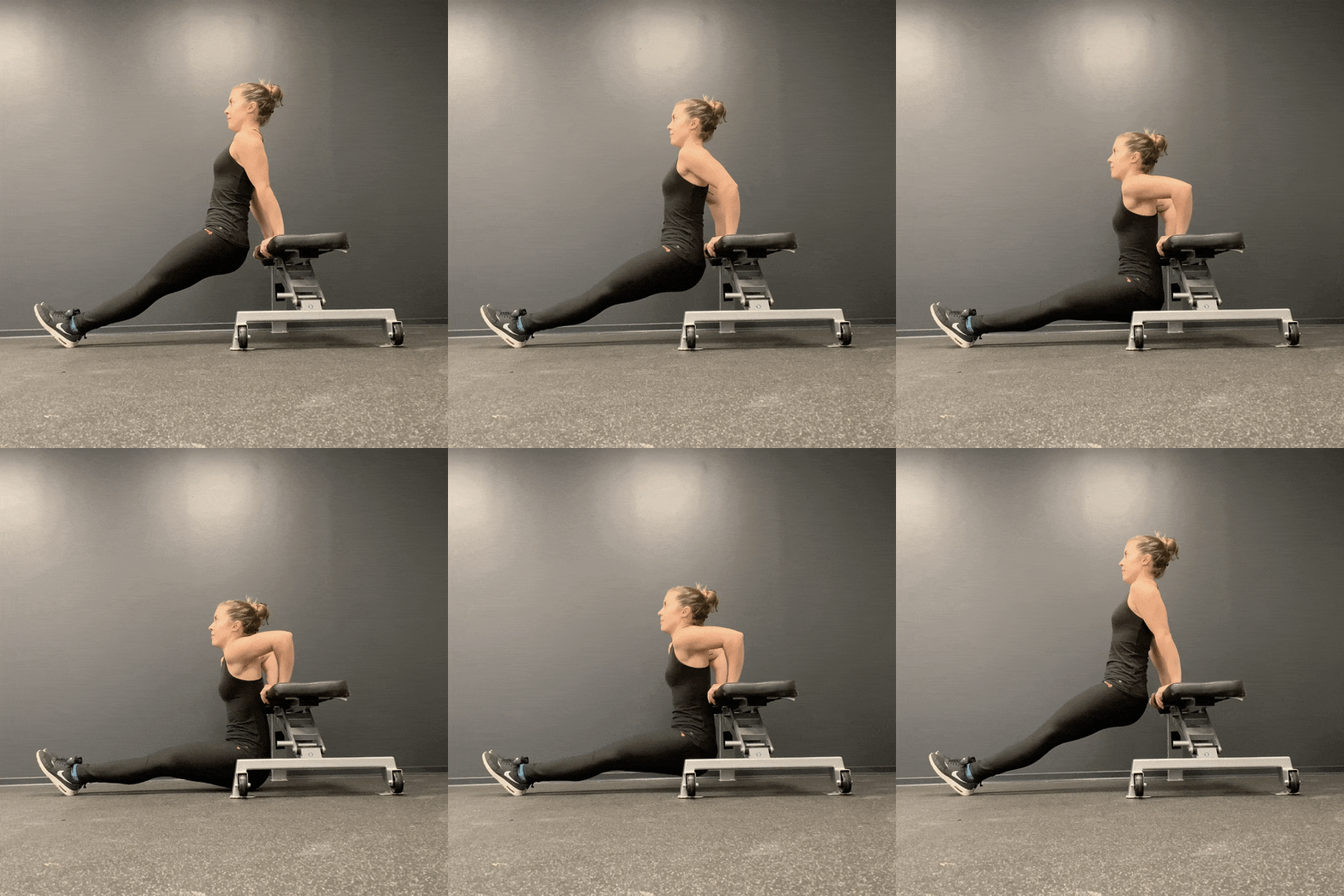
The bench dip, often called a tricep dip, is a compound bodyweight exercise primarily targeting the triceps, although it also engages the shoulders and chest to a lesser degree.
One of the biggest benefits of bench dips is that they can be performed almost anywhere, requiring only a bench or some kind of stable platform.
As effective as they are, some people feel discomfort in their shoulders when doing bench dips, as they place them in an internally rotated position. You can minimize the stress on the shoulders by pointing your knuckles outward instead of forward and not lowering yourself too deep. You don’t get additional triceps growth from lowering your shoulders below your elbow; it’s just more shoulder strain.
How to Do Bench Dips
- Turn your back towards a sturdy training bench, and put your hands on the pad about shoulder-width apart. Extend your legs in front of you.
- Lower yourself with control for as far as comfortable by bending your arms.
- Reverse the motion and return to the starting position.
- Repeat the movement for the desired number of repetitions.
Bench Press

You’re likely familiar with the bench press as one of the best upper body exercises and a top contender for the best exercise to build big pecs and great pressing strength.
However, it should also be mentioned for its ability to strengthen and build your triceps. Because you can use heavy weights and it’s easy to continually practice progressive overload by slapping more plates on the bar, getting strong in the bench press will build your triceps. A stronger muscle is almost always a bigger muscle.
How to Bench Press
- Lie on the bench, pull your shoulder blades together and down, and slightly arch your back.
- Grip the bar slightly wider than shoulder-width apart.
- Inhale, hold your breath, and unrack the bar.
- Lower the bar with control, until it touches your chest somewhere close to your sternum.
- Push the bar up to the starting position while exhaling.
- Take another breath while in the top position, and repeat the movement for your desired number of repetitions.
Close-Grip Bench Press

The close-grip bench press is a variation of the traditional bench press, performed with a narrower grip that shifts the work away from the chest to the triceps. It’s a compound exercise where you can use a lot of weight to overload your triceps into muscle and strength gains.
You don’t need to position your hands too close together on the bar. You only put stress on your wrists with no added benefit for triceps growth. Instead, place them at around 95–100% of your biacromial distance. That’s the distance between the two bony points at the top of your shoulder blades that you can feel on your shoulders:

Keep your elbows close to your body as you lower the barbell. Unlike a traditional bench press where your elbows flare out more, here they should be at about a 45-degree angle from your body. You target your triceps and keep your shoulders happier.
How to Do Close-Grip Bench Presses
- Lie on the bench with your lower back in its natural arch and pull your shoulder blades together and down.
- Grip the bar. Your hands should be shoulder-width apart or slightly closer.
- Take a breath, hold it, and unrack the bar.
- Lower the bar with control until it touches your chest somewhere where the ribs end.
- Push the bar up to the starting position while exhaling.
- Take another breath in the top position, and repeat for the desired number of repetitions.
Dips

The “squat for the upper body”—tha bar dip—is a fantastic compound movement for your chest, front delts, and triceps. While dips are often part of a chest workout, you can make it even better for triceps with a few tweaks.
- Stay upright during the dip. The more you lean forward, the more you hit your chest. So, maintain a straight posture with minimal forward lean to emphasize your triceps.
- Keep your elbows close to your body, and make sure they go straight back as you dip down without flaring out to the sides. You shift the workload to your triceps instead of your shoulders.
If bodyweight dips are too easy, strap on a weight belt or hold a dumbbell between your feet to increase resistance. Conversely, use a resistance band to assist you:

How to Do Dips
- Grip a dip station about shoulder-width apart, and climb or jump to get into the starting position.
- Lower yourself with control until your shoulder is below your elbow, or as deep as you comfortably can.
- Reverse the motion and return to the starting position.
- Repeat the movement for the desired number of repetitions.
Dumbbell Triceps Extension

The dumbbell triceps extension is a superb isolation exercise for the triceps. The overhead position is very advantageous for stimulating muscle growth in the long head of the triceps.
You can perform dumbbell triceps extensions with one arm at a time or use a heavier weight with both arms at the same time. You can also vary the exercise by standing or sitting down.
This is one exercise where you really want to get a good stretch in the bottom position to maximize your triceps growth potential—it’s way more important than using as heavy a dumbbell as possible.
How to Do Dumbbell Triceps Extensions
- Lift a dumbbell up to a straight arm over your head.
- Lower the dumbbell down behind your head, while keeping your upper arm still and vertical.
- Reverse the motion and extend your arm again.
- Repeat the movement for the desired number of repetitions.
Overhead Cable Triceps Extension

If you want big triceps, you can’t neglect the long head of the muscle. It makes up two-thirds of your triceps, and there is no better way to blast it than to do triceps extensions with your arms overhead.
Overhead extensions place the long head of the triceps in a stretched position, and heavy loads in a stretched position equals muscle growth. The neat thing is that you don’t even have to use particularly heavy weights for them to feel heavy in this position.
Using a cable maximizes the tension on your triceps throughout the entire movement compared to free weights, where the tension lessens at the top when you lock out.
Remember to keep your elbows the same distance apart throughout the exercise. Letting them flare out can be easy, especially if you use more weight than you can handle with good form, but it’ll reduce the effectiveness of the exercise.
How to Do Overhead Cable Triceps Extensions
- Fasten a rope handle in the lower position of a cable pulley. Stand with your back against the pulley, with a slight forward lean, and hold the rope behind your head and your upper arms next to your ears.
- Straighten your elbows until your arms are fully extended.
- Reverse the motion by bending your arms again.
- Repeat the movement for the desired number of repetitions.
Tricep Pushdown

The tricep pushdown is the most popular exercise for building terrific triceps, and it’s easy to see why. It’s fun, easy to learn and master, and effective regardless of your fitness level.
Experiment with rope and bar attachments to see which feels better and gives you a better contraction. The muscle activation is very similar, so which one you choose mainly comes down to personal preference.
Keep your body steady throughout the exercise. No cheating by using momentum—let your triceps do the work. This is an exercise where focus on form over ego matters. It’s better to use a lighter weight that allows you to keep your elbows tucked to your sides and only move your lower arm than to pump out a ton with sloppy form.
How to Do Tricep Pushdowns
- Stand facing a cable machine with your feet comfortably apart. Grip the bar with an overhand grip, keeping your hands about shoulder-width apart. Your elbows should be slightly bent, and your upper arms close to your sides and perpendicular to the floor.
- Engage your core and maintain an upright posture throughout the exercise to help stabilize your body and isolate the triceps.
- Start by extending your arms downward, focusing on pushing the bar down towards your thighs. Keep your upper arms close to your sides and stationary during the movement.
- As you lower the cable, squeeze your triceps and focus on contracting the muscle. Feel the tension in your triceps as you fully extend your arms.
- Return to the starting position by allowing the cable to rise back up using the same path. Maintain control throughout the ascent.
- Repeat the movement for the desired number of repetitions.
Advanced Training Techniques
You don’t need advanced training methods to see great progress during your first months of training. Add weight to the bar when you can, keep pushing it, stay consistent, and the gains will come.
However, when the river of gains slows to a trickle, advanced techniques can be implemented in your training to push your muscles out of their comfort zone.
In this section of How to Get Big Arms, you’ll learn the best and when to use them.
Drop Sets
Drop sets are a bodybuilding technique where you perform an exercise until failure, reduce the weight, and continue doing more reps until failure.
How to Implement Drop Sets in Your Arm Workout
- Let’s say you’re doing barbell curls. Begin with a weight heavy enough to perform 6–10 reps to failure. You shouldn’t be able to pump out an eleventh rep without compromising form.
- When you hit failure, reduce the weight by 20–30%. Then, with minimal rest, keep going until you hit failure again.
- You can drop the weight 2–3 times, each drop pushing your muscles more and more.
When to Implement Drop Sets
- At the end: Use drop sets at the end of your arm workout. Why? They’re exhausting, and if you start with drop sets, you won’t have much left in the tank for the rest of the session.
- Not every day: Drop sets are intense. If you do them, consider giving your arms a good rest afterward or rotating them into your program every other workout.
Drop sets are not more or less effective than traditional straight sets for muscle growth. Not if your total training volume remains the same. However, using them in addition to your regular reps to boost your intensity and volume can help with muscle hypertrophy and breaking through plateaus.
Supersets
Supersets involve doing two exercises back-to-back with no rest in between. The idea is to get more work done in less time and to increase the intensity by overloading your muscles.
Types of Supersets
- Antagonistic superset: Antagonist supersets involve pairing exercises that target opposing muscle groups, like biceps and triceps—for example, a bicep curl and a tricep pushdown.
- Agonistic superset: This involves pairing exercises that target the same muscle group, like two different bicep exercises in a row. For example, think barbell bicep curls followed by hammer curls.
Implementing Supersets in an Arm Workout
Supersets can make your arm workouts both fun and brutal. Here’s how you might implement them:
Example Workout
- Superset 1: Bicep Curls and Triceps Extensions
- Do 10–12 reps of bicep curls immediately followed by 10–12 barbell triceps extensions. Do not rest between the exercises. Take a 60-second break after each superset.
- Repeat for three sets.
- Superset 2: Hammer Curls and Overhead Tricep Extensions
- The same idea: 10–12 reps of hammer curls followed immediately by 10–12 reps of overhead tricep extensions. Rest for 60 seconds after each superset.
- Repeat for three sets.
When to Use Supersets
- When uou are short on ime: Supersets are great for cramming a lot of exercise into a shorter period.
- To increase intensity: If your workouts have hit a plateau, adding supersets can increase the challenge and stimulate muscle growth if they allow you to cram more work into your sessions. Just be sure to allow for rest and recovery, as supersets, especially for the same muscle, can tax your muscles and nervous system.
Partial Reps
Partial reps involve performing an exercise over a limited range of motion instead of completing the full movement. For example, you might perform full bicep curls until you can’t do any more reps, then do partials in the bottom 50% of the movement for a few more reps rather than calling it quits.
Why Use Partial Reps?
Partial reps allow you to:
- Overload your muscles: By focusing on a specific part of the movement, you can use heavier weights or do more reps than usual, piling on more stress (the good kind!) on the muscles.
- Push past failure: Partials can help you extend a set and dig deeper into your muscle fibers when you can’t squeeze out another complete rep.
You should focus on a full range of motion, going from fully extended to fully contracted in most of your reps. However, going past failure with partials now and then can be an excellent way for the intermediate- to the advanced trainee to provide the muscle with the extra stimulus needed for growth.
Forced Reps
Forced reps are an advanced resistance training technique in which you perform additional repetitions of an exercise past the point of muscle fatigue with the assistance of a spotter.
Let’s say you’re doing bicep curls. Curl as you normally would, and when you can’t do another full rep on your own, that’s where your spotter comes in. They should give just enough assistance to help you lift the weight while you still do most of the work.
When you train arms, you can even spot yourself if you train one arm at a time, like concentration curls.
Why Use Forced Reps?
The idea is to push your muscles beyond their usual stopping point, increasing muscle growth and strength through increased muscle fiber recruitment, time under tension, and metabolic stress.
How to Implement Forced Reps in an Arm Training Workout
- Go for arm exercises where a spotter can easily assist you, like bicep curls, tricep extensions, or close-grip benches.
- Make sure your spotter isn’t just anyone who can count to ten. You need someone who knows when to help and how much assistance to give—enough to keep the weight moving but not so much that they’re lifting it for you.
- Save this technique for the end of your workout. You don’t want to exhaust your muscles too early in the session. Consider doing forced reps on the last one or two sets of your arm exercises.
- Forced reps are intense. They should not be a daily special but more like a treat you give yourself occasionally to push past a plateau. Integrating them once every week or two in your program is enough.
- Because forced reps are taxing, give your arms proper time to rest and recover. More isn’t always better; sometimes it’s just more.
Cheating
Cheating is a technique in which you intentionally use momentum to lift heavier weights or perform more reps than you could with strict form. The goal is to add intensity and volume to your workout and go beyond failure for additional growth potential.
When to Cheat
- Advanced technique: Cheating is not for beginners. It is best used by those with a good strength base and solid technique. If you’re new to lifting, focus on nailing your form first.
- Sticking points: Use cheating to get past sticking points in your lifts, where it is tough to complete the movement with strict form.
- Last few reps: Cheating is best used towards the end of a set to squeeze out one or two final reps that you couldn’t complete otherwise. Not from the first rep.
How to Cheat Effectively
- Not all exercises are cheat-friendly. Good options for your arm workouts include bicep curls or tricep pushdowns. Avoid cheating in exercises where losing control could cause injury, like deadlifts and squats.
- The goal is to use as little momentum as necessary to get past the sticking point. Cheating isn’t a green light to flail wildly. For example, a slight hip thrust to help finish a bicep curl is enough.
- Even when you’re cheating, control the weight. Ensure you can handle the weight on the eccentric (lowering) phase of the lift, which can help stimulate muscle growth and strength.
- Cheating shouldn’t be the mainstay of your routine. Use it sparingly, when trying to break through a plateau or hitting those last reps.
Example Cheating Implementation in Arm Training
Let’s say it’s your bicep day. You’re doing 3 sets of 8 reps of bicep curls:
- Sets 1 and 2: Complete with strict form to ensure you’re targeting the muscle correctly.
- Set 3: Use a slight body swing to help move the barbell or dumbbells on the last two reps. Make sure you’re still controlling the weight and focusing on the bicep as you lift and lower it.
When to Introduce Advanced Training Techniques
Before even considering these advanced techniques, you must understand the basics of strength training first. That means you should have at least several months (I’d say six months as a comfortable rule of thumb) of consistent training under your belt. Your form should be as impeccable as a freshly ironed shirt, and you should have the stamina to push through longer and more intense sessions without losing that form.
If you’ve hit a plateau (a.k.a., your gains have taken a nap), it might be time to shake things up. Advanced techniques like drop sets and forced reps can help your muscles grow and break through the stubborn plateau.
Before introducing advanced training techniques into your arm routine, ensure your recovery is on point. These techniques can be taxing, and your body’s ability to recover will dictate your readiness. Good sleep, nutrition, and stress management are non-negotiable. Also, use them sparingly, like at the end of a workout or every other workout, not all the time.
Monitoring Progress and Adjusting Your Plan
Building bigger arms requires hard work and dedication. But you can make your hard work all the more effective with intelligent planning and regular monitoring.
Tracking your progress provides feedback essential for motivating and allowing you to shape your training routine according to your performance and gains. Adjustments based on accurate monitoring optimize your efforts and will enable you to push through inevitable plateaus.
In this section of How to Get Big Arms, you’ll learn effective methods to track your progress, signs that indicate when to adjust your workout plan, and strategies to overcome plateaus to keep you on the road to ARMageddon.
How to Track Your Progress Effectively
Tracking your progress is essential regardless of your fitness goals, including when you want to increase the size and strength of your arms. It helps you set benchmarks, understand how your body responds to different exercises, and fuel your motivation through visible improvements.
Methods of Measurement
- Tape measurements: Regularly measuring the circumference of your arms can provide a precise, quantitative measure of growth. It is simple and effective and can be done weekly to record your progress consistently. The downside of relying only on the tape measure is that it doesn’t differentiate between muscle and fat gains, and the latter can come very rapidly, giving a false impression of how effective your arm building is.
- Progress photos: Visual documentation is handy. Taking photos from multiple angles in consistent lighting helps you notice changes that are not measurable by tape. It is also a great motivational tool, allowing you to compare your progress visually over time.
- Strength benchmarks: Tracking your strength gains, like how much weight you can curl or press, is a measure of progress and an indirect indicator of muscle growth. A stronger muscle is almost always a bigger muscle, so even if you’re training solely for hypertrophy, don’t underestimate strength gains as a tool to reach your goals.
Tools and Technology
- Fitness apps like StrengthLog can track your workouts, helping you stay on course and allowing you to see the correlation between different aspects of your training program and the rate of your progress.
- If you prefer a more hands-on approach, a spreadsheet with dates, measurements, and workout details can be an excellent way to have complete control over tracking. You can download our free printable workout log if you prefer physical over digital.
Monitoring your progress with these methods ensures you see where you’ve been and helps you plan where to go in your training by setting the stage for making informed adjustments to your workout routine.
When and How to Adjust Your Workout Plan
Adjustments to your workout plan are necessary when you encounter plateaus in muscle growth, feel fatigue that doesn’t resolve despite adequate rest, or simply no longer enjoy your workouts.
Recognizing these signs early is essential to saving time and making changes before you become demotivated or risk overtraining.
Strategies for Adjusting Your Workout Plan
- If progress stalls, altering how much you lift (volume) and how hard you work during a session (intensity) can be beneficial. For instance, increasing the number of reps per set or the weight you lift can jump-start muscle growth. This is one reason why many people lack progress: they stay in a rut, doing their sets, but they don’t challenge themselves enough.
- Sometimes, the solution might be adjusting how often you train your arms. If you’re overtraining, reducing the frequency could help your muscles recover better and grow. Conversely, if you’re undertraining, increasing the frequency might be necessary. You could do more sets per workout, but that might reduce the quality of the sets towards the end of the training session.
- Introducing new exercises or varying your grip, angle, and technique can reinvigorate a stale program. Periodization, which involves cycling through phases of volume and intensity, is super helpful for continual progression and prevents boredom.
- Adequate rest and recovery are as crucial as your workouts themselves. Always try to get enough sleep and manage your stress, as these factors affect muscle recovery and growth more than you might think.
- As your training demands increase, so do your nutrition needs. More intense training phases require more calories, protein, and energy in the form of carbs and fat. You might also have to readjust your meal timing to avoid discomfort if you need to up your food intake significantly.
Dealing with Plateaus
A training plateau occurs when you no longer see significant gains in strength or muscle size despite continuing with your routine. Most people encounter plateaus sometime during their fitness journey. The good news is that they are not insurmountable, so don’t worry if you find yourself on one.
Common Reasons for Plateaus
- Your muscles adapt to the demands you place on them, and without new challenges, growth will stall.
- If you are overlooking rest and recovery, you can end up in a state of fatigue and decreased performance, which may cause plateaus.
- Insufficient nutrition, especially lacking enough protein or calories, can put your ability to build muscle to a grinding halt.
Strategies to Overcome Plateaus
- Altering your exercise routine every few months can help you continually challenge your muscles. Incorporate different exercises, adjust your sets and reps, or change the type of resistance used. You often don’t need to change a routine for the sake of changing it; for example, the routines in How to Get Big Arms don’t suddenly lose effectiveness. However, it can be mentally beneficial and a boost to your motivation to try something new when you’ve been doing the same thing week after week for a long time.
- Sometimes, improving overall arm size requires focusing on weaker parts of the muscle group. For instance, if your biceps grow quickly and lag behind your triceps, take a good long look at your routine and address this imbalance. Reduce the training volume and frequency for your biceps and put extra effort into your triceps training.
- Techniques like drop sets, supersets, or eccentric loading can increase the intensity of your training sessions, providing new stimuli for growth.
- A periodized training plan that cycles through different focus areas (e.g., strength, hypertrophy, power) can provide varied stimuli and prevent adaptation.
By strategically addressing and overcoming plateaus, you’ll keep the gains coming and your training program engaging and effective.
Be proactive. At the first sign of staleness, take note of it and consider taking action before you reach an actual plateau.
Monitoring progress, adjusting your plan, and effectively dealing with plateaus are critical aspects of a successful arm-building plan. Or any training program for that matter.
Consistency, patience, and adaptability are your keys to achieving and maintaining substantial arm growth. Monitor your progress closely, take action when needed, and make the appropriate adjustments to your routine, and you’ll make continuous progress towards bigger, stronger arms.
Nutrition to Get Big Arms
To get big, you have to eat big.
While some people take that saying too far, ending up fat instead of jacked, there is some truth to it. If you struggle to add size to your arms and your body weight hasn’t gone up in some time, it’s probably a sign that you need to pay more attention to your nutrition.
You can curl until you’re blue in the face, but unless you support all that effort with the proper nutrients (and the right amount), it won’t result in the arm gains you want.
In this section of How to Get Big Arms, you’ll learn what to put into your mouth to get that tape measure to stretch an extra inch or two. Around your arms, that is, not your waistline.
Calories
A calorie is a unit of energy your body needs to function and perform. When you eat food, you’re fueling up with calories, just like putting gas in a car.
Your body uses these calories to do everything from keeping your cells functioning to doing the dishes to getting through a high-intensity arm workout.
If you eat more calories than you burn, your body stores them for later, like a squirrel with nuts, which leads to weight gain over time. Conversely, if you burn more calories than you consume, you’ll lose weight.

You generally want to be in a caloric surplus to build muscle and add mass to your arms. It encourages muscle growth, and it is much easier to build muscle if you give your body a surplus of energy rather than a deficit. You’ll have:
- More energy in the gym.
- A hormonal balance that is more conducive to muscle growth.
- Greater muscle protein synthesis, the process where your body adds to your muscle fibers, making them bigger and stronger. It’s a continuous process that occurs 24/7, ensuring that your muscles are constantly growing and getting stronger.
A very unscientific but usually accurate estimation is that you will have to gain 10 pounds of body mass to add one inch to your arms. You can’t expect your body weight to remain the same while you keep building bigger and bigger arms. On the contrary, you have to train your entire body for muscle growth and eat enough food to support that growth, which will lead to a gain in total body weight and size.
How Many Calories Do You Need to Gain Muscle?
For most people, you’re looking at a calorie intake of 250 to 500 calories above what is needed for weight maintenance.
Our calorie calculator does the number crunching for you.
If your maintenance calories (including activity) are 2,500 calories per day, consuming an additional 250 to 500 calories would mean a total of about 2,750 to 3,000 calories per day.
Macronutrients: Protein, Carbohydrates, and Fat
Now, where do you get those calories? From the food you eat, more specifically from the protein, carbs, and fat in your diet.
- Protein provides four kcals per gram.
- Carbs also provide four kcals per gram.
- Fat provides a whopping nine kcals per gram.
Protein, carbs, and fat are called macronutrients. They are the big three nutrients your body requires in large amounts for energy (calories), growth, and overall health.
However, macronutrients don’t just provide calories. They are essential for numerous functions in your body.
Protein
Protein is the most essential nutrient for building bigger arms or for building muscle in general. If you don’t get enough protein, you’ll struggle to put on lean mass, no matter how hard and heavy you hit the weights.

To build muscle effectively, you need far more than the ~0.8 grams of protein per kilogram (0.36 grams per pound) per day recommended for the average person. Double those numbers, and you’re in the ballpark.
Based on the available scientific research, my recommendation is to consume 1.6–2.2 grams of protein per kg (0.7–1 gram per pound) of body weight per day. That’s the sweet spot for optimizing muscle growth. The lower number is enough for most, but if you want to be 100% on the safe side, aim for the higher. There are no adverse effects of a high-protein diet.2 Except for protein farts. Then again, some would consider those bonus benefits, not adverse effects.
Like with calories, you can use our protein calculator to figure out how much you need, based on your body weight.
High-quality proteins contain are found in:
- Animal products like chicken, turkey, beef, eggs, and fish.
- Dairy products such as milk, cheese, and yogurt.
- Plant-based sources include quinoa, beans, lentils, and tofu.
- Protein powder like whey, casein, and soy.
The 30 Best Protein Foods for Muscle Growth
You can consume your protein in as few or as many meals as you like. It doesn’t matter much. Your body will utilize all the protein you eat. If you hear someone say that you can’t absorb more than ~30 grams per meal or use more than that for building muscle, you know that someone isn’t up to date on protein research.
Spreading your intake throughout the day, especially post-workout, might offer some minor benefits. However, the exact timing of your protein feedings isn’t something to worry about unless you’re a competitive bodybuilder.
Carbs
While carbohydrates don’t directly contribute to muscle growth like protein, they are still very helpful when training to get big arms.
Carbs provide the best fuel for your workouts. The carbs you eat are stored in your muscles as glycogen, which you then use as high-octane fuel when you lift weights.
When you eat plenty of carbs, the glycogen draws water into the muscles, making them look big and full (not bloated, as the water is stored inside the muscles, not under the skin). That means your arms will increase in size and look better from a high carb intake, even if the added size isn’t muscle protein.
There are no one-size-fits-all recommendations for how many carbs you should eat. Some people prefer a low-carb, high-fat approach, while others thrive on a diet where the majority of their calories come from carbohydrate-rich foods.
The 11 Best Carbs for Bodybuilding and Muscle Growth
That being said, aiming for ~4.5 grams of carbs per kilogram of body weight per day (~two grams per pound) is a good amount to aim for. That’s 360 grams of carbs if you weigh 180 pounds.
The majority of your carbs should come from slow-digesting sources like oats, potatoes (both sweet and regular), rice, legumes, veggies, and fruits. After a workout, you can maximize recovery by opting for easily digestible carbs like white bread, a banana, or a sports drink, but don’t stress over it. It’s not essential.
Fat
Fats are essential for the production of hormones like testosterone, which are crucial for muscle growth. They also provide essential fatty acids that the body cannot produce on its own, which keep your cells functioning and combat inflammation.
You don’t get fat from eating fat—that’s an old myth. You get fat from eating more food overall than you need over time.
Fats should account for about 20% to 35% of your total calorie intake, with a balance of saturated, monounsaturated, and polyunsaturated fats.3 You can eat more fat than that if you do a low-carb, high-fat diet like keto, but you shouldn’t go below 20% of your calories, or you might compromise your anabolic, muscle-building hormones (and generally feel like crap).
Good fat sources include fatty fish like salmon and mackerel, fattier cuts of meat, nuts and seeds, avocadoes, olive oil, butter, and whole eggs. Yes, there are sources of saturated fat, which has been associated with cardiovascular risk, in that list, but saturated fat in moderation won’t harm you.
Meal Timing
Do you need to spread your meals out at specific intervals, or can you eat when you like, as long as you hit your daily calories and macros to build muscle?
Meal timing used to be considered essential if you wanted to see muscle growth (or to lose fat, for that matter). However, last decade’s research has shown that your total intake of calories and nutrients is much more critical than when you eat them or how you distribute them throughout the day.
Some people prefer eating smaller, more frequent meals (e.g., every three to four hours) to continuously fuel their bodies and muscles with the necessary nutrients. Others may find it more practical or satisfying to have larger meals less frequently.
Both approaches are 100% acceptable for building muscle mass (and big arms). Some studies suggest that spreading your protein intake throughout the day can help optimize muscle protein synthesis, the process your body uses to build muscle. However, you can likely just eat more protein when you eat, and your body will figure out how to use it just as well for muscle growth but over a longer time.
How Much Protein per Meal Can You Use to Build Muscle Mass?
That being said, meal timing around your workouts can be beneficial. You don’t have to worry about chugging a protein shake the second you finish your last set, but eating something during the hours before and after you train provides your muscles with nutrients when they can use them the most.
- Eating a meal rich in carbohydrates and protein about 2–3 hours before training can help fuel your workouts. If you haven’t eaten for many hours, you can also eat or drink rapidly absorbed carbs and protein (like whey) right before training.
- After a workout, consuming protein and carbohydrates within a couple of hours gives your muscles what they need to grow and replenish energy stores.
Pre-Workout Meal Strategies: What to Eat Before Training
Ultimately, how you time and size your meals should also take into account your digestion and comfort. For example, some feel sluggish if they eat a large meal before a workout, while others need a substantial meal in the belly to perform well.
Supplements
This brief setion discusses supplements for building muscle (and bigger arms.) Which ones work, which might be worth a shot, and which are a waste of your money?
What Are Dietary Supplements?
Dietary supplements are products designed to supplement your diet and provide nutrients, like vitamins, minerals, amino acids, and other substances, that you might not be getting enough of from your diet, especially if you’re training hard.
These supplements are specifically formulated to boost athletic performance, support muscle growth and recovery, improve strength and endurance, and aid overall physical fitness. They are intended to complement your diet, not replace a balanced nutritional intake.
While most supplements are, at best, a waste of money if you eat a reasonably balanced diet, a few can help you add lean muscle or perform better in the gym.
That being said, you don’t need supplements for great arms gains. They can be helpful but aren’t essential. If you’re deciding between buying good food and the most hyped of supplements, always go with the food.
Supplements That Work
Protein supplements: Protein powders like whey, casein, and plant-based alternatives (like pea or soy protein) are great for boosting your daily protein intake. They are food in powdered form and do not have any special muscle-building properties you can’t get from your regular diet, but they are convenient. Protein supplements are often taken post-workout to help kickstart muscle protein synthesis, but you can use them anytime.
The Best Protein Powder for Men and Women Over 50
Creatine: Creatine is one of the most researched supplements and has proven to increase muscle mass, strength, and performance. It provides energy for quick, intense bursts of activity, like weightlifting, sprinting, or barbell curls. Five grams of creatine monohydrate per day should be part of your daily supplement routine if you want to build muscle and big arms.

Caffeine: Widely used as a pre-workout stimulant, caffeine boosts alertness, delays fatigue, and improves gym performance. Take 3–6 milligrams per kilogram of body weight (1.4–2.7 mg/lbs) an hour before working out and feel your energy soar. It doesn’t have to be in supplement form; regular coffee works just as well.
Supplements That Don’t Build Muscle But Still Can Be Beneficial
Multivitamins and minerals: These are essential micronutrients vital for overall health and may, in some cases, be depleted during high-intensity training. You won’t benefit from a vitamin supplement if you don’t have a deficiency. However, a multivitamin containing no more than the recommended dietary allowance can be a good insurance policy if you are unsure if your diet is 100% on point.
Fish oils (Omega-3): Omega-3 fatty acids are beneficial for overall health and have anti-inflammatory properties that can help with exercise recovery. They can be a worthwhile supplement if you don’t eat a lot of fatty fish.
Beta-alanine: Beta-alanine is an amino acid that helps fight muscle fatigue by buffering acid in muscles during high-intensity exercise and boosts performance in short-duration, high-intensity exercises. Research doesn’t fully support it for strength training, but many fitness enthusiasts swear by it. Also, some people enjoy the tingling effect it produces and feel it enhances their workout performance.
Supplements That Are a Waste of Money
Glutamine: Many athletes take extra glutamine to aid in recovery and support the immune system, particularly during intense training. There is no scientific support for this, especially since the body produces it on its own, and it’s the most abundant amino acid in all protein foods.
Branched-Chain Amino Acids (BCAAs): BCAAs (leucine, isoleucine, and valine) are essential amino acids metabolized in the muscle rather than the liver. They are thought to help reduce muscle soreness and promote muscle protein synthesis. However, research shows that only the muscle soreness part is true; BCAAs do not build muscle when taken in supplement form.
Testosterone Boosters: If it’s legal, it ain’t boosting anything, at least not enough to make any meaningful difference. Testosterone boosters are generally useless, and they are also among the dietary supplements most often found containing illegal substances.4
***
If you want to try supplements, go with creatine first and foremost. It’s the only supplement that will provide a substantial and noticeable effect. Protein supplements are great, but you can get enough protein from regular foods. You also get creatine from foods—meat and fish, in particular—but you’d have to eat unrealistic amounts daily to see the effects you want.
The 12 Best Bodybuilding Supplements in 2025
Rest and Recovery
Every gym rat and fitness enthusiast knows you must hit the weights hard to build muscle. Pushing your limits in the gym is more or less a must if you want to see actual results.
However, many forget—or underestimate—how vital rest and recovery are for muscle growth. Your muscles don’t grow while you’re lifting but in the hours and days following your workout. If you don’t allow for adequate rest and recovery, you will not get the results you want and might even be setting yourself up for overtraining, injury, and setbacks.
The time you spend outside the gym, giving your muscles the chance to recuperate and grow, is equally important. In this section of How to Get Big Arms, you’ll learn why rest and recovery are indispensable for adding lean mass to your arms (or any other muscle group, for that matter).
Your Muscles Grow When You Rest
Muscle growth, or hypertrophy, occurs when you subject your muscle fibers to mechanical tension, like when you’re doing bench presses or bicep curls.
During a heavy workout, your body receives signals from your muscles that it’s time to reinforce and grow the muscle fibers to handle what you put them through.
However, the growth process itself starts after you’ve put the weights down and during the following 24 to 48 hours.5 6
The building and strengthening process that follows can only happen if you give your body the time to recover. Rest days allow your muscles to adapt by thickening the fibers, which ultimately leads to muscle growth.
The Role of Sleep in Muscle Recovery
One of the most critical aspects of muscle recovery is sleep. If you skimp on your sleep, muscle growth slows, and fat gain becomes easier.
Sleep: The Easiest Way to Muscle Growth and Fat Loss
During sleep, your body goes into overdrive to repair itself. For example, 50–70% of your daily growth hormone release happens during early sleep.
Physical fatigue from sleeping too little leads to worse performance in the gym after only a night or two. Mental fatigue from too little sleep impacts your focus and motivation during high-intensity workouts.
In addition, poor sleep can also affect your mood and decrease motivation, which spells disaster for consistency in training and achieving your long-term goals.
Aiming for 7–9 hours of quality sleep each night is ideal for most people to maximize muscle recovery. A consistent sleep schedule, creating a comfortable sleep environment, and minimizing disruptions like playing with your phone before bed are all good ideas to promote sleep quality. Limiting your caffeine intake in the afternoon and evening, avoiding heavy meals close to bedtime, and minimizing blue light exposure from screens can also help improve the quality of your sleep.
Managing Stress for Better Recovery
While a certain amount of physical stress from lifting weights is necessary for muscle growth to happen, mental stress is a different story.
Chronic stress leads to elevated cortisol levels, hinders muscle recovery, and leads to fat accumulation and other health issues.
Consider incorporating relaxation practices into your daily routine to manage stress. Techniques like mindfulness meditation, deep-breathing exercises, or just going outside for a daily walk can reduce stress levels a lot.
Also, organizing your schedule to avoid overcommitting can prevent the buildup of stress in the first place. Reducing stress is great, but avoiding it altogether is even better. That’s easier said than done, but it’s something to strive for.
The Importance of Physical and Psychological Relaxation
Physical relaxation doesn’t mean lying on the couch all day. Doing nothing has its place, too, but active recovery might be more effective than total rest for muscle recovery.
Active recovery involves light physical activity, unlike your regular workout intensity. Activities like yoga, swimming, or going for a bike ride promote blood flow to your muscles and help with nutrient delivery and waste removal for better recovery and growth potential.
Mental relaxation is equally important. Give yourself mental breaks from the constant focus on training and fitness goals to avoid burnout and a cycle of stress, sleep issues, and diminished performance.
So, keep attacking the weights as hard as you can, but remember that the time you dedicate to rest and recovery is equally important for building muscle.
Neglecting rest leads to plateaued results, injuries, and burnout.
If you prioritize sleep, manage stressors, and incorporate physical and mental relaxation into your routine, you will create the optimal environment for muscle growth. Building muscle is not only about what you do in the gym but also about how well you recover outside of it.
How to Get Big Arms: Final Rep
Who-hoo! You have reached the end of How to Get Big Arms!
What is the next step? It’s time to pack your gym bag and get ready for some high-intensity arm training. If you’ve read the article all the way through before hitting the weights, you have awesome arm-focused workouts to look forward to, regardless of whether you’re new to strength training or have been training for years.
I want to take the time to thank you for reading. Armed ( 🥁) with the routines and training tips within this article, you’re ready for the biceps and triceps gains you’ve always wanted. I hope you found it helpful and interesting and that your upcoming training and results will be rewarding.
If you haven’t already done so, remember to download StrengthLog to get started.
StrengthLog is your friendly gym buddy, helping you track your reps, sets, exercises, workouts, and, most importantly, your progress. You’ll find the routines presented in this book there for you to follow, along with more than 100 other workouts and programs, many of which are free. With StrengthLog, you’re in control of your fitness journey.
If you want to try out the premium programs and features, we offer a 14-day trial that you can activate in the app. You simply can’t go wrong! StrengthLog is like a personal trainer in your pocket, always there to teach you how to do a new movement, inspire, motivate, and push you to a new personal best to be your best.
Good luck with your arm training!
Last reviewed: 2026-01-30
References
- Eur J Sport Sci. 2022 Aug 11;1-11. Triceps brachii hypertrophy is substantially greater after elbow extension training performed in the overhead versus neutral arm position.
- Gropper SS, Smith JL, Carr TP. Advanced Nutrition and Human Metabolism. Eighth ed. Boston MA: Cengage Learning; 2022.
- Medicine & Science in Sports & Exercise: March 2009 – Volume 41 – Issue 3 – p 709-731. Nutrition and Athletic Performance.
- Foods 2020, 9(8), 1012. Dietary Supplement and Food Contaminations and Their Implications for Doping Controls.
- J Physiol. 2005 Nov 15;569(Pt 1):3. Why muscle stops building when it’s working.
- Can J Appl Physiol . 1995 Dec;20(4):480-6. The time course for elevated muscle protein synthesis following heavy resistance exercise.
