
Are you ready to transform your body into a powerhouse of practical strength? These 10 functional strength training exercises are here to save the day!
Functional strength training is more than building bulging biceps (although that is a nice bonus); it’s about boosting your ability to perform everyday activities with strength and confidence.
This article reviews the best functional strength training exercises you can do using free weights or your own body weight.
What Is Functional Strength Training?
Functional strength training is all about building strength that helps you perform daily activities more efficiently and with less risk of injury. Instead of focusing on maximum muscle growth or getting a great pump, functional strength training often involves training multiple muscle groups and mimics real-life movements.
Here’s a breakdown of what functional strength training exercises often involve:
- Instead of focusing on one muscle at a time, functional strength training exercises usually target several muscles and joints simultaneously. Squats, lunges, and pull-ups are prime examples.
- A powerful core is the backbone of functional strength. Functional strength training exercises often engage your abs, obliques, and lower back to build a solid foundation and boost your core strength.
- Functional strength workouts include exercises that improve your balance and coordination, making you less likely to trip over your own feet.
- Functional strength training exercises increase your range of motion and make you more flexible, so you can reach the top shelf without pulling a muscle.
- Many functional strength training exercises mimic real-life scenarios and activities—you get good at the things you practice. Think deadlifts to simulate picking a heavy box up from the floor or shoulder presses to help you lift stuff overhead.
In a nutshell, functional strength training is training that makes you better at being you—stronger, faster, and more capable in your daily life or, for example, sports.
1. Deadlift

The deadlift is a fantastic exercise for multiple muscle groups, primarily the lower back, glutes, hamstrings, adductors, and quadriceps. It is one of the most fundamental and effective compound movements you can do inside and outside the gym.
The deadlift is one of the best functional strength training exercises because it is almost a full-body exercise in itself and makes you stronger and more resilient in real-life movements.
- Deadlifting mimics everyday lifting and bending movements, like picking up heavy things from the ground. When you train these movement patterns you improve your ability to perform similar tasks safely and efficiently without blowing out your back.
- It works multiple muscle groups simultaneously, making your entire body pitch in to lift the barbell. That is one of the hallmarks of functional movements, as daily activities often require the coordinated effort of several muscle groups.
- Strengthening the posterior chain (back, glutes, and hamstrings) is crucial for correcting and maintaining good posture and preventing musculoskeletal problems.
In short, the deadlift is one of the top functional exercises that enhances your ability to perform everyday activities easily and with less risk of injury. When you include deadlifts into your workout routine, you build a strong foundation of strength, stability, and mobility that benefits all aspects of life.
How to Deadlift
- Stand with your feet hip-width apart, with your toes pointing slightly outward. The barbell should be over the middle of your feet, close to your shins.
- Bend at the hips and knees to reach the bar. Grip the barbell slightly wider than shoulder-width apart. You can use an overhand grip (both palms facing you) or a mixed grip (one palm facing you and the other facing away).
- Keep your back straight and chest up. Engage your core and ensure your shoulders are slightly in front of the bar. Your hips should be higher than your knees but lower than your shoulders.
- Pull the bar close to your body, with a straight back, until you are standing straight. Keep the bar close to your body, and your arms straight throughout the lift. The bar should travel in a straight line vertically.
- Reverse the motion by hinging at the hips and bending the knees. Lower the bar to the starting position in a controlled manner, maintaining a straight back.
- Reset your position if necessary.
- Repeat the movement for your desired number of repetitions.
2. Squat

Often called the king of all exercises, the squat is one of the traditional strength training exercises that never goes out of style. It is one of the most fundamental functional training exercises you can do, whether you’re doing standard barbell squats, dumbbell squats, bodyweight squats, or any other variation.
Squats target your quads, adductors, glutes, and lower back. In addition, they hit a number of other muscles all over the body for stability and support. They replicate movements like sitting down, standing up, and picking up objects from the ground, translating directly into everyday life activities, making them easier and safer.
Including squats in your workout program offers many functional benefits.
- Squats enhance hip, knee, and ankle mobility. Better mobility reduces the risk of injuries and improves your movement efficiency.
- They strengthen the muscles around your joints to provide support and reduce injury risks. They also boost balance and coordination, contributing to fewer falls and accidents.
- For many athletes, the squat is the number one strength training exercise. It improves lower body strength, power, and explosiveness, and almost all athletes benefit from the increased speed, agility, and jumping ability that squatting brings to the table.
- Squats build muscular endurance and make it easier to perform repetitive tasks without getting tired. They are particularly beneficial for jobs or activities that require standing, bending, or lifting for long periods of time.
In short, the squat enhances strength, mobility, and overall functionality, making everyday tasks a breeze and boosting your athletic performance.
How to Squat
- Place the bar on your upper back with your shoulders blades squeezed together. Inhale and brace your core slightly, and unrack the bar.
- Take two steps back, and adjust your foot position.
- Squat as deep as possible with proper form.
- With control, stop and reverse the movement, extending your hips and legs again.
- Exhale on the way up or exchange air in the top position.
- Repeat the movement for the desired number of repetitions.
3. Lunges

The lunge trains your quadriceps, glutes, and adductors and can be done with a barbell, a pair of dumbbells, or just your body weight. Regardless of how you do it, you can be sure of one thing: you’re doing one of the best compound exercises for lower body strength and functionality.
Lunges fit perfectly into the functional strength exercises category because they mimic walking, climbing stairs, and other day-to-day activities. They challenge your balance and coordination and translate to better control and stability in many daily tasks.
- Walking, bending, and lifting all require the coordinated effort of all the muscle groups that lunges strengthen. Also, many sports require quick, powerful movements that lunges develop, including running, jumping, and changing directions rapidly.
- Lunges are also great for flexibility, as they stretch the hip flexors and hamstrings, enhancing your range of motion.
- Perhaps most importantly, lunges work each leg independently—unilateral training. It is always a good idea to include some form of unilateral training in your weight training routine to develop symmetrical strength and help prevent or correct muscle imbalances.
In addition to the standard forward lunge, you can spice your routine up with several variations.
- Reverse Lunge: Step backward instead of forward. Works the glutes more.
- Walking Lunge: Perform lunges in a walking motion across a room or open space. They require more balance and coordination than stationary lunges.
- Side Lunge: Step to the side rather than forward or backward to target your inner and outer thighs and hit your gluteus medius more than regular lunges. Also called lateral lunge.
- Jumping Lunge: Add a jump when switching legs for a plyometric challenge and a cardio boost.
In short, incorporating lunges into your functional strength training routine builds muscle and strength in your lower body, improves flexibility, boosts your athletic ability, and makes performing daily tasks easier.
How to Do Lunges
- Stand up straight with your feet hip-width apart, holding a pair of dumbbells at your sides with your palms facing inwards or with a barbell on your shoulders. Or, it you’re doing bodyweight lunges, simply hold your arms comfortable at your sides.
- Lower your body towards the ground by bending your front knee and lowering your back knee until it almost touches the floor.
- Return to a standing position by pushing yourself up with your front leg.
- Repeat the movement for the desired number of repetitions, switch legs, and perform the exercise on the other side.
4. Overhead Press


The overhead press, also known as the shoulder or military press, is more than a muscle-building exercise; it’s one of the best upper-body functional fitness exercises with numerous benefits for everyday life. You can with a barbell or a pair of dumbbells.
When you do overhead presses, you primarily work the deltoids, especially the anterior and lateral deltoids (the front and side of your shoulders). But that’s not all—your triceps and upper chest also get an excellent workout. Plus, your core muscles will be on high alert to stabilize and support the lift.
- The main functional benefit of overhead presses is that they improve your ability to lift objects overhead, whether placing items on high shelves or hoisting luggage into an overhead compartment.
- They also strengthen pushing motions, common in daily tasks like shoving heavy doors open or push-starting your barely functional old hunk of junk car.
- Overhead presses can also help correct postural imbalances by strengthening your upper back and shoulder muscles, leading to better alignment and reduced risk of back and shoulder injuries.
In addition, doing overhead presses with good form promotes shoulder joint health and increases your range of motion. It encourages your shoulders to move through their full range, improves flexibility, and reduces stiffness.
A balanced, strong upper body helps prevent injuries, particularly in the shoulders and back. The overhead press is a great exercise that builds impressive shoulders while boosting your ability to perform everyday tasks more efficiently and safely.
How to Do Overhead Barbell Presses
- Place a barbell in a rack at about chest height.
- Grip the bar slightly wider than shoulder-width apart and step close to it.
- Tighten your abs, unrack the bar and let it rest against your front delts while you step back from the rack. This is your starting position.
- Push the barbell up, extending your arms fully, while exhaling.
- Bring the weights back down to your shoulders, slow and controlled, while inhaling.
- Repeat the movement for the desired number of repetitions.
How to Do Overhead Dumbbell Presses
- Grab a pair of dumbbells, and lift them up to the starting position at your shoulders.
- Inhale and lightly brace your core.
- Press the dumbbells up to straight arms, while exhaling.
- Inhale at the top, or while lowering the dumbbells with control back to your shoulders.
- Repeat the movement for the desired number of repetitions.
5. Barbell Row
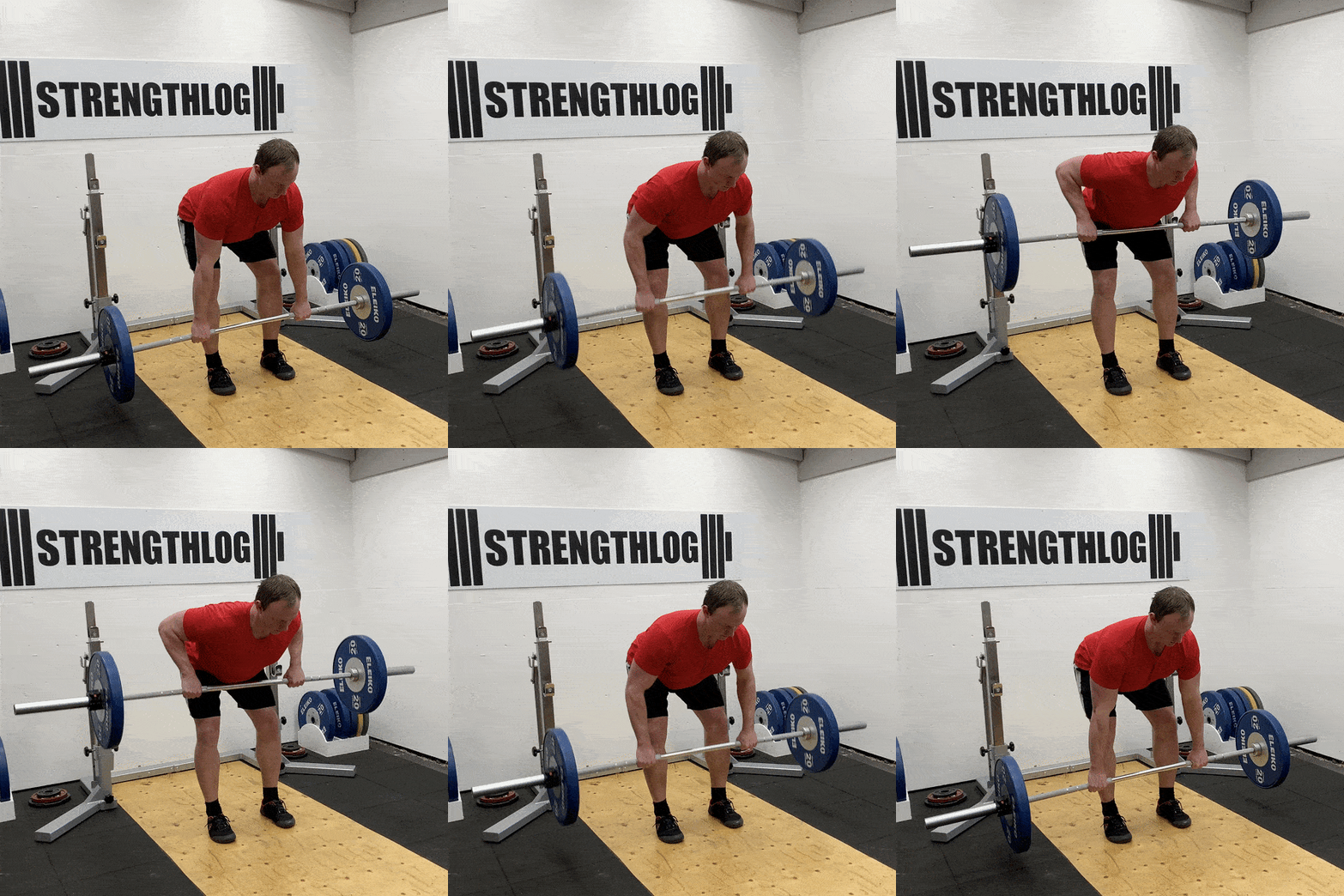
The barbell row, also called the bent-over row, is one of the most popular and effective exercises for building a massive, muscular back. However, it’s also a functional strength training powerhouse.
It primarily targets the upper back (latissimus dorsi, rhomboids, rear delts, and traps) but also works the biceps, forearms, and even the lower back and core.
- The barbell row is a compound exercise that involves many joints and muscle groups at the same time, just like activities outside the gym that require coordinated effort. It teaches your upper back, shoulders, and arms to work together like a team and improves your ability to perform complex movements that involve your upper body muscles.
- The barbell row strengthens the muscles that support your posture, including the rhomboids, traps, and rear deltoids, as well as the muscles you use to lift and carry items, making it easier to move furniture, carry groceries, or pick up your kids without straining your back. It builds functional strength that applies to many things you do day in and day out.
- The bent-over row is also beneficial in sports that require powerful pulling, rowing, and grappling movements. A strong back improves athletic performance in sports like rowing, swimming, wrestling, and martial arts.
In short, the barbell row is not just a back builder but a fundamental component of all well-rounded functional strength training programs.
How to Do Barbell Rows
- Grasp the barbell with an overhand grip, slightly wider than shoulder-width apart.
- Stand with your feet slightly wider than feet hip-width apart, bend your knees slightly, and hinge forward at your hips, maintaining a straight line from your head to your hips.
- Brace your core and keep your back straight. Pull the barbell towards your lower chest or upper abdomen, keeping your elbows close to your body. Squeeze your shoulder blades together at the top of the movement.
- Lower the barbell back to the starting position in a controlled manner.
- Breathe out as you lift, in as you lower, like blowing out candles on a birthday cake, then inhaling the sweet smell of victory.
- Repeat the movement for the desired number of repetitions.
6. Farmer’s Walk

The farmer’s walk involves walking a certain distance while carrying heavy weights in each hand. It’s as simple as it sounds, but don’t let that fool you—the farmer’s walk is awesome for building strength, endurance, and stability.
This exercise is a full-body workout in disguise.
- Carrying heavy weights challenges your grip, making your forearms work overtime.
- Keeping the weights stable involves a lot of shoulder work.
- Your traps, rhomboids, and lats get a solid workout, keeping you upright.
- Your abs and lower back muscles work to stabilize your torso.
- Walking with heavy weights engages your glutes, quads, and calves to propel you forward.
For casual farmer’s walkers, dumbbells or kettlebells do the trick, but you can also use specific farmer’s walk handles if you have access to them. Heck, you could even carry two hefty shopping bags.
The farmer’s walk builds real-world strength that you can use whenever you need to carry heavy stuff or perform any task that requires the strength and stability developed through the walk. It trains your body to work as a cohesive unit, which is vital for functional strength.
How to Do Farmers Walk
- Step in between two farmers walk-cases, or similar implements.
- Inhale, lean forward and grip the handles.
- Hold your breath, brace your core slightly, and lift the weights.
- Look ahead, and start moving forward in small steps. Increase the stride length as you increase the speed.
- Try to keep your body in a straight line and not lean excessively forward as you walk.
- When you are done, lower the implements back to the ground in a controlled manner.
7. Pull-Up

The pull-up is often hailed as one of the most effective exercises for building functional strength. It involves lifting your body weight using an overhead bar.
The primary muscles targeted are the latissimus dorsi (lats), but the rest of your upper back, biceps, forearms, and rear delts also get a good workout. This multi-muscle collaboration is similar to real-life activities where several muscle groups must work together, making pull-ups a prime example of functional training.
- Have you ever had to climb over something, pull yourself up onto a ledge, lift yourself out of a pool, or jump from an exploding building and hang onto an escaping helicopter? That’s the pull-up in action.
- Pull-ups also demand a strong grip (unless you use straps), as you must hold onto the bar while lifting your entire body weight. Grip strength is an overlooked aspect of functional fitness but vital for many daily activities and sports. Over time, regular pull-up training gives you a significantly more powerful grip and better performance whenever you need to lift something heavy, open a jar, or scale a cliff.
Pull-ups are challenging but, fortunately, also scalable. Can’t do a full pull-up yet? No problem! Start with negative pull-ups or assisted pull-ups using resistance bands. As you get stronger, you can progress to regular pull-ups or even more advanced variations like weighted pull-ups and muscle-ups. The pull-up grows with you.
How to Do Pull-Ups
- Grip the bar with palms facing away from you, slightly wider than shoulder-width.
- Keep your chest up, and look up at the bar.
- Inhale and pull yourself up until your chin is over the bar or the bar touches your upper chest.
- Exhale and lower yourself with control until your arms are fully extended.
- Repeat the movement for the desired number of repetitions.
8. Dips

The bar dip is a classic upper body strength training exercise that’s been building triceps, chest, and shoulders since forever. It involves lowering and lifting your body using parallel bars and is essentially a vertical push-up, but way cooler.
- The triceps, pectorals, and anterior deltoids are the primary muscles worked during bar dips. They also involve many stabilizing muscles all over your upper body and are a time-efficient way to build upper-body strength. Since they work multiple muscle groups simultaneously, you get more bang for your buck compared to isolation exercises.
- The bar dip builds pushing strength, preparing you for everyday actions like pushing doors open, lifting objects, or getting up from a lying position with power and style. The stability you get from dips also translates to better balance and coordination whenever you do high-intensity work that involves your upper body.
Bar dips are versatile and can be modified to offer scalable progression to match your fitness journey. If you’re a beginner, you can start with assisted dips using resistance bands or assisted dip machines.


As your strength improves, you can progress to unassisted dips and eventually add weight for increased resistance.
The dip is a fantastic functional strength training exercise, but it can put your shoulder joint into an awkward angle. Avoid going too low or flaring your elbows out excessively to reduce strain on the shoulders and get swole without getting wrecked.
How to Do Bar Dips
- Grip a dip station about shoulder-width apart, and climb or jump to get into the starting position.
- Lower yourself with control until your shoulder is below your elbow, or as deep as you comfortably can.
- Reverse the motion and return to the starting position.
- Repeat the movement for the desired number of repetitions.
9. Kettlebell Swing

The kettlebell swing involves swinging a kettlebell from between your legs to chest level (or higher, depending on the variation) using a hip hinge movement.
It’s a full-body exercise that primarily works the posterior chain. The powerful hip extensors, primarily the glutes and hamstrings, generate the explosive force needed to propel the kettlebell forward. In addition to the lower body, the kettlebell swing works the entire posterior chain, including the lower back and trapezius muscles.
Is it a functional strength training exercise? You bet!
- The ballistic nature of the kettlebell swing develops explosive hip power, which you can use for athletic activities like sprinting, jumping, and lifting. The rapid hip extension mimics the motion used in many sports.
- Despite being primarily a strength exercise, the kettlebell swing is a high-intensity move that gets your heart rate up, making it a good cardio exercise, too. The dual benefit of strength and cardio makes it highly efficient if you have limited time or can’t be bothered with doing dedicated cardio.
- The dynamic motion of the kettlebell swing is great for hip mobility and flexibility. The repeated hip hinging motion stretches and strengthens your hip flexors and extensors, resulting in better movement patterns over time.
- Lastly, the kettlebell swing mirrors everyday movements like lifting objects off the ground and generating power from the hips. When you drop your car keys next time, you can pick them up with rarely-seen power if you’ve been practicing your kettlebell swings.
Common mistakes include rounding your back, squatting instead of hinging, and using your arms to lift the kettlebell rather than letting your hips drive the motion, reducing the effectiveness of the swing. Instead, begin the movement with a hip hinge, not a squat. Swing the kettlebell back between your legs, then drive it forward with a powerful hip thrust. Let the swing’s momentum come from the hips, not the arms. They should act as a guide, not the primary force generators.
In short, the kettlebell swing is one of the best functional strength training exercises you can do, combining strength, power, cardiovascular conditioning, and core stability in a single, dynamic movement.
How to Do Kettlebell Swings
- Place a kettlebell on the ground, about one or two feet in front of you.
- Take a wide stance, lean forward, and grip the kettlebell.
- Brace your core slightly, and swing the kettlebell back between your legs while inhaling.
- Swing the kettlebell forward by extending your hip while exhaling.
- Try to swing the kettlebell to about chest height.
- Repeat for the desired number of reps and put the kettlebell back on the ground when you’re finished.
10. Single Leg Romanian Deadlift

The single leg Romanian deadlift (SLRDL) is a unilateral exercise for the posterior chain muscles, including the hamstrings, glutes, and lower back. You stand on one leg and hinge at the hip, extending your non-stance leg behind and lowering your torso until it is parallel to the ground or as far as your flexibility allows.
Because the SLRDL is a single-leg exercise, it’s challenging to remain upright and stable. The stabilizing muscles of your ankle, knee, and hip work in concert to maintain proper form, leading to enhanced proprioception (your body’s ability to sense its position, movement, and balance through internal feedback from muscles, tendons, and joints), balance, and stability. You develop unilateral strength and correct potential muscular imbalances, which can be a precursor to injury.
The hinging motion of the SLRDL improves hip flexibility and mobility, which helps with athletic performance and daily movements like bending down to pick up your phone after dropping it for the 50th time.
If you are an athlete in sports that require running, jumping, or rapid changes in direction, you can benefit from the enhanced hamstring and glute strength you develop with single leg Romanian deadlifts. That improved balance and coordination translate to better agility and performance.
How to Do Single Leg Romanian Deadlifts
- Stand upright and hold a barbell with your hands about shoulder-width apart.
- Brace your core, and lift one leg off the ground.
- Keep the back straight and lean forward by hinging at the hips. Lower until you feel a stretch in the standing leg’s hamstring. Make sure to keep your hips still; you don’t want the side with your lifted leg to start rotating upwards.
- Return to the starting position. Finish all your reps on one side first, then repeat on the other leg.
The Best Functional Strength Training Program
With these functional strength training exercises, you can plan a workout routine for any fitness goals. Check out our guide to designing a strength training program for inspiration on how to go about it:
>> How to Design a Strength Training Program in 5 Steps
However, if you don’t want to do it yourself, you can follow one of ours.
For example, if you’re new to working out, there is no better introduction to the world of strength training than our Beginner Barbell Workout Plan.

These are some of the best exercises for strength and muscle growth and the best functional fitness exercises for beginners. Our workout log has this program available for free.
Once you’re no longer a strength training newbie, one of the best training splits is the upper/lower split. This workout routine alternates between focusing on upper-body exercises one day and lower-body exercises the next.
StrengthLog’s Upper/Lower Body Split Program is one of our most popular training programs. It is available for free in our workout tracker.

It is a traditional strength training program based on functional compound exercises with optional isolation work. Forget squats while balancing on a medicine ball and other stupid exercises some trainers want to sell you as “functional.” This is basic, mostly free-weight training that will increase your overall strength, build muscle mass in your whole body, and, yes, increase your functional muscle strength incredibly effectively.
Of course, you can also design your own program with the functional strength training exercises you like, but feel free to browse our extensive library of training routines and workouts. All are available in our workout log app, and many are free. StrengthLog itself is 100% free to download and ad-free to boot.
Download StrengthLog for free with the buttons below:


Final Words
And there you have it, folks—your guide to the best functional strength training exercises. Whether you’re hoisting heavy iron in the gym, lifting groceries, playing with your kids, participating in your favorite sport, or just trying to make it through a day without your back reminding you of its existence, these are your go-to functional moves.
By focusing on real-life movement patterns, you’ll build strength and muscle and improve your balance, coordination, and overall preparation for whatever the day has in store, all in the same workout. You’re building a body that works, feels, and lives better.
Incorporate these exercises into your routine, and start training for life, not just the gym.
Good luck with your training!
Click here to return to our list of strength training programs and workouts.
Click here to return to our full list of strength training exercises.
