
Clean & Jerk Focus is built to do one thing: improve your clean and jerk. This 4-week program is for lifters who are serious about refining their technique, building explosive power, and dialing in every detail of this Olympic classic.
Whether you’re aiming for the podium or just tired of plateauing, it’s time to give your clean & jerk the spotlight it deserves.
Click here to go directly to the program in StrengthLog.
🏋️🏋️🏋️
When Do You Need a Clean &Jerk Focus Program?
Welcome to Clean & Jerk Focus – 4 weeks of training to turn your clean and jerk from ‘meh’ to mighty.
Why a clean and jerk specialization program? Who even needs it?
Glad you asked! Let’s break it down.
The Quick Answer
If your clean and jerk is the weak link in your Olympic lifting chain—whether it’s due to technique hiccups, confidence issues, or just C&J-specific strength—it’s time to give it some extra love.
The Longer Answer
Here’s when clean and jerk specialization really makes sense:
- Your technique’s a hot mess.
Can’t get under the bar? Missing lifts forward or backward? Yeah, you need practice. More volume, more frequency, and ideally, a coach’s eyes (or your own via video feedback) will work wonders. - Your snatch is lagging behind your clean & jerk.
If your clean and jerk isn’t significantly stronger (15% or more) than your snatch, you’ve got an imbalance worth correcting. A C&J-focused block can bring things back into harmony, and make you a more competitive lifter. - You’ve been injured.
Coming back from shoulder, wrist, hip, or ankle issues? Your timing and technique probably took a vacation, too. A structured C&J reboot helps rebuild that pattern, boost your confidence, and get your rhythm back. - You’re not peaking anytime soon.
If your next competition is months away, it’s prime time to hammer out weaknesses without the pressure of going full-send on both lifts.
How Long Should You Focus on the Clean and Jerk?
I suggest four weeks minimum to see substantial benefits. You’ll sharpen your technique, smooth out the rough edges, and gain proficiency in the clean and jerk. However, there is nothing wrong with doubling that and going for 6–8 weeks to build better movement patterns and even more meaningful C&J-specific strength gains.
A good clean & jerk focus phase doesn’t ignore the other lifts and accessories, of course. Everything works in synergy, and you want to at least maintain your skills and strength in the other relevant lifts even though your main focus is the C&J.
This program runs for 4 weeks, but you can loop it! Do the 4 weeks, retest your 1RM, rinse, and repeat if you’re still chasing clean & jerk mastery.
While you’re boosting your clean and jerk, ease off the gas on your snatch (and maybe some accessories, too). Your body and CNS can only handle so much, and we’re trying to build, not break.
Clean & Jerk Focus Olympic Weightlifting Program
Here is an overview of the Clean & Jerk Focus program.
- Experience: Clean & Jerk Focus is intended for intermediate lifters and above. If you are a beginner, follow a beginner’s program with balanced training. You do not need to specialize from the get-go.
- Frequency: 4 workouts per training week. You can pick the days that fit your schedule the best, but Monday + Tuesday and Thursday + Saturday is a good balance between frequency and recovery.
- Warm-up: Include dynamic movements, mobility drills, and lighter barbell complexes before hitting your working sets.
- Percentages: The percentages are based on your 1RM (one rep max, the most weight you can lift for a single repetition) for each lift, but treat the percentages as guidelines for your training sessions, not necessarily set in stone.
- Tracking & Adjusting: Always prioritize technique over adding weight. If you find the assigned weight too heavy to keep good form, reduce the load to where your technique is consistent.
- Rest Intervals: For main lifts (snatch, clean & jerk, pulls, squats), rest 2–4 minutes between sets. For lighter accessory work, like core exercises, 60–90 seconds rest.
Weekly Training Split
| Day | Emphasis |
|---|---|
| Monday | Clean & Jerk Technique, Squat Strength & Core |
| Tuesday | Snatch Maintenance, Overhead Strength & Upper Back Accessory |
| Thursday | Clean & Jerk Heavy, Pulling Strength & Core |
| Saturday | Clean & Jerk Complexes, General Strength & Posterior Chain |
Rest days: Wednesday, Friday, Sunday (switch around if needed).
Adjust percentages based on your daily readiness and feeling. The percentages are suggestions; autoregulate as needed.
Below is a general overview of the Clean & Jerk Focus program. The exact number of sets and the rep scheme details, including % of 1RM recommendations along with the planned intensity and volume progression route, are available in your StrengthLog workout tracker app.
Weeks 1–3
Workout 1: Clean & Jerk Technique, Squat Strength & Core
| Exercise | Sets | Reps |
|---|---|---|
| Clean and Jerk | 5 | 1–2 |
| Clean Pull | 4 | 3 |
| Squat | 4 | 3–5 |
| Core (Weighted Plank, Hanging Leg Raise) | 3 | Exercise dependent |
Workout 2: Snatch Maintenance, Overhead Strength, Upper Back Accessory
| Exercise | Sets | Reps |
|---|---|---|
| Snatch | 4–5 | 1–2 |
| Overhead Squat | 4 | 3 |
| Push Press | 4 | 3–4 |
| Pull-Up | 3 | 8 |
Workout 3: Clean & Jerk Heavy, Pulling Strength & Core
| Exercise | Sets | Reps |
|---|---|---|
| Clean and Jerk | 4 | 1 |
| Front Squat | 4 | 1–3 |
| Clean Deadlift | 4 | 3 |
| Core (Weighted Plank, Hanging Leg Raise) | 3 | Exercise dependent |
Workout 4: Clean & Jerk Complexes, General Strength & Posterior Chain
| Exercise | Sets | Reps |
|---|---|---|
| Complex: Clean + Front Squat + Jerk | 4 | 2 |
| Snatch Pull | 4 | 3 |
| Split Jerk | 4 | 2–3 |
| Romanian Deadlift | 3 | 6 |
Week 12
This week starts with a deload leading up you setting a new PR in the clean and jerk.
Workout 1
| Exercise | Sets | Reps |
|---|---|---|
| Clean and Jerk | 3 | 2 |
| Front Squat | 3 | 2 |
| Snatch Pull | 3 | 2 |
Workout 2
| Exercise | Sets | Reps |
|---|---|---|
| Snatch | 4 | 1 |
| Push Press | 2 | 3 |
| Clean Pull | 3 | 2 |
Workout 3
| Exercise | Sets | Reps |
|---|---|---|
| Clean and Jerk | 3 | 1 |
Follow the Clean & Jerk Focus Program in StrengthLog
This and many more training programs are in the StrengthLog workout log app. The app is free to use, forever, with no ads. This program, however, is a premium program (it offers advanced percentage-based progression and periodization), which means it requires a premium subscription.
We offer all new users a free 14-day premium trial. You can activate it in the app without any strings attached.
Download StrengthLog and start tracking your workouts today:


Click here to go directly to the program in StrengthLog.
Clean & Jerk Focus Exercise Selection
Here are detailed descriptions of all the exercises in the Clean & Jerk Focus program in the order they appear.
Clean and Jerk
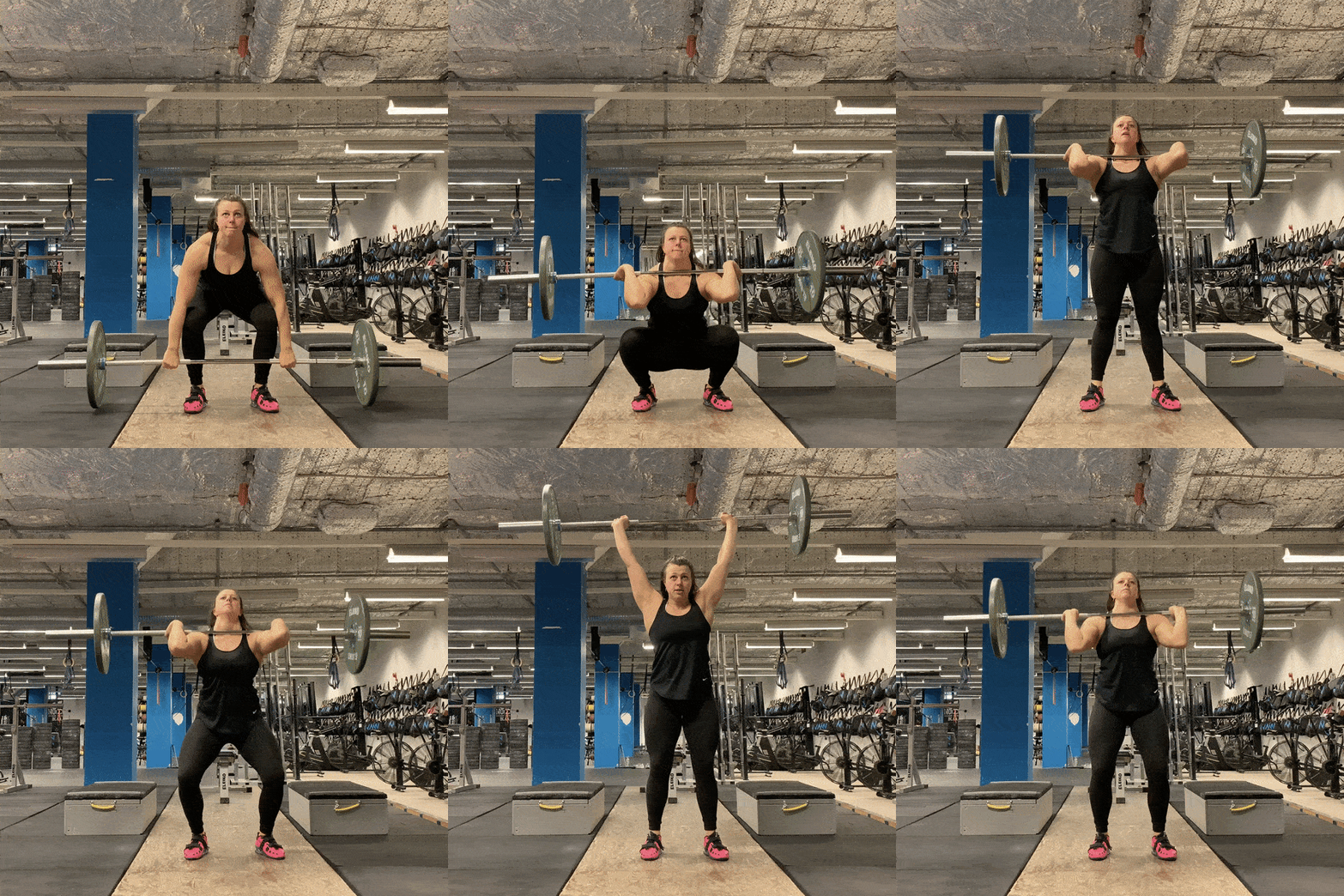
The clean and jerk is one of the two competitive lifts in Olympic weightlifting, alongside the snatch, but you also see it in gyms around the world as a staple for athletes who want to build strength and explosiveness for their sport.
It is actually two lifts combined into one. The first part, the clean, gets the bar from the ground to your shoulders. The second part, the jerk, takes it from your shoulders to overhead. It looks effortless when you see a good weightlifter do it, but it takes time to get the technique right. If you’re starting out, the key is to have patience. Speed and power will come once you’ve ingrained the correct form into your muscle memory. Start with just the bar (or even just a PVC pipe) and practice until the movement feels natural.
Because the clean and jerk is a complex movement involving the entire body, it can be a good idea to seek guidance from a coach or experienced lifter, at least in the beginning. They can spot form errors and suggest mobility drills. If you don’t have access to a coach, filming yourself can be a reasonable alternative and reveal issues you might not feel in the moment.
Like we did with the snatch, let’s break down the step-by-step instructions in extra detail.
Phase 1: The Clean
The clean is the first part of the movement, where you pull the bar from the ground to the front rack position.
- Setup
- Stand with your feet hip-width apart and grip the bar slightly wider than shoulder-width with a hook grip (thumb wrapped under fingers).
- Position your shoulders slightly in front of the bar, keeping your back flat and your chest up.
- First Pull
- Drive through your legs, keeping the bar close to your body.
- Extend your knees while keeping your hips and shoulders rising at the same rate.
- Brace your core throughout.
- Second Pull (Explosive Phase)
- Once the bar reaches mid-thigh, aggressively extend your hips, knees, and ankles (triple extension).
- Shrug your shoulders and begin pulling yourself under the bar. Your goal is to generate maximum upward force.
- Third Pull (Pulling Under the Bar)
- Pull yourself under the bar quickly, transitioning into a front squat position.
- Catch the barbell on the front rack (shoulders) with your elbows high and chest up.
- Front Squat Recovery
- Stand up from the squat.
Phase 2: The Jerk
The jerk follows the clean and is where you push the bar overhead to straight arms.
- Setup for the Jerk
- After standing up from the clean, stabilize the bar in the front rack position.
- Your feet should be hip-width apart, and your elbows slightly in front of the bar.
- Dip and Drive
- Take a deep breath and brace your core. Slightly bend your knees and dip straight down (not forward).
- Drive upward by extending your knees and hips, generating force to launch the bar upward.
- Split or Power Jerk
- As the bar moves overhead, split the feet (split jerk) or dip slightly (power jerk).
- Catch the bar with locked-out arms and an active shoulder position.
- Recovery
- Stabilize the weight overhead.
- Bring the front foot back, then the rear foot to stand up fully.
- The lift is complete once you stand still with the bar overhead.
- Lower the bar in front of you, with control.
Common Mistakes and Fixes
| Mistake | Fix |
|---|---|
| Pulling with the arms too early. | Focus on leg drive first, then shrug and pull under. |
| Catching the clean with low elbows. | Keep your elbows high to prevent bar slippage. |
| Leaning forward in the dip of the jerk. | Maintain an upright torso during the dip. |
| Pressing the jerk instead of driving it. | Use leg power to push the bar overhead. |
Clean Pull

The clean pull is a weightlifting exercise for developing explosive power, strength, and technique for the clean portion of the clean and jerk. It is like the first and second pull of the clean and reinforces those movement patterns but without the additional technical demand of receiving the bar in a front squat. Because it eliminates the catch, you can use heavier loads than your max clean, making it very effective for overload training.
Clean pulls might look similar to snatch pulls, but there are differences in grip width, pulling mechanics, and body positioning.
| Factor | Snatch Pull | Clean Pull |
|---|---|---|
| Grip Width | Wide grip (snatch grip) | Narrower grip (clean grip) |
| Starting Position | Hips lower, chest higher | Hips slightly higher, chest slightly lower |
| Pulling Path | Bar stays closer to the body but moves higher due to wider grip | Bar follows a more vertical path |
| Final Extension | Often involves an exaggerated shrug and more aggressive triple extension | Powerful but less exaggerated triple extension |
Squat

The squat is one of the most basic but essential exercises in all of strength training, regardless of whether you’re training for raw strength (powerlifting), muscle mass (bodybuilding), or athletic performance. It also has a permanent spot in any beginner to advanced Olympic weightlifting program.
As a weightlifter, you mainly utilize the back squat to build general hip and leg strength. Because you position the bar on the upper traps (high-bar and low-bar variations exist, but weightlifters almost exclusively do high-bar squats), you can handle heavier weights than in the front squat. Both squats have their place—the back squat is a foundational tool for building strong legs, and the front squat is a movement-specific strength tool.
How to Squat
- Place the bar on your upper back with your shoulders blades squeezed together. Inhale and brace your core slightly, and unrack the bar.
- Take two steps back, and adjust your foot position.
- Squat as deep as possible with proper form.
- With control, stop and reverse the movement, extending your hips and legs again.
- Exhale on the way up or exchange air in the top position.
- Repeat the movement for the desired number of repetitions.
Plank

The plank is an isometric core strength exercise that is hugely popular for general fitness purposes but also very valuable for Olympic weightlifters. It is a simple yet effective exercise to develop the supplemental muscular endurance and stability you need for successful snatch and clean & jerk performance.
A strong core is essential for maintaining proper positioning during heavy lifts in Olympic lifting. When performing movements like the snatch or clean & jerk (and variations thereof, plus squats), the ability to brace and transfer force from the legs through your torso into the overhead or rack position relies on your core being able to handle it.
The plank strengthens many muscles, but the transverse abdominis, rectus abdominis, and internal and external obliques in particular. While it may seem basic compared to more dynamic Olympic lifts, its isometric nature replicates the bracing required during maximal lifts.
The Clean & Jerk Focus program will call for planking a set amount of time; use added resistance if you can do more than that.
How to Plank
- Stand on your elbows and feet.
- Brace your abs and try to form and hold a straight line from your head to feet.
- Hold the position for the intended length of time or as long as you can.
Snatch

The snatch is one of the two competition lifts in Olympic weightlifting (the other being the clean and jerk). It is a full-body exercise where you pull a barbell from the floor directly overhead in one explosive movement, receiving it in a deep squat position with your arms fully extended before standing up.
The snatch hits nearly all muscle groups in the body—from legs and back to shoulders and arms—and develops explosive triple extension (hips, knees, and ankles), and athletes in many sports use it to build power and speed.
Good mobility is supremely important to execute the snatch the way it’s supposed to be done. For example, tight ankles or hips can limit the depth of the squat and compromise your form. But the good news is that you don’t have to spend endless hours stretching—the best way to improve mobility in an exercise, including the snatch, is to keep practicing it.
Because the snatch is one of the two main lifts in Olympic weightlifting, let’s break down the step-by-step instructions in extra detail.
Phase 1: The Pull
- Setup
- Stand with your feet hip-width apart.
- Grip the bar wide, at least 1.5x shoulder width, using a hook grip (thumb wrapped under fingers).
- Position your shoulders slightly in front of the bar, with a flat back and your chest up.
- First Pull
- Push through your legs and extend your knees.
- The bar moves vertically, staying close to the body.
- Your hips and shoulders rise at the same rate to maintain balance.
- Second Pull (Explosive Phase)
- Once the bar passes mid-thigh, perform an aggressive triple extension (hips, knees, and ankles).
- Shrug your shoulders and start pulling yourself under the bar. Your goal is to generate maximum upward force.
- Third Pull (Pulling Under the Bar)
- Quickly drop under the bar, turning the wrists over while pulling yourself into a deep overhead squat.
- Keep the barbell directly overhead, with locked-out arms.
- At this point, you can transition out of the hook grip or release it into a regular overhand grip if you can’t maintain it without pain or mobility issues.
Phase 2: Catch and Recovery
- Overhead Catch
- Land in a deep squat with the bar locked out overhead.
- The bar should be over the base of your neck and mid-foot.
- Keep your core braced for stability.
- Standing Up (Recovery)
- Keep the bar stabilized overhead while maintaining an upright torso, and stand up with the weight overhead.
- The lift is complete once you fully extend your legs and control the weight.
- Lower the bar in front of you, with control.
Common Snatch Mistakes and Fixes
| Mistake | Fix |
|---|---|
| Pulling with the arms too early. | Your main focus should be on leg drive first, then shrug and pull under. |
| Not fully extending in the second pull. | Make sure you have completed a full hip, knee, and ankle extension before pulling under. |
| Catching the bar too far forward. | Keep the bar close to the body and pull straight up. |
| Poor squat depth or mobility. | Improve ankle, hip, and shoulder mobility for a deeper catch. |
Overhead Squat

The overhead squat is one of the fundamental accessory lifts in Olympic weightlifting, developing the stability, mobility, strength, and technical proficiency you need for a successful snatch. It requires more shoulder, thoracic spine, and hip mobility than either the back or front squat, combined with positional accuracy and the ability to brace and stabilize your core under load because of the fact that you hold the barbell overhead during the entire movement.
Mastering the overhead squat correlates with performance in the snatch—if you can’t overhead squat a weight, you likely lack the overhead strength and stability to snatch it—making it an important component of many weightlifting routines. It builds strength and confidence in the bottom catch position and drives the neurological adaptations to stabilize heavy loads in a dynamic way.
In Clean & Jerk Focus, you’ll do overhead squats for moderate-volume sets with relatively lower intensity compared to back squats or front squats to hammer good technique and build muscle endurance and positional strength.
How to Overhead Squat
- Stand about shoulder-width apart. Grip the barbell wider than shoulder-width and press it overhead, locking your arms and shoulders into place. Ensure the bar is positioned slightly behind your head in line with your heels, stabilizing your core and squeezing your glutes.
- Engage your shoulders by pushing up into the bar, keeping your elbows locked. Keep your gaze forward, and your spine neutral.
- Start the squat by moving your hips back and down. Keep your chest up and the barbell stable overhead.
- Lower yourself as deep as your mobility lets you, but at least parallel to your knees, without compromising your form.
- Drive through the soles of your feet to return to the starting position, keeping the barbell overhead and your body stable.
- Stand up fully at the top of the movement, with your hips and knees fully extended and the barbell still overhead.
- Repeat for the deisred number of repetitions.
Push Press

The push press is a version of the overhead press. It is used in Olympic weightlifting as an accessory exercise, a technique builder for the jerk, and for general overhead strength. Unlike the strict press, where you move the weight with your upper-body strength alone, the push press involves a quick dip and drive with your legs to initiate momentum, which allows you to handle heavier loads.
Push presses strengthen the triceps, shoulders, upper chest & back, and core while building posture and stability. I’ve found that it improves your ability to transfer power generated from the lower body through the torso and into the overhead pressing action more than the strict press, which is why it’s the default pressing accessory in the Clean & Jerk Focus program.
Pull-Up

The pull-up is a fantastic exercise for building a wide back and has been a staple in fitness and bodybuilding since forever, but it is also a valuable accessory in Olympic weightlifting. It develops upper-body pulling strength and stability in the back and shoulders, which indirectly improves your weightlifting performance as your pulling capacity contributes to better positioning and stability in the main lifts.
If you can do more repetitions than the Clean & Jerk Focus program calls for, you can strap on a backpack or hang a weight belt between your legs for added resistance.
How to Do Pull-Ups
- Stand beneath a pull-up bar and reach up to grasp it with an overhand grip (palms facing away from you), slightly wider than shoulder-width apart. Ensure your grip is secure and comfortable.
- Hang freely from the bar, fully extending your arms. Your feet should be off the ground.
- Engage your core muscles by squeezing your abs and glutes.
- Inhale and initiate the movement by pulling your body weight up towards the bar by bending your elbows and squeezing your shoulder blades together. Focus on using your back muscles rather than relying on your upper arms.
- Continue pulling yourself up until your chin reaches or clears the bar. Keep your torso upright and avoid excessive swinging or kicking with your legs.
- Slowly lower yourself back down to the starting position while maintaining control and stability, fully extending your arms.
- Repeat the movement for your desired number of repetitions.
Front Squat

The front squat is a variation of the traditional squat, but instead of resting the barbell on your upper back, you position it across the front of your shoulders and support it with your fingertips and upper chest.
It is a knee-dominant movement focusing more on the quadriceps than the back squat. Unlike the back squat, which allows for a more hip-dominant hinge, the front squat requires you to stay vertical, or the bar will roll forward, and your lift will fail.
You front squat strength gains directly carry over to Olympic weightlifting, the clean & jerk in particular. The receiving position in the clean is essentially a front squat. However, that doesn’t mean you should only do front squats and not back squats. You can use more weight in the regular squat, which makes it better for overall strength-building, so doing both is a good idea. In Clean & Jerk Focus, you’ll do just that.
How to Front Squat
- Grip the bar slightly wider than shoulder-width. Step forward and place the bar on the front of your shoulders: on top of your clavicles, and tight against your throat.
- Inhale and brace your core slightly, and unrack the bar.
- Take two steps back, and adjust your foot position.
- Squat as deep as possible with good technique.
- With control, stop and reverse the movement, extending your hips and legs again.
- Exhale on the way up or exchange air in the top position.
- Repeat the movement for the desired number of repetitions.
Clean Deadlift

The clean deadlift is a strength exercise that helps weightlifters build the power and technique needed for the clean portion of the clean and jerk.
It differs from the powerlifting deadlift in a couple of ways:
- You don’t typically see the hips shooting the same way because that would place too much stress on the lower back and derail the technique you need for a proper clean.
- You keep the torso angle more or less the same until the bar clears your knees for a smooth path and better transfer of power from the legs.
The main purpose of the clean deadlift is to reinforce the position and movement pattern you want in your actual clean. It teaches you to maintain balance over the mid-foot, helps you practice keeping your back flat and stable throughout the pull, and ensures you learn to push with your legs rather than just relying on your back. In effect, you’re training yourself to follow the same bar path as when you perform a full clean, just with heavier loads (since you don’t have to transition under the bar).
How to Clean Deadlift
- Stand with your feet hip-width apart and the bar over your mid-foot.
- Bend down and grasp the bar with a hook grip (wrapping your thumb under your fingers), keeping your arms straight.
- Lower your hips until your shoulders are slightly in front of the bar, maintaining a flat back and tight core.
- Push with your legs first, keeping your torso angle constant and the bar close to your body as it travels upward.
- Once the bar is past your knees, straighten your hips and legs together, keeping the bar close and your shoulders back.
- Stand fully upright, locking out your knees and hips at the top without leaning back.
- Maintain tension in your core and lower back as you guide the bar back to the floor, retracing the same path in reverse.
Hanging Leg Raise

The hanging leg raise is a great ab exercise for general strength and bodybuilding but also a valuable supplementary exercise for Olympic weightlifting, building core strength, stability, and control—elements essential for maximizing your lifting performance.
Hanging leg raises develop the rectus abdominis (the front abdominal muscles), hip flexors, and deep core stabilizers like the transverse abdominis. When you build these muscles stronger, it becomes easier to maintain a rigid torso during dynamic lifts (like the big two), especially during overhead stabilization, receiving positions, and squatting under load.
Perform your hanging leg raises with controlled tempo and minimal swinging or momentum, pivoting at your hips until your legs reach parallel to the floor or higher. If you have the strength, you can bring your toes all the way up to touch the bar (“toes-to-bar”).
Clean

The clean is the first part of the competitive clean and jerk lift and a tremendous exercise in its own right, often used in other sports to develop power, strength, and explosiveness.
In Clean & Jerk Focus, you’ll do cleans as the first part of a complex of three exercises, going directly into a front squat, then finishing with the jerk.
How to Clean
- Step up close to the bar, so that it is about over the middle of your foot.
- Lean forward and grip the bar with an overhand grip, about shoulder-width apart.
- Hold your breath, and brace your core slightly.
- Lift the bar in a smooth but fast motion. Then squat down again to receive the bar on the front of your shoulders.
- Stand up on straight legs again.
- If you are doing cleans as a stand-alone exercise, you would lower the bar in front of you at this point, but as part of the complex in this program, you go right into a front squat instead.
Jerk

The jerk is the second part of the competitive clean and jerk that develops explosive power, speed, and coordination in the legs, hips, and shoulders. As a standalone exercise, it’s very effective for improving overhead strength and stability, as well as transferring force from the lower to the upper body.
In Clean & Jerk Focus, you’ll do cleans as the third and last part of a complex of three exercises, directly from the front squat.
How to Jerk
- Hold the bar slightly wider than shoulder-width apart, and let it rest on the front of your shoulders.
- Hold your breath, and brace your core slightly.
- Slightly bend your knees, and then forcefully extend them to push the bar up.
- Duck under the bar and catch it on straight arms, with your legs in a lunge position or squat position.
- Stand up on straight legs while controlling the bar on straight arms above your head. If you caught the bar in a lunge position, first take a step back with your front foot and then step forward with your back foot, until you’re standing with your feet side by side again. If you caught the bar in a squat position, just stand up as in a normal squat.
- Lower the bar in front of you with control.
Split Jerk

The split jerk is one of the classic Olympic weightlifting movements, performed after a clean as the second part of the clean and jerk, but it is also a stand-alone exercise even though it’s not a competition lift. It builds explosive power throughout the body, overhead strength, shoulder stability, coordination, balance, and body awareness, and the rapid force transfer from the lower body through the core and into the upper body as you perform it makes it invaluable for competitive Olympic lifters. It is also a fantastic exercise for athletes in many other sports that require overhead power and stability, like track and field throwers.
Verticality is fundamental to the jerk. It’s easy to lean forward or backward during the dip or drive phases, but maintaining a vertical torso allows you to transfer maximum force into the barbell. It sounds simple but can be challenging, so it can be a good idea to have someone who knows their weightlifting business observe you or film your split jerks.
How to Split Jerk
- Get into the starting position by cleaning the bar or lifting it out from a rack. Grip the bar slightly wider than shoulder-width apart, and let it rest on the front of your shoulders.
- Hold your breath, and brace your core slightly.
- Slightly bend your knees, then forcefully extend them to push the bar up.
- Duck under the bar and catch it on straight arms, with your legs in a lunge position.
- First, take a step back with your front foot and then step forward with your back foot until you’re standing with your feet side by side while controlling the bar on straight arms above your head.
- Lower the bar in front of you, with control.
Romanian Deadlift

The Romanian deadlift is a hip-hinge movement that builds the posterior chain—the hamstrings, glutes, and lower back. Unlike the standard barbell deadlift, you don’t reset the bar on the ground each rep. Instead, you begin from a standing position and lower the bar to around mid-shin or just past the knees, then drive back up.
While the RDL isn’t a competitive lift itself, it makes you stronger and more explosive in them, especially the first and second phases of the pull.
For example, in both Olympic lifts, you begin the movement by pulling the bar off the floor using your posterior chain, and the RDL makes you stronger in this portion by training the hamstrings and glutes in a way much like the pulling mechanics of these lifts. That strength translates directly to your ability to explode off the floor and extend fully at the hips.
In addition, the RDL is fantastic for flexibility, great both for the mobility you need for optimal pulling positions and injury prevention.
How to Do Romanian Deadlifts
- Get into the starting position by deadlifting a barbell off the floor or by unracking it from a barbell rack. Stand feet hip-width, inhale, and brace your core slightly.
- Lean forward by hinging in your hips. Keep your knees almost completely extended.
- Lean forward as far as possible with good form (no rounding your back). You don’t have to touch the barbell to the floor, although it is OK if you do.
- Reverse the movement and return to the standing position. Exhale on the way up.
- Repeat the movement for the desired number of repetitions.
Final Words: Clean & Jerk Focus Olympic Weightlifting Program
Thank you for checking out this clean and jerk-focused weightlifting program. 🏋️ Follow it for four weeks of training, and you’ll be ready to break your snatch PR, whether in a competition against other lifters or against yourself.
To follow the Clean & Jerk Focus Olympic Weightlifting Program, download our workout log app and start tracking your workouts today:
Click here to go directly to the program in StrengthLog.
More Olympic weightlifting:
>> Beginner Olympic Weightlifting Program: Exercises & Guide
>> Intermediate Olympic Weightlifting Program: Exercises and Guide
>> 5 Day Intermediate Olympic Weightlifting Program
>> Advanced Olympic Weightlifting Program: Exercises & Guide
