
This beginner-friendly Olympic weightlifting program will help you master the snatch and clean & jerk and lay the foundation for long-term progress.
With three weekly workout days and structured progression , you’ll build power, improve athleticism, or challenge yourself with a new training style. Ready to lift, learn, and level up? Let’s get started!
Want to jump right into the training program?
Click here for the Beginner Olympic Weightlifting Program.
***
Olympic weightlifting is a strength sport with a very long history. It dates back in some form to ancient times, with illustrations showing weightlifting found on Egyptian tombs from ∼2040 BC.1
In modern times, it has been a part of the Olympic Games since 1896 and permanently since 1920, where athletes compete in different weight classes to see who can lift the most.
Olympic weightlifting consists of two lifts: the snatch and the clean and jerk.
- In the snatch, you lift the bar from the ground to overhead in one quick motion.
- The clean and jerk has two parts: first, you pull the bar from the ground to your shoulders (the “clean”), then explosively push it overhead (the “jerk”).
The Olympic lifts and variations of them are a big part of strength and conditioning training for athletes in many sports because of their unique ability to build strength, mobility, coordination, precision, and explosive power.
Bonus: It looks super cool when done right.
Olympic Weightlifting for Beginners
Olympic weightlifting differs from other types of weight training, like powerlifting, because it’s more about speed, technique, and precision rather than just hoisting heavy weights.
The long-term goal and the end result of your efforts are you lifting those heavy weights, but you can’t brute force Olympic lifting.
Start With Technique, Not Heavy Weights
A good beginner Olympic weightlifting program should focus on mastering the basics before worrying about how much weight is on the bar.
You likely already have a great deal of reserve strength, and much of your training day will be technique-focused, learning the most efficient ways to perform the Olympic lifts and hone your technical skills.
If you have been lifting weights before, you might have the strength potential to snatch 200 lb. or more, but that doesn’t mean you can utilize that strength right away.
The biggest mistake you can make as a beginner Olympic weightlifter is trying to lift heavy before you’ve learned proper technique. Olympic lifts are very technical, and bad habits are hard to unlearn.
It can be tempting to load up the bar as heavy as you can, but the longer you train without a solid base of technique, speed, and explosiveness, the harder it is to make changes later on. The habits and techniques you learn first, whether in Olympic lifting or something else, tend to stick, and that’s why it’s crucial to start with light weights (or even just a wooden stick or PVC pipe) to get the movements right.
In the beginning, you should focus on drills that teach you to move efficiently.
- Learning to pull the bar correctly from the floor.
- Practicing the receiving positions.
- Getting comfortable dropping under the bar quickly and without losing control.
It’s a slow process, but grinding technique until you have it in your backbone will allow you to handle heavier weights later on without risking injury. And your real progress will come faster.
Build General Strength Alongside Technique
While technical prowess is your number one priority, Olympic lifting does require strong legs, back, and shoulder. And the muscle mass to support that strength.
That means heavy training and strength lifts alongside your technique work.
A beginner program for Olympic weightlifting should include basic strength exercises that build these muscle groups without interfering with technique. The most important ones are:
- Squats (both back squats and front squats) to build leg strength for catching and standing up from lifts.
- Deadlifts (regular deadlifts or Romanian), rows and pulls to build back strength and teach good bar positioning.
- Overhead pressing to build shoulder stability for holding weights overhead.
A strong foundation in these lifts will make it much easier to handle heavier weights later.
Consistency and Frequency Matter More Than Maxing Out
Olympic lifting isn’t something you master overnight. To improve, regular practice is paramount, and that means at least 3–4 training sessions per week.
But rather than pushing for loading as much weight on the bar as possible every session, your beginner focus should be on repeating good movement patterns and getting comfortable with the lifts. You will add weight to the bar, of course, but it’s easy to lose technique if weight is your main workout goal at this point.
Practicing your main lifts often if the best way to teach your muscles, nervous system, and brain to coordinate the movements and apply strength to them. It does not take many days for the nervous system to “forget” how to do the Olympic lifts, regressing your form. You don’t want to start each practice re-learning what you did last session.
It’s better to do 10 reps with perfect form at a light weight than one rep with bad form at a heavier weight. In the long run, lifters who stick to consistent, quality practice are the ones who see real progress.
Beginner Olympic Weightlifting Program
This 12-week Beginner Olympic Weightlifting Program is designed for everyone taking their first steps in weightlifting and looking to build a foundation in the snatch and clean & jerk.
Training three days per week, you’ll develop technique, strength, and confidence with structured progressions in both lifts, alongside key accessory exercises.
The program balances skill development with strength work for steady improvement without overwhelming volume. Whether you’re new to the sport or getting back after a layoff or long hiatus and want to refine your fundamentals, this program will set you up for long-term success on the platform.
General Guidelines
- Frequency: 3 workouts per training week (e.g., Monday, Wednesday, Friday).
- Warm-up: General warm-up (bike, rower, or dynamic movements), plus technique and bar drills (empty bar complexes) for the snatch and clean & jerk before loading.
- Percentages: The percentages are based on an estimated 1RM for each lift at this point. As a complete beginner, your 1RM may change quickly, and you won’t be able to test your true 1RM until you have a good technique. Treat the percentages as guidelines. Always prioritize technique over adding weight. If you find the assigned weight too heavy to keep good form, reduce the load to where your technique is consistent.
- Rest Intervals: For main lifts (snatch, clean & jerk, pulls, squats), rest 2–4 minutes between sets. For lighter accessory work, 60–90 seconds rest.
How to Accurately Estimate Your 1RM
This program uses percentages of your 1RM (one-rep max or the heaviest weight you can lift once with good form) for progression,
However, since you are a beginner in Olympic weightlifting, your actual 1RMs in the snatch, clean & jerk, and associated lifts are likely limited more by technique than by strength. Testing a true 1RM would not be ideal (if possible) at this stage. Instead, you can estimate your 1RM using submaximal loads and rep calculators while focusing on maintaining good form.
Here’s how:
Method 1: Use a Rep-Max Estimation Approach
Since Olympic lifts are very technical compared to many other basic strength training exercises, using a traditional rep-max chart (like for squats or deadlifts) may not be entirely accurate. However, you can follow this approach:
- Work up to a technical max – This is the heaviest weight you can lift with good form. It should not break down into bad habits.
- Estimate based on reps – If you can hit multiple reps at a submaximal weight with solid form, you can estimate your 1RM using this modified Epley formula:
1RM=W×(1+0.025×R)
- W = Weight lifted
- R = Reps performed
Example Calculation
If you clean & jerk 100 kg for 3 reps (you won’t, at this point, but I used a nice, even number for the sake of illustration), your estimated 1RM would be:
1RM=100×(1+0.025×3)=100×1.075=107.5 kg
And yes, it works with pounds as well.
Adjust based on feel – If the lift still feels light but technical breakdown occurs, your estimated 1RM is likely lower than your true strength potential, so be conservative.
Method 2: Use Strength Ratios as a Guide
The snatch and clean & jerk are often correlated with your squat and pulling strength. If you know your front squat 1RM, you can use these rough ratios:
- Snatch = ~60-65% of front squat 1RM
- Clean & Jerk = ~80-85% of front squat 1RM
The front squats, while being a relatively technical lift itself, is much more stable than the Olympic lifts and can be used for 1RM-testing by a beginner.
Example:
- If your front squat 1RM is 100 kg:
- Your snatch 1RM might be around 60–65 kg.
- Your clean & jerk 1RM might be around 80–85 kg.
These calculations assumes reasonable technical proficiency, so adjust accordingly.
Method 3: Use an Auto-Regulated % Approach
Instead of assigning strict 1RM percentages, use an approach where you lift within a range of effort:
- Work up to a technical heavy single (not a true max).
- Take 90% of that lift as your “working 1RM” for the program.
- Progress by adding small increments as your skill improves.
Example:
- If your best clean & jerk with good form is 75 kg, then:
- Use 75 × 0.9 = 67.5 kg as a training reference.
- Apply program percentages to 67.5 kg instead of a theoretical max.
Summary
- Don’t test your true 1RM yet—it will be limited by your technique rather than strength. And your technique won’t be all that great yet.
- Use a technical max and estimate based on submaximal reps.
- Strength ratios can help, but form trumps absolute weight.
- Reassess your estimates every 4–6 weeks as your technique improves.
Program Structure
This beginner Olympic weightlifting program is structured into three 4-week blocks. Each block focuses on specific aspects of technique, strength, and skill development with steady progression. Each week has three sessions (Workout 1, 2, 3).
The focus is on learning fundamental movement patterns using light weights first, then progressive loading, and finally higher-intensity lifting.
Block 1 Progression (Weeks 1–4)
- Develop basic movement patterns, build mobility, and reinforce technique with light weights. Low to moderate intensities, higher volume of singles for practice.
Block 2 Progression (Weeks 5–8)
- Build on the technique gains from the first block, slightly higher intensities, still moderate volume.
Block 3 Progression (Weeks 9–12)
- Continue refining your technique while pushing intensity higher. Lower the volume of singles but increase weight.
The exercises are the same within each 4-week training block, but the intensities and sets/reps adjust as you gain strength and proficiency in the movements.
Here is the template:
Week 1, 3, 5, 7, 9 & 11
Workout 1
| Exercise | Sets | Reps |
|---|---|---|
| Snatch | 4–8 | 1 |
| Clean Pull | 2–3 | 3 |
| Front Squat | 3–5 | 3–5 |
| Overhead Press | 3 | 5 |
Workout 2
| Exercise | Sets | Reps |
|---|---|---|
| Clean and Jerk | 4–8 | 1 |
| Snatch Pull | 2–3 | 3 |
| Squat | 3 | 3–5 |
| Romanian Deadlift | 3 | 8 |
Workout 3
| Exercise | Sets | Reps |
|---|---|---|
| Snatch | 4–8 | 1 |
| Clean Pull | 2–3 | 3 |
| Front Squat | 3–5 | 3–5 |
| Push Press | 3 | 5 |
Week 2, 4, 6, 8,10 & 12
Workout 1
| Exercise | Sets | Reps |
|---|---|---|
| Clean and Jerk | 4–8 | 1 |
| Snatch Pull | 2–3 | 3 |
| Squat | 3 | 3–5 |
| Overhead Press | 3 | 5 |
Workout 2
| Exercise | Sets | Reps |
|---|---|---|
| Snatch | 4–8 | 1 |
| Clean Pull | 2–3 | 3 |
| Front Squat | 3–5 | 3–5 |
| Barbell Row | 3 | 8 |
Workout 3
| Exercise | Sets | Reps |
|---|---|---|
| Clean and Jerk | 4–8 | 1 |
| Snatch Pull | 2–3 | 3 |
| Squat | 3 | 3–5 |
| Push Press | 3 | 5 |
Why repeat Snatch and C&J on several days?
As a beginner, you benefit from frequently practicing complex lifts. You train your brain, muscles, and nervous system to work together, and repeating them allows more practice sessions at lower intensities with a focus on technique.
Notes
- Always prioritize correct positions over chasing heavier weights.
- If you feel fatigued or your form is deteriorating, reduce weight by 5–10% (auto-regulation).
- You may re-test your snatch, clean & jerk, and squat maxes after week 12 (or in the final week if you feel ready). Real 1RM tests, not just estimates. Adjust future percentages accordingly.
The exact set and rep details, including % of 1RM recommendations along with the planned intensity and volume progression route, are available in your StrengthLog workout tracker app.
Follow This Training Program in StrengthLog
This program and many more are in the StrengthLog workout log app. The app is free to use, forever, with no ads. This program, however, is a premium program (it offers advanced percentage-based progression and periodization), which means it requires a premium subscription.
We offer all new users a free 14-day premium trial. You can activate it in the app without any strings attached.
Download StrengthLog and start tracking your workouts today:


Beginner Olympic Weightlifting Program Exercise Selection
Here are detailed descriptions of all the exercises in the Beginner Olympic Weightlifting Program in the order they appear.
Snatch

The snatch is one of the two competition lifts in Olympic weightlifting (the other being the clean and jerk). It is a full-body exercise where you pull a barbell from the floor directly overhead in one explosive movement, receiving it in a deep squat position with your arms fully extended before standing up.
The snatch hits nearly every muscle group in the body—from legs and back to shoulders and arms—and develops explosive triple extension (hips, knees, and ankles), and athletes in many sports use it to build power and speed.
Starting light and mastering the snatch movement pattern is more important than lifting heavy when you are new to weightlifting. You can use an empty bar or even PVC pipes for technique drills, then increase the weights slowly to allow your body and nervous system to adapt.
You might have to work on your mobility to execute the snatch the way it’s supposed to be done. For example, tight ankles or hips can limit the depth of the squat and compromise your form. But the good news is that you don’t have to spend endless hours stretching—the best way to improve mobility in an exercise, including the snatch, is to keep practicing it. If you haven’t done Olympic weightlifting before, the snatch will feel awkward at first, but you’ll notice improvements very rapidly.
Because the snatch is one of the two main lifts in Olympic weightlifting, let’s break down the step-by-step instructions in extra detail.
Phase 1: The Pull
- Setup
- Stand with your feet hip-width apart.
- Grip the bar wide, at least 1.5x shoulder width, using a hook grip (thumb wrapped under fingers).
- Position your shoulders slightly in front of the bar, with a flat back and your chest up.
- First Pull
- Push through your legs and extend your knees.
- The bar moves vertically, staying close to the body.
- Your hips and shoulders rise at the same rate to maintain balance.
- Second Pull (Explosive Phase)
- Once the bar passes mid-thigh, perform an aggressive triple extension (hips, knees, and ankles).
- Shrug your shoulders and start pulling yourself under the bar. Your goal is to generate maximum upward force.
- Third Pull (Pulling Under the Bar)
- Quickly drop under the bar, turning the wrists over while pulling yourself into a deep overhead squat.
- Keep the barbell directly overhead, with locked-out arms.
- At this point, you can transition out of the hook grip or release it into a regular overhand grip if you can’t maintain it without pain or mobility issues.
Phase 2: Catch and Recovery
- Overhead Catch
- Land in a deep squat with the bar locked out overhead.
- The bar should be over the base of your neck and mid-foot.
- Keep your core braced for stability.
- Standing Up (Recovery)
- Keep the bar stabilized overhead while maintaining an upright torso, and stand up with the weight overhead.
- The lift is complete once you fully extend your legs and control the weight.
- Lower the bar in front of you, with control.
Common Snatch Mistakes and Fixes
| Mistake | Fix |
|---|---|
| Pulling with the arms too early. | Focus on leg drive first, then shrug and pull under. |
| Not fully extending in the second pull. | Make sure you have completed a full hip, knee, and ankle extension before pulling under. |
| Catching the bar too far forward. | Keep the bar close to the body and pull straight up. |
| Poor squat depth or mobility. | Improve ankle, hip, and shoulder mobility for a deeper catch. |
Clean Pull

The clean pull is a weightlifting exercise for developing explosive power, strength, and technique for the clean portion of the clean and jerk. It is like the first and second pull of the clean and reinforces those movement patterns but without the additional technical demand of receiving the bar in a front squat. Because it eliminates the catch, you can use heavier loads than your max clean, making it very effective for overload training.
Clean pulls might look similar to snatch pulls, but there are differences in grip width, pulling mechanics, and body positioning.
| Factor | Snatch Pull | Clean Pull |
|---|---|---|
| Grip Width | Wide grip (snatch grip) | Narrower grip (clean grip) |
| Starting Position | Hips lower, chest higher | Hips slightly higher, chest slightly lower |
| Pulling Path | Bar stays closer to the body but moves higher due to wider grip | Bar follows a more vertical path |
| Final Extension | Often involves an exaggerated shrug and more aggressive triple extension | Powerful but less exaggerated triple extension |
How to Clean Pull
- Stand with your feet hip-width apart and grip the bar just outside your knees. Keep your back straight, chest up, and shoulders slightly in front of the bar.
- Push through your legs to lift the bar from the floor, keeping it close to your body. Maintain a straight back and extend your knees while keeping your torso angle constant.
- Once the bar passes your knees, explosively extend your hips, knees, and ankles while pulling the bar upward.
- As you extend, shrug your shoulders forcefully and let the momentum bring the bar up. Keep your arms relaxed and elbows pointing up.
- Let the bar descend under control and reset for the next rep.
- Repeat the movement for the desired number of repetitions.
Front Squat

The front squat is a variation of the traditional squat, but instead of resting the barbell on your upper back, you position it across the front of your shoulders and support it with your fingertips and upper chest.
It is a knee-dominant movement focusing more on the quadriceps than the back squat. Unlike the back squat, which allows for a more hip-dominant hinge, the front squat requires you to stay vertical, or the bar will roll forward, and your lift will fail.
You front squat strength gains directly carry over to Olympic weightlifting, the clean & jerk in particular. The receiving position in the clean is essentially a front squat. However, that doesn’t mean you should only do front squats and not back squats. You can use more weight in the regular squat, which makes it better for overall strength-building, so doing both is a good idea. In the Beginner Olympic Weightlifting Program, you’ll do just that.
How to Front Squat
- Grip the bar slightly wider than shoulder-width. Step forward and place the bar on the front of your shoulders: on top of your clavicles, and tight against your throat.
- Inhale and brace your core slightly, and unrack the bar.
- Take two steps back, and adjust your foot position.
- Squat as deep as possible with good technique.
- With control, stop and reverse the movement, extending your hips and legs again.
- Exhale on the way up or exchange air in the top position.
- Repeat the movement for the desired number of repetitions.
Overhead Press

The overhead press (also called the strict press or simply “the press”) is a classic exercise in weightlifting, powerlifting, bodybuilding, sports, and general strength training. It used to be a contested lift in Olympic weightlifting (as the clean and press) but was removed in 1972 as lifters developed more and more excessive back-bending techniques to lift heavier weights, making it difficult for judges to determine if a lift was performed correctly.
The main movers in the overhead press are the shoulders, triceps, and upper chest, making it great for improving stability and lockout strength in the snatch and clean & jerk. You also use your core to stabilize the movement and the upper back to control the bar path.
When doing overhead presses, keep your legs straight and avoid using them for momentum. That’s a push press (which you’ll also be doing in the Beginner Olympic Weightlifting Program), but the overhead press should be a strict upper-body movement.
How to Do Overhead Presses
- Place a barbell in a rack at about chest height.
- Grip the bar slightly wider than shoulder-width apart and step close to it.
- Tighten your abs, unrack the bar and let it rest against your front delts while you step back from the rack. This is your starting position.
- Push the barbell up, extending your arms fully, while exhaling.
- Bring the weights back down to your shoulders, slow and controlled, while inhaling.
- Repeat the movement for the desired number of repetitions.
Clean and Jerk
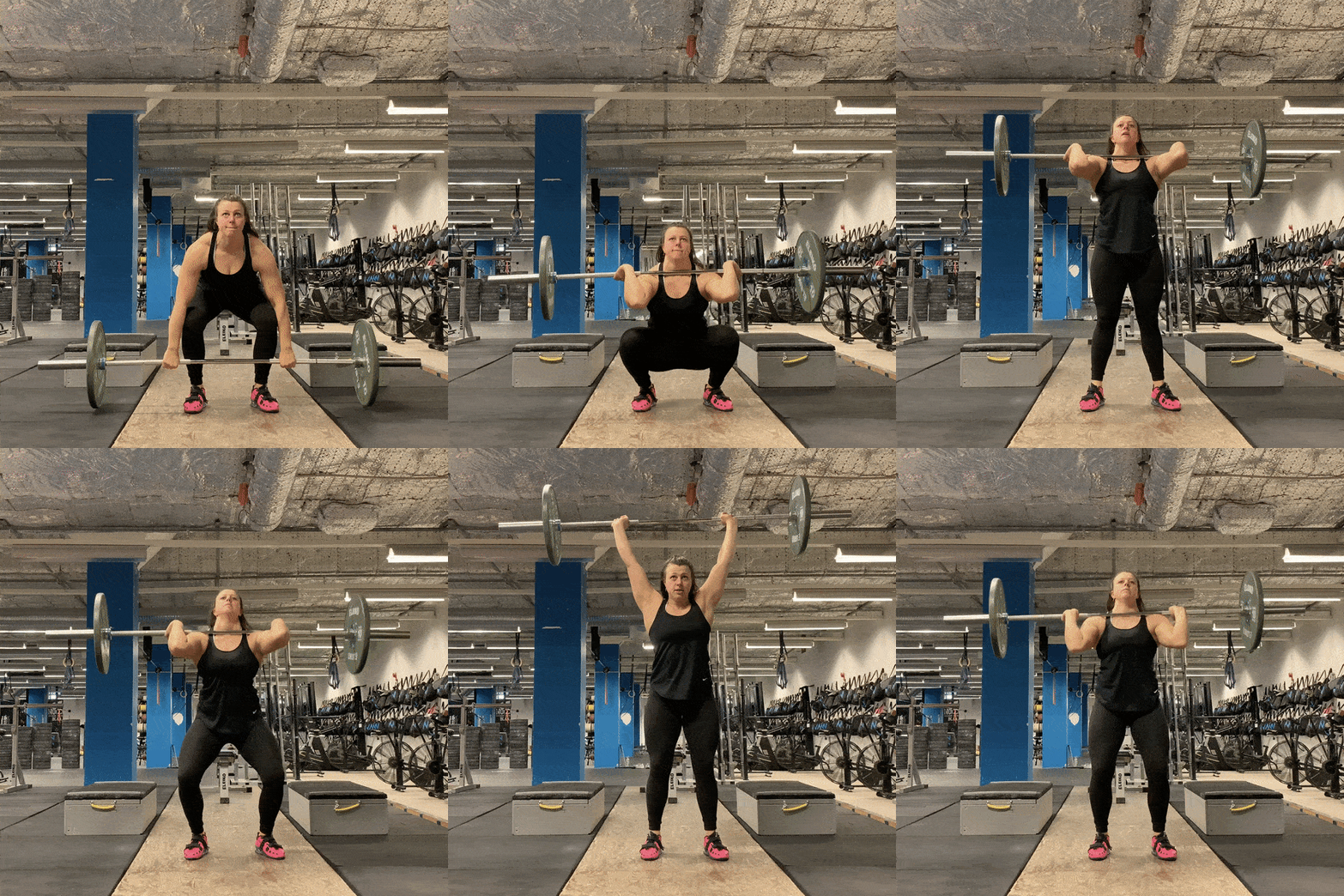
The clean and jerk is one of the two competitive lifts in Olympic weightlifting, alongside the snatch, but you also see it in gyms around the world as a staple for athletes who want to build strength and explosiveness for their sport.
It is actually two lifts combined into one. The first part, the clean, gets the bar from the ground to your shoulders. The second part, the jerk, takes it from your shoulders to overhead. It looks effortless when you see a good weightlifter do it, but it takes time to get the technique right. If you’re starting out, the key is to have patience. Speed and power will come once you’ve ingrained the correct form into your muscle memory. Start with just the bar (or even just a PVC pipe) and practice until the movement feels natural.
Because the clean and jerk is a complex movement involving the entire body, it can be a good idea to seek guidance from a coach or experienced lifter, at least in the beginning. They can spot form errors and suggest mobility drills. If you don’t have access to a coach, filming yourself can be a reasonable alternative and reveal issues you might not feel in the moment.
Like we did with the snatch, let’s break down the step-by-step instructions in extra detail.
Phase 1: The Clean
The clean is the first part of the movement, where you pull the bar from the ground to the front rack position.
- Setup
- Stand with your feet hip-width apart and grip the bar slightly wider than shoulder-width with a hook grip (thumb wrapped under fingers).
- Position your shoulders slightly in front of the bar, keeping your back flat and your chest up.
- First Pull
- Drive through your legs, keeping the bar close to your body.
- Extend your knees while keeping your hips and shoulders rising at the same rate.
- Brace your core throughout.
- Second Pull (Explosive Phase)
- Once the bar reaches mid-thigh, aggressively extend your hips, knees, and ankles (triple extension).
- Shrug your shoulders and begin pulling yourself under the bar. Your goal is to generate maximum upward force.
- Third Pull (Pulling Under the Bar)
- Pull yourself under the bar quickly, transitioning into a front squat position.
- Catch the barbell on the front rack (shoulders) with your elbows high and chest up.
- Front Squat Recovery
- Stand up from the squat.
Phase 2: The Jerk
The jerk follows the clean and is where you push the bar overhead to straight arms.
- Setup for the Jerk
- After standing up from the clean, stabilize the bar in the front rack position.
- Your feet should be hip-width apart, and your elbows slightly in front of the bar.
- Dip and Drive
- Take a deep breath and brace your core. Slightly bend your knees and dip straight down (not forward).
- Drive upward by extending your knees and hips, generating force to launch the bar upward.
- Split or Power Jerk
- As the bar moves overhead, split the feet (split jerk) or dip slightly (power jerk).
- Catch the bar with locked-out arms and an active shoulder position.
- Recovery
- Stabilize the weight overhead.
- Bring the front foot back, then the rear foot to stand up fully.
- The lift is complete once you stand still with the bar overhead.
- Lower the bar in front of you, with control.
Common Mistakes and Fixes
| Mistake | Fix |
|---|---|
| Pulling with the arms too early. | Focus on leg drive first, then shrug and pull under. |
| Catching the clean with low elbows. | Keep your elbows high to prevent bar slippage. |
| Leaning forward in the dip of the jerk. | Maintain an upright torso during the dip. |
| Pressing the jerk instead of driving it. | Use leg power to push the bar overhead. |
Snatch Pull

The snatch pull is a great accessory exercise for reinforcing snatch mechanics while allowing you to use more weight than you could handle in the full movement. Unlike the snatch itself, where you receive the bar overhead in a squat, the snatch pull stops at the top of the second pull, meaning you don’t actually catch the bar—you just focus on the forceful upward pull.
Snatch pulls have several benefits that make them indispensable for weightlifters. First and foremost, they build confidence and strength in the specific movement patterns you need to snatch heavy weights and improve your capacity to generate force quickly—a quality referred to as “speed-strength,” which is central to success in Olympic lifting. It also helps you fine-tune your positioning by ingraining a vertical line of drive.
You can program snatch pulls both during hypertrophy phases, with higher repetitions and moderate weights to build posterior chain strength and technique, and lower reps with heavier weights to maximize force production and speed.
How to Snatch Pull
- Stand with your feet hip-width apart, gripping the barbell with a wide snatch grip. Keep your back straight, chest up, and shoulders slightly in front of the bar.
- Push through your legs to lift the bar off the floor, keeping it close to your body. Maintain a straight back and keep your arms extended.
- As the bar passes your knees, shift your torso upright and prepare to extend your hips.
- Explosively extend your hips, knees, and ankles (triple extension), shrugging your shoulders and pulling the bar upward.
- Keep the bar close to your body as it rises, then control it back down to the floor.
- Repeat the movement for the desired number of repetitions.
Squat

The squat is one of the most basic but essential exercises in all of strength training, regardless of whether you’re training for raw strength (powerlifting), muscle growth (bodybuilding), or athletic performance.
As a weightlifter, you mainly utilize the back squat to build general leg and hip strength. Because you position the bar on the upper traps (high-bar and low-bar variations exist, but weightlifters almost exclusively do high-bar squats), you can handle heavier weights than in the front squat. Both squats have their place—the back squat is a foundational strength tool, and the front squat is a movement-specific strength tool.
How to Squat
- Place the bar on your upper back with your shoulders blades squeezed together. Inhale and brace your core slightly, and unrack the bar.
- Take two steps back, and adjust your foot position.
- Squat as deep as possible with proper form.
- With control, stop and reverse the movement, extending your hips and legs again.
- Exhale on the way up or exchange air in the top position.
- Repeat the movement for the desired number of repetitions.
Romanian Deadlift

The Romanian deadlift is a hip-hinge movement that builds the posterior chain—the hamstrings, glutes, and lower back. Unlike the standard barbell deadlift, you don’t reset the bar on the ground each rep. Instead, you begin from a standing position and lower the bar to around mid-shin or just past the knees, then drive back up.
While the RDL isn’t a competitive lift itself, it makes you stronger and more explosive in them, especially the first and second phases of the pull.
For example, in both Olympic lifts, you begin the movement by pulling the bar off the floor using your posterior chain, and the RDL makes you stronger in this portion by training the hamstrings and glutes in a way much like the pulling mechanics of these lifts. That strength translates directly to your ability to explode off the floor and extend fully at the hips.
In addition, the RDL is fantastic for flexibility, great both for the mobility you need for optimal pulling positions and injury prevention.
How to Do Romanian Deadlifts
- Get into the starting position by deadlifting a barbell off the floor or by unracking it from a barbell rack. Stand feet hip-width, inhale, and brace your core slightly.
- Lean forward by hinging in your hips. Keep your knees almost completely extended.
- Lean forward as far as possible with good form (no rounding your back). You don’t have to touch the barbell to the floor, although it is OK if you do.
- Reverse the movement and return to the standing position. Exhale on the way up.
- Repeat the movement for the desired number of repetitions.
Barbell Row
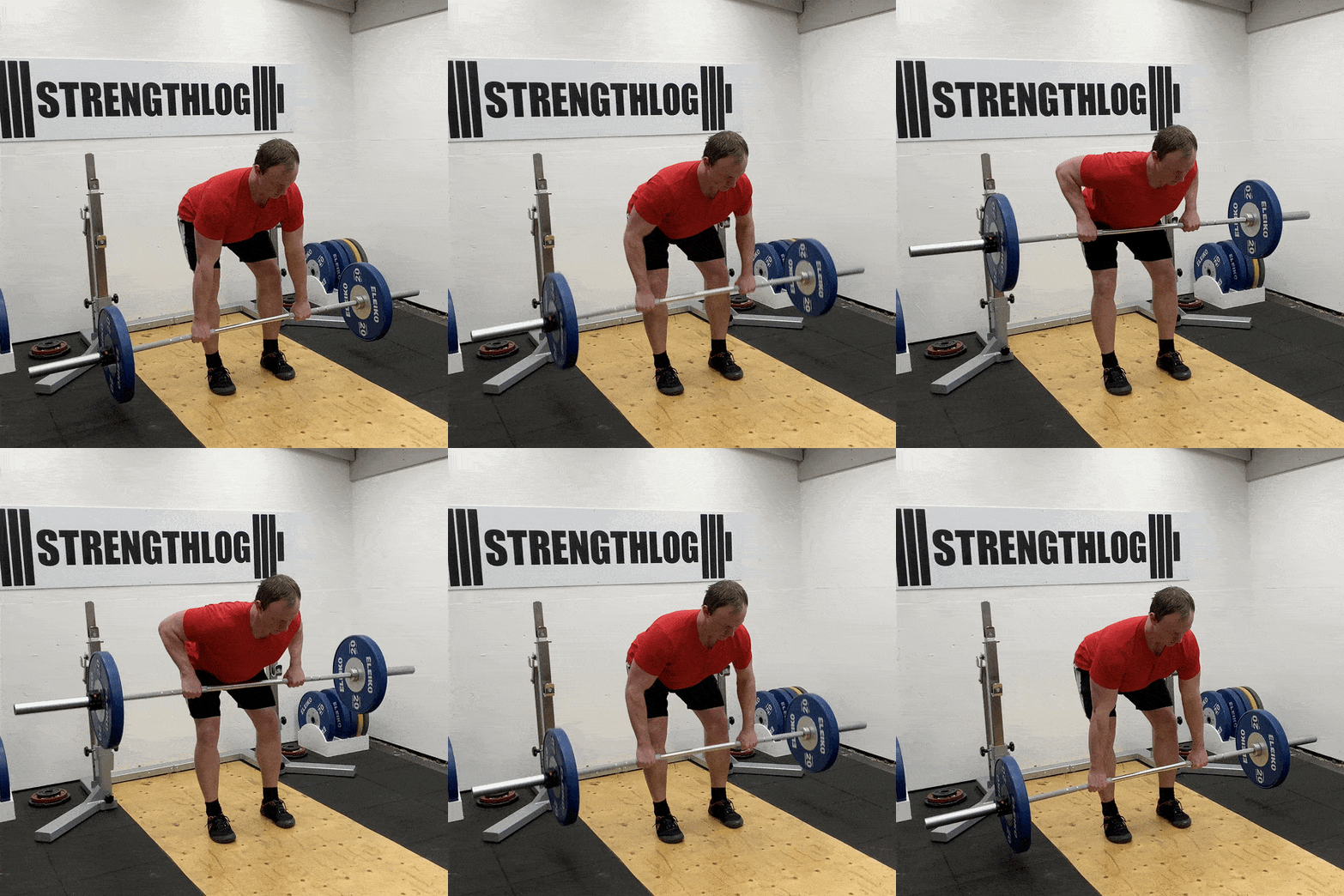
The barbell row is one of the best compound pulling exercises for building upper body muscle and strength and a staple in bodybuilding and powerlifting. For weightlifting, it plays a more supportive, accessory role rather than being a direct competition lift.
Olympic weightlifting is about power and speed, but you still need raw strength to pull heavy weights. Barbell rows hit your upper back, lats, and rear delts, which help you keep the bar tight and give you a stronger first and second pull in both the clean and snatch. A weak upper back leads to looping the barbell away from your body, which can throw your lift off from the start or make catching the weight much harder.
How to Do Barbell Rows
- Grasp the barbell with an overhand grip, slightly wider than shoulder-width apart.
- Stand with your feet slightly wider than feet hip-width apart, bend your knees slightly, and hinge forward at your hips, maintaining a straight line from your head to your hips.
- Brace your core and keep your back straight. Pull the barbell towards your lower chest or upper core, keeping your elbows close to your body. Squeeze your shoulder blades together at the top of the movement.
- Lower the barbell back to the starting position in a controlled manner.
- Repeat the movement for the desired number of repetitions.
Push Press

The push press sits somewhere between the strict overhead press and the jerk. While the strict press relies solely on upper-body strength, and the jerk involves a dip, drive, and rapid descent under the bar, the push press uses a short, controlled dip and drive from your legs to launch the bar overhead.
Getting comfortable supporting heavier weights overhead is essential for the jerk. Push presses allow you to handle weights heavier than your strict press numbers, not only making you stronger but also building confidence and stability in the overhead position.
In addition, it builds coordination between the lower and upper body under load without the complexity of the full Olympic lifts, and the initial dip and drive train the explosive lower-body extension that you also use in the jerk.
How to Push Press
- Clean a bar to your shoulders, or lift it out from a rack.
- Let the bar rest against the front of your shoulders, with your grip slightly outside your shoulders.
- Inhale and lightly brace your core.
- Bend your knees, and then forcefully push yourself and the bar upwards using your legs.
- When your legs are extended, immediately start pressing the bar with your arms, until your arms are fully extended.
- With control, lower the bar back to your shoulders.
- Repeat the movement for your desired number of repetitions.
Final Words: Beginner Olympic Weightlifting Program
Thank you for checking out this beginner Olympic weightlifting program. 🏋️ If you’ve been thinking about getting into the Olympic lifts—they are some of the most effective and fun things you can do with a barbell, after all—this program will get you off to a great start.
To follow the Beginner Olympic Weightlifting Program, download our workout log app and start tracking your workouts today:
Click here to go directly to the program in StrengthLog.
