
Full body exercises are the ultimate time savers: big, multi-joint exercises that hit nearly every fiber in your body to move the weight from point A to point B.
In this article, I’m ditching the fluff and focusing on these heavy hitters.
These are 10 of the best full body exercises that give you the highest return on investment and build functional strength fast so you can get in, get strong, and get on with your life.
Want to jump straight to them?
Yes, take me to the exercises!
Table of Contents
What Is a Full Body Exercise?
What even is a full body exercise?
If you get really pedantic about it, there are no true full body exercises.
Get too literal – “Does this exercise recruit 100% of the 600+ muscles in my body?” – then the answer is always no. Not even Olympic lifts like the clean and jerk would qualify; it leaves your pecs mostly out of the action.
There are no official rules or guidelines on what makes an exercise “full body”.
But, for it to be legally classified as “full body” in my book, an exercise must satisfy a few conditions:
Upper-Lower Crossing
It must involve the upper body and lower body working together to complete the rep. Note that this is not an established principle in exercise physiology, but since there are no official rules for what constitutes a full body exercise, I feel this one makes a ton of sense.
If the primary movers are in your legs, but the weight is supported by your upper body (or vice versa), then it’s full body.
So, for example, the squat: it’s your lower body moving the weight, but your entire back, traps, and abs must statically contract to stop you from collapsing. The load crosses the equator of your waist.
But if you can mostly relax your upper body while training your legs (or if it’s minimally involved, like when you’re doing leg presses), it’s a leg exercise, not full body.
Core Force Transfer
In addition, and very much related to the above: a full body exercise transfers force through the core.
You generate force from your legs into a braced core and transfer it to your upper body, where your shoulders and arms use the power to finish the press.
Your body acts as a single kinetic chain.
If that kinetic chain gets broken, like if you sit down on a bench and do shoulder presses, you have removed enough links to break that chain.
That doesn’t make the exercise worse, just different. And no longer a full body exercise.
CNS Demand
Not a strict rule, but a true full body exercise taxes your central nervous system (CNS) so hard that you almost need a nap afterwards.
A slight overexaggeration, but if you’ve ever done a deadlift workout filled with sets to failure, you know what I’m talking about.
It triggers a systemic fight-or-flight response. That 400+ lb deadlift has your brain screaming at every muscle fiber in your body (not literally, but you get the point) from your grip to your hamstrings to your neck, to fire simultaneously.
If you can have a casual conversation immediately after a heavy set, chances are you didn’t do a full body exercise, or you’re a highly conditioned athlete.
Verdict: What Makes a Full Body Exercise?
For me, that line is drawn where coordination meets heavy loading.
- Biceps curl? No. Single joint, local fatigue.
- Leg extension? Again no. The machine stabilizes you.
- Chin-up? Borderline. Chin-ups are upper-body dominant but still require whole-body bracing. Whether they count depends on how strict your definition is, but I would leave them out of a list of full body exercises. In fact, that’s just what I did.
- Power snatch? Check, check, and check again on everything that makes an exercise full body.
Basically, if you have to use your entire body to stabilize the weight while a specific part of you moves it, it’s full body enough for me, as long as there is some force transfer between the upper and lower body going on as well.
And one last thing: you’re not going to find any balance-on-one-leg-on-a-medicine-ball-while-doing-rotational-squats-and-juggling exercises in this article. No exercises that might work everything you’ve got, but do so for the sake of novelty or while being rather useless. Only full body exercises that serve a purpose here.
Top 10 Best Full Body Exercises
Here is my definitive (others might, and should, disagree; there are a ton of great exercises that could fit on this kind of list) and slightly opinionated top 10 list of full-body exercises.
The list is in alphabetical order:
| Exercise | Primary Movement Pattern | Training Goal |
| Burpee | Prone-to-Vertical | Endurance |
| Clean and Jerk | Power / Triple Extension | Explosiveness, Power |
| Deadlift | Hinge | Raw Strength |
| Farmer’s Walk | Loaded Carry | Grip & Real-world Strength |
| Kettlebell Swing | Ballistic Hinge | Posterior Power |
| Power Snatch | Power / Triple Extension | Explosive Power, Speed |
| Sled Push / Sled Pull | Horizontal Force Production | Strength & Conditioning, Work Capacity |
| Squat | Squat | Lower-Body Strength & Athletic Performance |
| Thruster | Squat + Push | Metabolic Conditioning |
| Turkish Get-Up | Stabilization | Coordination & Stability |
I could have filled this list of the best full body exercises with just Olympic lifts, but that would be cheating, so I’m limiting them to two.
All exercises are detailed in our workout log app, StrengthLog, so you always have proper form at a glance when you’re training.
Download StrengthLog free and start tracking your workouts today:


Here we go, and I know you’re going to love the first one.
1. Burpee

Burpees are legendary for conditioning, and everyone loves them. Not. But they mix strength, explosiveness, endurance, and the right amount of suffering to get fast results.1
A burpee is a four-count chain reaction of movements, three patterns mashed together at high speed:
- A squat (lower body)
- A push-up (upper body push)
- A jump (explosive power)
Because you are rapidly changing levels, going from vertical to horizontal and back to vertical, doing 10 burpees feels much harder than doing 10 of each in three separate sets.
The burpee is the only bodyweight exercise on this list, but it’s here for several reasons. It hits your chest, triceps, abs, hip flexors, and legs, and you can do it anywhere, anytime, until you collapse.
Pro Tip: You don’t have to do the standard version. Burpees scale like magic, so you can modify them to match your fitness level:
| Level | Variation | Description |
| Beginner | The Sprawl | Drop down, kick back to a plank, stand up. No push-up, no jump. |
| Intermediate | Standard Burpee | The classic version described above. |
| Advanced | Burpee Pull-Up | Do a burpee under a pull-up bar, jump up, and do a pull-up. |
| Elite | Devil’s Press | Holding a dumbbell in each hand, perform a burpee, then snatch the weights overhead. |
Muscles Worked in a Burpee

Primary muscles worked:
Secondary muscles worked:
How to Do Burpees
- Stand with your feet shoulder-width apart.
- Quickly drop into a squat and place your hands on the floor in front of you.
- Immediately jump your feet back into a plank position, without pausing.
- Perform a fast push-up to get your chest down to the floor.
- Jump your feet right back toward your hands.
- Explosively jump up, reaching your arms overhead.
- Land softly and immediately flow into the next rep, with no break.
2. Clean and Jerk
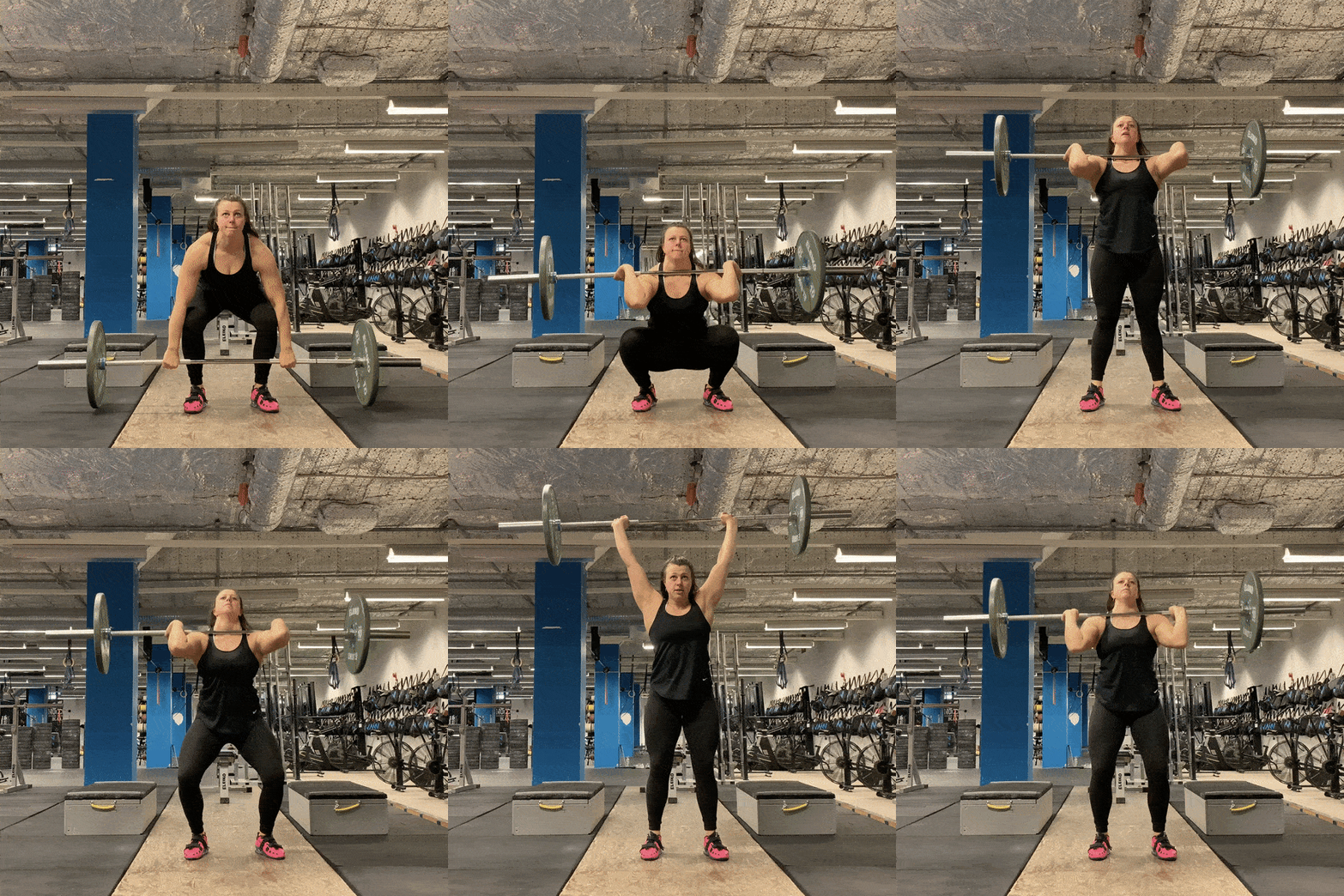
I promised max two Olympic lifts, and I’m sticking to it. But I’m playing my ace card early: the clean and jerk.
It is arguably the most athletic movement a human being can perform with a barbell. If the squat is the king of lifts, as the saying goes, the clean and jerk is the wizard, the knight, and the dragon all rolled into one.
The clean and jerk is one of the two lifts contested in the Olympics (the other being the snatch). It is a two-part drama:
- The Clean: You pull the bar from the floor and “catch” it on your shoulders (the front rack position).
- The Jerk: You dip your legs and violently drive the bar overhead, locking your arms out while dropping underneath it.
In other words, you move a load from the floor to your shoulders to overhead, which requires explosive power from the hips, core stability, and shoulder strength. It recruits nearly every muscle fiber in your body in under two seconds.
Learning weightlifting exercises like the clean and jerk gives you big benefits when it comes to athleticism, even if you’re not going to compete in the sport of weightlifting.2
Want to get started with Olympic lifting? Check out our free Beginner Olympic Weightlifting Program!
Pro Tip: The clean and jerk is a very technical exercise. Don’t just watch a YouTube video and load the bar. Get a coach or start with a PVC pipe.
Muscles Worked in the Clean and Jerk

Primary muscles worked:
Secondary muscles worked:
How to Clean and Jerk
- Step up close to the bar, so that it is about over the middle of your foot.
- Lean forward and grip the bar with an overhand grip, about shoulder-width apart.
- Hold your breath, and brace your core slightly.
- Lift the bar in a smooth but fast motion. Then squat down again to receive the bar on the front of your shoulders. Stand up on straight legs again.
- Slightly bend your knees, and then forcefully extend them to push the bar up.
- Duck under the bar and catch it on straight arms, with your legs in a lunge position.
- First, take a step back with your front foot and then step forward with your back foot, until you’re standing with your feet side by side again, while controlling the bar on straight arms above your head.
- Lower the bar in front of you, with control.
3. Deadlift

Picking a heavy object off the ground and standing up: that’s the deadlift in less than 10 words. If you could only do one exercise for the rest of your life to remain a functioning human being, you wouldn’t pick the biceps curl. You’d pick the deadlift and be happy you did.
Deadlifts strengthen your entire posterior chain (the backside of your body), teach you how to hinge at the hips (a fundamental movement pattern), and build grip strength like a medieval blacksmith.
Pro Tip: If you have lower back issues, swap the regular barbell for a trap bar (hex bar). You position the weight’s center of gravity in line with your own center of mass, making the lift safer while still allowing you to load it up as heavy or heavier.
It’s also easier to learn, and research shows that trap bar deadlifts actually trump regular deadlifts for both muscle activation and developing power and force (and thus, likely athletic performance).3 4
Muscles Worked in the Deadlift

Primary muscles worked:
Secondary muscles worked:
- Quads (primary if using a trap bar)
- Hamstrings
- Adductors
- Trapezius
- Forearm Flexors
How to Deadlift
- Step up close to the bar so that it is about over the middle of your foot.
- Inhale, lean forward, and grip the bar.
- Hold your breath, brace your core slightly, and lift the bar.
- Pull the bar close to your body, with a straight back, until you are standing straight.
- Lower the bar back to the ground with control.
- Take another breath, and repeat for reps.
4. Farmer’s Walk

The farmer’s walk (or farmer’s carry) is the simplest exercise on the list. You pick up two heavy things and you walk. Simple, yes, but also simply effective.
Research shows that doing the farmer’s walk produces greater forces throughout the entire body than deadlifts, but with significantly less stress on your back and spine.5
It trains your grip, core stability, almost all major muscle groups from neck to toe, and improves your functional capacity to carry heavy things, something that’s actually useful in real life.
Pro Tip: Before you lift the weights from the ground, you want to draw your shoulder blades back and down and tighten your core as if someone’s getting ready to throw a haymaker to your gut. You’ll set your upper body in a stable position and protect your shoulders.
Muscles Worked in Farmer’s Walk

Primary muscles worked:
Secondary muscles worked:
How to Do the Farmer’s Walk
- Pick up a pair of suitably heavy weights (dumbbells, kettlebells, or special handles).
- Hold your breath, brace your core slightly.
- Look ahead and start moving forward in small steps. Increase the stride length as you increase the speed.
- Keep your body straight and avoid leaning excessively forward as you walk.
- When you are done, put the weights back on the ground in a controlled manner.
5. Kettlebell Swing

The kettlebell swing is the hinge pattern perfected and ballistic training at its finest. It’s the most popular of all kettlebell exercises and the one I often use to introduce someone to the wonders of kettlebell training.
Check out The 27 Best Kettlebell Exercises for Muscle, Strength & Stability to learn more.
Swings train your posterior chain to be explosive without the high impact and joint stress of jumping, and can even improve your 1RM in the squat.6 Plus, they’re fantastic for grip strength and even give you a cardio boost.
If you want to make your lower back muscles work harder, you can do one-armed swings instead of holding the kettlebell with both hands.7 8
Pro Tip: Keep your arms glued to your ribcage until your hips pop the weight off your body. The kettlebell should “float” up; you shouldn’t be front-raising it.
Muscles Worked in Kettlebell Swings

Primary muscles worked:
Secondary muscles worked:
How to Do Kettlebell Swings
- Place a kettlebell on the ground, about one or two feet in front of you.
- Take a wide stance, lean forward and grip the kettlebell.
- Brace your core slightly, and swing the kettlebell back between your legs, while inhaling.
- Swing the kettlebell forward by extending your hip, while exhaling.
- Try to swing the kettlebell to about chest height.
- Repeat for reps and put the kettlebell back on the ground when you’re finished.
6. Power Snatch

My second Olympic choice. While the clean and jerk is about absolute power, the snatch is about speed and precision, and the power snatch is technically easier because you catch the bar in a higher position.
Power snatches are also used outside weightlifting circles. It’s a common exercise in strength and conditioning routines for many sports because it builds the kind of body that performs as well as it looks. It trains triple extension, coordinating your ankles, knees, and hips to extend with maximal force at the same time, which is exactly what you do when you jump, sprint, or tackle someone.9
And, not to forget, it is one of the coolest-looking movements in the gym: dynamic, fast, and very satisfying when you whip a bar up over your head.
Pro Tip: If you have never done power snatches before, start with a PVC pipe or a broomstick, or, even better, have a coach teach you. Learn the movement pattern before you try it with a loaded barbell.
Muscles Worked in Power Snatch
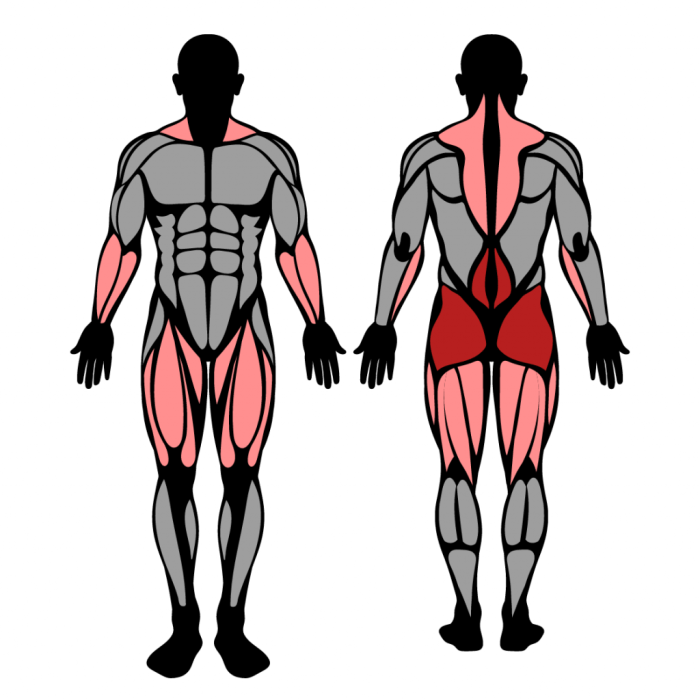
Primary muscles worked:
Secondary muscles worked:
How to Power Snatch
- Step up close to the bar, so that it is about over the middle of your foot.
- Lean forward and grip the bar with a wide overhand grip, close to the weight plates.
- Hold your breath, brace your core slightly, and lower your hip closer to the floor.
- Lift the bar in a smooth but fast motion by extending your legs and knees simultaneously.
- Once the bar has reached maximum speed, bend your knees slightly and catch the bar on straight arms over your head.
- When you’ve got control of the bar, stand up straight.
- Lower the bar in front of you, with control.
7. Sled Push

It sits in the corner of the gym looking like a harmless pile of metal, but looks can (and do) deceive. It teaches foundational functional loaded movement by driving into the ground (sled push) or leaning back and driving through your heels (sled pull).
Unlike most exercises, like say, a squat or deadlift, there is no eccentric (lowering) phase where most of the muscle damage happens. That means you can do heavy sled work and not be sore the day after: pure volume without the recovery cost.
Not only do sled pushes train most of your body, but they also improve sprint speed over short distances, which makes them great choices for many explosive team sports.10
And they don’t require a lot of technique training. Just load up a sled and push (or pull): one of the few exercises that lets you improve strength, cardio, and explosiveness with a single piece of equipment and with minimal risk of injury.
Pro Tip: For best results, use a really heavily loaded sled so that you have to struggle to move it your intended distance.11 12
How to Do Sled Pushes
- Load the sled with the desired weight.
- Stand behind the sled and grab the handles with both hands.
- Lean slightly forward, keeping your back flat and core tight.
- Drive through your legs and push the sled forward.
- Keep a steady pace and controlled steps until you reach the end of the track or until the desired distance.
Muscles Worked in the Sled Push

Primary muscles worked:
Secondary muscles worked:
How to Do Sled Pulls
- Attach a harness to the sled and securely strap it around your waist or shoulders.
- Lean slightly forward into a sprint position, keeping your core engaged.
- Drive explosively through your legs to start moving the sled.
- Sprint forward with powerful, short strides.
- Maintain good sprint mechanics until you reach the end of the track or the desired distance.
8. Squat

If the gym were a monarchy, the squat would rule the kingdom. It’s one of the most popular and best exercises for everyone, from powerlifters, bodybuilders, and athletes to the average person building a stronger body, as well as older adults staving off muscle loss and staying healthy.
When you drop down into a heavy squat, you’re structurally loading your entire skeleton and asking most major muscle groups in your body to cooperate. Not only your lower body; if your upper half is jelly, the power from your legs leaks out before it moves the bar.
There are many squat variations you can do, from beginner air squats to advanced Zercher squats, but most lifters can stick to the basics:
| Variation | Best For | What and Why |
| Barbell Back Squat | Max strength & Muscle mass | The classic. Perhaps the number one exercise for lower body strength, mass, and overall athletic performance. |
| Front Squat | Quads & Upper Back posture | It forces you to stay upright and involves your core more. |
| Goblet Squat | Beginners & Mobility | Beginner-friendly. Holding a dumbbell or kettlebell at your chest fixes your form automatically. |
Go deep to make your squats more of a full body exercise. If you aren’t at least hitting parallel, strip the weight. Half-reps give you half the results in this case.
Pro Tip: Stop squatting in squishy running shoes. It’s like trying to lift weights while standing on a platform of marshmallows. Wear flat shoes or dedicated weightlifting shoes.
Learn more about lifting shoes, what they do, and why you should use them in my article Lifting & Weightlifting Shoes 101: Science-Backed Benefits, Drawbacks & Buyer’s Guide.
Muscles Worked in the Squat

Primary muscles worked:
Secondary muscles worked:
How to Squat with Proper Form
- Place the bar on your upper back. Inhale and brace your core slightly, and unrack the bar.
- Take two steps back, and adjust your foot position.
- Squat as deep as possible with good technique.
- With control, stop and reverse the movement, extending your hips and legs again.
- Exhale on the way up or exchange air in the top position.
- Inhale and repeat for reps.
9. Thruster

If you’ve ever thought, “I wish I could do cardio, leg day, and shoulder day all at the same time,” look no further than the thruster.
It’s essentially a front squat combined immediately with a push press, and, like burpees at the beginning of the list, it’s an exercise everyone likes to hate. You can do them with kettlebells, dumbbells, a barbell, or no weight at all, depending on what you have at hand.
If you are looking for the most bang for your buck exercise to burn calories and build power, muscular endurance, and conditioning all in one, you have found it.
The most famous workout involving thrusters is “Fran” (21 reps, 15 reps, 9 reps of thrusters and pull-ups). Top athletes do it in about two minutes.
Pro Tip & Quick Workout: If you want the worst of both worlds (thrusters and burpees), try this “ladder” finisher at the end of your next workout. Use a light to moderate weight with minimal rest between sets:
- 10 Thrusters / 1 Burpee
- 9 Thrusters / 2 Burpees
- …continue until…
- 1 Thruster / 10 Burpees
- Fall down in a heap
Muscles Worked in Kettlebell/Dumbbell Thrusters

Primary muscles worked:
Secondary muscles worked:
How to Do Kettlebell/Dumbbell Thrusters
- Stand with your feet shoulder-width apart and hold two kettlebells or dumbbells in rack position.
- Lower into a squat until your thighs are approximately parallel to the ground.
- Drive explosively up from the bottom position by extending your hips and knees, and use the force from your legs to press the weights overhead in one fluid motion.
- Fully extend your arms at the top and lock out the weights overhead.
- Lower the weight back to your shoulders in a controlled manner and immediately transition into the next repetition.
10. Turkish Get-Up

The Turkish get-up looks like a circus act to the uninitiated, but it is one of the best full body exercises for keeping you mobile, stable, and strong enough to get off the floor without groaning.
It’s not really a muscle-building exercise (you won’t get huge biceps from it). It is a movement exercise that teaches your body to move as a unit and builds stability in your shoulders through an extreme range of motion.13
Another neat-o benefit of the get-up is that it identifies weak functional links instantly. Can’t lunge? Can’t rotate your thoracic spine? The Turkish get-up will let you know and help you work on the problem.
Pro Tip: Before you do the get-up with a kettlebell, try it with a shoe balanced on your closed fist. If the shoe falls, your technique or balance was off. If the shoe stays, you earn the kettlebell, and you won’t have risked a weight on your face.
Muscles Worked in Turkish Get-Ups

Primary Muscles Worked
Secondary Muscles Worked
How to Do Turkish Get-Ups
- Lie on your back with a dumbbell or kettlebell in one hand, extended straight toward the ceiling. Place your other arm out to the side on the floor for balance.
- Bend the knee on the same side as the weight, keeping your foot flat on the floor.
- Keep the weight pressed overhead and rise up onto your elbow, then onto your hand.
- Lift your hips off the ground and sweep your straight leg back, bringing yourself into a kneeling position under your body.
- From here, move into a lunge position and stand all the way up with the weight still overhead.
- Reverse the movement step by step to return to the starting position.
- Repeat for reps, then switch sides.
Full Body Fundamentals Program
Below is Full Body Fundamentals, a 3-day, full-body–focused training program built around the big compound exercises above (one or two additions), with minimal volume (three exercises per session) and time-effective sessions.
Each day uses different primary movements to avoid overlap and manage fatigue while still working the whole body every session.
It is intended for advanced beginners and up, although it works best for intermediate lifters with some training experience. Advanced lifters can also make great use of it to keep in shape or even progress when training time is limited.
General Structure
- Workout 1: Hinge Strength & Posterior Chain
- Workout 2: Squat + Upper Push Conditioning
- Workout 3: Push, Pull, and Conditioning
- Sets: Three per exercise
- Rest: 2–3 min for heavy lifts, 60–90 sec for conditioning-style exercises (recommendations only; feel free to rest as much or as little as you need).
I suggest you take a rest day between each workout for a total of three sessions per week. For example: Monday, Wednesday, and Friday. But it’s a suggestion, not written in stone. Adapt to your life and schedule. Two days in a row is fine if needed.
Warming Up
Here’s a simple 5–10 minute warm-up to get your mind and body ready.
- Start with 3–5 minutes of light cardio (jogging in place, jumping jacks, or brisk walking, for example) to get your blood flowing. Optional but helpful.
- Follow up with some dynamic movements like arm circles, leg swings, and a few bodyweight squats and lunges.
- Lastly, do one light set of the first exercise (or all exercises) before you start your main “work sets.”
This is what the workouts look like:
Workout 1: Hinge Strength & Posterior Chain
| Exercise | Sets | Reps |
| Deadlift or Trap Bar Deadlift | 3 | 3–5 |
| Kettlebell Swing | 3 | 12–15 |
| Farmer’s Walk | 3 | 20–30 meters or yards |
Workout 2: Squat + Upper Push Conditioning
| Exercise | Sets | Reps |
| Squat or Front Squat | 3 | 5–8 |
| Thruster | 3 | 8–10 |
| Burpee or Devil’s Press | 3 | 10–15 |
Workout 3: Push, Pull, and Conditioning
| Exercise | Sets | Reps |
| Sled Push | 3 | 10–15 meters or yards |
| Pull-Up | 3 | Do as many reps as you can |
| Push Press | 3 | 5–6 |
Note: If you have the technique down pat, you can switch out the push presses for three sets of power snatches. I deliberately excluded Olympic exercises from this program to make it more accessible, but that doesn’t mean you shouldn’t do them if you want and know how. On the contrary.
Once you can do the recommended reps for all sets of an exercise, increase the weight a bit. Trying to improve on your previous best by doing one more rep or lifting a little heavier is called progression and is the key to getting stronger and building muscle.
Other Workouts and Programs
In addition to the Full Body Fundamentals program, you’ll find plenty of full body workouts and programs in our workout log app.
Some examples include:
- StrengthLog’s Full Body Workout Routine, 2x/Week (free)
- StrengthLog’s Full Body Workout Routine, 3x/Week (free)
- StrengthLog’s Home Workout Split (requires a premium subscription)
Note that these are full body workouts but aren’t entirely based on full body exercises like Full Body Fundamentals.
Follow the Full Body Fundamentals Program in StrengthLog
What’s the best way to follow Full Body Fundamentals?
By downloading our free workout tracker, StrengthLog.
The app makes it super easy to keep track of your weights and reps and makes suree you’re on the right path. It remembers what weights you’ve used and how many reps you’ve done, and automatically loads them into your next workout so you can try to beat your last session.
Download it and start tracking your gains today!
StrengthLog is free to use, and so is this program.
Track Your Training. See Real Progress.
Log your workouts in one place and watch your numbers climb, week after week.
- Free to get started
- Fast workout logging
- Cardio and strength training
- Free weights and machines
- Progress over time, personal bests
- Beginner-friendly training programs and workouts for every fitness goal
Download StrengthLog free:
Final Rep
We all want the look and feel only strength training can give, but most of us have jobs, families, and a Netflix backlog to get through. That’s the beauty of these full body exercises: they are the ultimate time savers.
You don’t need to spend an hour or more isolating your inner-lower-left triceps. If you focus on these big lifts, you’re hitting 90% of your results with 10% of the exercises.
The other 10%? They come from consistency and effort. See you in the gym!
Want more?
Subscribe to our weekly newsletter to get notified of new articles, and get weekly training tips!
Or, you can view our full list of strength training exercises here.
Last reviewed: 2025-11-25
References
- Journal of Science and Medicine in Sport, Volume 22, S31. Sprint running & burpees: comparison of acute physiological and neuromuscular effects of two high intensity interval training protocols.
- Sports Med. 2022 Jan 13;52(7):1533–1554. Comparison of Weightlifting, Traditional Resistance Training and Plyometrics on Strength, Power and Speed: A Systematic Review with Meta-Analysis.
- International Journal of Strength and Conditioning 5(1), May 2025. Differences in Muscle Activation and Joint Kinematics Between Deadlift Styles When Performed at High-Intensity Training Loads.
- J Strength Cond Res. 2016 May;30(5):1183-8. An Examination of Muscle Activation and Power Characteristics While Performing the Deadlift Exercise With Straight and Hexagonal Barbells.
- International Journal of Sports Science & Coaching, October 1, 2014. A Biomechanical Analysis of the Farmers Walk, and Comparison with the Deadlift and Unloaded Walk.
- J Strength Cond Res. 2012 Aug;26(8):2228-33. Kettlebell swing training improves maximal and explosive strength.
- J Strength Cond Res. 2016 May;30(5):1196-204. Core Muscle Activation in One-Armed and Two-Armed Kettlebell Swing.
- Sports Med Int Open. 2019 Jan; 3(1): E12–E18. Trunk Muscle Activity in One- and Two-Armed American Kettlebell Swing in Resistance-Trained Men.
- Strength and Conditioning Journal 29(3):p 10-20, June 2007. Application of the Power Snatch for Athletic Conditioning.
- Journal of Bodywork and Movement Therapies, Volume 42, June 2025, Pages 302-312. Effects of resisted sled training on sprint performance in team sports. A systematic review and meta-analysis.
- J Strength Cond Res. 2020 Oct;34(10):2751-2759. Influence of Resisted Sled-Pull Training on the Sprint Force-Velocity Profile of Male High-School Athletes.
- J Strength Cond Res. 2014 Oct;28(10):2738-45. Effects of weighted sled towing with heavy versus light load on sprint acceleration ability.
- J Bodyw Mov Ther. 2019 Jan;23(1):23-31. A descriptive analysis of shoulder muscle activities during individual stages of the Turkish Get-Up exercise.
