
Alright, let’s build you some cartoon arms.
Big biceps come from a combo of 1) enough hard sets of the right exercises, 2) progressive overload, 3) good technique that loads your actual biceps, and 4) the usual suspects: recovery and enough good food.
Read on for the best exercises, my top tips (both science-based stuff and some bro-speculation), and proven workouts for beginners to advanced.
Let’s go to the gun show.
Table of Contents
Biceps Anatomy 101
Time to talk about the guns. The pipes. The pythons.
Whatever you call them, you should know the basics of how your biceps work. It’ll make it easier to understand the whys and hows when we talk exercises in a bit.
So, before we get into the nitty-gritty, let’s take a look at what we’re dealing with under the hood. I promise to keep it simple and to the point.
If you still want to jump straight to the exercises, that’s OK:
Biceps Brachii
The biceps isn’t a single blob of muscle. It’s composed of two heads: the long head and the short head.
Biceps literally means “two-headed” in Latin, and the brachii part simply means of the arm.
So: biceps brachii = the two-headed muscle of the (upper) arm.

- The long head sits on the outside of your arm. It crosses the shoulder joint, which is a neat little anatomical trick. When you see a mountain-like peak on a bodybuilder’s arm, you’re looking mostly at the long head.
- The short head sits on the inside of your arm. It doesn’t give you the peak, but what it does give you is a wide, thick look from the front.
If you think your biceps just bend your elbow, you’re underestimating them.
They have no less than three functions: 1) flex your elbow (like when you curl), 2) supinate your forearm (turning your palms up), and 3) raise your arm out in front of you.
Brachialis
Okay, so the brachialis technically isn’t part of the biceps, but it lives right underneath it.
In fact, when most people talk about the biceps, they include this guy in the conversation, often without knowing it.
You can’t see the brachialis (unless you’re super lean, in which case you might spot part of it), but when you make it grow, it pushes your biceps up, making your arm look bigger.

The brachialis does one thing only: it flexes your elbow, just like the biceps. It, not the biceps, is your primary elbow flexor.
You might have heard or read that you should curl with a neutral (hammer) or reverse grip to target the brachialis.
The truth is that the brachialis is indifferent to your grip choices. Palms up, palms down, holding a dumbbell, holding a sack of potatoes, it pulls exactly the same way.
Instead, when you switch to a hammer or reverse grip, your biceps lose their mechanical leverage and partially clock out for the set. But the weight still needs to move, so your brachialis (and the meaty brachioradialis muscle on top of your forearms) ends up doing more of the work.
The Best Exercises to Build Big Biceps
The biceps is a relatively simple muscle. It only does a few things, and building big biceps doesn’t require 20 different exercises to hit every function, every head, and every fiber.
At the same time, doing 10 sloppy sets of the exact same standing dumbbell curl isn’t going to get you there.
If your biceps’ favorite isn’t here, it’s likely because I didn’t want to turn this into just a long list of biceps exercises. I want to boil it down to just the five I’d base a workout around if someone held a gun to my head and told me I could never switch things up.
But that’s one of the neat things about strength training: there are very few downright bad exercises.
Anyways, these are mostly curls, but a bonus compound movement also earns a spot on this Mount Rushmore of biceps builders.
1. Barbell Curl / EZ Bar Curl


The barbell curl allows you to overload the biceps with the most weight of all isolation exercises. It’s the old-school classic that has been building big biceps since the dawn of the iron game.
Keep your elbows pinned to your sides and avoid swinging the bar up with hip action. No one cares about 1RM in the barbell curl. That said, a little strategic cheating in the last few reps when you can’t do any more strict ones is fine.
Feel free to use an EZ bar (the squiggly zigzag one) if a straight bar hurts your wrists. Some would say the straight bar is the better option because you don’t get full supination with the EZ bar, but even if that’s technically true, it doesn’t matter outside of textbooks. And speaking of textbooks, studies agree that the choice is “purely a matter of subjective comfort.”1
How to Do Barbell Curls
- Grip a bar with an underhand (supinated) grip, hands about shoulder-width apart.
- Lift the bar with control, by flexing your elbows.
- Don’t let your upper arm travel back during the curl, keep it at your side or move it slightly forward.
- Reverse the movement and lower the bar back to the starting position.
- Repeat for reps.
2. Incline Dumbbell Curl

If you’ve ever done a set of incline curls, you know how weak you get. Dumbbells you can easily handle in regular dumbbell curls? Forget it.
Grab dumbbells that are at least 15–20% lighter than what you usually curl standing up. Trust me on this. The stretch makes them feel so much heavier.
And that’s a good thing. You’ve just removed your mechanical advantages and stretched the muscle into a position where it’s not as mechanically efficient, so it has to work really hard to contract.
Also, when you pin your shoulders back, you put the long head under stretched load at the bottom of the movement. Science tells us that training a muscle in a loaded stretch is a good way to trigger growth.2
While you can’t isolate one head of the biceps and your peak is largely genetic, incline curls do hit the long head harder, and that’s the one that contributes the most to your peak.
Slow eccentric. Full stretch. Control the bottom. Give strict incline curls a chance, and you’ll know what real biceps pump is.
How to Do Incline Dumbbell Curls
- Grab a pair of dumbbells, and sit down on an inclined bench. Let your arms hang straight down by your sides.
- Lift the dumbbells with control, by flexing your elbows.
- Reverse the movement and lower the dumbbells back to the starting position.
- Repeat for reps.
3. Hammer Curl


I’ve picked hammer curls instead of standard dumbbell curls as my go-to. The only difference is the grip: you hold the dumbbells with your palms facing each other, as if you were hammering a nail.
If you remember from the anatomy lesson above (you didn’t skip it, did you?), a hammer grip puts your biceps in a weaker position, and that’s why hammer curls are gold for building the brachialis. It doesn’t really care how you hold the dumbbells, but when your biceps can’t pull its weight, it has to step up and take more of the load.
I should mention that some lifters swear by hammer curls for building big biceps (or brachialis, but you know what I mean), while others mostly feel them in the forearms. Probably tendon insertions, limb length, and even your nervous system coordinating the movement to shift which muscle “feels” dominant.
So, if you’re not feeling them, stick to regular dumbbell curls. I love me some hammers, though. You can also try hammer curls with a rope on a low cable machine. You get tension through the entire movement, and you can probably focus more on your upper arms.
How to Do Hammer Curls
- Hold a pair of dumbbells in a neutral grip (palms facing each other), arms hanging by your sides.
- Lift the dumbbells with control by flexing your elbows.
- Don’t let your upper arms travel back during the curl. Keep them at your sides, or move them slightly forward.
- Reverse the movement and lower the dumbbells back to the starting position.
- Repeat for reps.
4. Preacher Curl

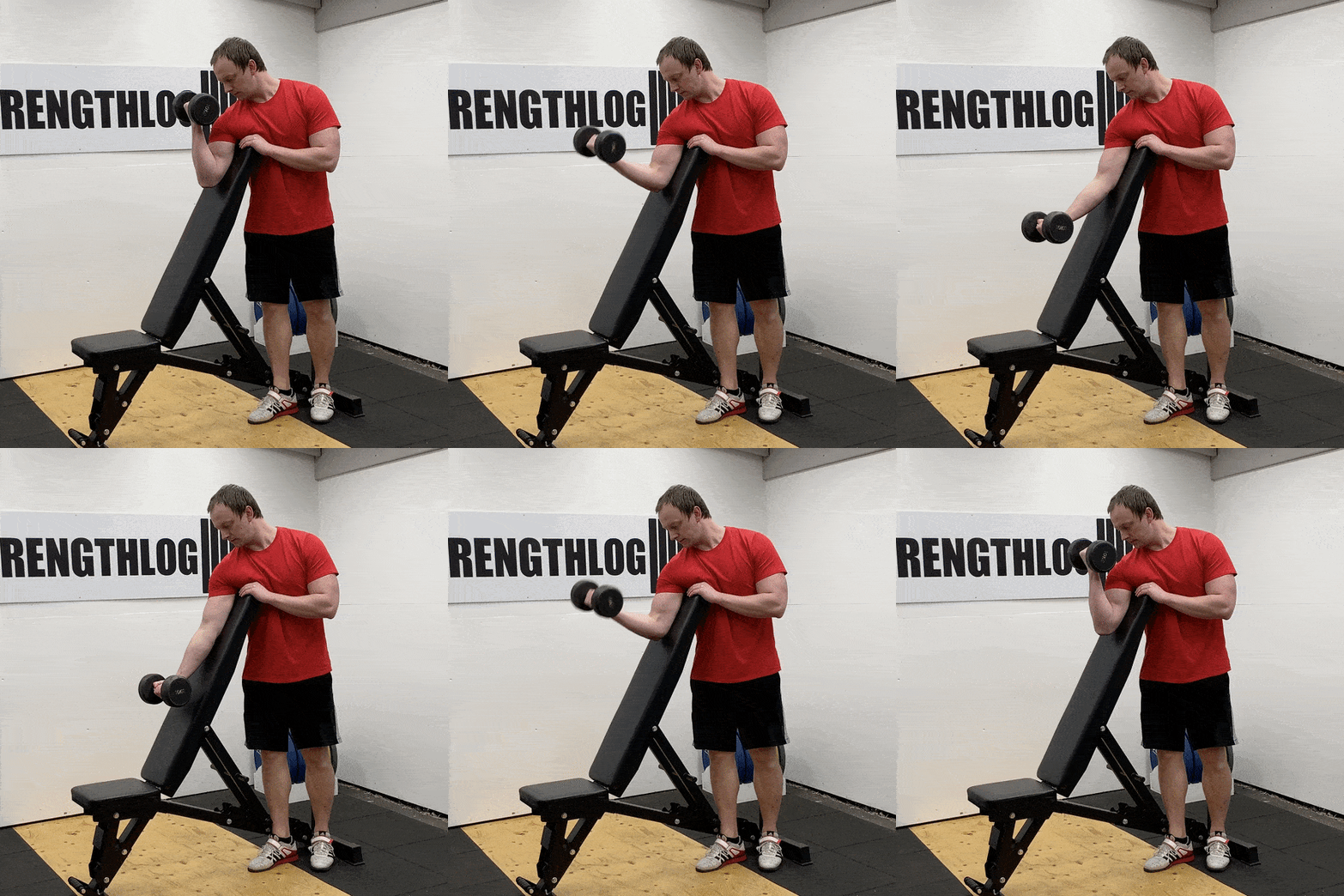
Very few, if any, exercises isolate your biceps more than preacher curls. When you put your arms snugly against the pad, you lock your shoulders into place and cannot use momentum.
There are a number of variants: seated or standing, barbell (straight or EZ bar), dumbbell, cable, or machine. Regardless of which one you like, it’s a top-tier exercise for building big biceps.
When you put your elbows in front of your torso as you do in preachers, you put slightly more focus on the short head of the biceps because the long head gets shortened and can’t produce as much force. Also, recent research suggests that they might be extra effective for adding mass to the lower part of your biceps, near the elbow.3
This is one exercise where you don’t want to go for the heaviest possible weights. Be sure to control the movement at all times, and don’t bounce at the bottom. Straighten your arm, but don’t hyperextend or lock out your elbows completely at the bottom while relaxing. Always maintain tension here. You’ll save both your biceps tendon and your elbows.
Preacher curls are a safe exercise, but you can make them unsafe if you’re being stupid. Don’t be stupid. I don’t want to frighten you, but once you’ve seen a biceps tendon tear live, you know why going for PRs in the preacher curl can be a bad idea.
How to Do Dumbbell Preacher Curls
- Use a preacher curl bench, or position the backrest of a regular training bench so that it leans back slightly.
- Grab a dumbbell, stand behind the bench, and rest your upper arm against the backrest.
- Lower the dumbbell as far as you can, and then reverse the motion, returning to the starting position.
- Repeat the movement for the desired number of repetitions.
How to Do Barbell Preacher Curls
- Grab a barbell and sit down at a preacher curl bench, resting your upper arms against the pad.
- Lower the barbell as far as you can, with control, to straight arms.
- Reverse the motion and return to the starting position.
- Repeat the movement for the desired number of repetitions.
5. Bonus Exercise: Chin-Up

I’m remiss if I didn’t mention the chin-up. It’s better known as a back exercise, but it can also be a great biceps builder because you can load it way heavier than you can a curl.
Your lats are stronger than your biceps and will happily steal the show. Here’s how to stop them:
- Bring your hands a bit closer together than shoulder-width to force the elbow joint through a longer range of motion.
- Keep your torso as straight and vertical as possible. You want your body to hang straight down and keep your core tight.
- Imagine the bar is a heavy barbell and you’re curling it down to your collarbone. Focus on closing the gap between your forearm and your biceps, not pulling yourself up with your lats.
- At the bottom, straighten your arms and get a good stretch in your biceps, but don’t relax your shoulders into a dead hang. Keep your shoulder blades tight and the tension on your arms so the initial pull isn’t all lats.
Are chin-ups the absolute best biceps builder? For isolated hypertrophy, a strict barbell or dumbbell curl will edge them out because they remove your lats from the equation. But as a heavy compound movement for biceps mass? They’re easily S-tier.
Also, legendary bodybuilder Mike Mentzer ranked it (and supinated pulldowns) at the very top of biceps exercises. And huge guys from the ’70s are rarely wrong.
How to Do Chin-Ups
- Grip the bar with a supinated grip (palms facing you), about shoulder-width apart or slightly closer.
- Inhale and pull yourself up until your chin is over the bar, or the bar touches your upper chest.
- Exhale and lower yourself with control until your arms are fully extended.
Top 6 Tips for Building Big Biceps
Many lifters overcomplicate and overthink their biceps training.
If you spend five minutes on social media, you might be convinced that if your pinky finger isn’t rotated at exactly a 12.5° angle at the top of a dumbbell curl, your arms won’t grow.
But you really don’t need to treat your biceps workouts like you’re trying to split the atom when you’re pretty much just folding a hinge.
If you want to build big biceps, focus on these pillars. Most everything else is just noise.
1. Training Volume and Intensity
You want to hit your biceps with enough weekly volume and keep it effective.

Many lifters either do too little to grow, or they do a lot of junk volume that feels pumpy but doesn’t force the biceps to respond.
I like between 10 and 20 hard sets per week for biceps as a starting range if you’re an intermediate lifter or above (and that aligns with current research).4 5
If you already do lots of pulling (rows, pull-ups) and notice that your biceps feel overworked, you might start closer to 8–14 direct sets and see how you feel.
A “hard set” is a set where you go close to failure, around 0–3 reps in reserve (RIR). You want the last rep of your sets to slow down a lot. Those are the money reps that stimulate the most growth.
At the same time, it’s not a good idea to turn every set into a max effort grind forever. Living at failure will work short-term, but most do better with most sets at 1–2 RIR and occasional “to-failure” sets.
Stimulate, don’t annihilate, like 8-time Mr. O Lee Haney would have said, if he had been spotting you.
If you finish a set and could’ve done 5 more reps, that’s too easy. You stop when you actually approach failure, not when it stops feeling fun.
2. Training Frequency
You can do a dedicated bro-split arm day once a week or do 2–3 shorter biceps sessions with the same total volume. It doesn’t matter much how often you train a muscle, as long as you get the same work done.6
However, it can be hard to keep focus and intensity for 20 sets in one session. That’s why splitting your biceps work into several workouts can mean better quality sets.
Every kind of training split has its proponents, but I have never seen a difference in real-life results whether you train your biceps once, twice, or more often, as long as you get the same amound of hard work in.
Bodybuilders on bro-splits, push/pull/legs (PPL) splits, the Arnold split—whatever—all build biceps as their genetics, work ethic, and training technique allow, in my experience, regardless of frequency or theorycrafting.
Also, if you train back and biceps on separate days, you get a bonus biceps workout. Each set of rows or pulldowns counts as ~50% of a curl toward your weekly biceps training, so don’t forget to count them.7
3. To Cheat or Not to Cheat?
Cheating is when you use momentum or involve other muscle groups to move a weight that your biceps (in this case) cannot handle on their own.
It is generally frowned upon by lifting purists. But believe it or not, there is a right way to cheat. It’s a technique called controlled momentum or cheat curls used by old-school bodybuilders like Arnold.
If you do as many reps as you can with strict form but “cheat” up a few more when you reach failure, you can overload the eccentric (resist on the way down) and get more training volume in.
One recent study failed to see any difference in biceps growth between only strict reps and cheat reps, but those participants were 1) untrained and 2) using sloppy form from the first rep.8 Newcomers to strength training grow from looking at the bar, so I don’t consider it relevant for experienced lifters.
I recommend controlled cheating strategically. Using the least amount of momentum necessary to keep the set going, and paying for it with a slow, painful negative, is a legitimate intensity technique.
Do your strict reps to 0–1 reps in reserve. Add 1–3 controlled cheat reps with deliberate slow negatives. And do it only on your top sets of the heaviest exercises, like barbell curls.
4. Train Your Biceps First
Most people fry their biceps after back day. And that’s fine.
But if building big biceps is your big priority, you might want to consider training them first, at least in some sessions. Your nervous system is fresh. You can generate more force. More force equals more tension, and more tension equals growth stimulus.
If biceps are an afterthought after your rows and pull-ups, they’ll always be training on leftovers. If they matter the most right now, treat them like it.

When you’re doing dedicated arm days or training your biceps with something like chest or shoulders, this practice is a given.
However, if you’re doing PPL, your pulling performance will drop if you train biceps first. You might stimulate your biceps slightly better while sacrificing some back. There is no free lunch here. That trade-off might be worth it, or it might not, again depending on your goals.
So, if you’re on a PPL split, stick with it as designed. After all, training back means you’re hitting biceps too. But if you’re following a training split that allows you to put your biceps first without sacrificing performance in bigger lifts, I suggest you do so if you prioritize getting them to grow.
5. Mind-Muscle Connection
Mind-muscle connection is something bodybuilders have used since forever to make the muscle work harder. It’s when you really focus on feeling the muscle work during your reps.
This technique sits somewhere at the crossroads of bro-science and neuroscience, but recent research shows that bodybuilders can indeed activate their muscles more by focusing specifically on them.9
A good mind-muscle connection is especially helpful when you isolate a small muscle like the biceps. For example, in one study, focusing on squeezing the muscle nearly doubled biceps gains compared to focusing on just moving the weight.10
This technique doesn’t work very well on heavy compounds or for getting maximally strong, and can even reduce force output. For example, if you tell someone squatting near max to “squeeze your glutes,” they’ll end up producing less force than if they just focus on driving the bar up.
Beginners don’t need to mess about with mind-muscle connection yet, but if you’re an intermediate lifter or above trying to build big biceps, I suggest you try to really feel them working when you curl. Don’t just lift weights. Train your muscles.
6. Progressive Overload
Biceps are no different than other muscle groups when it comes to progressive overload. They grow when you demand more from them than they’re used to.
The easiest way is to progress reps first, then weight. A dead-simple but very effective method is “double progression”:
- Pick a rep range, like 8–12. If you follow a workout or program in the StrengthLog app, we’ve already programmed it for you.
- Use a weight you can do, say, 8–10 reps with good form.
- Each workout or each week, try to add reps until you hit the top (12) for all sets.
- Then, increase the weight by the smallest increment possible, and repeat.
Muscle growth happens in a wide range of reps. Anything from 3 to 30+ works equally well as long as you make them count.11 12 13
For biceps, I don’t like super heavy weights or chasing 1RM records. The risk of injury or tearing something makes it not worth it. Keep the really low reps to your squats, rows, pulls, and presses.
I recommend:
- 6–10 reps for heavier curls as long as your elbows tolerate it (if you’ve been training for decades and have accumulated micro-injuries over time, you might want to go higher).
- 10–20 for cables, preacher, and pump work.
Even if the growth stimulus itself is the same, using different rep ranges can improve your effort quality and manage joint stress, and keep you progressing that way.
If your arms won’t grow, it’s usually one of these things:
- Not enough hard sets close to failure
- Too many hard sets to failure (yes, that’s a thing)
- Loose form that leaks tension away from your biceps
- Not enough food or sleep (or both)
- You’re doing tons of back work and then sprinkling in curls with no real effort
- Not progressing (same weights and number of reps forever)
Note that you can’t get infinitely strong in a small muscle like the biceps. If you’ve been training for 10 years, you’re likely curling as much as you’ll ever curl. Instead, your progression can be perfecting your form and advanced techniques (like drop sets and supersets).
Big Biceps Workout Routines
Time to curl!
Here, I’m going to give you not one but two great biceps workouts. One for intermediate-level trainees and general strength and muscle growth, and one bodybuilding biceps workout for Operation: Python Growth.
Intermediate Biceps Workout
This is an excellent biceps session for both the biceps and brachialis at slightly different muscle lengths or positions.
| Exercise | Sets | Reps | Notes |
| Barbell Curl | 3 | 8 | Feel free to use an EZ bar if it feels more comfortable. |
| Preacher Curl | 3 | 12 | Barbell, dumbbell, cable, machine: pick the one you prefer. |
| Cable Curl | 3 | 20 | Fight the burn and try to get close to failure. |
Do this workout twice per week for best results, or you can pair it with a back workout on another day and run it once weekly.
Start the intermediate biceps workout in StrengthLog.
Bodybuilding Biceps Workout
This is a bodybuilding workout for bodybuilders (or experienced lifters who want to give bodybuilding a go). You combine heavy low-rep training with lighter high-rep work for an awesome pump and growth.
| Exercise | Sets | Notes |
| Barbell Curl | 3 | You can end the last strict set with a cheat rep or two. |
| Incline Dumbbell Curl | 3 | Focus on getting a good stretch in the muscle at the bottom and squeeze at the top. |
| Hammer Curl | 3 | You can go fairly heavy here, but stay in control of the weights. |
| Preacher Curl | 3 | Controlled reps, constant tension, squeeze and focus. |
This workout works great both as a standalone biceps session once or twice weekly or as part of a PPL or Arnold split.
You can see the exact set configuration and rep ranges in the StrengthLog app.
Go directly to the bodybuilding biceps workout in StrengthLog.
Training back and biceps is very popular, but you can combine both of these with any muscle group of your choice.
Personally, I prefer a dedicated arm day (more for how it feels rather than superior results), but back and triceps and chest and biceps are two underrated and underutilized combos. Just a tip.
These biceps workouts work best for intermediate-level lifters and above. If you’re a beginner, they’re likely a bit too much at the moment. You might not even need a dedicated biceps workout at this time and will likely get great results with one of our free beginner programs for building muscle:
Track Your Biceps Workouts In StrengthLog
These are two of the many workouts for all muscle groups in our workout log app, StrengthLog.


The app makes it super easy to keep track of your weights and reps and ensures you’re on the right path.
It remembers what weights you used in your last session, and automatically loads them into your next one. And trying to improve on your last workout (progressive overload) is the number one factor for improving, building muscle, and getting stronger.
Download it and start tracking your gains today!
StrengthLog is free to use, and so is the intermediate workout.
For the bodybuilding biceps routine, you’ll need a subscription to follow it in-app. We offer a 14-day free trial (no strings attached and no funny business) that you can activate in the app, so you can check it out before making a decision.
Track Your Training. See Real Progress.
Log your workouts in one place and watch your numbers climb, week after week.
- Free to get started
- Fast workout logging
- Cardio and strength training
- Big bodybuilding and powerlifting focus
- Free weights and machines
- Progress over time, personal bests
- Free and premium training programs and workouts for every fitness goal
Download StrengthLog free:


Quick Nutrition and Recovery Tips for Building Big Biceps
You can’t curl your way out of a bad diet, and you can’t grow if you overtrain.

If you want big biceps, your body needs the materials and the recovery bandwidth to add new muscle.
- If you want the fastest arm growth, aim for a small calorie surplus (roughly +200 to +400 a day as a ballpark). You can build muscle without a surplus, but it’s much more challenging, especially if you’re an experienced lifter.
- Protein builds muscle. Getting roughly 2 g per kg of body weight (or 1 g per lb) is a solid evidence-based target for hypertrophy.
- Carbs help performance (and curls are performance). You don’t need to carb-load to train your biceps, but if your arm sessions feel flat, try adding some carbs before and after your workouts.
- Creatine monohydrate is the most effective (pretty much the only effective) supplement for building strength and muscle. It’s not biceps-specific, it’s “doing more work over time”-specific, but worth it for everyone to try.
- Poor sleep makes building any muscle, biceps included, a cruel joke. Few things are more anabolic than sleep, and you want to get enough of it—quality sleep. Easier said than done, sometimes, I know, but try to prioritize it over nonessential things at least.
Our calculators can help:
- Calorie calculator: how many calories should you eat to pack on the mass?
- Protein calculator: find out how much protein you need to grow.
And for more in-depth info about everything nutrition for lifting, check out Nutrition for Strength Training – the Fun and Easy Way.
Final Rep
Big biceps are not built in heroic bursts of motivation.
They’re built with consistency and hard work.
Boy, did I bring out the clichés to close this one out, or what?
It’s true, though!
Give these exercises and tips a go. Fire up StrengthLog and follow one of these workouts.
Stick with it, and your arms won’t have a choice but to grow.
Want even more?
Subscribe to our weekly newsletter to get notified of new articles and get weekly training tips!
Last reviewed: 2026-02-12
References
- PeerJ. 2018 Jul 13;6:e5165. Differences in electromyographic activity of biceps brachii and brachioradialis while performing three variants of curl.
- Sports Medicine and Health Science, Volume 8, Issue 1, January 2026, Pages 34-42. Does longer-muscle length resistance training cause greater longitudinal growth in humans? A systematic review.
- Int J Sports Med. 2025 May;46(5):334-343. Distinct muscle growth and strength adaptations after preacher and incline biceps curls.
- J Hum Kinet. 2022 Feb 10:81:199-210. A Systematic Review of The Effects of Different Resistance Training Volumes on Muscle Hypertrophy.
- International Journal of Strength and Conditioning, Vol 1 No 1 (2021). Resistance Training Recommendations to Maximize Muscle Hypertrophy in an Athletic Population: Position Stand of the IUSCA.
- J Sports Sci. 2019 Jun;37(11):1286-1295. How many times per week should a muscle be trained to maximize muscle hypertrophy? A systematic review and meta-analysis of studies examining the effects of resistance training frequency.
- Sports Med. 2025 Dec 4. doi: 10.1007/s40279-025-02344-w.The Resistance Training Dose Response: Meta-Regressions Exploring the Effects of Weekly Volume and Frequency on Muscle Hypertrophy and Strength Gains.
- Int J Exerc Sci. 2025 Mar 1;18(3):329-342. Do Cheaters Prosper? Effect of Externally Supplied Momentum During Resistance Training on Measures of Upper Body Muscle Hypertrophy.
- Eur J Appl Physiol. 2026 Jan 24. Electromyographic activity during bench press differs by attentional focus strategy and sport: a cross-sectional comparison of bodybuilding, powerlifting, and paralympic powerlifting.
- Eur J Sport Sci. 2018 Jun;18(5):705-712. Differential effects of attentional focus strategies during long-term resistance training.
- J Strength Cond Res. 2017 Dec;31(12):3508-3523. Strength and Hypertrophy Adaptations Between Low- vs. High-Load Resistance Training: A Systematic Review and Meta-analysis.
- J Hum Kinet. 2020 Aug; 74: 51–58. The Effects of Low-Load Vs. High-Load Resistance Training on Muscle Fiber Hypertrophy: A Meta-Analysis.
- Front. Sports Act. Living, 04 July 2022. Resistance Training Variables for Optimization of Muscle Hypertrophy: An Umbrella Review.
