
No. You don’t need to bench press to build a big chest.
Now, before the powerlifting purists come at me with pitchforks, let me explain.
Your chest grows from mechanical tension, enough hard volume, progressive overload, and time.
The barbell bench press can provide those things, but it’s only one option. It might not even be the best option for your body (or injury history).
Can the bench press help? Of course. Is it overrated for chest growth in some lifters? Definitely.
And if you don’t or can’t bench, you still have plenty of ways to build an impressive chest.
Here’s how.
What Is the Bench Press?
Come on, everyone knows the bench press, even if you’ve never been under the bar yourself.
It’s an upper-body exercise where you lie on a weight bench and push a load away from your chest.

It’s the most popular gym exercise and a staple in powerlifting, bodybuilding, strength and conditioning for numerous sports, and general fitness.
The first thing people ask when they find out you lift is almost always, “How much do you bench?”
For good reason. It’s a super-effective exercise for improving upper-body strength and building your chest, shoulders, and triceps.
And you still don’t need to do it (unless you are or want to be a powerlifter). That’s one of the many neat things about strength training—there are no “must-do” exercises.
What Your Chest Really Needs to Grow
Your chest consists of the pectoralis major with its two heads—the clavicular (upper) and sternal (lower)—plus the smaller pectoralis minor beneath.


These guys don’t care if the resistance comes from a barbell, dumbbells, cables, a machine, rings, or your bodyweight. They respond to tension and effort.
Any exercise that provides tension across a full range of motion and allows you to progressively overload the muscle will build your chest. The body doesn’t award extra growth points because the exercise is popular.
The primary function of the chest isn’t simply pushing weight away from you; it’s horizontal adduction—bringing your upper arms across your body toward your midline, like when you give grandma a big old bear hug.
If you’re built for the bench press, it’s probably pretty much all you need to get a bigger chest.
But if you “bench for chest” and mostly feel it in your front delts and triceps, the bench might be a decent strength lift but a mediocre chest builder.
What Makes the Bench Press So Effective
“Mediocre” is a harsh word, but I’m not here to bash the bench press. It’s a phenomenal exercise. Just look at the facts:
Progressive Overload Is Easy
Slapping 2.5 lb plates on a bar is the easiest way to track your strength gains over time.
Dumbbell presses, cables, and machines are harder to micro-load (but not impossible).
You Can Use Heavy Loads
Out of all exercises, the bench press allows you to move the maximum amount of weight.
I don’t think anyone would say it’s less than great for getting strong.
It’s Fun
(Caveat: It can be fun, if you have the anatomy for it and it doesn’t hurt).
Let’s be real, pressing heavy weights feels awesome.
If you enjoy benching, that’s a big point in its favor. Enjoyment drives effort. And effort drives results.
That said, the bench press has real drawbacks.
It can be rough on your wrists, elbows, and especially shoulders. It can be awkward without a spotter. Some feel it more in the triceps and front delts rather than the chest. Fatigue can be high relative to chest stimulus. And some body types (long arms, flat rib cage) often don’t get as much pec growth from it.
The Best Bench Press Alternatives
Now we’re getting to the practical part.
These chest exercises can replace the barbell bench press, and, for some lifters, outperform it for pure pec development.
Dumbbell Chest Press

The dumbbell chest press is often the first and best substitute.
Dumbbells allow you to get a more natural arm path, more freedom at the shoulder, and a bigger stretch at the bottom.
Many lifters feel their chest better with dumbbells than with a barbell.
You can also adjust your grip angle, press in a way that fits your structure, and avoid the “locked-in” feeling you can get with a barbell that irritates some shoulders.
For hypertrophy, dumbbell presses are hard to beat.
Incline Dumbbell Press

If your upper chest is lagging, the incline dumbbell press is one of the best exercises to bring it up to par for that shelf-like upper chest look.1
Have you seen anyone with an overdeveloped upper chest? I don’t think so. Including some incline work is a good idea for anyone who wants an aesthetic chest.
A low to moderate incline often works best (too steep and your front delts start taking over). Somewhere around 30° is a good angle for most.
Machine Chest Press

Don’t let anyone tell you machines are for beginners. A good machine chest press is fantastic for hypertrophy because 1) stability is high, 2) setup is easy, and 3) you can focus 100% on pushing close to failure safely.
And when you don’t have to worry about balancing a barbell, your output can go into training your pecs harder. Many get better chest stimulus and better recovery from machines than from heavy barbell work.
I said “a good machine chest press” because some seem to be built one-size-fits-all, without the ability to adjust them to your frame (rarer these days, but a problem if that’s your gym).
Smith Machine Chest Press

Some lifters roll their eyes at the Smith machine, but for hypertrophy, it’s really neat.
The fixed path can help you focus more on your chest working, and it’s easy to take your sets close to failure without a spotter.
As long as the setup fits your body and doesn’t bother your shoulders, the Smith machine can build great pecs. Flat presses are fine, but to me and the majority of bodybuilders I’ve worked with, the Smith machine incline bench press in particular maximizes chest pump without any shoulder issues.
Push-Up

Push-ups deserve more respect than they get for building a big chest.
Regular push-ups are almost as good as the bench press for muscle growth.2

Add load, bands, chains, rings, or deficit handles, and they can rival any other pressing variation for building big pecs.
For some, ring push-ups or deep deficit push-ups (like between a pair of kettlebells) feel better than benching ever has. And if you train at home without a full garage gym setup, push-ups are almost indispensable.
Cable Chest Fly

Remember “horizontal adduction”? That’s cable flyes in a nutshell.
They give you constant tension through the entire movement, and you can even cross your hands for a big squeeze and contraction you can’t get with any other exercise.
High-to-low, low-to-high, or midline flyes are all great depending on what part of the chest you’re focusing on and what feels best.
Pec Deck / Machine Fly
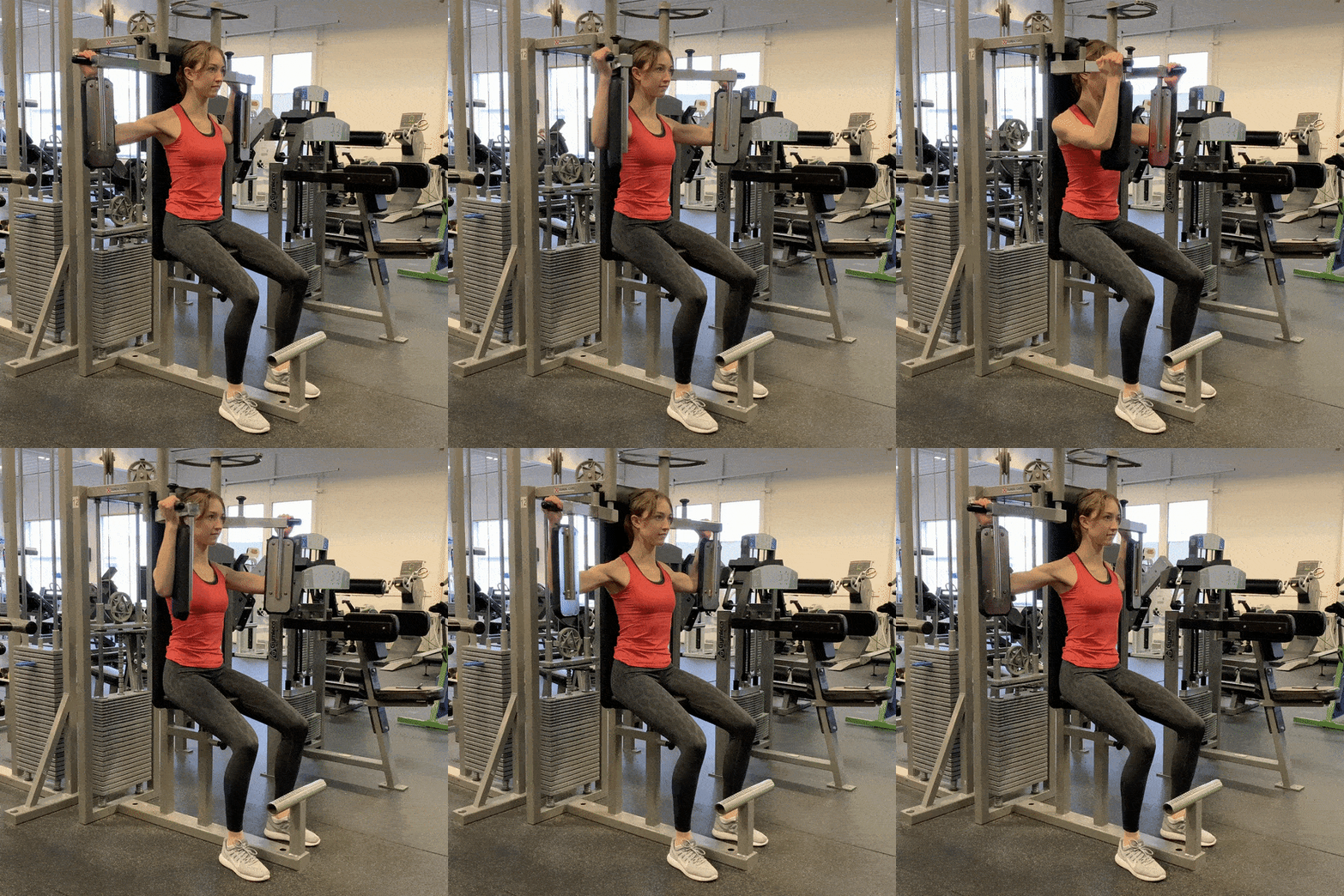

Machine flyes are another excellent exercise for chest hypertrophy and even more stable than cable flyes.
Easy to load, easy to take close to failure, and easy to accumulate quality, isolated volume without building up fatigue in the rest of your upper body.
Dips

Dips can build serious chest mass, but they’re not for everyone.
If you have good shoulder mobility and scapular control, you can often do dips and get an awesome chest workout. Those who don’t might find they wreck their shoulders or sternum.
If dips feel good to you, lean forward a little (and stay there—don’t go upright at the top) and push your pecs out in front of your delts for a great chest builder. If they feel bad, you can skip dips without feeling guilty.
What Really Matters for Chest Growth
These are the factors that will determine your results far more than exercise selection ever will:
Progressive Overload
Are you consistently doing more over time?
More weight, more reps, or more sets?
If not, you’ll eventually plateau with any exercise, bench press or no bench press.
Track your training. Progressive overload is the key to building muscle and strength, and no, you can’t rely on your memory.
Train Close to Failure
Training to true failure isn’t necessary for muscle growth, but you want to get reasonably close in most of your sets.
Besides, many lifters, especially beginners, overestimate how close they are to failure, thinking they’re 1–2 reps away when they really could have done 3–5 more.
You don’t have to grind every set to failure, but your working sets should feel challenging.
I’m talking about the point where the weight—be it a barbell, dumbbells, or whatever—slows down significantly.3
Get Sufficient Weekly Volume In
Most evidence suggests 10–20 hard sets per muscle group per week are the sweet spot for growth.4 5
It doesn’t really matter if you get those sets done in one or more weekly workouts, but spreading them across several can make it easier to do quality sets throughout the entire session instead of fizzling out in the second half.
Do a Full Range of Motion
Research shows that a full range of motion trumps a partial ROM for most outcomes, including building more muscle.6
And avoiding a full ROM is a typical rookie mistake when it comes to chest training. You can hoist more weight, sure, but you’ll reduce the growth stimulus.
You don’t need to overdo it—you’ll lose tension in your pecs and stress your shoulder joints beyond a certain point—but take every rep through a full, controlled range.
Keep an Eye on Diet and Recovery
Your chest isn’t going to grow if you’re sleeping 5 hours a night and eating 1,500 calories.
No exercise selection change will override poor diet and recovery fundamentals.
Chest Workouts Without the Bench Press
Want to put the “no bench” philosophy into practice? Try one of these workouts on your next chest day.

Bodybuilding Chest Workout
This is a chest workout for intermediates and above. It combines compound exercises with isolation movements to target all muscle fibers of your pecs for maximum growth.
| Exercise | Sets |
|---|---|
| Dumbbell Chest Press | 4 |
| Smith Machine Incline Bench Press | 4 |
| Dips | 3 |
| Cable Chest Fly | 3 |
| Dumbbell Pullover | 2 |
This is a premium workout. You can see the full set and rep details in the StrengthLog app.
Start the Bodybuilding Chest Workout in StrengthLog.
Dumbbell Chest Workout
This is a complete chest workout using only dumbbells. Perfect for the home gym, provided you have an adjustable bench.
| Exercise | Sets | Reps |
|---|---|---|
| Dumbbell Chest Press | 4 | 8 |
| Incline Dumbbell Press | 4 | 10 |
| Dumbbell Chest Fly | 4 | 12 |
This workout is free in the StrengthLog app.
Go directly to the Dumbbell Chest Workout in StrengthLog.
You’ll also find a beginner and a more advanced variation of this workout in the app.
Cable Chest Workout
Want to build your chest with cables only? You can do that too.
This workout hits your entire chest and takes no more than 25 minutes to complete.
| Exercise | Sets | Reps |
|---|---|---|
| Cable Chest Press | 4 | 8 |
| Cable Incline Chest Fly | 3 | 12 |
| Standing Cable Chest Fly | 3 | 15 |
This is a free workout.
Open the Cable Chest Workout in the StrengthLog workout tracker app.
All Chest No Bench
This is an intermediate-level chest workout for building muscle without any barbell bench presses whatsoever.
You can substitute the machine chest flyes with dumbbell flyes if you train at home or don’t have access to a good machine.
| Exercise | Sets | Reps |
|---|---|---|
| Incline Dumbbell Press | 4 | 8 |
| Dips | 3 | 10 |
| Machine Chest Fly | 3 | 12 |
| Push-Up | 3 | Max |
The All Chest No Bench workout is free to follow in the StrengthLog app.
Go directly to the All Chest No Bench workout.
Track These Chest Workouts in StrengthLog
These are four of the many workouts for every body part and muscle group in the StrengthLog workout tracker.


The app remembers what weights you used in your last session, and automatically loads them into your next one. And trying to improve on your last workout is the key to getting bigger and stronger over time.
Download it and start tracking your gains today!
Note that StrengthLog is free, but you’ll need a subscription to follow some of our more advanced workouts and programs in-app. We offer a 14-day free trial (no strings attached and no funny business) that you can activate in the app, so you can check it out before making a decision.
Track Your Training. See Real Progress.
Log your workouts in one place and watch your numbers climb, week after week.
- Free to get started
- Fast workout logging
- Cardio and strength training
- Bodybuilding, powerlifting, and general fitness
- Free weights and machines
- Progress over time, personal bests
- Free and premium training programs and workouts for every fitness goal
Download StrengthLog free:


Myth vs. Reality
Myth
“You must bench press to get a big chest.”
Reality
Not true. Many bodybuilders and physique athletes have built world-class chests using dumbbells, cables, and machines exclusively.
Myth
“Machines and cables are inferior to free weights for hypertrophy.”
Reality
Up-to-date research shows that machine-based training builds just as much muscle as free-weight training.
Myth
“If you don’t bench press, you’re limiting your chest growth.”
Reality
Only if you fail to replace it with other good chest exercises.
If your program includes good alternatives and progression, you’re not missing out just because you don’t bench.
Myth
“Heavier bench = bigger chest.”
Reality
You can increase your bench press by improving leverage and technique without optimizing muscle growth.
Building muscle requires enough volume, muscle exhaustion, and making the right muscle do the job, not just moving maximum weight from point A to point B.
Final Rep
The barbell bench press is a fantastic lift, but it is not a mandatory toll you have to pay on the road to a big chest.
For some, it’s a great mass builder. For others, it’s just okay. And for some, it’s worth skipping entirely.
If benching hurts your shoulders, or if you just don’t feel it in your pecs, drop it.
Choose exercises you can do pain-free and with good form, push them hard, and progressively overload them over months and years. That’s the whole game for building your chest.
Want even more?
Subscribe to our weekly newsletter to get notified of new articles and get weekly training tips!
Last reviewed: 2026-04-16
References
- Int J Exerc Sci. 2020; 13(6): 859–872. Effects of Horizontal and Incline Bench Press on Neuromuscular Adaptations in Untrained Young Men.
- Journal of Exercise Science & Fitness. Volume 15, Issue 1, June 2017, Pages 37-42. Low-load bench press and push-up induce similar muscle hypertrophy and strength gain.
- Med Sci Sports Exerc. 2026 Mar 24. Optimizing Strength and Hypertrophy: The Combined Effect of Intensity and Velocity Loss Thresholds in Bench Press Training.
- J Hum Kinet. 2022 Feb 10:81:199-210. A Systematic Review of The Effects of Different Resistance Training Volumes on Muscle Hypertrophy.
- International Journal of Strength and Conditioning, Vol 1 No 1 (2021). Resistance Training Recommendations to Maximize Muscle Hypertrophy in an Athletic Population: Position Stand of the IUSCA.
- International Journal of Strength and Conditioning, Vol. 3 No. 1 (2023): Vol 3 No 1 (2023). Partial Vs Full Range of Motion Resistance Training: A Systematic Review and Meta-Analysis.
