
Muscles Worked in Leg Press

Primary muscles worked:
Secondary muscles worked:
How to Leg Press
- Adjust the machine so that you only need to extend your legs slightly to be able to release the weights. Adjust the safety pins so that they catch the weight if you are unable to lift it.
- Place your feet on the platform, about shoulder-width apart.
- Inhale and lower the weight by bending your legs.
- Lower the weight as deep as possible without rounding your back and while keeping your glutes on the seat.
- Press the weight back up again as you exhale.
Table of Contents
Introduction to the Leg Press
The leg press is a popular leg exercise that, compared with barbell squats, requires less balance, control, and mobility. This means that this exercise can be easier to start with for a beginner and also that you can train closer to muscular failure without thinking about balance.
Many people can use much heavier weights in the leg press than in the barbell squat, but you will probably get the best training effect if you prioritize form and range of motion over weight.
There are several variations of the leg press, and we’ll go through a bunch of them later on in this article.
What Muscles Do the Leg Press Work?
The leg press works most of your leg muscles, primarily the quadriceps, glutes, and adductors.
The secondary worked muscles are your hamstrings.
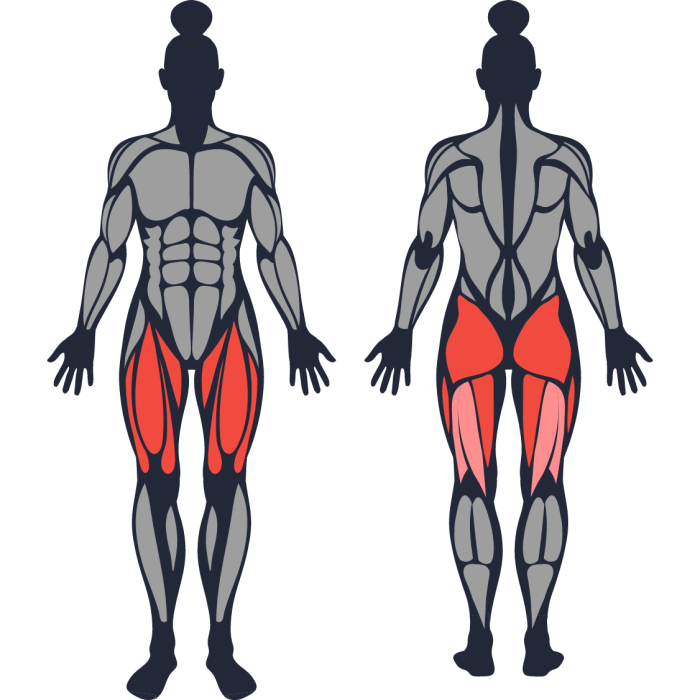
You can change your foot position to target the muscles a bit differently. Placing the feet higher up on the platform will target your hamstrings and glutes a bit more than if you keep your feet lower. It won’t make an enormous difference, though, and the activated muscles will remain as described above.
Leg Press Benefits
The leg press offers a lot of benefits, such as:
- Quadriceps & glute development. The leg press primarily targets the quadriceps and glutes, promoting growth and strength.
- High weight capacity. The leg press allows for heavy loads, promoting progressive overload and muscle growth.
- Focus on the muscles worked. The leg press enables a controlled and safer weight progression, allowing you to go closer to muscular failure while reducing the risk of injury compared to free weight exercises. It’s a great complement to your squat and deadlift training.
Leg Press: Proper Form & Technique
The leg press is quite a simple and safe exercise once you learn it, but here are some key points to remember.


Feet
Place your feet shoulder-width apart, centered on the platform, with toes pointing slightly outward. As previously noted, you can change the placement of your feet depending on what muscles you want to focus on and also depending on how you’re built. For some people, it might be hard to go deep enough with their feet shoulder-width apart, and therefore more suitable to widen the stance a bit.
Core and Back
Make sure to brace your core throughout the movement. You can grasp the handles on either side of the seat or use safety straps, if available, to stabilize your upper body as well.
You don’t want any movement in your lower back, so make sure to reverse the movement before your back starts rounding.
The movement
Inhale as you slowly bend your knees, lowering the platform until your thighs are close to your chest.
Exhale while forcefully pushing through your heels, extending your legs to return the platform to the starting position without locking your knees.
Make sure to keep the movement controlled and not let your knees fall inwards.
Common Mistakes in Leg Press
- Cutting off depth. Since the leg press allows you to add much more weight than, for example, the barbell squat, it’s easy to get greedy and add more weight – without noticing that you start to cut off the depth. You still want the full range of motion, so make sure you do full reps before adding more weight.
- Going too deep. This is the opposite of the above mistake, but it’s also very common to see. Going deeper than your mobility allows will add unnecessary pressure to the lower back and is an injury risk you want to avoid. Make sure to have your lower back and butt still during the entire set, and reverse the movement before you feel any rounding of your lower back or your butt leaving the seat.
- Overextending the knees. By fully locking out the knees, you’ll add a lot of pressure to the joints instead of the muscles working. Make sure that you stop the movement before overextending the knees.
Leg Press Variations
There are a lot of different forms of leg press machines out there, with different angles, movement patterns, et cetera. If one machine doesn’t suit you – maybe another one will. We’ll go through a couple different ones below, and encourage you to try around and see if you find your favourite.
- Seated Leg Press
- Vertical Leg Press
- One-Legged Variations
1. Seated Leg Press

The seated leg press is an alternative to the regular leg press. They might seem identical at first, but there are some key differences.
Range of Motion
Due to the position in the seated leg press, where your hips are relatively extended, the range of motion is typically be a bit shorter than the regular leg press. The machine’s design may also restrict how deep you can go, both at the hip and knee joints, which also contribute to a reduced range of motion.
Positioning
If you’re using the leg press for rehabilitation purposes, or have limited mobility, it’s often easier to get in and out of the seated leg press. In contrast, the seat in a regular leg press is closer to the floor and can be more difficult to access.
Training Level
The seated leg press is equipped with a weight stack, which could be less intimidating for beginners than using a plate loaded version of the leg press.
On the other hand, the seated version can be limiting, either if you get too strong for the weight stack, or if you want to do smaller weight increments.
The seated version is also a bit easier to learn, and adjust, while the regular leg press requires a bit more of you in terms of stability and control.
Is This Variation For Me?
If you’re looking for a very accessible leg press variation, which offers great stability and doesn’t need (or want) a very long range of motion, this is a great alternative.
2. Vertical Leg Press

The vertical leg press might seem intimidating, but it can be a great alternative to the regular leg press.
Positioning
Compared to the regular leg press, the vertical leg press allows for a deeper hip flexion at the bottom of the movement. This can lead to more activation of the glutes and hamstrings, but it could also be more challenging for your hip mobility and core activation.
Range of Motion
If you have the mobility for it, the vertical leg press offers an even longer range of motion than the regular leg press. Both variations have a good range of motion, and in comparison to the seated leg press, the risk of the machine limiting you in the movement is very small.
Training Level
Since the angles are steeper in the vertical leg press, it demands more technique and control from the lifter. You need to maintain a strong core during the movement to prevent your lower back from rounding in the bottom. You are also pushing the weights straight above you, which can feel intimidating for a beginner.
Is This Variation For Me?
If you have good hip mobility, and want a leg press variation that’s focusing more on your hamstrings and glutes, the vertical leg press could be a great alternative.
3. One-Legged Variations


The single-leg leg press can be a challenging and fun variation of the traditional two-leg leg press. Let’s go through the differences below.
Positioning
In both versions, you have the same starting position regardless if you’re doing the leg presses with one or two legs. However, when performing the single-leg leg press, there is more demand on your core and hip stability to keep the rest of your body still throughout the movement.
Range of Motion
The range of motion is similar between the two variations, but when working with one leg at a time, it may feel slightly deeper or more difficult to control, especially at the bottom of the movement. Maintaining a full, controlled range of motion is important to maximize the benefits and avoid unnecessary load on the lower back.
Training Level
The two-leg version is generally easier to learn and allows for heavier loads, making it suitable for building overall strength. The single-leg leg press, on the other hand, requires more coordination, control, and body awareness. It is a great tool for addressing strength imbalances between legs but may be more technically demanding, particularly for beginners.
Is This Variation for Me?
If you want to focus on improving single-leg strength or correct muscular imbalances, the single-leg leg press is an excellent option. If your goal is to lift heavier weights with a more stable base, the traditional two-leg leg press might be the better choice. Another thing to keep in mind is that when you’re working with one leg at the time, one set takes double the time. The single-leg leg press might be a less suitable alternative if you want to keep the workout time to a minimum.
Leg Press Alternatives
First of all, there are a lot of different forms of leg press machines with different angles, movement patterns, et cetera. If one machine doesn’t suit you – maybe another one will. But if you don’t want to do the leg press or work out at a gym that doesn’t have one, there are some alternatives for you.
1. Hack Squat

The hack squat is almost like a mix of the barbell squat and the leg press. The machine offers you stability similar to the leg press, but the upright body position is more resemblant to the squat.
2. Belt Squat

The belt squat isn’t as stable as the leg press but is still more stable than the barbell squat. By moving the weight placement from your shoulders, like in the barbell squat, to your waist, the belt squat will also move some tension from your lower back.
3. Barbell Squat

The barbell squat is a good alternative to the leg press if you don’t have access to machines. It is a more complex exercise than the leg press, and it’s harder to reach muscular failure in the squat.
How Many Sets and Reps Should You Do in the Leg Press?
The number of reps you do in the leg press could be guided by the general recommendations of rep ranges for achieving different goals within strength training.
- For muscle growth, around 6–15 reps per set.
- For strength, around 3–8 reps per set.
There are no clear-cut lines between these two goals, however. Training in the “muscle growth range” will still increase your strength, and training in the “strength range” will still cause your muscles to grow. It’s just a matter of what you are emphasizing.
Read More: How Many Reps to Build Muscle vs. Strength?
How many sets you do of an exercise depends on your training experience, how many times you work out in a week, and your other training. But around ten sets per week for a given muscle group is a good starting point, and you can go even higher when you are used to training or if you stop your sets short of failure. You can read more about training volume in our article: How Many Sets per Muscle Group per Week?
Since the leg press is an exercise that includes several muscles in your legs, you need to look at how much work you’re putting into those muscles overall and not just in the leg press.
A lot of lifters like to add the leg press as a finisher after their squats or deadlifts to add more volume to their leg workouts without stressing their lower back by adding more sets of barbell exercises. They often stay in the higher rep range while doing leg presses, between 8-15 reps.
Maybe 3–4 sets of leg presses per workout and 1–2 workouts per week are a good starting point. After a couple of weeks, you can evaluate and see if you think that you might benefit from adding some more.
Leg Press Workouts
We have a lot of workouts that include the leg press, especially the ones focusing on muscle growth. Two examples are the free workout “Quad Workout” and the premium workout “All Legs No Squats” displayed below.
Quad Workout
- Barbell Squat, 3 sets x 5 reps
- Bulgarian Split Squats, 3 sets x 10 reps
- Leg Press, 3 sets x 15 reps
- Leg Extension, 3 sets x 20 reps
This is a workout that focuses both on improving your strength and muscle growth in the quads, and it’s available for free in our app StrengthLog.
All Legs No Squats
- Leg press, 6 sets
- Barbell Walking Lunges, 3 sets
- Romanian Deadlift, 6 sets
- Leg Extension, 4 sets
- Seated Leg Curl, 4 sets
- Standing Calf Raise, 6 sets
- Seated Calf Raise, 3 sets
To see all the details about weight selections and rep range, you need to download our workout log app. This workout requires a premium subscription.
By tracking your workouts in the app, you keep track of your weights and reps so that you can easily remember (and, more importantly: try to improve on them) in your next workout.
Download StrengthLog for free with the buttons below:


Read more:
- Leg Press vs Squat: Which is Better For You?
- How to Train Your Leg Muscles: Exercises & Workout
- How to Train Your Glute Muscles: Exercises & Workout
- Squats vs. Leg Extensions For Quad Growth: New Study