
All you really need for a great workout is a hunk of iron with a handle: a kettlebell!
With the exercises in this article, you’ll train your body in ways traditional weights can’t and build functional, head-to-toe fitness.
These are the kettlebell exercises that deliver.
Want to jump straight to them?
Yes, take me to the exercises!
Table of Contents
What Is a Kettlebell?
A kettlebell is a cast-iron or steel weight shaped like a ball with a handle on top. It’s used for strength, endurance, and power training, and it’s very popular for functional fitness.

Unlike a dumbbell, with its evenly balanced weight, a kettlebell’s center of mass is offset, down in the bell part and away from the handle, about 6–8 inches away from your grip.
That unstable design is the whole point and what makes kettlebell training unique. When you swing it, clean it, or snatch it, you’re managing momentum, and you’d be hard-pressed to get the same ballistic, pendulum-like action from any other training equipment.
Kettlebell exercises build strength, power, and explosiveness that translate to everything athletic.1 They automatically activate your stabilizer muscles and core in almost every exercise.
They are great for teaching your body to work as a unit, and because of the lopsided design and the handle, you can move seamlessly from one exercise to the next without putting the bell down. For example, you can do a swing, use the momentum to clean it to the rack position, do a squat, and then press it overhead.
In short: kettlebells are awesome! At least as long as you don’t swing in your living room and happen to toss it through a wall.
A (Very) Brief History of Kettlebells
Kettlebells are not new. Not by any means. When you train with one, you’re swinging a piece of history that stretches from Russian farmers to Soviet soldiers to modern fitness.
That’s pretty cool!
Here’s a timeline of the evolution of the modern kettlebell:
1700s
The modern kettlebell, as we know it, was born in 18th-century Russia. But they weren’t for working out.
They were farm equipment.
Russian farmers used them as counterweights when they measured out grain at the market. These weights were measured in poods (one pood is roughly 16.38 kg or 36 lb). Today, the pood unit is largely obsolete except in kettlebell training.
As you can imagine, it wasn’t long before these farmers, waiting around at the market, started challenging each other. And just like that, the first kettlebell athletes were born.
1800s
By the early 19th century, kettlebells were used by circus strongmen and athletes. Around that time, Dr. Vladislav Krayevsky, the physician to the Russian czar, began promoting kettlebell training for the Russian military and athletes.2
In 1885, he founded the Circle for Amateur Athletics, the birth of competitive kettlebell lifting, or Girevoy Sport (Kettlebell Sport).
1900s
The Soviets loved kettlebells. They were cheap to make and considered effective for building a strong population.
In 1948, kettlebell lifting became the Soviet Union’s national sport, and, by the 1980s, the government actually created an “Official Kettlebell Commission” and mandated kettlebell training for all workers to make them fitter and more productive.
1990s–2000s
For most of the 20th century, kettlebells were almost unknown in the West. They had a brief boom in American gyms in the early 1900s, but vanished.
Then, in 1998, Pavel Tsatsouline, a former physical training instructor for the Soviet Special Forces (Spetsnaz), wrote an article for an American fitness magazine about them.3
The response was massive. People were hungry for this new but ancient piece of training equipment, and Tsatsouline went on to create the first kettlebell certification program, the Russian Kettlebell Challenge (RKC), in 2001.
Present Day
From there, the kettlebell exploded in popularity, and you can now find them in just about every commercial gym on the planet. Even scientists in Antarctica train with kettlebells!
Source: 4
The Best Kettlebell Exercises
Time to hit the iron!
Here are 27 of the best kettlebell exercises for strength, stability, and functional fitness, in alphabetical order.
You can find them all in our extensive exercise library in the StrengthLog app:

Goblet Squat

At a glance, the goblet squat looks like a squat for beginners. And it is! It was invented as such by famous trainer Dan John, and it’s arguably the single best way to learn squat mechanics. It’s like a built-in coach that yells “Chest up!” without you having to pay it a high hourly rate.
However, goblet squats are not a good tool for building maximal strength, because your legs are (and should be) capable of squatting way more weight than your arms and upper back can hold in that goblet position.
So, once you’re strong enough that your arms become the limiting factor, you want to move on to exercises like the kettlebell front squat. But that being said, even then, the goblet squat remains a great mobility drill and a fantastic way to train your squat pattern in a different way than with the weight on your shoulders. Holding something heavy to your chest and squatting gives you the real-life benefit of doing it the way you often lift things in everyday life.
And for beginners and intermediates, I can’t think of a better way to get introduced to possibly the most important movement pattern of all, the squat.
Muscles Worked
The same as in other squat variants: quads, glutes, adductors, lower back, and core. But more quad-dominant than back squats because of the front-loaded position.

How to Do Goblet Squats
- Grab a kettlebell and hold it against your chest.
- Stand with your feet about shoulder-width apart, and your toes pointing slightly outward.
- Inhale, lightly brace your core, and squat down as deep as possible.
- Reverse the movement and return to the starting position. Exhale on the way up.
Gorilla Row With Kettlebells

The gorilla row sits at the crossroads of strength, functional power, and core control. Not to mention that it looks pretty cool.
You stand in a wide, gorilla-like stance with two kettlebells on the floor between your feet, hinge at the hips, keep your back flat, and then row one bell up at a time, alternating between arms.
You can either:
- Put the kettlebells down between every rep and pull from a dead stop on the floor in a rhythmic row-plant-row-plant motion.
- Keep the kettlebells elevated above the floor throughout each set.
The floor-based, alternating variant allows you to go heavier and focus on the explosive rip off the floor, while the “floating” variant requires more stability and less weight and involves your entire posterior chain.
Regardless of execution, the gorilla row builds a powerful, thick back, core strength, and can improve your conditioning while making you look like a giant ape doing it. What’s not to like?
Muscles Worked
This is primarily a back-builder (lats, rhomboids, mid-traps, and rear delts), but your biceps and forearms also help out. If you do it without putting the kettlebells down, your glutes, hamstrings, and lower back will also work isometrically to hold the hinge position.

How to Do Gorilla Rows
- Stand with feet wider than shoulder-width apart, holding a kettlebell in each hand between your legs. Hinge forward with a slight bend in your knees.
- Keep your back straight and core engaged, rowing one kettlebell up toward your hip while keeping the opposite arm stable.
- You can plant the kettlebell on the floor between reps or keep it elevated.
- Lower the kettlebell in a controlled motion and repeat with the opposite arm.
- Continue alternating arms for the desired number of repetitions.
Kettlebell Clean

The kettlebell clean is the gateway drug to kettlebell presses, jerks, thrusters, and front squats. Basically, if you train with kettlebells, learning to clean is a good idea.
A clean is the most effective way to get a bell from the floor or a swing up to the rack position on your forearm, cradled between your biceps and shoulder. From there, you can start any of the above (and more) exercises.
However, the clean is not only a transition movement. It builds work capacity and teaches your body to generate force fast. Is it going to give you 20-inch biceps? No. What it will give you is a more powerful posterior chain (glutes, hamstrings, back) and a better hip-hinge mechanic you can put to use in jumping, sprinting, and other exercises like the deadlift.
If you’re new to kettlebell cleans, here’s a common beginner mistake to avoid: letting the bell flop over and smash your forearm. Ouch. It should “float” up and roll around your wrist. The key is to keep your elbow tucked into your body as it comes up.
Muscles Worked
Total body power. The engine of the movement is your posterior chain: glutes, hamstrings, and hips. Your core has to brace as you clean the bell, and your upper back and traps stabilize it at the top.

How to Do Kettlebell Cleans
- Stand with a wide stance, with a kettlebell placed about 20 inches in front of you.
- Grab the kettlebell with one hand and tilt it slightly toward you.
- In one powerful motion, pull the kettlebell back between your legs.
- Stand up explosively to make the kettlebell swing forward.
- Use your arm to guide the kettlebell closer to your body as it rises.
- As the kettlebell passes your hip, perform an uppercut-like motion to bring your arm under the kettlebell and into the rack position.
Kettlebell Clean and Jerk

The kettlebell clean and jerk is the big daddy of kettlebell lifts. It is a two-part movement where you 1) clean the bell to the rack position like I described above, and 2) perform a “jerk” to get it overhead.
A jerk involves a double dip: you dip your knees, drive the bell up, then drop back under the bell by dipping your knees again to catch it with a locked-out arm, before finally standing up straight. And the jerk is not a press. You want to push your body under the bell, not just push the bell up.
A clean and jerk, kettlebell or otherwise, is a technical lift. You might want to learn the clean and the push press on their own before you attempt it. The timing of the dip-drive-dip-stand part can be tricky, so you want to start light and learn the movement first. Focus on being violent with your hip drive and quick with your feet as you drop into the catch.
The barbell clean and jerk is an Olympic classic, but the kettlebell version is also a tremendous exercise for building coordination, explosiveness, and the triple extension (ankles, knees, and hips) that gives you much of the force in all sports that involve jumping, sprinting, and punching.
Muscles Worked
Everything. Legs, glutes, hips, core, shoulders, triceps, traps, forearms… It’s almost easier to list the muscles it doesn’t work.

How to Do the Kettlebell Clean and Jerk
- Stand with your feet slightly wider than shoulder-width, with a kettlebell placed about 20 inches / 50 cm in front of you.
- Grab the kettlebell with one hand and tilt it slightly toward you.
- In an explosive motion, pull the kettlebell backward between your legs.
- Stand up explosively. This will cause the kettlebell to swing forward.
- Pull the kettlebell close to your body and, as it passes your hip, perform an uppercut-like motion to bring your arm under the bell and into the rack position.
- Slightly bend your knees, then explosively extend your legs. Use the power from your hips and legs to drive the kettlebell upward.
- As the kettlebell rises from the force of your legs, finish the movement by pressing with your arm to lock the weight out overhead.
- Land softly back into the rack position.
- Repeat for reps.
Kettlebell Clean and Press

The clean and press is probably my favorite kettlebell exercise, or at least tied with the good ol’ swing. If I were stranded on a desert island… well, I’d probably be more worried about finding water, but the clean and press would be a close second for things to do while I waited for rescue.
The kettlebell clean and press is a classic combo: You clean a kettlebell to the rack position, and then perform a strict overhead press. No leg drive allowed on the press (that would make it a push press or jerk).
I don’t really like the term “functional strength” because all strength is functional, but this would be the definition of it. You learn to move a weird, offset object from the floor to overhead, stabilizing it through your entire kinetic chain.
And, unlike some other compound kettlebell exercises, it’s also really good for pure muscle strength and hypertrophy. The press part of the movement is as good as any overhead press for building cannonball delts and the strength that comes with them.
After the clean part, it’s a good idea to pause. Don’t rush the press part. Reset your body: squeeze your glutes, brace your abs like someone’s about to punch you in the gut, and get your lats tight. Press in a straight line, finishing with your biceps by your ear.
Muscles Worked
Glutes, hamstrings, and upper back for the clean, then it’s all shoulders, triceps, and core for the press. Your abs, obliques, and glutes have to be locked down tight to create a stable platform to press from.

How to Do the Kettlebell Clean & Press
- Stand with a wide stance, with a kettlebell placed about 20 inches/50 cm in front of you.
- Grab the kettlebell with one hand and tilt it slightly toward you.
- In one powerful motion, pull the kettlebell back between your legs.
- Stand up explosively. This will cause the kettlebell to swing forward.
- Use your arm to guide the kettlebell closer to your body as it rises.
- As the kettlebell passes your hip, perform an uppercut-like motion to bring your arm under the kettlebell and into the rack position.
- From the rack position, press the kettlebell upward until your arm is fully extended and your upper arm is next to your ear. Keep your shoulder blades in a neutral position.
- Reverse the movement and repeat for reps.
Kettlebell Curl

Alright, gotta get the guns. The kettlebell curl is, well, a biceps curl. But with kettlebells! You can curl two kettlebells normally like you would dumbbells, or you can use a single, heavier bell and hold the horns (the vertical parts of the handle) and curl it bottom-up. Keep your elbows pinned to your sides and curl the weight up, squeezing your biceps, just like you would with a barbell or a pair of dumbbells.
The kettlebell isn’t the best tool for biceps isolation. The center of gravity is weird, it can be awkward on your wrists, and because of the weight distribution, it’s easier to cheat and use your shoulders or back. But it works! If you don’t have dumbbells at hand, kettlebells can be the next best thing to get a good biceps pump. The biggest mistake is the same as any curl: swinging your whole body. Lock it down.
Muscles Worked
Biceps and forearms. That’s it.

How to Do Kettlebell Curls
- Hold a pair of kettlebells in an underhand (supinated) grip, arms hanging by your sides.
- Lift the kettlebells with control, by flexing your elbows.
- Don’t let your upper arms travel back during the curl. Keep them at your sides or move them slightly forward.
- Reverse the movement and lower the kettlebells back to the starting position.
- Repeat for reps.
Kettlebell Floor Press

A bench press, but on the floor. You lie on your back, knees bent, with a kettlebell in each hand. You press the bells up from your chest until your elbows lock out, then lower them until your triceps touch the floor.
The kettlebell floor press is a neat alternative to the barbell or dumbbell bench press if you train at home with kettlebells and don’t have a bench, but still want to get a good push day done. It’s also good for building lockout strength for the “real” bench press.
It’s a very simple and safe exercise. You can’t over-extend your shoulder at the bottom, and it’s very hard to do wrong. The setup is the trickiest part. You may need to roll the bells into position.
Muscles Worked
The floor press trains your push muscles: your chest, front delts, and triceps.

How to Do Kettlebell Floor Presses
- Sit on the floor with your legs straight and a pair of kettlebells beside you.
- Pick the kettlebells up and place them in your hip crease.
- Lie down while you bring the kettlebells up to your chest.
- Press to straight arms, bend your knees, and place your feet flat on the floor.
- Lower the kettlebells slowly until your upper arms hit the floor.
- Reverse the motion and push the kettlebells up to straight arms again.
- Repeat for reps, then gently drop the kettlebells to the floor to finish the set.
Kettlebell Front Squat

The kettlebell front squat is a front-loaded movement, meaning you hold the weights in front of your chest in the rack position, resting them in the little triangle formed by your biceps, forearm, and chest. It forces you into an upright position, shifting more work to your quads compared to back squats.
Kettlebell front squats are a great step up from the goblet squat. While you will eventually be weight-limited in the goblet squat, with your arms giving out before your legs, this exercise distributes the load across your torso. Because your arms aren’t the only thing holding the kettlebell in place, you can go significantly heavier. And heavier = more strength and muscle-building potential.
It is less grab-and-go than goblet squats, with a slightly steeper learning curve, but like the goblet variant, it’s a self-correcting movement; the weight will literally dump forward if your posture fails.
Muscles Worked
This is a quad-dominant squat, but your glutes, adductors, and core (particularly your lower back) also do a lot of work.

How to do Kettlebell Front Squat
- Stand with your feet about shoulder-width apart, with two kettlebells in the rack position.
- Brace your core, chest up, and keep your shoulders back.
- Bend your knees and push your hips backward into a squat, keeping your weight on your heels.
- Lower as far as your mobility allows you to. Keep the kettlebells stable in the rack position.
- Reverse the movement by standing up, and repeat for reps.
Kettlebell Halo

The kettlebell halo is an excellent mobility and warm-up drill. You hold a kettlebell by the horns, upside down (bottoms-up), right in front of your face. You then draw a halo around your head, keeping the bell as close as possible without bonking yourself on the conk.
When you do kettlebell halos, you involve large parts of your upper body, but it’s generally not a tremendous muscle builder. Instead, it’s more of a muscle mobilizer. If you have tight shoulders, I suggest you give them a go. I bet you’ll notice a difference within weeks.
Pro Tip: Imagine your head is a pillar and you’re tracing a circle around it. Try to pull the bell apart with your hands as it’s behind your head to create more tension and stability.
Muscles Worked
Kettlebell halos work your shoulders, upper back, and scapulae while your core keeps your body stable.

How to Do Kettlebell Halos
- Hold a kettlebell upside-down by the horns in front of your chest.
- Brace your core and keep your elbows close to your body.
- Begin circling the kettlebell slowly around your head, keeping it close to your skull.
- Move in a smooth, controlled motion — don’t let your ribs flare and keep your head still.
- Complete the desired number of reps.
Kettlebell Plank Pull Through

The kettlebell plank pull through is a really nasty core exercise. And I say that in the most positive way possible. You get into a high plank (like a push-up position) with a kettlebell outside one of your hands. With your hips still, you reach under your body with the opposite hand, grab the bell, and drag it to the other side. Plant the hand, then repeat with the other arm.
The challenge of the exercise isn’t the pull itself, as you might think. It’s not moving the rest of your body while you do it. The plank pull through trains anti-rotation, your ability to stop unwanted movement. It’s a very big part of athletic performance and lets your arms and legs do their thing with full power.
Pro Tip: Imagine someone has put a glass of water on your lower back and someone tells you you’ll get a thousand bucks if you drag the bell across without spilling a drop. You won’t actually get any money, but the visualization forces you to lock your hips in place.
Muscles Worked
The main muscles working when you do pull throughs are your abs, obliques, and transverse abdominis, your inner corset muscle. In addition, stabilizer muscles all over your body work isometrically to keep you still.

How to Do Kettlebell Plank Pull Throughs
- Get into a plank position with your hands directly under your shoulders and a kettlebell placed just outside one hand.
- Keep your body stable and engage your core.
- Reach the opposite hand under your body and drag the kettlebell to the other side.
- Return your hand to the plank position and repeat on the other side.
Kettlebell Press

We kinda covered the kettlebell press in the “Clean and Press,” but this is the lift itself. Starting from the rack position, you press the kettlebell (or kettlebells) straight overhead to a full lockout (biceps by your ear). Your legs and hips do not move; it’s a test of upper-body pressing strength, not full-body power.
The difference between the full-blown kettlebell press and the pressing part of the clean and press is that you have the option of using two kettlebells at once, one in each hand. You get more stability (even though you lose the ability to counterbalance with your free arm), which can be good for hypertrophy. That’s because you distribute the load evenly and don’t get the same sideways pull as you try not to corkscrew your torso while a single kettlebell drifts overhead.
Muscles Worked
This is an exercise for the shoulders (primarily the front delt) with assistance from the triceps. If you do it one side at a time, your obliques are forced to get more involved.

How to Do Kettlebell Presses
- Stand with your feet slightly wider than shoulder-width and lift your chest proudly, holding two kettlebells in the rack position.
- Inhale and brace your core lightly.
- Press the kettlebells upward until your arms are fully extended and your upper arms are next to your ears. Keep your shoulders in a neutral position — neither shrugged up toward your ears nor actively pulled down.
- Press in a path that feels comfortable for you. For most people, this is somewhere between the arm pointing straight forward and straight out to the side.
- Lower the kettlebells back down to the rack position in a controlled manner.
- Repeat for reps.
Kettlebell Push Press

The kettlebell push press is a more power-focused version of the strict kettlebell press. You get the bell to the rack position, but this time, you use your legs in a quick dip-and-drive: a small knee bend followed by an explosive extension of your hips and knees. You rocket the bell off your shoulder, and your arm finishes the job.
The power starts in your quads and glutes, travels through your core, and is expressed through your shoulders and triceps. It’s more of a power exercise than a strength exercise, but it’s great for conditioning and athletic performance. If you want to build muscle, stick to the regular press; if you want to get better at sports that involve explosive upper-body power, the push press is it.
Pro Tip: Imagine you’re trying to jump, but your feet are glued to the floor. That’s the power you want. Your leg drive should do most of the work; you should feel the bell become weightless for a split second, and then use your arm to catch up and lock it out.
Muscles Worked
The push press sits between an upper-body press and a full-body lift. It’s still shoulders and triceps, but now you’re bringing in the glutes and quads, too.

How to Do Kettlebell Push Presses
- Stand with your feet about shoulder-width apart, with a kettlebell in the rack position.
- Breathe in and brace your core.
- Bend your knees, then extend your legs and push the kettlebell up until your arm is straight and your upper arm is close to your ear.
- With control, lower your kettlebell to the rack position again.
- Repeat for reps.
Kettlebell Row

The kettlebell row is like your classic dumbbell row, but with kettlebells. You’ll hinge at your hips so your torso is nearly parallel to the floor, and pull the kettlebell up towards your hip.
You can do it with two kettlebells (one in each hand) or by grabbing the horns of one heavy kettlebell. Or, you can do it one arm at a time and support your non-working hand on a bench or your knee. I like that last one the best because I feel my back muscles working without relying on core and low-back stability, but all versions are excellent back builders, so go with what feels best for you.
Muscles Worked
You’ll feel this one mostly in your lats, upper back, and rear delts, but your biceps and forearms do their fair share of the work, too.

How to Do Kettlebell Rows
- Stand with your feet about hip-width apart, with two kettlebells in front of your feet.
- Lean forward by hinging in your hips.
- Keep your spine neutral, brace your core, and grab the kettlebells.
- Lift the kettlebells up so that they’re hanging in your arms, which you keep hanging straight down towards the ground.
- Lift the kettlebells by pulling them against you as far as you can.
- Keep the elbows close to your sides, and aim for your thumbs to touch your ribs.
- Reverse the movement with control and start over before the kettlebells reach the ground.
Kettlebell Snatch

The kettlebell snatch is often called the czar of kettlebell exercises. In one motion, you swing the bell from between your legs and punch it straight overhead to a locked-out position. It’s demanding and it’s technical, but the payoff is equally rewarding.
It’s excellent for building explosive power, full-body strength, and coordination. And aerobic capacity, because the explosive hip-hinge movement jacks your heart rate up in a hurry. In fact, research shows that 20 minutes of kettlebell snatches, done three times per week, improves aerobic capacity enough to be considered an alternative to regular cardio.5 And that was in already fit soccer players.
The kettlebell snatch is a pretty technical lift, and having the kettlebell swing and clean and press mechanics down pat first can make it easier and more fun to learn. The first gives you the hip drive, timing, and power generation you need for the snatch, and the second teaches you how to rack the bell and stabilize it overhead.
Muscles Worked
Most muscles on the back of your body: glutes, hamstrings, hips, core, upper back, lats, shoulders, and triceps.

How to Do Kettlebell Snatches
- Stand with your feet fairly wide apart, with a kettlebell about 20 inches in front of you.
- Grab the handle with one hand and tilt the kettlebell towards you, then powerfully swing the kettlebell back between your legs.
- Stand up in a strong and explosive movement. The kettlebell will start to move forward.
- Pull on the kettlebell with your arm, as if you’re starting a lawnmower, to force the kettlebell into a path closer to your body.
- As the kettlebell reaches your head height, let it fly upwards while you sneak your hand underneath it.
- Catch the kettlebell at arm’s length above your head.
- When reversing the movement, begin by pushing the kettlebell forward. As it starts to fall, ease your grip to make it easier for the handle to rotate.
- Remain upright as the bell falls downward. Just as your hand approaches your groin, let your hips move backward. Guide the bell so it travels far back, not downward.
- Either perform more reps or let the bell swing forward and set it down.
Kettlebell Swing

The kettlebell swing is the most popular and most studied of all kettlebell exercises. Almost every other major kettlebell lift is built on the foundation of the swing. And while some other, more technical lifts might be “better” in some cases, like for specialized athletes, the multiple benefits of the swing, combined with how easy it is to learn and do, make it hard to dispute its place on the throne as the number one kettlebell exercise.
Swings improve your general physical capacity, explosiveness, power, muscle endurance, posture, and more. They can even boost your 1RM in the squat, and many people credit them for restoring their back health after an injury and building it back better than before.6 7
Swings may contribute to hypertrophy, but I wouldn’t consider them a primary muscle-building exercise. If muscle growth is your main goal, they might still be useful as an accessory, but probably not as the main method.
If you want to make your lower back muscles work even harder, you can do one-armed swings instead of holding the kettlebell with both hands.8 9 That makes the erector spinae muscles running down your back have to fight to resist rotation as you swing.
Muscles Worked
Kettlebell swings train the entire posterior chain. Plus, your core and grip get a good workout, too.

How to Do Kettlebell Swings
- Place a kettlebell on the ground, about one or two feet in front of you.
- Take a wide stance, lean forward and grip the kettlebell.
- Brace your core slightly, and swing the kettlebell back between your legs, while inhaling.
- Swing the kettlebell forward by extending your hip, while exhaling.
- Try to swing the kettlebell to about chest height.
- Repeat for reps and put the kettlebell back on the ground when you’re finished.
Kettlebell Thruster

If you told me you only had 10 minutes to work out, I might tell you to do 10 minutes of kettlebell thrusters. It’s the lovechild of a kettlebell front squat and a push press turned into a full-body sadistic baby (it’s one of the most exhausting things you can do). You squat down, and as you explode up, you use your momentum to drive the bells overhead. It builds strength, power, and cardio all at once.
It’s a foundational exercise in CrossFit. You usually do it with a barbell, but kettlebells work just as well (and provide a few benefits, like a more natural range of motion, asymmetrical load, and, of course, lower space requirements).
Pro Tip: A thruster might be made up of two exercises, but remember to treat it as one. Don’t squat, stand all the way up, and then do a strict shoulder press. The press should be a direct extension of the squat’s upward drive, with momentum.
Muscles Worked
What don’t they train? Quads, glutes, hamstrings, core, shoulders, and triceps. And your heart.

How to Do Kettlebell Thrusters
- Stand with your feet shoulder-width apart and hold two kettlebells in the rack position.
- Lower into a squat until your thighs are approximately parallel to the ground.
- Drive explosively up from the bottom position by extending your hips and knees, and use the force from your legs to press the weight overhead in one fluid motion.
- Fully extend your arms at the top and lock out the weight overhead.
- Lower the weight back to your shoulders in a controlled manner and immediately transition into the next repetition.
Kettlebell Tibialis Raise

From a full-body exercise to a very specialized exercise for a small area: the kettlebell tibialis raise for the shin muscle at the front of your lower leg. You sit on a bench with your leg out, hook a kettlebell handle over your foot, and flex your foot, pulling your toes up towards your shin (dorsiflexion).
The tibialis anterior muscle is the brake for your foot and important for knee health. Most people don’t need to train it specifically, because it gets plenty of work if you’re active walking, running, or just going about your day.
Some exceptions include athletes in sports where the tibialis might be a limiting factor if you need to strengthen it for injury prevention or rehab, or if you’re a bodybuilder and feel your calves overpower your shins.
If you do train your tibialis, this is a good exercise that doesn’t require any specialized equipment like a tib bar. The only downside is that it can be awkward to set up, and you might have a hard time convincing the darn kettlebell to stay put. Doing it barefoot (if your gym allows) or with flat shoes like Converse can help quell this kettlebell rebellion.
Muscles Worked
The tibialis raise works, you guessed it: the tibialis anterior and nothing else.

How to Do Kettlebell Tibialis Raises
- Sit on a high bench or a box where your feet can hang freely without touching the floor.
- Hook the handle of a kettlebell over the top of your foot. Wedge your foot in there securely.
- With control, flex your foot upwards (dorsiflexion), lifting the kettlebell.
- Squeeze at the top, then lower the weight back down.
- Repeat for reps.
Kettlebell Windmill

The kettlebell windmill is a fantastic mobility-meets-stability exercise dressed up as a circus strongman act of balance. It trains oblique and core strength and shoulder stability in a rather unique movement pattern, all while stretching your hips and hamstrings like taffy. It’s one of those exercises almost nobody does but many would benefit from.
Start light. There is no shame in grabbing a baby kettlebell while you figure out the mechanics. It’s more of a movement than a muscle builder, anyway. It trains you to be strong in weird positions, and that’s strength you can use in real life (and unpredictable, explosive sports). Most lifts happen in one plane, like up-down or forward-back, but the windmill teaches power in diagonal and rotational patterns.
Muscles Worked
Obliques, shoulders (stability), glutes, hamstrings and adductors (flexibility).

How to Do Kettlebell Windmills
- Stand with your feet slightly wider than shoulder-width apart and hold a kettlebell in one hand, arm fully extended overhead.
- Turn your feet slightly away from the side holding the kettlebell.
- Keep your eyes on the kettlebell and slowly bend forward, rotating your torso, while lowering your free hand toward the floor along the inside of your leg.
- Keep the kettlebell stable overhead throughout the movement.
- Once you reach the bottom position, slowly return to the starting position by straightening your torso.
- Repeat for the desired number of reps before switching sides.
One-Arm Kettlebell Press

This is the kettlebell press we already covered, but done with a single bell. The one-arm kettlebell press trains the same main muscles (shoulders, triceps), but the difference is the core. With one kettlebell, everything will want to leak energy, and your body will try to lean, so your obliques on the opposite side have to work harder to keep you from bending sideways.
Muscles Worked
Shoulders and triceps, just like the two-arm version, but with some extra oblique action.
How to Do One-Arm Kettlebell Presses
- Stand tall with feet shoulder-width apart, holding a kettlebell in one hand at shoulder height.
- Brace your core and keep your wrist straight under the kettlebell.
- Press the kettlebell straight up until your arm is fully extended.
- Lower it back to shoulder height with control.
- Repeat for reps, then switch arms.
One-Arm Kettlebell Swing

The one-arm kettlebell swing is the same explosive hip hinge as the two-hand swing, but… you guessed it, with one arm.
The main difference from the two-handed variant is that the bell will try to twist your torso as it swings. Your goal is to keep your shoulders and hips square to the front, which adds anti-rotation to an already comprehensive exercise.
Pro Tip: Your “free” arm isn’t free. Swing it back with the same force as your bell arm. That active counter-movement keeps your shoulders square and maximizes your power.
Muscles Worked
Glutes and hamstrings with an added anti-rotation challenge for your core.

How to Do One-Arm Kettlebell Swings
- Place a kettlebell on the ground, about one or two feet in front of you.
- Take a wide stance, lean forward and grip the kettlebell with one hand.
- Brace your core slightly, and swing the kettlebell back between your legs, while inhaling.
- Swing the kettlebell forward by extending your hip, while exhaling.
- Try to swing the kettlebell to about chest height.
- Repeat for reps and put the kettlebell back on the ground when you’re finished.
Renegade Row
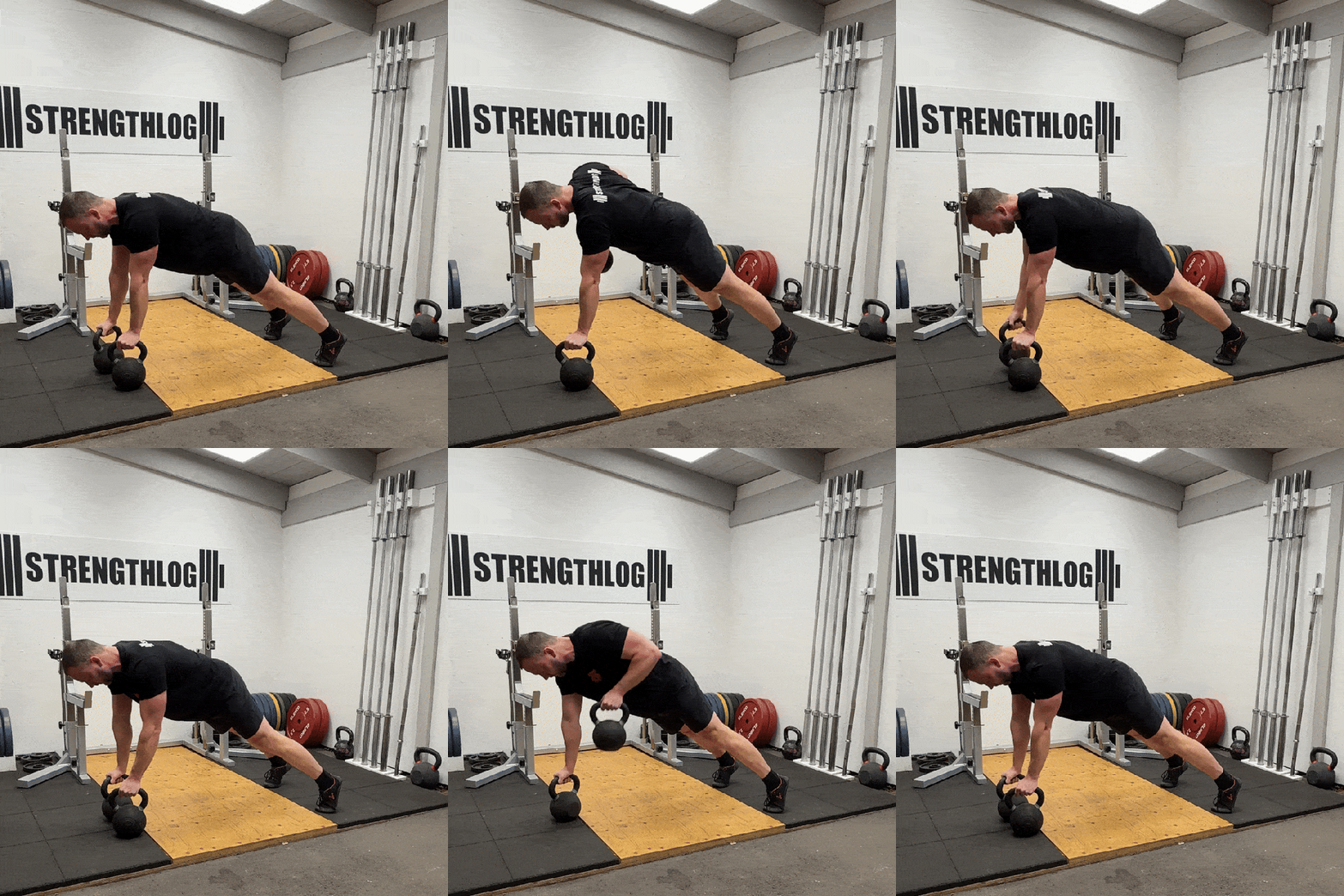
If a plank and a one-arm row had a baby, and that baby was raised by a drill sergeant, you’d get the renegade row. You start in a plank position, each hand gripping a kettlebell. From there, you row one bell up toward your ribcage, then lower it back down, keeping your core braced. Then you switch sides. It sounds easy, but your body will try to twist or sag, and you’ll have to fight it the entire set.
Renegade rows are not super effective for building muscle and maximum strength (you want stability for those two things, and this exercise is anything but stable), but it’s a real bang-for-your-buck exercise. It looks like a back exercise (and it is), but it’s also almost a full-body assault, especially on your core.
Muscles Worked
Renegade rows work your lats, traps, rhomboids, and biceps like any row, but also throw plenty of core action your way.

How to Do Renegade Rows
- Start in a high plank position with your hands gripping a pair of kettlebells placed directly under your shoulders.
- Keep your body in a straight line from head to heels, feet slightly wider than hip-width for balance.
- Brace your core and row one weight toward your ribcage, keeping your elbow close to your body.
- Lower the weight back to the ground with control.
- Repeat on the opposite side, alternating sides for the desired number of reps.
Seated Kettlebell Press

Very similar to the regular kettlebell press we talked about before, the seated kettlebell press trains your shoulders and triceps. And just like the standing variant, you can use one or two kettlebells at a time.
The difference is that, by sitting, you remove your lower body and any potential momentum from the equation, which can be beneficial if muscle growth is your goal.
Muscles Worked
Shoulders and triceps. That’s it!

How to Do Seated Kettlebell Presses
- Sit on a bench or box with your feet flat on the floor, maintaining good posture and an upright torso. Hold the kettlebell in the rack position.
- Breathe in and brace your core.
- Press the kettlebell overhead until your arm is fully extended and your upper arm is in line with your ear. Keep your shoulder blades in a stable, neutral position.
- Lower the kettlebell back to the rack position in a controlled motion.
- Repeat for reps.
Single-Leg Deadlift With Kettlebell

The single-leg deadlift with a kettlebell is a hinge movement and a cousin of the classic deadlift, but on one leg.
It is top-tier for balance, glute, and hamstring strength, and gives all the small stabilizer muscles in your hips and core a workout. It also teaches your body to move as one coordinated machine, not a collection of random parts. And it makes you look cool in the gym mirror, at least if you think drinking birds are the height of coolness.
Single-leg deadlifts are great for runners, athletes, or anyone who wants to fix muscle imbalances. They build unilateral (one-sided) stability like few other exercises.
Pro Tip: If you struggle with balance, you can hold the kettlebell in the hand opposite your standing leg. That kind of contralateral loading uses your lats and core as a counterbalance.
Muscles Worked
Single-leg deadlifts works almost your entire posterior chain, from your hamstrings up to your neck.

How to Do Single-Leg Deadlifts With Kettlebell
- Stand on one leg, holding a kettlebell in the opposite hand, maintaining an upright posture with a slight bend in the knee of the standing leg.
- Hinge forward at the hips, extending your free leg straight back as your torso lowers.
- Keep your back straight and lower the kettlebell toward the ground without touching it.
- Drive through the heel of the standing leg to return to an upright position.
- Repeat for reps, then switch legs.
Standing Hip Flexor Raise

The standing hip flexor raise is like giving your hip flexors their own gym membership; they usually tag along for other exercises, but here, you isolate them under load, which rarely happens otherwise.
It primarily trains your iliopsoas (really two muscles, the psoas and iliacus) and the rectus femoris (which is also one of your quad muscles). These guys are responsible for pulling your knee toward your chest. You also get some bonus work for your tibialis anterior, which has to work to keep your toes pulled up so the kettlebell handle doesn’t slide off your foot.
Weak hip flexors can contribute to all sorts of nasty stuff, including lower back pain and knee issues. Strengthening them keeps your whole system balanced. Not to mention that they stabilize your pelvis and drive sprinting and jumping mechanics.
Muscles Worked
It’s in the name: your hip flexors. The tibialis anterior helps keep the kettlebell in place.

How to Do Standing Hip Flexor Raises
- Stand on a small elevation, such as a step platform or a few weight plates.
- Place one foot on the elevated surface and place the other foot through the handle of a kettlebell.
- Engage your core and maintain an upright posture throughout the movement.
- Lift your knee toward your chest by flexing your hip while keeping your standing leg stable.
- Pause briefly at the top, then slowly lower your leg back to the starting position with control.
- Repeat for reps, then switch legs.
Suitcase Carry

The suitcase carry is a simple but effective anti-lateral flexion (which simply means that it stops you from bending sideways) and anti-rotation exercise rolled into one.
So you’re walking. With a weight. How hard can it be? Pretty hard, actually, because when you hold a heavy load on only one side of your body, that force will try to pull you down on that side.
Suitcase carries train your body to handle uneven loads, whether that means building a more stable midsection when you’ve got a heavy barbell on your back, withstanding force from one side in sports, or dealing with everyday tasks that require asymmetrical control and keep your back safe while doing them.
Muscles Worked
Almost your entire body gets activated when you do suitcase carries. It lights up a muscle map like a Christmas tree:

How to Do Suitcase Carries
- Pick up a kettlebell or dumbbell with one hand, letting it hang at your side, like when carrying a suitcase. Brace your core and start walking forward.
- Take small steps and focus on keeping the core tight and your posture straight, rather than leaning forward.
- Continue this movement for the desired distance. When finished with the first side, set the weight down.
- Pick up the kettlebell with the other hand and repeat.
Turkish Get-Up

The Turkish get-up is a not-so-simple exercise where you lie on your back holding a kettlebell straight up with one arm, move through a series of steps to get to a standing position, and then reverse the process back down to the floor. All while keeping the kettlebell locked out overhead.
It’s not a maximum strength or hypertrophy exercise, but that’s not the point. You build stability in your shoulders and teach your body to function like a unit, linking your arm, core, hips, and legs. It’s also a neat diagnostic tool: if you have a weak point somewhere (like your core or shoulders), tight hips, or a stability issue on one side, the get-up will find it and call it out.
The learning curve is also pretty steep. It’s a complex multi-stage movement, and I think it’s a good idea to do it without any weight at all before trying it with a kettlebell.
Muscles Worked
Most of them: shoulders (rotator cuff, deltoids), core (every part of it), glutes and hips, legs (quads, hamstrings), upper back (lats, traps, rhomboids), and triceps.

How to Do Turkish Get-Ups
- Lie on your back with a dumbbell or kettlebell in one hand, extended straight toward the ceiling. Place your other arm out to the side on the floor for balance.
- Bend the knee on the same side as the weight, keeping your foot flat on the floor.
- Keep the weight pressed overhead and rise up onto your elbow, then onto your hand.
- Lift your hips off the ground and sweep your straight leg back, bringing yourself into a kneeling position under your body.
- From here, move into a lunge position and stand all the way up with the weight still overhead.
- Reverse the movement step by step to return to the starting position.
- Repeat for reps, then switch sides.
Waiter’s Walk With Kettlebell

The waiter’s walk is the ideal exercise if you want to look like a jacked sommelier carrying a buffet of benefits for core strength, shoulder stability, and posture correction.
Unlike other overhead exercises that require strength or mobility (or both), the waiter’s walk adds dynamic stability to the mix. You’re forced to stabilize not just in one spot but while your body is in motion.
It’s not a main get-huge exercise but an accessory best done at the end of a workout, so you don’t tire out the smaller stabilizer muscles you need fresh for the big lifts.
Muscles Worked
When you’re doing waiter’s walks, you’re working your shoulders, triceps, and core.

How to Do Waiter’s Walks
- Stand tall with feet hip-width apart, holding a kettlebell in one hand.
- Press the kettlebell overhead, with your arm straight and your palm facing forward.
- Walk forward while keeping the kettlebell stable above your head.
- Stop, lower the kettlebell, switch hands, and repeat.
Two Great Kettlebell Workouts to Get You Started
With the kettlebell exercises we’ve just covered, you can design a workout for any experience level and training goal.
But what if you don’t want to design your own?
Then follow one of ours!
Here are two kettlebell workouts from the StrengthLog workout app. They are free, so you can just load them up and get started.
Full Body Workout With Kettlebells
| Exercise | Sets | Reps |
| Kettlebell Front Squat | 3 | 10 |
| Kettlebell Swing | 3 | 20 |
| One-Arm Kettlebell Press | 3 | 10 |
| Kettlebell Row | 3 | 10 |
This is a simple but effective workout where you train all your body’s largest muscle groups with four kettlebell exercises.
Start the Full Body Workout With Kettlebells free in StrengthLog.
Kettlebell Swing & Goblet Squat Descending Ladder
This is a short and sweaty workout in which you only use a single kettlebell for a series of supersets consisting of swings and goblet squats.
You do 10 swings, immediately followed by 10 squats, then go back to swings, this time for 9 reps, and so on, until you’re at a single rep for both exercises.
| Superset | Kettlebell Swing Reps | Goblet Squat Reps |
| 1 | 10 | 10 |
| 2 | 9 | 9 |
| 3 | 8 | 8 |
| 4 | 7 | 7 |
| 5 | 6 | 6 |
| 6 | 5 | 5 |
| 7 | 4 | 4 |
| 8 | 3 | 3 |
| 9 | 2 | 2 |
| 10 | 1 | 1 |
Choose a light weight (at least the first time you try) and knock out the sets as quickly as you can!
Open the Kettlebell Ladder, free in StrengthLog, to get started.
StrengthLog has several more great kettlebell workouts, from a free pyramid workout to premium options like a conditioning circuit and a fun gauntlet adventure.
What’s the best way to track these workouts?
With StrengthLog, our workout log app.
That way, it’s super easy to keep track of your weights and reps and make sure you’re on the right track.
The app remembers what weights you used in your last session, and automatically loads them into your next session. And trying to improve on your last workout is the key to improving and getting stronger over time.
Download it and start tracking your gains today.
Track Your Training. See Real Progress.
Log your workouts in one place and watch your numbers climb, week after week.
- Free to get started
- Fast workout logging
- Kettlebell exercises and workouts
- Cardio, mobility, and strength training
- Sport-specific strength plans, including running, soccer, judo, boxing, and more
- Progress over time, personal bests
- Free and premium training programs and workouts for every fitness goal
Download StrengthLog free:


What Weight Kettlebells Should I Get?
Ready to get started with kettlebell training? If you work out in a gym, you’ll likely find all the kettlebells you need there. But if you train at home, you’re going to have to purchase at least one, preferably two or three to start.
Here’s a table with suggested weights for beginners and trained (not necessarily kettlebell-trained but strength-trained in general). If you’re advanced, you already know what you need.
Consider getting two kettlebells, because different lifts have different demands: one bell for upper-body presses (lighter) and one for swings (heavier because the movement uses your hips and legs).
It can even be a good idea to get two press kettlebells so you can do two-handed exercises, like front squats and two-handed swings.
| Experience Level | Gender | Press Kettlebell | Swing Kettlebell |
|---|---|---|---|
| Beginner | Women | 8 kg (18 lb) | 12–16 kg (26–35 lb) |
| Beginner | Men | 12 kg (26 lb) | 16–20 kg (35–44 lb) |
| Trained | Women | 10–12 kg (22–26 lb) | 16–20 kg (35–44 lb) |
| Trained | Men | 16 kg (35 lb) | 20–24 kg (44–53 lb) |
Final Rep
So, there you have it—the kettlebell: part cannonball, part dumbbell, and part magic wand for functional strength.
But reading this article built exactly zero muscle. The good stuff happens when you pick one up and actually do the exercises.
Pick your favorites, create your own kettlebell workouts, or follow one of ours. Remember to download our workout log to track your gains.
Want more?
Subscribe to our weekly newsletter to get notified of new articles and get weekly training tips!
Click here to return to our full list of strength training exercises.
Last reviewed: 2025-10-29
References
- Cureus. 2024 Feb 3;16(2):e53497. Enhancing Athletic Performance: A Comprehensive Review on Kettlebell Training.
- Мария Соколова, Два «бульдога» на грудь. Как доктор Краевский стал «отцом русской атлетики» “Аргументы и Факты”, 22 August 2016.
- Sports Rehab Expert: 2012 Teleseminar Interview #4 – Pavel Tsatsouline.
- Cotter, S. (2021). Kettlebell training (2nd ed.). Human Kinetics.
- J Strength Cond Res. 2015 Jul;29(7):1943-7. Effects of Kettlebell Training on Aerobic Capacity.
- J Strength Cond Res. 2012 Aug;26(8):2228-33. Kettlebell swing training improves maximal and explosive strength.
- J Strength Cond Res. 2012 Jan;26(1):16-27. Kettlebell swing, snatch, and bottoms-up carry: back and hip muscle activation, motion, and low back loads.
- J Strength Cond Res. 2016 May;30(5):1196-204. Core Muscle Activation in One-Armed and Two-Armed Kettlebell Swing.
- Sports Med Int Open. 2019 Jan; 3(1): E12–E18. Trunk Muscle Activity in One- and Two-Armed American Kettlebell Swing in Resistance-Trained Men.
